30 More Days Of Noir #1: Bunco Squad (dir by Herbert I. Leeds)


Welcome to Noirvember!

Yeah, yeah, I know.  That sounds kinda silly, doesn’t it?  However, November is traditionally the month that classic film bloggers tend to concentrate on writing about film noir.  It provides a bit of grit and cynicism in between the horror fun of October and the holiday schmaltz of December.

I have to admit that I’m a little bit torn when it comes to taking part in Noirvember.  On the one hand, I love a good film noir and there’s quite a few obscure and underrated ones available on YouTube right now.  On the other hand, as a natural-born contrarian, I don’t like the idea of hopping on any bandwagons.

In the end, my love of film noir won out.  So, welcome to my first entry in 30 More Days of Noir.

The 1950 film, Bunco Squad, tells the story of Tony Weldon (Ricardo Cortez), a con man who specializes in using a phony psychic routine to swindle rich people out of their money.  He runs a fake enlightenment center and he claims that he can speak to the dead.  His latest target is the wealthy Jessica Royce (Elisabeth Risdon).  After he finds out that her son was killed during the invasion of Normandy, he and his associates go out of their way to trick her into believing that Tony can contact her son and that her son wants her to leave all of her money to Tony’s organization.  It’s actually kind of interesting watching as Tony and his gang manage to track down information about Jessica and her son, asking the most mundane of questions to find out things that Jessica believes only her son would know.  Watching Tony operate, I was reminded of those documentaries and news reports that you see about phony faith healers and other people who claim they can speak to the dead but who actually just go on very vague fishing expeditions.  (“I’m sensing something about the letter L.  Does that mean anything to you?”)

Tony is not just a con artist.  He’s also a murderer, one who specializes in cutting brake lines on cars.  If you try to expose Tony, you’re probably going to end up driving off of a cliff.  I guess you can get away with that when you’re a con artist in California.  Myself, I live in North Texas where the land is totally flat.  Someone could cut my brake lines and I would probably just keep going forward until I eventually ran out of gas.  Once that happened, someone would probably pull over and offer to give me a lift to the nearest gas station.  That’s one reason why someone like Tony Weldon could never pull off any of his crimes in my home state.

Fortunately, the detective of the LAPD’s Bunco Squad know what Tony’s doing.  The only problem is that they have to get some proof that Tony is swindling Ms. Royce and they have to manage to do it before Tony gets a chance to tamper with all of their brakes.  Leading the Bunco Squad is Steve Johnson (Robert Sterling) and you better believe that there’s no way someone named Steve Johnson is going to be anything other than honest and upright.  Working with a real-life magician named Dante, Johnson attempts to expose all of Tony’s tricks.

It’s probably open for debate whether or not Bunco Squad is a true noir.  On the one hand, Tony and his schemes are very noirish.  On the other hand, Steve and the members of the Bunco Squad are so upright that there’s none of the ambiguous morality that you find in the best film noirs.  I guess I would call this a half-noir.

The best thing about Bunco Squad is that it’s only 67 minutes long, which is all the time that it needs to tell a compact and occasionally interesting story.  There’s no excessive padding to try to force the story out to an unwieldy 90 minutes.  Instead, Bunco Squad jumps right into its story and it doesn’t let up until things come to an end.  The other good thing about Bunco Squad is that you’ve got Ricardo Cortez, giving a charmingly evil performance as Tony Weldon.  The film’s heroes are a pretty dull bunch but Cortez brings a nice charge of danger to the proceedings.

Bunco Squad is an obscure film but it moves quickly and the story is interesting enough to hold your attention for an hour.  It can be found on YouTube.
Horror on TV: FreakyLinks 1.13 “The Final Word” (dir by David Straiton)


Well, Halloween is nearly over and so is Horrorthon.  Here’s is our final episode of televised horror for 2020.  It’s also the final episode of FreakyLinks!

In this episode, Ethan Embry and the team try to prove that a murder was actually a supernatural occurrence.  Their efforts are recorded for a true crime television show.  The mockumentary approach is reminiscent of The Blair With Project, which was done by the same people who were behind FreakyLinks.  So, there you go!

It’s too bad that there was never a Baywatch Nights/FreakyLinks cross-over.

Oh well.  This episode aired on June 22nd, 2001 and it brought to an end the story of Derek Barnes.  Enjoy the show, everyone!  Happy Halloween!

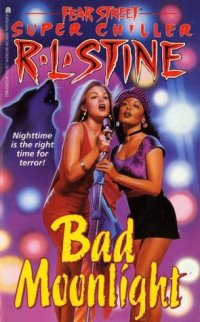
Horror Novel Review: Bad Moonlight by R. L. Stine


Before I say anything else, I have a confession to make.  I read this book really quickly.  I mean, I basically sat down, and skimmed over every page and didn’t write out a single note about the book.

Why was I reading it so quickly?  Bad Moonlight is a book that I ordered off of Amazon last month with the intention of reviewing it for October but then I changed my mind.  As often happens, I ended up running behind and, with Halloween approaching, I decided to set aside all of the Stine books that I hadn’t yet read and reviewed because I wanted to review a different (and, to be perfectly honest, adult) horror novel for Halloween.

Unfortunately, the book that I was planning on reivewing turned out to be really bad, despite the fact that it was co-written by one of my favorite filmmakers.  I didn’t feel like getting all negative on Halloween, especially when it would involve being negative about a filmmaker who I adore and who is no longer with us and whose legacy pretty much defines modern horror.  So I decided to put off reviewing that book (I’ll write about it in November).  Needing something for today, I grabbed R.L. Stine’s Bad Moonlight and I quickly read it.  Fortunately, R.L. Stine wrote books that are pretty much designed to be a quick read.

Bad Moonlight was first published in 1994.  It tells the story of Danielle.  Danielle is 18 but, in a rather creepy aside, we’re told that she looks like she’s closer to 12 because she’s not as developed as the typical 18 year-old.  She’s the lead singer in a band.  The band’s struggling but at least they have a totally hot roadie named Kit.  Anyway, one night, Danielle is inspired to write a song called Bad Moonlight and then she bites Kit’s lower lip until it bleeds.  The band’s fans love the new song and Danielle goes onto write several other songs that all deal with moonlight.  She also writes a song that may or may not be about the death of Joey, “the sound guy.”  Joey was murdered but who killed him?  Everyone thinks it was Danielle, mostly because Danielle is always having these weird hallucinations.  Since this is a Stine book, Danielle is also an orphan with a mysterious background.  She lives with her Aunt Margaret and she sees a psychiatrist named Dr. Moore.  Dr. Moore likes to hypnotize her.  That’s never a good sign.

Anyway, you can probably guess, just based on the title, that this book has to do with werewolves and a big conspiracy to make Danielle into a werewolf bride.  It’s actually kind of a fun book, because you can tell that Stine actually wanted to focus on all of the band melodrama but, because he’s R. L. Stine, he also had to toss in a bunch of werewolves.  The effort to bring the band drama and the werewolf mythos together is a valiant one and it kind of comes out of nowhere and you have to appreciate just how weird Stine allows things to get.  It’s an entertainingly silly book.

If nothing else, it shows how strange the world can look when it’s illuminated by …. BAD MOONLIGHT!

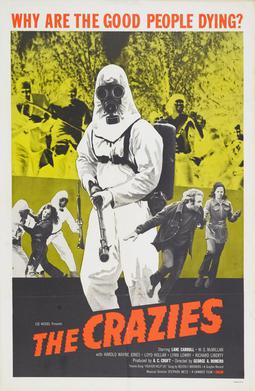
Horror Film Review: The Crazies (dir by George Romero)


Ah, The Crazies.  The original Crazies.

This 1973 film is one of George Romero’s best non-Dead films, though it never seems to get the respect that it really deserves.  Even today, the original is often overlooked in favor of the remake.  And don’t get me wrong — the remake of The Crazies is good and it features several effective jump scares.  But the remake is a slick Hollywood film and, watching it, you always have the safety of knowing that you’re watching a slick Hollywood film.  The original, though, is rough and low-budget and it looks and it feels real.  As a result, it sticks with you long after the haunting final scenes.

The storyline is simple but effective.  People in a small Pennsylvania town are going crazy and murdering each other.  Usually, it’s impossible to tell who is infected until they’re already attacking you.  The infected are just like the zombies from Night of the Living Dead with one key difference.  The crazies may be as relentless as the Dead but they’re also human beings.  They think.  They plan.  They scheme.  And when they die, they die like humans and we’re reminded that, just a few short hours ago, they were friendly and, more or less, harmless.

The government, of course, shows up in the town and tries to contain the outbreak.  The main image that most people will carry away from The Crazies is of men in white hazmat suits, walking through small-town America and killing almost everyone they see.  As is typical for a Romero film, the so-called solution often seems to be worse than the problem.  We also get the typical conflict between the scientists and the military.  The  military wants to destroy the infected.  The scientists want to cure them.  The film is bleakly cynical as the one man who knows how to cure the disease is ignored and finally killed in a stampede of quarantined citizens.

The film follows six people as they attempt to escape from the town and avoid getting sick themselves.  Needless to say, it’s not as easy as it sounds.  The characters who everyone seems to remember are Artie (Richard Liberty) and his daughter, Kathy (Lynn Lowry).  What happens to them is perhaps the most disturbing moment in a film that’s full of them.  The other members of the group can only hope to survive, even as they slowly lose their grip on sanity.

It’s a disturbing film, precisely because it’s not slick.  The actors are not movie star handsome and the attacks are not perfectly choreographed.  The grainy cinematography gives the entire film a documentary feel and serves as a reminder that Romero made industrial films before he revolutionized the horror genre.  The Crazies works because it feel like it could be happening in your community or your back yard.  And, ultimately, it offers up no solution.  Mankind could save itself, Romero seems to be saying, if only mankind wasn’t so stupid.

Needlessly to say, a film as bleak as The Crazies was not a hit in 1973.  But it’s lived on and continued to influence other horror makers.  It’s one of Romero’s best.

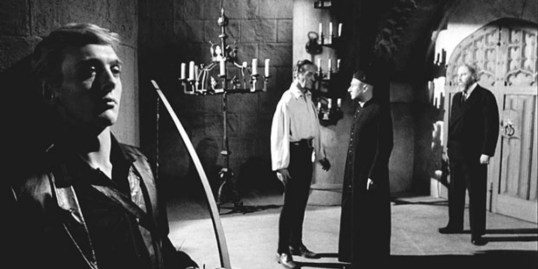
Horror Film Review: Eye of the Devil (dir by J. Lee Thompson)


If you thought Bohemian Rhapsody was overedited, you wait until you see the 1966 British horror flick, Eye of the Devil.

Seriously, I lost track of average number of of cuts that were used in each scene.  It was like, “There’s Deborah Kerr!  There’s Deborah Kerr from another angle!  There’s Donald Pleasence staring at something!  There’s David Hemmings in a corner.  There’s Deborah Kerr again!  There’s an overhead shot of the entire room!  Hemmings again, staring off to the left.  Now, a different shot of Hemmings staring off to the right.  Pleasence!  Kerr!  Hemmings!  There’s Sharon Tate, was she there the whole time?  Another overhead shot.”  All in five minutes.

Now, I will admit that the frantic editing style was a bit more effective in Eye of the Devil than in Bohemian Rhapsody, if just because Eye of the Devil was meant to be a bit of a filmed dream.  The whole movie was set up to be a surreal journey into the heart of French darkness so the disorientating visual style was effective, even if it did kind of give me a headache while I was watching it.

In the film, Deborah Kerr play Catherine, who is the wife of Philippe (David Niven), who owns a vineyard and who is perfectly charming and David Niven-like until he returns to the vineyard.  Then he suddenly becomes withdrawn and cold.  It turns out that the vineyard is struggling a bit.  It’s the dry season, which I guess is a bad thing when you’re making wine.  While Philippe tries to keep morale up among the peasants, two siblings — Christian (David Hemmings) and Odile (Sharon Tate) — wander around the castle.  Christian carries a bow and arrow and seems to be kind of arrogant.  Odile smiles enigmatically and turns frogs into doves.  Meanwhile, Donald Pleasence plays the vineyard priest, who appears to believe that something drastic needs to be done to reverse the dry season.

Soon, Catherine is stumbling across strange ceremonies and discovering that no one seems to care about her concerns that Christian and Odile are going to be a bad influence on the children.  She’s especially upset when Christian points an arrow at her.  Philippe, meanwhile, just laughs off her concerns.  Obviously, it was just a joke! he says.

Eye of the Devil is about as enjoyably pretentious as a British film from 1966 can be.  It’s not just that the movie is edited to the point of chaos.  It’s also that characters have a bad habit of going off on discussions about relationship between magic and reality.  And yet, it’s so pretentious and so silly and so overdirected that you can’t help but love it.  It’s just such a film of its era that it’s impossible not to get something out of it.  Add to that, Sharon Tate and David Hemmings share an otherworldly beauty as the two siblings.  Deborah Kerr shows that she could make even the silliest of situations of compelling.  David Niven is surprisingly effective as a non-charming character.  And then you’ve got Donald Pleasence, making enigmatic statements and showing off the intense stare that would later make Dr. Sam Loomis an icon of horror.

Eye of the Devil may be a mess but it’s a beautiful mess.

Horror on the Lens: Night of the Living Dead (dir by George Romero)


Happy Halloween everyone!

Well, as another horrorthon draws to a close, it’s time for another Shattered Lens tradition!  Every Halloween, we share one of the greatest and most iconic horror films ever made.  For your Halloween enjoyment, here is George Romero’s Night of the Living Dead!

(Be sure to read Arleigh’s equally famous review!)

Horror on TV: FreakyLinks 1.11 “Live Fast Die You” (dir by David Barrett)


On tonight’s episode of FreakyLinks, Ethan Embry and the crew investigate real-life adrenaline vampires!  Agck!

This episode features appearances from Jeffrey Combs, Dennis Christopher, Paige Moss, and everyone’s favorite, Eric Baflour!

This episode originally aired on June 1st, 2001.

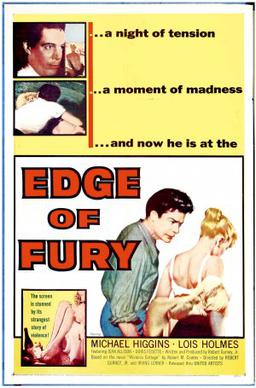
The TSL’s Horror Grindhouse: Edge of Fury (dir by Robert J. Gurney Jr. and Irving Lerner)


Damn, this is a dark movie.

The 1958 film, Edge of Fury, opens with a man standing on the beach.  It seems like it should be a pleasant opening but instead, the entire scene feels threatening.  The man, Richard Barrie (Michael Higgins), is a veteran of the Korean War and he’s working on a painting with what appears to be an almost possessed intensity.  Thanks to the film’s black-and-white, noir-like cinematography, the beach does not look inviting.  Instead, it looks dark and cold.  A voice over informs us that Richard once asked to be confined for not only his own good but also the good of society.  However, the authorities could not intervene because Richard had yet to commit a crime.

Suddenly, the police arrive.  They arrest Richard and take him away, suggesting that Richard has finally proven just how much of a threat he actually is.

The rest of the film is told in flashback.  We watch as Richard, who works in a bookstore, comes across a beach house that he quickly rents.  It turns out that he wants to stay there with the Hacketts, Florence (Lois Holmes) and her daughters, Eleanor (Jean Allison) and Louisa (Doris Fesette).  Somewhat improbably, Richard and Florence are friends, having met in a grocery store.  Florence trusts Richard because he’s so polite and nice.  Eleanor has a crush on Richard because he’s handsome and brooding.  And Louisa just thinks that Richard is kind of a loser.

The Hacketts move into the beach house and Richard sets up an artist’s studio in the shed.  He paints a lot of pictures of Louisa, despite the fact that Louisa has a boyfriend and wants nothing to do with him.  Though the three women don’t realize it, Richard is growing increasingly unstable and obsessed.  He wants the three women to be his new family and when he realizes that he’s not going to get his way, he turns violent….

And certainly, this is not the only film to be made about a mentally disturbed man who becomes obsessed with what he considers to be the perfect family.  It’s also not the only film to end with an act of shocking violence and to leave the audience feeling as if they’ve just taken a journey into a waking nightmare.  What does set Edge of Fury apart from some other films is that it was made in 1958 and, in many ways, it’s the exact opposite of what we expect a 1958 film to be.  This is a dark, dark movie that suggests that the universe is ruled by chaos and that kindness will be rewarded with pain.

Seriously, it’s dark.

That said, it’s definitely a flawed film.  You never buy that Florence would trust Richard as much as she does.  Michael Higgins is frighteningly intense as Richard but the rest of the cast often seems to simply be going through the motions.  That said, it’s definitely a film that sticks with you.  This isn’t a story that you just shrug off and forget.

Probably the best thing about the film is the cinematography.  This film was an early credit for Conrad L. Hall, who later went on to become one of the great cinematographers.  He fills the film with ominous shadows and hints of the madness to come.  As filmed by Hall. the beach looks like some alien landscape, as twisted as the inside of Richard’s mind.

Edge of Fury took me by surprise.  It’s nowhere close to being perfect but it’s worth tracking down on YouTube.

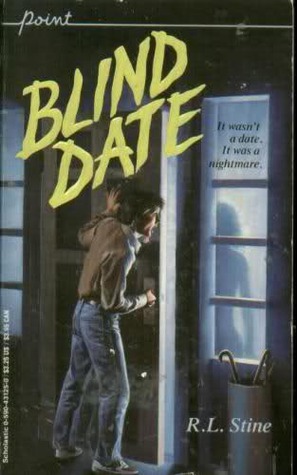
Horror Novel Review: Blind Date by R.L. Stine


First published way back in 1986, Blind Date represents a significant moment in YA horror literature.  This is the first “horror” novel to be written by R.L. Stine!

Blind Date tells the story of Kerry, who is a teenager who has a lot of problems.  A year ago, he was in a really serious car accident.  He doesn’t remember much about the accident but he does know that, as a result of the accident, his older brother is now in a mental institution and his father doesn’t talk to him much.  Poor Kerry.  One thing that I’ve noticed from reading all of these Stine and Christopher Pike books over the course of this month is that both of them always seemed to come up with plots that featured car accidents.  I guess it makes sense.  When you’re a teenager, you can’t wait to get your first car but you’re also aware that you’re eventually going to have your first accident.

Anyway, Kerry is kind of a loser but he is on the football team.  Unfortunately, he apparently injured the school’s star quarterback during practice so now he has the entire team wanting to kill him.  Perhaps the only good thing going on in Kerry’s life is that he’s been set up on a blind date with a mysterious girl named Amanda….

Except, when Kerry goes to Amanda’s house, he’s met by two bereaved parents who explain that Amanda’s dead!  OH MY GOD, IS KERRY’S DATE A GHOST!?  No, actually, it turns out Kerry’s date is actually named Mandy and apparently, Kerry misheard.  Or something.  Who knows?  The important thing is that Kerry has a girlfriend who can comfort him whenever he gets his ass kicked by the football team, which is something that is definitely going to happen because Kerry goes to a school that’s ruled by mob justice..

Mandy is a little bit vague about her past, which should be a huge red flag but Kerry has something else to worry about.  His brother, Donald, has escaped from the mental hospital!  And apparently, he has a history of trying to kill Kerry!  Can Kerry pursue a successful relationship, mend fences with the football team, and avoid getting killed by his brother?  Or is the story going to end with Kerry getting beaten over the head with a stuffed moose?

(Yes, you read that right.)

Actually, the story ends with a twist that I’m pretty sure Stine came up with at the last minute.  To be honest, the whole book kind of reads as if someone said to Stine, “We need two hundred pages and we don’t really care what’s on them.”  The story goes from one strange development to another.  It makes for a kind of weird story that doesn’t always make sense but it is compulsively readable.

And really, that’s the thing with the work of both Christopher Pike and R.L. Stine.  You don’t reread these books because they’re particularly scary or even that well-written.  You read them because they’re just so damn strange.  It’s never enough to have just one twist.  Instead, there has to be a dozen twists and if they don’t really seem to make sense or go together …. well, so what?  That’s what life’s like when you’re a teenager, right?  It may not always make sense.  It may not always turn out the way you want.  But it’s still something you miss once it’s gone.

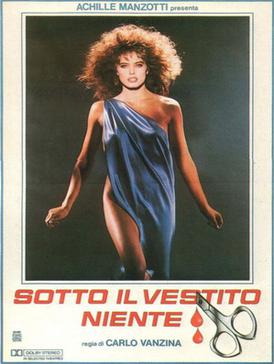
International Horror Film Review: Nothing Underneath (dir by Carlo Vanzina)


The 1985 Italian film, Nothing Underneath, is a giallo that’s achieved some notoriety based on the fact that it’s not a very easy film to find.

Seriously, I’ve spent years looking for this film.  I had read enough good things about it to make me believe that it was a film that I, as an unapologetic fan of Italian horror, simply had to see.  Unfortunately, as far as I can tell, it’s never gotten a proper DVD or Blu-ray release in the United States.  It’s not so much that the film is controversial or even particularly graphic.  Apparently, the main problem is that the film takes place in the world of high fashion and that means that there are several scenes that take place at fashion shows and most of those scenes feature songs that were very popular in 1985.  Nothing Underneath has never gotten a proper video release because of all the music.  It’s kind of unfortunate, really.  There are so many good movies that are currently in limbo because of disputes over the rights to the music on the film’s soundtrack.

Anyway, the good news is that last night, I was able to find Nothing Underneath on YouTube!  So, I finally got to watch it.

The bad news is that I watched it in Italian with no subtitles.

Now, that’s not quite as big of an issue as you might think.  The thing with Italian horror films is that the story is often less important than how it’s told.  The best Italian horror films are all about style and suspense and less about keeping track of who did what to whom.  That’s certainly appears to be the case with Nothing Underneath.  Film is a visual medium, after all.

The film is about a brother and a sister.  Bob (Tom Schanley) is a park ranger who works at Yellowstone and is very happy with his simple and honest life.  Jessica (Nicole Peering) is a fashion model who currently lives in Milan and who spends all of her days modeling lingerie and fighting off sleazy coke addicts.  Bob and Jessica have such an extremely strong bond that, occasionally, Bob has visions of Jessica’s life in Milan.  Whenever Jessica is in danger, Bob knows it.  When Bob has a vision of someone stalking Jessica while carrying scissors and wearing black gloves, he rushes back to his ranger station and calls Italy to warn her.  Unfortunately, he’s too late.  By the time he convinces the surly desk clerk as Jessica’s apartment building to give Jessica the message, Jessica has disappeared.

Bob flies to Milan, determined to find his sister.  He teams up with Commissioner Danesi (Donald Pleasence) to investigate Jessica’s disappearance.  As soon as I saw Donald Pleasence, I automatically assumed that he would eventually turn out to be involved in Jessica’s disappearance but no.  Pleasence actually plays a good guy in the film, one who appears to harbor no dark secrets.  That was kind of a nice change of pace and, even though he was dubbed into Italian, I could tell that Pleasence gave a likable and sympathetic performance in this film.

It turns out that the black-gloved killer is murdering models all over Milan.  Can Bob discover the killer’s identity?  Will he be able to protect Barbara (Renee Simonsen), the killer’s latest target?  And will he discover all of the sordid details about Jessica’s life in Milan?

Despite the language barrier, I enjoyed Nothing Underneath.  It’s an old school giallo, right down to the whodunit mystery and the point-of-view shots of the black-gloved killer.  Visually, the film is impressive.  The opening sequence neatly contrasted the simplicity of Yellowstone with the decadence of Milan and the scenes of the killer stalking their latest victim were nicely done and very suspenseful.  It was a bit hard to judge the actors (as usual, some of the dubbing was very poorly done) but Donald Pleasence was a delight as always and Tom Schanley come across as being very sincere and likable as the park ranger.

I’m glad to have seen Nothing Underneath.  I hope it gets a decent video release at some point in the future.