Hi, everyone! I’m in charge of “music video of the day” for this week so let’s get things started with this trippy little video from Laurence-Anne.
Basically, you remember those big bulky computers that everyone used to have? Well, judging from this video, it’s a pretty good thing that we got rid of the because they’ll cause you to sucked into a maze and then melt away. Seriously, everyone …. melting is just not worth it. While I personally don’t know anyone who has melted, I imagine that it would be a pretty difficult thing to come back from. You melt and you can pretty much say goodbye to whatever future plans you may have had.
Last night, for the first time, I watched the 1948 Best Picture nominee, The Treasure of the Sierra Madre.
Directed by the legendary John Huston and featuring a wonderful performance from the equally legendary Humphrey Bogart, The Treasure of the Sierra Madre has a reputation for being one of the greatest films ever made. It’s a reputation that is more than deserved. That makes the film a pleasure to watch but, unfortunately, it also makes it somewhat intimidating to write about.
(In the past, Leonard and I have discussed how it’s so much more difficult to write a review of a good film than it is to write a review of a bad film. Sad to say, it’s often easier to be negative than it is to be positive. Writing a review of a bad film only requires the ability to be snarky. Writing a review of a good, much less a great film, is far more difficult. It’s one thing to realize a film is good. It’s another thing to try to explain why.)
The Treasure of Sierra Madre tells the story of three Americans in Mexico, drifters living on the edge of society. Fred C. Dobbs (Humphrey Bogart) and Bob Curtin (Tim Holt) spend their days begging for spare change and taking whatever work they can find. When they meet an eccentric but wise prospector named Howard (Walter Huston), the three of them end up going on a quest for gold. It’s not a spoiler to tell you that the three men find their gold, though Dobbs is shocked to discover that gold dust can easily be mistaken for sand and doesn’t naturally shine in the sun. Just as Howard warned would happen, the three men start to grow paranoid about their newfound wealth. Meanwhile, others — including a pushy American named Cody (Bruce Bennett) and an outlaw known as Gold Hat (Alfonso Bedoya) — show up near the camp, leaving the men to wonder how far each of them will go to protect their shares of the treasure.
When the three of them first meet in a dirty flophouse, Howard warns Dobbs and Curtin that gold will drive a man to insanity. Howard says that he knows because it’s happened to him more than once. Still, as we watch the three prospectors descend further into paranoia with each new bag they fill with gold dust, we can’t help but wonder if the gold is driving them crazy or if it’s just causing them to reveal their true selves. From the minute we first see Dobbs on a street in a Mexican city, begging for money and snarling at a child (played, incidentally, by a very young Robert Blake) who tries to sell him a lottery ticket, it’s obvious that Dobbs is desperate, angry, and resentful. Finding the gold doesn’t do anything to alleviate the anger that Dobbs feels towards the world as much as it just gives him an excuse to indulge in it fully. Whereas, in the past, Dobbs always had to hold back his anger in hope of getting another handout, the gold allows him to fully embrace his seething resentment. Compared to Dobbs, Howard and Curtin don’t seem to change quite as much. Of course, it should be remembered that Howard is an old man who knows that he doesn’t have much time left. Meanwhile, Curtin is often too busy reacting to Dobbs’s anger to truly indulge in his own. Watching the film, you have to wonder how things would have gone if Dobbs hadn’t been there. Without the distracting of Dobbs’s growing instability, would Curtin have remained the sane member of the group? The scene where Curtin first meets Cody suggests that, on his own, Curtin is just as capable of being as paranoid as Dobbs.
Indeed, though greed is certainly a motivating force in The Treasure of the Sierra Madre, it’s not the film’s main subject. Instead, this film is a study of men living on the fringes of society. We learn surprisingly little about how Dobbs and Curtin came to be two beggars living in Mexico. We learn a bit more about Howard’s background, largely because Howard likes to talk. But again, we don’t really learn that much about who Howard was before he became a prospector. Howard, Curtin and Dobbs are forgotten men, without any real friends or family. They’ve got each other, though that bond doesn’t always appear to be a particularly strong one. Howard and Curtin have managed to find some sort of peace with their existence. Dobbs has not. While the film may partially be a portrait of the corrosive effects of greed, it’s also a character study of three men who have been forgotten and abandoned and how they deal with living outside of the world that everyone else takes for granted.
There’s much to love in The Treasure of the Sierra Madre, from John Huston’s powerful direction to the dark humor that runs through some of the film’s best moments. Houston fills the film with little details that make it feel authentic. (My favorite little moment came towards the end when a man facing a firing squad makes sure that he’s wearing his hat before he’s shot.) Walter Huston, Tim Holt, Bruce Bennett and Alfonso Bedoya all give strong performances, though the film is dominated by Humphrey Bogart. Walter Huston won a (deserved) Academy Award for his performance but one of Bogart’s best performances somehow went unnominated. Bogart gives a ferocious and never less than compelling performance as Dobbs. At his worst, Dobbs is almost like a trapped animal, roaming the cage of his existence and snapping at anyone who gets too close. At the same time, Dobbs’s naked desperation makes it impossible not to feel some sympathy for him. Bogart was never more vulnerable than when Dobbs was begging for money and never more frightening than after he got it.
The Treasure of the Sierra Madre is a classic, one that has been endlessly imitated but which will probably never be equaled. Nominated for four Oscars, The Treasure of the Sierra Madre won three (for John Huston’s direction and screenplay and for Walter Huston’s performance as Howard) but it lost best picture to Laurence Olivier’s Hamlet. As much as I like Hamlet, this is a case where the Academy made a mistake.
The Oscar nominations are finally due to be announced on March 15th and the Oscars themselves are scheduled to be awarded at the end of April. In anticipation of the big event (and the end of this current lengthy awards season), I am going to spend the next two months watching and reviewing Oscar nominees of the past. Some day, I hope to be able to say that I have watched and reviewed every single film nominated for Best Picture. It’s a mission that, with each passing year, I come a little bit closer to acomplishing.
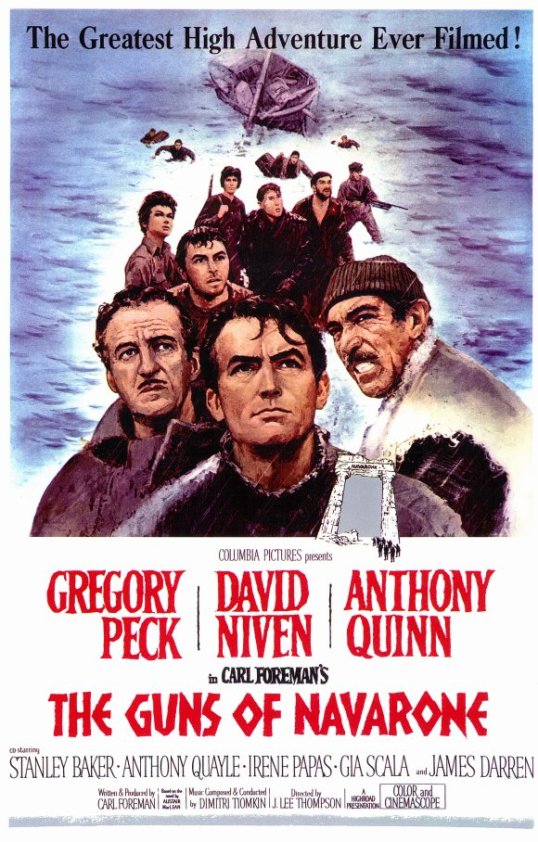
Tonight, I decided to start things off by watching the 1961 best picture nominee, The Guns of Navarone.
The Guns of Navarone takes place in 1943, during World War II. 2,000 British troops are stranded on the Greek island of Kheros and the Nazis are planning on invading the island in a show of force that they hope will convince Turkey to join the Axis powers. The Allies need to evacuate those troops before the Nazis invade. The problem is that, on the nearby island of Navarone, there are two massive guns that can shoot down any plane that flies over and sink any ship that sails nearby. If the British soldiers are to be saved, the guns are going to have to be taken out.
Everyone agrees that it’s a suicide mission. Even if a commando team manages to avoid the patrol boats and the German soldiers on the island, reaching the guns requires scaling a cliff that is considered to be nearly unclimbable. Still, the effort has to be made. Six men are recruited to do the impossible. Leading the group is Major Roy Franklin (Anthony Quayle), a natural-born leader who is described as having almost supernatural luck. Franklin’s second-in-command is Keith Mallory (Gregory Peck), an American spy who speaks several languages and who is an expert mountain climber. Spyros Pappadimos (James Darren) and Butcher Brown (Stanley Baker) are both assigned to the team because they have fearsome reputations as killers, though it quickly becomes clear that only one of them kills for enjoyment. Colonel Stavrou (Anthony Quinn) is a member of the defeated Greek army and he has a complicated past with Mallory. Finally, Corporal Miller (David Niven) is a chemistry teacher-turned-explosive expert. Waiting for the men on the island are two members of the Resistance, Spyros’s sister Maria (Irene Papas) and her friend, Anna (Gia Scala). The mission, not surprisingly, the mission doesn’t go as planned. There’s violence and betrayal and not everyone makes it to the end. But everyone knows that, as tired as they are of fighting, the mission cannot be abandoned.
The Guns of Navarone was a huge box office success when it was originally released, which probably has a lot to do with it showing up as a best picture nominee. It’s an entertaining film and, watching it, it’s easy to see how it served as a prototype for many of the “teams on a mission” action films that followed. Though none of the characters are exactly deeply drawn, that almost doesn’t matter when you’ve got a cast that includes actors like Gregory Peck, Anthony Quinn, and David Niven. At it best, the film works as a triumph of old-fashioned movie star charisma. Peck is upright and determined to do whatever needs to be done to get the job done. Quinn is tempermental and passionate. David Niven is cynical, witty, and very, very British. Quayle, Darren, and especially Stanley Baker provide strong support. Before Sean Connery got the role, Stanley Baker was a strong contender for James Bond and, watching this film, you can see why.
Seen today, there’s not a lot that’s surprising about The Guns of Navarone. It’s simply a good adventure film, one that occasionally debates the morality of war without forgetting that the audience is mostly watching to see the bad guys get blown up. Some of the action scenes hold up surprisingly well. The scene where the team is forced to deal with a German patrol boat is a particular stand-out.
The Guns of Navarone was nominated for 7 Academy Awards, including Best Picture. Though it lost the top prize to West Side Story, The Guns of Navarone still won the Oscar for Best Visual Effects.
Since it’s due to leave HBOMax at the end of the day and since HBOMax isn’t exactly cheap, I decided that I should go ahead and watch The Little Things, the serial killer thriller that has been getting some unexpected Oscar buzz due to the performance of Jared Leto.
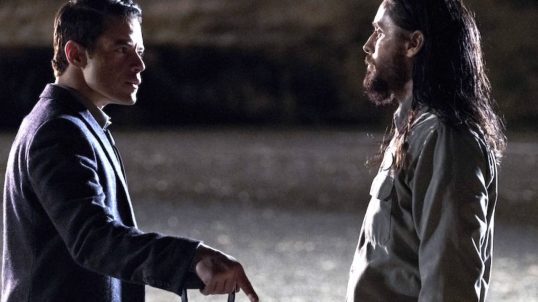
Taking place in the 90s, The Little Things follows two cops as they investigate a series of murders. Deacon (Denzel Washington) is the former hotshot homicide detective who, back in the day, allowed his obsession with an unsolved murder to destroy his life. He lost not only his wife but also nearly his life. Now, he’s a small town deputy who is still haunted by the cases that he didn’t solve. Jim (Rami Malek) is the detective who has picked up where Deacon left off. Deacon is haunted and unable to move on. Jim is young and cocky and obviously doomed to repeat all of Deacon’s mistakes. At first, Jim doesn’t want to work with Deacon and Deacon seems to be a little bit skeptical of Jim’s abilities. Eventually, though, they bond over their mutual righteousness. Jim is the type of who reminds the crime scene technicians that they’re working for the victim. Deacon is the type who muses about whether or not God has abandoned humanity. On the one hand, we should be thankful that they’re good at their job. On the other hand, you wouldn’t necessarily want to invite either of them to a party.
Deacon and Jim’s investigation leads them to a suspect named Sparma (Jared Leto) and you know that he’s a bad dude as soon as you learn that his name is “Sparma.” It sounds like too much of a mix of sperm and pharma for this guy to be anything other than dangerous. Sparma is an appliance repairman with unwashed hair, a permanent smirk on his face, and a disconcerting history of confessing to crimes that he didn’t actually commit. Jim and Deacon both think that Sparma is guilty but can they prove it? How far will they go to take a possible killer off the streets?
Jared Leto is certainly creepy as Sparma. In fact, I think you could probably argue that he’s a little bit too obviously creepy and unhinged in the role. Most real life serial killers — especially the ones who manage to kill for years without being detected — are able to blend in with society. Consider the cases of killers like Gary Ridgway, the Green River killer who avoided capture for nearly three decades, or Dennis Rader, the infamous BTK killer. While it’s true that everyone in his hometown apparently thought Rader was a dick even before he was revealed to be a serial killer, he also still managed to hold down a respectable job while raising a family and fooling people into thinking that he was just a normal jerk as opposed to a homicidal one. That ability to blend in and disguise their true selves is one of the things that makes real-life serial killers so frightening. Sparma, however, might as well have the words “murderer” tattooed on his forehead. I can understand why Jared Leto is getting Oscar buzz because it’s a showy role and it allows him to act up a storm. But it’s still hard not to feel that the film, which tries to introduce the idea that Deacon and Jim’s obsession with this case has led to them developing a tunnel vision that has left them incapable of suspecting anyone other than Sparma, might have been a bit more effective if it had taken a slightly more ambiguous approach to the character.
That said, The Little Things is a well-made movie. Though it’s bit overlong and occasionally meanders a bit too much for its own good, the film looks great and director John Lee Hancock does a good job of creating an effectively creepy atmosphere, providing the viewer with some wonderfully ominous images as Deacon and Jim search for the truth in the middle of the night. For instance, the scene where Deacon imagines himself talking to the ghosts of the killer’s victims really shouldn’t work but it does because Washington gives such a committed performance and Hancock, as a director and writer, is smart enough to just let the scene develop naturally. Even as he ages, Denzel Washington remains a compelling actor and he helps to carry The Little Things over more than few speed bumps on the way to the end credits. At its best, the film works as an examination of obsession and there is a haunting intensity to the film’s final moments that suggests the movie that The Little Things could have been if the film’s pace had been just a little bit tighter.
In the end, The Little Things is uneven but it has enough effective moments to be watchable.
We’re still in the process of recovering from last week’s winter storm down here and I have to admit that, for me personally, it’s been a bit of a struggle to actually maintain my focus. Last week’s combination of power outages and freezing weather threw me off of my usual rhythm and I’m still getting it back.
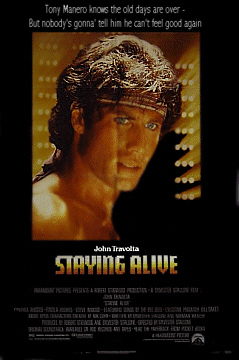
Fortunately, I have a little help from my friends. Earlier tonight, a group of us watched the 1983 film, Staying Alive.Staying Alive is the somewhat notorious sequel to Saturday Night Fever. If Saturday Night Fever was actually a dark and gritty coming-of-age story disguised as a crowd-pleasing musical, Staying Alive is …. well, it’s something much different. It’s a film about dancing and Broadway, directed and at least partially written by Sylvester Stallone. Why exactly would anyone think that Sylvester Stallone was the right director to make a movie about dancing and Broadway? Your guess is as good as mine but, in the end, the important thing is that Stallone wrote a key supporting role for his brother, Frank Stallone. Frank not only performs several songs but he proves that he can glare with the best of them.
As for the film itself, it opens with Tony Manero (John Travolta) having left behind Brooklyn and the world of disco. Now, he lives in Manhattan, he teaches a dance class, he humiliates himself looking for an agent, and he’s struggling to make it on Broadway. (Basically, he’s turned into Joey from Friends.) When Tony’s lucky enough to get cast in a lavish musical called Satan’s Alley, Tony has a chance to become a star but only if he can …. well, I was going to say control his ego but actually, his ego isn’t that much of a problem in Staying Alive. Actually, there’s really nothing standing in Tony’s way, other than the fact that — in Staying Alive as opposed to Saturday Night Fever — he’s portrayed as kind of being an irredeemable idiot. If Saturday Night Fever was all about revealing that Tony was actually smarter and more sensitive than he seemed, Staying Alive seems to be all about saying, “Whoops! Sorry! He’s just as obnoxious as you thought he was.”
Staying Alive is a notoriously ill-conceived film, though it’s also one of those films that’s just bad enough to be entertaining when viewed with a group of snarky friends. That said, the opening credits montage — which features Tony dancing while Kurtwood Smith glares at him — is actually pretty good. Travolta smolders with the best of them and the sequence does a good job of capturing Tony’s mix of desperation and determination. It’s unfortunate that Kurtwood Smith pretty much disappeared from the film following the opening credits. Judging from what little we see of him, Smith would have been pretty entertaining as a permanently annoyed choreographer. Finally, how can you not love the neon credits? This a scene that screams 80s in the best possible way.
So, while I continue to work on getting back to my usual prolific ways, why not enjoy this scene that I love from Staying Alive?
As you may have heard, we’ve had a bit of inclement weather down here in Texas. Tuesday morning, around one a.m., the house was surrounded by six inches of snow. The temperature outside was 3 degrees. Because the power was down (not due to the rolling blackouts that had paralyzed the rest of the state but instead because some idiot drove into a substation) it was about 40 degrees inside of the house. It was cold, I was shivering, and I couldn’t sleep. So, I decided to sit in bed and read a book. Even though I had a flashlight with me, I quickly discovered that I didn’t need it. The snow outside was so bright that it actually generated enough light that I was able to read by it. That was actually kind of nice.
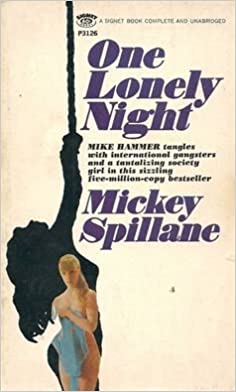
As for the book that I decided to read, it was an old paperback detective novel that I purchased at Half-Price Books a few years ago. (Half-Price Books has a wonderful vintage section.) Originally published in 1951, Mickey Spilliane’s One Lonely Night is one of the many books that Spillane wrote about the adventures of a tough New York-based private investigator named Mike Hammer. Many of those books were later adapted into films. 1955’s Kiss Me Deadly is probably the best-known. (And, of course, the much-missed Gary Loggins was quite a fan of Mike Hammer and the author who created him.)
One Lonely Night opens at night and with Mike Hammer in a bad mood. Earlier in the day, a judge scolded Hammer for being too quick to kill people, leaving Hammer to feel as if he was being portrayed as being some sort of blood-thirsty monster. When night comes, Hammer is still wandering around Manhattan and obsessing on the fact that he’s somehow developed a reputation for being violent and quick to kill. It’s interesting because, on the one hand, it’s hard not to feel bad for Hammer. His feelings have obviously been hurt and, as he explains in his hard-boiled narration, he only kills people who have to be killed. He doesn’t necessarily do it for fun though, at the same time, he doesn’t make any apologies for doing what he feels needs to be done. On the other hand, as you read the book, you can’t help but notice that Hammer really does kill a lot of people. When he’s not killing, he’s thinking about killing. He’s obsessed with violence and, even if he’s found a way to justify that to himself, it’s still hard not to be slightly disturbed by such a one-track mind. Hammer knows that he will never be able to escape his fearsome reputation and he also know that most people will never see him as being anything more than a murderer. But, at the same time, he also understands that important role that he, in his own ruthless way, plays in maintaining the proper balance between good and evil. He’s a former soldier, a World War II vet who one took as much pleasure in killing Nazis as he now takes in killing criminals. He’s frightening but he’s necessary.
As for the book’s plot — well, it’s hard to know where to even begin. It all starts with Hammer wandering around Manhattan and running into a mysterious woman being pursued by a male assassin. The woman, apparently thinking that Hammer is another assassin, jumps off a bridge rather than accept Hammer’s help. Hammer, who has just told us in glorious detail about how much he resents being called a killer, proceeds to kill the other man and then toss his body off the bridge as well. Before Hammer throws away the dead man, he uses the pavement to scrape off the man’s fingerprints because …. well, he’s Mike Hammer and he does stuff like that. (What’s interesting is that Hammer informs us about destroying the man’s fingerprints rather casually, as if it’s something that anyone would do under the circumstances.) Through a convoluted series of events, this all leads to Hammer investigating a politician who is being blackmailed by his twin brother and also uncovering a secret communist spy ring and a plot to steal a lot of very sensitive documents. Everything’s connected in its own strange way. Hammer seduced two communists, kills a lot of people, and spends a lot of time talking about how much he hates the weaklings who, in his opinion, are destroying American society. Hammer may not believe in much but he definitely believes in America.
The story is next to impossible to follow. One gets the feeling that Spillane simply made it up as he was writing it, without really worrying about whether or not everything really added up. When Spillane can’t come up with a logical way to connect the various elements of the story, he resorts to coincidence. Mike Hammer has a talent for being in the wrong place at the wrong time. And yet, the story’s incoherence is actually one of the reasons why One Lonely Night works. The narrative messiness, mixed with Hammer’s unapologetically over-the-top tough guy narration, makes the story feel like almost a fever dream. Hammer walks through an increasingly surreal version of New York and only he seems to understand just how ludicrous the world has become. He’s neither as idealistic as his allies nor as cynical as his opponents. Instead, he’s an untouchable avenger, moving through the chaos and simply accepting that nothing makes sense beyond his own primal instincts. Hammer is the ultimate individualist, worrying only about himself and occasionally his secretary, Velda.
One Lonely Night is definitely a product of its time. One can only imagine the howls of rage that would greet the book if it were written today. In 1951, one could presumably get away with writing a novel about a private detective ruthlessly killing a bunch of political subversives. Today, of course, the book’s storyline would probably lead to an angry twitter hashtag campaign. Of course, what those readers would probably miss is that Spillane clearly doesn’t mean for us to take Mike Hammer all that seriously. At it’s best, the book is almost a parody of the classic tough guy posturing that we associate with pulp fiction. Hammer is so ruthlessly determined and his enemies are so incredibly weasely that it’s obvious that Spillane was having a bit of fun with both his readers and at the expense of his critics. Just as Hammer spends the book complaining about a judge who accused him of being too quick to kill, Spillane seems to saying to the critics of his style of writing, “You think pulp detective stories are sordid? I’ll show you sordid!”
I enjoyed One Lonely Night. It kept me entertained during one very cold night.
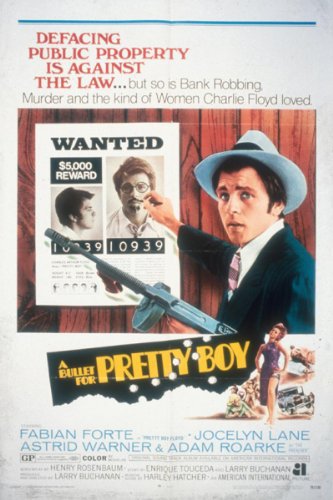
By most accounts, Charles A. Floyd — better known by the nickname “Pretty Boy” Floyd — was one of the nicer of the Depression-era outlaws. Though he robbed his share of banks, he was usually described as being rather polite and sensible while he did so. He didn’t steal from the poor. While he did kill a few men, they were all law enforcement officers who were also shooting at him. And while that may not sound like a good thing, with murder being murder and all, it’s still a marked contrast to Bonnie and Clyde, who were known for being as deliberately violent as possible. Pretty Boy Floyd reportedly had a strong dislike for Bonnie and Clyde and even told his relatives in Oklahoma not to help the Barrow Gang hide from the police.
The most violent thing that Floyd was ever accused of was taking part in the killing of four law enforcement officers in Kansas City. (This was the so-called Kansas City Massacre.) Since one of the victims was an FBI Agent, Floyd quickly became public enemy number one and was eventually gunned down in a cornfield in Ohio. (Some accounts say that Floyd was initially only wounded and was executed by the FBI after he surrendered.) Most modern historians agree that Floyd was not involved in the Kansas City Massacre. Even after he had been shot and told that he was dying, Floyd reportedly vehemently denied having had any involvement in what happened in Kansas City. In the view of most historians, Pretty Boy Floyd was a polite country boy who just happened to rob banks.
That’s certainly the way that he’s portrayed in the 1970 film, A Bullet For Pretty Boy. Though this low-budget movie from Texas-born filmmaker Larry Buchanan opens with a title card telling us that we’re about to see a true story, it’s highly fictionalized. Singer Fabian Forte plays Charles A. Floyd, who goes from getting married to going to jail on a manslaughter conviction in record time. (It was all because someone was making trouble at the wedding reception so really, you can’t blame Floyd for anything that happened.) Floyd is supposed to serve six years but he decides to break out after only serving three and a half. Again, you really can’t blame Floyd for doing that. No one wants to work on a chain gang. Eventually, Floyd ends up hanging out at a brothel, where he falls in with a gang of bank robbers and a prostitute named Betty (Jocelyn Lane) ends up falling for him. After several bank robberies and gunfights, Floyd ends up working with an outlaw named Preacher (Adam Roarke). Everyone does not live happily ever after.
While watching A Bullet For Pretty Boy, it’s pretty easy to see the influence of the 1967 film, Bonnie and Clyde. There’s a lot of sudden bursts of violence (though never quite as bloody as the violence from Bonnie and Clyde) and the film is clearly on the side of Pretty Boy Floyd as opposed to the cops trying to catch him. However, whereas Bonnie and Clyde presented its title characters as being rebels against the establishment, A Bullet For Pretty Boy is content to portray Floyd as just being someone who ended up in a bad set of circumstances and who did what he felt he had to do to survive. As played by Forte, Floyd is good at robbing banks but he doesn’t seem to really enjoy doing it. That, of course, is a polite way of saying that Fabian Forte is credible but slightly boring in the lead role. He’s likable enough but he’s not exactly compelling and he often finds himself overshadowed by more energetic performers like Adam Roarke.
That said, I enjoyed A Bullet For Pretty Boy. Certainly, this film is better than the typical Larry Buchanan film. There aren’t any slow spots and the film does a good job of capturing the feeling and atmosphere of rural Texas and Oklahoma. (Undoubtedly it helped that the film was directed by a Texan who actually knew something about the communities that he was portraying.) The shoot outs and the bank robberies are just well-staged enough to hold your attention and that’s really the main thing that one can ask from a film like this. A Bullet From Pretty Boy doesn’t exactly make a lasting impression but it’s entertaining enough while you’re watching it.
“They wanted me to laugh when I wanted to cry,” Jacob Taylor (András Korcsmáros) says at one point during the upcoming horror film, The Poltergeist Diaries.
Jacob is attempting to explain why he’s recently abandoned not only his job but also the closeness of his girlfriend and his family and retreated to an isolated house in the middle of the woods. And really, who can’t relate to what Jacob’s feeling? We’ve all been in that situation at some point. We’ve all felt that we were expected to conform to some arbitrary standard and that our honest emotions were not welcome. Not all of us have chosen to go off the grid and isolate ourselves but there’s probably not a single person reading this who has not, at some point, been tempted.
We learn quite a bit about Jacob over the course of The Poltergeist Diaries. We learn that he was always something of an outsider. He was a seeker, a brilliant student who wrote stories and made films and who always seemed to be trying to discover some sort of hidden truth. We learn that he was also close to his mother. In fact, it was her worsening health that apparently led to Jacob leaving the city and heading out to the country. He got a big house for a surprisingly cheap price. He often filmed himself as he walked around the woods that surrounded his new home. He saw things in the woods and he heard things in the house.
Of course, the main thing that we learn about Ben is that he’s missing. The film opens with a statistic, telling us that thousands of people disappear every year in the United States and that only 15% of them are recovered alive. Jacob Taylor is among the missing and whether or not he’s among that lucky 15% is anyone’s guess.
The Poltergeist Diaries is set up as a documentary, featuring interviews with the people who knew Jacob along with footage that Jacob himself shot of the woods and his house. Among those interviewed are Jacob’s girlfriend (Kata Kuna) and his brother (Péter Inoka), along with a police detective (Dávid Fecske) who has his own reasons for taking a particular interest in Jacob’s mysterious disappearance. Eric Roberts even makes a brief appearances, playing Jacob’s apologetic stepfather. As I’ve said many times on this very site, any film the features Eric Roberts is automatically going to be better than any film that doesn’t.
It’s an effectively creepy film, one that makes good use of the faux-documentary format. (Jacob being a frustrated artist helps to explain why, even with things getting increasingly strange in the house, he keeps filming.) The first half of the film is dominated by interviews with people who knew Jacob and who are haunted by his disappearance. By the time the film switches over to showing us the footage that Jacob filmed in the house and the woods, the audience is definitely ready to discover what happened. András Korcsmáros plays Jacob as just being unstable enough to leave some doubt as to whether or not he’s really stumbled across something supernatural or if he’s just allowing the isolation to get to him. He’s at his best when he’s trying to articulate what he’s feeling. His performance captures Jacob’s desperation and makes him into an intriguing protagonist, one who is both sympathetic and enigmatic. You’re never quite comfortable Jacob but you still hope the best for him.
Visually, director József Gallai does a good job of creating and maintaining a properly ominous and threatening atmosphere. The woods that surround Jacob’s house are creepy because they really do appear to stretch on forever and it’s very easy to imagine that they’re could be someone (or something) hiding behind every tree. The imagery leaves you feeling uneasy and every time that Jacob went outside, I found myself anticipating an attack. The inside of the house is just as creepy, full of dark hallways and menacing shadows. This is a film that keep you watching for any hint of unexpected or mysterious movement.
It makes for an effectively intense and dream-like horror film, with the final 15 minutes providing a number of effective jump scares. It’s a film that will inspire you to take a second look at every shadow and jump at every bump in the night. It’s a seriously creepy movie. Don’t watch alone.
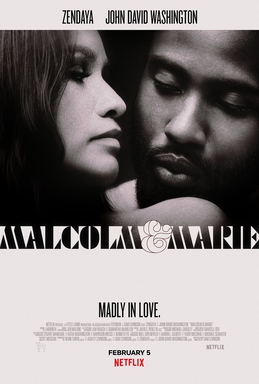
John David Washington is Malcolm, a director who has been called the next Spike Lee though he would rather be known as the next William Wyler.
Zendaya is Marie, an actress and former drug addict who is Malcolm’s girlfriend and the inspiration for his latest film.
Malcom & Marie is the first Hollywood production to be filmed during the COVID-19 lockdowns. It was shot largely in secret and the announcement that it even existed took many people by surprise. This is pandemic filmmaking: a small cast working with a small crew in one location and it’s all stagey as Hell.
Indeed, Malcolm & Marie feels like an interminable play and one can easily imagine future acting students performing the film’s monologues on dingy stages in low-lit classrooms. That it’s a talky film is, I guess, unavoidable. When you’ve only got two characters and no one’s trying to rob a bank or kill the Avengers, there’s not really much to do other than to talk. To be honest, this is the type of film that some of us have spent the past few years repeatedly asking for: it attempts to deal with big issues, it features two characters with their own separate ways of looking at the world, and it debates all the issues of art and commerce. There’s no explosions. There’s no CGI. There’s not post-credits scene designed to get us to spend money to see a sequel. When we asked for a film like this, did we realize that the end result would be so monotonous and boring? The obvious answer is that we didn’t but a part of me wonders if there’s not a certain group of critics who look at a film like Malcolm & Marie and think to themselves, “It’s so dull that it has to be good! It’s either that or else we admit that we just wasted two hours of our life in the middle of a pandemic.”
(Seriously, everyone — life is short and you only get so many hours. You don’t get those hours back, either. Two hours may not seem like a lot but when you’ve only got 168 hours to live, those wasted hours start to add up.)
The film open with Malcolm and Marie returning from the premiere of his latest film. Malcolm is excited because the premiere went well. Marie is upset because Malcolm failed to thank her when he gave his post-film speech. (Of course, there’s more to her anger than that.) Malcolm and Marie bicker and then they laugh and then they go back to arguing again. They start to make love several times, just to stop as one of them inevitably brings up what happened at the premiere. Malcolm spends a lot of time complaining about the critics and how they insist on trying to categorize him as being solely a black filmmaker or a political filmmaker or a male filmmaker when he just wants to be known as a great filmmaker. Malcolm compares himself to William Wyler and George Cukor. Marie continually calls him out for being so full of himself, perhaps because she knows that neither Wyler nor Cukor would have allowed Malcolm to indulge in so many endless rants. One especially gets the feeling that William Wyler, who directed The Best of Years Of Our Lives and who risked his life filming World War II, would have told Malcolm to get a grip.
Watching the film, one gets the feeling that the entire production is basically just a two-hour therapy session for director Sam Levinson. When Malcolm vents about the critics, Sam Levinson is venting about the critics. When Marie calls out Malcolm and talks about how selfish he is, it comes across as Levinson saying, “See, I’m actually a lot more self-aware than you realize!” And when Marie stays with Malcolm despite the fact that he’s a pompous blowhard, it comes across as Levinson letting us know that he’s decided that he’s worth the trouble.
And really, that’s fine. Insecurity can be a painful thing and it’s something that everyone has to deal with. Far too often, people assume that just because you’re attractive or you’ve got a lot of money or you’ve found success in your field, that means you magically no longer have to deal with any self-doubt. In fact, the opposite is true. The more attractive you are and the more successful you are and the more honest you are about both your strengths and your weaknesses, the more time you spend wondering if people like you or if they just like being associated with you. To paraphrase a frequently heard saying, with great talent comes great insecurity. So, I certainly don’t blame the film’s director for spending the pandemic putting together a two-hour therapy session. But that still doesn’t make the film particularly interesting to watch.
Even though Sam Levinson’s keeps the camera moving, Malcolm & Marie ultimately feels more theatrical than cinematic. For all the yelling and the anger and the failed attempts at sex, it’s just a bit dull. Far too many scenes are both overwritten and, in Washington’s case, overacted. John David Washington never convinces us that Malcolm is worth all of the trouble. When he’s supposed to be compelling, he just comes across as being a blowhard. Zendaya, on the other hand, proves herself to be a major talent by giving a compelling performance even in this mess of a film. Even when her dialogue is awkward, Zendaya manages to find some sort of emotional truth in her character. She’s relatable and, as opposed to Washington, she makes Marie’s complaints into something universal. We can understand her frustration and her anger because, in our own individual ways, we’ve all been there. We all know what it’s like to be underappreciated. We all know what it’s like to wonder where we fit in. Of course, it also helps that both Zendaya and the viewer spend the majority of the movie annoyed with Malcolm.
Malcolm & Marie is essentially a two-hour argument and watching it is about as much fun as …. well, listening to two people argue for two hours. Zendaya proves her talent but otherwise, this is one private discussion that need not be heard by the public.
As chaotic as 2020 may have been, one thing remained unchanged! Lifetime provided me with a lot of entertainment! Below, you’ll find my picks for the best Lifetime films and performances of the past year!
(For my previous best of Lifetime picks, click on the links: 2014, 2015, 2016, 2017, 2018, and 2019!)
Coming up next (tomorrow at the latest — maybe sooner, depending on how much time I can devote to watching 6 movie today): My picks for the best films of 2020! Finally!



 Through the Shattered Lens