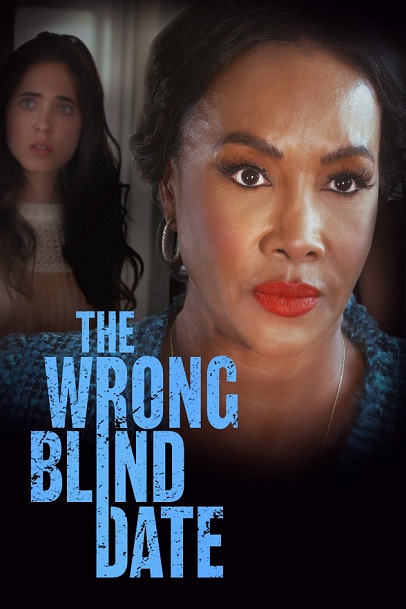
Lifetime Film Review: The Wrong Blind Date (dir by David DeCoteau)


“Looks like he was the wrong blind date!”

You tell them, Vivica A. Fox!

The Wrong Blind Date is the latest of the Lifetime “Wrong” films.  Like all of the “Wrong” films, it was directed by David DeCoteau and it features Vivica A. Fox delivering the film’s title.  It may seem somewhat silly to those who don’t regularly watch these films but, if you’re a fan of the “Wrong” series, you will literally sit through just about anything just for the chance to hear Vivica A. Fox say the movie’s name.  The film’s realize this too.  Lifetime films, at their best, are very self-aware.  None are as self-aware as the “Wrong” films.

In this one, Fox has a supporting role.  She plays Beth, who works as a therapist.  One of her patients is Laura (Meredith Thomas).  Laura has got a lot to deal with.  Her daughter, Hannah (Sofia Masson), has just started going to college and is dating Noah (Rainer Dawn).  Laura and her friend, Angela (Lesli Kay), are trying to launch their own design firm.  Laura is also in the process of getting a divorce from her husband, an abusive ex-cop named Michael (Clark Moore).  Michael is controlling and temperamental and he’s also determined to convince Laura not to go through with the divorce.

When Laura puts her profile on a dating website, she’s shocked by the number of replies that she gets.  One of those replies is from Kevin (Matthew Pohlkamp).  Kevin is handsome and charming and he lives in Beverly Hills.  He lists his job as investment banking.  Kevin has money and he’s so interested in Laura that he even finds a way to contact her after she deletes her dating profile!  At first, Laura thinks that Kevin’s behavior is a little stalkerish but then she agrees to go on one date with him.  And that one date leads to another and then another and then….

But wait a minute!  This is a Lifetime film!  Even more importantly, this is a “Wrong” film.  Those of us who have spent years viewing these movies know better than to trust any perfect man who claims to be wealthy.  Laura may not realize that there’s obviously something sinister about Kevin but we do!  Unfortunately, Laura is so used to her husband acting like a jerk that she’s overly impressed when Kevin does things like refuse to pick a fight with an obnoxious drunk.  It’s only after Laura leaves that Kevin returns to the bar and beats the man up.

Yes, Kevin has some problems.  He’s the wrong blind date.  And it soon becomes apparent that he’s lying about who he is, where he lives, and what he even does for a living.  It’s not a spoiler to tell you that Michael has hired Kevin to fool his wife, all as a part of a rather silly plan to convince Laura to take him back.  But when Kevin starts to become obsessed with Laura, not even Michael can stand in his way.

These films are predictable but fun.  We all know better than to trust Kevin but that doesn’t make it any less enjoyable to watch as Hannah vainly tries to convince her mother that she needs to do a little more research into her new boyfriend’s background.  And, of course, there’s the murders.  There’s always a murder or two in a Lifetime film.  Mereidth Thomas and Sofia Masson are convincing as mother and daughter and Matthew Pohlkamp is credible whether being charming or unhinged.  And, of course, Vivica A. Fox says the name of the movie.  It’s Lifetime, what’s not to enjoy?
TV Review: The Walking Dead 11.9 “No Other Way” (dir by Jon Amiel)


Well, so much for The Reapers.

The Walking Dead‘s 11th season returned last Sunday.  As you can probably guess from the fact that it’s taken me until Friday to get around to watching and reviewing it, it didn’t exactly arrive with the type of fanfare that previously greeted every premiere of The Walking Dead.  Not to belabor a point that I’ve been making since this season began but it’s been a while since The Walking Dead was really a big deal.  It definitely had a good run, especially during the early seasons.  However, I don’t think anyone will deny that the later seasons have been frustratingly uneven.  Season 11 is the show’s last, though the future does hold the promise of Walking Dead movies and perhaps a Walking Dead anthology series.  The Walking Dead may be coming to an end but it’s definitely not dead yet.

When Season 11 started, it appeared that the majority of the episodes were going to center around the Alexandrians battling The Reapers.  I wasn’t particularly looking forward to that, as the Reapers weren’t really that interesting.  Beyond all of the babbling about religion, there wasn’t that much to separate them from The Whisperers or the Saviors.  So, as you can imagine, I was happy that this episode featured what appeared to be the nearly complete and total destruction of the Reapers.  Maggie and her group ruthlessly and systemically destroyed every Reaper that they came across, with the exception of Leah.  Gabriel killed a sniper, which leads me to wonder why Gabriel still wears his collar when its obvious that it means nothing to him.  Negan watched as Maggie killed every Reaper that she saw and he wisely decided that it was probably time for him to head off on his own before Maggie got around to killing him.  Indeed, the interesting thing about Maggie is that we really only cheer for her because we know her and we’ve been conditioned to be on her side.  She’s just as ruthless as the show’s bad guys and she uses the exact same justifications that were previously used by everyone from The Governor to Negan to Pope.  Even the fact that she’s mourning Glenn doesn’t really make her all that different from those she’s attacked.  In the world of The Walking Dead, everyone has lost someone.

(And really, it was pretty much Rick’s fault that Glenn died.)

Meanwhile, Alexandria was hit by a violent storm and a walker invasion but, as usual, everyone there managed to survive.  Afterwards. Maggie, Darryl, and the gang finally returned home.  However, also approaching Alexandria were Eugene and the Commonwealth.

The show then jumped forward 6 months.  Maggie was still in charge of Alexandria but it was impossible not to notice that Alexandria no longer looked as clean and peaceful as it once did.  Surrounding the town were the soldiers of Commonwealth.  And leading the soldiers was …. DARYL DIXON!

Now, that is an effective cliffhanger!

So, what’s going on here?  Is this yet another case of Daryl going undercover (booo!) or has Daryl truly changed sides?  I’m hoping that he actually did change sides, just because the whole undercover Daryl thing has been done to death and I think that Maggie and Darryl have a more interesting dynamic as rivals than as allies.  Given the history of the characters, it’s easy to imagine a scenario where Daryl might chafe at Maggie’s leadership style.  Or perhaps Darryl truly believes that the Commonwealth is offering up a better society than what’s going on at Alexandria.  I mean, honestly, Alexandria does require a bit of commitment on the part of its citizens.  I probably would chose not to live in Alexandria.

So, which is it?  Is Daryl a friend or a foe?  We’ll find out over the upcoming weeks!

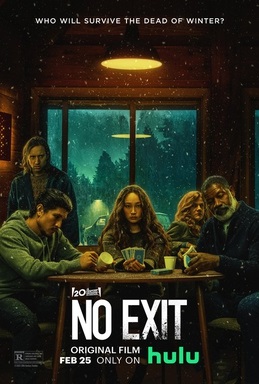
Film Review: No Exit (dir by Damien Power)


After she learns that her mother is in the hospital and possibly on the verge of death, Darby (Hannah Rose Liu) breaks out of drug rehab, steals a car, and starts driving to Salt Lake City.  However, what Darby doesn’t know is that she’s also driving straight into a blizzard.  Soon, Darby is forced to take shelter at a nearby state park visitors center.

Darby isn’t the only person seeking shelter that night.  There’s a married couple, Ed (Dennis Haysbert) and Sandi (Dale Dickey).  Ed is a veteran of the Marine Corp while Sandi is a nurse.  There’s Ash (Danny Ramirez), who has the friendliest smile to ever be seen in the middle of a blizzard.  And then there’s Lars (David Rysdahl), who is distinguished by his long hair and his nervous mannerisms.  When Darby first enters the visitors center, Lars is curled up in a corner and loudly snoring.

And then there’s Jay (Mila Harris).  Jay is a child who happens to be bound and gagged in one of the vehicles parked outside.  When Darby discovers her, she has to not only save the child’s life but also figure out which one of the people in the visitors center is responsible for kidnapping her.

Clocking in at a brisk 90 minutes, No Exit is full of twists and turns.  I’ll do my best to keep spoilers to a minimum in this review.  Not all of the film’s twists work, of course.  There’s a few moments that, in hindsight, didn’t exactly make sense.  After watching the film, you could spend hours debating why certain characters did the things that they did, assuming that you were so inclined and that you could actually find anyone else willing to sit through your analysis.  However, the film itself is so quickly paced and well-directed that it doesn’t matter that the story itself is occasionally a bit implausible.  From the minute Darcy breaks out of that rehab, the film captures the viewer’s attention and it doesn’t let go until the final credits start to roll up the screen.  This is an entertaining B-movie, one that makes good use of its isolated location and its talented cast.  Havana Rose Liu especially deserves a lot of credit for her sympathetic lead performance as Darby.  Darby is a cynic and a survivor but she still has enough humanity inside of her to risk her life for a stranger.

The film looks great, with its scenes of cars driving through the raging snow storm and the film’s cast gathered in the somewhat tacky visitors center.  All of the snow falling reminded me of i’m thinking of ending things and I have to admit that a part of me kept expecting there to be some sort of a metaphysical twist towards the end of the film.  I found myself wondering if the visitors center would be revealed to be Hell, which wasn’t a totally outlandish idea when one considers that the film shares the same name as Sartre’s famous play.  But no, No Exit is a thriller that deals with concerns that are very much earthbound.  It’s an well-executed thriller and an entertaining way to spend 90 minutes.  It can currently be viewed on Hulu.

International Film Review: Don’t Kill Me (dir by Andrea De Sica)


Don’t Kill Me, an Italian film that is currently available on Netflix, opens with two teenagers in a car.  Robin (Rocca Fasano) is driving.  His girlfriend, Mirta (Alice Pagani), is in the passenger’s seat.  Robin is driving fast and erratically.  In fact, he nearly crashes the car more than a few times.  This is because Robin is driving with his eyes closed, forcing Mirta to shout directions at him.  It’s almost as if Robin wants Mirta to come to a violent end.

Eventually, they end up in a quarry.  Having taken a break from attempting to crash the car, Robin wants Mirta to take a drug with him.  Mirta’s never tried the drug before.  She’s nervous, even though Robin assures her that it will be a wonderful experience.  Mirta finally agrees but requests, “Please don’t kill me.”

Yeah, good luck with that.

Of course, Mirta dies.  Mirta’s body is sealed up in her family’s vault.  A few hours after the funeral, a very confused and angry Mirta smashs her way out of the vault.  Dazed, she wanders back to her old house.  She’s definitely not alive but she’s not completely dead either.  Instead, she is one of what the film calls “the Overdead.”  She’s nearly immortal.  At one point, she gets shot several times and, while it’s not a pleasant experience, it also doesn’t come anywhere close to killing her.  She still has her memories of what life was like before she died and, to judge from the other members of the Overdead who she meets, it appears that she won’t ever age.  Unfortunately, being one of the Overdead also means that if she doesn’t regularly drink the blood of the living, she’ll start to decay.  Starvation is the only way to destroy a member of the Overdead.  There’s a secret group of men who have spent centuries tracking down and starving the Overdead.  Those men are soon chasing after Mirta.

Don’t Kill Me is at its strongest during its first half, when the film skips through time and the emphasis is on atmosphere and ennui.  The scene where Mirta breaks through the crypt carries hints of Jean Rollin’s Living Dead Girl and, much like Rollin’s best films, the first half of Don’t Kill Me often focuses on both the importance and the mystery of how we recall things.  Meanwhile, the scenes of Mirta wandering through the countryside and prowling the clubs for food are reminiscent of Jess Franco’s Female Vampire.  The first half of the film feels like a tribute to the wonderful Eurohorror of the past.  Unfortunately, the film starts to lose its way once Mirta is captured by the secret society that’s trying to destroy her.  In its second half, it just becomes another film about escaping from a military base.  Don’t Kill Me is based on a YA novel and it’s obviously meant to be the first in a series of films about Mirta’s life as one of the Overdead.  As a result, the film’s ending is a bit unsatisfactory.  For all the build-up, it sputters to a “to be continued” style conclusion.

That said, there was enough that worked about Don’t Kill Me that I’m willing to forgive what didn’t work.  I may be alone in that as most of the online reactions that I’ve seen towards this film have been overwhelmingly negative.  Well, so be it.  There was enough atmosphere to keep me interested.  Alice Pagani gave a pretty good and sympathetic performance as the conflicted Mirta and Fabrizio Ferracane, as the man determined to capture and starve her, was enjoyably villainous.  Don’t Kill Me may not be for everyone but it worked for me.

TV Review: Pam & Tommy 1.6 “Pamela in Wonderland” (dir by Hannah Fidell)


Yes, I’m still reviewing this.

If the earlier episodes of Pam & Tommy seemed to owe a huge debt to the aesthetic of Ryan Murphy, the latest episode feels more indebted to the style of Aaron Sorkin.  The entire episode centered around Pam testifying at a deposition.  While being asked increasingly intrusive and sexist questions about her career as a model and how she and Tommy came to make the infamous the sex tape, Pam flashed back to her past.  We saw how she was discovered at a Canadian Football game and how she eventually ended up up posing for Playboy.  Hugh Hefner (played by Mike Seely) showed up, wearing his stupid red robe, and puffing away on his pipe.  In typical Sorkin rip-off fashion, the episode featured the attorneys asking a lot of questions and the only person of color to be seen was the unnamed court stenographer whose only line of dialogue was to briefly give Pam some encouragement.

Compared to the other episodes of Pam & Tommy, Pam In Wonderland actually worked fairly well.  It helped that it largely focused on Lily James, whose performance as Pam is probably the strongest thing that this show has going for it.  This is the second episode in a row not to feature the character of Reed Gauthier and the show was definitely better off without his presence and the attempts to somehow convince us that there’s any reason to portray him as being a sympathetic character.  With no Reed and Tommy reduced to appearing in flashbacks, this was the first episode that was fully told from Pam’s point of view and, when the attorneys suggested that Pam was somehow to blame for what had happened because of her past as a model or just the fact that she allowed herself to be filmed in the first place, every woman watching could relate to what Pam was going through because we’ve all heard the same condescending tone and we’ve all been told that somehow, the bad things that happen to us are actually our fault.  Lily James did a wonderful job of portraying Pam’s struggle to keep smiling and just get through the worst day of her life.  I knew what she was going through.  Again, Lily James is the best thing that this show has going for it.

And yet, I have to be honest that I still found myself wondering just what exactly the overall point of the show is.  For all of the episode’s strong points, it’s still hard to see why this story needs to be told as an 8-hour miniseries as opposed to a 90-minute film on FX.  The first three episodes did a good job of fitting this story into the early days of the Internet and the culture of the late 90s.  But the subsequent episodes haven’t added much to that initial impression.  It’s also worth noting that Pam herself has repeatedly distanced herself from the program and said, even before the show started shooting, that she didn’t want anything to do with it.  One could argue that, as a show, Pam & Tommy is as intrusive and exploitive as the attorneys at the disposition.  With each new episode, it become difficult to deny that this is a show that seeks to exploit the very same thing that it claims to be condemning.

One final thought on this episode and culture in general: how did people not realize that Hugh Hefner was creepy as Hell before he died?  Today, of course, A&E is airing an entire TV series dedicated to exploring what an asshole Hugh Hefner actually was.  But, just 11 years ago, Hefner was still being portrayed as some lovable old lothario in a sailor’s cap.  NBC even tried to air a Mad Men-style show about how great life was at The Playboy Club.  Remember that?  Creepy old Hef even provided the narration at the start of the first episode.  Last night’s episode of Pam & Tommy presented Hef as being essentially a benevolent (if manipulative) father figure.  It felt oddly tone deaf, though that may indeed be how Pam herself saw the old man.

Seriously, though …. did no one ever tell him how stupid he looked in those red pajamas?

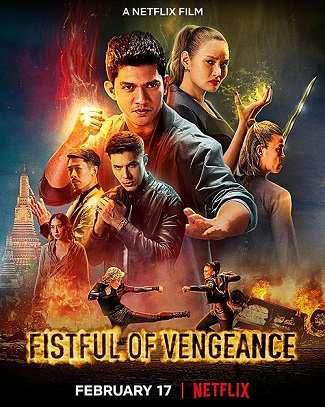
Film Review: Fistful of Vengeance (dir by Roel Reiné)


I just finished watching Fistful of Vengeance on Netflix.  The film has a running time of 95 minutes and I have to admit that I spent a good deal of the film in a state of confusion.  While some of that was undoubtedly due to my ADD, there are two other factors to consider:

First off, Fistful of Vengeance is based on a show called Wu Assassins.  (Wu Assassins is also available on Netflix.)  The movie takes place immediately after the end of the show’s first season.  At this point, I should go ahead and admit that I have never seen the show.  The movie does start with a quick recap of who everyone is and why they’re running around the world and fighting supernatural warriors and, from what I’ve read, the film itself is meant to be stand-alone work of entertainment.  That said, I’m sure it can be argued that my lack of knowledge of Wu Assassins effected my ability to actually follow the plot of Fistful of Vengeance.  If you’re a fan of the show, you should probably just watch the movie and ignore my review.

The second thing to consider about Fistful of Vengeance is that the plot really didn’t matter.  Yes, there’s a lot of people conspiring against each other.  Yes, there’s a lot of talk of talismans and spirits and monsters and ancient powers.  And, yes, there’s international cartels and magical warriors.  There’s a mystery to be solved, as Tommy (Lawrence Kao) and his friends try to track down the person or persons responsible for the death of Tommy’s sister.  New allies are found and a few surprisingly enthusiastic sex scenes are staged.  Enemies are fought and I assume that there’s a reason for it all.  However, when watching the film, it soon becomes obvious that all of that plot is just there as an excuse for the action and the glossy images.  Fistful of Vengeance is not plot-driven.  Instead, Fistful of Vengeance is driven by style.

And you know what?

There’s not a damn thing wrong with that.

Seriously, you don’t watch a film like this because you’re searching for the meaning of life or because you’re hoping for some form of greater enlightenment.  You watch a movie like Fistful of Vengeance because you want to see good-looking people wearing nice clothes and kicking ass.  One fight follows another and all you really need to know is that you want Kai Jin (played by action specialist Iko Uwais), Tommy, and their team to win.  You don’t really need to know who they’re fighting or why they’re fighting.  Instead, the appeal is watching the artistry of the kicks and the punches and the tossing of weapons.  Add in some monsters and some magical powers and a nice propulsive soundtrack and the movie pretty much has everything that an audience needs to be entertained.  It’s a big, glossy, colorful, and rather silly movie.  I had no idea what was going on for most of it but I still found myself watching.  It’s fun, it’s entertaining, and it really doesn’t demand much.  It’s not really a film that’s going to stick with you but watching it is also not terrible way to spend 95 minutes of your day.

Music Video of the Day: High by The Chainsmokers (2022, dir by Kid. Studio)


I have a long-standing fear of heights so the video for this song kind of freaks me out.

Whenever I’m on a plane, I find myself wondering what would happen if I somehow found myself plunging through the clouds.  I would hope that I would achieve a state of grace during the experience but …. well, it probably wouldn’t happen.  I’ve seen any number of shows that featured people skydiving.  Usually, it’s presented as being this great experience but it’s definitely something that I could go without.

James Bond, I will say, was a good sky driver.  Seriously, Bond could do just about anything back in the day.  That was before he got all whiny.  Oh well.

Don’t fall out of planes, everyone.  D.B. Cooper was a cool guy and he made a lot of money but he’s not a role model that one needs to emulate.

Enjoy!

Why? You only say you love me when you’re high
It’s like we go through the same shit every night
Oh why, oh why?
You always swear that it’s gonna change, but it never does
Why? You’ll only say you love me when you’re high
It’s like we go through the same shit every night
Oh why, oh why?
You always swear that shit’s gonna change, but it never does

Tell me that you’re gonna change
Then act like this instead
I’m too old to want somebody who’s always switching up their friends
I can’t make you love me but at least you could pretend
Scripts gonna leads to fifths until I’m fucked out of my head
You play the same old songs I know that you’re different in your Air Force Ones
Filling my prescription I could bite your tongue
Like I got an addiction yeah
You always say this shit’s gonna change, but it never does

Why? You only say you love me when you’re high
It’s like we go through the same shit every night
Oh why, oh why?
You always swear that it’s gonna change, but it never does
Why? You’ll only say you love me when you’re high
It’s like we go through the same shit every night
Oh why, oh why?
You always swear that shit’s gonna change, but it never does

I know it’s my fault I pick up your phone call
When it’s half past one and you’re halfway drunk
You say you love me and it sounds so dumb
But you’re the only one I can run away from the same old songs
I know that you’re different in your Air Force Ones
Filling my prescription I could bite your tongue
Like I got an addiction yeah
You always say this shit’s gonna change, but it never does

Why? You only say you love me when you’re high
It’s like we go through the same shit every night
Oh why, oh why?
You always swear that it’s gonna change, but it never does
Why? You’ll only say you love me when you’re high
It’s like we go through the same shit every night
Oh why, oh why?
You always swear that shit’s gonna change, but it never does

Film Review: Swan Song (dir by Todd Stephens)


Once upon a time, Pat Pitsenbarger (Udo Kier) was one of the most important citizens of Sandusky, Ohio.  He was the town’s leading hairdresser.  He was the man who the wealthy trusted with their appearance.  When he wasn’t cutting hair, he performed drag as Ms. Pat and when he wasn’t cutting or performing, he built a nice home with his partner.  He often remembers the two of them working in the garden.

All of that is in the past, though.  Pat’s partner died years ago and Pat was reminded of his place in the community when some of his wealthiest clients didn’t even bother to come to the funeral.  Pat lost his business.  He lost his home.  He’s spent the past decade or so living in a nursing home.  Pat may be the best-groomed and best-spoken resident of the nursing home but he’s still definitely a man who is waiting for death.

One day, a lawyer shows up at the home and informs Pat that one of his most faithful clients, Rita Parker Sloan (played by Linda Evans), has died.  Rita had one last request.  She wanted Pat to do her hair and makeup for the funeral.  At first, Pat is hesitant.  His memories of Rita are not particularly pleasant.  But finally, he decides to do it.  He escapes from the nursing home and starts to walk to the funeral home.  To do Rita’s makeup, he’s going to need supplies, some of which haven’t even been existed since the 80s.  Unfortunately, he has no money and, as he soon discovers, his old home no longer exists either.  The world has changed.

As quickly becomes clear, there’s more to Pat’s journey than just wanting a final chance to do Rita’s hair.  As he walks through the town, he tries to reconnect with his past, just to discover that much of his past has been torn down.  His old beauty shop is under different management.  His old house has been torn down.  Few people seem to remember or recognize him.  One of the few people who does remember Pat is his former protégé, Dee Dee (Jennifer Coolidge), who now basically hates his guts.  Meanwhile, Rita waits in the funeral home, her hair and makeup a mess.

Released last year, Swan Song is an imperfect but ultimately touching movie.  The shadow of death hangs over almost every scene.  It’s not just that Pat is doing one last favor for the deceased Rita.  Nor is it just that Pat is haunted by memories of his dead partner.  (The scene where Pat visits his grave is one of the most effective in the movie, thanks to Kier’s heartfelt performance.)  It’s the fact that Pat himself knows that he’s getting older and he only has a certain amount of time left.  His walk across Sandusky is not just about traveling to the funeral home.  It’s also his final chance to see the world, remember the past, and experience how things have changed (or not changed as the case may be).  The journey is about Pat coming to terms with his anger, his sadness, and his past.  It’s also about Pat’s desire to go out the same way that he’s always lived, on his own terms.

As I said, it’s not a perfect film.  There are a few scenes that threaten to get a bit mawkish.  But even the most overwritten scenes are saved by the brilliant lead performance of Udo Kier, who gives a wonderfully complex performance as Pat.  Since the 70s, Kier has been a mainstay in European exploitation cinema.  He stared in Flesh For Frankenstein and Blood For Dracula.  He had key supporting roles in two Dario Argento films.  He appeared in art films, horror films, dramas, comedies, and thrillers.  He’s appeared in blockbusters and small indie films.  At times, it can seem like Kier is one of those actors who basically accepts anything that’s offered to him, regardless of whether the material is worthy of his talents or not.  Kier has appeared in good films and bad and, perhaps because he’s been such a ubiquitous cinematic presence, he’s often been unfairly taken for granted as an actor.  In Swan Song, Udo Kier gives one of his best performances as the sometimes brutally snarky but ultimately kind-hearted Pat Pitsenbarger.  If for no other reason, watch this movie to appreciate the often underrated talent of Udo Kier.  A lesser actor would have turned Pat into a cliché.  Udo Kier transforms Pat into a complex and rather heart-breaking character.

Swan Song is currently streaming on Hulu.

Scenes That I Love: Jack Nicholson’s Freeway Performance in Bob Rafelson’s Five Easy Pieces


Today, the Shattered Lens wishes a happy 89th birthday to Bob Rafelson, who was one of the first directors to not only truly recognize the genius of Jack Nicholson but also one of the co-creators of the Monkees.  (In fact, Rafelson brought the Monkees and Nicholson together when he made his directorial debut with 1968’s Head.  The Monkees starred in the film while Nicholson wrote the script.)  After getting his start on television, Rafelson became one of the leading figures of the Hollywood counterculture that came to power in the late 60s and the early 70s and a business partner of producer Bert Schneider, Rafelson also played a role in the creation of such classic films as Easy Rider, The Last Picture Show, and Hearts and Minds.  Like Nicholson, Rafelson was never a hippie.  Instead, his vision was closer to the vision of Jack Kerouac and Neal Cassady.  Rafelson and Nicholson brought the sensibility of the Beat Generation to Hollywood and, for a while at least, they changed the face of American culture.

In honor of Bob Rafelson’s birthday, today’s scene that I love comes from his 1970 film, Five Easy Pieces.  In this Oscar-nominated film, Jack Nicholson plays Bobby Dupea.  Born to a wealthy and music-obsessed family, Bobby currently works in an oil field and is alternatively angry, cynical, and idealistic.  (That both the main character and the director shared the same first name is probably not a coincidence as Rafelson also came from an artistic family.  Though many of Bobby’s famous outbursts — especially the famous one involving a chicken sandwich — were based on things that had actually happened to Nicholson, the character was equally based on Rafelson.)  After Jack Nicholson’s Oscar-nominated turn in Easy Rider, Five Easy Pieces featured Nicholson playing the type of role for which he would be best-known in the 70s, the wayward rebel who must choose between being a part of society or being forever an outcast.  

In this scene, Bobby and his oilfield co-worker find themselves stuck in a traffic jam.  Bobby gets a chance to show off both his temper and his talent.  It’s a great scene and Nicholson gives such a strong performance that it’s only later that you realize that Bobby’s anger didn’t really accomplish much.  That was a recurring theme in Nicholson’s early films.  With this scene, Bob Rafelson captures both a man and a country in conflict.

Five Easy Pieces would be nominated for Best Picture, though it would lose to Patton. After his supporting nomination for Easy Rider, Nicholson received his first best actor nomination for this role here. (Again, Patton triumphed, though George C. Scott famously refused to accept his Oscar.) Sadly, Bob Rafelson was not nominated for Best Director.

Equally sadly, Rafelson’s subsequent films received mixed reviews (though most have been positively reevaluated in recent years) and struggled at the box office. With Hollywood becoming more concerned with finding the next blockbuster than producing films about existential wanderlust, Rafelson often struggled to bring his vision to the screen. He hasn’t directed a film since 2002’s No Good Deed. However, his work lives on amongst serious film students and historians of the 70s. If any director’s work is worthy of rediscovery and reevaluation, it’s Bob Rafelson’s.