A Loyalty Day Film Review: My Son John (dir by Leo McCarey)


Oh my God, did you know that it’s Loyalty Day!?

Well, actually, it’s not Loyalty Day for everyone.  In fact, a lot of the world’s citizens are celebrating Communist May Day today.  However, here in the United States, it’s Loyalty Day.  Even if you are an American, it’s possible that you’ve never heard of Loyalty Day.  It was first celebrated in 1921 and it was intended to provide a non-Communist alternative to International Workers Day.  It wasn’t until 1955 that Loyalty Day was officially recognized by Congress.

From Wikipedia:

Loyalty Day is defined as follows in 36 U.S.C. § 115:

  • (a) Designation.— May 1 is Loyalty Day.
  • (b) Purpose.— Loyalty Day is a special day for the reaffirmation of loyalty to the United States and for the recognition of the heritage of American freedom.
  • (c) Proclamation.— The President is requested to issue a proclamation—
    • (1) calling on United States Government officials to display the flag of the United States on all Government buildings on Loyalty Day; and
    • (2) inviting the people of the United States to observe Loyalty Day with appropriate ceremonies in schools and other suitable places.

Though released before it officially became a holiday, the 1952 film, My Son John, is perfect for Loyalty Day.
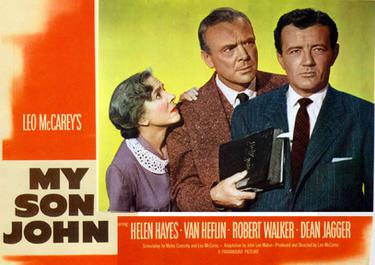
The John of the title is John Jefferson (Robert Walker, in his final role), an employee of the State Department.  While his younger brothers (played by Richard Jaeckel and James Young) are two high school football stars who are looking forward to serving their country in Korea, John is an intellectual who considers concepts like patriotism to be simplistic and naive.  While his father (Dean Jagger) sings patriotic songs at the American Legion hall, John rolls his eyes at such middle class activities.  (“If you don’t like your Uncle Sammy,” move to another country, John’s father sings.)  The only person to whom John is especially close is his nervous mother, Lucille (Helen Hayes).

However, John is keeping a secret from even Lucille.  He’s a double agent, working for the communists!  With FBI agent Stedman (Van Heflin) hot on his trail, will John ever be able to see the light about the communists?  And, how will the communists respond to John having doubts about the cause?

My Son John was a dream project for Hollywood director Leo McCarey.  (It’s not a coincidence that the devoutly Catholic McCarey made a film about a devoutly Catholic family who discovers that one of their own has become a communist.)  McCarey carefully supervised every detail of the film and he was even able to talk stage legend Helen Hayes into starring in the film, her first in 14 years.  My Son John is full of scenes of shadowy communists, smug intellectuals, and all-American FBI agents marveling at the strength of Lucille Jefferson’s faith.  Everything that is today often cited as a negative aspect to living in the suburbs is presented as being a positive in My Son John.  The film’s communists come into a world of happy families, big houses, and well-manicured lawns and they set out to make everyone else as miserable as they are.  There’s nothing subtle about either McCarey’s approach or Helen Hayes’s performance but, as is often the case with propaganda, the film is crudely effective.

My Son John was Robert Walker’s final film.  In fact, he died before completing work on the film, leading the ending being rewritten.  (No longer would John personally deliver a commencement address.  Instead, his words come out of a tape player that has been rolled out on stage.  A holy light shines down on the player while The Battle Hymn of the Republic plays in the background.  It’s bizarre but it’s also probably the most memorable part of the movie.)  Scenes from Strangers On A Train were rather awkwardly spliced into final moments of My Son John, never mind the fact that Robert Walker’s gleefully evil performance as Bruno Antony had little in common with his self-tortured performance as John Jefferson.

Surprisingly, considering that My Son John was released at the height of the anti-Communist era, the film was not a success at the box office.  (Audiences seemed to better appreciate low-budget and pulpier anti-communist films, like I Was A Communist For The FBI.)  Still, thanks to the Internet, My Son John is still available to be viewed on this Loyalty Day.

So, remember — if you don’t like your Uncle Sammy …. well, actually, the cool thing about this country is that you don’t have to like your Uncle Sammy.  You have the right to decide for yourself how you feel about old Uncle Sammy.  That’s an idea that is worth being loyal to.
A Blast From The Past: Dragnet 1968 3.1 “Public Affairs: DR-07” (dir by Jack Webb)


May 1st is a day of many holidays, including Law Day.

President Dwight D. Eisenhower first proclaimed May 1st to be Law Day in 1958 and apparently, it’s been celebrated every year since.  On Law Day, Americans are meant to reflect on the role of law in the foundation of the nation and also consider its importance to the social order.

To observe this year’s Law Day, I’m happy to present our readers with my favorite episode of Dragnet 1968.  

Dragnet began as a radio program in 1949 before making it’s way over to television in 1951. Each episode starred (and the majority were directed by) Jack Webb, who played a no-nonsense cop named Joe Friday. Friday narrated every episode, dropping trivia about the history of Los Angeles while also showing viewers how the cops went about catching criminals. Despite what is commonly believed, Joe Friday never said, “Just the facts, ma’m,” but he did investigate each case with the cool determination of a professional who kept his emotions under control. The majority of Dragnet’s episodes were based on actual cases that were worked by the LAPD, hence the opening declaration of, “The story you are about to see is true.”

On television, Dragnet originally ran from 1951 to 1959, during which time Dragnet also became the first television series to be adapted into a feature film. Jack Webb decided to relaunch Dragnet in 1966 and he produced a made-for-television movie that followed Friday and his latest partner, the far more talkative Bill Gannon (Harry Morgan), as they worked multiple cases over the course of one long weekend.  That made-for-television movie led to a series that ran from 1967 to 1970.

The second television series is the best-remembered version of Dragnet, beloved for its scenes of Friday and Gannon debating the issues with a motely collection of hippies, campus radicals, and pipe-smoking academics.  Jack Webb viewed Friday as being the voice of the common American, who supported the troops, supported the president, and who wanted to spend the weekend grilling in peace.  Friday was the middle-aged suburbanite who wanted to the kids to stay off the grass, whether it was on his front lawn or being sold on a college campus.  These episodes were often campy.  It’s hard not to smile while listening to Friday and Gannon deadpan their way through conversations with flakey long-haired hippies.  It was often obvious that the writers of Dragnet had never actually had any experiences with the hippies, beyond what they saw on the evening news.  And yet, as silly as things often were, the show is an interesting time capsule of the time in which it was made.  If nothing else, it’s a chance to see the 60s through the eyes of the other side.

My favorite episode was the show’s third season premiere.  It originally aired on September 19th, 1968 and it features Joe and Gannon appearing on a talk show.  The subject of the show: “The Fuzz Who Needs Them?”  Joe and Gannon argue on behalf of the fuzz.  Appearing on the other side of the panel are a pipe-smoking academic (Stacy Harris) and the publisher (Howard Hesseman, credited as Don Sturdy) of an underground newspaper.  Questions are asked from the audience.  John Dietz (played by Lou Wagner, who also plays Harlan Arliss on CHiPs) wants to know why drug are illegal.  Mondo Mabamba (Dick Anthony Williams) wears blue glasses and demands to know why the cops are always sitting in squad cars.  Overseeing the show is the evil Chuck Bligh (Anthony Eisley).  Friday struggles to hold back his disgust as the newspaper publisher throws a “Make Love Not War” pin at him.

This an interesting episode, if just because both sides are allowed to make their case and, in a rarity for Dragnet, neither Friday nor Gannon change anyone’s mind.  On the one hand, the academic and the publisher are both portrayed as being fairly obnoxious.  On the other hand, Howard Hesseman delivers his lines with such sharpness that his character cannot be as easily dismissed as the usual Dragnet hippie.  Chuck Bligh’s talk show predicts the political panel shows of today and it’s interesting to see how we’re still debating many of the same issues that were raised in this episode.

Here is today’s Blast From The Past:

Song of the Day: All Time High, performed by Rita Coolidge


Today, the Shattered Lens wishes a happy birthday to recording artist Rita Coolidge!

Rita Coolidge, who rose from being a backing singer to being a successful headliner in her own right, sung my favorite James Bond theme song, All Time High from Octopussy.

(Not surprisingly, this was a rare care of the Bond film’s title not being used in the theme song.)

I love this song and not just because it’s one of the few that I can actually sing.  As performed by Coolidge, this song captures the romance, mystery, and fun that epitomized the Bond franchise before Daniel Craig came along and turned James Bond into a sexless, weepy loser.

It only seems appropriate to make All Time High today’s song of the day!

All I wanted was a sweet distraction for an hour or twoHad no intention to do the things we’ve doneFunny how it always goes with love, when you don’t look, you findBut then we’re two of a kind, we move as one
We’re an all-time highWe’ll change all that’s gone beforeDoing so much more than falling in loveOn an all-time highWe’ll take on the world and winSo hold on tight, let the flight begin
I don’t want to waste a waking moment, I don’t want to sleepI’m in so strong and so deep, and so are youIn my time, I’ve said these words before, but now I realizeMy heart was telling me lies, for you, they’re true
We’re an all-time highWe’ll change all that’s gone beforeDoing so much more than falling in loveOn an all-time highWe’ll take on the world and winSo hold on tight, let the flight begin
So hold on tight, let the flight beginWe’re an all-time high
(Songwriters: Tim Rice and John Barry)

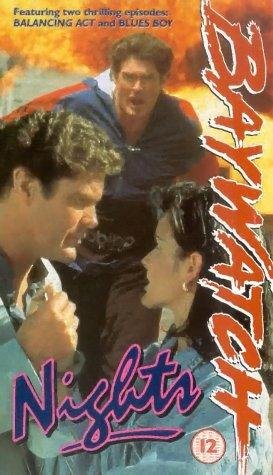
Late Night Retro Television Review: Baywatch Nights 2.2 “The Creature”


Welcome to Late Night Retro Television Reviews, a feature where we review some of our favorite and least favorite shows of the past!  On Tuesdays, I will be reviewing Baywatch Nights, a detective show that ran in Syndication from 1995 to 1997.  The entire show is currently streaming on You tube!

Mitch, Griff, and Ryan search for an amphibian hybrid.

Episode 2.2 “The Creature”

(Dir by David W. Hagar, originally aired on October 6th, 1996)

The Creature of the title is a young blonde woman (played by Shelli Lether) who has spent her entire life locked away in a secret lab.  One night, a security guard decides that he wants to get to know The Creature better.  The Creature responds by killing both him and his co-worker.  She escapes from the lab, running into the California night.

Mitch and Ryan are brought to the lab by the mysterious Diamont Teague, who explains that he’s not sure what was going on at the lab but whatever was housed in the building has escaped.  Mitch leaves to track down the Creature.  (He recruits Griff to help him out.)  Meanwhile, Ryan stays at the lab and looks through magnifying scopes and studies slides and computer read-outs and eventually, she figures out that the lab was the focus of a DNA experiment.  The creature is half-amphibian and half-human.

“Can we do that?” Mitch asks when Ryan calls him.

“Apparently so,” Ryan calmly replies.

(Seriously, Ryan’s so cool.)

It also turns out that Mitch and Griff are not the only people who are searching for the Creature.  There are also a group of soldiers that are determined to track down the Creature, destroy it, and cover up the fact that it was created in the first place.  Mitch, needless to say, is not happy about that.  Mitch is a lifeguard and, as a lifeguard, he believes in guarding every life, even the life of a humanoid amphibian who murders anyone who approaches her.

And, if this was Baywatch, Mitch probably would have saved the Creature.  But this is Baywatch Nights and the night is darker than the day.  The Creature gets blown up in a tunnel but it appears that all of the soldiers get blown up with her.  Take that, Feds!  As for Mitch, he gets out of the tunnel just in time and makes a slow motion jump as the explosion erupts behind him.  A chastened and mournful Mitch then announces that he’s going home as the sun rises over the horizon.  Hey, Mitch — don’t forget to call Ryan and let her know that she can leave the lab.

After last week’s disappointing second season premiere, The Creature is the first classic episode of Baywatch Nights‘s supernatural season.  The action moves quickly and through multiple locations.  (The Creature may not know much about the world but she’s still drawn to a club.)  The story is ludicrous enough to be entertaining.  Shelli Lether is surprisingly sympathetic as the murderous Creature.  Even Hasselhoff throws his heart into his attempts to convince the soldiers not to destroy the Creature.  This episode was fun and dumb in a very likable way.

Next week, Mitch battles another sea monster!

The Films of 2024: Miller’s Girl (dir by Jade Halley Bartlett)


Halfway through Miller’s Girl, I yelled “SHUT UP!” at my television.

I wasn’t shouting at a specific person in the film or because I had heard something that I found to be morally offensive.  I was just shouting at the movie in general.  Miller’s Girl is a film about people who talk nonstop, despite not really having anything interesting or new to say.  It’s a film about smart people but it doesn’t so much capture the way that smart people sound as much as it captures a dumb person’s idea of what it’s like to sound smart.  All of the dialogue is so calculated and so overwritten and so mind-thuddingly obvious, I was tempted to mute the film.  But then I’d just be stuck looking at the images and the images weren’t that interesting either.

The Miller of the title is Jonathan Albert Miller (Martin Freeman), a writer who once published a short story collection called — *snicker* — Apostrophes and Ampersands.  (Again, this is the type of title that someone who has never actually read a book would consider to be clever.)  Miller hasn’t written anything since he married wife, Bitchy McBitchface (played by Dagmara Domińczyk).  Actually, her name is Beatrice and she spends most of her time drinking and reminding Mr. Miller that he’s a failure.

Mr. Miller teaches a creative writing class at a high school in Tennessee.  He enjoys sharing a smoke and a cup of coffee with his best friend, Coach Boris Fillmore (Bashir Salahuddin).  Even though Fillmore is a coach, he speaks in the same overwritten and florid dialogue as everyone else in this film because God forbid anyone sound like an individual.  Mr. Miller finds himself becoming obsessed with one of his students, Cairo Sweet (Jenna Ortega).  But Cairo, it turns out, might just be manipulating Mr. Miller so that she can use her experience of being seduced by a teacher for her admissions essay to Yale.  Meanwhile, Cairo’s friend, Winnie (Gideon Adlon, giving the best performance in the film), longs for Cairo.

The script for this film ended up on the 2016 Black List, which is the annual list of the “best unproduced scripts” in Hollywood.  It’s amazing how many truly mediocre films have first gained attention by having their script included in the Black List.  Cedar Rapids, The Beaver, Broken City, The Promotion, Dracula Untold, St. Vincent, The Judge, Money Monster, Boston Strangler, The Mother, and now Miller’s Girl are all Black List films that went into production.  Perhaps the film’s overwritten and overly arch dialogue seemed brilliant on the page but when it’s actually recited out loud, it just sounds like everyone involved is trying too hard to sound like an intellectual.  Eventually, you find yourself longing to hear just one line that might convey some sort of genuine emotion as opposed to empty posturing.  In a moment of unintentional hilarity, Miller masturbates while reading one of Cairo’s stories.  The film makes the mistakes of including Cairo reading the story in voice-over, revealing that Cairo is not only a terrible writer but that Miller will basically jerk off to anything.

Jade Halley Bartlett not only wrote the script but also makes her directorial debut and gives the film a flat visual style to go along with the intellectual emptiness of it all.  This cast is full of talented people but Jenna Ortega, who has been so good in other movies and shows, is miscast as a femme fatale and Dagmara Dominczyk’s attempt at a Tennessee accent will bring to mind cats mating in an alley.  Gideon Adlon is the only member of the cast who makes you believe that her character has a life outside of the requirements of the script.

I really thought there was no way I would see a film worse than Mea Culpa this year but Miller’s Girl has proven me wrong.

Retro Television Review: Fantasy Island 4.23 “Man-Beast/Ole Island Opry”


Welcome to Retro Television Reviews, a feature where we review some of our favorite and least favorite shows of the past!  On Tuesdays, I will be reviewing the original Fantasy Island, which ran on ABC from 1977 to 1984.  Almost the entire show is currently streaming on Daily Motion.

This week, we learn something new about the Island.

Episode 4.23 “Man-Beast/Ole Island Opry”

(Dir by George W. Brooks, originally aired on May 16th, 1981)

Did you know that Fantasy Island is home to a world-famous country music venue?

Yes, I’m talking about the Ole Island Opry!  Operated by Lottie McFadden (Anne Francis), the Ole Island Opry is a mainstay of the Island, even though it’s never been mentioned before.  Lottie says that everyone from Charley Pride to Hank Williams to Dolly Parton has played at the Ole Island Opry.

If you’re anything like me, you’re saying, “What the heck?”

I mean, seriously, why have we never heard of this place before?  How many country music fans live on the Island?  Why would established artists be so eager to play at a venue that’s sitting on an isolated island?  And how big is this Island anyway?  With the fishing village, the native villages, the downtown area that we see sometimes, the children’s side of the Island, the ancient castles, the isolated mansions, the Ole Island Opry, and all the magical portals, Fantasy Island has got to be at least the size of New Zealand.

These questions go unanswered, as usual.  Instead, the episode focuses on Charlie Rowlands (Jimmy Dean), who was an up-and-coming country music star until his wife died and he gave up stardom to raise his daughter, Jennie (Wendy Schaal).  Charlie is an old friend of Lottie’s and his fantasy is for Jennie to make her singing debut at the Ole Island Opry.

What Charlie doesn’t know is that Jennie has a fantasy of her own.  She wants her father to stop pressuring her to become a singer so that she can focus on her love of photography!  Mr. Roarke is able to grant both fantasies.  Jennie sings but is really bad and her father finally realizes that she’s not meant to be a country-western star.  Instead, Jennie asks her father to come up on stage and sing a song.  Charlie sings King of the Road and, despite being a bit older than the usual up-and-comer, he gets a recording contract.  He also wins the love of Lottie, who leaves the Island with him.  As for Jennie, she can now attend a Yankee art school without feeling guilty.  Yay!

Jimmy Dean gave a charming performance but otherwise, this fantasy was just silly.  Perhaps it would have worked if Charlie and his daughter had stepped into the past and found themselves in Nashville in the 40s but having Jennie make her debut (and farewell) at the “Ole Island Opry” just required a bit too much of a suspension of disbelief.  As well, Mr. Roarke has a habit of combining people’s fantasies without giving them any advance warning.  It always seem to work out okay but I still think Mr. Roarke is lucky that he hasn’t gotten sued by a guest who didn’t want to share their fantasy with anyone else.

The other fantasy featured David (David Hedison) and Elizabeth Tabori (Carol Lynley) coming to the Island in an attempt to cure David of a recurring nightmare that he’s been having, one in which Elizabeth and he are in a dark cave and Elizabeth is terrified of something.  Mr. Roarke quickly deduces that David is a werewolf.  David can be cured by a very rare plant.  Unfortunately, it will take the plant a few days to arrive so David will have to survive two full moons on Fantasy Island.

As with most of this show’s horror-themed fantasies, this fantasy was simple but fun.  The werewolf makeup was pretty basic but David Hedison poured himself into the role of the tortured David Tabori.  Fortunately, the magic flower arrives just in time to curse David of his ancestral curse.

As David and Elizabeth leave, Tattoo says that David must have been crazy because werewolves don’t exist.  Suddenly, Tattoo realizes that he’s turning into a werewolf.  Roarke has a good laugh as the end credits roll.

This week was another uneven trip to the Island.  It’s interesting that, even with a werewolf on the loose, everyone still braved the night to attend the show at the Ole Island Opry.  Fantasy Island is a strange place and I wouldn’t have it any other way.

Late Night Retro Television Review: CHiPs 2.2 “The Volunteers”


Welcome to Late Night Retro Television Reviews, a feature where we review some of our favorite and least favorite shows of the past!  On Mondays, I will be reviewing CHiPs, which ran on NBC from 1977 to 1983.  The entire show is currently streaming on Freevee!

This week, we’ve got ourselves a convoy!

Episode 2.2 “The Volunteers”

(Dir by John Florea, originally aired on September 23rd, 1978)

After a high-speed chase causes a robbery suspect to crash his car into a chemical storage facility (which subsequently explodes), three truckers have to get their trucks full of chlorine gas to the next available facility.  Unfortunately, it’s a 170-mile drive over rough terrain and it’s a very hot day.  If the gas gets to hot, it’ll explode.  If It doesn’t get to the storage facility in time, it’ll explode.  In fact, it appears that just about anything can make chlorine gas explode.  Californians might love chlorine for their pool but they don’t want it in the air.

Getraer assigns Ponch, Baker, Baricza, and Jane Turner to escort the trucks to the facility.  Jane Turner (Rana Ford) is a new member of the highway patrol.  She drives a squad car and she’s the first woman and only the second black person who we’ve seen working for the highway patrol on this show.  She doesn’t really do much in this episode and, about halfway through, she breaks off from the main group to help deal with a highway pile-up.  For that matter, Getraer and Baricza end up vanishing as well.  As usual, it’s all on Ponch and Baker.

Despite the danger of a chemical spill killing the population of Los Angeles county, Ponch spends most of this episode trying to get laid.  The episode opens with him leering at a jogging stewardess (Anna Upstrom) and then bragging about how he has a date with her later that night.

“She doesn’t smoke, drink, or dance,” Ponch says.

“What are you two going to do?” Baker earnestly asks.

Ponch arches his eyebrow and grins.

But Ponch is soon distracted by one of the truck drivers, a woman named Robbie Davis (Katherine Cannon), who is quick to yell that not only can she drive a truck but she can vote as well.  Ponch arches his eyebrow and grins.  Baker gets in on the action by saying, “Prettiest little truck driver I’ve ever seen.”

Robbie’s father (Tige Andrews) and the other trucker (Sam Brodie) all totally think Robbie should hook up with Ponch but they’re still amused when, late in the episode, Ponch accepts a ride from a blonde in a convertible.  Ponch arches and eyebrow and grins as he gets in the car.  WE GET IT, PONCH!

It’s not easy transporting chlorine gas.  Along with rough desert terrain, there’s also a group of beer-drinking rednecks who drive by in a pickup truck and threaten to shoot one of the tanks.  All of that drunk driving leads to another multi-car pile-up.  For some reason, one of the vehicles in the pile-up was transporting a tiger, which promptly gets loose and enters a grocery store.  Ponch and Baker grab raw meat from the butcher’s station and use it to trick the tiger into entering an office.  After they shut the door, the owner of the store yells at them for wasting meat.  There’s also a town puts up a roadblock to keep the trucks from coming through because they don’t want chlorine gas getting into the air.  And then there’s an avalanche, which causes chlorine gas to leak out of Robbie’s truck, sending her to the hospital.

Considering everything that happens in this episode, it’s odd that it all feels rather boring.  The best episodes of CHiPs focus on fast motorcycles and beautiful scenery.  This episode featured slow-moving trucks and the desert.  Bleh.  I hate the desert.  This episode also featured a lot of interaction between Robbie, her father, and their friend.  In fact, they were so prominently featured that it wouldn’t surprise me if this episode was meant to be a backdoor pilot for a trucking show.  (This episode aired in 1978, which was a big year for trucker movies.)  But the Davis family just wasn’t that interesting.

This episode didn’t really capture my attention.  Hopefully, next week will see a return of fast bikes and nice scenery.

The Films of 2024: Mea Culpa (dir by Tyler Perry)


It’s another year and that means it’s time for another bad melodrama from Tyler Perry.

In Mea Culpa, Kelly Rowland plays Mea Harper, an Atlanta defense attorney who is hired to defend Zyair Malloy (Trevante Rhodes, delivering his lines with all of the passion of a first generation chatbot) against the charge that he murdered one of his many girlfriend.  Zyair is an artist, so he lives in a loft with an open elevator and a lot of mood lighting.  He’s been accused of not only murdering his ex but also using her blood and teeth in one of his paintings.  Protestors gather outside of a gallery showing his work and chant, “We hate Zyair!  We hate Zyair!”

Mea just happens to be the sister-in-law of Ray (Nick Sagar), the assistant district attorney who feels that prosecuting Zyair Malloy will be his ticket to the mayor’s office.  Mea’s entire family tells her that she needs to drop Zyair as a client and support her brother-in-law’s ambitions.  However, Mea doesn’t like her family.  Her cancer-stricken mother-in-law (Kerry O’Malley) is always talking how she wishes her youngest son had married someone else.  Mea’s husband, Kal (Sean Sagar), is a total wimp who doesn’t even have the guts to tell everyone that he lost his job and had to go to drug rehab.

Soon Zyair is hitting on Mea and trying to get her into his bed so that he can paint her.  Mea tries to resist but when she finds evidence that Kal has been going to a hotel with Ray’s wife, she gives in.  Except — uh oh! — it appears that there was a perfectly innocent explanation for the visit to the hotel!

Much like A Fall From Grace, Mea Culpa tries to be enjoyably sordid but it’s actually just dull.  You would think that, after 13 films, Perry would have finally learned something about both pacing and how to direct actors but Mea Culpa moves at a snail’s pace and it features some of the worst acting that I’ve ever seen.  The final third of the film features a few surprise twists but the plot also features so many unbelievable coincidences that even a crazy twist can’t save the film from being forgettable.

Tyler Perry is an interesting figure on the American pop culture landscape.  On the one hand, he’s a talented character actor.  One need only rewatch Gone Girl to see how good an actor Tyler Perry can be when he’s not directing himself.  And, as tempting as it may be, one should not discount the fact that his films and his television series have made a lot of money.  Despite what the critics might say, Tyler Perry does have an audience and apparently, he understands what they want.  Tyler Perry has also provided jobs and opportunities for blacks behind and in front of the camera.  Perry makes films featuring blacks playing something more than just the comedic relief or the best friend of a white person and, again, the importance of that should not be discounted.

On the other hand, Tyler Perry is a not-particularly imaginative director and a heavy-handed writer and Mea Culpa is more evidence of that.  As much as one might want to find something praiseworthy about him as a cinematic artist, the fact of the matter is that even Tyler Perry’s “good” films, like A Jazzman’s Blues, aren’t so much good as they’re just not quite as bad as usual.  Given his success and the struggle that blacks have faced trying to move up in the American film industry, I think that everyone would like for Tyler Perry to be a good director but he’s not.  He’s a good actor and a good businessman but as a director, Mea Culpa is all too typical of his output.

Retro Television Review: Miami Vice 2.12 “Phil the Shill”


Welcome to Retro Television Reviews, a feature where we review some of our favorite and least favorite shows of the past!  On Mondays, I will be reviewing Miami Vice, which ran on NBC from 1984 to 1989.  The entire show can be purchased on Prime!

The Vice Squad goes after Phil Collins!

Episode 2.11 “Phil the Shill”

(Dir by John Nicolella, originally aired on December 13th, 1985)

Switek and Zito call in sick so that they can go to the taping of a silly game show called Rat Race.  While Zito sits in the audience, Switek answers trivia questions about Elvis and competes in an obstacle course race with his spacey opponent (Emo Phillips).  Hosting the show is the very effusive and very British Phil Mayhew (Phil Collins).

As we already know, Switek knows everything about Elvis.  And he’s in better shape than Emo Phillips so, when it comes time for the obstacle course, he reaches and hits his buzzer first.  But Switek’s buzzer doesn’t go off.  Emo’s buzzer works and Emo proceeds to robotically recite a complex string of Elvis trivia.

To his horror, Switek realizes that the quiz show was fixed!

Switek and Zito decide that they want to take down Phil and reveal his con artist ways.  Unfortunately, for them, the rest of the Squad doesn’t care.  Crockett, in particular, is annoyed that Switek pretended to be sick to get a night off of work.  However, it then turns out that Phil has hooked up with Sarah MacPhail (Kyra Sedgwick), the girlfriend and business partner of Tony Rivers (Michael Margotta), a drug dealer that Crockett has spent months trying to set up.

It’s time to call in Izzy and have him pretend to be an interior decorator so that Phil can be tricked into throwing a party that can be attended by …. SONNY BURNETT AND RICO COOPER!  Listen, I know I mention that a lot but I just can’t let it go …. how are Sonny and Rico able to maintain their undercover identities when they’re constantly arresting major drug dealers and taking part in DEA busts?  How come it never occurs to the criminals that dealer Sonny Burnett might have something in common with cop Sonny Crockett?  Does no one ever notice that Sonny Burnett drives the same car and wears the same white suit as Sonny Crockett?

This was a bit of an odd episode.  It was obviously written so that Phil Collins (whose In The Air Tonight set the mood for the entire series) could play Phil Mayhew.  And while Phil Collins does not appear to have been an actor of amazing range, he still does a good job as the weaselly Phil Mayhew.  The Phil scenes are played for humor while the scenes with Tony Rivers definitely are not.  Tony is a violent sociopath who casually kills several people over the course of the episode.  Scenes of Switek pouting about the game show feel awkward when combined with scenes of Tony machine gunning two drug dealers.  Collins does a good job within his range and Michael Margotta is an energetic villain.  However, the best performance in this episode actually comes from Kyra Sedgwick, who does a great job as someone who eventually turns out to be just as ruthless and dangerous her boyfriend.

This is a fast-paced and energetic episode, one that moves quickly enough that the viewer doesn’t really have time to consider the oddness of Phil Mayhew getting involved with the same drug dealer that Crockett happens to be investigating.  Personally, I’m always happy when the members of the supporting cast get to do something more than just stand in the background.  Switek and Zito are a good team.

Late Night Retro Television Review: Degrassi Junior High 3.2 “Can’t Live With ‘Em: Part 2”


Welcome to Late Night Retro Television Reviews, a feature where we review some of our favorite and least favorite shows of the past!  On Sunday, I will be reviewing the Canadian series, Degrassi Junior High, which aired on CBC and PBS from 1987 to 1989!  The series can be streamed on YouTube!

The tragedy of Wheels continues.

Episode 3.2 “Can’t Live With ‘Em: Part Two”

(Dir by Kit Hood, originally aired on November 28th, 1988)

What a sad episode!

Much as with the previous episode, several storylines play out over the course of this episode.  For the most part, this episode is all about setting up the rest of the season.  Among the things that happen:

Lucy starts to hang out with Paul (Michael Blake), a student at Borden High and she stops hanging out with her best friend, L.D.

Arthur, who has taken to wearing a white scarf to school, finally admits to Yick that his family is rich and that he has been buying and selling stock in a company called Repco.  Yick responds by demanding that Arthur pay for their food when they go to the local diner.

Shane hears Spike talking to Liz about how much she misses having free time.  As soon as Spike gets home from school, she has to look after baby Emma while Spike’s mother goes to work.  Shane approaches Spike and says that he knows that she doesn’t want to talk to him but he’s still going to give her half of his allowance and get a part-time job to help her pay for a babysitter for Emma.

Nancy and Kathleen are still running for school president and getting aggressive in their campaigning.  Kathleen confesses to Melanie that she’s scared she’s going to lose.  Melanie points out that, even if she does come in second, Kathleen will still be Vice President.  Kathleen replies that she doesn’t want to be the second-in-command.  She wants it all.

(Kathleen is rarely portrayed sympathetically on this show but I totally related to how she felt.)

Scooter and Bartholomew Bond debate whether Superman is better than Spider-Man.

Even with all that going on, this episode is dominated by Wheels.  Last week, Wheels was informed that his parents had been killed by a drunk driver.  This week found him struggling with anger, depression, and survivor’s guilt.  He was supposed to be with his parents when they were going to the movies and if had gone with them instead of sneaking out to Joey’s house, Wheels probably would have died with his parents.  Wheels is haunted by a nightmare in which he wakes up to find his parents coming home from the movies.

“I thought you were dead!” Wheels says.

“We are,” his mother replies.

Wheels doesn’t know what’s going to happen.  Wheels is only 14 so living on his own is not an option.  His grandmother and grandfather live miles away so if Wheels goes to live with them, it’ll mean abandoning his entire life in Toronto but that might be better than having to enter the foster system.

When Wheels returns to school, no one knows how to talk to him.  Not even Snake is willing to approach him.  Only Joey tries to talk to Wheels.  The first time, Joey hands Wheels the demo tape that they made for the Zit Remedy.  Wheels breaks the tape.  The next time that Joey approaches Wheels, Wheels beats him up in the school hallway.  Joey — and this is why everyone loves him — doesn’t get angry at Wheels.  When Wheels finally approaches him and apologizes, Joey tells Wheels that he can beat him up whenever he needs to.

“I’m scared,” Wheels says.

Joey hugs him as the end credits role.

Awwwwwww!

This episode was Degrassi at its best, offering a lot of heartfelt emotions but no easy solutions.  Neil Hope (who had lost his own father right before shooting this episode) gives a heart-breaking performance as Wheels and Pat Mastroianni reminds us that, underneath Joey’s bluster, he’s a good person who truly cares about his friends.  Just as with last week, this episode is even more tragic if you know what’s destined to happen to the characters later on in the series.  For now, though, I’m just going to be happy that Wheels had a friend like Joey.