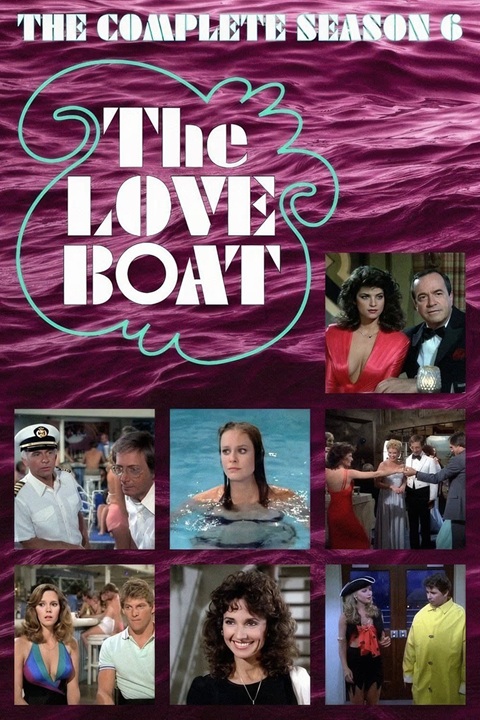
Welcome to Retro Television Reviews, a feature where we review some of our favorite and least favorite shows of the past! On Wednesdays, I will be reviewing the original Love Boat, which aired on ABC from 1977 to 1986! The series can be streamed on Paramount Plus!
This week, Charo’s back!
Episode 5.27 “April in Boston/Saving Grace/Breaks of Life”
(Dir by Richard Kinon, originally aired on May 1st, 1982)
April Lopez (Charo) is back! This time, she has given up show business and is now working as a Spanish tutor for stuffy private school headmaster Bradford York (David Hedison). She is falling for Bradford but she knows that he would never accept her as an entertainer. Or would he? We’re about to find out because the entertainment that Julie booked, probably while in a cocaine-fueled haze, fails to show up. Would April be willing to perform?
April sings “Let’s get physical, physical,” in the ship’s lounge but when Bradford stops by to get a drink, April covers her face with a mask. “If I sang like that,” Bradford says, “I’d wear a mask too….”
And that really gets to the main problem with this story. Bradford York is jerk! Seriously, I know why some people find Charo to be annoying and I do think The Love Boat tended to overuse the character but she deserves a lot better than Bradford York! Eventually, of course, Bradford leans that April is the singer and he tells her that he loves her in Spanish. (He has to ask April how to say it first.) So, I guess it’s a happy ending but we all know that April’s going to be single again once the sixth season starts.
As for the other storylines, Gwen (Jayne Meadows) and George Finley (Gene Rayburn) are a divorced couple who end up in the ship’s infirmary together. We’ve never seen the infirmary before and I assume we’ll never see it again. The two of them fall in love all over again. It tuns out Gwen was just faking her injury so she could be with George. It seems like Doc Bricker should have noticed that.
Finally, Grace Bostwick (Jane Powell) is a widow who is prevented from jumping overboard by Gabriel (Hugh O’Brian). Gabriel says he’s angel, sent from Heaven to help Grace move on from her grief. It turns out that he’s not. He’s just someone who knew Grace was suicidal and figured he would have to come up with something dramatic to keep her from plunging into the ocean. Everyone on the boat acts as if this makes total sense. Grace is very forgiving. Never has one lie been responsible for so much love.
What a weird episode. A man pretended to be an angel, Charo performed while wearing a mask, and the ship has an infirmary! Weird as it was, the episode kept me entertained. I’ve always liked Charo’s mix of sincerity and flamboyance. That said, she deserves better than Bradford York. The angel storyline was problematic for all sorts of reasons but at least Jane Powell and Hugh O’Brian gave good performances. They almost sold it. Almost.
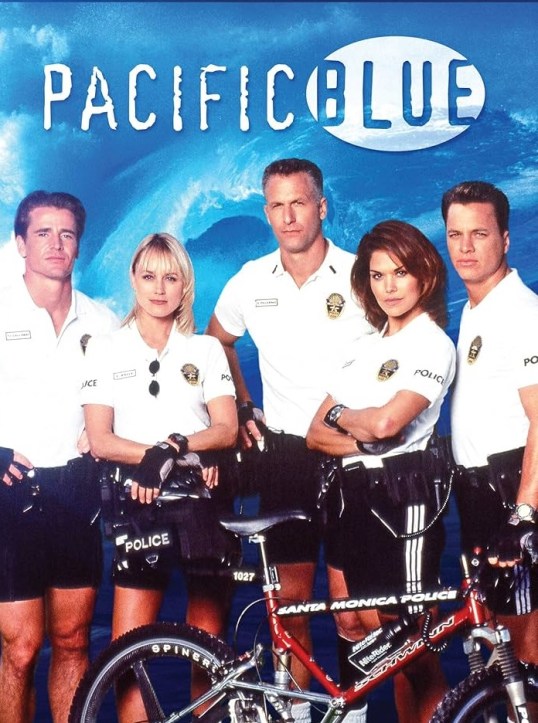
Welcome to Late Night Retro Television Reviews, a feature where we review some of our favorite and least favorite shows of the past! On Tuesdays, I will be reviewing Pacific Blue, a cop show that aired from 1996 to 2000 on the USA Network! It’s currently streaming everywhere, though I’m watching it on Tubi.
It’s another day in L.A.
Episode 2.3 “Rapscallions”
(Dir by Gary Winter, originally aired on September 7th, 1996)
There’s a lot happening in Santa Monica or wherever it is this stupid show takes place.
Mr. Baron (Tom Towles) has hired two thugs to run all the tenants out of a building so it can be turned into a drug den. TC and Cory help the tenants. TC encourages one of them, Travis (Anthony De Longis), to be a big old hero.
The lifeguards challenge the bicycle cops to a street hockey game. Victor goes crazy trying to recruit good players. The lifeguards bring in a professional player who apparently works as a lifeguard during the summer. The bicycle cops still manage to hold the lifeguards to a tie. Their goalie collapses at the end of the game, apparently as a result of getting hit in the face by the puck a hundred times. So, I guess he’s dead now. Oh well. At least the bike cops can feel like heroes before facing another day of people laughing about how dorky they look on their bicycles.
Palermo has a new girlfriend (Marisa Urkovich), which upsets his 16 year-old daughter, Jessie (Johna Stewart-Bowden). Jessie wants her parents to get back together but Palermo has to explain that the divorce is final. He is never going to remarry Jessie’s mother. Palermo’s heart belongs to the bicycles now.
There was a lot happening in this episode and I have to admit that I really didn’t care about any of it. After this episode ended, I started thinking about the show’s main characters and I asked myself whether or not any of them were actually likable. I mean, let’s consider this:
Jim Davidson plays TC Callaway, who doesn’t even have a consistent backstory. When we first met him, he was being pressured to quit his job and become an executive at his family’s business. TC was wealthy when we first met him but we haven’t heard anything about his family or their company since then and TC certainly doesn’t act like someone who grew up with money. Sometimes, TC has a regular girlfriend who lives with him and sometimes, it appears that he does not. Of course, the main problem with TC is that it’s hard to keep him straight from either Victor or Palermo. Once he puts on his riding helmet and his sunglasses, TC basically looks about as generic as someone can. A huge part of the problem is that TC never has any facial expressions or anything that would suggest any sort of personality at all.
Darlene Vogel plays Chris Kelly, who is still whining about being on the bike patrol. When the show started, she was obviously meant to have a will they or won’t they thing with TC but the total lack of chemistry between Darlene Vogel and every performer on the show pretty much ended that. For someone who was originally meant to be one of the main characters, Chris never really seems to have much to do on the show. She spent this episode smirking whenever anyone asked to see Palermo. Everyone’s had that friend that they secretly can’t stand and that’s pretty much who Chris is on this show.
Marcos A. Ferraez plays Victor Del Toro, who at least has a bit of a personality in that he’s always getting angry about something and he always stops and stares whenever he sees anyone wearing a bikini. (Since this series takes place on a beach in California, you can imagine the amount of time that is taken up by this.) Victor is impulsive and competitive but he’s also a bike cop so it’s still hard not to feel like he’s overcompensating because of his job.
Paula Trickey plays Cory McNamara. Cory is as close to being a likable character as you’re going to find on PacificBlue and Paula Trickey, at least by this point in the series, is definitely the best member of the ensemble. Unfortunately, the show itself seems to only be interesting in either finding excuses for her to get sprayed with water or having her get menaced while wearing a tank top.
And finally, Rick Rossovich is Lt. Palermo. Palermo is strict and no-nonsense, which is actually what you want from a boss. Unfortunately, for the by-the-book boss thing to be compelling, someone in the group has to be a rule-breaker and that’s not really a description that applies to anyone on PacificBlue. Rossovich was not a bad actor but, at least at this point in the series, Palermo still spends way too much time telling people that bicycle cops are real cops. If you haven’t been able to convince them yet, you never will.
In short, this episode of PacificBlue didn’t work because the cast was boring and putting them on bicycles did not help. Hopefully, things will change as I continue to watch the series or else it’s going to be long couple of seasons.
As today is Orson Welles’s birthday, it seems appropriate that today’s song of the day should come from the score of one of his best films, Touch of Evil.
Though the Academy of Motion Picture Arts and Sciences claim that the Oscars honor the best of the year, we all know that there are always worthy films and performances that end up getting overlooked. Sometimes, it’s because the competition too fierce. Sometimes, it’s because the film itself was too controversial. Often, it’s just a case of a film’s quality not being fully recognized until years after its initial released. This series of reviews takes a look at the films and performances that should have been nominated but were, for whatever reason, overlooked. These are the Unnominated.
I come here to defend Charlton Heston.
1994’s Ed Wood is a great film that has one unfortunate line. Towards the end of the film, director Ed Wood (Johnny Depp) meets his hero, Orson Welles (Vincent D’Onoforio), in a bar. They talk about the difficulties of directing a film. Wood talks about the trouble that he’s having with Plan 9 From Outer Space. Welles says that he can understand what Wood is going through because the studio is forcing him to cast Charlton Heston as a Mexican in his next movie.
And look, I get it. It is true that Charlton Heston does play a Mexican prosecutor named Mike Vargas in Welles’s 1958 film, Touch of Evil. And it is true that Heston is not the most convincing Mexican to ever appear in a film. And I understand that there are people who enjoy taking cheap shots at Charlton Heston because he did have a tendency to come across as being a bit full of himself and he was a conservative in a industry dominated by Leftists. There are people who actually think Michael Moore doesn’t come across like a self-righteous prick when he confronts Heaton in Bowling for Columbine. I get the joke.
But it’s not true and it’s not fair. When Touch of Evil was first put into production by Universal, Welles was not hired to direct. He was hired to play Hank Quinlan, the formerly honest cop with a habit of planting evidence on those who he believed to be guilty. When Charlton Heston was offered the role of Vargas, he asked who had been hired to direct. When he was told that a director hadn’t been selected, Heston was the one who suggested Welles be given the job. When, as often happened with Welles’s film, the studio decided to take the film out of Welles’s hands, Heston argued for Welles’s vision while Welles was off trying to set up his long-dreamed of film of Don Quixote. Say what you will about Charlton Heston’s career, he fought for Orson Welles, just as he later fought for Sam Peckinpah during the making of Major Dundee. Heston may not have agreed with either Welles or Peckinpah politically but he fought for them when few people were willing to do so.
That Touch of Evil is a brilliant film is pretty much entirely due to Welles’s directorial vision. The story is pure pulp. While investigating the murder of an American businessman in Mexico, Vargas comes to believe that Quinlan is attempting to frame a young Mexican for the crime. While Vargas watches Quinlan, his wife Susie (Janet Leigh) is menaced by the crime lord Joe Grandi (Akim Tamiroff), who has his own issues with both Vargas and Quinlan. The plot may be the stuff of a B-programmer but, as directed by Welles, Touch of Evil plays out like a surreal nightmare, a journey into the heart of darkness that is full of eccentric characters, shadowy images, memorably askew camera angles, and lively dialogue. Welles and cinematographer Russell Metty create a world that feels alien despite being familiar. Just as he did with Gregg Toland in CitizenKane, Welles shapes a film that shows us what’s happening in the shadows that most people try to ignore.
There’s really not a boring character to be found in Touch of Evil and the cast is full of old colleagues and friends of Welles. Marlene Dietrich shows up as Quinlan’s former lover. Mercedes McCambridge plays a leather-clad gang leader. Dennis Weaver is the creepy owner of a remote motel. (Two years before Psycho, Touch of Evil featured Janet Leigh being menaced in a motel. Mort Mills, who played Psycho’s frightening highway patrolman, plays a member of law enforcement here as well.) Zsa Zsa Gabor shows up for a few brief seconds and it makes a strange sort of sense. Why shouldn’t she be here? Everyone else is. Joseph Cotten plays a coroner. Ray Collins plays a local official. In the film’s skewered world, Charlton Heston as Mike Vargas works. His upright performance grounds this film and keeps it from getting buried in its own idiosyncrasies. Big personalites are everywhere and yet the film is stolen by Joseph Calleia, playing Quinlan’s quiet but observant partner. Calleia’s performance is the heart of the film.
TouchofEvil was not nominated for a single Oscar and that’s not surprising. It’s not really the type of film that was noticed by the Academy in the 50s. It was too pulpy and surreal and, with its story of a crooked cop framing someone who might very well be guilty anyway, it was probably too subversive for the Academy of the 1950s. It would take a while for TouchofEvil to be recognized for being the noir masterpiece that it is. In a perfect world, Welles would have been nominated for directing and for his larger-than-life performance as Quinlan. Joseph Calleia would have been nominated for Supporting Actor and perhaps both Janet Leigh and Marlene Dietrtich would have been mentioned for Supporting Actress. That didn’t happen but it would have been nice if it had.
As I continue my celebration of Chow Yun-Fat, who turns 70 years old on May 18, 2025, I decided to revisit the film that made him a star, the Hong Kong classic A BETTER TOMORROW (1986).
This undisputed action movie classic opens with Ho (Ti Lung) and his partner and best friend, Mark (Chow Yun-Fat) going about a normal workday. Except these two men are part of a triad organization that manufactures counterfeit American dollars. Ho seems serious while Mark appears to be the fun, cool guy, with his trench coat, Alain Delon sunglasses, and huge smile. They stroll through their organization’s offices, play with piles of fake money, and Mark even lights his cigarette with a $100 bill. They seem to have the world by a string when their boss asks Ho to take an up and coming guy in the organization named Shing (Waise Lee) along on their next deal in Taiwan. Before heading to Taiwan, Ho goes to see his dad in the hospital where he sees his younger brother Kit (Leslie Cheung), who has entered the Hong Kong police academy and is completely unaware that Ho is part of a criminal organization. Ho’s dad doesn’t want to see his sons on the opposite side of the law, so he asks him to leave his life of crime behind. Ho decides that the job in Taiwan will be his last, but unfortunately, the deal quickly goes awry, turning into a big shootout, with Ho and Shing barely escaping with their lives. They are tracked down by the police where Ho turns himself in, allowing Shing to escape. When the triad bosses find out that Ho has been arrested, they send a big henchman to kidnap his dad, who is now at Kit’s house, as leverage to make sure Ho doesn’t talk to the police. Kit, his girlfriend and his dad all fight the huge henchman, but dad is eventually stabbed to death. Cut to Mark reading the paper and seeing that his best friend has been arrested. He finds the betrayer in the Fung Lim restaurant and proceeds to take his revenge, in slow motion and with two guns no less. On his way out though, he takes a couple of rounds to his right knee.
Cut to three years later and Ho is getting out of prison. Kit doesn’t want to have anything to do with him and blames him for their father’s death. Distraught, but knowing he needs to work, he goes to a taxi company run by Ken (Kenneth Tsang) and is able to land a job. While working his shift, he goes by their old office building and sees Mark, who’s now a cripple with a limp and a leg brace. Shing, now a boss, walks out of the building surrounded by his bodyguards and throws cash on the ground at Mark’s feet, treating him like nothing more than a beggar. Ho goes to talk to Mark and the two men embrace. Mark wants to join forces with Ho and retake the underworld by storm. Ho wants to steer clear of his old life and try to reconnect with a completely uninterested Kit. Everything comes to a head when Kit is set up by Shing to be shot and Mark is viciously beaten. Determined to relive his old glory days, and now having given up on Ho for help, Mark breaks into the triad’s offices and steals the plate that is used to create the phony money. Ho has decided he can no longer sit on the sidelines. He and Mark use the plate as an excuse to lure Shing and his men to the docks where they engage in an apocalyptic shootout that will change all of their lives forever.
It’s hard to know where to start when talking about a movie like A BETTER TOMORROW. I’m not going to do a normal review where I discuss the various pros and cons of the film. Why, you ask? Because it’s a great movie, but it’s so much more than just that. A BETTER TOMORROW would change action filmmaking forever, and eventually turn Director John Woo and actor Chow Yun-Fat into worldwide stars. It would become the highest grossing film in Hong Kong cinema history. It would create a trenchcoat fad in tropical Hong Kong that would find its way across the world entrapping movie nerds like a young Quentin Tarantino. It would create the heroic bloodshed film genre, a genre that would become a staple of Hong Kong cinema for years to come. It would mix balletic action and raw emotion in a way that had never been done before. And the whole world would eat it up. John Woo may have even made better action films in the ensuing years with movies like THE KILLER and HARD-BOILED, but they were all inspired by the greatness and success of A BETTER TOMORROW. It’s quite simply one of the most influential movies of all time, and it’s still influencing later generations of filmmakers. I watched Gareth Evans’ new film HAVOC (2025) a few days ago, and it clearly pays homage to this amazing film through its use of music from a key scene.
I did want to talk a little bit about the main stars of the film. Ti Lung, who plays Ho, was one of the great stars of the Shaw Brothers kung fu films from the 70’s. He’s excellent in the lead role, so much so that the he would win the Taiwan Golden Horse award as best actor for his performance. Leslie Cheung, who plays the younger brother Kit, was a huge pop star in Hong Kong. He sings the memorable tune that plays over the film’s closing credits. I’ll admit that his portrayal of Kit gets on my nerves, though. While I can understand his feelings of anger towards his brother, he often comes off as whiney, acting more like a petulant child than a serious adult. He would become a very good actor over time, but I don’t think he’s very good here. On a sad note, on April 1st, 2003, suffering from depression, Cheung would commit suicide by jumping off the 24th floor of the Mandarin Hotel in Hong Kong. It was a tragic end for a great Hong Kong artist. It’s hard to believe now, but prior to A BETTER TOMORROW, Chow Yun-Fat was considered “box office poison.” He had been a TV star in Hong Kong, but his movies would never do very well. That would all change with A BETTER TOMORROW. Even though he was more of a supporting character in the film, he became the undisputed breakout star and he would capture the hearts of the people of Hong Kong and all of Asia from that point forward. His charismatic performance became the personification of the flawed, emotional, heroic, super-badass. Women loved him and men wanted to be like him, and he made it all look so easy. I’ve said before that he’s one of the great international movie stars of the last 40 years. It all began with A BETTER TOMORROW.
Finally, I wanted to take a moment to discuss the Director of A BETTER TOMORROW, John Woo. Woo had been kicking around the Hong Kong film industry for many years, having directed quite a few martial arts films and comedies in the 70’s and early 80’s. By the time of A BETTER TOMORROW, he was considered past his prime. He wanted to make films like his heroes Jean-Pierre Melville and Martin Scorsese, but was considered too much of a risk by most of the local industry. Luckily for him, Tsui Hark and Cinema City would give him a chance to make the movie he wanted to make, even if it came with a tight budget, and a cast that included a fading martial arts star and the human equivalent of box office poison. Woo would take this opportunity and change what action movies looked like forever. Good for him, and us, as we’d get so many great films, including one of my all time favorites, FACE/OFF (1997) with John Travolta and Nicolas Cage. I said all of this about the stars because before A BETTER TOMORROW came out, it looked like a project that would go nowhere fast. Instead it changed the world of cinema. It also changed the world of a movie nerd from Toad Suck, Arkansas, with the aftermath of its success providing so many hours of entertainment in my own life. It’s truly amazing what one great film can do.
For some reason, certain people seem to feel the need to try to reduce what Orson Welles accomplished with 1941’s CitizenKane.
In 1971, the famous film critic Pauline Kael published an essay called RaisingKane, in which she argued that screenwriter Herman J. Mankiewicz deserved the majority of the credit for CitizenKane. This was Kael’s shot at rival Andrew Sarris and his embrace of the auteur theory. (1971 was the same year that Kael described DirtyHarry as being a “fascist work of art” so I guess even the best film critics can have a bad year.) David Fincher’s father, after reading Kael’s essay, wrote the screenplay for Mank, which not only made the case that Mankiewicz deserved the credit but which portrayed Orson Welles in such a negative fashion that you really did have to wonder if maybe Orson had owed old Jack Fincher money or something. Herman J. Mankiewicz himself always claimed that he deserved the majority of the credit for CitizenKane but then he would, wouldn’t he?
The truth of the matter is that Mankiewicz did write the screenplay for CitizenKane and he did base the character of Charles Foster Kane on William Randolph Hearst and the character of Kane’s second wife on Hearst’s mistress, Marion Davies. There’s some debate over how much of the film’s narrative structure belongs to Mankiewicz and how much of it was a result of Welles rewriting the script. Mankiewicz played his part in the making of CitizenKane but he played that part largely because Orson Welles allowed him to. Like all great directors, Welles surrounded himself with people who could help to bring his vision to life. (That’s something that would think David Fincher, of all people, would understand. Aaron Sorkin may have written The Social Network but the reason why the film touched so many is because it was a David Fincher film.)
Make no mistake about it. CitizenKane is Orson Welles’s vision and Welles is the one who deserves the majority of the credit for the film. The themes of Citizen Kane are ones to which Welles would frequently return and the cast, all of whom bring their characters to vivid life, is made up of largely of the members of Welles’s Mercury Theatre. The tracking camera shots, the dark cinematography, and the satiric moments are all pure Welles. As the Fincher film argues, Mankiewicz may have very well meant to use the film to attack Hearst for his personal hypocrisy and for opposing the political ambitions of Upton Sinclair. If so, let us be thankful that Orson Welles, as a director, was smart enough to realize that such didacticism is often deadly dull.
And there’s nothing dull about Citizen Kane. It’s a great film but it’s also an undeniably fun film, full of unforgettable imagery and scenes that play like their coming to us in a dream. It’s a film that grabs your interest and proves itself to be worthy of every minute that it takes to watch it. I was lucky enough to first see Citizen Kane at a repertory theater and on the big screen and really, that’s the best way to watch it. It’s a big film that’s full of bigger-than-life characters who are ultimately revealed to be full of the same human longings and regrets as all of us. As a young man, the fabulously wealthy Charles Foster Kane thinks that it would be “fun” to run a newspaper. Later, he thinks that he’s found love by marrying the niece of the President. He runs for governor of New York and, watching Welles in these scenes, you can see why FDR tried to recruit him to run for the Senate. Welles has the charisma of a born politician. When Welles first meets Susan Alexander (Dorothy Comingore) it’s easy to laugh. The great man has just been splashed by a taxi. Susan laughs but then winces in pain due to a tooth ache. Later, Kane insists on trying to turn her into an opera star. He runs a negative review written by his friend (Joseph Cotten) and then he promptly fires him. As in all of Welles’s films, it’s all about personal loyalty. Kane may betray his wife and the voters but he’s ultimately just as betrayed by those around him. In the end, you get the feeling that Kane was desperately trying to not be alone and yet, that’s how he ended up.
There are so many stand-out moments in CitizenKane that it’s hard to list them all. The opening — MIGHTY XANADU! — comes to mind. The satirically overdramatic newsreel is another. (CitizenKane can be a very funny film.) Joseph Cotten’s performance continues to charm. Orson Welles’s performance continues to amaze. Who can forget Agnes Moorehead as Kane’s mother or Everett Sloane as Mr. Bernstein, haunted by that one woman he once saw on a street corner? Myself, I’ve always liked the performances of Ray Collins (as the sleazy but strangely reasonable Boss Gettys), Paul Stewart (as the subtly menacing butler), and Ruth Warrick (as Kane’s first wife). Mankiewicz may have put the characters on paper but Welles is the one who selected the amazing cast that brought them to life.
CitizenKane was nominated for nine Oscars and it won one, for the screenplay written by Welles and Mankiewicz. Best Picture went to How Green Was My Valley. When was the last time anyone debated who should be given credit for that movie?
Welcome to Retro Television Reviews, a feature where we review some of our favorite and least favorite shows of the past! On Tuesdays, I will be reviewing the original Fantasy Island, which ran on ABC from 1977 to 1984. Unfortunately, the show has been removed from most streaming sites. Fortunately, I’ve got nearly every episode on my DVR.
This week, we’re traveling in time!
Episode 6.16 “Return to the Cotton Club/No Friends Like Old Friends”
(Dir by Don Weis, originally aired on February 26th, 1983)
Aspiring singer Charlie Whelan (Lou Rawls) wants to go back to a time where all that mattered was talent. As he tells Roarke and Tattoo, it’s all about image and connections now. Charlie wants to go back to the Cotton Club, the famous New York club where blacks were allowed to perform on stage while gangsters sat in the audience. Roarke sends Charlie back in time and soon, Charlie is at the Cotton Club. He meets Dutch Schultz (J.D. Cannon). He befriends the club’s manager, Gus Kelly (Yaphet Kotto). He falls for another singer, Linda (Berlinda Tolbert).
The first thing I noticed about this fantasy is that The Cotton Club looked really cheap. It looked like an old VIP lounge in an airport. It was kind of tacky. The other thing I noticed is that the fantasy wasn’t historically accurate. The Cotton Club was not owned by Dutch Schultz. In fact, Schultz had little to do with The Cotton Club. The gangster who owned the Cotton Club was Owney Madden, an Irish gangster who eventually left New York City for Hot Springs, Arkansas. In the show’s defense, the man who Charlie knew as Dutch Schultz was eventually revealed to be another guest who was having a fantasy of his own. I’ve always had mixed feelings about Roarke’s habit of combining fantasies. I feel like a guest should only have to pay half-price if their fantasy is going to mixed up with somebody else’s.
As for this fantasy, it was okay. Lou Rawls certainly gave a better performance here than he ever did on Baywatch Nights. And Yaphet Kotto was a charming as ever, even if his role was, again, not historically accurate. (The Cotton Club may have hired black performers but otherwise, it was heavily segregated.) I like almost anything involving 1930s gangsters. I can’t help it. They had style.
As for the other fantasy, Doreen Murphy (Markie Post) wants to have a reunion with her friends from college. Doreen asks Roarke to make her rich and beautiful so that she can shame all of the people who never believed in her. Roarke gives her a magic necklace that changes her from being a brunette to being a blonde. That’s all it takes! One of Doreen’s friends is Liz (Cybill Shepherd). Liz is married to the unfaithful Al (Lyle Waggoner), who takes an interest in Doreen. Doreen learns a lesson about true beauty being more than just an appearance. She also learns that people don’t dislike her as much as they dislike her bitter attitude. Doreen gives the necklace to Liz so that Liz can get her cheating husband back. Good, I guess.
This was an uneven trip to the Island. Neither story was particularly compelling. The Cotton Club fantasy at least had Yaphet Kotto. Otherwise, this was a forgettable trip. The writers really didn’t even seem to be trying to come up with anything unexpected or surprising. At least the Island continues to look lovely.
If you enjoy bone-crunching action filmmaking, Gareth Evans’ films THE RAID (2011) and THE RAID 2 (2014) are as good as it gets in the 21st century. When I saw that Evans had a new film coming to Netflix that stars a badass looking Tom Hardy, I have to admit I got excited. The trailer only increased my anticipation with its promise of stylized, intense action, as well as a cast that includes personal favorites like Timothy Olyphant (JUSTIFIED T.V. Series) and Forest Whitaker (GHOST DOG). I settled in front of my TV and hit play, with high hopes for HAVOC!
The film opens with conflicted police detective Walker (Tom Hardy) sharing words of regret via voiceover, and then immediately shifts to a high speed chase between an 18 wheeler and a bunch of cops. It is an intense scene that ends with washing machines filled with cocaine being thrown onto a trailing cop car! We soon learn that the big truck was being operated by Mia (Quelin Sepulvida) and Charlie (Justin Cornwell), the son of ethically challenged businessman Lawrence Beaumont (Forest Whitaker). It seems Charlie and Mia stole the drugs to pay off her debts to Chinese triads. When they go to a club to deliver the drugs, a group of masked men proceed to interrupt the drop and kill everybody, including the beloved son of the triad’s leader Tsui (Yann Yann Yeo). When Walker sees Charlie on security footage from the club, he goes to Beaumont, a man who knows his dirty secrets, and makes a deal. He’ll get his son back, and they’ll be square for life. Soon the triads are in town ready to hunt down and kill Charlie and Mia, who they believe are responsible for the massacre. Add to that a group of corrupt cops, led by Vincent (Timothy Olyphant), who also want Charlie and Mia dead, and detective Walker and his new partner Ellie (Jessie Mei Li) have their hands full on Christmas Eve!
Here are some observations after my first viewing of HAVOC. First, Tom Hardy is a badass in the central role as Walker. I’ve been a fan of Hardy ever since he started breaking out in America after his performance in BRONSON (2008). I really loved him as Mad Max in FURY ROAD (2015). I’d never really envisioned him as this kind of action lead, but he definitely brings a certain gravitas to the role. Second, this movie feels like a bone crunching super hero movie at times, as it’s chock full of special effects. I found the action sequences featuring gunplay and hand to hand combat to be brutally awesome, but the car chase scenes aren’t quite up to the same standard. I mentioned the 18 wheeler chase in the plot description. As the scene plays out it’s a lot like watching an unrealistic chase scene from a later sequel to THE FAST AND THE FURIOUS franchise. It’s an exciting scene in a lot of ways, but it doesn’t seem set in the real world, which is a slight subtraction for me. Third, the movie is set on Christmas Eve, and I enjoy films that take place on holidays. We have a scene early in the film where “Father of the Year” Walker is buying his daughter’s Christmas gifts at a local convenience store. A little later, there’s a cool abduction scene that plays out to the sound of Bing Crosby singing “O Holy Night.” That’s good stuff. Fourth, director Evans seems to be trying to channel the spirit of 80’s and 90’s John Woo, as his film features an endless arsenal of weaponry, coupled with high emotions, and even a little classic music from an iconic scene in Woo’s own A BETTER TOMORROW (1986). No matter how many rounds are fired, there’s always more bullets or guns to be found as the last half of the film is almost nonstop action spread out over two amazing sets, first in a club and then at a cabin. And both of our featured parents, murderous triad leader Tsui and corrupt businessman Beaumont, get a chance to show their human sides by illustrating their sacrificial love for their children. Although HAVOC most certainly does not compare favorably to Woo’s HARD-BOILED, I can also see that Hong Kong classic being referenced here. Fifth, I’m a big fan of Timothy Olyphant, especially of his character Raylan Givens in the TV series JUSTIFIED. I had to forget Raylan on this night because his character here is an irredeemable piece of crap. Of course, Olyphant is excellent and delivers his evil with a smile on his face.
Overall, I enjoyed HAVOC, but I don’t think it’s quite as good as either of the director’s RAID films, and that’s okay. I’d probably go with a solid 7 stars out of 10 for a rating. I love Hardy and Olyphant, who both bring their tremendous charisma to the table. I also enjoyed the many cool moments throughout the film leading to the action extravaganza that plays out at the end. It will be interesting to see how often I want to go back to this film in future years. I do know that if you enjoy action movies, you should definitely watch this film. Just don’t expect another RAID 2.