Brad reviews SHAOLIN SOCCER (2001), starring Stephen Chow!


My favorite living actor is the Hong Kong legend Chow Yun-Fat. His heroic bloodshed gangster films with John Woo turned me into a Hong Kong superfan. I’m also a big fan of Jackie Chan. His kung fu action-comedies eventually led to him being one of the biggest movie stars in the world. But did you know that when they were at the peaks of their careers in Hong Kong in the early 90’s, neither was the biggest star in their homeland? Nope! The true box office champion in Hong Kong was the comedian Stephen Chow. From 1990-1995, Stephen Chow led the box office every year except 1994, when Chow Yun-Fat barely edged him out. In the 2000’s, Stephen didn’t make a lot of movies, but when he did, they were record breaking box office smashes. The first of those was SHAOLIN SOCCER.

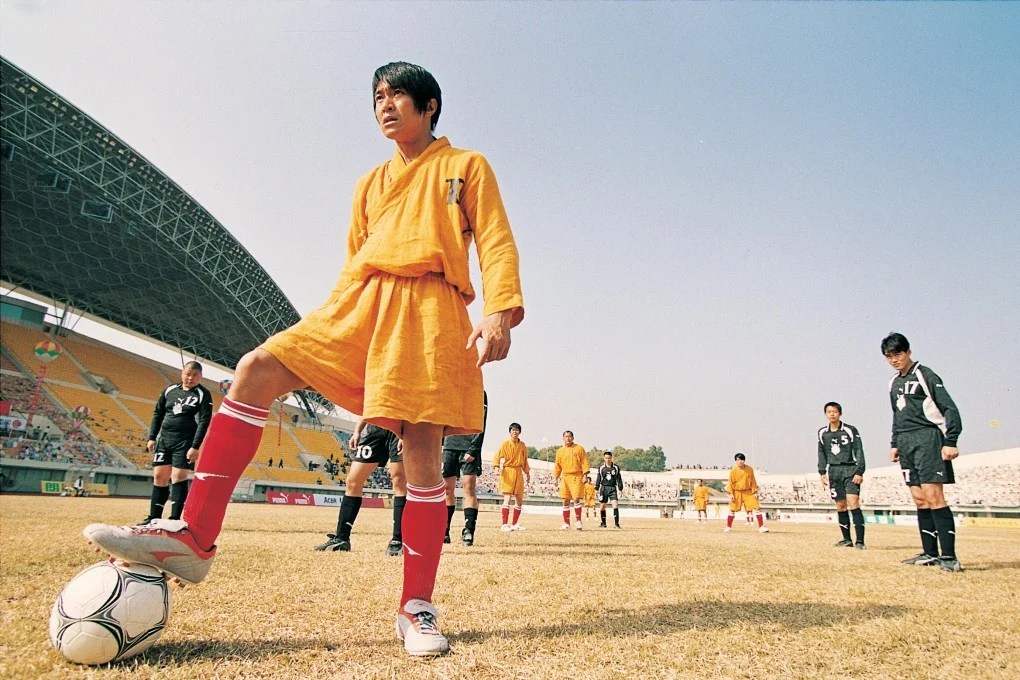
The film has a pretty simple concept… a former soccer great, known as Golden Leg Fung (Ng Man-Tat), has been down on his luck for 20 years after his leg was broken in a soccer match. Drunk and at his lowest, he runs into the Mighty Steel Leg Sing (Stephen Chow), a poor Shaolin disciple who spends his time trying to figure out a way to make the teachings of Shaolin popular again. When Fung sees the power with which Sing can kick a soccer ball, he comes up with the idea of recruiting and coaching a soccer team of Shaolin kung fu masters. He wants to challenge Team Evil, the reigning Chinese soccer champions, and their arrogant Coach Hung (Patrick Tse), the man responsible for his crippled leg. Can they win the Chinese Cup, restore the legend of Golden Leg Fung, and bring Shaolin Kung Fu into the modern world? 

No matter what you think of my summary above, I can assure you that it doesn’t even come close to doing the film justice. What may sound like just a kung fu comedy is actually a kung fu comedy, a sports movie, and an effects driven, fantastical live-action cartoon all rolled up into one. As funny as I thought he was in the James Bond parody FROM BEIJING WITH LOVE (1995), writer-director Stephen Chow proves himself to be a comedic genius with SHAOLIN SOCCER. Apparently the citizens of Hong Kong agreed as the film broke all of their previous box office records when it was released in the summer of 2001. Chow would break his own records a few years later when he wrote, directed and starred in the international hit KUNG FU HUSTLE (2004).

As the film kicks into gear, we’re treated to a succession of “Magnificent Seven” like scenes where Fung and Sing try to build their soccer team from Sing’s former Shaolin “brothers.” These aren’t obvious badasses like Charles Bronson and James Coburn, though. These guys may be Shaolin masters, but in the world they live in now, they’re a bunch of beaten down losers. They all initially turn the guys down due to their complete lack of confidence in themselves, but something has undeniably stirred in them again. With Fung and Sing sitting alone and thinking all hope is lost, Chow brilliantly parodies John Woo, and the brothers join them in stylish, wind blown slow-mo!

Once the Shaolin masters get together on the team, director Stephen Chow cranks up the CGI and special effects to 10 to illustrate their true powers. This is all done for entertainment purposes, so don’t expect anything that resembles real soccer. Their first practice begins with Mighty Steel Leg Sing kicking a ball straight up in the air, so the team just has to hang out and take naps while they wait for the ball to finally come back down. As the guys discover their true CGI-enhanced Shaolin soccer superpowers, they seem unbeatable… that is, until they run back into the superdrug-enhanced Team Evil and their unethical coach Hung. Part of the fun of these types of movies is in seeing how they deal with adversity and overcome the bigger, badder team. I want to shout out Patrick Tse, who played Coach Hung. He’s deliriously over-the-top here, and we definitely want to see him get his comeuppance. One of the reasons I decided to rewatch SHAOLIN SOCCER is to celebrate Tse, who passed away on July 16th, 2026, at the age of 89, after a 7-decade film career in Hong Kong. Rest in peace, sir. 

I think that the best thing I can say for this film is that underneath the entertaining craziness of the comedy and special effects is a sweet underdog story of unappreciated greatness being unleashed. The various characters may seem like jokes in their day to day lives, but they’re not, and it’s a joy to behold as the world sees how special they really are. This theme runs through several of Stephen Chow’s films. In his best movies, he doesn’t just prove that he’s a brilliant comedian, but he also shows us that he’s got a good heart. 
Brad’s “scene of the day” – FROM BEIJING WITH LOVE (1994), starring Stephen Chow!


I love the Hong Kong actor and comedian Stephen Chow, who just happens to be celebrating his 63rd birthday today. While he may be best known for the smash hits SHAOLIN SOCCER (2001) and KUNG FU HUSTLE (2004), I first became a fan when I saw his James Bond send up, FROM BEIJING WITH LOVE. I was so impressed with his deadpan delivery style in the film, and even though he seems kind of goofy, he turns out to be a major badass. I loved it!

In honor of Stephen Chow’s birthday, I present this scene from the Hong Kong comedy FROM BEIJING WITH LOVE. Enjoy!

A BETTER TOMORROW (1986) – John Woo and Chow Yun-Fat change action movies forever! 


As I continue my celebration of Chow Yun-Fat, who turns 70 years old on May 18, 2025, I decided to revisit the film that made him a star, the Hong Kong classic A BETTER TOMORROW (1986).

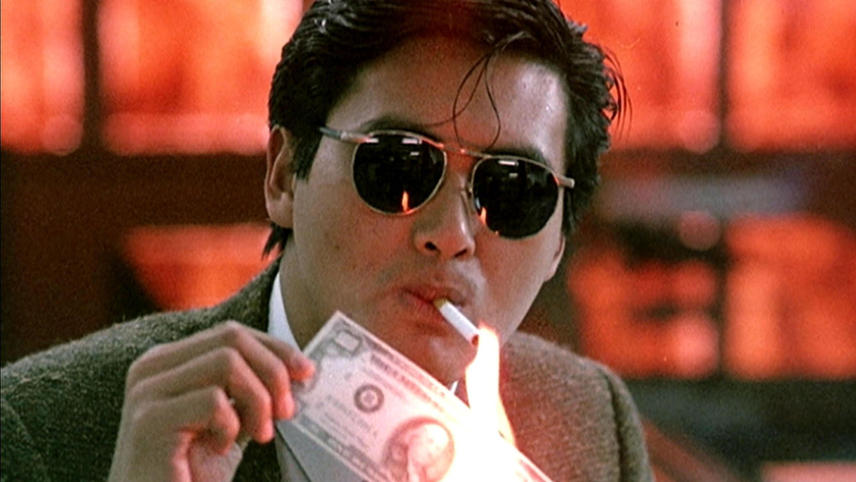
This undisputed action movie classic opens with Ho (Ti Lung) and his partner and best friend, Mark (Chow Yun-Fat) going about a normal workday. Except these two men are part of a triad organization that manufactures counterfeit American dollars. Ho seems serious while Mark appears to be the fun, cool guy, with his trench coat, Alain Delon sunglasses, and huge smile. They stroll through their organization’s offices, play with piles of fake money, and Mark even lights his cigarette with a $100 bill. They seem to have the world by a string when their boss asks Ho to take an up and coming guy in the organization named Shing (Waise Lee) along on their next deal in Taiwan. Before heading to Taiwan, Ho goes to see his dad in the hospital where he sees his younger brother Kit (Leslie Cheung), who has entered the Hong Kong police academy and is completely unaware that Ho is part of a criminal organization. Ho’s dad doesn’t want to see his sons on the opposite side of the law, so he asks him to leave his life of crime behind. Ho decides that the job in Taiwan will be his last, but unfortunately, the deal quickly goes awry, turning into a big shootout, with Ho and Shing barely escaping with their lives. They are tracked down by the police where Ho turns himself in, allowing Shing to escape. When the triad bosses find out that Ho has been arrested, they send a big henchman to kidnap his dad, who is now at Kit’s house, as leverage to make sure Ho doesn’t talk to the police. Kit, his girlfriend and his dad all fight the huge henchman, but dad is eventually stabbed to death. Cut to Mark reading the paper and seeing that his best friend has been arrested. He finds the betrayer in the Fung Lim restaurant and proceeds to take his revenge, in slow motion and with two guns no less. On his way out though, he takes a couple of rounds to his right knee. 

Cut to three years later and Ho is getting out of prison. Kit doesn’t want to have anything to do with him and blames him for their father’s death. Distraught, but knowing he needs to work, he goes to a taxi company run by Ken (Kenneth Tsang) and is able to land a job. While working his shift, he goes by their old office building and sees Mark, who’s now a cripple with a limp and a leg brace. Shing, now a boss, walks out of the building surrounded by his bodyguards and throws cash on the ground at Mark’s feet, treating him like nothing more than a beggar. Ho goes to talk to Mark and the two men embrace. Mark wants to join forces with Ho and retake the underworld by storm. Ho wants to steer clear of his old life and try to reconnect with a completely uninterested Kit. Everything comes to a head when Kit is set up by Shing to be shot and Mark is viciously beaten. Determined to relive his old glory days, and now having given up on Ho for help, Mark breaks into the triad’s offices and steals the plate that is used to create the phony money. Ho has decided he can no longer sit on the sidelines. He and Mark use the plate as an excuse to lure Shing and his men to the docks where they engage in an apocalyptic shootout that will change all of their lives forever. 

It’s hard to know where to start when talking about a movie like A BETTER TOMORROW. I’m not going to do a normal review where I discuss the various pros and cons of the film. Why, you ask? Because it’s a great movie, but it’s so much more than just that. A BETTER TOMORROW would change action filmmaking forever, and eventually turn Director John Woo and actor Chow Yun-Fat into worldwide stars. It would become the highest grossing film in Hong Kong cinema history. It would create a trenchcoat fad in tropical Hong Kong that would find its way across the world entrapping movie nerds like a young Quentin Tarantino. It would create the heroic bloodshed film genre, a genre that would become a staple of Hong Kong cinema for years to come. It would mix balletic action and raw emotion in a way that had never been done before. And the whole world would eat it up. John Woo may have even made better action films in the ensuing years with movies like THE KILLER and HARD-BOILED, but they were all inspired by the greatness and success of A BETTER TOMORROW. It’s quite simply one of the most influential movies of all time, and it’s still influencing later generations of filmmakers. I watched Gareth Evans’ new film HAVOC (2025) a few days ago, and it clearly pays homage to this amazing film through its use of music from a key scene.

I did want to talk a little bit about the main stars of the film. Ti Lung, who plays Ho, was one of the great stars of the Shaw Brothers kung fu films from the 70’s. He’s excellent in the lead role, so much so that the he would win the Taiwan Golden Horse award as best actor for his performance. Leslie Cheung, who plays the younger brother Kit, was a huge pop star in Hong Kong. He sings the memorable tune that plays over the film’s closing credits. I’ll admit that his portrayal of Kit gets on my nerves, though. While I can understand his feelings of anger towards his brother, he often comes off as whiney, acting more like a petulant child than a serious adult. He would become a very good actor over time, but I don’t think he’s very good here. On a sad note, on April 1st, 2003, suffering from depression, Cheung would commit suicide by jumping off the 24th floor of the Mandarin Hotel in Hong Kong. It was a tragic end for a great Hong Kong artist. It’s hard to believe now, but prior to A BETTER TOMORROW, Chow Yun-Fat was considered “box office poison.” He had been a TV star in Hong Kong, but his movies would never do very well. That would all change with A BETTER TOMORROW. Even though he was more of a supporting character in the film, he became the undisputed breakout star and he would capture the hearts of the people of Hong Kong and all of Asia from that point forward. His charismatic performance became the personification of the flawed, emotional, heroic, super-badass. Women loved him and men wanted to be like him, and he made it all look so easy. I’ve said before that he’s one of the great international movie stars of the last 40 years. It all began with A BETTER TOMORROW.

Finally, I wanted to take a moment to discuss the Director of A BETTER TOMORROW, John Woo. Woo had been kicking around the Hong Kong film industry for many years, having directed quite a few martial arts films and comedies in the 70’s and early 80’s. By the time of A BETTER TOMORROW, he was considered past his prime. He wanted to make films like his heroes Jean-Pierre Melville and Martin Scorsese, but was considered too much of a risk by most of the local industry. Luckily for him, Tsui Hark and Cinema City would give him a chance to make the movie he wanted to make, even if it came with a tight budget, and a cast that included a fading martial arts star and the human equivalent of box office poison. Woo would take this opportunity and change what action movies looked like forever. Good for him, and us, as we’d get so many great films, including one of my all time favorites, FACE/OFF (1997) with John Travolta and Nicolas Cage. I said all of this about the stars because before A BETTER TOMORROW came out, it looked like a project that would go nowhere fast. Instead it changed the world of cinema. It also changed the world of a movie nerd from Toad Suck, Arkansas, with the aftermath of its success providing so many hours of entertainment in my own life. It’s truly amazing what one great film can do.