Film Review: Godzilla vs. Mothra (dir by Takao Okawara)


Godzillamothra1992

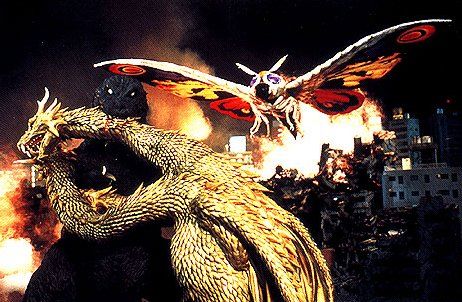
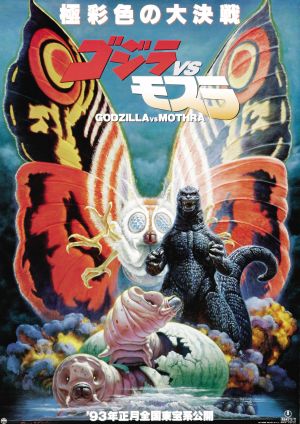
Last night, I watched a marathon of Godzilla films on Chiller and, perhaps somewhat foolishly, I took it upon myself to review each film that I saw.  Following Godzilla vs. Mechagodzilla, I watched the 19th film in the franchise, 1992’s Godzilla vs. Mothra.

If you’ve seen any previous Godzilla films, you will not be surprised to discover that Godzilla vs. Mothra opens with a random ecological disaster.  A meteorite strikes the Earth, causing a mudslide on Infant Island that reveals a very large egg.  As you can probably guess from the title, the egg contains the latest incarnation of Mothra, the giant moth who protects human civilization.

And human civilization needs to be protected because that meteorite has also woken up Battra, another ancient insect that serves as a bit of an anti-Mothra.  Battra was created by the Earth to maintain a balance between the planet and the humans who lived on it.  Whenever the Earth feels threatened, Battra destroys the menace.  Unfortunately, mankind is now the biggest threat to the planet.

And, finally, when that meteorite struck, Godzilla was hibernating under the sea.  Now, Godzilla is awake and he’s not particularly happy about it.  One thing that I always find interesting about Godzilla films is that the film’s human heroes are always 1) so shocked to discover that Godzilla has woken up and 2) so incapable of tracking Godzilla down once he does wake up.  Seriously, how hard is it to find a gigantic lizard that breathes radioactive fire?
godzilla_vs_mothra_2

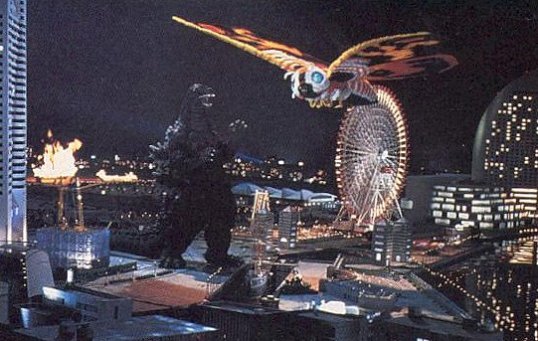
Godzilla vs. Mothra has its good points (for example, the idea behind Battra is a fascinating one and, as is to be expected from a Godzilla film, the monster fights are handled well) but, for the most part, it’s one of the more uneven of the Godzilla films.  The film is maybe 10 minutes too long, the heavy-handed ecological message makes Godzilla vs. Hedorah look subtle and nuanced, it drags whenever the monsters are not on-screen, and, as far as the English language version is concerned, the dubbing is so atrocious that I almost suspect that it was done poorly on purpose.

But, that said, Godzilla vs. Mothra has one big thing going for it.  Mothra kicks ass!  Of all the various monsters that often play sidekick (or rival) to Godzilla, Mothra is my favorite.  (I even like her more than that armadillo from Godzilla vs. Gigan.)  Whereas the rest of the Toho monsters can never seem to decide whether they want to destroy the Earth or save it, Mothra is the franchise’s warrior queen.  She is the one who serves not only as the voice of reason but she is also usually the only one who can convince Godzilla to stop destroying Tokyo long enough to defeat the aliens or Ghidorah or whatever other threat has invaded Japan this week.  And, during those rare times when Godzilla ignores her (like in this film, for instance), Mothra puts him in his place.

Best of all, Mothra may start out as an ugly larvae but you always know that, halfway through the film, she’s going to emerge as a beautiful moth.  There’s a valuable life lesson there for all of us.

Seriously, Mothra — you go, girl!

Mothra13

Other Godzilla Reviews:


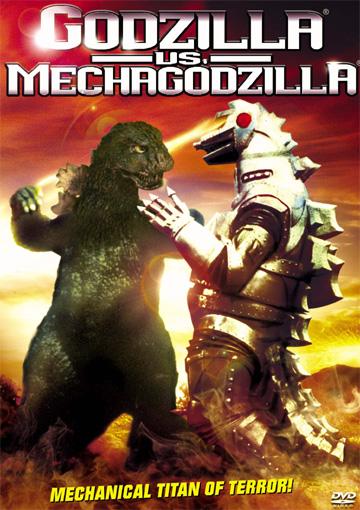
Film Review: Godzilla vs. MechaGodzilla (dir by Jun Fukuda)


godzilla-mechagodzilla1974

The Godzilla marathon on Chiller is continuing.  Immediately following Godzilla, Mothra, and King Ghidorah, we were treated to the 14th film in the Godzilla franchise, 1974’s Godzilla vs. Mechagodzilla.

There’s no way that I can start this review without pointing out a mistake made by Chiller.  In both the programming guide and at the start and end of each commercial break, Chiller insisted that they were showing a film from 2002 called Godzilla Against MechaGodzilla.  However, from the minute the film started, it was obvious that we were watching something from the 70s.  Between the jazzy score and unfortunate male hair choices, this film was so 70s that it might as well have been snorting coke and listening to progressive rock.  Mind you, that’s not a complaint on my part.  In general, films from the 70s are a lot of fun.

And that’s a pretty good description of Godzilla vs. Mechagodzilla.  It’s a fun movie, especially if you’re watching it with a group of snarky friends.  Some movies were specifically made to be watched with a group and Godzilla vs. Mechagodzilla is one of those films.

When, in Godzilla vs. Mechagodzilla, Godzilla emerges from Mt. Fuji, he is greeted by his armadillo friend from Godzilla vs. Gigan.  Godzilla reacts by savagely attacking his armadillo friend.  “No,” I shouted at the TV, “bad Godzilla!”  Seriously, it may just be because I live in Texas and I always feel bad whenever I see one of his relatives laying dead in the middle of the street but I love that giant armadillo!

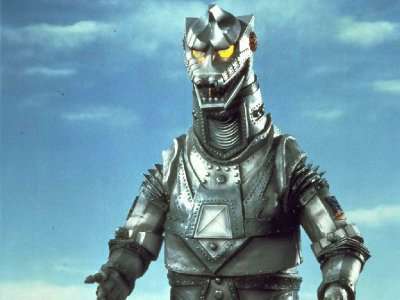
Anyway, Godzilla decides to live up to his new identity as Jerkzilla by going on yet another rampage through Japan.  Suddenly, Jerkzilla is confronted by … Godzilla!  That’s right, it turns out that Jerkzilla isn’t Godzilla at all.  Instead, he’s a giant robot named Mechagodzilla!

Mechagodzilla!

Mechagodzilla!

As you may have guessed, the blame all lies with aliens.  In Godzilla Vs. Gigan, the trouble was the result of intergalactic cockroaches that had taken on human form.  In Godzilla vs. Mechagodzilla, the villains are space monkeys who have taken on human form.  And I do have to say — and I mean no offense to the space cockroaches — but the space monkeys seem to have a much better shot at conquering the planet than those roaches ever did.

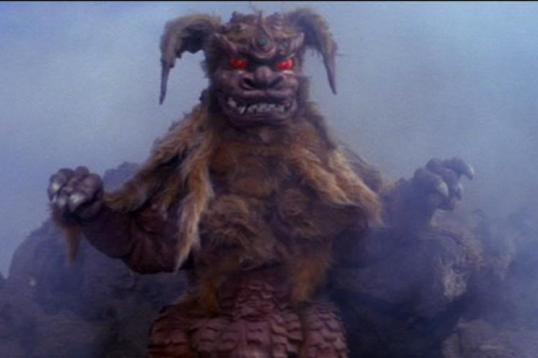
However, Mechagodzilla is not the only new monster to be found in this movie.  There’s also King Caesar, an ancient creature who, if you believe prophecy, is destined to rise out of the mountains.  (And, as we all know, one of the first rules of cinema is that prophecy always comes true!)  Through the efforts of a group of typical Godzilla movie humans, King Caesar does wake up.  Will he work with Godzilla or Mechagodzilla?

King Caesar

King Caesar

Godzilla vs. Mechagodzilla is a strange one and, judging from some of the comments that I’ve read online, that’s exactly why it’s a personal favorite of a lot of Godzilla fans.  Myself, I enjoyed it.  I wouldn’t necessarily recommend it to anyone who isn’t already a fan of the franchise but those of you who enjoy a good Godzilla movie will find a lot to appreciate here.  The monsters are silly but charming, the story moves quickly, and the film even has a big musical number for no particular reason.

Seriously, is a world that can’t appreciate a big robot Godzilla a world that any of us want to live in?

Other Godzilla Reviews:

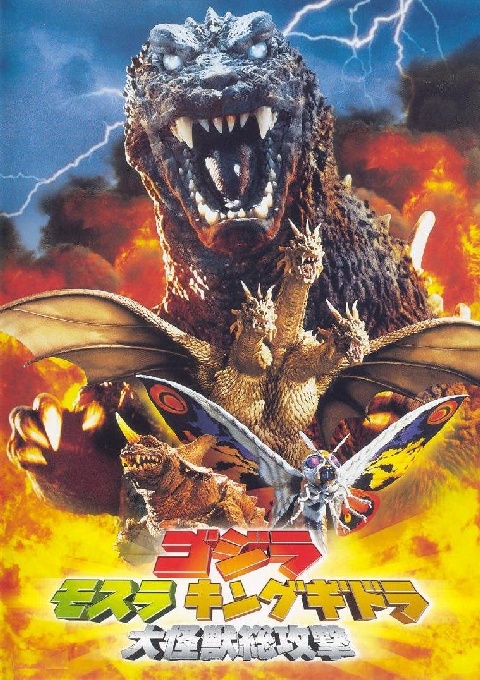
Film Review: Godzilla, Mothra, and King Ghidorah: Giant Monsters All-Out Attack (dir by Shusuke Kaneko)


gmk1-1

In honor of the opening of the new American version of Godzilla, Chiller is showing a marathon of Godzilla films today. While I was out and about during the first few films, I did make it home and turn on the TV in time to catch Godzilla, Mothra, and King Ghidorah: Giant Monsters All-Out.

That Godzilla is one moody lizard!  Half of the time, he’s Earth’s protector and you can’t help but love the big guy, no matter how many cities he destroys.  However, whenever Godzilla is in a bad mood — well, that’s when you better start looking out.

2001’s Godzilla, Mothra, and King Ghidorah: Giant Monsters All-Out Attack finds him in one of his bad moods but, at least he has an excuse.  He’s been possessed by the spirits of Japanese soldiers who were killed in World War II.  Convinced that Japan has forgotten them and their sacrifice, they are now determined to use Godzilla to get their vengeance.

Fortunately, there are three ancient guardian monsters who, once awoken, can protect the Earth from Godzilla.  Those three monsters are a dinosaur named Baragon, Mothra the giant Moth, and Ghidorah, the three-headed dragon with no arms.  With Godzilla attacking, it’s up to Ghidorah to save mankind and…

Wait a minute!

Isn’t Ghidorah supposed to be like the epitome of pure evil?  In fact, back when Godzilla was still the Earth’s protector, wasn’t Ghidorah the monster that Godzilla was always protecting us from?

Seriously, what the Hell…

Well, it really doesn’t matter.  You don’t watch a Godzilla film for continuity.  You watch them to enjoy all of the rubber-suited mayhem and that’s exactly what this film delivers.  And you know what?  Godzilla is actually a lot better at being a villain than a hero.  Whereas the heroic Godzilla always had to watch his step to make sure that he didn’t actually step on any of his human friends, the villainous Godzilla does not care.  Villainous Godzilla is a force of pure destruction and, as a result, is a lot more exciting to watch than heroic Godzilla.

And, perhaps not coincidentally, Godzilla, Mothra, and King Ghidorah: Giant Monsters All-Out Attack is one of the more entertaining entries in the Godzilla franchise — a nonstop thrill-ride of monster mayhem that also happens to feature interesting and compelling human characters as well.  Seriously, try not to be emotionally moved by the scenes of reporter Yuri and her father Admiral Tachibana working through their relationship while Tokyo burns around them.  There’s a reason why this movie ends with a close-up of a beating heart!

And, it should be noted, it also happens to have the best title of any film in the Godzilla franchise.

11088621-gal-jpg


Film Review: Godzilla vs. Destoroyah (dir by Takao Okawara)


With the new Godzilla film scheduled to be released in just two more days, we’ve been taking a look back at some of Godzilla’s previous adventures.  We’ve looked at everything from Godzilla vs. King Kong to Ghidorah, The Three-Headed Monster.  We’ve even taken a look at Godzilla’s adventures in the Marvel Universe.  Today, we consider the 22nd Godzilla film, 1995’s Godzilla vs. Destoroyah.

As Godzilla vs. Destoroyah opens, the task of monitoring and managing Godzilla has been entrusted to a military organization known as G-Force.  To be honest, my first impulse was to mock G-Force because their headquarters is known as G-Center and I kept expecting to see a tour group walking through the building while their cheerful guide explained, “This is the spot — the G-Spot.”  However, I have to admit that if I ever somehow found myself as a member of the military, I would want to be a member of G-Force, just because some of the female G-forcers get to wear a really nice uniform with a cute black skirt and a beret.  Seriously, I’d enlist just to get the beret.

It's all about the beret.

It’s all about the beret.

Anyway, G-Force may have cute uniforms but they’re apparently not very good at doing their job because they’ve lost track of Godzilla.  When last seen, Godzilla and his son — Godzilla, Jr. (yes, that’s what they actually call him) — were living on the charmingly named Birth Island.  However, Birth Island has been destroyed and when Godzilla, Sr. finally resurfaces, he’s glowing red and destroying Hong Kong.

Yes, Godzilla, Sr. has some issues.  As the G-Force scientists eventually deduce, Godzilla’s heart — which also acts as a nuclear reactor — is on the verge of a meltdown.  Not only is Godzilla dying but his death will probably cause a nuclear chain reaction that will lead to the end of the world.  As silly as this particular plot twist might sound, it actually works pretty well.  It’s a much-needed return to Godzilla’s roots, a reminder that, before he became a film star, Godzilla was meant to be the living embodiment of the atomic nightmare.  As well, the fact that Godzilla is slowly being destroyed by the same thing that brought him to life gives him a certain tragic dignity.  You may not believe that you could feel sorry for a big rubber lizard but you would be wrong.  Once it becomes clear that Godzilla is using his last remaining strength to search for and protect his son, you’d have to have a heart of stone not to be moved by his plight.

Godzilla vs. Destoroyah

Unfortunately, G-Force is apparently full of men with hearts of stone and, instead of trying to make that father-son reunion happen, they instead decide to trot out the old Oxygen Destroyer that was used to defeat the original Godzilla back in the 1954.  (In the 90s, the series was retconned to explain that the first Godzilla was destroyed in 1954 and that all the subsequent Godzilla movies featured the original’s successor.)  However, what G-Force has failed to take into account is that experimenting with the Oxygen Destroyer will also create a giant mutant crab known as Destoroyah.

Destoroyah, despite having a bit of a name problem, is actually pretty scary and, at times, feels like something that could have sprung from the imagination of H.R. Giger.  An extended scene, in which Destoroyah menaces a woman trapped in a car, is particularly well done.

Since this is a Godzilla film, all of this inetivably leads to a gigantic fight between Godzilla, Junior, and Destoroyah that manages to destroy Tokyo for the hundredth time.  Of course, even as Godzilla steps up to save the world from Destoroyah, he still remains a ticking atomic bomb…

godzilla-destoroya-screenshot

Godzilla vs. Destoroyah was meant to be the final Japanese Godzilla film, a final hurrah for the series before the American version (directed by noted Shakespearean scholar Roland Emmerich) was released.  As such, Godzilla vs. Destoroyah is very much a tribute to Godzilla’s long history (clips from the first film abound) and an attempt to give Godzilla a proper and heroic send-off before he would be reinterpreted by the Americans.  There’s an elegiac feel to much of Godzilla vs. Destoroyah and it works a lot better than you would have any reason to expect.  If this had been the final Japanese Godzilla film, it would have been a perfect chapter to end on.

However, as we all know, Godzilla vs. Destoroyah was not the final Japanese Godzilla film.  Roland Emmerich’s Godzilla was a notorious flop and continues to be reviled by good people everywhere.  Toho bought back the rights to the character and went on to produce 6 more films starring Godzilla.  And now, in just a few more days, a second attempt at an American Godzilla film will be released.

Will it be as good as Roland Emmerich’s film?

Yes.  Of course, it will.  How couldn’t it be?  Roland Emmerich is basically just Uwe Boll with a bigger budget, after all.

Will the new Godzilla be as good as Godzilla vs. Destoroyah?

That’s a question that remains to be answered.

GODZILLA%20VS_%20DESTOROYAH


Film Review: Ghidorah, The Three-Headed Monster (dir by Ishiro Honda)


ghidrah_poster_05

“These monsters are as stupid as human beings!” — Detective Shindo in Ghidorah, The Three-Headed Monster.

With that above line, Ghidorah, The Three-Headed Monster stakes it claim to being one the best of the old Godzilla movies.

First released in 1964, Ghidorah was the fifth film to feature Godzilla.  Historically, it’s important because it was the first film to feature Godzilla as a hero.  Though he doesn’t quite assume the role of Earth’s protector that would define his later films, Godzilla is definitely presented as being the lesser of two evils.  Godzilla’s previously threatening role was taken by the film’s title character.  Ghidorah, a flying, three-headed dragon, would go one to become one of Godzilla’s most frequent foes and you can tell why from watching this film.  Seriously, if anyone could be considered a worthy opponent to Godzilla, its Ghidorah.

Ghidorah!

Ghidorah!

As is often the case with the best of the Japanese monster films, Ghidorah’s plot doesn’t make a lot of sense but it’s still fun to watch.  As the film begins, Detective Shindo has been assigned to protect Princess Selina of the fictional country of Selgina.  And Selina needs the protection because Selgina is full of sinister men wearing elaborate, court jester-style costumes.  They want Selina dead and they go so far as to plant a bomb on her airplane.  However, right before the bomb goes off, an apparently possessed Selina jumps out of the plane.

Meanwhile, Prof. Murai leads a group of scientists through the wilderness, searching for a meteor that has crashed to Earth.  Is the meteor somehow connected to the bomb on Selina’s plane?  As a matter of fact it is.  Now, to be honest, you’ll probably figure out what’s going on with the meteor long before Prof. Murai or any of his colleagues but director Ishiro Honda still does a good job of building up the suspense.  You know what’s going to happen but that doesn’t make it any less entertaining when it actually does.

While Murai investigates that meteorite, a woman who looks exactly like Selina suddenly shows up in Japan, telling people that she is a Martian and predicting the end of the world.  First, she predicts that Rodan, a prehistoric pterosaur who was believed destroyed in a previous film, will come back to life.  As you can probably guess, that’s exactly what happens.

Rodan

Rodan

Next, she predicts that Godzilla will rise from the sea and destroy a boat.  Soon, Godzilla is destroying a boat and getting into a fight with Rodan.  Finally, Selina predicts that Ghidorah will destroy the world.  Soon, Ghidorah is flying over Tokyo and shooting bolts of lightning from his three heads.

Fortunately, Mothra the giant Moth happens to be in town and it falls to her to try to talk Rodan and Godzilla into teaming up with her to defeat Ghidorah.  Unfortunately, Godzilla and Rodan really don’t see why they should waste their time trying to save humans.  This leads to the film’s highlight — an extended argument between three monsters, conducted in angry roars and translated by the two miniature twins who live on Mothra’s island.  (At one point, they reprimand Godzilla for cursing.)  Watching these negotiations, a frustrated Shindo realizes that Godzilla and Rodan are just as stupid as human beings.

That scene (and Shindo’s realization) pretty much sum up everything that I love about Ghidorah.  It’s a thoroughly over-the-top, occasionally rather silly film that also happens to be a lot of fun.  The action moves quickly, the monsters are all truly monstrous, and the plot is so twisty that its impossible not to enjoy.  Best of all, this film features Godzilla fighting his most worthy opponent.  Ghidorah is both a classic monster and a classic film.

Godzilla, Rodan, Ghidorah, and Mothra

Godzilla, Rodan, Ghidorah, and Mothra

Film Review: Godzilla vs. The Sea Monster (dir by Jun Fukuda)


Godzilla vs. The Sea Monster

With the latest version of Godzilla set to be released in a little over a week’s time, we’ve been taking a look back at some of previous adventures of the king of all monsters.  Today’s movie is the 7th Godzilla film, Godzilla vs. The Sea Monster.

First released in 1966 (and also known as Ebirah, Horror of the Deep), Godzilla vs. The Sea Monster opens with a young man named Ryoto who is desperately looking for brother, Yata.  Yata is a fisherman who has gone missing at sea.  Everyone else assumes that Yata is dead but Ryoto knows that if he can just find a boat, he can set sail and rescue his brother.

But where and how can Ryoto get a boat?

Well, Ryoto happens to spot a dance marathon being broadcast on television.  First prize is a yacht!  Ryoto runs down to the dancehall, just to discover that the contest has already been going on for three days and that it’s too late for him to enter.

(Incidentally, if you know how much I love to dance than you also know how much I loved the fact that this Godzilla film featured a random and somewhat senseless dance scene.  Seriously, it was just so 1966.)

DANCE!

DANCE!

While at the dance, Ryoto meets Ichino and Nita, both of whom have already lost their chance to win the yacht.  However, Ichino and Nita take sympathy on Ryoto and decide to take him to the docks so that he can see the yacht that he could have won if only he had been able to enter the contest.  (If you’re thinking to yourself that this doesn’t make any sense and seems like an awfully complicated set up for a Godzilla movie — well, you’re right.  Get used to it because this is about as logical as any of the characters in this film get.)

Our heroes.

Our heroes.

Once they board the yacht, they’re confronted by a man named Yoshimura, who is carrying both a rifle and a briefcase full of money.  As they stare at each other, a news report comes over the radio.  It appears that there’s been a bank robbery.  Yoshimura assures them that he’s not the bank robber and then, for some reason, invites them to spend the night on the yacht.

(I imagine that a lot of kids in 1966 were going, “Where’s Godzilla!?” at this point.  Well, don’t worry.  Godzilla will show up … eventually.)

When everyone wakes up the next morning, they discover that the yacht is now floating out in the middle of the ocean.  That’s right — Ryoto has set sail and apparently, he just assumed that his three new friends would want to come along with him.

Anyway, long story short — the boat gets destroyed by a combination of a storm and a giant lobster (that would be Edirah) and our four “heroes” end up washed up on Devil’s Island.  As they investigate their surroundings, they discover that the island is controlled by a terrorist organization known as Red Bamboo.  (We know that Red Bamboo is evil because one of its leaders wears an eye patch.)

He's bad.

He’s bad.

Red Bamboo, it turns out, has been kidnapping the natives of Infant Island and putting them to work on Devil’s Island.  Now, if you’ve seen any previous Japanese monster movies, you might know that Infant Island is also the home of Mothra, a giant moth who is occasionally Godzilla’s ally.  The natives — both those who have been enslaved and those left on Infant Island — are busy praying for Mothra to come rescue them.

Mothra

Mothra

At this point, you may be tempted to repeat, “But where’s Godzilla!?”

Don’t worry, Godzilla does eventually show up.  It turns out that he’s on Devil’s Island, as well.  However, he’s asleep.  Our four “heroes” decide that the best way to defeat Red Bamboo and save the slaves would be to wake up Godzilla…

Okay, so this is a weird one.  The film takes a while to get going, plot threads are raised and abandoned almost at random, and, once he does wake up, Godzilla doesn’t really act much like himself.  (That could be because Godzilla vs. The Sea Monster was originally written to be a King Kong movie.  That would certainly explain why Godzilla becomes infatuated with an escaped slave named Dayo.)

Godzilla and Dayo

Godzilla and Dayo

But, with all that in mind, Godzilla vs. The Sea Monster has its charms.  In many ways, I would compare it to Godzilla vs. Hedorah, in that the film is hardly Godzilla at his best but, at the same time, it has enough odd moments to keep things interesting.  Ebirah may not qualify as one of Godzilla’s best opponents but he still has his moments.  His first appearance — in which a giant claw reaches out of the ocean to grab that stolen yacht — is undeniably effective.  Meanwhile, Red Bamboo makes for an enjoyably silly organization of evil doers.  They’re like an amazingly inefficient version of Hydra.  Their island headquarters is the epitome of 1966 evil chic and you have to appreciate the fact that not even they seem to be sure just what exactly their master plan entails.

And finally, there’s that big dance number at the beginning!

Seriously, you can’t go wrong with a random dance number…

Film Review: Godzilla vs. Gigan (dir by Jun Fukuda)


Godzilla and Friends

Godzilla and Friends

With the newest version of Godzilla scheduled to be released in another week and a half, we’ve been taking a look back at the some of the Big G’s previous adventures.  On Monday, Arleigh paid tribute to King Kong vs. Godzilla.  Yesterday, I reviewed the exquisitely odd Godzilla vs. Hedorah.  And today, we take a look at the 12th film in the series, 1972’s Godzilla vs. Gigan.

Gengo is a cartoonist who has a lot of talent and a really kickass girlfriend who happens to have a black belt in karate.  The one thing that Gengo does not have is a job because he can’t seem to convince any publishers to take a chance on characters like Shakura, a monster created from children’s discarded homework.  (Personally, I would have loved to have seen a movie called Godzilla vs. Shakura.)  However, things start to look up for Gengo when he is hired to help design an amusement park called World Children’s Land.

However, as Gengo quickly discovers, something is not right at World Children’s Land.  For one thing, the park manager says that, as soon as the park opens and everyone sees Godzilla Tower, there won’t be any more need for the real Godzilla or any of his friends on Monster Island.  Then, a young woman and her hippie friend approach Gengo and explain that the woman’s brother is being held prisoner somewhere in the park.  Finally — and perhaps most seriously — it turns out that park is actually being managed by a bunch of cockroaches from outer space.

The roaches have taken human form (though they still cast cockroach shadows) and spend a lot of time talking about how much they want peace but make no doubt about it, they’re planning on conquering Earth and doing away with all of humanity.  See, the roaches polluted their own planet and now, they’re looking for a new home.  But, before they can conquer the world, they have to destroy Godzilla.

And so, the roaches summon two monsters from outer space.  One of them is Ghidorah, a three-headed dragon who fought Godzilla in several films.  And I do have to say that Ghidorah is a fearsome creature:

Ghidorah!

Ghidorah!

However, as impressive as Ghidorah is, his friend Gigan is even more impressive.  Gigan is apparently a cyborg of some sort, complete with metal hooks for hands and a buzzsaw in his tummy.  Check him out:

Gigan

Gigan

Fortunately, Godzilla has an ally in his fight against Gigan and Ghidorah. Anguirus appears to be a giant armadillo and, judging from a scene where he and Godzilla have a conversation (!), he appears to be somewhat surly.  However, Anguirus is simply too cute to be believed!

Awwwww!  He's not your typical armadillo!

Awwwww! He’s not your typical armadillo!

Perhaps in response to the mixed reception earned by the frequently surreal Godzilla vs. Hedorah, Godzilla vs. Gigan is a much more traditional Godzilla adventure.  I would venture that if you asked most people to describe a typical Godzilla film, they’d probably describe Godzilla vs. Gigan.  Aliens invade Earth, evil monsters destroy Tokyo, and eventually Godzilla swims over from Monster Island to save the day.

But traditional as the film may have been, I still enjoyed it.  The monsters are memorable, the battle scenes are entertaining, and the cheap special effects (as well as the unapologetic use of stock footage) are far more charming than they have any right to be.  Listen, if you’re watching a movie like Godzilla vs. Gigan and expecting a coherent script or Avatar-style special effects then you probably need to lighten up a little.

On a final note, Godzilla vs. Gigan was released in the States as Godzilla on Monster Island and I have to say that I really like the idea of Monster Island.  Not only do all the monsters appear to get along as long as there’s no humans around but you have to appreciate the fact that Monster Island is exactly what it says it is (unlike, say, Greenland or Vermont).  I mean, if you go to a place called Monster Island and get eaten by a monster, you really have no one to blame but yourself.  Perhaps we need to set up a Shitty, Alcoholic Father Island or an Internet Troll Island so that we can keep all of the world’s real-life monsters separated from the rest of us.

Just an idea.

But until that happens, why not enjoy Godzilla vs. Gigan?

Film Review: Godzilla Vs. Hedorah (dir Yoshimitsu Banno)


GODZILLA-VS-THE-SMOG-MONSTER

With the new Godzilla film due to be released in two more weeks, we’re taking a look back at the Godzilla franchise here on the Shattered Lens.  Yesterday, Arleigh reviewed King Kong Vs. Godzilla.  Today, I’m taking a look at Godzilla vs. Hedorah.

First released in 1971, Godzilla vs. Hedorah is, to put it lightly, a weird freaking movie.  Judging from the reviews and the comments that I’ve read online, it’s also widely considered to be one of the worst of the Godzilla films.  I watched it earlier today and — well, yes, it’s not exactly Godzilla’s finest moment.  However, I’d be lying if I said that I didn’t enjoy Godzilla vs. Hedorah.  It’s just such an odd movie.

When Godzilla vs. Hedorah was originally released here in the states, it was retitled Godzilla vs. The Smog Monster.  That’s right!  This is a Godzilla film with a message!  And that message is “Stop polluting the planet or else a meteorite will crash into the ocean and cause all of the waste to take on sentient form.”  And, just in case you can’t pick up on that message despite the fact that the film is about an actual smog monster, the movie’s theme song makes the message even more explicit.  Both the theme song and the James Bondesque opening credits also serve to remind us that this isn’t your typical Godzilla movie.

(In the film’s defense, the song sounds a lot better when heard in the original Japanese.)

Godzilla vs. Hedorah starts out with a child named Ken who idolizes Godzilla and is worried about all of the muck that he sees floating in the water.  “If Godzilla saw this,” Ken tells us, “he wouldn’t be very happy.”  Ken also has dreams in which Godzilla arises from the ocean and uses his radioactive breath to set all of the world’s pollution on fire.

No sooner has Ken read an essay that he’s written about pollution then Hedorah comes to life and starts destroying Japan.  Oddly enough, nobody in the film seems to be that upset about the imminent end of the world.  However, according to Wikipedia, this was the 11th Godzilla film and I suppose that, after the 5th or 6th giant monster attack, it’s reasonable that people would adopt a somewhat blasé attitude towards them.

Anyway, Hedorah is destroying Japan by flinging around acidic sludge, a bunch of hippies decide that, seeing as how the world is doomed anyway, they might as well party on Mt. Fuji, and Ken’s father tries to figure out a way to defeat Hedorah.  Meanwhile, Godzilla comes to the aide of humanity and you have to wonder why.  The film implies that he’s been moved by Ken’s faith in him but, to be honest, Godzilla goes through this entire film looking somewhat annoyed by everything, including Ken.  He’s willing to fight Hedorah but he doesn’t seem all that emotionally invested in it.

(If anything, Godzilla reminded me of how our cat Doc acts if he’s see a cat in the alley right before dinnertime.  Doc might hiss once or twice but it’s pretty clear that his main concern is getting back inside so he can eat and then take a nap.  The hissing is just to make sure the rest of us know that Doc’s not losing his touch.)

As I said before, Godzilla vs. Hedorah is not necessarily a good movie but it sure is strange!  How strange is it?  Well, let’s just take a look at Hedorah:

HedorahPersonally, I think Hedorah looks more like Cthulhu than a smog monster but regardless, he’s certainly memorable.

However, there’s more to the strangeness of this film than just Hedorah.  Godzilla vs. Hedorah was the first Godzilla film to be made in the 1970s and its obvious that director Yoshimitsu Banno wanted to make sure that his Godzilla film stayed up with the times.  Hence, along with a heavy-handed political message, Godzilla vs. Hedorah features every single technique that was considered to be cutting edge in 1971.

Freeze frames?

This film’s got them.

Split-screens?

Hmmm…kinda.  There’s a few scenes where — for no particular reason — we see a dozen or so tv screens, all featuring a dozen or so talking heads talking at once.

Hippies?

Hippies everywhere.

A random dance scene with groovy camera angles and gratuitous use of the zoom lens?

Yes.  In fact, that was my favorite scene in the movie.

And, of course, there are the cartoons.  Whereas modern movies would probably waste a lot of money on a lot of CGI to show us how Hedorah was created and grew, this movie shows us with random cartoons.  And you know what?  The cartoons are actually a lot more fun than any CGI ever could be.

In many ways, those cartoons perfectly sum up the appeal of Godzilla vs. Hedorah.  They’re silly and a little stupid but how can you not enjoy them?  Godzilla Vs. Hedorah isn’t exactly good but it’s definitely a lot of fun.

Film Review: Only Lovers Left Alive (dir by Jim Jarmusch)


Is it possible that the iconic American independent filmmaker Jim Jarmusch is a fan of the late and beloved French film director Jean Rollin?

I ask this question because Jarmusch’s latest film, Only Lovers Left Alive, is one of the most Rollinesque films to have ever been made by a director other than Jean Rollin.

The most obvious similarity between Jarmusch’s film and much of Rollin’s work is that they both deal with vampires.  Rollin was the visual poet of vampire cinema and, if nothing else, Only Lovers Left Alive is a very poetic film.  The film tells the story of three vampires — ennui-stricken Adam (Tom Hiddleston), Adam’s wife Eve (Tilda Swinton), and Eve’s hedonist sister Ava (Mia Wasikowska), all of whom would be perfectly at home in any of Rollin’s vampire films.

But, to be honest, the horror genre has reached the point where ennui-stricken and decadent vampires are hardly unique. What distinguished both Only Lovers Left Alive and the best films of Jean Rollin is the way that they both use and defy the conventions of the vampire genre to explore issues of sexuality, religion, politics, and artistic expression.  Much like Rollin, Jarmusch understands what the audience expects from a vampire film and he makes his larger points by manipulating, defying, and occasionally even confirming those expectations.

In other words, Only Lovers Left Alive is no Twilight and we’re all better off for it.

DAY1-0217.CR2

There are other similarities between Only Lovers Left Alive and the best films of Jean Rollin.  Much like Rollin, Jarmusch tells his story through a collection of sensual and increasingly dream-like images.  Even Rollin’s trademark lingering shots of empty beaches and ancient castles are duplicated, in Only Lovers Left Alive, with haunting shots of the empty streets in Detroit and Tangiers.  When, towards the end of the film, two hungry vampires find themselves searching for blood in an ancient city, it was impossible for me not to think of a similar scene in Jean Rollin’s Two Orphan Vampires.

Now, I’m sure that some of you are probably saying, “That’s great, Lisa, but can you just tell me whether the film is worth watching or not?”

To answer your question, it is.  It’s not a flawless film.  There’s a few comedic scenes involving a doctor played by Jeffrey Wright that aren’t quite as entertaining as they could be.  And while it’s an interesting idea to have Christopher Marlowe show up as a vampire, John Hurt’s performance did not quite work for me.  But, whenever the film concentrates on the chemistry between Hiddleston, Swinton, Wasikowska, and Anton Yelchin (who plays a hilariously naïve human), it works brilliantly.

So yes, definitely — see Only Lovers Left Alive.

968full-only-lovers-left-alive-screenshot

See it for the scenes in which Adam and Eva drive through the ruins of Detroit, looking for Jack White’s house (“Oh!  I love Jack White!” Eve exclaims) and discussing Adam’s belief that the “zombies” (his term for the rest of us) are on the verge of destroying themselves.  Adam serves as the film’s philosophical and political mouthpiece and often times, his dialogue runs the risk of being a bit too on-the-nose perfect but Tom Hiddleston is such a charismatic performer that it doesn’t matter.  Wisely, Hiddleston delivers his most portentous lines with just a hint of self-mockery, as if to let us know that even Adam knows he’s being overdramatic.

See it for the amazing sequence in which Adam plays music in Detroit while Eve dances to it in Tangiers.  If Katharine Hepburn had been turned into a vampire, she would have been a lot like Tilda Swinton’s Eve.

See the film for Mia Wasikowska’s hilarious turn as a petulant and immature brat who just happens to be vampire.  The scenes in which she goes out of her way to annoy the dour Adam left me convinced that, if I ever become a vampire, I’ll probably be a lot like Ava.

See it because the White Hills appear as themselves, playing in a club and absolutely killing it.

See it because it’s one of the few vampire films to strike a perfect balance between humor and drama.

Most of all, see it because it’s a good and unique movie and, so far this year, we’ve had a bit of a shortage where those are concerned.

As for me, if I ever meet Jim Jarmusch, I’m going to ask him for the title of his favorite Jean Rollin film.

If nothing else, it should be an interesting conversation.

only-lovers-left-alive-poster


A Warning From The Past: The Last Prom


As I’ve mentioned previously on this site, I love old educational films.  Not only do they serve as valuable time capsules but they’re also often so melodramatic and over-the-top that I can’t help but appreciate them.

After all, there’s a reason why one of my favorite DVDs is entitled Driver’s Ed Scare Films Volume Five.

And one of my favorite films on that compilation is 1980’s The Last Prom.  Taking place in the small town Indiana and featuring a ghostly choir wailing away on the soundtrack, The Last Prom tells the tale of Sandy, a junior who makes the mistake of going to the prom with a senior who owns a van.  Needless to say, the entire film is a bit of a downer but its worth watching just to see all of the old clothes and the old haircuts (not to mention the Sandy spinning around in circles montage).

Having watched this film several times, I have to say — in Bill’s defense — that tunnel was way too narrow.  But, seriously, don’t drink and drive.