At the height of the Civil War, the small town of Border City, Missouri has declared itself to be neutral ground. Mayor Delilah Courtney (Nina Varela) announces that anyone who enters her town looking to recruit for either the Union or the Confederacy will be arrested and will face the possibility of being hung from the noose in the middle of Main Street.
That doesn’t stop Charles Quantrill (Brian Donlevy) from coming to town. Quantrill is a former Confederate officer who now terrorizes the Arkansas/Missouri border with his gang of thieves. Accompanying Quantrill is his wife, Kate (Audrey Totter), who once lived in Border City and who still enjoys singing a song at the saloon.
Another new arrival is Sally Maris (Joan Leslie), who comes down from Michigan to help her no-account account, Bitterroot Bill (Reed Hadley), run his saloon. Sally attempts to bring some order to the rowdy saloon, which makes an enemy out of Kate. When Bill is killed in a gunfight, Sally takes over the saloon and soon, she is being challenged first to a fight and then to an actual duel by Kate. With the disapproving Mayor Courtney watching all of the action from her office, it is obvious that one of the women is eventually going to be taken to the noose in the middle of the street but which one?
This is one of the best of the many B-westerns that Allan Dwan directed in the 1950s. Though much of the emphasis is on the usual western action — Quantrill wants to take over a mine, there’s a Confederate spy in town, and both Frank and Jesse James appear as supporting characters — the film is really about the rivalry and eventual partnership between a group of strong-willed woman who aren’t going to let anyone tell them how to live their lives. As tough as Kate is, Sally proves to be stronger than she looks and, in the end, they realize that they are stronger working together for a common goal than trying to tear each other down. Audrey Totter and Joan Leslie both give sexy and tough performances as Kate and Sally. They’re equally believable hanging out in a saloon, flirting with a cowboy, or drawing guns on each other in the middle of the street.
Along with taking a strong stand against vigilante justice, Woman They Almost Lynched features an exciting stage coach robbery, an intriguing story, and two very interesting lead characters. It’s a western that deserves to be better known.
On February 14th, 1929, seven men were murdered in a garage in Chicago, Illinois. Five of the seven men were known to be associates of gangster George “Bugs” Moran. The other two men were considered to be innocent bystanders, a mechanic and a dry cleaner who just happened to enjoy hanging out with gangsters. Though no one was ever convicted of the crime, it was well-known that the murders were carried out on the orders of Al Capone.
In many ways, the St. Valentine’s Day Massacre was a turning point in America’s relationship with organized crime. Before the massacre, Capone had become a bit of a folk hero. He knew how to talk to the press and he was viewed as merely breaking a law (in this case, prohibition) that most people opposed in the first place. However, after the murders, public opinion soured on Capone.
Some of it was the brutality of the crime. It’s been said that over five hundred bullets were fired in that garage, all to kill seven defenseless men who were lined up against a wall. Grisly pictures of the victims were released to the press. Perhaps if the seven men had been carrying weapons and had been involved in a shootout with their murderers, the public’s reaction would have been different. But this was a cold-blooded execution.
Personally, I think the fact that the killers disguised themselves as cops also played a role in the public’s outrage. It was a very calculated move on the part of the killers and it highlighted just how much planning went into the St. Valentine’s Day Massacre. As well, it undoubtedly made people paranoid. If a bunch of killer could dress up like cops, who knew who else they could dress up as?
Finally, I think that Capone’s biggest mistake was carrying out the crime on Valentine’s Day. You don’t murder people on a holiday. Anyone should know that. If Capone had waited until February 20th, he probably could have gotten away with it.
The 1967 film, The St. Valentine’s Day Massacre, details the rivalry between Capone and Moran, starting with them fighting for control over the Chicago rackets and ending with the title event. Moran is played by Ralph Meeker while Jason Robards plays Capone.
Now I know what you’re probably thinking. Perennial WASP Jason Robards as Al Capone? That may sound like odd casting and, let’s just be honest here, it is. However, it actually kind of works. Robards may not be convincingly Italian but he is convincingly ruthless. Add to that, one of the major subplots of the St. Valentine’s Day Massacre is that, even as the head of the Chicago Outfit, Capone still feels like an outsider in the world of organized crime because, while he is Italian, he isn’t Sicilian. Capone feels as if Lucky Luciano and all of the major New York crime bosses look down on him and one reason why he’s so ruthless about taking over Chicago is that wants to show Luciano that he can be just as effective a crime lord as any Sicilian. Capone feeling out of place in the Mafia is reflected by Robards initially seeming to be out of place in a gangster film. By the end of the movie, of course, Capone has proven himself and so has Jason Robards.
Robards isn’t the only familiar face to be found in The St. Valentine’s Day Massacre. Though this film was released by 20th Century Fox, it was directed by Roger Corman and Corman fills the production with members of his stock company. Dick Miller, Jonathan Haze, and Jack Nicholson all have small roles as gunmen. Bruce Dern plays the unlucky mechanic who enjoys hanging out with gangsters. Buck Taylor, Leo Gordon, and Joe Turkel all have small roles. John Agar plays Dion O’Bannon and is gunned down in his flower store. Though not members of the Corman stock company, George Segal and David Canary plays brothers who work for Moran. There’s a lot of characters wandering through this film but Corman makes sure that everyone gets a chance to make an impression.
It’s a good gangster film. Though he was working with a larger budget than usual, Corman still brought his exploitation film aesthetic to the material and the end result is a violent, melodramatic gangster film that looks really impressive. The film’s recreation of 1920s Chicago is a visual delight and looking at the well-dressed and stylish gangsters walking and driving down the vibrant city streets, you can understand why organized crime would have such a draw for some people.
The St. Valentine’s Day Massacre is a classic gangster film and a classic Corman film. It’s an offer you can’t refuse.
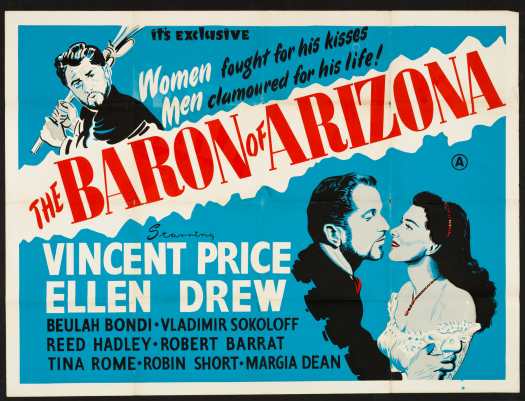
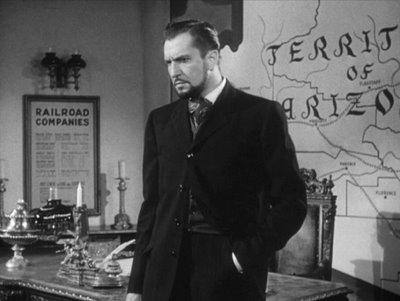
We all know and love Vincent Price for his creepy performances in horror films, from his demented Henry Jarrod in HOUSE OF WAX, to all those AIP/Roger Corman/Edgar Allan Poe shockers, to his turn as The Inventor in EDWARD SCISSORHANDS. But the actor was more than just a screen fiend, playing in many a filmnoir, comedies, costume swashbucklers, and even the Western genre. Our Man Vinnie got top billing in a strange little oater titled THE BARON OF ARIZONA, and as a bonus for film fans the director is a young tyro by the name of Samuel Fuller!
In this bloodless but gripping outing, Price plays James Addison Revis, a swindler, con man, and forger who concocts an elaborate, grandiose scheme to gain control over the Arizona Territory in 1882. He begins his con game ten years earlier by grooming an orphaned waif named Sofia to later be…
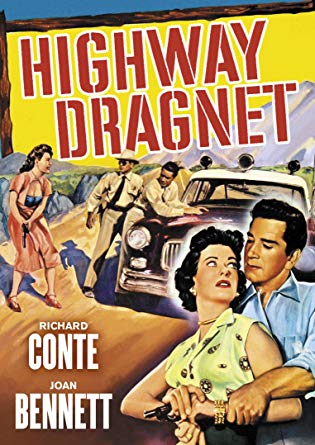
Nifty is not really a word that I ever use, mostly because I’m not 80 years old and I’m not totally sure what the word means. I’ve always assumed that nifty is way of saying that something is good without being too good and, if that’s true, then I have to say that the low-budget 1954 film noir, Highway Dragnet, certainly is a nifty film.
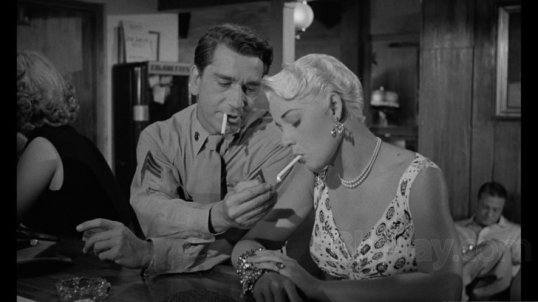
Highway Dragnet opens with Jim Henry (Richard Conte, who decades later would play the evil Barzini in The Godfather) in Las Vegas. Jim’s just gotten out of the army and he’s visiting his friend, Paul (Frank Jenks). Paul is a secret agent who is often unexpectedly called away. Unfortunately, this means that Paul is not around when Jim is accused of murdering another man. Since Jim was previously seen hitting on the dead man’s girlfriend, the police naturally assume that Jim’s the murderer. When Jim says that Paul can provide an alibi whenever he gets back from doing his super secret spy stuff, the cops assume that Paul doesn’t actually exist.
Under the direction of the stern Lt. White Eagle (Reed Hadley), the cops are doing a lot of assuming! Now, if Jim was smart, he would say, “Hey, White Eagle, you know what? When you assume, you make an ass out of u and me!” But Jim’s not smart so he decides to fire a gun at the cops and then go on the run!
Hey, Jim …. none of that makes you look innocent!
Anyway, while making his way across the desert, Jim comes across two women who are having car trouble. Mrs. Cummings (Joan Bennett, who went from nearly getting cast as Scarlett O’Hara in Gone With The Wind to becoming a low-budget noir mainstay) is a fashion photographer and Susan Willis (Wanda Hendrix) is her model. Jim fixes their car and then asks them for a ride. They agree, little knowing that they’re heading straight into a …. HIGHWAY DRAGNET!
Of course, it turns out that Jim’s new friends have a connection to the crime of which he’s been accused. The plot of Highway Dragnet hinges on a totally implausible coincidence. This is perhaps not surprising when you consider that the script for Highway Dragnet was written by the legendary Roger Corman. In fact, it was the first script that he ever sold and, though the film was directed by Nathan Juran, Highway Dragnet feels very much like a Corman quickie. The plot is whatever it needs to be to get the story from the beginning to the end in 71 minutes. Whether it all makes sense or not doesn’t appear to be all that much of a concern.
So, here’s what does work about Highway Dragnet. First off, director Nathan Juran (who was also an award-winning art designer) manages to capture some memorable images of the Nevada desert and the film ends with a wonderfully over-the-top and atmospheric confrontation in a flooded house. Secondly, Joan Bennett is as passive-aggressively menacing in Highway Dragnet as she would later be in Dario Argento’s Suspiria. I also liked the performance of Reed Hadley, playing the unstoppable and incorruptible Lt. White Eagle.
Last Saturday, I watched Highway Dragnet with my friends in the Late Night Movie Gang and we enjoyed it. It’s undoubtedly a minor film noir but it’s still entertaining when taken on its own terms. If nothing else, the box office success of this low-budget production (which was shot over ten days) reportedly inspired Roger Corman to get serious about pursuing his own career in the film industry and, for that, movie lovers will always be thankful.
Having grown up on endless reruns of I LOVE LUCY (and her subsequent variations on the Lucy Ricardo character), I’m not used to watching Lucille Ball in a dramatic role. In fact, I think the 1985 TV movie STONE PILLOW is the only time I’ve seen her play it straight until I recently watched THE DARK CORNER on TCM, a minor but enjoyable noir with Lucy headlining a good cast in a story about a private eye framed for murder. And since today marks the 105th anniversary of the redhead’s birth, now’s as good a time as any to look back on this unheralded hardboiled tale.
Lucy, looking mighty sexy at age 35, plays Kathleen Stewart, secretary to PI Bradford Galt, recently relocated to The Big Apple. He’s got a secret past that’s dogging him, and a shady man in a white suit following him. Galt confronts the tail, who claims to be…
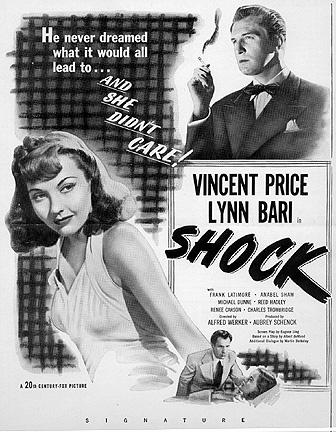
Shock opens with a young housewife named Jane Stewart (Anabel Shaw) waking from a dream, getting out of bed, looking out a window, and seeing something rather serious happening in the house next door. A man and a woman are arguing. Though Jane doesn’t recognize the man, horror fans will immediately realize that he’s Vincent Price, without a mustache. As Jane watches, the man beats the woman to death. When Jane’s husband, Lt. Paul Stewart (Frank Latimore), returns home, he discovers that Jane is in a catatonic state.
Paul calls the local cranky physician, Dr. Harvey (Charles Trowbridge), to the house. Dr. Harvey takes one look at Jane and announces, “She’s in shock!” (YAY! WE HAVE A TITLE!) Paul looks confused so Dr. Harvey goes on to explain, “She’s had a great shock.” Unfortunately, Dr. Harvey is not trained to deal with shock but he knows someone who is. That man’s name is Dr. Richard Cross.
Soon Dr. Cross shows up and — OH MY GOD, IT’S VINCENT PRICE! That’s right — Dr. Cross not only caused Jane’s shock but now he’s going to treat it! Or is he? Though Dr. Cross claims to be wracked with guilt over the murder, his nurse, Elaine Jordan (Lynn Bari), is less concerned about it. In fact, since Elaine is also his mistress, she’s rather happy that Dr. Cross has murdered his wife. Now, she just has to convince him to murder Jane before she recovers from her shock.
(Interestingly enough, Dr. Cross’s plan involves treating Jane with insulin shock therapy, which would seem to indicate that Dr. Cross has seen Dr. Kildare’s Strange Case too many times.)
I had high hopes for Shock, largely because of the presence of Vincent Price. From what I’ve read, the box office success of Shock changed the course of Price’s career. Before Shock, Price was a character actor who occasionally got a good supporting role. After Shock, he was transformed into the horror icon who we all know and love today. Shock was the first time that Price was cast in the type of mad scientist role that would later become his trademark. For that reason, Shock has an important place in the history of cinematic terror.
But, unfortunately, Shock itself is kind of forgettable. It’s pretty much your standard thriller, one that makes the mistake of revealing Price’s villainy from the start. (It would have been far more effective if the film tried to shock us with the realization that Price is the bad guy.) It’s always fun to watch Vincent Price in a movie but he actually gives a rather subdued performance here and, as a result, he’s not as much fun as he would be in his later films. In other words, Shock is no House On Haunted Hill.
That said, Shock is definitely a piece of film history and, as such, it’s worth watching. And here it is:
 At the height of the Civil War, the small town of Border City, Missouri has declared itself to be neutral ground. Mayor Delilah Courtney (Nina Varela) announces that anyone who enters her town looking to recruit for either the Union or the Confederacy will be arrested and will face the possibility of being hung from the noose in the middle of Main Street.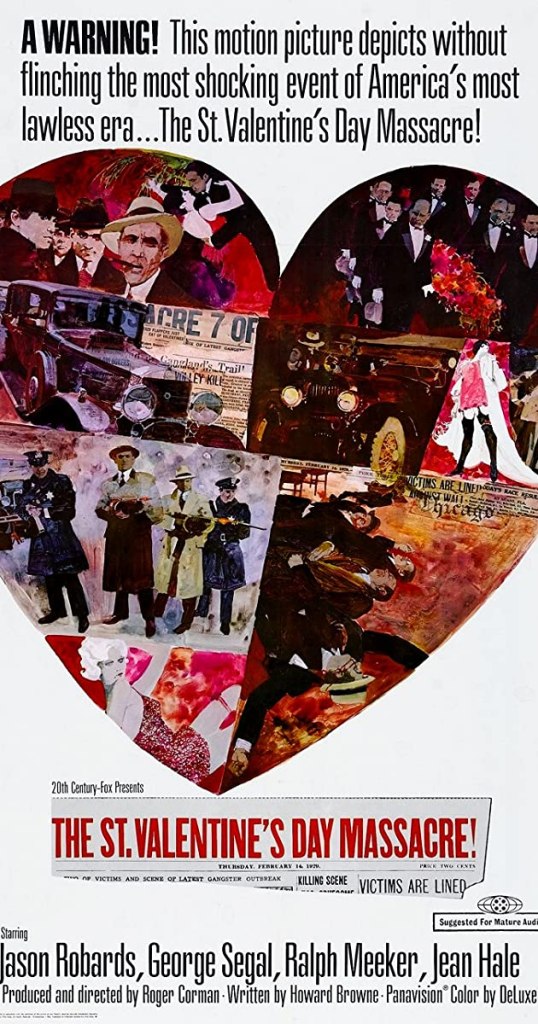



 Through the Shattered Lens