Brad reviews STRAIGHT TALK (1992), starring Dolly Parton and James Woods! 


STRAIGHT TALK opens with Shirlee Kenyon (Dolly Parton) having a bad day in the town of Flat River, Arkansas. First, she gets fired from her job at a dance studio because she likes to talk to the customers more about their problems than she does teaching them to dance. Then she goes home to her lazy, unemployed boyfriend Steve (Michael Madsen), who’s more interested in drinking beer and bowling than talking to her. She tells him she wants to leave town and go to Chicago for a fresh start. He heads to the bar, so she packs her bags and heads to the Windy City. Upon arriving, she finds a job as a receptionist at a local radio station. Through a case of mistaken identity that can only happen in the movies, Shirlee finds herself on air as “Dr. Shirlee,” where she begins fielding calls from people with all kinds of problems. With her homespun wisdom, Dr. Shirlee soon finds herself to be the toast of Chicago. Feeling guilty that the station is advertising her as a “Doctor” when she’s not, Shirlee reluctantly continues on when her boss Alan (Griffin Dunne) convinces her she’s a “doctor of the heart.” Alan takes that simple lie and creates an entire fake public identity for Shirlee. When reporter Jack Russell (James Woods), in serious need of a story, senses that something’s not adding up with Dr. Shirlee, he convinces his editor Milo Jacoby (Jerry Orbach) to let him try to get close to the city’s new star to see if he can dig up some dirt. As he gets to know her, however, he’s charmed just like the rest of city and the two begin to fall in love. With Shirlee feeling guilty about being marketed as someone she’s not, and with Jack feeling bad about deceiving her for a scoop, is there any chance that their love can survive when the truth finally comes out?

STRAIGHT TALK is one of those movies that lives or dies based on whether or not you like its stars. This early 90’s romantic comedy was made for Dolly Parton’s fans, of which there are many. She looks beautiful, she has a great wardrobe, she sings the catchy soundtrack tunes, and she dispenses down-home country wisdom in a way that only Dolly can. And then there’s James Woods as the cynical reporter / love interest. Not traditionally handsome or known for his performances in romantic comedies, he brings his unique style to the role, and somehow it really works. As a huge fan of Woods, I may be a little biased, but I think that he has a great chemistry with Dolly. There does seem to be some basis for my claim as the two seemed to really enjoy each other on the set. Dolly has been quoted as saying that he’s “a great kisser” and a “thrill to be around.” Woods recently posted on social media that “Dolly Parton is the nicest person I’ve ever worked with…. She’s everything you imagine and so much more. Anybody who’s ever spent any time with her absolutely adores her.” I think these genuine feelings show through on the screen and provide levels of entertainment that transcend what’s on the pages of the script.

Aside from the excellent chemistry of its leads, STRAIGHT TALK does lean hard into romantic comedy cliches, and honestly that’s okay with me. I enjoyed the familiar plot lines… Will Shirlee become a star in the big city? Will reporter Jack expose her past? Will the two fall in love? Will her old boyfriend Steve show up? Will her “on-air” advice cause some unexpected problems? Well, of course, on all accounts! As these well worn stories play out against the backdrop of an early 90’s movie version of Chicago, I enjoy the movie for what it is, an entertaining fluff piece. The interesting supporting cast (Griffin Dunne, Michael Madsen, Jerry Orbach, John Sayles, Spalding Gray, etc.) do their jobs well, further enhancing my appreciation of the movie. 

With all that said, I do recognize that the joy of movies is purely a subjective experience, and if you’re not a fan of Dolly Parton, you probably won’t enjoy STRAIGHT TALK. It’s not a great movie in traditional terms, but it is a great “Dolly Parton” movie. I like Dolly, and I especially enjoy her relationship with James Woods within the film, so this is another one of those movies from my youth that I like to watch every few years. I enjoy it every single time. 

Brad reviews HITCH (2005), starring Will Smith and Kevin James!


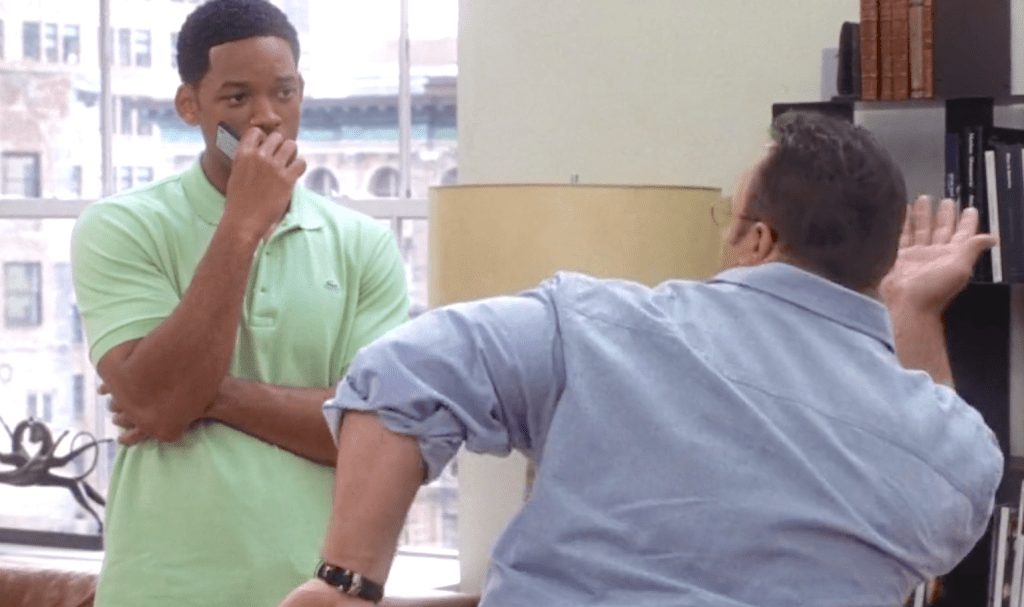
I guess you can call this the holiday season of love for me, as I turn my attention today toward the 2005 romantic comedy HITCH. Will Smith stars as Alex “Hitch” Hitchens, a somewhat legendary and highly discreet consultant based in New York City. His specialty… helping less than perfect, even slightly awkward, men win the hearts of beautiful women. His methods are very effective, but he only works with men who are genuinely in love and not just chasing a one-night stand. His latest lovelorn client, the sweet and clumsy tax accountant Albert Brennaman (Kevin James), is smitten with a famous heiress named Allegra Cole (Amber Valletta), a client of the tax firm he works for. As Hitch works his magic for Albert, he also meets the cynical, but extremely beautiful tabloid journalist Sara Melas (Eva Mendes). Hitch finds himself falling for Sara at the same time that she’s on the trail of an urban myth of a “Date Doctor,” mistakenly believing that he is exploiting the emotions of women in the city for his own personal gain. When Sara and Amber discover who Hitch really is, will the guys’ true love win the day, or will the ladies believe it was all just a sleazy, manipulative setup?

HITCH is one of my favorite romantic comedies, and I watch it every year, usually multiple times. I’m a romantic at heart, and I really enjoy a film that plays with the idea of characters who truly care about, and respect, each other. This dynamic plays out through several different relationships. My favorite is the genuine friendship that develops between Hitch and Albert Brennamen. Hitch recognizes the sincere feelings that Albert has for Allegra, and he then goes all in to help him win her heart. While Will Smith is effortlessly charming and in peak movie star form, unsurprisingly, the character I identify the most with is Kevin James as Albert. His character is so sweet and earnest in his pursuit of Allegra that you just can’t help but pull for him. Balance that part of his character with James’ excellent physical comedy, whether it be his natural clumsiness or his unfounded confidence in his dance moves, and James gives the performance that takes this movie over the top for me. When teaching Albert the dance moves that he should stick with when he’s out on a date with Allegra, Hitch utters the line, “Don’t you bite your lip. Stop it!” It was that moment when I realized that, like Albert, I never dance without biting my own lip!

While the fraternal love between Hitch and Albert is my favorite relationship in the film, I also like the romantic relationship that develops between Hitch and Sara. I appreciate the way both characters step out of their comfort zones and risk their own hearts for each other. This is not easy for either of them, as Hitch’s charm and confidence actually masks deep insecurities based on his past relationships. Sara, on the other hand, has allowed herself to become very cynical towards all men, building walls so tall that no man can climb them. The fact that they truly open themselves up to each other, even if there are some serious complications along the way, gave me a strong rooting interest in their happiness.

The last performance I wanted to highlight in HITCH is that of Jeffrey Donovan, who plays sleazy narcissist Vance Munson. Munson tries to hire Hitch to help him get a vulnerable woman into bed, and in a moment of pure audience satisfaction, he pays the price for his disrespect. About the time I watched HITCH, Donovan was starring in a T.V. series that I really enjoyed called BURN NOTICE. I’m a big fan of Donovan, and he’s perfect here as a man you love to hate. In a movie full of likable characters, Vance Munson was a needed counterpoint, and his A-hole character really stands out.

No movie is perfect, but if you’re in the mood for something that’s lighthearted, funny, and makes you want to fall in love, then HITCH is about as close as it gets.

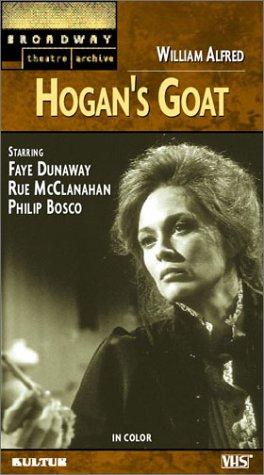
Made-For-Television Film Review: Hogan’s Goat (dir by Glenn Jordan)


1971’s Hogan’s Goat opens in Brooklyn in the 1890s.  This was when Brooklyn itself was still a separate city, before it become a borough of the unified New York City.  If you’ve watched the video that I include with most of my Welcome Back Kotter reviews, you’ll notice the boast: “Fourth largest city” on the Welcome to Brooklyn sign.  And indeed, if Brookyln had remained independent, it would now be the fourth most populated city in America, behind New York, Los Angeles, and Chicago.  Sorry, Brooklyn.

(However, Houston thanks you.)

Local ward boss Matt Stanton (Robert Foxworth) heads home with what he thinks is exciting news.  He tells his wife, Kathleen (Faye Dunaway), that he is finally going to be mayor of Brooklyn.  The current mayor, a man named Quinn (George Rose), has been caught up in some sort of corruption and the Democratic political machine is ready to abandon him.  Matt Stanton is about to become one of the most powerful men in New York.  That’s not bad for a relatively young man who came to America from Ireland in search of a better life.  Adding to Stanton’s happiness is the fact that he’ll be defeating Quinn, a canny politician towards whom Stanton holds a grudge.  Kathleen, however, is worried.  An immigrant herself, Kathleen met Stanton while the latter was in London.  They were married in a civil ceremony and, ever since Stanton brought her back to Brooklyn, she has been lying and telling everyone that they were married in a church.  Kathleen feels that she and Stanton have been living in sin and she wants to have a convalidation ceremony.  Stanton refuses because doing so would mean admitting the lie in the first place and he can’t afford to lose the support of the Irish Catholic voters of Brooklyn.

However, it turns out that there are even more secrets in Stanton’s past, ones that Kathleen doesn’t know about but Quinn does.  When those secrets start to come out, Kathleen comes to realize that there’s much that she doesn’t know about her husband.  Stanton, with political power in his grasp, desperately tries to hold on to the image that he’s created of himself and Kathleen, leading to tragedy.

Hogan’s Goat was an Off-Broadway hit when it premiered in the mid-60s and its success led to Faye Dunaway getting her first film offers.  The made-for-television version of Hogan’s Goat, which premiered on PBS and featured Dunaway recreating her stage role, is essentially a filmed play.  Little effort was made to “open up” the story and, as a result, the film is undeniably stagy.  It’s clear from the start the film was mostly shot to record Faye Dunaway’s acclaimed performance for posterity.  Indeed, she’s the only member of the theatrical cast to appear in the film version.  Dunaway does give a strong performance, easily dominating the film with her mix of nervous intensity and cool intelligence.  The rest of the cast is a mixed bag.  Robert Foxworth is appropriately driven and ambitious as Stanton but his Irish accent comes and goes.  Philip Bosco does well as a sympathetic priest and George Rose is appropriately manipulative as Quinn.

In the end, the story of Hogan’s Goat is probably of the greatest interest to Irish-American history nerds like me, who have read and studied how Irish immigrants, especially in the 19th century, faced tremendous prejudice when coming to the United States and how they reacted by building their own political machines and dispensing their own patronage.  In Hogan’s Goat, the conflict is less between more Stanton and Quinn and more between Kathleen’s traditional views and her devout Catholicism and Stanton’s own very American ambition.  Whereas Kathleen still fights to retain her faith, pride, and her commitment to who she was before she married Stanton, Stanton fights for power and to conquer the man who Stanton feels has everything that he desires.  In the end, Stanton’s hubris is not only his downfall but Kathleen’s as well.

Film Review: Quick Change (dir by Bill Murray and Howard Franklin)


“Leave the Bronx …. it is time to leave the Bronx….”

Escape from New York….

“Someday, a real rain will come and watch all this scum off of the streets….”

“Kill, Berkowitz!” the Dog with John Turturro’s voice commands, “Kill!  KILL!”

And then there’s 1990’s Quick Change:

Of the many films that have been made about people desperately trying to get the Hell out of New York City, Quick Change is one of the funniest.  The appropriately-named Grimm (Bill Murray) works in the city planning office and has had all that he can take of New York’s crime and rudeness.  His solution is to dress up like a clown and rob a bank.  His girlfriend Phyllis (Geena Davis) and best friend Loomis (Randy Quaid) are already inside the bank, disguised as customers.  When Grimm, who claims to be a “crying on the inside” type of clown, takes everyone in the bank hostage and forces them into the vault, Phyllis and Loomis grab as much of the money as they can.  Talking on the phone to police chief Rotzinger (Jason Robards), Grimm makes a series of pointless demands.  Each demand that is met leads to Grimm releasing a group of hostages.  By removing his clown makeup, Grimm is able to join Phyllis and Loomis when they are “released.”  Rotzinger, who has even managed to procure a monster truck, thinks that the robber is still in the bank while Grimm, Phyllis, and Logan head for the airport.

Of course, things don’t go as planned.  What starts out as a energetic and good-natured Dog Day Afternoon parody quickly becomes an increasingly surreal journey through New York.  The streets are in terrible condition.  The signs that would have provided directions to the airport have been taken down by a road construction crew.  (They explain that they’re only taking down the signs today and it will be a few days before they get around to putting them back up.)  One of the few polite people they meet turns out to be a thief who steals four dollars from Grimm’s wallet but fails to notice that he’s got a million dollars taped around his waist.  Stanley Tucci shows up as a mobster.  Tony Shalhoub plays a well-meaning taxi driver who speaks his own indecipherable language.  Grimm keeps running into rude cops who, despite being on the hunt for the bank robbers, are frequently too busy being rude to notice what’s happening in front of them.

Best of all, Grimm, Phyllis, and the increasingly addled Loomis board a bus being driven by the film’s greatest character.  Played by Philip Bosco, the bus driver is a wonderful comedic creation.  “That’s not exact change,” the driver says when Loomis attempts to pay him with a hundred dollar bill.  “Behind the white line,” he says before starting the bus.  When Loomis, who has a habit of running into things and appears to be suffering from a concussion, tries to sit down, the bus driver informs him that he’s not allowed to sit until he receives exact change.  The driver has a schedule to keep and, to his credit, he largely manages to do so.  Bosco plays him with such deadpan determination that it’s hard not to admire his dedication to following every single regulation to his job.  As opposed to Grimm, the driver has learned to deal with living in New York by obsessively making every scheduled stop.

Quick Change struggles sometimes to balance its moments of humor and drama.  Scenes of Loomis running like a cartoon character are mixed with scenes of Phyllis worrying that Grimm might actually be a hardened criminal and struggling with whether or not to tell him that she’s pregnant.  This was Bill Murray’s first and only film as a director and sometimes, he does struggle to maintain a consistent tone.  But, in the end, what’s important is that it’s a funny film.  Bill Murray is one of those actors who can make you laugh just by existing and, as a director, he’s smart enough to give Jason Robards enough room to make Rotzinger into something more than just a standard comedic foil.

Quick Change is a comedic nightmare, one that made me laugh even as it also made me glad that I don’t have to drive in New York.  I get lost just driving around the suburbs of Dallas.  There’s no way I’d ever be able to find my way out of New York.

Catching-Up With Two Courtroom Dramas: Suspect and 12 Angry Men


As a part of my continuing effort to get caught up with reviewing all of the movies that I’ve seen this year, here’s two courtroom dramas that I recently caught on This TV.

  • Suspect
  • Released in 1987
  • Directed by Peter Yates
  • Starring Cher, Dennis Quaid, Liam Neeson, John Mahoney, Joe Mantegna, Philip Bosco, Fred Melamed, Bernie McInerney, Bill Cobbs, Richard Gant, Jim Walton, Michael Beach, Ralph Cosham, Djanet Sears 

Suspect is a hilariously dumb movie.  How dumb is it?  Let me count the ways.

First off, Cher plays a highly successful if rather stressed public defender.  And don’t get me wrong.  It’s not that Cher is a bad actress or anything.  She’s actually pretty good when she’s playing Cher.  But, in this movie, she’s playing someone who managed to graduate from law school and pass the DC bar.

Secondly, Cher is assigned to defend a homeless man when he’s accused of murdering a clerk who works for the Justice Department.  The homeless man is deaf and mute, which isn’t funny.  What is funny is when he gets a shave and a shower and he’s magically revealed to be a rather handsome and fresh-faced Liam Neeson.  Liam doesn’t give a bad performance in the role.  In fact, he probably gives the best performance in the film.  But still, it’s hard to escape the fact that he’s Liam Neeson and he basically looks like he just arrived for a weekend at Cannes.

Third, during the trial, one of the jurors (Dennis Quaid) decides to investigate the case on his own.  Cher even helps him do it, which is the type of thing that would get a real-life attorney disbarred.  However, I guess Cher thinks that it’s worth the risk.  I guess that’s the power of Dennis Quaid’s smile.

Fourth, the prosecuting attorney is played by Joe Mantegna and he gives such a good performance that you find yourself hoping that he wins the case.

Fifth, while it’s true that real-life attorneys are rarely as slick or well-dressed as they are portrayed in the movies, one would think that Cher would at least take off her leather jacket before cross-examining a witness.

Sixth, it’s not a spoiler to tell you that the homeless man is innocent.  We know he’s innocent from the minute that we see he’s Liam Neeson.  Liam only kills who people deserve it.  The real murderer is revealed at the end of the film and it turns out to be the last person you would suspect, mostly because we haven’t been given any reason to suspect him.  The ending is less of a twist and more an extended middle finger to any viewer actually trying to solve the damn mystery.

I usually enjoy a good courtroom drama but bad courtroom dramas put me to sleep.  Guess which one Suspect was.

  • 12 Angry Men
  • Released 1997
  • Directed by William Friedkin
  • Starring Courtney B. Vance, Ossie Davis, George C. Scott, Armin Mueller-Stahl, Dorian Harewood, James Gandolfini, Tony Danza, Jack Lemmon, Hume Cronyn, Mykelti Williamson, Edward James Olmos, William Petersen, Mary McDonnell, Tyrees Allen, Douglas Spain

The 12 Angry Men are back!

Well, no, not actually.  This is a remake of the classic 1957 film and it was produced for Showtime.  It’s updated in that not all of the jurors are white and bigoted Juror #10 (Mykelti Williamson) is now a member of the Nation of Islam.  Otherwise, it’s the same script, with Juror #8 (Jack Lemmon) trying to convince the other jurors not to send a young man to Death Row while Juror #3 (George C. Scott) deals with his family issues.

I really wanted to like this production, as it had a strong cast and a strong director and it was a remake of one of my favorite films.  Unfortunately, the remake just didn’t work for me.  As good an actor as Jack Lemmon was, he just didn’t project the same moral authority as Henry Fonda did the original.  If Fonda seemed to be the voice of truth and integrity, Lemmon just came across like an old man who had too much time on his hands.  Without Fonda’s moral certitude, 12 Angry Men simply becomes a story about how 12 men acquitted a boy of murder because they assumed that a woman would be too vain to wear her glasses to court.  The brilliance of the original is that it keeps you from dwelling on the fact that the accused was probably guilty.  The remake, however, feels like almost an argument for abandoning the jury system.

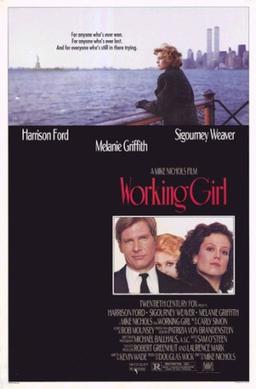
Lisa Reviews An Oscar Nominee: Working Girl (dir by Mike Nichols)


(With the Oscars scheduled to be awarded on March 4th, I have decided to review at least one Oscar-nominated film a day.  These films could be nominees or they could be winners.  They could be from this year’s Oscars or they could be a previous year’s nominee!  We’ll see how things play out.  Today, I take a look at the 1988 best picture nominee, Working Girl!)

Welcome to the 80s!

Yes, Working Girl is definitely a film of its time.  It’s a film that’s obsessed with big things: big dreams, big offices, big money, and big hair.  It’s a movie where the heroes talk about hostile takeovers and where everyone’s dream is to eventually to be an executive on Wall Street.  You know all of those people who claim that The Big Short is the greatest movie ever made?  I can guarantee that the majority of them would totally hate every character in Working Girl.  Working Girl is such a film of the past that it even features Alec Baldwin doing something other than bellowing at people.  In fact, Baldwin’s actually sexy in Working Girl.  It was strange to see him in this film and realize that he was the same actor who currently spends all of his time picking fights on twitter and defending James Toback.

Of course, Alec Baldwin has a relatively small role in Working Girl.  He plays Mick Dugan, the type of blue-collar guy who gives his girlfriend lingerie for her birthday (“I just wish you would get me something that I could wear outside,” she says as she tries it on) and who then proceeds to cheat on her while she’s off at work.  From the minute we first meet Tess McGill (Melanie Griffith), we know that she deserves better than Mick.

Tess is a professional administrative assistant.  She’s just turned 30 but she’s not ready to give up her dreams and settle for a life of fighting off coke-snorting executives and coming home to some guy like Mick.  (Speaking of early performances from infamous actors, one of the coke-snorting executives is played by Kevin Spacey.)  Tess has got a bachelor’s degree in Business.  As she puts it, she has a “mind for business and a bod for sin.”

She’s also got a new boss, an up-and-coming executive named Katharine Parker (Sigourney Weaver).  It turns out that Katherine is 29 years old.  (“I’ve never worked for someone younger than me before,” Tess says as Katherine gives her a condescending smile.)  Katharine encourages Tess to think of her as being a mentor.  If Tess has any ideas for investments, she should feel free to bring them to Katharine.  Of course, when Tess does so, Katharine claims that her bosses shot the idea down.  It’s only after Katharine breaks her leg in a skiing accident and is laid up in Europe that Tess discovers that Katharine has actually been stealing her ideas and not giving her any credit for them.

What is Tess to do?  Well, she does what any of us would do.  She passes herself off as an executive and presents her idea to Jack Trainer (Harrison Ford) herself.  Jack is impressed with the idea but he’s even more impressed with Tess.  Of course, complicating things is that Jack was once in a relationship with Katharine and Katharine still thinks that she’s going to eventually marry Jack.  And, of course, there’s the fact that Tess is lying about actually being an executive…

Working Girl is a frequently amusing film, elevated by performances of Melanie Griffith and, in the role of Tess’s best friend, Joan Cusack.  Add to that, Harrison Ford is remarkable non-grouchy as Jack Trainer and Sigourney Weaver appears to be having the time of her life playing a villain.  Even as I laughed at some of the lines, here was a part of me that wished that the film had a bit more bite.  At times, Working Girl tries too hard to have it both ways, both satirizing and celebrating Wall Street culture.  In the end, the film works best as a piece of wish-fulfillment.  It’s a film that says that not only can you win success and Harrison Ford but you can get your bitchy boss fired too.

Despite being a rather slight (if likable) film, Working Girl was nominated for Best Picture of 1988.  However, it lost to Rain Man.

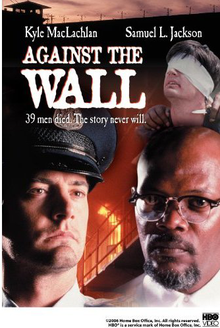
A Movie A Day #108: Against The Wall (1994, directed by John Frankenheimer)


The year is 1971 and Malcolm Smith (Kyle MacLachlan) has just started working as a prison guard at Attica Correctional Facility.  Even though his father (Harry Dean Stanton) was a prison guard, Malcolm does not fit in with the other guards at Attica.  Malcolm is younger than them and is disgusted by the inhumane treatment of the prisoners.  If not for his wife (Anne Heche) and the child that they are expecting, Malcolm would just quit but he needs the money.  He fears that he is going to eventually turn into just another sadistic guard.
When a prison riot breaks out, Malcolm is one of the guards taken hostage.  While the psychotic Chaka (Clarence Williams III) wants to kill all of the guards, Jamaal X (Samuel L. Jackson) realizes that killing the hostages will sacrifice what little leverage that prisoners have.  If the guards are killed, Jamaal X reasons, the state police will have no reason not to storm the prison and violently restore order.  Over the course of the four-day riot, Jamaal and Malcolm become unlikely friends and allies but it turns out that, even with the guards being held hostage, the government has no interest in negotiating with the prisoners.

This moving, thought-provoking, and well-acted docudrama originally aired on HBO and it won John Frankenheimer a well-deserved Emmy.  Samuel L. Jackson is powerful as Jamaal X and this is one of the few times that Kyle MacLachlan got to play a thoroughly normal person with no dark secrets or weird quirks.  Malcolm Smith is just a regular everyman who finds himself in the middle of a history-making event.

For fans of Twin Peaks, Against the Wall features three alumni of the show.  Kyle MacLachlan, of course, starred as Dale Cooper while Clarence Williams III appeared in one episode as Roger Hardy.  Finally, Harry Dean Stanton, a longtime favorite of David Lynch, appeared in Twin Peaks: Fire Walk With Me.

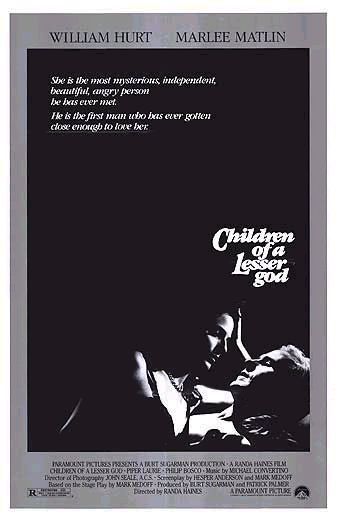
Embracing the Melodrama Part II #76: Children of a Lesser God (dir by Randa Haines)


Children_of_a_Lesser_God_film_posterSo, we all know that The Hurt Locker was the first best picture winner to have been directed by a woman.  And we also all know that, when Kathryn Bigelow won her Oscar for that film, she was the first woman to win the Academy Award for Best Director.

But do you know the title of the first film to be both be directed by a woman and to be nominated for best picture?  Well, you probably do now because I’m assuming that you’ve read the title of this post and you’ve seen the picture of the film’s poster above.  But, let’s just pretend that you don’t so I can triumphantly say, “The 1986 film Children of a Lesser God was the first nominee for best picture to be directed by a woman!”

And the name of that director was Randa Haines.  Never heard of her?  You’re probably not alone in that.  After making her feature debut with Children of a Lesser God, Haines only directed three more theatrical films.  Instead, she’s spent most of her career in television and, if not for the nudity and the language, Children of a Lesser God could probably pass for a well-made Lifetime movie.  That’s not necessarily a criticism because I happen to like well-made Lifetime movies.  But still, it’s not surprising that Children of a Lesser God was the only 1986 best picture nominee not to receive a nomination for best director.

(For the record, Platoon won best picture and Oliver Stone won best director.  Nominated in Haines’s place was David Lynch for Blue Velvet.)

As for the film itself, it’s a well-acted and well-made film.  It’s not exactly great in the way that we ideally expect a best picture nominee to be.  It’s directed a bit too much like a television movie and the film ends on a happy note that doesn’t exactly feel earned.  (If any film would have benefitted from a bittersweet conclusion, it would have been Children of a Lesser God.)  Still, at the same time, you can tell why the film was nominated.  It deals with a social issue (in this case, the way that the deaf are marginalized by mainstream society) and it’s a romance between … well, I was going to say mature adults but actually, William Hurt was 15 years older than Marlee Matlin when they played lovers in this film, which adds a perhaps unintentional layer of ambiguity to their relationship.  Children of a Lesser God was also the first film to feature a deaf performer in a lead role and, when Marlee Matlin won the Oscar for Best Actress, she became both the youngest and, to date, the only deaf actress to win.

Ultimately, Children of a Lesser God is more interesting from a historical point of view than a cinematic one.  But the value of history should never be underestimated!  It’s a worthy-enough film and Matlin’s angry performance holds up well.  (As for William Hurt, how you respond to his performance will depend largely on how much tolerance you have for his voice.  Whenever Matlin communicates through sign language, Hurt repeats aloud whatever it is that she’s said.  As a result, the film is basically 2 hours straight of William Hurt talking and, on occasion, it’s a bit too theatrical and distracting.  If the film were made today, the filmmakers would probably just use subtitles.)  Finally, and perhaps most importantly, even if it didn’t lead to bigger things for Randa Haines, Children of a Lesser God did open the door for others to follow.

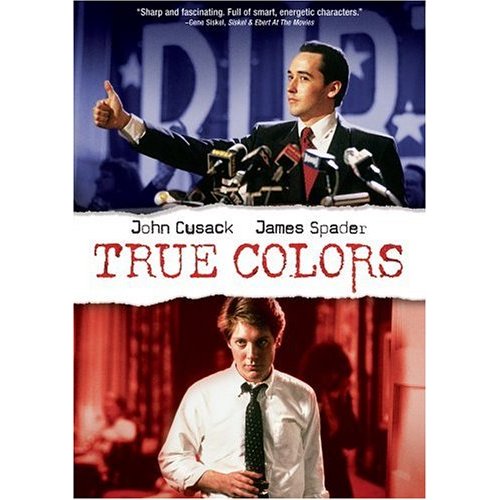
Embracing the Melodrama #39: True Colors (dir by Herbert Ross)


True Colors

For the past 9 days, I’ve been posting chronological reviews of 54 of the most (and least) memorable melodramas ever filmed.  I started with a film from 1916 and yesterday, I completed the 80s.  Today, we start in on the 90s with the 1991 political drama True Colors.

True Colors tells the story of two ambitious law students.  Tim Gerritty (James Spader) is a wealthy idealist who wants to work at the Justice Department so he can uncover and prosecute political corruption.  His roommate and eventual best friend is Peter Burton (John Cusack).  Although Peter initially lies about his background, it’s eventually revealed that he comes from a poor family and the result of growing up in poverty has left Peter with an obsessive desire for revenge on everyone who has ever looked down on him.  And how is Peter planning on getting that revenge?  By marrying the daughter of Sen. James Stiles (Richard Widmark) and eventually running for a seat in the U.S. House.  Despite the fact that Tim happens to be in love with Sen. Stiles’s daughter as well, he still supports his friend Peter and even agrees to be his best man.  However, as Peter gets closer and closer to achieving his goals, Tim starts to reconsider their friendship….

There’s a scene about halfway through True Colors, in which Peter Burton attempts to blackmail Sen. Stiles into supporting his political career.  Stiles agrees but then angrily adds, “God help you when the people find out.  They always do, you know.”  I was naturally waiting for Peter to come up with a properly sarcastic response but instead, Peter simply looks down at the ground, properly chastened.  It’s a jarringly false note and, unfortunately, everything that comes after this scene feels equally false.  The film, which starts out as such a strong portrait of what happens with friendship comes into conflict with ambition, ends up turning into a painfully predictable political diatribe, the type of thing that makes the portrait of politics in The Adjustment Bureau seem subtle and nuanced by comparison.  When Tim decided to betray Peter, it should be a moment full of moral ambiguity.  Instead, we’re expected to ignore their long friendship and just be happy that Tim is willing to do the right thing and protect the integrity of the American political process.

And, who knows?  Maybe that’s the way people viewed politics back in the early 90s.  But for audiences today, it all feels really naive and simplistic.

But, if you can manage to look past the film’s weak’s script, you can enjoy the acting.  John Cusack is wonderfully intense as Peter, making the character compelling even when the screenplay lets him down.  Watching him in True Colors is like watching the performance that he should have given in The Butler.  James Spader is sympathetic as Tim and, like Cusack, his performance almost allows him to overcome a script that doesn’t seem to realize that Tim is essentially a self-righteous jerk.  And finally, there’s Mandy Patikin who has a lot of fun playing the local crime boss who sponsors Peter’s career and who, in one memorable (if out-of-place ) scene beats up a shark that’s jumped up on the desk of his yacht.

Much like High Stakes, True Colors is one of those obscure films that occasionally pops up on cable, usually late at night and usually serving as filler between showings of better-known films.  Keep an eye out for it, if just for the chance to enjoy the performances.