A Quick Review: The Hobbit: The Battle of the Five Armies (dir by Peter Jackson)


TheHobbit5Armies

It seems kind of weird to do a quick review for a 144 minutes film that not only serves as the end of one epic trilogy but also as a prequel for yet another epic trilogy.

Well, so be it.  I hate to admit it but I really don’t have that much to say about The Hobbit: The Battle of the Five Armies beyond the fact that I saw it on the day after Christmas, I enjoyed it, and I thought Aidan Turner was really hot.  It’s not a perfect film but then again, The Hobbit has never been a perfect trilogy.  As opposed to the Lord of the Ring films, The Hobbit told a story that could have easily been told in two films.  As a result, whenever you watch one of The Hobbit films, you’re aware of all of the filler that was included just to justify doing three films.

But so what?  The Hobbit films are fun.  Despite the cynical economic reasons behind turning The Hobbit into a trilogy, director Peter Jackson’s love for the material always came through.  In the title role, Martin Freeman was always likable.  Ian McKellan and Christopher Lee made for properly enigmatic wizards.  Though apparently his inclusion caused some controversy among purists, it was nice to Orlando Bloom as Legolas.  I also liked Evangeline Lilly’s elf character, even if everyone else seemed to dislike her and her love story with Aidan Turner.  And then there was Benedict Cumberbatch providing a perfectly evil and self-satisfied voice for Smaug.

I have to admit that, with the exception of Aidan Turner, I was never a big fan of the dwarves.  They were all so surly and bad-tempered and it didn’t take me too long to get tired of Richard Armitage showing up as Thorin and acting like a jerk.  However, in the final part of the trilogy, Armitage’s surly performance started to make sense.  As Thorin grew more and more paranoid, I saw that The Hobbit was actually using both the character and Armitage’s performance to make a much larger point.  Power corrupts and most conflicts are ultimately all about money and property.  It was a good message.

When the Battle of the Five Armies started, I was shocked to discover how little I remembered about the previous two Hobbit films.  It took me a while to get caught up on who everyone was and why they were all fighting over that mountain.  As opposed to the LoTR films, it’s not always easy to get emotionally invested in The Hobbit films.  But, Jackson is a good director and he’s a good storyteller and, even though it took me a while to get caught up, I was still often enthralled with what I was watching on screen.  The images were so stunning and the battle scenes were so spectacularly done that I could handle being occasionally confused.

Battle of the Five Armies is a fitting end for the Hobbit trilogy.  It’s not a perfect film but it is exciting and fun and that’s really all that matters.  At the end of it, the audience in the theater applauded, not just for the film but in recognition of everything that Peter Jackson has given us over the past 14 years.

It was a good way to spend the day after Christmas.

Song of the Day: The Last Goodbye from The Hobbit: The Battle of the Five Armies (by Billy Boyd)


TheHobbitTheLastGoodbye

It’s been 13 years since the first film in what will ultimately become Peter Jackson’s Middle-Earth Saga and now we’re in the stretch run. The Hobbit: The Battle of the Five Armies is set to arrive in North America this December 17. The film premiered in London on December 1, 2014.

Kids who first saw The Fellowship of the Ring in 2001 are now young adults. For adults who have returned time and time again to the world Peter Jackson built for over a decade of limitless imagination and hard work of thousands this final film will be the culmination of watching what many in years past have called unfilmable.

So, it’s with both joy and sadness that the book finally closes on Peter Jackson’s Middle-Earth journey and what better way than the final end credits song “The Last Goodbye” written and recorded by Peregrin Took himself, Billy Boyd.

The video itself mixes in scenes from both The Battle of the Five Armies and the previous five films. We also get some behind-the-scenes footage of the cast making their final farewells as filming closes to an end.

Damn people cutting onions.

The Last Goodbye

I saw the light fade from the sky
On the wind I heard a sigh
As the snowflakes cover my fallen brothers
I will say this last goodbye

Night is now falling
So ends this day
The road is now calling
And I must away
Over hill and under tree
Through lands where never light has shone
By silver streams that run down to the sea

Under cloud, beneath the stars
Over snow one winter’s morn
I turn at last to paths that lead home
And though where the road then takes me
I cannot tell
We came all this way
But now comes the day
To bid you farewell
Many places I have been
Many sorrows I have seen
But I don’t regret
Nor will I forget
All who took the road with me

Night is now falling
So ends this day
The road is now calling
And I must away
Over hill and under tree
Through lands where never light has shone
By silver streams that run down to the sea

To these memories I will hold
With your blessing I will go
To turn at last to paths that lead home
And though where the road then takes me
I cannot tell
We came all this way
But now comes the day
To bid you farewell

I bid you all a very fond farewell.

Trailer: The Hobbit: The Battle of the Five Armies (Teaser)


TheHobbit5Armies


It hasn’t been received as well as Jackson’s own The Lord of The Rings trilogy, but The Hobbit did hit it’s stride with 2013’s The Hobbit: The Desolation of Smaug. People still haven’t bought into Jackson’s decision to film the prequel trilogy in the 48-frame rate format which gives the films an ultra-definition look that anyone with an HDTV will recognize when watching with the anti-judder effect on.

Yet, this is The Hobbit and any flaws and ill-timed decisions made still hasn’t diminished it’s hold on those who have read the book and on those who were pulled into the cinematic world adapted by Jackson. We now see the final film in the Middle-Earth cinematic universe about to come down on audiences this 2014 Holiday. This weekend at the Comic-Con saw the first teaser trailer air at Hall H to the delight of those in attendance.

Warner Brothers has seen fit to release a shorter version of the teaser shown at Hall H, but it still shows that all the set-up and slog through the first film will have an epic pay-off with the final leg of this trilogy: The Battle of the Five Armies.

Here’s Your Chance To Tell Lisa Marie What To Watch!


So, guess what I did this morning?  That’s right — I put on a blindfold, a stumbled over to my ever-growing Blu-ray, DVD, and even VHS collection and I randomly selected 12 films!

Why did I do this?

I did it so you, the beloved readers of Through the Shattered Lens, could once again have a chance to tell me what to do.  At the end of this post, you’ll find a poll.  Hopefully, between now and next Monday (that’s March 24th), a few of you will take the time to vote for which of these 12 films I should watch and review.  I will then watch the winner on Tuesday and post my review on Wednesday night.  In short, I’m putting the power to dominate in your hands.  Just remember: with great power comes great … well, you know how it goes.

Here are the 12 films that I randomly selected this morning:

The Baader Meinhof Complex (2008) — This German film was nominated for Best Foreign Language Film.  It tells the true life story of the left-wing German terrorist group, The RAF.

The Cat’s Meow (2001) — From director Peter Bogdonavich, this film speculates about the events that led to the shooting of silent film director Thomas H. Ince.  Starring Kirsten Dunst as Marion Davies, Edward Herrmann as William Randolph Hearst, and Eddie Izzard as Charlie Chaplin.

Heavenly Creatures (1994) — The close relationship between two teenage girls (Melanie Lynesky and Kate Winslet) leads to both a vibrant fantasy world and real-life murder.  Directed by Peter Jackson.

In A Lonely Place (1950) — In this film noir from director Nicholas Ray, Humphrey Bogart plays a screenwriter who may (or may not) be a murderer.

Liquid Sky (1983) — In this low-budget, independent science fiction film, an alien lands in New York and soon several members of the city’s underground art scene are vaporized.  Not surprisingly, it all has to do with heroin.

Made in Britain (1983) — A very young Tim Roth makes his debut in this British film.  Roth plays Trevor, a Neo-Nazi who — despite being intelligent and charismatic — also seems to be intent on destroying himself and everything that he sees.

Much Ado About Nothing (2013) — In between The Avengers and Agents of SHIELD, Joss Whedon found the time to direct this adaptation of Shakespeare’s play.

Peyton Place (1957) — In this Oscar-nominated film, the sordid secrets of an outwardly idyllic New England town are exposed.

Pretty Poison (1968) — Having just been released from a mental institution, Dennis (Anthony Perkins) finds himself involved with teenager Sue Anne (Tuesday Weld), who — despite her wholesome appearance — is actually psychotic.

Troll 2 (1990) — A family moves to Nilbog, a small town that is populated by vegetarian goblins.  This movie is widely considered to be one of the worst ever made.

Walkabout (1971) — In this visually stunning Nicolas Roeg film, a teenage girl and her younger brother find themselves stranded and left for dead in the Australian outback.  They try to survive with the help of an Aborigine.

Zabriskie Point (1970) — In this 1970 film, the great Italian director Michelangelo Antonioni takes a look at the 60s counter-culture.  Airplanes are stolen, buildings explode, and orgies magically materialize in the middle of the desert.

The poll will be open until Monday, March 24th.

Happy voting!

Trailer: The Hobbit: The Desolation of Smaug (Sneak Peek)


The Hobbit - The Desolation of Smaug

“The lord of silver fountains,

The King of carven stone,

The King beneath the mountain

Shall come into his own!

And the bells shall ring in gladness

At the Mountain-king’s return,

But all shall fail in sadness

And the lake shall shine and burn.”

Today, over in NYC a special fan event for The Hobbit: The Desolation of Smaug was held which introduced a new one-sheet poster (look above), but also premiere a 3-minute sneak peek trailer to the second entry in The Hobbit Trilogy.

To say that this extended trailer is a vast improvement to all the previous teasers and official trailers for this second film in the prequel set would be an understatement. It still shows the film as being much more darker in tone than the book source it’s being adapted from, but it definitely shows a film that looks and feels much more put together than the first film (still just an assumption, but I have hopes I’ll be correct).

We see more of Luke Evans as Bard the Bowman who looks to fit in rather well instead of looking “too modern” as some feared he would look. I like how the trailer uses the poem, “The King Beneath the Mountains”, but in an altered form to make it sound like it was a prophecy. I know purist will probably rail and scream to anyone who will listen that this wasn’t how Tolkien wrote the poem. If they haven’t figured out by now that these film adaptations have been altering the written work to better fit the story then what have they been watching over the past decade.

I, for one, can’t wait for this middle film in the trilogy to finally come out and come out it shall on December 13, 2013. I saw the first film in every format and watch it in all format I shall for this one as well.

Horror Scenes I Love: Dead Alive aka Braindead


DeadAlive“Party’s over!”

[spoilers]

The latest “Scenes I Love” is from a horror-comedy classic from the early 90’s.

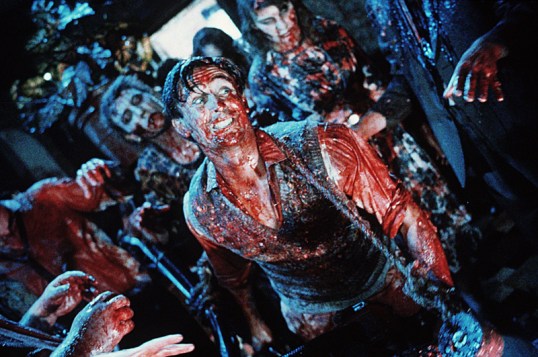
Before Peter Jackson traveled and chronicled Middle-Earth he was a Kiwi filmmaker who dabbled and had fun with low-budget splatstick horror. One such film was the horror-comedy zombie flick Dead Alive aka Braindead. The scene in question happens in the extended climactic third reel of the film and has to go down as the goriest and bloodiest film sequence ever shot.

Watching this clip makes one wonder how Peter Jackson was the same person who made this film and the Tolkien films.

Review: The Hobbit: An Unexpected Journey (dir. by Peter Jackson)


kinopoisk.ru

It’s hard to believe that’s it’s been 11 years since Peter Jackson released The Lord of the Rings: The Fellowship of the Ring on the masses in 2001. There were much trepidation from Tolkien fans that Jackson (who had been known mostly for low-budget splatter horror-comedies) wouldn’t be able to handle the monumental task of adapting what many consider the greatest novel ever written in the 20th century. Tolkien’s epic fantasy became the standard by which fnatasy epics would be compared to for decades to come and still do. To say that Jackson succeeded in this epic task would be an understatement. The Lord of the Rings trilogy would hoard awards from 2001 to 2003 and also box-office receipts to make any dwarf-lord green with envy.

It’s now 2012 and we finally have the release of Jackson’s next trip into Middle-Earth as he adapts another of Tolkien’s beloved novels. This time he tackles The Hobbit which for some Tolkien fans remains their favorite of the author’s works. It’s a novel that might not have the epic scope and breadth of The Lord of the Rings, but what it lacks in that department it more than makes up in being a fun, adventure tale of a curious hobbit named Bilbo Baggins, a wizard named Gandalf the Grey and a fellowship of twelve dwarfs led by one Thorin Oakenshield of Erebor.

The Hobbit was originally written as a children’s book, but in later years Tolkien would retcon some parts of the novel to better fit with his magnum opus in The Lord of the Rings.It’s this revised version of that children’s story that Peter Jackson, Fran Walsh, Philippa Boyens and Guillermo Del Toro would adapt for the big-screen. Initially a two-film set that would tell the story of Bilbo and his merry band of adventurers, but it has since been expanded to become a trilogy as Jackson and his writers take a page out of Tolkien’s bag of tricks and try to tie-in this latest trilogy to the Lord of the Rings which precedes it by a over a decade.

The first film in this new trilogy is called The Hobbit: An Unexpected Journey and we begin by returning to sometime before the beginning of the first trilogy’s first film. We see the aged Bilbo reminiscing of his adventures 60 years hence and deciding to put it to pen and paper as a sort of memoir of that adventure to reclaim the lost dwarf-hold of Erebor. It’s in this opening that we get to see Frodo once more (played once again by Elijah Wood who doesn’t seem to have aged) prior to him taking up the One Ring.

Bilbo recounts to Frodo the realm of Erebor deep inside the Lonely Mountain east of the Shire to Frodo and how it’s wealth in silver, mithril, gold and precious gems became well-known throughout Middle-Earth. Yet, as Bilbo warns, it’s the very sickness of avarice by Erebor’s Thror the King which seals the dwarf-hold’s doom. We learn that hoards of wealth does more than light up the dwarf king’s eyes with greed but also brings the attention of one of the very last dragon’s in Middle-Earth. The arrival of Smaug to Erebor signals the death of not just that dwarf realm, but the surrounding human town of Dale. The surviving dwarfs of Erebor flee in a massive diaspora towards any safe haven willing to take them in. What was once a proud and powerful realm has now been sundered and it’s afterwards that we get to the meat of the film’s story.

Martin Freeman as a younger Bilbo Baggins was more than just great casting but one which the film needed if one was to believe that this young Bilbo would grow old to be the Ian Holm one fans of the first trilogy have come to know well. His performance as Bilbo Baggins of Bag End becomes the anchor from which the rest of the company would revolve around. When we first meet Freeman as Bilbo he’s not the adventurer that he would become, but a hobbit that’s respectable and one not for doing anything foolish like going on adventures. Yet, his lot in life changes as Gandalf maneuvers the situation so that he becomes embroiled in the quest by Thorin Oakenshield (played by Richard Armitage) to retake his ancestral lands of Erebor and it’s massive wealth from Smaug who has taken it for his lair.

While many would think that a film called The Hobbit would focus on Bilbo I thought the way the film unfolded that this story was all about the dwarfs with extra focus on the single-minded Thorin who comes off initially as both condescending, superior and dismissive of poor old Bilbo. The film never fails to show how much Thorin thinks so less of Bilbo yet throughout the film’s two and a half and more running time we see cracks in Thorin’s ice-cold demeanor towards the young hobbit. By film’s end we see just how wrong Thorin has been of Bilbo’s worth and it makes for one of the film’s more emotional scenes when Thorin realizes this as well.

The Hobbit: An Unexpected Journey is not just about a brooding dwarf prince and his motley band of dwarfs getting into one trouble after the next once they’ve left the Shire with Bilbo. The film also brings on a parallel storyline which tries to lay down the foundation that would tie this new trilogy with the first one. It’s the storyline of the Great Necromancer that Gandalf and a fellow wizard, Radagast the Brown, suspect might be the Great Enemy returned. We learn soon enough during the White Council in Rivendell (attended by Gandalf, Galadriel, Elrond and Saruman the White) that this so-called Necromancer might be Sauron looking to regain his former strength and gather an army to him.

It’s this second storyline that get’s sandwiched within the Thorin Oakenshield Fellowship quest that comes off a bit awkward in the film’s overall narrative flow. Where the film is all about fun adventuring and camaraderie when the dwarfs and Bilbo are on the screen, when they’re not and the film tries to tell us about Sauron’s eventual return the film slows down. These scenes are not uninteresting. On it’s own these sequences bring back the epic tone of the original trilogy and brings it into this film, but it’s that very grandiose theme that seems out of place in what is simply a “men on a mission” story.

Fortunately, we don’t spend too much time dwelling on this side-story. The final third of the film is all about Thorin and company needing to escape from one goblin lair and orc ambush to another. The last 45 minutes or so flies back swiftly after a very uneven first two hours that would make more than a few theater-goers look at their watch. The wait is worth it as we see that Jackson hasn’t forgotten how to choreograph and stage fantasy action scenes. While the use of CGI might be more evident this time around than the previous three films they’re still small compared to other blockbuster films of it’s type. It’s still all about WETA practical effects, make-up and costumes that combine to create a world that’s become familiar yet still have a sense of newness to them as we see new areas of Middle-Earth only mentioned in brief passing in the original trilogy.

The Hobbit: An Unexpected Journey is a wonderful return to the world of Middle-Earth. It is not without it’s missteps and flaws, but it also gets saved by some great performances from the ensemble cast which makes up the dwarfs. The aerial shots of the New Zealand’s eclectic geography shows just how much cinematographer Andrew Lesnie has become such a major component of making Middle-Earth come alive. Even the return of Howard Shore as the film’s composer was a welcome that brought more than a few smiles.

There’s no way of talking about The Hobbit without bringing up the stylistic gamble Peter Jackson has taken in filming this film and the rest of the trilogy in 48fps instead of the traditional 24fps (frames per second) that filmmakers have been using for almost a hundred years now. It’s an aesthetic choice that gives the film a overly realistic look akin to watching a stage production live. Everything looks too perfect and the High-Frame Rate (HFR) takes away some of the cinematic look which many have grown up seeing every time they watch a film. This new filming style works in certain areas like wide shots of the outdoor scenes. Whether it’s the emerald green rolling hills of the Shire to the snowcapped Alpine peaks of the Misty Mountains, these scenes in HFR came out beautiful. It’s when the film switches over to a much more enclosed and personal space within rooms and halls that we get the unusual “soap opera” look some have complained about. It takes a bit of getting used to, but some make the adjustment quickly enough while others may never make the adjustment.

Yet, it is when the film shows a CGI-created sequence that the HFR fails. While the doubling of the frame rate during filming has made the 3D in the film come off smoothly it did make some of the CG-effects come off as too video game-like. A sequence earlier in the film where we see a flashback of Thorin and the dwarfs of Erebor trying to retake another fallen dwarf hold in Moria (Khazadum in dwarfish) looks like a cinematic cutscene as a dwarf army charges and battles it out with an orc and goblin force which had taken Moria as it’s own.

All the scenes where HFR fails to come off as believable turn out better when The Hobbit was seen in traditional 24fps. I actually think that downscaling the film from it’s original HFR to a more traditional film frame speed of 24fps gave the film an even more magical look than the original trilogy. Jackson and his team of filmmakers have two more films to release and hopefully take some of the criticism this first film has received about HFR that they tweak and work on making the new style much more believable instead of taking the audience out of the film’s narrative.

The Hobbit: An Unexpected Journey doesn’t come off as grandiose as the original trilogy and for some that might come as a disappointment. Yet, as an adventure film it more than does it’s job to fully entertain it’s audience while, at the same, time reminding it’s audience how much this film and this trilogy will lead into The Lord of the Rings. I recommend that people just see the film and decide on their own whether it’s a worthy addition to the Middle-Earth saga as seen through the eyes of Peter Jackson. I, for one, think it is and with two more films left we shall see whether Jackson’s return to Middle-Earth has been a triumphant one or not.

I Saw The Hobbit


The_Hobbit-_An_Unexpected_Journey_74

Full disclosure (this paragraph is something of an insane rant and has nothing to do with the Hobbit, so feel free to skip it): I am in the incredibly tiny minority who was not overly impressed with the Lord of the Rings films. While I thought that they did an exemplary job of capturing the setting, sights and sounds of Middle Earth, and even the grand scope of Tolkien’s masterwork, I found some of the inexplicable changes to the core story that started appearing in The Two Towers (why is Faramir a dick? The whole point of his character is that he is unlike Boromir in aspect. He is something greater. Like Aragorn. He’s a reason to hope. Why does Faramir take Frodo and Sam to Osgiliath? So we can see it under siege? Probably. Sam then somehow fends off a Nazgul on winged steed by tackling Frodo and crying out. Hmmmmm…swiss cheese. If Aragorn’s army of ghosts can simply sweep across the field and massacre Sauron’s entire army without apparent effort or effect… and Aragorn knows Sauron has another, bigger army… why doesn’t he just go ahead and spend the ten minutes to kill that army too? I’m sure the spirits of the dead would be willing to stay off their eternal rest for ten minutes. Especially because they’re under you control, Aragorn. King of the Dummies.) In addition, Return of the King in particular is much too long. Since the Hobbit has now been split into a stunning three films (!) … in retrospect it seems like Return of the King could definitely have occupied two. Particularly since some of the action elements from The Two Towers were woven into it and… okay.

Moving on.

I saw The Hobbit! Against my wishes, and against my better judgment, I went on a double date sort of affair in the bitter cold to take in this pre-coronated motion picture just days after its release. Fearing the worst, I brought along a large flask filled to the brim with Kraken spiced rum and decided I wouldn’t be shy about pulling off of it. I didn’t really end up needing to, much to my surprise… because here’s the thing about The Hobbit: I liked it. Sort of. Mostly. Oh, more full disclosure: I saw the film in two dimensions at the standard twenty-four frames per second. We didn’t feel like driving to a fancy theater.

As I’d come to expect from Jackson’s Lord of the Rings films, the production here is outstanding. From the very instant The Hobbit begins, we’re drawn back into the realm of Middle Earth. Dwarves, Elves, and now… a dragon. Of course, one of the major reveals that Jackson is keeping for his second film is Smaug, so we don’t see more than the ophoid slit of his eye in what really amounts to an extended intro that describes the history of Erebor, its fall, and the escape of a few dwarves, including Thorin Oakenshield (Richard Armitage). Once we’re all caught up, we return to Hobbiton, and meet Bilbo Baggins (Martin Freeman). Freeman is excellent as the earnest, earthy Bilbo, who is friendly and considerate, but really doesn’t feel like he wants to be involved in an adventure at all … at first. It’s in this first section at Bilbo’s hobbit hole that, in my estimation, the film shines most. The dwarves of Thorin’s company arrive in a steady stream, along with the wizard Gandalf (Ian McKellen), and treat Bilbo to a night of drinking and feasting… and reminiscing about their lost home, the twilight of the dwarven people, and their enmity with the goblins of the mountains. The music, the mood, the performances, are superb, and by morning… I was as ready as Bilbo was to follow Thorin on his damn fool idealistic crusdade.

The film’s tone throughout mostly remains what I feel to be appropriate to the story being told. The Hobbit is a much more lighthearted affair than the ponderous material of The Lord of the Rings. Instead of twisted Uruks made by the unholy marriage of man and goblin, we have goblins that do a lot of singing and arguing among themselves, and who ultimately don’t seem particularly organized or threatening. Perhaps without the all-possessing will of Sauron behind them, goblins are an essentially pathetic people. There are stupid trolls, dumb goblins, and running axe and sword fights to spare, including some invented and extended action sequences which are a necessity in any three hour long fantasy film epic. The problems that the Hobbit suffers, and they are relatively few but fairly damning, universally occur when it drifts away from this lighthearted tone and fast pacing.

Without going into too much detail, let me just say that Jackson crams the final meeting of the White Council (if you don’t know what that is, believe me, there is not time for a lengthy explanation, but check the footnote at the bottom for the cliff notes version) as a scene in the middle of the film that, frankly, goes on forever. Christopher Lee and Cate Blanchette reprise their roles (Saruman and Lady Galadriel, respectively) from the Lord of the Rings films and join Elrond (Hugo Weaving) and Gandalf in some lengthy pontificating about the threat posed by The Necromancer, the evil force which is corrupting Mirkwood from within. Because this film doesn’t ever reach Mirkwood, we haven’t seen enough of Mirkwood yet to really understand its corruption, and while the White Council’s final meeting does happen concurrently with the events of the Hobbit, it has essentially nothing to do with that story, this scene is dead weight. It absolutely kills the momentum of the film. Worse yet? It’s book-ended by two long sequences where Bilbo Baggins has, essentially, no lines at all and spends huge periods of time off the screen. Now, I may not be a famous movie director, but I have watched a lot of movies in my life… and I can tell you that there’s a problem if your character driven fantasy story about a single unlikely hero and his friends excludes that unlikely hero from a third of its run time. It’s triply aggravating because Freeman is so magnetic as Bilbo when he’s on-screen.

Because of this real problem in the mid-point of the film, the Hobbit very much loses its way for a while, even if you happen to have read the novel and already know how the story is going to play out. This was a real disappointment for me, as I actually thought one of the few genuinely great bits of the script and directing in the Lords of the Rings trilogies was editing action and plot points smartly to keep the films moving. That doesn’t happen here. The setting and music eventually drug me back in (also, the riddle-telling sequence with Gollum (a returning Andy Serkis) is delightful. It has a lot to do with Martin Freeman. I might have a little man crush.) and I was with the movie again by the finale, but I really did feel disappointed when I walked out of the theater, and that sucked after such a promising start.

Anyway, if you’re looking for a recommendation, see The Hobbit! I can’t speak as to the technology additives I’m afraid, but the film itself is enjoyable enough. Just don’t expect a masterpiece, because this film, while good… falls well short of great.

Tolkien Nerd Footnote: The White Council – This is a group comprised of the wizards (Saruman, Gandalf, Radagast the Brown, and two Blue Wizards who are MIA) and the leaders of the Elves (Elrond, Galadriel, and Ciridan), though as Gandalf bears Ciridan’s ring and he spends all his time building escape ships, he doesn’t show up for this dance. Basically, the White Council was the body of good powers in the world that kept things peaceful and friendly during Sauron’s long slumber. They’re mentioned only in passing except during The Fellowship of the Ring when Gandalf tells the story that is recounted for us live in this film. Their last act was to put the Necromancer out of Mirkwood, after Gandalf discovered that the Necromancer was, in all likelihood, Sauron garbed in a lesser form to pull the proverbial wool over the council’s eyes.

Song of the Day: Song of the Lonely Mountain from The Hobbit: An Unexpected Journey (by Neil Finn)


The Hobbit: An Unexpected Journey doesn’t seem to be resonating with as many people like the previous The Lord of the Rings trilogy. Not to say that the film is a bad one. For those disappointed in the film seems to want a repeat of the first trilogy. My review of the film will and shall be up later today to help celebrate the site’s 3rd year anniversary. For now let me share the ending song to the first part of Peter Jackson’s latest Tolkien trilogy.

“Song of the Lonely Mountain” is sung by Neil Finn of Crowded House and it follows on the tradition of past Tolkien adaptations by Jackson by turning to musicians who Jackson and Shore enjoy listening to. The song has a Celtic, folksy rock sound to it. I particularly enjoyed the addition of hammers ringing on anvils to help listeners visualize the exiled dwarfs of Erebor toiling in front of their foundry in preparation for the day they retake their homeland from the dragon Smaug.

I didn’t like the song when it was first premiered a couple weeks in advance of the film, but it has since grew on me and has joined the other three end credits songs from the original trilogy as favorite original film songs.

Song of the Lonely Mountain

Far over the Misty Mountains rise
Leave us standing upon the heights
What was before, we see once more
Our kingdom a distant light

Fiery mountain beneath the moon
The words unspoken, we’ll be there soon
For home a song that echoes on
And all who find us will know the tune

Some folk we never forget
Some kind we never forgive
Haven’t seen the back of us yet
We’ll fight as long as we live
All eyes on the hidden door
To the Lonely Mountain borne
We’ll ride in the gathering storm
Until we get our long-forgotten gold

We lay under the Misty Mountains cold
In slumbers deep and dreams of gold
We must awake, our lives to make
And in the darkness a torch we hold

From long ago when lanterns burned
Till this day our hearts have yearned
Her fate unknown the Arkenstone
What was stolen must be returned

We must awake and make the day
To find a song for heart and soul

Some folk we never forget
Some kind we never forgive
Haven’t seen the end of it yet
We’ll fight as long as we live
All eyes on the hidden door
To the Lonely Mountain borne
We’ll ride in the gathering storm
Until we get our long-forgotten gold
Far away from Misty Mountains cold

Trailer: The Hobbit: An Unexpected Journey (2nd Official)


It just a littleunder 3 months before Peter Jackson takes us back to Middle-Earth with the first of three films that will make up The Hobbit trilogy.

There’s not much else to say other than this latest trailer for The Hobbit: An Unexpected Journeyjust continues to whet the appetite for all things Middle-Earth. It’s much more action-packed with some nice new scenes instead of just rehashing what was in the original teaser trailer from year ago.

Enough words. Just watch the trailer below and decide for yourself whether another trip to Middle-Earth (before all the War of the Ring brouhaha of the first trilogy) is worth your monies.

The Hobbit: An Unexpected Journey premieres worldwide on December 14, 2012.