Lisa Reviews An Oscar Nominee: Moonstruck (dir by Norman Jewison)


Nominated for Best Picture of 1987, Moonstruck is a film about love, romance, New York City, and being Italian.

Loretta Castorini (Cher) is a widow and a bookkeeper who lives with her parents, Cosmo (Vincent Gardenia) and Rose (Olympia Dukakis) in Brooklyn.  When her boyfriend, Johnny (Danny Aiello), asks Loretta to marry him, Loretta says yes even though she knows that, while she likes him, she’s not really in love with him.  After he proposes, Johnny reveals that he has to go to Sicily to see his “dying” mother.  He asks Loretta to pay a visit to his estranged brother, Ronny (Nicolas Cage), and invite him to the wedding.  Loretta, a strong believer in family and the importance of following tradition, agrees.

Loretta finds Ronny working in the bakery that he owns.  Ronny is not thrilled to learn that his brother has gotten engaged.  Ronny reveals that he has a wooden hand.  He lost his real hand when he accidentally placed it in a bread slicer while having a conversation with Johnny.  After he lost his hand, Ronny’s then-fiancée left him.  Ronny has never forgiven Johnny for the loss of his hand.  “I lost my hand!  I lost my bride!”  Ronny yells to the heavens.  Loretta, however, immediately understands that Johnny actually hurt his hand to get his fiancée to break up with him.  A conversation at Ronny’s apartment leads to the two of them impulsively sleeping with each other.  The next day, Ronny promises to never bother Loretta again if she agrees to go the opera with him.

What the guilt-stricken Loretta doesn’t know is that her father is having an affair himself and it turns out that Cosmo and Mona (Rose Gilette) enjoy the opera as well.  Meanwhile, Rose finds herself tempted by a lecherous college professor named Perry (John Mahoney).

There’s a lot of stereotypes to be found in Moonstruck.  Of course, passionate Ronny loves the opera.  Of course, the simple but well-intentioned Johnny abandons his fiancée so that he can rush to Sicily to be with his “dying” mother who, it turns out, isn’t dying at all.  Of course, Loretta slaps Ronny and tells him to snap out of it.  (I should note that I’m a fourth Italian myself so I could definitely relate to some of this film.  I’ve never liked opera, though.)  Fortunately, the film’s cast is so perfectly chosen and John Patrick Shanley’s script so adroitly maintains the balance between the broad comedy and the small dramatic moments that it doesn’t matter that all of the characters are a bit stereotypical.  The film comes to a wonderful life.  It’s impossible not love these characters, flaws and all.  Cher and Olympia Dukakis deserved the Oscars that they both won for this film.  Vincent Gardenia deserved the nomination that he received.  Nicolas Cage, Danny Aiello, and John Mahoney were not nominated but they should have been.  In particular, John Mahoney is heart-breaking in his small role, playing the type of lecherous character that most films would have just portrayed as being a cardboard buffoon.  As for Nicolas Cage, Moonstruck is a film that features both his trademark eccentricity and his ability to show the real and vulnerable human being underneath all of the bluster.  Moonstruck is a film about the search for love and the glory of finding it.  It’s a wonderfully romantic film, even if almost all of that love seems to involve infidelity.  As directed by Norman Jewison, Moonstruck not only celebrates falling in love but also celebrates being lucky enough to do so in New York City.  It’s a love letter not just to its characters but to the city as well.

Moonstruck was nominated for Best Picture but it lost to a far more epic production, The Last Emperor.


DEATH WISH – It’s a wonderful life…at least it has been for me!


Over the next 5 days, I will discuss Charles Bronson’s DEATH WISH series in chronological order. This series has brought me countless hours of entertainment over the last 40 years, so enjoy and let me know your thoughts!

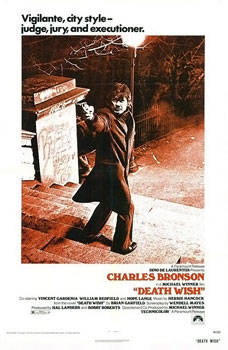
“Don’t ever make a death wish, because a death wish always comes true!” – I’ve always thought this was kind of a corny saying on the original DEATH WISH trailer, but as one of the world’s biggest Charles Bronson fans, I still hold the original DEATH WISH (1974) in extremely high regard. This is the 70’s revenge classic that made Bronson a box office superstar in his home country, while simultaneously influencing the way vengeance was depicted on screen for decades to come. DEATH WISH is one of the most underrated and influential films from a decade that was full of great films.  

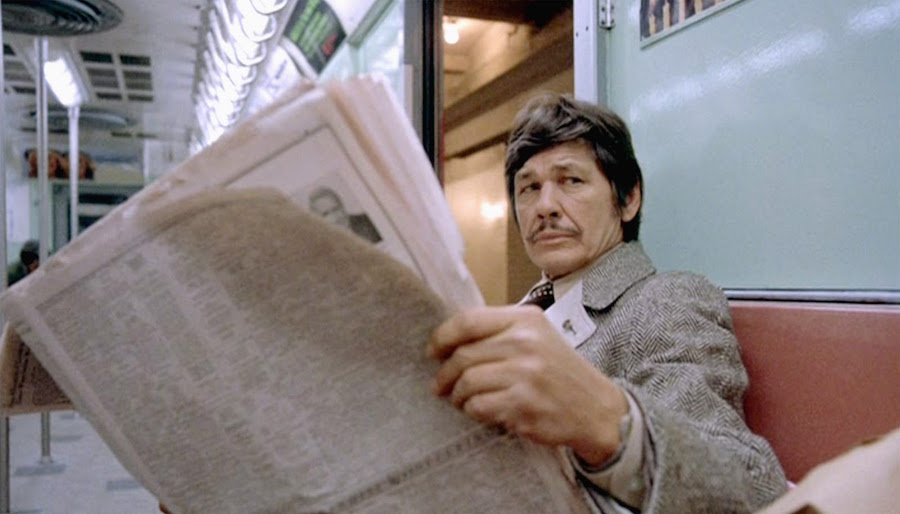
If you’re reading this review, I’d be about 99% positive that you know the basic story of the film. Charles Bronson plays Paul Kersey, a conscientious objector whose wife is killed and whose daughter is raped by a group of criminal thugs in New York City. When the police are incapable of providing justice, Kersey turns into a sidewalk vigilante and stalks the streets and subways of New York, luring thugs to mug him so he can shoot them with his 32-caliber Colt Police Positive pistol. Vincent Gardenia plays detective Frank Ochoa, who’s put in charge of finding the vigilante and putting an end to his one-man mission of justice.  

It’s been 50 years since DEATH WISH was released into theaters and it’s hard to fathom just how controversial the film was in its time, especially since I wasn’t even 1 year old when it was released. The graphic rape scene that kicks off the events of the film, combined with the vigilante subject matter, turned off so many big stars, including Jack Lemmon, Henry Fonda and George C. Scott. This opened up the door for Charles Bronson who didn’t have any such misgivings. They just didn’t understand what a nerve the film would touch with the filmgoing public, who were tired of their cities being overrun by violent criminals. The movie became an audience participation movie unlike any others of the time with cheering in the seats every time Kersey offed another criminal. The controversial film became one of the top box office hits of the year and the biggest of Bronson’s career. 

DEATH WISH was the fourth of six films directed by Michael Winner and starring Charles Bronson. In typical Winner fashion, the film has some strange touches, but the director is extremely effective in building the motivation for vigilante justice that was required for the film to thrive. He handles the action sequences well, and his cast is outstanding. Bronson & Gardenia are perfect in the lead roles, and the lovely Hope Lange has the brief, infamous role as Kersey’s brutalized wife. Stuart Margolin is especially memorable as the Arizona businessman who gives Kersey his gun. There are also a number of actors in small roles who were not well known when the movie was made who would go on to successful film careers. The biggest is Jeff Goldblum who has the most memorable role of the three muggers who attack Kersey’s wife and daughter at the beginning of the film. It’s a brief, but no holds barred performance for sure. Oscar winning actress Olympia Dukakis has a small role as a cop who expresses her frustration about the amount of leg work expected of her by Detective Ochoa. And finally, Christopher Guest has one scene as a young cop who finds the wounded vigilante and recovers his gun.  

On a personal note, this film holds a special place in my heart as the first Charles Bronson film I ever saw. It was probably in 1984 or ‘85, and I stayed up with my dad to watch the late movie on our local TV station. The movie happened to be DEATH WISH. As bad things were happening to Kersey’s family at the beginning of the film, my dad told me not to worry, that “Charles would get them.” That intrigued me and let me know that Bronson had a reputation that preceded him. From that point forward, I wanted to rent a Charles Bronson film every time we went to the video store. And the rest, as they say, is history!

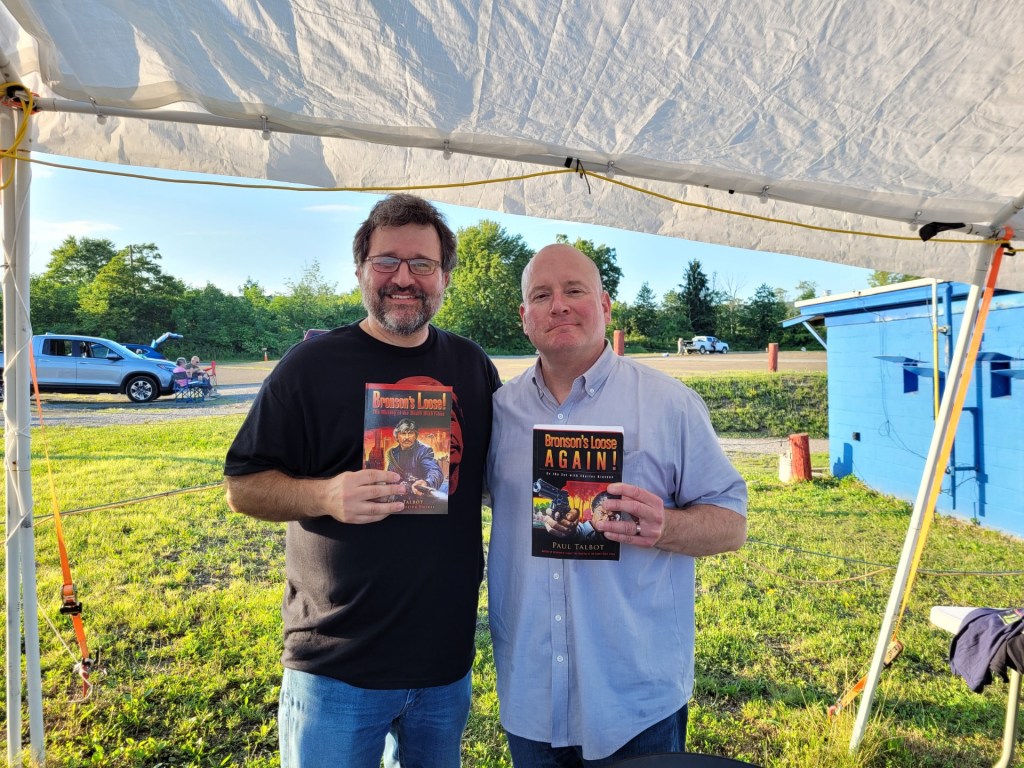
BONUS: The definitive book about the DEATH WISH film series was written by my friend, author and film historian Paul Talbot. The name of the book is BRONSON’S LOOSE: THE MAKING OF THE DEATH WISH FILMS. If you have any interest in Charles Bronson, the DEATH WISH series or Cannon Films, I can’t recommend Paul’s books more highly.

Bronson’s Revenge: Death Wish (1974, directed by Michael Winner)


To quote “Dirty” Harry Callahan, “I’m all broken up about his rights.”

In 1972, a novel by Brian Garfield was published.  The novel was about a meek New York City accountant named Paul Benjamin.  After Paul’s wife is murdered and his daughter is raped, Paul suffers a nervous breakdown.  A self-described bleeding heart liberal, Paul starts to stalk the streets at night while carrying a gun.  He is hunting muggers.  At first, he just kills the muggers who approach him but soon, he starts to deliberately set traps.  Sinking into insanity, Paul becomes just as dangerous as the men he is hunting.  Garfield later said that the book was inspired by two real-life incidents, one in which his wife’s purse was stolen and another in which his car was vandalized.  Garfield said that his initial response was one of primitive anger.  He wondered what would happen if a man had these rageful thoughts and could not escape them.

The title of that novel was Death Wish.  Though it was never a best seller, it received respectful reviews and Garfield subsequently sold the film rights.  At first, Sidney Lumet was attached to direct and, keeping with Garfield’s portrayal of Paul Benjamin, Jack Lemmon was cast as the unlikely vigilante.

Lumet, ultimately, left the project so that he could concentrate on another film about crime in New York City, Serpico.  When Lumet left, Jack Lemmon also dropped out of the film.  Lumet was replaced by Michael Winner, a director who may not have been as thoughtful as Lumet but who had a solid box office record and a reputation for making tough and gritty action films.

Winner immediately realized that audiences would not be interested in seeing an anti-vigilante film.  Instead of casting an actor with an intellectual image, like Jack Lemmon, Winner instead offered the lead role (now named Paul Kersey and no longer an accountant but an architect) to Charles Bronson.  When Winner told Bronson that the script was about a man who shot muggers, Bronson replied, “I’d like to do that.”

“The script?” Winner asked.

“No, shoot muggers.”

At the time that he was cast, Charles Bronson was 52 years old.  He was the biggest star in the world, except for in America where he was still viewed as being a B-talent at best.  Bronson was known for playing tough, violent men who were not afraid to use violence to accomplish their goals.  (Ironically, in real life, Bronson was as much of an ardent liberal as Paul Kersey was meant to be at the beginning of the movie.)  Among those complaining that Charles Bronson was all wrong for Paul Kersey was Brian Garfield.  However, Bronson accepted the role and the huge box office success of Death Wish finally made him a star in America.

To an extent, Brian Garfield was right.  Charles Bronson was a better actor than he is often given credit for but, in the early scenes of Death Wish, he does seem miscast.  When Paul is first seen frolicking with his wife (Hope Lange) in Hawaii, Bronson seems stiff and awkward.  In New York City, when Paul tells his right-wing colleague (William Redfield) that “my heart does bleed for the less fortunate,” it doesn’t sound natural.  But once Paul finds out that his wife has been murdered and his daughter, Carol (Kathleen Tolan), has been raped, Paul gets mad and Bronson finally seems comfortable in the role.

In both the book and the original screenplay, both the murder and the rape happened off-screen.  Never a subtle director, Winner instead opted to show them in a brutal and ugly scene designed to get the audience as eager to shoot muggers as Bronson was.  Today, the power of the scene is diluted by the presence of Jeff Goldblum, making his screen debut as a very unlikely street thug.  Everyone has to start somewhere and Goldblum got his start kicking Hope Lange while wearing a hat that made him look like he belonged in an Archie comic.

With his wife dead and his daughter traumatized, Paul discovers that no one can help him get justice.  The police have no leads.  His son-in-law (Steven Keats) is a weak and emotional mess.  (As an actor, some of Bronson’s best moments are when Paul makes no effort to hide how much he loathes his son-in-law.)  When a mugger approaches Paul shortly after his wife’s funeral, Paul shocks himself by punching the mugger in the face.

When Paul is sent down to Arizona on business, he meets Ames Jainchill (Stuart Margolin), a land developer who calls New York a “toilet” and who takes Paul to see a wild west show.  Later at a gun club, Paul explains that he was a conscientious objects during the Korean War but he knows how to shoot.  His father was a hunter and Paul grew up around guns.  When Paul returns to New York, Ames gives him a present, a revolver.  Paul is soon using that revolver to bring old west justice to the streets of New York City.

As muggers start to show up dead, the NYPD is outraged that a vigilante is stalking the street.  Detective Frank Ochoa (Vincent Gardenia) is assigned to bring the vigilante in.  But the citizens of New York love the vigilante.  Witnesses refuse to give an accurate description of Paul.  When Paul is wounded, a young patrolman (Christopher Guest, making almost as unlikely a film debut as Jeff Goldblum) conspires to keep Paul’s revolver from being turned over as evidence.

The critics hated Death Wish, with many of them calling it an “immoral” film.  Brian Garfield was so disgusted by how Winner changed his story that he wrote a follow-up novel in which Paul is confronted by an even more dangerous vigilante who claims to have been inspired by him.  Audiences, however, loved it.  Death Wish was one of the top films at the box office and it spawned a whole host of other vigilante films.

Death Wish is a crude movie, without any hint of subtlety and nuance.  It is also brutally effective, as anyone who has ever felt as if they were the victim of a crime can attest.  In a complicated and often unfair world, Kersey’s approach may not be realistic or ideal but it is emotionally cathartic.  Watching Death Wish, it is easy to see why critics hated it and why audiences loved it.

It is also to see why the movie made Bronson a star.  Miscast in the role or not, Bronson exudes a quiet authority and determination that suggests that if anyone could single-handedly clean-up New York City, it’s him.  An underrated actor, Bronson’s best moment comes after he punches his first mugger and he triumphantly reenters his apartment.  After he commits his first killing, Bronson gets another good scene where he is so keyed up that he collapses to the floor and then staggers into the bathroom and throws up.  Garfield may have complained that the Death Wish made his madman into a hero but Bronson’s best moments are the ones the suggest Paul has gone mad.  The real difference between the book and the movie is that the movie portrays madness as a necessary survival skill.

This Friday, a new version of Death Wish will be playing in theaters.  Directed by Eli Roth, this version starts Bruce Willis as Dr. Paul Kersey.  Will the new Death Wish be as effective as the original?  Judging from the trailer, I doubt it.  Bruce Willis or Charles Bronson?  I’ll pick Bronson every time.

Tomorrow, Bronson returns in Death Wish II!

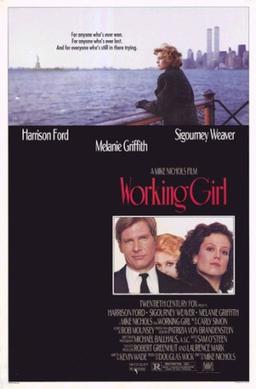
Lisa Reviews An Oscar Nominee: Working Girl (dir by Mike Nichols)


(With the Oscars scheduled to be awarded on March 4th, I have decided to review at least one Oscar-nominated film a day.  These films could be nominees or they could be winners.  They could be from this year’s Oscars or they could be a previous year’s nominee!  We’ll see how things play out.  Today, I take a look at the 1988 best picture nominee, Working Girl!)

Welcome to the 80s!

Yes, Working Girl is definitely a film of its time.  It’s a film that’s obsessed with big things: big dreams, big offices, big money, and big hair.  It’s a movie where the heroes talk about hostile takeovers and where everyone’s dream is to eventually to be an executive on Wall Street.  You know all of those people who claim that The Big Short is the greatest movie ever made?  I can guarantee that the majority of them would totally hate every character in Working Girl.  Working Girl is such a film of the past that it even features Alec Baldwin doing something other than bellowing at people.  In fact, Baldwin’s actually sexy in Working Girl.  It was strange to see him in this film and realize that he was the same actor who currently spends all of his time picking fights on twitter and defending James Toback.

Of course, Alec Baldwin has a relatively small role in Working Girl.  He plays Mick Dugan, the type of blue-collar guy who gives his girlfriend lingerie for her birthday (“I just wish you would get me something that I could wear outside,” she says as she tries it on) and who then proceeds to cheat on her while she’s off at work.  From the minute we first meet Tess McGill (Melanie Griffith), we know that she deserves better than Mick.

Tess is a professional administrative assistant.  She’s just turned 30 but she’s not ready to give up her dreams and settle for a life of fighting off coke-snorting executives and coming home to some guy like Mick.  (Speaking of early performances from infamous actors, one of the coke-snorting executives is played by Kevin Spacey.)  Tess has got a bachelor’s degree in Business.  As she puts it, she has a “mind for business and a bod for sin.”

She’s also got a new boss, an up-and-coming executive named Katharine Parker (Sigourney Weaver).  It turns out that Katherine is 29 years old.  (“I’ve never worked for someone younger than me before,” Tess says as Katherine gives her a condescending smile.)  Katharine encourages Tess to think of her as being a mentor.  If Tess has any ideas for investments, she should feel free to bring them to Katharine.  Of course, when Tess does so, Katharine claims that her bosses shot the idea down.  It’s only after Katharine breaks her leg in a skiing accident and is laid up in Europe that Tess discovers that Katharine has actually been stealing her ideas and not giving her any credit for them.

What is Tess to do?  Well, she does what any of us would do.  She passes herself off as an executive and presents her idea to Jack Trainer (Harrison Ford) herself.  Jack is impressed with the idea but he’s even more impressed with Tess.  Of course, complicating things is that Jack was once in a relationship with Katharine and Katharine still thinks that she’s going to eventually marry Jack.  And, of course, there’s the fact that Tess is lying about actually being an executive…

Working Girl is a frequently amusing film, elevated by performances of Melanie Griffith and, in the role of Tess’s best friend, Joan Cusack.  Add to that, Harrison Ford is remarkable non-grouchy as Jack Trainer and Sigourney Weaver appears to be having the time of her life playing a villain.  Even as I laughed at some of the lines, here was a part of me that wished that the film had a bit more bite.  At times, Working Girl tries too hard to have it both ways, both satirizing and celebrating Wall Street culture.  In the end, the film works best as a piece of wish-fulfillment.  It’s a film that says that not only can you win success and Harrison Ford but you can get your bitchy boss fired too.

Despite being a rather slight (if likable) film, Working Girl was nominated for Best Picture of 1988.  However, it lost to Rain Man.

So You Want To Be A Rock’n’Roll Star: The Idolmaker, Breaking Glass, That’ll Be The Day, Stardust


So, you want to be a rock and roll star?  Then listen now to what I say: just get an electric guitar and take some time and learn how to play.  And when your hair’s combed right and your pants fit tight, it’s gonna be all right.

If you need any more help, try watching these four films:

Idolmaker

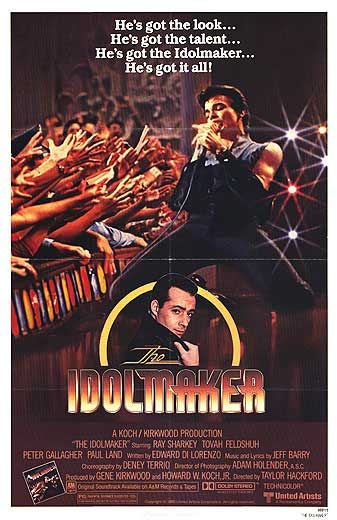
The Idolmaker (1980, directed by Taylor Hackford)

The Idolmaker is a movie that asks the question, “What does it take to be a star?  Who is more interesting, the Svengalis or the Trilbys?”  The year is 1959 and Vinny Vacari (Ray Sharkey, who won a Golden Globe for his performance but don’t let that dissuade you from seeing the movie) is a local kid from New Jersey who dreams of being a star.  He has got the talent.  He has got the ambition and he has got the media savvy.  He also has a receding hairline and a face like a porcupine.

Realizing that someone who looks like him is never going to make hundreds of teenage girls all scream at once, Vinny instead becomes a starmaker.  With the help of his girlfriend, teen mag editor Brenda (Tovah Feldshuh) and a little payola, he turns saxophone player Tomaso DeLorussa into teen idol Tommy Dee.  When Tommy Dee becomes a star and leaves his mentor, Vinny takes a shy waiter named Guido (Peter Gallagher) and turns him into a Neil Diamond-style crooner named Cesare.  Destined to always be  abandoned by the stars that he creates, Vinny continually ends up back in the same Jersey dive, performing his own songs with piano accompaniment.

The Idolmaker is a nostalgic look at rock and roll in the years between Elvis’s induction into the Army and the British invasion.  The Idolmaker has some slow spots but Ray Sharkey is great in the role of Vinny and the film’s look at what goes on behind the scenes of stardom is always interesting.  In the movie’s best scene, Tommy performs in front of an audience of screaming teenagers while Vinny mimics his exact moments backstage.

Vinny was based on real-life rock promoter and manager, Bob Marcucci.  Marcucci was responsible for launching the careers of both Frankie Avalon and Fabian Forte.  Marcucci served as an executive producer on The Idolmaker, which probably explains why this is the rare rock film in which the manager is more sympathetic than the musicians.

breakglass_lrg

Breaking Glass (1980, directed by Brian Gibson)

At the same time that The Idolmaker was providing American audiences with a look at life behind-the-scenes of music stardom, Breaking Glass was doing the same thing for British audiences.

In Breaking Glass, the idolmaker is Danny (Phil Daniels, who also starred in Quadrophenia) and his star is an angry New Wave singer named Kate (Hazel O’Connor).  Danny first spots Kate while she is putting up flyers promoting herself and her band and talks her into allowing him to mange her.  At first, Kate refuses to compromise either her beliefs or her lyrics but that is before she starts to get famous.  The bigger a star she becomes, the more distant she becomes from Danny and her old life and the less control she has over what her music says.  While her new fans scare her by all trying to dress and look like her, Kate’s old fans accuse her of selling out.

http://www.youtube.com/watch?v=8ALdL8oV_sY

As a performer, Hazel O’Connor can be an acquired taste and how you feel about Breaking Glass will depend on how much tolerance you have for her and her music.  (She wrote and composed all of the songs here.)  Breaking Glass does provide an interesting look at post-punk London and Jonathan Pryce gives a good performance as a sax player with a heroin addiction.

thatll-be-the-day-poster

That’ll Be The Day (1973, directed by Claude Whatham)

Real-life teen idol David Essex plays Jim MacClaine, a teenager in 1958 who blows off his university exams and runs away to the Isle of Wright.  He goes from renting deckchairs at a resort to being a barman to working as a carny.  He lives in squalor, has lots of sex, and constantly listens to rock and roll.  Eventually, when he has no other choice, he does return home and works in his mother’s shop.  He gets married and has a son but still finds himself tempted to abandon his family (just as his father previously abandoned him) and pursue his dreams of stardom.

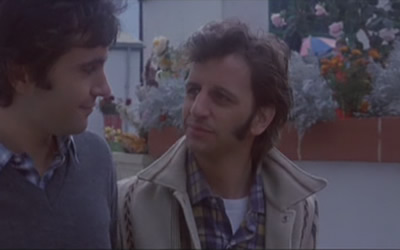
David Essex and Ringo Starr

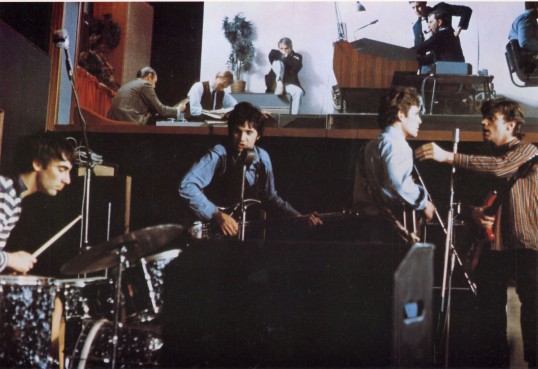
Based loosely on the early life of John Lennon, the tough and gritty That’ll Be The Day is more of a British kitchen sink character study than a traditional rock and roll film but rock fans will still find the film interesting because of its great soundtrack of late 50s rock and roll and a cast that is full of musical luminaries who actually lived through and survived the era.  Billy Fury and the Who’s Keith Moon both appear in small roles.  Mike, Jim’s mentor and best friend, is played by Ringo Starr who, of all the Beatles, was always the best actor.

That’ll Be The Day ends on a downbeat note but it does leave the story open for a sequel.

stardust-1

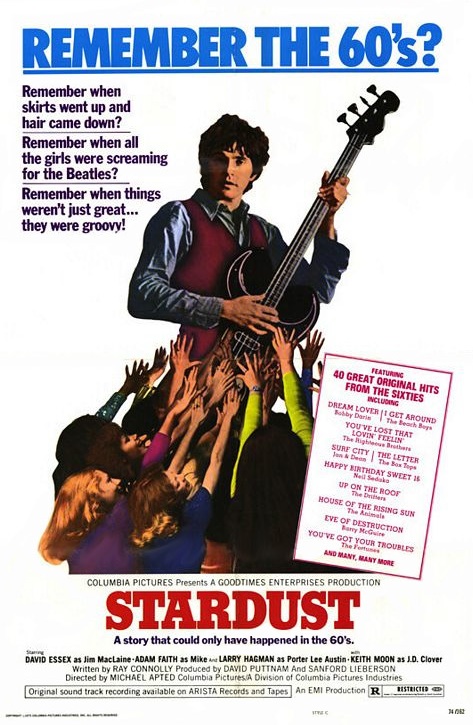
Stardust (1974, directed by Michael Apted)

Stardust continues the story of Jim MacClaine.  Jim hires his old friend Mike (Adam Faith, replacing Ringo Starr) to manage a band that he is in, The Straycats (which includes Keith Moon, playing a far more prominent role here than in That’ll Be the Day).  With the help of Mike’s business savvy, The Stray Cats find early success and are signed to a record deal by eccentric Texas millionaire, Porter Lee Austin (Larry Hagman, playing an early version of J.R. Ewing).

When he becomes the breakout star of the group, Jim starts to overindulge in drugs, groupies, and everything that goes with being a superstar.  Having alienated both Mike and the rest of the group, Jim ends up as a recluse living in a Spanish castle.  Even worse, he gives into his own ego and writes a rock opera, Dea Sancta, which is reminiscent of the absolute worst of progressive rock.  Watching Jim perform Dea Sancta, you understand why, just a few years later, Johnny Rotten would be wearing a homemade “Pink Floyd Sucks” t-shirt.

Stardust works best as a sad-eyed look back at the lost promise of the 1960s and its music.  Watch the movie and then ask yourself, “So, do you really want to be a rock and roll star?”

21494_2

Horror Film Review: Big Driver (dir by Mikael Salomon)


Bleh Stephen King

You have to be careful about admitting that you think Stephen King is overrated.

For a year and a half, I’ve been meaning to write a post entitled “10 Reasons Why Stephen King Sucks” but I haven’t. Some of that is because I don’t necessarily think that he does suck.  I think he’s a good writer but I also think that he’s overrated and that his novel about the Kennedy assassination got so many details about Texas wrong that I don’t even know where to begin.  (However, following the rules of clickbait, “sucks” works better than “overrated.”)  Mostly, though, it’s just because Stephen King fans tend to be a bit cult-like.  Criticizing King is like saying you don’t care about Beyonce’s marriage or admitting that you find President Obama to be a dull speaker or telling Vermont to go fuck itself or listing 10 Reasons Why You Hated Avatar.  You shouldn’t do it unless you want to run the risk of dealing with a lot of angry and irrational true believers.

That said, it’s always a little bit safer to criticize the movies that have been made from Stephen King’s books and short stories.  Even King’s most slavish followers will admit that Stephen King films tend to be uneven as far as quality is concerned.  Stanley Kubrick’s The Shining is one of the best horror films of all time but it’s interesting to note that Stephen King himself rarely has a good word to say about Kubrick’s adaptation of his novel.  For reasons that I’ve never quite understood, a lot of people love The Shawshank Redemption.  Then there are the adaptations that nobody likes, like Bag of Bones and Dreamcatcher.

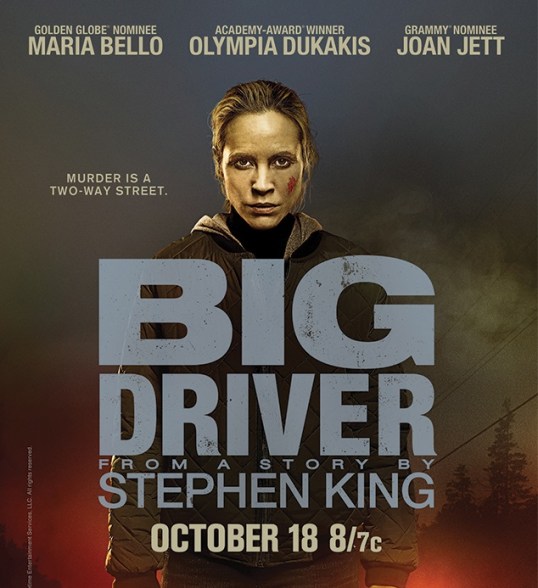
And then there’s Big Driver, an adaptation of a Stephen King novella that aired on Lifetime last night.  For the past two months, Lifetime has been advertising this film with short but effective commercials that featured a bloodied Maria Bello running down a dark road while a gigantic truck ominously followed behind her.  I saw the commercials and, seeing as how Maria Bello is a favorite actress of mine and how much I love Lifetime movies in general, I was excited to see Big Driver.  Then, I saw another commercial in which Stephen King was quoted as saying, “This is the film that Stephen King fans have been waiting for,” and I have to admit that it left me a little bit less enthused because, quite frankly, I’ve always been under the impression that Stephen King will endorse anything as long as he gets paid and his ass gets kissed.  (Someday, we’ll have to do a survey to discover just how many crappy books come with a Stephen King pull quote on the cover describing the book’s author as being “the future of horror!”)  And I have to admit that I resented the fact that Lifetime seemed to be assuming that I would ever allow Stephen King to tell me what was good and what was bad.  I can decide that for myself without having someone else tell me what I’ve been “waiting for.”

(I have issues with authority.  Can you tell?)

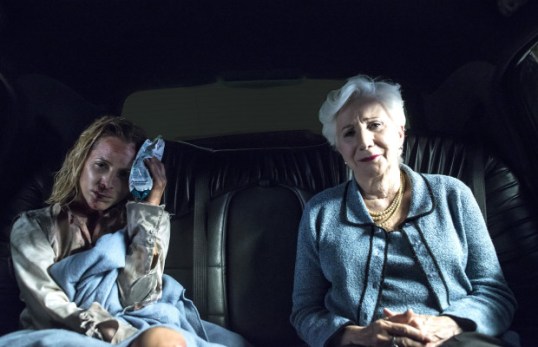
Big Driver, incidentally, is Stephen King’s take on I Spit On Your Grave.  Mystery writer Tess Thorne (Maria Bello) is raped and left for dead by a serial killer who is known as Big Driver (Will Harris).  Feeling that the police would simply say that she was “asking for it”, Tess does not report the attack but instead uses the same techniques that she writes about in her books to track down both Big Driver and his mother (Ann Dowd) and sets out to get both revenge for herself and justice for all of Big Driver’s other victims.  (Those detective techniques, by the way, largely seem to consist of knowing how to use Google.)  Along the way, Tess hallucinates conversations with both her car’s GPS and with one of the fictional detectives from her books (played by Olympia Dukakis).

BD

When I watched Big Driver last night, I actually had to stop watching after an hour.  The film was just too intense and disturbing for me to handle in one sitting.  The scene where Tess was raped was too painful to watch and Maria Bello’s performance was so raw and real that I had to change the channel.  It wasn’t the film’s fault.  It’s just that I wasn’t in the right emotional state to watch the movie.  It was a lot more intense than anything that I would have ever expected to see on Lifetime.  (Lifetime, after all, is the television equivalent of comfort food.)  So, I stopped watching after an hour and I turned over to SyFy so I could watch a much more light-hearted horror film, Finders Keepers.  Fortunately, I had the DVR recording Big Driver and I finished watching the film early this morning.

What I discovered, when I watched the rest of the film, is that Big Driver is a frustratingly uneven film.  The first half is difficult to watch and that’s the way it should have been.  But, as I watched the rest of the film, I found myself growing annoyed with Tess’s imaginary friends.  The talking GPS and the spectral presence of the fictional detective all served to make Tess look less like a woman demanding justice and more like the proverbial unstable person who shouldn’t have been messed with.  One reason why the original I Spit On Your Grave has recently been reevaluated by several feminist film critics is because the victim in that film is never portrayed as being crazy or unbalanced.  Her actions are purely the result of what has been done to her and, as such, that film is ultimately far more empowering than most critics will ever be willing to admit.   By calling into question Tess’s grip on reality, Big Driver fails to empower and, if a film like this isn’t going to be empowering, than what is the point?

Big Driver is, however, redeemed by Maria Bello’s fierce performance as Tess.  Maria Bello is one of my favorite actresses.  When you see that a character is played by Maria Bello, you know that character is not going to put up with any bullshit and she’s not going to be afraid to kick someone’s ass if she has to.  Even when the film’s script lets the character down, Maria Bello keeps Tess strong.  It’s a great and, I would say, even an important performance.

As for Big Driver‘s place in the pantheon of Stephen King film adaptations, it’s about in the middle.  It’s neither as good or as bad as it could have been but it is undeniably effective.

big-driver-stephen-king-lifetime