4 Shots From 4 Films is just what it says it is, 4 shots from 4 of our favorite films. As opposed to the reviews and recaps that we usually post, 4 Shots From 4 Films lets the visuals do the talking. Hollywood royalty Olivia de Havilland is alive & well, and celebrating her 102nd birthday today! In her honor, here are 4 shots from the films of Olivia de Havilland:
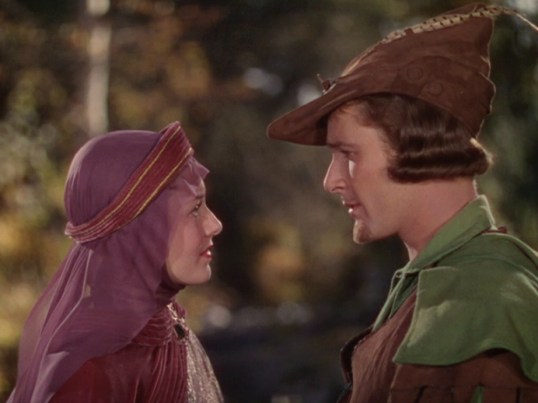
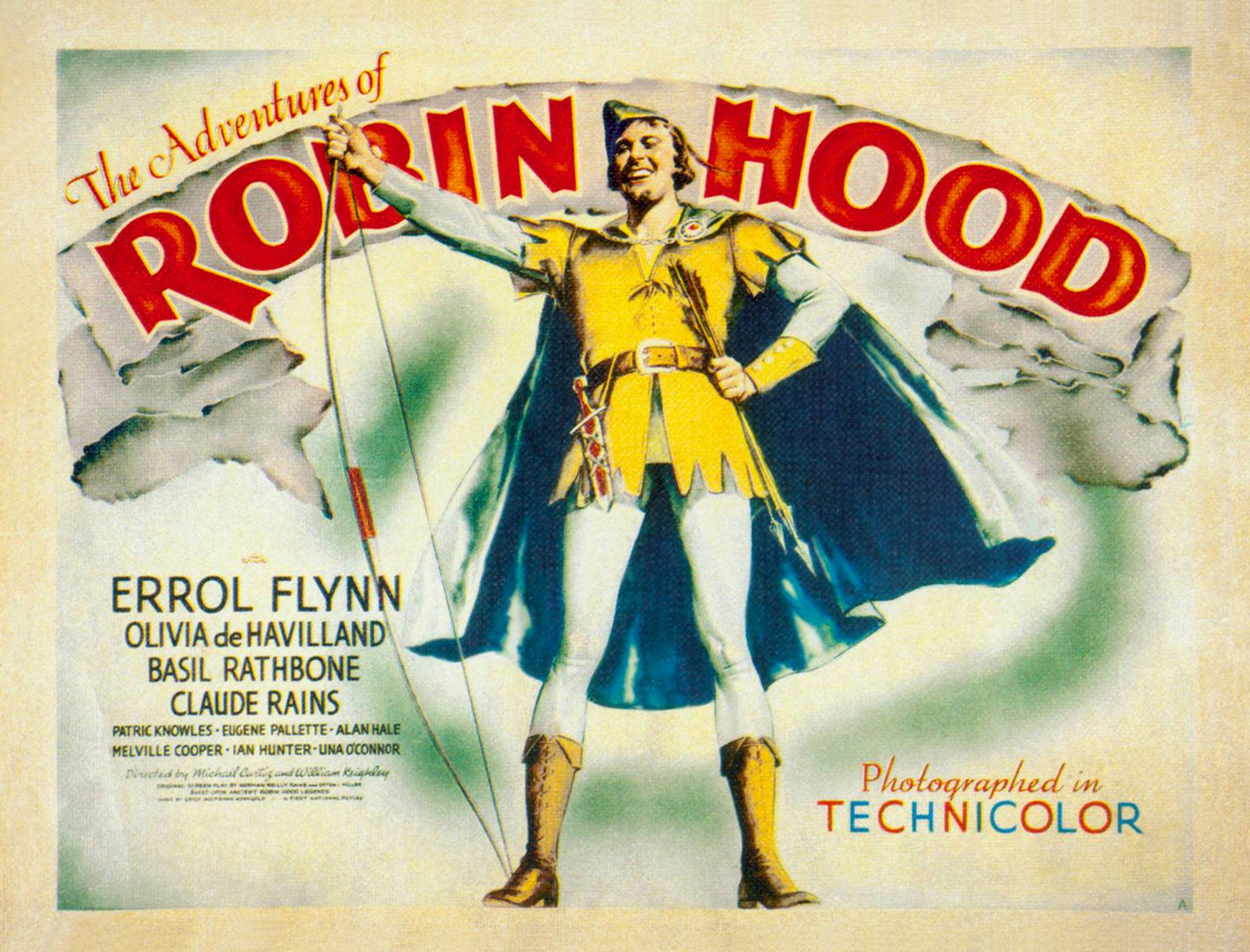
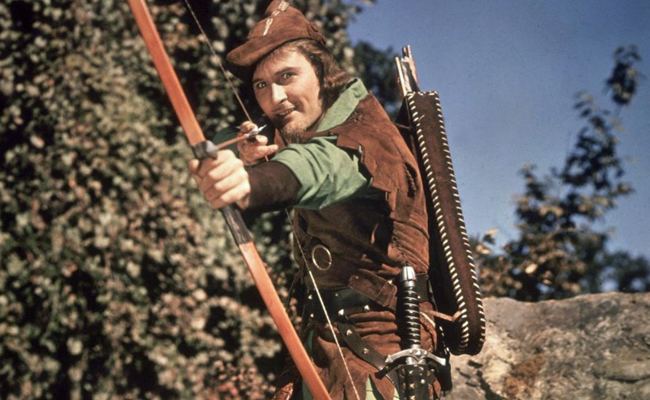
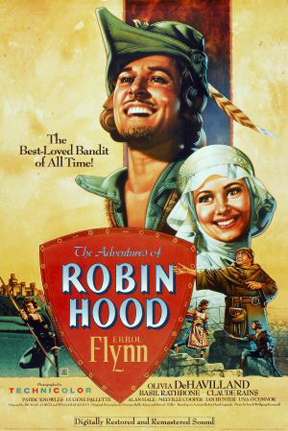
The Adventures of Robin Hood (1938; D: Michael Curtiz)
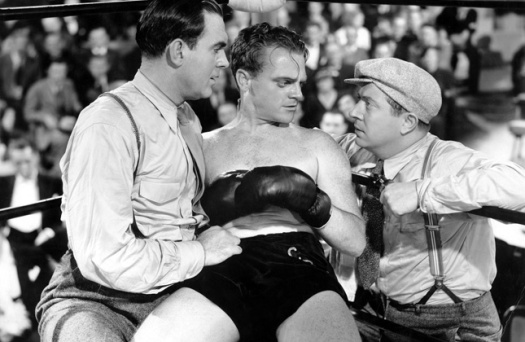
Faith and begorrah! You can’t get much more Irish than a film featuring Jimmy Cagney , Pat O’Brien , and Frank McHugh all together. THE IRISH IN US is sentimental as an Irish lullaby, formulaic as a limerick, and full of blarney, but saints preserve us it sure is a whole lot of fun! The story concerns three Irish-American brothers, the O’Hara’s, living with their Irish mum in a cramped NYC apartment. There’s sensible, levelheaded cop Pat (O’Brien), dimwitted fireman Michael (McHugh), and ‘black sheep’ Danny (Cagney), who’s a fight promoter.
O’Brien, Cagney, and McHugh
Pat announces his intention to marry pretty Lucille Jackson (19-year-old Olivia de Havilland in an early role), while Danny’s got a new fighter named Carbarn Hammerschlog ( Allen Jenkins , who’s a riot), a punchy pug who “every time he hears a bell ring, he starts sluggin”! Danny and Lucille ‘meet cute’ while he’s out…
(With the Oscars scheduled to be awarded on March 4th, I have decided to review at least one Oscar-nominated film a day. These films could be nominees or they could be winners. They could be from this year’s Oscars or they could be a previous year’s nominee! We’ll see how things play out. Today, I take a look at the 1949 best picture nominee, The Heiress!)
“I have been taught by the masters.”
— Catherine Sloper (Olivia De Havilland) in The Heiress (1949)
I’m not going to spoil too much of the ending of The Heiress, beyond saying that those are the words with which Catherine ends the film. Taken out of context, they may not seem like much. However, after you’ve spent two hours with Catherine, her father, and the man who claims that he’s in love with her, these are perhaps seven of the most chilling words ever uttered. When you hear them, you don’t know if you should cheer or be very, very afraid. Myself, I had both reactions but, then again, I often do.
The Heiress, which is based on a play that’s based on a novel by Henry James, takes place in 19th century New York City. Austin Sloper (Sir Ralph Richardson) is a widely admired and very successful physician. He’s also a very cold man, one who has never recovered from the death of his wife. He lives with his daughter, Catherine (Olivia de Havilland). Catherine is shy and is continually told that she’s plain and boring. She’s devoted to her father, though Austin is cruelly manipulative of her. Catherine, who has never been in a relationship, has pretty much accepted that she’s destined to be alone.
Or, at least, she has until she meets Morris Townsend (Montgomery Clift).
From the first minute that Catherine meets him, Morris seems to be perfect. He’s handsome. He’s intelligent. He’s witty. He’s charming. He’s Montgomery Clift, for God’s sake! For Catherine, it’s love at first sight and Morris says that it’s the same for him. Suddenly, Catherine’s life no longer revolves around her father. Now, she dreams of marrying Morris.
Austin isn’t happy about this. Despite showing his daughter nothing but disdain for most of her life, Austin suddenly become protective of her. He says that Morris only wants to marry her because she stands to come into a great deal of money. To prove his point, he announces that, if Catherine and Morris get married, he will disinherit Catherine and neither she nor her husband will ever get their hands on his money.
How will Morris respond to Austin’s threat? Well, you’ll have to watch the movie to find out and you really should! The Heiress is a great movie, featuring noirish direction from William Wyler and brilliant performances from by de Havilland, Richardson, and Clift. Dr. Sloper may be a monster but Richardson plays him with so much authority that it’s hard to dismiss his worries about Morris, no matter how much you may want to. Montgomery Clift, meanwhile, keeps you guessing about Morris’s intentions. And, finally, the great Olivia de Havilland deservedly won an Oscar for her performance as Catherine Sloper. Over the course of the film, Catherine goes from being a withdrawn wallflower to being a … well, I can’t tell you anymore. I don’t want to spoil the film any more than I already have. The ending will leave you shaken in the best possible way.
The Heiress was nominated for best picture but lost to All The King’s Men.
Yesterday, the New Mexico Film Critics Association named their picks for the best of 2017! They also became the first group to pick Blade Runner 2049 as the best film of 2017.
We’re about a quarter of the way through the baseball season, so let’s take a trip to the ballpark with Joe E. Brown in ALIBI IKE, a 1935 comedy based on a story by Ring Lardner, one of the best baseball writers of the early 20th Century. Brown, known for his wide mouth and comical yell, is an admittedly acquired taste; his “gosh, golly” country bumpkin persona is not exactly what modern audiences go for these days. But back in the 30’s he was one of Hollywood’s top box-office draws, specializing in sports themed comedies revolving around wrestling (SIT TIGHT), track and field (LOCAL BOY MAKES GOOD), swimming (YOU SAID A MOUTHFUL), polo (POLO JOE), football ($1,000 A TOUCHDOWN), and racing (boats in TOP SPEED, airplanes in GOING WILD, bicycles in SIX DAY BIKE RACE).
ALIBI IKE is the final chapter in Brown’s “baseball trilogy”. The first, 1932’s FIREMAN, SAVE MY CHILD, found him…
Readers of this blog know CASABLANCA is my all-time favorite movie, but THE ADVENTURES OF ROBIN HOOD is definitely in the Top Ten, maybe even Top Five (I’d have to think about it… sounds like a future post!). The story’s been told on-screen dozens of times, from the silent 1922 Douglas Fairbanks swashbuckler to Disney’s 1973 animated version to the recent Russell Crowe/Ridley Scott offering. But it’s this 1938 classic that remains definitive, thanks to a marvelous cast, breathtaking Technicolor, and the greatest cinematic swordfight in history.
You all know the legend of Robin Hood by now, so no need for a recap. Instead, I’ll go right into what makes this film so great, starting with Errol Flynn as the brave Sir Robin of Locksley. Flynn was at the peak of his career here, after starring in such action-packed hits as CAPTAIN BLOOD , THE CHARGE OF THE LIGHT…
Today marks the 100th birthday of one of the last true Golden Age greats, Olivia de Havilland. Film fans across the globe are celebrating the life and career of this fine actress, who fought the Hollywood system and won. Olivia is the last surviving cast member of GONE WITH THE WIND (Melanie Wilkes), won two Academy Awards (TO EACH HIS OWN, THE HEIRESS), headlined classics like THE SNAKE PIT and THE DARK MIRROR, and costarred with dashing Errol Flynn in eight exciting films, including CAPTAIN BLOOD , THE ADVENTURES OF ROBIN HOOD, SANTA FE TRAIL, and THEY DIED WITH THEIR BOOTS ON.
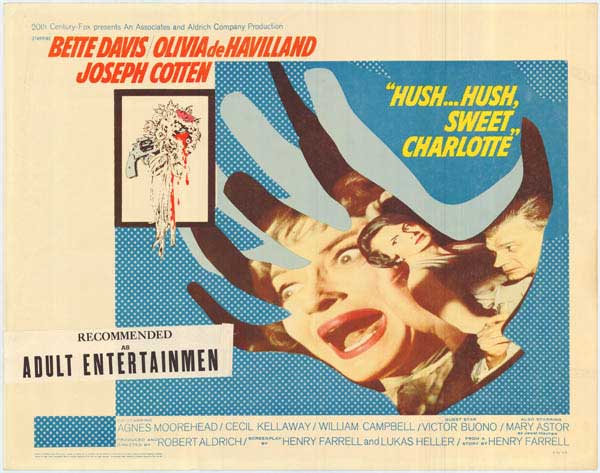
Olivia moved to Paris with her husband in the 1950’s and was semi-retired, acting in a handful of films. In 1962 director Robert Aldrich scored a huge hit, a psychological horror thriller called WHATEVER HAPPENED TO BABY JANE?, starring screen veterans Bette Davis and Joan Crawford. A new genre was…
I hope that you will join us all in wishing a happy birthday to the wonderful and legendary Olivia De Havilland, who turns 100 years old today! Not only is Olivia the last surviving cast member of Gone With The Wind but she’s also one of the last surviving stars from Hollywood’s Golden Age! Not only was she a wonderful actress but Olivia’s rivalry with sister Joan Fontaine continues to be one of the legendary moments of Oscar history!
This edition of 4 Shots From 4 Films features four movies that starred the one and only, Olivia De Havilland!
4 Shots From 4 Films
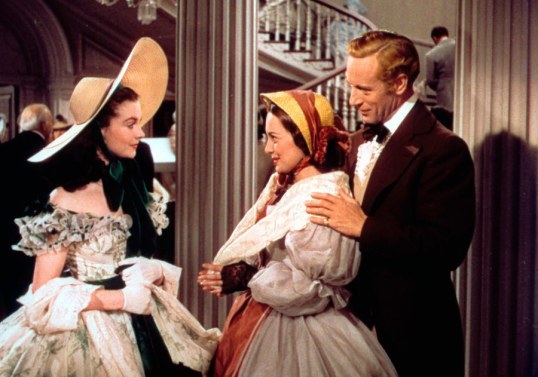
Gone With The Wind (1939, dir by Victor Fleming)
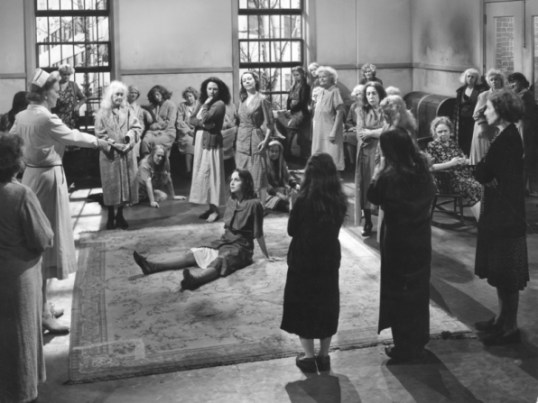
The Snake Pit (1948, dir by Anatole Litvak)
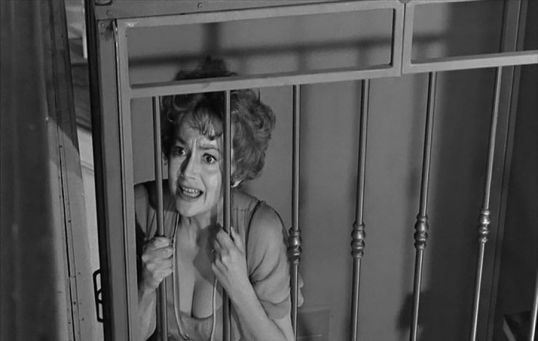
Lady in a Cage (1964, dir by Walter Grauman)
The Swarm (1978, dir by Irwin Allen)
By the way, do you know who shares a birthday with Olivia De Havilland? OUR VERY OWN PATRICK SMITH! Happy birthday, Pat!!!!!!
(For those following at home, Lisa is attempting to clean out her DVR by watching and reviewing 38 films by this Friday. Will she make it? Keep following the site to find out!)
Flamboyant. Athletic. Joyous. Determined. Handsome. Outspoken. Bigger than life. Revolutionary. Anarchist. Sexy. Libertarian. Is there any doubt why Errol Flynn remains the definitive Robin Hood?
And. for that matter, is there any doubt why the 1938 film The Adventures of Robin Hood remains not only the definitive Robin Hood film but also one of the most influential action films in history?
The Adventures of Robin Hood tells the story that we’re all familiar with. The King of England, Richard The Lionhearted (Ian Hunter), is captured while returning from the Crusades. His brother, King John (Claude Rains, in full autocratic villain mode), usurps the throne while Richard is gone and immediately raises taxes. He claims that he’s only doing this to raise the money to set Richard free. Of course, the real reason is that John is a greedy tyrant.
The only nobleman with the courage to openly oppose John is Sir Robin of Locksely (Errol Flynn). Sir Robin protects his fellow citizens from John’s main henchman, Sir Guy of Gisbourne (Basil Rathbone, also in full autocratic villain mode). In fact, Robin is so brave that, on multiple occasions, he even enters Sir Guy’s castle so that he can specifically tell King John and Sir Guy that he has no use for their laws. This, of course, always leads to Robin having to make a dramatic escape while arrows flies and swords are unsheathed all around.
And through it all, Robin Hood keeps smiling and laughing. He’s a wonderfully cheerful revolutionary. He may be fighting a war against a ruthless and unstoppable enemy and he may be the most wanted man in England but Robin is determined to have fun. One need only compare Robin to his humorless foes to see the difference between freedom and bureaucracy.
(We could use Errol Flynn’s Robin Hood today, though I suspect our government would just blow him up with a drone and then issue a statement about how, by stealing money from the rich and giving it to the poor, Robin was keeping the government from being able to rebuild bridges and repair roads.)
When Robin isn’t exposing the foolishness of organized government, he’s hanging out in Sherwood Forest. He’s recruiting valuable allies like Friar Tuck (Eugene Pallette) and Little John (Alan Hale, Sr.) He’s playing constant pranks and promoting revolution and, to his credit, he’s a lot more fun to listen to than that guy from V For Vendetta. He’s also romancing Maid Marian (Olivia de Havilland) and good for him. Two beautiful people deserve to be together.
Even better, he’s doing it in glorious Technicolor! There’s a lot of great things about The Adventures of Robin Hood. The action scenes are exciting. The music is thrilling. The film is perfectly cast. Errol Flynn may not have been a great actor but he was a great Robin Hood. But what I really love about the film is just the look of it. We tend to take color for granted so it’s interesting to watch a film like The Adventures of Robin Hood, one that was made at a time when color film was something of a novelty. For those of us who spend a lot of time talking about how much we love old school black-and-white, The Adventures of Robin Hood is a film that says, “Hey, color can be great too!”
(True, nobody in The Adventures of Robin Hood shouts, “I declare him to be …. AN OUTLAAAAAAAAAAAAWWWWWWWW!” Actually, now that I think about it, Ridley Scott’s Robin Hood would have worked much better if Oscar Isaac and Russell Crowe had switched roles.)
The Adventures of Robin Hood was nominated for best picture and it probably should have won. However, the Oscar went to Frank Capra’s You Can’t Take It With You.
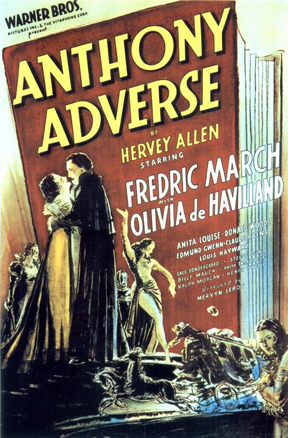
Late last night, I continued to clean out my DVR by watching the 1936 film, Anthony Adverse.
I recorded Anthony Adverse off of TCM, where it was being shown as a part of that channel’s 31 Days of Oscars. Anthony Adverse was aired because it was nominated for Best Picture of 1936. That’s significant because, if not for that nomination, I doubt that anyone would ever have a reason to watch Anthony Adverse. It’s certainly one of the more obscure best picture nominees. Despite a prestigious cast and being directed by the respectable Mervyn LeRoy, Anthony Adverse only has a handful of reviews over at the imdb. And most of those reviews were written by Oscar fanatics like me.
Anthony Adverse is an epic historical film, one that tells the story of Anthony Adverse (Frederic March). Anthony is the illegitimate son of Denis Moore (Louis Hayward) and Maria (Anita Louise), the wife of evil Spanish nobleman, Don Luis (Claude Rains, convincing as a nobleman but not as someone from Spain). Luis murdered Denis and Maria died giving birth so Luis abandons the baby at an Italian convent. Anthony is raised by nuns and priests and then, 10 years later, is apprenticed to an English merchant named John Bonnyfeather (Edmund Gwenn). Bonnyfeather just happens to be Anthony’s grandfather! Though Luis told him that Anthony died as soon as he was born, Bonnyfeather quickly figures out that Anthony is his grandson. However, Bonnyfeather doesn’t share that information with Anthony and instead, he gives Anthony the surname “Adverse.”
Bonnyfeather raises Anthony as his own son. Anthony grows up to be Frederic March and ends up falling in love with and marrying the beautiful Angela (Olivia De Havilland). However, Anthony is suddenly called away on business to Havana, Cuba. He doesn’t even have a chance to tell Angela that he’s leaving. He does leave her a note but it blows away. Assuming that she’s been abandoned, Angela goes to France, becomes an opera singer, and is soon the mistress of Napoleon.
Meanwhile, in Cuba, Anthony becomes convinced that Angela has intentionally abandoned him. Consumed by grief, he ends up running a slave trading post in Africa. He takes one of the slaves, Neleta (Steffi Duna), as his mistress and becomes known for his cruelty. However, he eventually meets Brother Francois (Pedro de Cordoba) and starts to reconsider his ways.
(The film’s treatment of the slave trade is …. well, it’s awkward to watch. The film is undoubtedly critical of slavery but, at the same time, it’s hard not to notice that the only slave with a prominent part in the film is played by a Hungarian actress. Anthony may eventually reject cruelty but it’s left ambiguous as to whether or not he rejects the slave trade as a business. If Anthony Adverse were made today, one imagines that this section of the film would be handled much differently.)
Meanwhile, back in Europe, Bonnyfeather is dying and his housekeeper, Faith (Gale Sondergaard, who won the first ever Oscar awarded for Best Supporting Actress for her performance here), plots to claim his fortune.
After I watched the movie but before I started this review, I did some research and I discovered that Anthony Adverse was based on a 1,222-page best seller that came out in 1933. I’m going to guess that the film’s long and ponderous story may have worked better on the page than it does on the screen. As a film, Anthony Adverse clocks in at 141 minute and it feels even longer. Despite the impressive cast, the film just never clicks. It’s never that interesting.
At the same time, I can understand why it was nominated for best picture. It’s a big movie, full of characters and extravagant sets and ornate costumes. You can tell it was an expensive movie to make and there’s enough philosophical dialogue that you can pretend there’s something going on underneath the surface. In the 1936, Anthony Adverse may have been quite impressive but seen today, it’s forgettable.
Anthony Adverse lost best picture to another overproduced extravaganza, The Great Ziegfield. Personally, I would have given the award to the unnominated My Man Godfrey.








 Through the Shattered Lens