Film Review: The Death of Stalin (dir by Armando Iannucci)


2017’s The Death of Stalin opens in Moscow in 1953.  Joseph Stalin (Adrian McLoughlin) calls into Radio Moscow and demands that he be sent a recording of the piano concerto that has just been performed live.  The only problem is that no one bothered to record it while it was being performed.  In a panic, the head of Radio Moscow announces that no one — not the musicians, not the exhausted conductor, and certainly not the audience — is allowed to leave until the orchestra has performed again.

Indeed, one of the recurring themes of The Death of Stalin is that everyone is terrified of their beloved dictator.  The orchestra fears being executed for failing to recreate their performance.  The members of the Central Committee fear being the next person to be purged from the ranks of Stalin’s government.  The two guards that are posted outside of Stalin’s bedroom are so terrified of interrupting Stalin and getting on his bad side that they don’t investigate when they hear Stalin collapsing to the floor.  When Stalin is found unconscious, the only doctors available are young and inexperienced because Stalin recently exiled all of the good doctors from Moscow.  Even after Stalin dies from a cerebral hemorrhage, his reign of terror continues as all the members of his household staff are promptly executed to keep anyone from learning either the exact details of Stalin’s death or the way that the members of the Central Committee responded to his passing.

The Death of Stalin is a dark comedy that follows the members of the Central Committee as they scramble to protect their own positions after Stalin’s death.  The humor comes from watching historical figures like Nikita Khrushchev, Vyacheslav Molotov, Lavrenti Beria, and Georgy Malenkov act like panicked junior executives who are desperately trying to save their own jobs during a corporate takeover.  Of course, the stakes are a bit higher.  Whoever succeeds Stalin will undoubtedly want to execute every other contender for the post.  As with so many of Armando Iannucci’s works, the humor comes from watching very powerful people act in very immature and petty ways.  While Malenkov (Jeffrey Tambor) tries to convince people that he actually is in charge, the brutal Beria (Simon Russell Beale) tries to bully his way into power and the wily Khrushchev (Steve Buscemi, giving one of his best performances) waits for his moment to strike.  (Beria, it should be noted, is one of history’s greatest monsters and the film, while a comedy, does not shy away from his depravity.)  Molotov (a hilarious Michael Palin) is so loyal to the Party that he says that Stalin was absolutely correct to have his wife executed just to then have Beria show up and reveal that Molotov’s wife is still alive.  Meanwhile, Stalin’s idiot son (Rupert Friend) claims that it’s all an American plot while the rest of the Central Committee laughs at him behind his back.  Only Georgy Zhukov (Jason Isaacs) seems to have full control of his emotions and his actions and it’s not a surprise to learn that, long after the events depicted in this film, purged from the Party.  In The Death of Stalin, the leaders of Russia are obviously scared of anyone who is too competent at their job.

The Death of Stalin is not only a satiric portrayal of petty bureaucrats.  It’s also a darkly humorous look of life in a dictatorship, where everyone is at the whim of whoever happens to be in charge at any given time.  The film is full of power-hungry narcissists who use their ideology and their nationalism as a shield for their own ambitions.  Everyone wants to control someone else.  Even as mourners pass by Stalin’s coffin, they’re given orders on how to properly grieve and move.  The film ends with a series of pictures of various people either having their faces scratched or, in some cases, just vanishing.  In a free country, failure leads to humiliation.  In a dictatorship,  it leads to non-existence as the formerly prominent are suddenly erased from a history that no longer has a place for them.  Ironically, of all the original leaders of communist Russia, it was Molotov who lived the longest.  He was 96 when he died in 1986.  If not for Stalin’s sudden death, he probably would have been purged and executed at the age of 63.

On this May Day, with so many people currently trying to rehabilitate the reputations of the 20th Century’s worst dictators, The Death of Stalin is must-watch.
 

Catching Up With The Films of 2022: White Elephant (dir by Jesse V. Johnson)


https://www.youtube.com/watch?v=5jzO-_xOp98

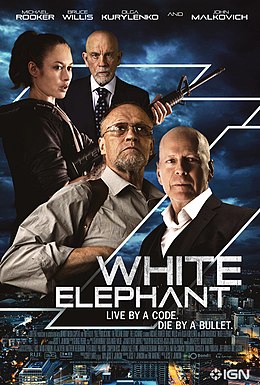
White Elephant is not that bad.  In fact, for a B-action movie it’s actually pretty good.  If nothing else, it featured one of Michael Rooker’s best performances.

It’s important to start out this review by making that clear because I think a lot of people are going to be tempted to judge this film based solely on the fact that this was one of the last films that Bruce Willis made before his family announced that he would be retiring from acting due to health reasons.  When the big story was published in the L.A. Times about Willis’s recent struggles and how those struggles led to him accepting countless roles in straight-to-video fare like American Siege, several people who worked on White Elephant were quoted, with many saying that Willis always did his best but that he was definitely not the Willis that they all remembered.  The film’s director, action maestro Jesse V. Johnson, publicly stated that he would not make another film with Willis because “the arrangement felt wrong” and that Willis deserved a better end to his career.

And it must be said that Bruce is obviously not himself in White Elephant.  As with many of his recent films, Bruce is cast as a villain in this piece.  He’s a crime lord named Arnold and he spends the majority of his time taking meetings and giving order to his underlings.  Eventually, he does pick up a gun and fire it but there’s very little of the cocky attitude and swaggering charisma that made Bruce Willis into a superstar.  He still has the physical presence to play a tough guy.  Bruce Willis still looks intimidating and the film uses him sparingly, never allowing us to spend too much time focusing on how different he seems from the Bruce Willis who starred in Die Hard and Pulp Fiction.  One never gets the feeling that Bruce is being deliberately exploited in White Elephant, that alone sets it above some of the other recent films that have featured Willis.  But, at the same time, Arnold is a fairly generic bad guy.

Fortunately, the majority of the film follows Michael Rooker in the role of a far more interesting criminal.  Rooker plays Gabe Tancredi, a former Marine turned hitman.  He’s about as ruthless as they come but he still has enough of a code of ethics that he realizes that he can’t kill a police officer named Vanessa (Olga Kurylenko), no matter how much Arnold wants her dead.  Ordered to kill her, Gabe instead protects her, which leads to Arnold sending all of his men after them.  It leads to several shootouts and explosions as Gabe puts his life at risk to finally do the right thing.

It’s a simple story but it’s told well.  Jesse V. Johnson started out as a stuntman and he clearly knows his way around an action scene and the final shootout in genuinely exciting.  The film is also helped by Michael Rooker, who brings a good deal of unexpected depth to the role of Gabe.  Even though Rooker obviously knew that White Elephant was a B-movie, he still refuses to phone in a single minute of his performance and, instead, he turns Gabe into a surprisingly complex killer.  Gabe’s relationships with his agent Glen (John Malkovich), his protegee Carlos (Vadhir Debrez), and Vanessa are all genuinely interesting.  I especially liked the early scenes between Rooker and Debrez, in which the two actors wonderfully play off of each other and we get the feeling Carlos is almost like a son to Gabe.  Of course, being genre savvy, we know that Carlos is eventually going to be assigned to take Gabe down but, because their friendship seemed so real, we find ourselves dreading that confrontation.  White Elephant is a B-movie but, much like last year’s Corrective Measures and Gasoline Alley, it’s a B-movie with a heart.

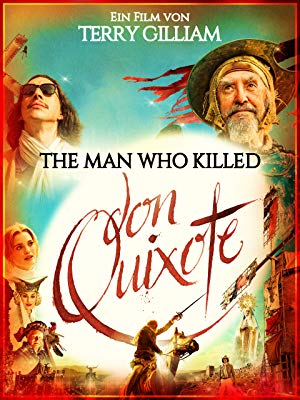
Icarus File No. 6: The Man Who Killed Don Quixote (dir by Terry Gilliam)


For many years, The Man Who Killed Don Quixote was a film best known for not having been made.

In the past, we’ve used the Icarus Files as a way to write about filmmakers who flew too close to the sun of their own ambition and who plunged down to the sea as a result.  However, in the case of The Man Who Killed Don Quixote, the sun is not director Terry Gilliam’s ambition.  Instead, the sun is a combination of shady financiers, natural disasters, and film industry silliness that seemed to all conspire to keep Gilliam from making his film.  And yet, unlike the real Icarus, Gilliam insisted on continuing to fly, regardless of how many times he crashed into the ocean.

Terry Gilliam first started to talk about adapting Migel de Cervantes’s Don Quixote into a film in the late 80s.  The tale of a Spanish nobleman who becomes convinced that he’s fighting giants when he’s actually only jousting with windmills, Don Quixote sounded like an obvious project for Gilliam.  Gilliam’s films have always dealt with the power and importance of imagination.  However, it’s often forgotten that Gilliam’s protagonists are often both saved and eventually destroyed by fantasy.  (One need only think about the end of Time Bandits, in which the young main character goes on the journey of a lifetime but then watches as his parents blow up in front of him.)  It’s easy to forget that Don Quixote dies at the end of Cervantes’s tale, having regained his sanity and having announced that his niece will be disinherited if she marries a man who has ever read a book about chivalry. 

From 1990 to 1997, Gilliam started pre-production on his version of Don Quixote several times, just for the production to be canceled.  Sometimes, this was due to Gilliam not being able to get the budget that he felt would be necessary to bring his vision to life.  Frustrated with the Hollywood studio system, Gilliam wanted to raise the money for and make his movie in Europe but this turned out to lead to a whole new set of financial and regulatory complications.

Filming finally started on the film in 2000, with Jean Rochefort playing a former film actor who thinks that he’s Don Quixote and Johnny Depp playing the director who fills the role of Sancho Panza.  Unfortunately, as shown in the poignant documentary Lost in La Mancha, the production seemed to be almost cursed from the start.  The footage from the first day of shooting was unusable, due to planes flying overhead.  The 2nd day of shooting was ruined by a flash flood that swept away much of the set.  Jean Rochefort injured himself and, despite his best efforts to act through the pain, he had to step away from the role.  Filming was suspended in 2000 and, for the next 16 years, Gilliam tried to find a way to get the stalled film started up again.  Many actors came and went, including Robert Duvall and, most promisingly, John Hurt.  Hurt agreed to play the role of Quixote but, just when it seemed that the film was finally going to go into production, Hurt passed away from pancreatic cancer.  A few months later, the original Quixote, Jean Rochefort, also passed away.  The film went back into limbo.

Finally, in 2016, a producer named Paulo Branco offered to fund the film.  Pre-production started up again, this time with Adam Driver in the Sancho Panza role and Michael Palin playing Quixote.  However, the project was soon once again stalled, as Branco wanted creative control of the film.  When Branco slashed both the budget of the film and Palin’s already reduced salary, Gilliam denounced Branco’s actions.  Branco suspended production but, by this point, Gilliam had already hooked up with another set of producers.  Jonathan Pryce replaced Michael Palin as Don Quixote and, finally, Terry Gilliam’s The Man Who Killed Don Quixote was filmed!

Once filming was complete, however, Paulo Branco popped up yet again.  Claiming that he owned the rights to the story and not Terry Gilliam, he sued to keep the film from being distributed.  The courts ruled in Branco’s favor but Gilliam countered that he hadn’t used one frame of footage that had been shot while Branco was serving as producer and that, while Branco had the rights to his version of The Man Who Killed Don Quixote, he did not have the rights to Gilliam’s.  While the lawyers argued, Amazon Studios withdrew from an agreement to distribute the film.  Once the case was finally settled, The Man Who Killed Don Quixote was finally given a haphazard release in a few countries, often in edited form.

And that’s a shame because The Man Who Killed Don Quixote is a delight.  It’s a film that is both playful and snarky, a celebration of imagination that also serves as a satire of Hollywood narcissism.  Adam Driver plays Toby Grummett, a director who returns to a Spanish village to direct an big-budget, epic adaptation of Don Quixote.  Ten years earlier, as a student filmmaker, Grummett shot a previous adaptation of Don Quixote in the same village.  When he tracks down the old shoemaker (Jonathan Pryce), who starred in his student film, he discovers that the shoemaker thinks that he is Quixote and that he’s become something of a tourist attraction.

And from there, the film follows Don Quixote as he takes Toby on a quest to fight giants and protect the helpless and to live a life of chilvary.  Along the way, Toby finds himself getting caught up in Quixote’s elaborate fantasy world.  It leads to a lot of comedy but there’s also something rather poignant about the old shoemaker’s attempts to be a hero and Toby rediscovering the love of fantasy and the imagination that he had when he was a film student.  And yet, it would be a mistake to assume that this film is simply a light-hearted fantasy.  The laughs are tinged with melancholy.  The enemies that Quixote and Toby meet are not just imaginary giants.  This a film that mixes comedy and tragedy in a way that few other films have the courage to do so.

As is typical with Gilliam’s later films, it bites off a bit more than it can chew but it’s still hard not to get caught up in it.  Driver and Pryce are both wonderfully cast and the film’s satire of the film business carries a sting to it.  Watching the film, it becomes apparent that Gilliam sees himself as being both Quixote and Toby.  The film’s ending seems to be Gilliam’s defiant message that he will always choose to fight the giants.

Previous Icarus Files:

  1. Cloud Atlas
  2. Maximum Overdrive
  3. Glass
  4. Captive State
  5. Mother!

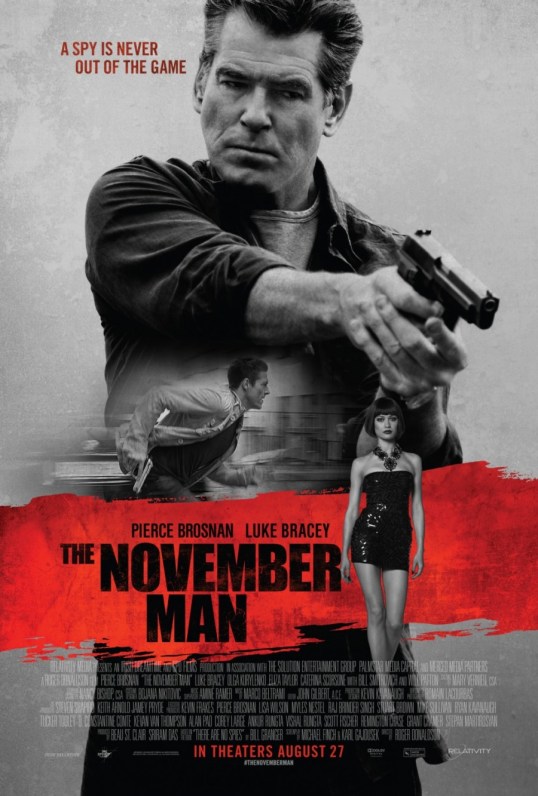
Trailer: The November Man


The-November-Man-poster-900x1333

Outside of Sean Connery, my other favorite James Bond has always been Pierce Brosnan. He was able to inject some of the fun that became camp when Roger Moore was Bond, but still retain the ice-cold lethality that Connery brought to the role. It was just bad luck that he ended up with Bond writers and directors that were hit or miss. I think Pierce woud’ve done just as good a job, if not better, in the films that Daniel Craig ended up doing as Bond.

We now have Brosnan back as a spy, but not as Bond, but as Peter Devereaux from the spy novel series written by Bill Granger. The November Man looks to be Brosnan’s attempt to try and add another spy thriller franchise in the mix with both Bond and Bourne. Whether Brosnan succeeds depends on how critics and audiences react to this film.

The trailer makes the film look interesting enough. Using the time-tested plot of master vs. protege, The November Man may have some success when it comes out at the tail end of the summer season with little to no competition.

One thing that’s good to see is Brosnan back on the screen. If Liam Neeson can transition into the elder action hero then I can’t see why Pierce Brosnan can’t do it as well. Neeson can’t be the only Irish kickass on the screen. Lisa Marie would agree that there’s never enough kickass Irish stars on the big-screen.

The November Man shoots its way onto the big-screen this August 27, 2014.

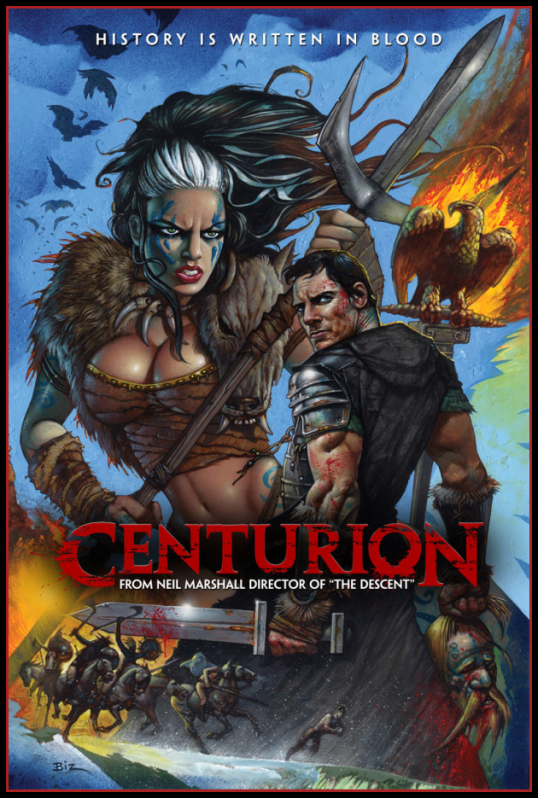
Scenes I Love: Centurion


Centurion

In honor of tonight’s episode of Game of Thrones which was once again directed by the great British filmmaker Neil Marshall I’ve chosen a favorite scene from his last film as the latest Scenes I Love.

Tonight’s episode saw the pivotal Battle of Castle Black which showcases the battle of Mance Rayder’s 100,000-strong Wildlling army against the few hundred Night’s Watch defenders of Castle Black and The Wall. It was a very bloody affair that saw more than a few important deaths. It also highlighted the fact that Neil Marshall has to be one of the great action directors of this era. He’s able to work both with CG and practical effects and definitely do so on a budget (yet still making the whole episode look cinematic).

For those who have followed Marshall’s work they won’t be surprised by his work on Game of Thrones. He’s done large-scale battles before and none more bloody, brutal and chaotic as the ambush battle in the forest in Centurion.

Review: Oblivion (dir. by Joseph Kosinski)


Oblivion-Movie-Poster

Good science-fiction films tend to be far and few between. Most of the time the ideas and ambition to make a good or great science-fiction film are right there on paper, but loses much once people actually have to create it for others to see. This puts the latest sci-fi film from Tron: Legacy filmmaker Joseph Kosinski in a weird position. His follow-up to the underwhelming sequel to the classic sci-fi film Tron is called Oblivion and it manages to be thought-provoking and entertaining, yet also have a sense of a been there and done that to the whole proceeding.

Oblivion quickly gets the introductions to the film’s backstory out of the way. Earth was attacked 60 years ago by aliens who were called “Scavengers” (Scavs for short) who destroyed the moon thus causing massive tectonic upheaval and gigantic tsunamis to ravage the planet. Humanity in its desperation would fight back with the only weapons it had left once the aliens began landing troops and that would be the nuclear kind. The planet is now devastated with the surviving population leaving Earth for a new colony on Saturn’s moon of Titan and in a massive tetrahedron space station orbiting Earth simply called “The Tet”.

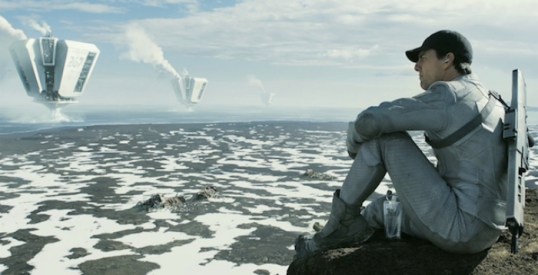
It’s the story of the technician pair left behind to provide support for the array of armed drones who patrol Earth for any remaining Scavs and protect the reclamation factories that has been removing the remaining resources that the planet has to be used as an energy source for the Titan colony. This pair of technician are Jack (Tom Cruise) and Victoria (Andrea Riseborough) who live in a towering base above the clouds. Jack does the dirty work by flying patrols in the area that encompasses what used to be the East Coast of the United States while Victoria (who also happens to be Jack’s lover) provides comm and technical support back at their base.

Oblivion01

Victoria can’t wait to finish their five-year stint on Earth and with two weeks left before they can rejoin the rest of humanity on Titan her dream is coming closer. Yet, Jack doesn’t seem to want to leave Earth behind. He has begun to dream about Earth before the war that he should have no memory of. First they’re dreams while he’s asleep but as the film shows it soon begins to invade and distract his waking hours as well.

It’s during one such mission where he comes across the a sudden arrival of a human spacecraft with surviving humans aboard that his dreams become reality. A woman he has dreamed off that he’s never met is one of the survivors (played by Olga Kurylenko) and she becomes the key to unlocking the secret that’s been kept from him about the true nature of the war that devastated Earth sixty years past and why he continues to have flashes of memories that he should never have had.

Oblivion sounds like it’s original at first glance, but as the story moves along we begin to see influences (at times outright plot point lifts) from past innovative sci-fi films such as Moon and The Matrix. While Kosinski (who co-wrote the film as well as directed it) does put his own spin on these ideas it’s not enough to fully distinguish the film from past sci-fi films which did them better. Oblivion is not bad by any means, but it fails to stretch beyond it’s influences that would’ve made it a great film instead of just being a good one. It doesn’t help that the script lags behind Kosinski’s talent for creating some beautiful images and vistas. The world-building he does with art director Kevin Ishioka manages to make a devastated Earth look serenely beautiful which when paired with cinematographer Claudio Miranda’s panoramic sweeps of the Icelandic location shoot make Oblivion one of the best looking film of 2013.

Yet, the script tries too hard to explore some heavy themes such as the nature of memory and identity. The film doesn’t explore them enough to make this film come off as something heavy sci-fi like Solaris. It just teases the audience enough to start a spark that could lead to conversations afterwards. The action that does punctuate the more introspective sections of the film does come off quite well despite coming only few at a time and not for any extended length.

Oblivion02

What seems to hold the film together outside of it’s visuals would be the performance of the cast which sees Tom Cruise doing a very workman-like performance as Jack. We’ve seen him do this sort of performance time and time again that it seems to be second-nature to him by now and something audiences come to expect now. Even Morgan Freeman as an aged resistance fighter lends a bit of serious gravitas to the film whenever he’s on-screen. But it’s the performances of the two female leads that sells the film despite it’s flaws. Olga Kurylenko has less to work with in the role of Jack’s mystery woman Julia. What she does get she does so with a level of empathy that instantly sells the notion that Jack and her were destined to be together despite the vast gulf of time and space.

The stand-out performance comes from Andrea Riseborough as Jack’s lover and partner Victoria. Where Jack comes off as restrained chaotic glee who marvels at the sight he sees every day he’s out on patrol the opposite is Victoria. Her organized and reserved demeanor comes off as sexy in a cold and calculated way, yet just behind that British reserve we see glimpses of her hanging on by a thread at the chaos she sees in Jack. Andrea Riseborough plays Victoria so well that every scene she’s in she steals it from Cruise. Her performance was all about slight changes to her body movement, a quick glance that speaks volumes of what she’s thinking. While this film may not make Riseborough an outright star it will get her noticed by other filmmakers soon enough.

With the summer blockbuster season of 2013 coming closer like a freight train with the approach of Iron Man 3 it’s a good thing that Oblivion was released weeks before this hectic season. For despite it’s flaws in it’s script and the lack of originality in it’s premise the film does succeed in being entertaining and thought-provoking enough that people should see it on the big-screen. Plus, nothing but the massive screen (especially IMAX) does full justice to some of the vistas shot of Iceland that doubles as devastated Earth. So, while Oblivion may not be the slam-dunk hit for Kosinki after failing with Tron: Legacy it is still a film worth checking out.

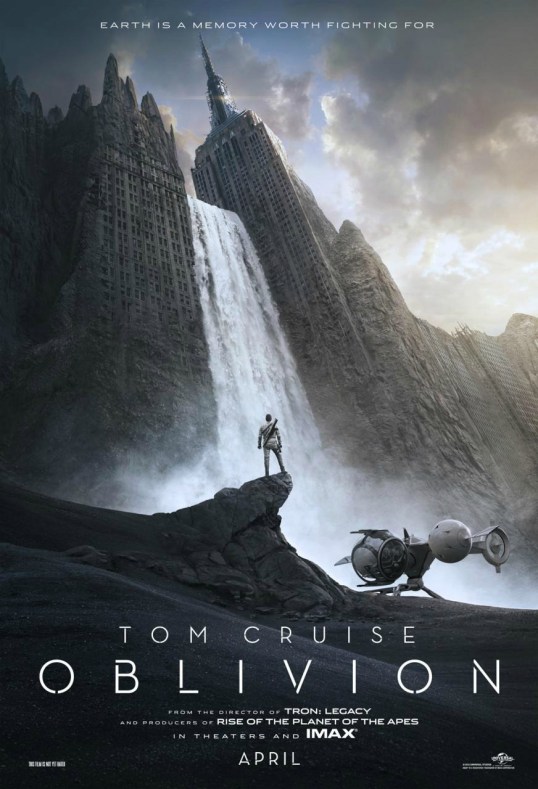
Trailer: Oblivion (Official)


Oblivion-Movie-Poster

Every year always has a couple of big genre films that seem to continually fly under the radar. This is surprising since people tend to think that films with huge budgets and a cast headlined by one of the biggest names in Hollywood tend to be overhyped before they even reached the big-screen. While I’ve heard of the upcoming scifi and post-apocalyptic film Oblivion for almost two years now it’s still a film that doesn’t generate much talk.

We know several things about Oblivion that came out before the release of the film’s first trailer: 1. it stars Tom Cruise and 2. it’s the follow-up film for Tron: Legacy director Joseph Kosinski. The second part may be one thing that has kept this film from being one of the biggest anticipated films of 2013. Kosinski’s underwhelming sequel to Tron didn’t make many genre fans excited as to what he might come up with next.

The trailer looks to erase some of those doubts as we get to see Oblivion as a very beautifully-shot film. We get see some great looking art direction for the film if the trailer show’s us anything about Oblivion. Plus, it has Morgan Freeman all decked out like one of David Lynch’s Fremen from Dune.

Oblivion is set for an April 12, 2013 release date.

Source: Apple

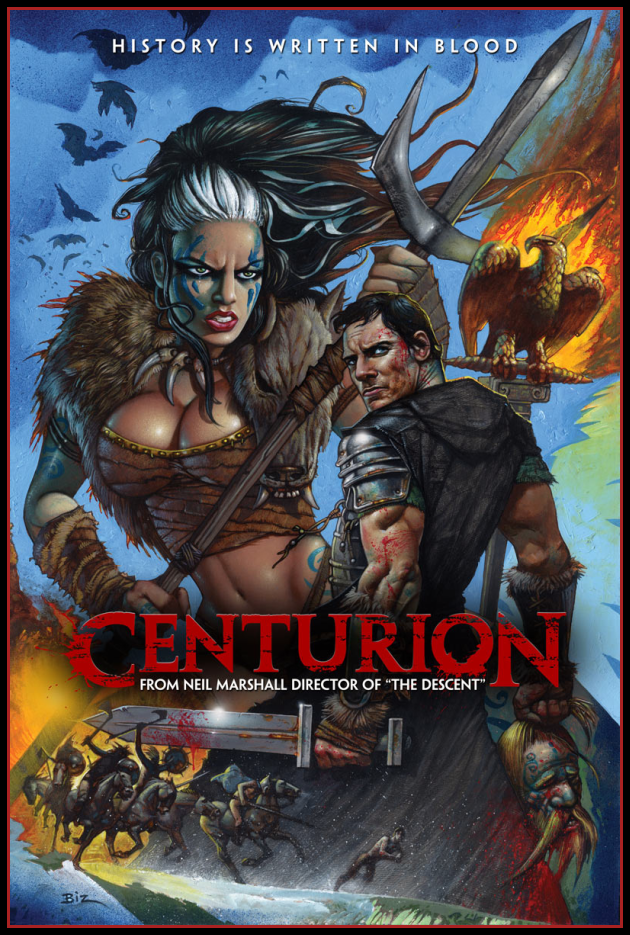
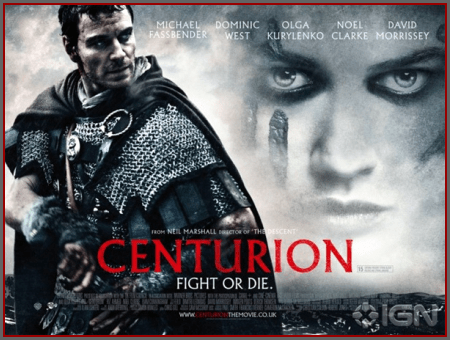
Quickie Review: Centurion (dir. by Neil Marshall)


I’ll outright say and admit that one of my favorite filmmakers has to be British-filmmaker Neil Marshall who burst into the scene almost a decade ago with his genre mash-up werewolf film, Dog Soldiers. Since then he has come out with a film every couple years which follows what’s becoming a trademark style of his.He would take a well-worn and used genre and mash it together with a few others to create a film that’s wholly his own. He did this with his follow-up films in The Descent and Doomsday. Now it’s 2010 and we have his latest film and it follows his usual style. Centurion is an adventure, chase and men on a mission film that doesn’t reinvent the genres it’s smashing together but instead embraces their traditions and creates a rip-roaring yarn which moves at a frenetic pace with characters who grow and expose their motivations as the film progresses to it’s bittersweet finale.

Neil Marshall will always be known to fanboys and the action crowd even if the elites of the film industry continues to dismiss the man as nothing more than competent filmmaker. In Centurion he shows that he could work within a traditional sword and sandal story and still show his signature style. We have it’s main character of Roman centurion Quintus Dias (played with a subdued and introspective seriousness by Michael Fassbender) who gets captured by the Picts of Britain during Rome’s occupation of the island. Unlike most Romans captured by the guerilla-warfare conducting Picts, Quintus has learned to speak Pict thus has become a valuable capture. But his loyalty to his Empire and its people dashes the hopes of the Picts ever learning anything from Quintus and decides to play some sport with him as the hunted prey.

It’s during the hunt for Quintus by a band of Pict warriors that he stumbles upon the Roman Ninth Legion led by General Titus Flavius Virilus (Dominic West). Once freed from his captors and hunters, Quintus is more than happy to rejoin his fellow Roman centurions in their hunt to once and for all destroy Pict leader Gorlacon (Urlich Thomsen) and his Pict army. To aid them in their search for this enemy army is the mute Brigantes scout, Etain (played with silent fury by Olga Kurylenko), who knows the lands where the Picts hide and do their hit-and-run raids.

It’s once the whole Ninth Legion has been led into the thick forests by Etain that the trap was sprung with Etain herself the catalyst for what amounts to as the massacre of the Legion. It’s this event which Marshall in his own way tries to explain one of history’s mysteries: The mysterious fate of the Roman Ninth Legion. Historians have never agreed as to why the Legion disappeared from Roman and historical records and Marshall’s film is one theory.

The rest of the film has the handful of the Legion who has survived trying, at first, to free their general from Pict captivity and when that mission fails with deadly results the remaining men who has chosen to follow Quintus try to make a run back to Roman lines. On their heels like a she-wolf leading a pack of wolves is Etain whose thirst for vengeance for what the Romans did to her (raped her as a young child and cut out her tongue in addition to wiping out her family and tribe) pushes her to get these Romans with near-supernatural drive. It’s rare to find a film where the main villain is a woman, but one whose abilities surpasses that of the men she’s hunting and whose motivations make her more than a tad sympathetic to her cause.

Centurion does action well with sequences involving a jump off of a steep cliff and into the river below to last stand inside an abandoned Roman fort. Marshall knows how to stage and shoot these scenes so we never lose sight of where the participants are. Most filmmakers nowadays try to hide their inability to choreography action sequences by using quick cut editing, hand-held camera jittery viewpoints and, at times, just shooting it from a distance. Neil Marshall doesn’t do anyone of these gimmicks and tricks which just shows that while his hybrid style in terms of storytelling might be new and refreshing he still embraces the traditional ways if it serves his films properly.

The acting in this film was quite good from not just its leads in Fassbender and Kurylenko but from everyone. This film’s ensemble cast includes veteran British actors just as Liam Cunningham, Paul Freeman and David Morrissey. Other supporting players such as Imogen Poots, Urlich Thomsen and Dominic West do a great job in the limited roles they’re given. The fact that Kurylenko utters not one word in her scenes yet commands each and everyone she’s in shows just how well Marshall can direct not just action pieces but how to direct his actors in doing their jobs.

This film doesn’t do anything to reinvent the action genre that is it’s foundation, but what it does is show that action films sometimes could be just as good when it’s filmmaker leans on practices from traditions past. Outside of the CGI-blood used to show the brutality of the fights and deaths this film is quite lacking in the CG department. Shot on location in the highlands of Scotland and studios near and around London, Centurion is quite a throwback to the sword and sandal films which dominated the film industry during the late 50’s and most of the 60’s. Marshall’s latest will not win any mainstream awards, but the genre crowd will definitely embrace it as something that will entertain and thus welcome it with cult status.

Neil Marshall’s Centurion Official Trailer


I have been a huge fan of Neil Marshall. The British filmmaker burst into the genre scene with his cult-classic werewolf-siege flick, Dog Soldiers. He then follows that up with the excellent all-female cast monster mash, The Descent. His third outing was a bit mixed for some, but I definitely had a great time with Doomsday. Marshall really knows the genre he works in and also enjoys staying in it.

His fourth film is a historical thriller set during the Roman occupation of Britain during the 2nd Century A.D. The film was originally called The Ninth Legion during the production, but has since been officially changed to Centurion. The basic premise of the film is Marshall’s telling of the legend of the 9th Legion and their disappearance north of Hadrian’s Wall. He’s made it known that the film will not be historically accurate and wasn’t meant to be. The film will be his way to re-tell the legend of the legion’s disappearance, it’s cause and wrap an action-thriller around it.

Starring in the film are Dominic West, Michael Fassbender (last seen as the British operative Hickox in Inglourious Basterds) and Olga Kurylenko. The film is tentatively dated to be released in the U.K. on April 23, 2010. No set date has been announced for a NA release, but I’m sure it will get one. It better.

Source: Centurion Official Trailer @IGN