Lisa Reviews An Oscar Nominee: Arrowsmith (dir by John Ford)


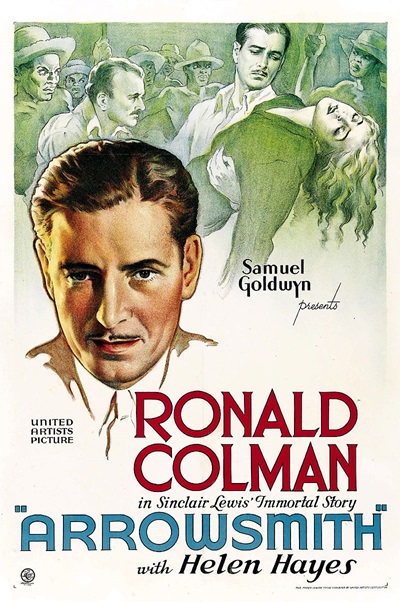
In the 1931 Best Picture nominee Arrowsmith, Ronald Colman stars as Martin Arrowsmith, a doctor who is trying to save lives without compromising his ethics.

Arrowsmith is mentored by the famed bacteriologist, Max Gottlieb (A.E. Anson) and married to a nurse named Leora (Helen Hayes).  At first, Arrowsmith makes his living as the local doctor in Leora’s small hometown in South Dakota.  However, Arrowsmith is ambitious and wants to do more with his life and career than just take care of a small town.  He wants to cure the world of disease.  When he’s offered a position at the prestigious McGurk Institute in New York, he enthusiastically accepts.  Having just suffered a miscarriage, Leora supports Arrowsmith’s decision and travels to New York with him.  No matter what happens, Leora is always there to support her husband, even when he doesn’t seem to appreciate it.

When Arrowsmith thinks that he’s discovered an antibiotic serum that appears to be capable of curing all sorts of diseases, he attempts to stay true to the methods taught to him by Dr. Gottlieb.  He takes his time.  He tests carefully.  He doesn’t rush out and give the serum to everyone.  However, Arrowsmith finds his methods continually sabotaged by his colleagues, who hope to raise money by telling the press about a miracle serum that can “cure all diseases!”  When Arrowsmith later finds himself combatting an outbreak of the Bubonic Plague in the West Indies, he again tries to employ the scientific method but finds himself being pressured by government officials to give his untested serum to every single person on the island.  Eventually, Arrowsmith’s ethics are pushed to their limits when even Leora falls ill.

Arrowsmith was based on a best-selling novel by Sinclair Lewis, though the plot was changed to make the story more palpable for film audiences.  In the novel, Arrowsmith is a bit of cad who regularly cheats on his wife.  In the film, Arrowsmith is passionate and driven but the exact nature of his relationship with wealthy Joyce Lanyon (Myrna Loy) is left so ambiguous that it actually leaves one wondering why the character is in the film at all.  What both the film and the novel have in common is an emphasis on the importance of science and the scientific method.  Arrowsmith’s idealism runs into the harsh reality of life during an epidemic.  Government officials are more concerned with saying that they’ve done something as opposed to considering whether their actions have ultimately done more harm than good.  In its way, Arrowsmith predicted the COVID era.

Arrowsmith was the first John Ford film to be nominated for Best Picture and its financial success allowed Ford the freedom to go on to become one of Hollywood’s most important directors.  Seen today, Arrowsmith feels a bit creaky and self-important, with little of the visual flair that Ford brought to his later films.  Ronald Colman’s performance as Arrowsmith seems a bit stiff, especially when compared to the much more lively (and sympathetic) performance of Helen Hayes.  Arrowsmith is a big and serious film and, if we’re going to be honest, it’s a little bit boring.  Still, it’s interesting to see the issues of today being debated 90 years in the past.

As for the Oscars, Arrowsmith was nominated for Best Picture, Adaptation, Cinematography, and Art Direction.  It lost in all four of the categories in which it was nominated.  That year, Best Picture was won by Grand Hotel, which curiously didn’t receive any other nominations at all.

Retro Television Review: Death Takes A Holiday (dir by Robert Butler)


Welcome to Retro Television Reviews, a feature where we review some of our favorite and least favorite shows of the past!  On Sundays, I will be reviewing the made-for-television movies that used to be a primetime mainstay.  Today’s film is 1971’s Death Takes A Holiday!  It  can be viewed on YouTube.

For a few days in 1971, no one dies.

The Vietnam War continues but there are no casualties.  There are natural disasters but no one loses their life.  Doctors are stunned.  World leaders start to panic.  An emergency session of the UN is called to debate what to do about living in a world where no one is dying.  One gets the feeling that the world’s leaders prefer it when people are dying in wars and disasters.

Death has taken a holiday.

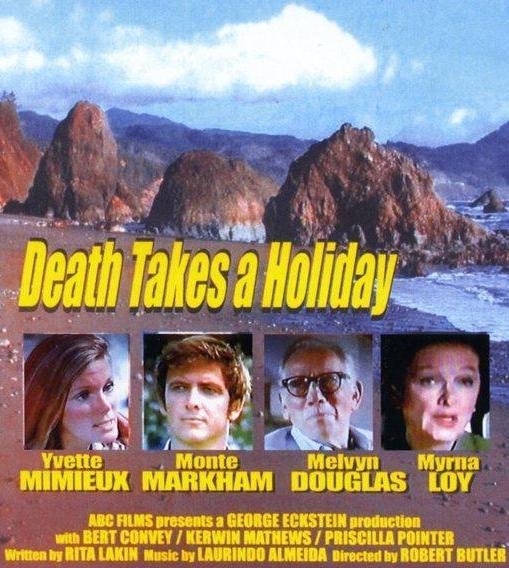
Death (Monte Markham) has become confused as to why humans so desperately want to live despite the fact that the world in which they exist is not always a happy one.  He is particularly confused by the elderly Judge Earl Chapman (Melvyn Douglas), who has suffered multiple strokes and other ailments and yet has always resisted whenever Death has come for him.  Death decides to take his holiday on the isolated beach where the Judge and his family are spending their weekend.  Though Death introduces himself as being David Smith, the Judge recognizes him.  It turns out that the Judge was always aware of death lingering around him and his family.

Death, for his part, has fallen in love with the Judge’s headstrong and rebellious daughter, Peggy (Yvette Mimieux).  In fact, Peggy was meant to die on the beach but, as soon as Death saw her drowning, he decided not to take her and instead allowed her to wash up back on the beach.  Death explains to the Judge that he can only spend so much time on vacation and that soon, people will start dying again.  Death says that he’ll be taking Peggy to the afterlife after the weekend ends.  The Judge tries to change his mind but Death is in love and he wants Peggy to be with him.

An adaptation of a play that inspired both 1934’s Death Takes A Holiday and 1998’s Meet Joe Black, the 1971 version of Death Takes A Holiday is a well-acted and intelligent made-for-television movie, one that eschews heavy-handed drama in favor of being a rather low-key meditation on what it means to both live and to die.  Melvyn Douglas and, as his wife, Myrna Loy both give poignant performances and Douglas even manages to sell the potentially maudlin moment where he explains why he has always clinged to life.  Monte Markham may not be the first actor who comes to mind when you think of someone to cast as the human form of Death but he does a good job in the role and he and Yvette Mimieux have a wonderful chemistry together.  The beach scenery is lovely and the story is an interesting one.  Clocking in at just 73 minutes, this version of Death Takes A Holiday is the best of all of them.

Retro Television Review: Indict & Convict (dir by Boris Sagal)


Welcome to Retro Television Reviews, a feature where we review some of our favorite and least favorite shows of the past!  On Sundays, I will be reviewing the made-for-television movies that used to be a primetime mainstay.  Today’s film is 1974’s Indict & Convict!  It  can be viewed on YouTube.

There’s been a murder!

The wife of Assistant District Attorney Sam Belden (William Shatner) has been found, shot to death.  Making things especially awkward is that the body of her lover is found next to her.  Though Belden is the obvious suspect, he has an alibi for the time of the murders.  He claims that he was in Las Vegas, attending a convention.  Two gas station attendants remember seeing him filling up his car with gas at around the same time that his wife and her lover was being shot.

Attorney General Timothy Fitzgerald (Ed Flanders) is not so sure that Belden is innocent.  He instructs two of his top prosecutors to check out Belden’s story and to see if there’s enough evidence to not only indict but also to convict.  Bob Matthews (George Grizzard) is a veteran prosecutor and he’s the one who narrates the story for us.  Assisting him is Mike Belano, who is played by the always likable Reni Santoni.  Just three years before this movie aired, Santoni played Harry Callahan’s partner in Dirty Harry.  There was just something about Santoni’s friendly but determined demeanor that made him perfect the role of the supportive partner or assistant.

The film is very much a legal procedural, with the emphasis on not only the investigation but also on the strategies and the techniques that are used in the courtroom by Matthews and defense attorney DeWitt Foster (Eli Wallach).  In many ways, it feels like a forerunner to Law & Order.  Usually, I love court procedurals but Indict & Convict was a bit too slow and high-minded for its own good.  Maybe it’s because I’ve been spoiled by all of the legal shows that I’ve seen but I have to admit that I spent a good deal of Indict & Convict wanting the prosecutors to get on with it.  Flanders, Grizzard, Santoni, and Wallach were all ideally cast but the film itself sometimes got bogged down with all the debate about the best way to win a conviction.  It’s a shame because the story itself is an intriguing one and I actually enjoyed the movie’s use of spinning newspaper headlines to let us know what had happened in between scenes.  Also, as a classic film fan, I enjoyed seeing Myrna Loy as the judge.  She didn’t get to do much other than say, “Sustained” and “Overruled,” but still …. Myrna Loy!

Most people who watch this film will probably do so out of the hope of seeing some trademark Shatner overacting.  William Shatner doesn’t actually get to say much in this film.  He spends most of the running time sitting silently at the defense table.  Towards the end, he does finally get a chance to deliver a brief speech and it’s everything you could hope for.  Shatner takes dramatic pauses.  Shatner emphasizes random words.  Every line is delivered with the subtext of, “Pay attention, Emmy voters!”  Eventually, Shatner would learn the value of laughing at oneself but apparently, that lesson had not yet been learned when he did Indict & Convict.

Retro Television Reviews: The Elevator (dir by Jerry Jameson)


Welcome to Retro Television Reviews, a feature where we review some of our favorite and least favorite shows of the past!  On Sundays, I will be reviewing the made-for-television movies that used to be a primetime mainstay.  Today’s film is 1974’s The Elevator!  It  can be viewed on YouTube!

Marvin Ellis (Roddy McDowall) hates his job.  He’s been assigned to be the manager of a new high-rise office building.  Parts of the building are still under construction but that hasn’t stopped the company that owns it from selling out office space.  When Mrs. Kenyon (Myrna Loy) comes by and asks to look at the top floor penthouse, Ellis agrees.  In public, Ellis is always friendly and always courteous.  It’s only under the most stressful of circumstances that Ellis reveals that he feels as if the building has been built of out lies and cheap material.

Ellis and Kenyon soon find themselves in a stressful situation when they are trapped in an elevator.  Of course, they’re not alone in the elevator.  There’s also Dr. Reynolds (Craig Stevens), his wife (Teresa Wright), and his mistress (Arlene Golonka).  And then there’s Robert Peters (Barry Livingston), a teenager who has inherited a fortune.  And finally, there’s Eddie Holcomb (James Farentino).  Eddie has a suitcase full of money that he’s stolen from an office in the building.  He’s also got a loaded gun.  And, perhaps worst of all, he has an intense fear of tight places.  The longer that he’s trapped in the elevator, the worse his claustrophobia becomes.

Because the building isn’t really finished yet, the elevator’s alarm button doesn’t really work.  Other than the passengers trapped inside, the only people who know about the stalled elevator are Eddie’s partners-in-crime.  Irene (Carol Lynley) is Eddie’s girlfriend and she just wants to get the situation resolved with as little violence as possible.  Pete (Don Stroud) is Eddie’s sociopathic friend.  Pete is not only determined to rescue Eddie and retrieve the suitcase.  He’s also determined to take care of any potential witnesses by killing everyone on the elevator.

The Elevator is a disaster film, along the lines of Airport and The Towering Inferno.  Due to the hubris of a faceless corporation, a group of people find themselves trapped in a potentially catastrophic situation.  Some of them react with bravery.  Some of them react with cowardice.  All of them get a chance to reveal a bit of who they are on the inside.  Some might say that being trapped in an elevator is not quite as bad being trapped in a fiery skyscraper or being a passenger on a airplane that’s being held hostage by a mad bomber.  Technically, they’re right but I am also going to admit right now that I absolutely hate elevators and I try to avoid them whenever I can.  I always say that this is because running up and down several flights of stairs is a good way to keep my legs looking good and certainly that’s part of it.  But an even bigger reason is that I dread the thought of being stuck in a confined space with a bunch of strangers.  If I was on an elevator that was stuck between floors, I would probably lose my mind.  I have a hard enough time just standing in line for longer than 3 minutes.  As directed by Jerry Jameson, The Elevator does as good job of capturing the feeling of being trapped in a small space.  It’s not a film to watch if you have claustrophobia.

As for the cast, Myrna Loy is a delight as the eccentric Mrs. Kenyon.  And seriously, how can you dislike any film that gives Roddy McDowall a monologue about how much he hates skyscrapers?  It’s an entertaining, if undemanding, film.  After watching The Elevator, I’ll keep taking the stairs.

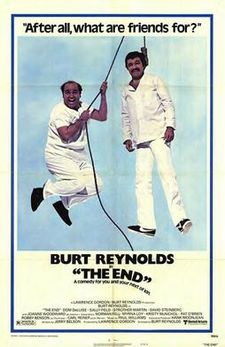
Film Review: The End (1978, directed by Burt Reynolds)


What if you were dying and no one cared?

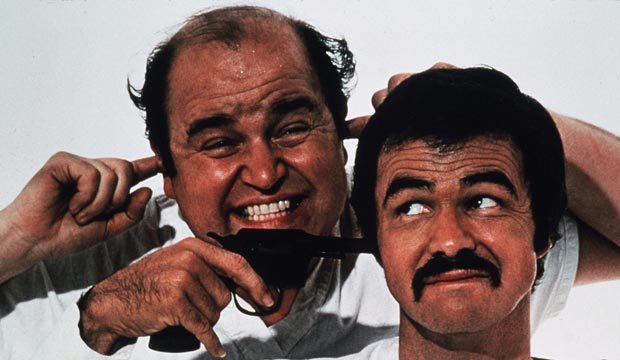
That is the theme of The End, which is probably the darkest film that Burt Reynolds ever starred in, let alone directed. Burt plays Sonny Lawson, a shallow real estate developer who is told that he has a fatal blood disease and that, over the next six months, he is going to die a slow and painful death. After seeking and failing to find comfort with both religion and sex, Sonny decides to kill himself. The only problem is that every time he tries, he fails. He can’t even successfully end things. When he meets an mental patient named Marlon Borunki (Dom DeLuise), he hires the man to murder him. Marlon is determined to get the job done, even if Sonny himself later changes his mind.

Yes, it’s a comedy.

The script for The End was written by Jerry Belson in 1971. Though Belson also worked on the scripts for Spielberg’s Close Encounters of the Third Kind and Always, he was best-known for his work on sitcoms. (Belson was an early collaborator of Garry Marshall’s.) The End was originally written with Woody Allen in mind but when Allen passed on it to concentrate on directing his own movies about death, the script spent five years in limbo. Reynolds later said that, when he eventually came across The End, he knew he had to do it because it was the only script that reflected “my strange sense of comedy.” United Artists was uncertain whether there was much box office potential in a film about a self-centered man dying and they required Reynolds to first make the commercially successful Hooper before they would produce The End.

The End was made for 3 million dollars and it went on to gross 40 million. That the film was a box office success is a testament to the late 70s starpower of Burt Reynolds because it’s hard to think of any other mainstream comedy that goes as much out of its way to alienate the audience as The End does. While watching The End for the first time, most viewers will probably expect two things to happen. First off, Sonny will learn to appreciate life and be a better person. Secondly, it will turn out that his fatal diagnosis was incorrect. Instead, neither of those happen. Sonny is going to die no matter what and he never becomes a better person. What’s more is that he never even shows any real interest in becoming a better person. The film’s signature scene comes when Sonny prays to God and offers to give up all of his money if he survives, just to immediately start backtracking on the amount. It’s funny but it’s also a sign that if you’re looking for traditional Hollywood sentiment, you’re not going to find it here.

Burt not only stared in The End but he also directed it and, as was usually the case whenever he directed a film, the cast is a mix of friends and Hollywood veterans. Sally Field plays Sonny’s flakey, hippie girlfriend while Robby Benson is cast as a young priest who fails to provide Sonny with any spiritual comfort. Joanne Woodward plays his estranged wife and Kristy McNichol plays his daughter. Myrna Loy and Pat O’Brien play his parents. Norman Fell, Carl Reiner, and Strother Martin play various doctors. The movie is stolen by Dom DeLuise, playing the only person who seems to care that Sonny’s dying, if just because it offers him an excuse to kill Sonny before the disease does. DeLuise was a brilliant comedic actor whose talents were often underused in films. The End sets DeLuise free and he gives a totally uninhibited performance.

Despite DeLuise’s performance, The End doesn’t always work as well as it seems like it should. Though Reynolds always said that this film perfectly captured his sense of humor, his direction often seems to be struggling to strike the right balance between comedy and tragedy and, until DeLuise shows up, the movie frequently drags. As a character, the only interesting thing about Sonny is that he’s being played by Burt Reynolds. That is both the film’s main flaw and the film’s biggest strength. Sonny may not be interesting but, because we’re not used to seeing Burt cast as such a self-loathing, self-pitying character, it is interesting to watch a major star so thoroughly reveal all of his fears and insecurities.

If you’re a Burt Reynolds fan, The End is an interesting film, despite all of its flaws. Burt often described this as being one of his favorite and most personal films. It’s a side of Burt Reynolds that few of his other films had the courage to show.

Hollywood Souffle: WIFE VS SECRETARY (MGM 1936)


gary loggins's avatarcracked rear viewer

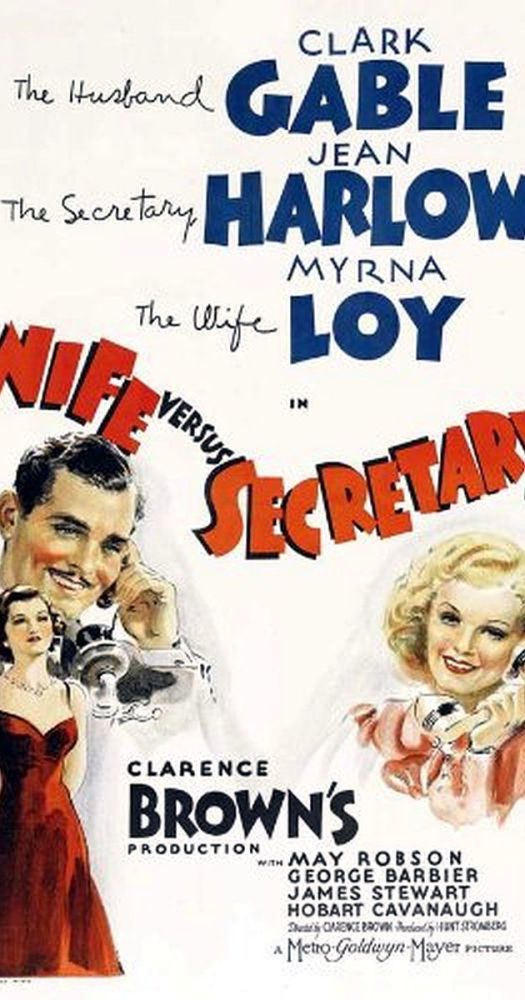
Gable’s back and Harlow’s got him , but so does Myrna Loy , with Jimmy Stewart along for the ride in WIFE VS SECRETARY. MGM boasted it had “more stars than there are in Heaven”, and this film is the very definition of “star vehicle”, a harmless soufflé of comedy, drama, and romance all wrapped up in a neat little package by veteran studio director Clarence Brown.

Publicity still for ‘Wife vs Secretary’

The plot’s as thin as Gable’s moustache: He’s a hard-driven publisher, and Loy’s his trusting, faithful wife. Harlow plays his loyal secretary and trusted aide-de-camp. She’s also quite beautiful (obviously, since she’s Jean Harlow!) and Gable’s mother tells Myrna she should get rid of her. Myrna laughs it off, but the seed of doubt has been planted. Jimmy plays Jean’s fiancé, who’s not too happy about being constantly cast aside by Jean’s work demands (and who can…

View original post 390 more words

Four Star Fun: LIBELED LADY (MGM 1936)


gary loggins's avatarcracked rear viewer

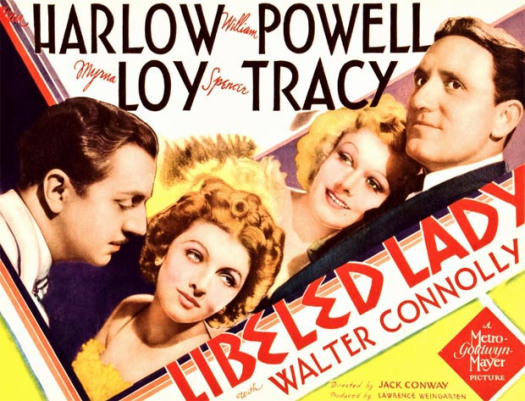
Jean Harlow ! Spencer Tracy ! William Powell ! Myrna Loy ! Four top stars at the top of their game shining bright in LIBELED LADY, a screwball comedy directed by Jack Conway with that trademark MGM gloss. Despite the zany improbability of the script by Maurine Watkins, Howard Emmett Rogers, and George Oppenheimer, the crackling, witty dialog gives all four stars (and supporting actor Walter Connolly) plenty of good material.

Here’s the plot: rich heiress Connie Allenbury (Loy) is suing the New York Evening Star for printing a story about her being a husband stealer. Her price: five million! Editor Warren Haggerty (Tracy), after once again blowing off his nuptials to long-time flame Gladys Benton (Harlow), recruits ex-reporter and frenemy Bill Chandler (Powell) in a crazy scheme involving marrying him off to Gladys (and is she pissed!), hop an ocean liner to London, and return with Connie, using his…

View original post 310 more words

Forgotten Horror: THIRTEEN WOMEN (RKO 1932)


gary loggins's avatarcracked rear viewer

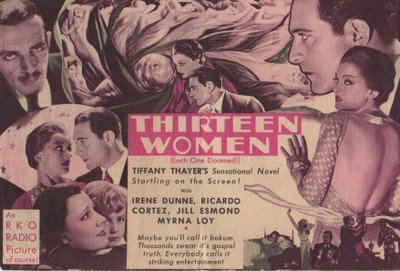
I pride myself on having seem almost every horror film made during the 1930’s, though once in a while an obscure title comes along whose attention has escaped me. But how on Earth did I miss THIRTEEN WOMEN, especially with a cast headlined by Irene Dunne (of all people!) and Myrna Loy ? This fast-paced thriller involving hypnosis, astrology, and serial murder is downright nasty, and has been cited as a precursor to the “slasher” genre… not to mention a whole lot of fun!

We begin with circus performer June Raskob receiving a letter from the mysterious Swami Yogadashi with her horoscope attached, predicting impending doom in the stars for her. But it’s her sister who dies, plunging to her death during their trapeze act (shown in gruesome detail), and poor June goes hopelessly insane. The scene shifts to exotic half-caste Ursula Georgi, who has the Swami under her hypnotic…

View original post 487 more words

That Old, Familiar Song: MANHATTAN MELODRAMA (MGM 1934)


gary loggins's avatarcracked rear viewer

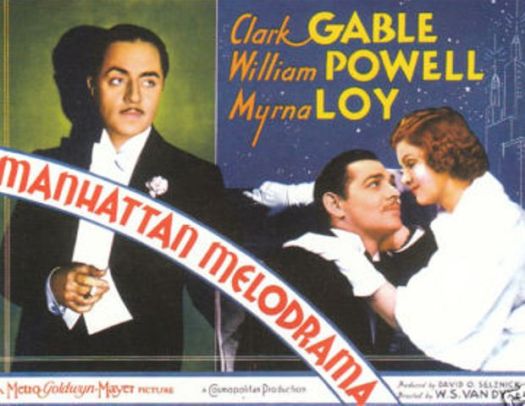
The plot of MANHATTAN MELODRAMA will certainly be familiar to movie lovers: there’s two kids, one rambunctious, the other studious. Rambunctious grows up to be on the shady side of the law, while Studious represents law’n’order. There’s Girl in the Middle, who loves Rambunctious but always winds up with Studious. Rambunctious perpetuates some evil deed, and Studious must now bring his old pal to justice. Girl in the Middle is torn between the two. In the end, justice prevails, and Rambunctious pays for his crimes, but not before making peace with Studious.

Sound familiar? Sure it does, having been rehashed umpteen times in countless westerns, gangster sagas, wartime dramas, and other genres. But MANHATTAN MELODRAMA was the first, even winning an Oscar for Arthur Caesar’s Best Original Story. Too bad Caesar didn’t copyright the idea; he’d have been a very rich man! The film also has that MGM shine going…

View original post 465 more words

Lisa Reviews An Oscar Nominee: Test Pilot (dir by Victor Fleming)


(With the Oscars scheduled to be awarded on March 4th, I have decided to review at least one Oscar-nominated film a day.  These films could be nominees or they could be winners.  They could be from this year’s Oscars or or they could be a previous year’s nominee!  We’ll see how things play out.  Today, I take a look at the 1938 best picture nominee, Test Pilot!)

Test Pilot is all about charisma.

It tells a fairly simple story.  I imagine that the plot seemed just as familiar in 1938 as it does in 2018.  Jim Lane (Clark Gable) is a test pilot.  In the early days of aviation, long before people took the idea of flight for granted, Jim Lane is a hero and celebrity.  Whenever a new aviation technique is developed, Jim is the one who tests it.  He’s the one who makes sure that it’s safe.  Every day, when Jim goes to work for Mr. Drake (Lionel Barrymore), there’s a chance that he might not make it home.  Not surprisingly, he’s cocky, reckless, and not prone to commitment.  He’s also handsome, charming, manly, and quick with a quip.  In short, he’s Clark Gable.

When the movie starts, Jim has only one real friend.  Gunner (Spencer Tracy) is his mechanic.  Gunner is a by-the-book, no-nonsense professional.  He might enjoy a drink every now and then but Gunner knows his job and he knows his planes and, even more importantly, he knows Jim.  Gunner’s a man of unimpeachable integrity, the type who will always call things as he sees them.  In short, he’s Spencer Tracy.

One day, while on a test flight, Jim is forced to make an emergency landing on a farm in Kansas.  That’s where he meets Ann Barton (Myrna Loy).  Ann is beautiful and outspoken.  She quickly proves that she can keep up with Jim, quip-for-quip.  In short, she’s Myrna Loy and, before you know it, she and Jim are in love.  Just as quickly, Jim and Ann are married.

The movie starts out as a bit of domestic comedy.  Jim may know how to fly a plane but it quickly becomes obvious that he doesn’t know much about commitment or being a husband.  When Jim attempts to buy his wife a nightgown, he doesn’t even know how to pronounce the word lingerie.  (He asks a store clerk for help in finding the “lonjur department.”)  However, Jim soon starts to find that married life agrees with him.

Of course, that’s a problem when your job requires you to defy death on a daily basis.  Ann worries that Jim is going to go to work and never come home, fears that are intensified after a race with another airplane ends in a terrible and (for the other pilot) fatal crash.  Gunner, meanwhile, starts to fear that there’s only so many times that Jim can cheat fate.  Both Ann and Gunner promise that they will never leave Jim’s side.

Well, you can probably already guess everything that’s going to happen.  Test Pilot is not exactly the most narratively adventurous movie ever made but, when you’ve got Gable, Tracy, Loy, and Barrymore all in the same film, you don’t really need to break any new ground, storywise.  Test Pilot is an example of the power of pure movie star charisma.  It’s watchable because the performances are just as entertaining today as they were in 1938.  The film features Gable doing what he did best and Tracy doing what he did best and Loy and Barrymore all doing what they did best.  In this case, that’s more than enough.

When it comes to the film’s numerous flight sequences, it’s perhaps best to try to put yourself in the shoes of someone seeing the film in 1938.  Today, of course, we’ve been spoiled by CGI.  We tend to assume that literally anything can happen in a movie.  In the 30s, however, people couldn’t take special effects for granted.  When they watched the flight footage in Test Pilot, they did it with the knowledge that it was filmed by people who actually were putting their lives at risk to get it.  At a time when commercial aviation was considered to be a luxury, Test Pilot provided audiences with a view of the world in the sky and of the world below, a view that they probably wouldn’t have gotten a chance to see otherwise.

A huge box office success, Test Pilot was nominated for best picture but lost to another film featuring Lionel Barrymore, Frank Capra’s You Can’t Take It With You.