The Daily Grindhouse: The Horror of Party Beach (dir by Del Tenney)


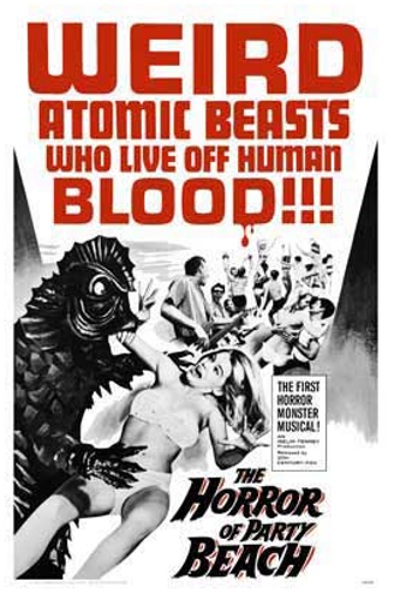
horror-of-party-beach-one-sheet-1964The Horror of Party Beach is a personal favorite of mine but it’s not an easy film to review.  Technically, this is a terrible film but it’s also a lot of fun.  It’s the type of film that makes the traditional definitions of good and bad irrelevant.  In short, this 1964 “horror” film simply has to be seen to be believed.

Party Beach is perhaps the most depressing stretch of sand and surf to ever appear in a 1960s beach film.  During the day, the beach is full of amazingly skinny dancers and leather-clad motorcyclists who spend all of their time dancing to music of the Del-Aires.  Occasionally, a fight breaks out between the motorcyclists and the dancers but, for the most part, everyone seems to spend their time engaging in witty banter that I imagine was probably dated even in 1964.  The skies are permanently overcast and the whole beach just reeks of a combination of societal decline and general ennui.

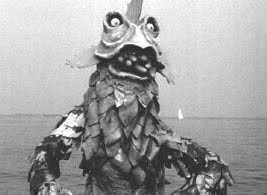
Even worse, the film opens with a toxic waste spill that somehow causes an underwater skeleton to mutate into a creature that’s apparently half-man and half-fish and which also has an insatiable lust for blood and a mouth that appears to be full of hot dogs.  Soon, every night, the creatures are wandering around the town, killing people, and dragging the bodies off to the quarry.
HorrorOfPartyBeach

One of the first victims is Tina, the wild girlfriend of Hank.  Hank is a scientist who has the young Aryan look that most B-movie heroes seemed to have in the early 60s.  Seriously, Hank manages to get through the entire film without once getting a single hair out-of-place.  You would think that Hank would be upset over Tina’s death but he’s not because, as he told Tina before she died, he’s “no longer the campus bigshot who will do anything for kicks!”  It also probably helps that Hank has fallen in love with Elaine, who appears to be about 40 years old but who, in a typically dramatic moment, turns down an invitation to go to a slumber party with all of her teenage friends.

Elaine’s father is Dr. Gavin.  Dr. Gavin is also Hank’s boss and we can tell that Dr. Gavin is a genius because he not only wears glasses but he’s also bald and smokes a pipe.  Together, Dr. Gavin and Hank try to figure out if there’s any way that the monsters can be stopped.

Dr. Gavin also has a maid named Eulabelle, who appears to have come to Horror of Party Beach straight from an awkwardly racist 1930s comedy.  At one point, Eulabelle explains that she’s not only locked the front door but that she’s “double-locked and triple-locked it.  Ain’t no monsters gettin’ in here…”

Perhaps if everyone on Party Beach had taken Eulabelle’s advice, many lives could have been saved.  But oddly, even after everyone knows that there are monsters among them, the party continues on Party Beach.  Not even the fear of death can silence the Del-Aires…

I make no apologies for loving The Horror of Party Beach.  Everything about it — from the ludicrous monsters to the expressionless performances of the cast to the thoroughly nonsensical plot — make The Horror of Party Beach a one-of-a-kind experience.  I’ve come across quite a few critics who have claimed that The Horror of Party Beach is one of the worst movies ever made but, seriously, it’s way too silly to be truly bad.  It may not be a good film but it’s definitely a fun viewing experience.

Film Review: The Racket (dir. by Lewis Milestone)


Originally released in 1928 and produced by Howard Hughes, The Racket was one of the first films to ever be nominated for an Oscar.  It was also one of the first films to miss out on its chance to claim Oscar glory as the first statuette for Best Picture was given to the producers of Wings.

Like many films that were made in during the silent era,  The Racket subsequently sunk into obscurity and, for several decades, it was considered to be a lost film.  After the death of Howard Hughes, the last remaining copy of The Racket was discovered hidden away in his vast film collection.  This print has been preserved at the University of Nevada, Las Vegas.  After several years of restoration, the film made its first appearance on TCM in 2004 and it has since been frequently broadcast on that network.  That’s how I first saw it way back in 2012.

Based on a play by Bartlett Cormack, The Racket is a gangster film.  Nick Scarsi (played by Louis Wolheim) is a powerful and politcally-connected bootlegger.  He’s pursued by one of the few honest cops in town, Captain McQuigg (Thomas Meighan).  When McQuigg proves to be incorruptible, Scarsi uses his political influence to get McQuigg transferred to a precinct in the suburbs.  However, when Scarsi’s younger brother is arrested for a hit-and-run in McQuigg’s new precinct, the captain uses the incident to launch a complex plan to bring down both Scarsi and the corrupt public officials that allow him to run the city.

Seen today, The Racket is an almost quaintly traditional gangster film.  According to the film’s title cards, everyone in the film speaks in hard-boiled slang and the characters — from the honest cop to the cynical reporters to the nightclub singer played by Marie Prevost — will all seem very familiar to anyone who has ever seen a classic Warner Bros. crime film.  That said, The Racket is still a lot of fun to watch and director Lewis Milestone keeps the story moving at a good pace.  At the very least, it’s interesting to see a gangster film that was actually made during the gangster era.  Nick Scarsi was based on Al Capone and, perhaps not surprisingly, the film was banned in Chicago when it was originally released.

The film shows up frequently on TCM and it’s also available on YouTube.  And it can be watched below!

The Daily Grindhouse: Shoot (dir. by Harvey Hart)


As I explained yesterday in my review of the 1935 film version of Les Miserables, one of my resolutions for 2013 is to review a film a day, alternating between films that were nominated for an Oscar and film’s that most certainly were not.  Today’s film stars two Oscar winners (Cliff Robertson and Ernest Borgnine) but it was not nominated for any awards itself.  Along with being ignored by the Academy, this film is unfairly obscure and has an oddly bad reputation among cult movie fans.  The movie is a Canadian exploitation film from 1976 and it’s probably even more relevant today than when it was first made.  The name of the film?  Shoot.

Rex (played by Cliff Robertson) is a veteran of the National Guard, a respected community leader in his small town, and a man who loves his guns.  His house is full of guns of all shapes and sizes and he’s so proud of his military background that the living room even appears to have camouflage style wallpaper.  From the film’s opening shots, it quickly establishes that Rex is not comfortable being civilized.  The few attempts that he makes to speak to his wife are painfully awkward.  Rex only feels truly alive during the weekends that he spends out in the wilderness, hunting with his buddies, played by Ernest Borgnine and Henry Silva.  His friends look up to Rex as their leader, to the extent that one of them refers to Rex as being the “senior officer in charge.”

During one hunting trip, Rex and his heavily armed friends pause to rest next to a river.  Suddenly, on the other side of the river, another group of heavily armed strangers show up.  They stare at each other for a few minutes before suddenly, a shot rings out.  The two groups start shooting at each other.  One man is wounded and another is killed before Robertson and his group retreat to the security of Borgnine’s cabin.

Instead of going to the police, Robertson convinces his group to keep the incident a secret.  They return to town, swearing not to tell anyone about what’s happened.  However, Robertson’s paranoia gets the better of him.  Before long, he’s convinced himself that the other group is going to seek revenge and that the only way to survive is to kill them first.  Along with the hot-headed Silva, Robertson recruits a small army of townsfolk to return with him to the wilderness.  Only Borgnine questions the wisdom of Robertson’s plan.  The whole thing eventually leads to a genuinely shocking and disturbing climax.

Robertson and his friends are obviously meant to be representatives of American gun culture and to call Shoot heavy-handed would be a bit of an understatement.  That said, Shoot is still an undeniably effective piece of propaganda.  Robertson, Silva, and Borgnine all give excellent performances and director Harvey Hart  manages to generate and maintain a good deal of suspense concerning just what (if anything) Robertson is going to find waiting for him in the wilderness.  Though the film has its slow spots, the emphasis on characterization and suspense makes the surprise ending all the more effective.

Shoot is not an easy film to see.  It has never been released on DVD or Blu-ray and I only happened to learn of it because I was bored one day and I was flipping through one of my film reference books.  However, the film has recently been uploaded to YouTube and here it is:

Film Review: Les Miserables (dir. by Richard Boleslawski)


Every year, I set a few goals for myself.  In 2012, for instance, my goal was to stop worrying so much about achieving unrealistic goals.  For 2013, my goal is to post a film review a day, alternating between reviews of films that have been nominated for Academy Awards and films that most assuredly were not.

With that in mind, I’d like to get things started by taking a look at Les Miserables.  Now, I’m not talking about the Tom Hooper-directed musical extravaganza that’s currently playing at a theater near you.  Instead, I’m talking about the Les Miserables that was directed by Richard Boleslawski and which was nominated for best picture of 1935.  (It lost to another literary adaptation that featured Charles Laughton as a classic villain, Mutiny On The Bounty.)  As opposed to Hooper’s film, this version of Les Miserables is not based on a Broadway musical.  Instead, it’s a condensed version of Victor Hugo’s original novel.

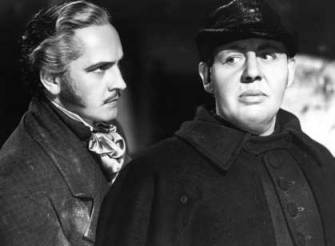
As opposed to the novel, Les Miserables takes a straight-forward chronological approach to telling the story of Jean Valjean.  We start with Valjean (played here by Fredric March) being sentenced to prison and then follow him through his experiences in prison.  We watch as the embittered Valjean first meets the kindly bishop (played here by Cedric Hardwicke) who turns his life around.  Valjean becomes both a mayor and the protector of the young Cosette, who eventually ends up falling in love with the young revolutionary Marius.  Thoughout all of this, Valjean is pursued by the obsessive Inspector Javert (Charles Laughton).

As a film, Les Miserables is more faithful to the spirit of Hugo’s original novel than to the exact details.  For instance, in this film, Javert first encounters Valjean while the latter is in prison.  While this is clearly different from the novel, it works perfectly from a cinematic point of view.  As well, the film jettisons many of the book’s longer digressions and instead, it focuses on the characters of Valjean and Javert.  As such, characters like Cosette and Marius are only important (and considered) in how they relate to the two main characters.  Fortunately, Valjean and Javert are played by two of the best actors to ever appear on screen.

While Charles Laughton, in the role of Javert, gets to the give the showier performance, the film is rightfully dominated by Fredric March’s quietly determined performance as Jean Valjean.  Valjean is a truly complex character who, over the course of the film, goes from being bitter and angry to kindly and strong and March perfectly captures each side of Valjean’s personality.  As an actor, Fredric March is not as well-remembered as some of his contemporaries (like Charles Laughton, for instance).  However, in this film, Fredric March proves himself to be the perfect Jean Valjean.  He is the Jean Valjean that all other Valjeans must be judged against.

While director Richard Boleslaswki is hardly a household name (I have to admit that I had never heard of him before I saw this film), his work on Les Miserables is impressive.  Interestingly, he directs the film almost as if it was a combination of a Warner Bros. gangster film and a Universal monster film.  (It’s easy to imagine some alternative universe where his version of Les Miserables starred Edward G. Robinson as Valjean and Boris Karloff as Javert.)  He’s at his strongest is the dream-like sequence where Valjean carries the wounded Marius through the sewers of Paris.

While Les Miserables may not be a perfect film, it is the perfect introduction to Hugo’s novel. Incidentally, the most faithful cinematic adaptation of Les Miserables actually came out a year before the Boleslawski version.  It was a French film that had a running time of five hours.  It occasionally turns up on TCM and, like the 1935 version, it’s well-worth watching.

Lisa Marie’s Favorite Film of 2012: Anna Karenina (dir by Joe Wright)


For the most part, 2012 was a bland year as far as cinema is concerned.  The most acclaimed films of the year (Argo and Lincoln being two obvious examples) were well-made and often entertaining but they were hardly revolutionary.  2012 was the year that the establishment told us what we should enjoy and, for the most part, film critics slavishly hopped on the bandwagon.  As you can probably guess, 2012 was not my favorite year as far as the movies are concerned.  That said, there were a few films that gave me hope.  As the year ends, despite being underwhelmed by most of the films that were released, there are a few that I truly did love.

My favorite film of 2011 was a criminally underappreciated film from director Joe Wright.  That name of that film was Hanna.  My favorite film of 2012 is another criminally underappreciated film from director Joe Wright.  The name of this film?  Anna Karenina.*

History has a way of repeating itself.

Anna Karenina is, of course, based on the classic novel by Leo Tolstoy.  Anna Karenina (played, quite brilliantly, by Kiera Knightley) is the wife of the noble (but somewhat boring and judgmental) Russian statesman Alex Karenin (Jude Law, who is also quite brilliant and rather tragic in a role that, in lesser hands, could have become a stock villain).  When Anna’s good-for-nothing brother (played in a wonderfully comedic performance by Matthew MacFayden) is caught cheating on his wife, Anna leaves her safe home in St. Petersburg and travels to Moscow where she helps to save her brother’s marriage and meets Count Vronsky (Aaron Taylor-Johnson).

Among the members of the Russian high society, it is well-known that Vronsky is pursuing the hand of the young and beautiful Kitty (Alicia Vikander, who generates a lot of sympathy for a character who, at the start of the film, could easily have been portrayed as just a spoiled brat).  However, at the ball where it is widely expected that Vronsky will ask Kitty to marry him, Vronsky creates a scandal by dancing with Anna instead.

Vronsky loses interest in Kitty and instead, he now obsessively pursues the married Anna.  Though Anna is resistant at first, she finally gives in and embarks on an adulterous affair with Vronsky, resulting in scandal and tragedy.

Again, history repeats itself.  The story of Anna Karenina is a familiar one that has been told repeatedly over the ages.  That’s one reason why Tolstoy’s novel has remained one of the greatest novels ever written and why it has been adapted into so many other mediums.  Director Joe Wright begins Anna Karenina with the assumption that the majority of the people in his audience already know the story of Anna’s ill-fated love affair with Vronsky.  As such, he puts less emphasis on the story itself and more on how the story is told.

Anna Karenina is a masterpiece of style.  When the film opens, Wright has his actors literally performing on a stage.  When Anna travels to Moscow, a miniature train is seen rolling across the stage.  When the scene changes from a factory to a high society ball, the factory workers walk backstage, change costumes, and then step back onstage, suddenly transformed into noblemen.  At one point, we even see a janitor nonchalantly cleaning up the now-empty theater while the story continues to play out on the stage in front of him.  When Anna and Vronsky dance for the first time, the other actors freeze in place and a spotlight shines down on the dancing couple.  It’s an amazingly romantic moment, one to which anyone who has ever been infatuated will be able to relate.  Finally, a door opens onstage and the characters (and the viewing audience) are able to step out into the “real” world but, throughout the film, we occasionally return to that stage.  While several critics have criticized this aspect of the film, I thought it was brilliant.  By literally putting his actors on stage, Wright both acknowledges that this is a story that may be familiar but can be interpreted in many different ways and he also drives home the point that, ultimately, we are all just actors on a stage, being observed and judged by a society that is often hostile to any sign of individual desire or unpredictable  emotion.

Needless to say, the film’s extreme stylization is not for everyone.  That’s actually one of the reasons that I love this version of Anna Karenina so much.  In a year that was almost excessively safe, Joe Wright took a risk and, as a result, encouraged us to look at a familiar story in a different way.  For that reason, Anna Karenina is my favorite film of 2012.

—-

* For the record, my second favorite film of 2012 was The Cabin In The Woods.

A Blast From The Past: Dating (1970)


As I may have mentioned a few times in the past, I am secretly a huge history nerd.  I am fascinated by the past and I’ve discovered that one of the best ways to learn about the past is to watch movies that were specifically made to be shown to the children and teenagers of the past.  I’m talking, of course, about educational films.

Take, for instance, this oddly dark little gem from 1970: Dating.

Dating may, on the surface, appear to just be an educational film about teen dating but I think it’s actually a portrait of generational ennui, envy, and repression.  It also features some vintage 70s fashion, dancing, and perhaps the most dreary party in the history of dreary parties.  If nothing else, this film shows that while the customs may change, the drama remains the same.  

Before there was Degrassi, there was Dating!

Film Review: Hitchcock (dir by Sacha Gervasi)


Alfred Hitchcock is one of those iconic cultural figures who will never go out of style.  Though he’s been dead longer than I’ve been alive, he’s still one of my favorite directors.  If I see a Hitchcock film listed in the TV schedule, I can guarantee that I will find the time to watch it.  Whether its The 39 Steps, Rebecca, Strangers On A Train, Topaz, or Frenzy, if it’s Hitchcock, I’m there. And I’m not alone as far as this is concerned.  If Hitchcock hadn’t made The Birds, James Nguyen would never have made Birdemic.  If Hitchcock hadn’t made Psycho, hundreds of low-budget horror films would never have had a chance to be distributed on DVD by Anchor Bay.

While it may have been Vertigo that was recently named the best film of all time by the Sight and Sound Poll, Psycho remains Hitchcock’s best known and most popular film.  Psycho is certainly my favorite Hitchcock film, which is why I was certainly curious when I first heard about Hitchcock, a new movie that claims to tell the true story behind the making of Psycho.

Hitchcock opens with 60 year-old Alfred Hitchcock (Anthony Hopkins) trying to figure out how to follow up the success of North By Northwest.  Hitchcock settles on adapting a little-regarded pulp novel that’s based on the true life crimes of serial killer Ed Gein.  Over the objections of the censors, the studio, and all of his associates, Hitchcock makes Psycho his next film.  At the same time, his wife Alma (Helen Mirren) deals with living in the shadow of her famous husband.  While Hitchcock devotes all of his time to his film and obsessing over his leading actresses, Alma find herself tempted by a slick screenwriter named Whitfield Cook (Danny Huston).

(Has anyone good ever been named Whitfield Cook?)

As a film, Hitchcock is likable but shallow.  Anthony Hopkins and Helen Mirren have great chemistry and they’re a lot of fun to watch but you never truly believe that you’re watching the true story of the making of a movie that changed cinematic history.  Whenever Hitchcock threatens to become truly insightful about the artistic process, the story abruptly cuts away to another scene of Alma writing on the beach with Whitfield Cook.  It doesn’t help that Danny Huston plays Cook as such an obvious cad that it actually diminishes Alma as character when she doesn’t immediately see through him.

Similarly, in the role of Alfred Hitchcock, Anthony Hopkins gives a performance that is very likable and quite watchable but, in the end, still feels rather shallow.  His performance feels like a good and entertaining impersonation but it never quite feels real.  The closest that the film (and Hopkins) comes to suggesting any of Hitchcock’s inner demons is when he imagines having a conversation with Ed Gein (played by Michael Wincott).  These scenes feel terribly out-of-place when compared to the rest of the film.

The actresses playing the women in Hitchcock’s life fare a little bit better.  Jessica Biel and Scarlett Johansson are well-cast as Vera Miles and Janet Leigh, respectively.  Helen Mirren is widely expected to earn an Academy Award nomination for her performance as Alma and she does have several strong scenes in Hitchcock.  As I watched the film, I certainly could relate to Alma’s desire to be taken seriously as an individual and her frustration with being defined solely by the vows of marriage.  It’s a feeling that Mirren captures perfectly.

In the end, Mirren aside, Hitchcock is entertaining but forgettable.

Scenes That I Love: Birdemic


There’s been a lot of talk about the end of the world recently.  In fact, a lot of people seem to be convinced that the world is going to end sometime later today. In the face of such negativity, it seems to me that we need to celebrate movies that remind us why we even bother to wake up in the morning and leave our homes.

One such movie is the 2008 epic Birdemic: Shock and Terror.  While the film itself deals with what happens when a bunch of birds go on a rampage, it still finds the time to highlight some of the good things about life.

Today, I want to highlight two scenes that I love from Birdemic.

In this first one, we’re reminded that, even in bad economic times, the corporate life can be a rewarding one.

This second scene celebrates the mystery of love and the excitement of flirtation.

And, just because I love you, here’s a bonus scene from a totally unrelated movie!

(That movie, by the way, was The Room.)

This Holiday Season, Giovanni Lombardo Radice Needs Your Help!


If you’re a fan of Italian horror, then you know who Giovanni Lombardo Radice is.  He danced for you in The House On The Edge of the Park.  He came back from the dead and helped to destroy the town of Dunwich in City of the Living Dead.  He went on an eating binge at a movie theater in Cannibal Apocalypse.  He’s appeared in three films directed by Michele Soavi, he recorded one of the greatest DVD commentaries ever for Cannibal Ferox, and he was a contributor to one of the most important books about Italian horror cinema, Eaten Alive.

However, there’s more to Giovanni Lombardo Radice than just a resume of showy roles in bloody movies.  He’s also a director, a writer, and an animal lover.  As anyone who follows him on Facebook knows, he can discuss the intricacies of William Shakespeare with the best of them.  He has appeared in films directed by people like Martin Scorsese and he is one of Quentin Tarantino’s favorite actors.

Most importantly, while he has always claimed to be somewhat bewildered by the popularity of some of his films, Giovanni Lombardo Radice is an actor who has always been kind and gracious to his fans.   I’ve met several Italian horror fans who have told me about how excited they were to get a reply to a question from Giovanni or how touched they were to get a gracious message from him.  Myself, I can still remember how excited I was when Giovanni responded to a rather odd dream that I had posted in my online dream journal.  (The dream and his response can be read here and here.)

Recently, Giovanni posted the following on his Facebook page:

MY dog Tommy has hernia and most probably must have surgery. Just what I needed….if you read that someone robbed a bank to cure his dog it will be me.

Anybody who is lucky enough to be friends with Giovanni on Facebook knows how much he loves animals and how much he loves Tommy.  Speaking as someone who spends 8 hours a day looking at cute cat pictures, my heart went out to him.

Earlier today, Giovanni announced (again on Facebook) that Tommy’s operation had been a success!  However, Giovanni is also flat broke.  People tend to assume that a cult film star like Giovanni Lombardo Radice must be rich but that’s rarely the case.  It’s been over 30 years since Giovanni made (and was paid for) the films that most people know him from and films like The House On The Edge of the Park and Cannibal Apocalypse didn’t become cult films until several years after they were first released.  When someone buys a DVD or a Blu-ray of a film like The House On The Edge of the Park, the money goes to the film’s distributor, not to the actors who appeared in the film.  Though Giovanni Lombardo Radice is definitely a star to many of us, he’s also just a working actor who struggles to make ends meet just like everyone else.

So, Giovanni Lombardo Radice is currently asking for help.  He has set up a paypal account connected to his e-mail address, info@giovannilombardoradice.com and he is accepting donations of any amount to help pay for Tommy’s surgery.

As an actor, Giovanni has always been there for his fans.  Hopefully, some of them will now be there for him.

Thank you for reading this and for your consideration.  And, to Tommy and Johnny, I wish both of you all the best this holiday season.  Buona fortuna!

Tommy

Tommy

Film Review: Killing Them Softly (dir. by Andrew Dominik)


Killing Them Softly is perhaps the most unpleasant film of 2012.

Taking place in 2008, Killing Them Softly tells the story of how a poker game got robbed in New Orleans and how that robbery led to a lot of people getting killed.  The poker game is run by Markie (Ray Liotta), a likable and well-meaning gangster who made a big mistake in the past.  A few years  previously, Markie arranged for one of his poker games to get robbed.  Though everyone knew that Markie was guilty, nobody could prove it and Markie continued to claim his innocence even while being tortured by a legendary hitman named Dillon (Sam Shepard).  So, years later, three small-time crooks figure that if they rob another one of Markie’s games, the Mafia will automatically blame Markie and hold him responsible.

Unfortunately, one of the crooks (played by Ben Mendelsohn, who was so good in Animal Kingdom) is also a heroin addict and something of an idiot.  He talks to the wrong people and soon the Mafia knows who was actually responsible.  Since Dillon is in the hospital, his protegé Jackie (Brad Pitt) is sent down to New Orleans to take care of the situation.  As Jackie explains to the mob’s representative (played by Richard Jenkins who gives a very Richard Jenkinsy performance here), not only do the three criminals have to die but Markie has to die as well.  It’s all strictly business.

Speaking of business, this entire story plays out against the backdrop of the 2008 elections.  For some reason, all of these sleazy criminals seem to be obsessed with watching CNN.  As a result, nearly every scene features either George W. Bush or Barack Obama speaking in the background.  At one point, Jackie says, “This is America,” just in case you couldn’t figure out that the film’s plot is supposed to be allegorical.

Killing Them Softly is an odd film, a well-made film that never quite convinces us that its story needs to be told.  Brad Pitt is miscast as Jackie and James Gandolfini has a truly annoying cameo as an alcoholic killer but otherwise, the film is perfectly cast.  Mendelsohn and Scoot McNairy are believable as two of the stupidest criminals to ever appear on-screen and Ray Liotta is likable and sympathetic as the tragic Markie.  Director Andrew Dominik makes good use of the New Orleans locations and the film has a few genuinely suspenseful moments.  That said, the film’s graphic and brutal violence quickly goes from being shocking to just being tedious.

If for no other reason, I did appreciate the fact that Killing Them Softly was brave enough to lump Barack Obama in with every other politician whose words are used to punctuate the film’s action.  Here in America, filmmakers tend to be very hypocritical when it comes to criticizing the government, going to almost ridiculous lengths to excuse Obama for following the same policies that they previously spent eight years attacking George W. Bush for instituting.  Instead of attempting to promote any partisan position, Killing Them Softly argues that the business of America will remains the same regardless of who is in charge.  Normally, that would seem to be a pretty obvious point but, in today’s cult-like political climate, it’s practically revolutionary.

Critics have been mixed on Killing Them Softly but, judging on both the film’s anemic box office and a lot of the comments that have been left online, audiences seem to absolutely loathe this film.  This isn’t particularly surprising because Killing Them Softly, with its constant emphasis on everything that’s ugly and dirty about life, seems to be a film that was specifically made to annoy audiences.  Even the film’s strengths ultimately serve to alienate the viewer.  I suspect that was Andrew Dominik’s ultimate goal and, on that count, he definitely succeeded.

Ultimately, I guess that’s why I ended up developing a strange sort of respect for Killing Them Softly, even though I found it impossible to enjoy the film itself and I would rather visit my gynecologist than ever have to sit through it again.  This is a film that stays true to itself, even at the risk of becoming unwatchable as a result.