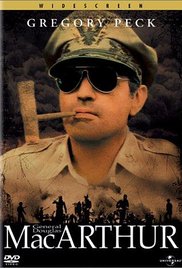
 The year is 1962 and Douglas MacArthur (Gregory Peck), the legendary general, visits West Point for one last time. While he meets the graduates and gives his final speech, flashbacks show highlights from MacArthur’s long military career. He leaves and then returns to Philippines. He accepts the Japanese surrender and then helps Japan rebuild and recover from the devastation of the war. He half-heartedly pursues the Presidency and, during the Korean War, gets fired by Harry Truman (Ed Flanders).
MacArthur is a stolid biopic about one America’s most famous and controversial generals. It was produced by Frank McCarthy, a former general who knew MacArthur and who previously won an Oscar for producing Patton. McCarthy was obviously hoping that MacArthur was do its subject what Patton did for George Patton and both films follow the same basic pattern. a warts-and-all portrait of a World War II general with all of the action centered around the performance of a bigger-than-life actor in the title role. Though obviously made for a low budget, MacArthur is a well-made and well-acted movie but it suffers because Douglas MacArthur was just not as interesting a figure as George Patton. Gregory Peck does a good job subtly suggesting MacArthur’s vanity along with capturing his commitment to his duty but he never gets a scene that’s comparable to George C. Scott’s opening speech in Patton. The main problem with MacArthur, especially when compared to Patton, is that George Patton was a born warrior while Douglas MacArthur was a born administrator and it is always going to be more exciting to watch a general lead his men into battle then to watch him sign executive orders.

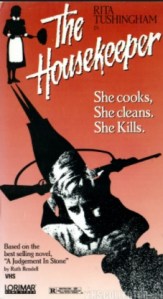 Eunice Parchman (Rita Tushingham) has always had a secret. She is dyslexic. When she was in school, the kids made fun of her for saying, “god” instead of “dog.” When she grew up, her cruel father threatened to send her to a special school so that she could learn how to read. Eunice suffocated him with a pillow and then moved to America, where she was hired as a housekeeper. Eunice is a good housekeeper except she can not read any of the directions that her obnoxious employers leave for her. When she befriends a religious fanatic (Jackie Burroughs) and accidentally overwaters her employer’s prized orchids in the same week, it can only lead to one thing, a shotgun rampage.
 Strange movie, Ted & Venus.
 Based on the campy 70s cop show that will live on forever in syndication, CHiPs is about two unlikely partners who, after a rough beginning, work together to catch a cop’s killer and capture a gang of armed robbers.
 Naked women are turning up murdered in Los Angeles. The only clue that the crimes are connected: the baby doll that is left beside each body. Can detectives Louis (Jeff Kober) and Larry (Bobby Di Cicco) solve the case while also dealing with issues in their own private life? Louis’s girlfriend (Melanie Smith) is worried that Louis is becoming obsessed with is work and that he is not willing to commit to their relationship. Larry is upset because he suspects his wife is keeping a secret from him. Their chief (John Saxon) wishes they would just solve the case, especially when the killer targets his own daughter. The problem is that Louis is so driven and prone to violence that he has managed to get himself suspended from the force. Why does that always happen to good cops?
 Vista Verde, an exclusive suburban high school in California, has a problem. Some of the students have a bad attitude. Some of them are experimenting with drugs. Graffiti is showing up all over the school. What better way to return peace to Vista Verde than for a bunch of WASPy rich kids and other jocks to organize into a secret vigilante force? The headmaster thinks that it’s a great idea and soon “The Sentinels” are holding mock trials and shooting the other students with paintball guns. One bad kid even turns up dead. Graffiti is no joke.
 You can’t always tell a book by its cover and that is the case with the Spirits, the nicest motorcycle gang to ever roll across America’s highways. When they come across an old couple on the side of the road with a flat tire, they don’t rob the couple. Instead, they change the tire. When they come across a young man named Chris (David Hyrly, who is overdubbed by a young Nick Nolte), they invite him to join them on their journey. When they are arrested, they sit in jail and roll a joint. The Spirits are solid dudes. But because they are rebels who live outside of straight society, they will always be picked on by the Man. After a redneck deputy rapes the Chris’s girlfriend, the deputy blames the Spirits. Soon, the Spirits find themselves under attack and are violently picked off one by one. In self-defense, the Spirits start to arm themselves. It all comes to a head in a violent confrontation in Northville Cemetery.
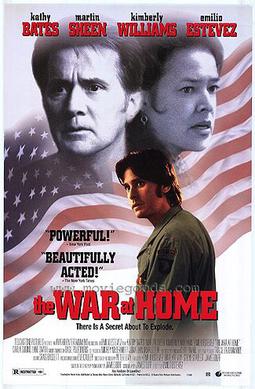 The year is 1972 and it is Thanksgiving week in small town America. The Colliers are getting ready for the holidays. Maurine (Kathy Bates) is intent on preparing the perfect Thanksgiving meal. Bob (Martin Sheen) is keeping an eye on his car dealership and wondering why kids today are not as respectful as they once were. The two Collier children are coming home from school. The youngest, Karen (Kimberly Williams), is hoping she can keep the peace because she knows that her older brother, Jeremy (Emilio Estevez), has returned from Vietnam a changed man. Suffering from severe PTSD, Jeremy is haunted by flashbacks and angry at everything, especially his father. The only reason he even attended college was so he could be near his girlfriend (Carla Gugino) and even she has told him that she no longer feels comfortable around him. When Jeremy returns home, his family first tries to ignore the problems that he’s having adjusting to civilian life but Jeremy is determined not to be ignored.
 November 22, 1963. While the rest of the world deals with the aftermath of the assassination of John F. Kennedy in Dallas, a man named Michael Curtis drives a jeep across the South Texas desert, heading for the border. In the jeep, he has a $800,000 and a high-powered rifle. When the jeep crashes, the man, the rifle, and the money are left undiscovered in the desert for 21 years.
 Through the Shattered Lens