Retro Television Review: Miami Vice 2.12 “Phil the Shill”


Welcome to Retro Television Reviews, a feature where we review some of our favorite and least favorite shows of the past!  On Mondays, I will be reviewing Miami Vice, which ran on NBC from 1984 to 1989.  The entire show can be purchased on Prime!

The Vice Squad goes after Phil Collins!

Episode 2.11 “Phil the Shill”

(Dir by John Nicolella, originally aired on December 13th, 1985)

Switek and Zito call in sick so that they can go to the taping of a silly game show called Rat Race.  While Zito sits in the audience, Switek answers trivia questions about Elvis and competes in an obstacle course race with his spacey opponent (Emo Phillips).  Hosting the show is the very effusive and very British Phil Mayhew (Phil Collins).

As we already know, Switek knows everything about Elvis.  And he’s in better shape than Emo Phillips so, when it comes time for the obstacle course, he reaches and hits his buzzer first.  But Switek’s buzzer doesn’t go off.  Emo’s buzzer works and Emo proceeds to robotically recite a complex string of Elvis trivia.

To his horror, Switek realizes that the quiz show was fixed!

Switek and Zito decide that they want to take down Phil and reveal his con artist ways.  Unfortunately, for them, the rest of the Squad doesn’t care.  Crockett, in particular, is annoyed that Switek pretended to be sick to get a night off of work.  However, it then turns out that Phil has hooked up with Sarah MacPhail (Kyra Sedgwick), the girlfriend and business partner of Tony Rivers (Michael Margotta), a drug dealer that Crockett has spent months trying to set up.

It’s time to call in Izzy and have him pretend to be an interior decorator so that Phil can be tricked into throwing a party that can be attended by …. SONNY BURNETT AND RICO COOPER!  Listen, I know I mention that a lot but I just can’t let it go …. how are Sonny and Rico able to maintain their undercover identities when they’re constantly arresting major drug dealers and taking part in DEA busts?  How come it never occurs to the criminals that dealer Sonny Burnett might have something in common with cop Sonny Crockett?  Does no one ever notice that Sonny Burnett drives the same car and wears the same white suit as Sonny Crockett?

This was a bit of an odd episode.  It was obviously written so that Phil Collins (whose In The Air Tonight set the mood for the entire series) could play Phil Mayhew.  And while Phil Collins does not appear to have been an actor of amazing range, he still does a good job as the weaselly Phil Mayhew.  The Phil scenes are played for humor while the scenes with Tony Rivers definitely are not.  Tony is a violent sociopath who casually kills several people over the course of the episode.  Scenes of Switek pouting about the game show feel awkward when combined with scenes of Tony machine gunning two drug dealers.  Collins does a good job within his range and Michael Margotta is an energetic villain.  However, the best performance in this episode actually comes from Kyra Sedgwick, who does a great job as someone who eventually turns out to be just as ruthless and dangerous her boyfriend.

This is a fast-paced and energetic episode, one that moves quickly enough that the viewer doesn’t really have time to consider the oddness of Phil Mayhew getting involved with the same drug dealer that Crockett happens to be investigating.  Personally, I’m always happy when the members of the supporting cast get to do something more than just stand in the background.  Switek and Zito are a good team.

Retro Television Reviews: The Last Angry Man (dir by Jerrold Freedman)


Welcome to Retro Television Reviews, a feature where we review some of our favorite and least favorite shows of the past!  On Sundays, I will be reviewing the made-for-television movies that used to be a primetime mainstay.  Today’s film is 1974’s The Last Angry Man!  It  can be viewed on YouTube.

During the Great Depression, Dr. Sam Abelman (Pat Hingle) is a doctor who works in the slums of Brooklyn.  Dr. Abelman can be gruff.  Dr. Abelman can be crotchety.  Dr. Abelman can be, as the title suggests, a little bit angry.  He can’t help but get annoyed at how difficult it is to get his patients to pay him.  He gets easily annoyed with red tape and bureaucracy.  Dr. Abelman is an angry man.  In his eyes, he’s the last angry man.

But that doesn’t mean that Dr. Abelman doesn’t care about his patients or the community in which he lives.  Underneath his gruff exterior, Dr. Abelman is truly a man who wants to make the world a better place.  Sam Abelman is especially angry at the doctors who have abandoned the neighborhood that once supported them and who now work at hospitals that have little room for the poor.

The film focuses on Dr. Abelman’s attempts to help Frankie Parelli (Michael Margotta), a troubled teenager who has a reputation for being a bully and a petty criminal.  When Frankie starts to suffer from frequent seizures, Dr. Abelman comes to be convinced that Frankie is suffering from a brain tumor.  Dr. Abelman wants to get Frankie seen by a specialist and a surgeon but it’s difficult because of Frankie’s own bad reputation and also the fact that Frankie’s family doesn’t have much money.  Dr. Abelman uses a combination of shaming and outrage to finally get Frankie examined.  But, when it become apparent that Frankie is going to need an operation, is Dr. Abelman going to be able to get him under the knife?

The Last Angry Man was loosely based on a novel by Gerald Green.  The novel was previously adapted into a 1959 film, which starred the great actor Paul Muni in his final role.  (Muni received an Oscar nomination for his performance.)  If the novel and the 1959 film emphasized the grittiness of the neighborhood in which Dr. Abelman worked, the 1974 made-for-TV version takes place in a remarkably clean version of Brooklyn.  It’s a very pleasant slum.  There’s no trash to be seen.  The apartment buildings and the streets have the crisp look that only comes from shooting on a studio backlot.  Everyone in the neighborhood is remarkably friendly.  Even Frankie is a rather mild-mannered delinquent.  Dr. Abelman may be angry but everyone’s so nice that it sometimes seems like he’s going a little bit overboard.

The Last Angry Man was clearly meant to be a pilot for a television series and, as such, the movie’s action doesn’t really seem to build up to any sort of grand climax.  Instead, the film is more about introducing Dr. Abelman and all the quirky people in the neighborhood.  Pat Hingle was a good actor but, as Dr. Abelman, he’s all bluster with little depth.  It’s hard not to feel that both the film and the potential show would have been well-served by having Pat Hingle and Sorrell Brooke (who plays Abelman’s best friend, Dr. Vogel) switch roles.  When Sorrell Brooke gets annoyed and angry in this film, you have no doubt that the feeling is genuine.

Unfortunately, The Last Angry Man just isn’t angry enough.

Film Review: Drive, He Said (dir by Jack Nicholson)


First released in 1971, Drive, He Said tells the story of two college roommates.

Hector (William Tepper) is a star basketball player who everyone expects to turn pro.  His intense coach (Bruce Dern) is always yelling at him to stop fooling around on the court but Hector is more interested in fooling around elsewhere as he’s having an affair with Olive (Karen Black), the wife of a self-styled “hip” philosophy professor named Richard (Robert Towne).

Gabriel (Michael Margotta) is Hector’s best friend.  They live together, even though Hector’s coach thinks that Gabriel is a bad influence.  Gabriel is a self-styled campus radical.  He has a devoted group of followers who will do just about anything that he tells them to do.  Gabriel is big into guerilla theater and symbolic protests.  Nothing he does seems to add up too much but, unlike Hector, he’s good at giving speeches.

Together, they worry about the draft!

Of course, they’re both worrying about two different types of drafts.  Hector is worried about the NBA draft and whether he should enter it.  He’s been playing basketball for as long as he can remember.  The only thing that he’s really good at is playing basketball.  And yet, Hector isn’t sure if he wants to spend the rest of his life taking orders from his coaches and devoting every minute to playing the game.  However, Hector’s worked himself into a corner.  When one NBA official asks him what he’s going to do if he’s not drafted, Hector admits that he doesn’t know.  When asked what his major is, Hector replies, “Greek.”

Gabriel, on the other hand, is worried about being drafted into the military and being sent to Vietnam.  Gabriel considers himself to be a revolutionary but it soon becomes clear that he really doesn’t have much of a plan for how to start his revolution.  Indeed, the film suggests that his activism is more about his own insecurity over his own sexuality than anything else.  Gabriel particularly seems to be obsessed with Hector’s affair with Olive.  While Hector reaches new highs on the court, Gabriel comes closer and closer to having a psychotic break.

Director Jack Nicholson found a way to work in shout out to his friend, Harry Dean Stanton

Drive, He Said was one of the many “campus rebellion” films that were released in the early 70s and, much like Getting Straight, it’s definitely a product of its time.  Today, it it’s known for anything, it’s for being the directorial debut of actor Jack Nicholson.  (Nicholson has said that, before he was cast in Easy Rider, he was actually planning on abandoning acting and pursuing a career as a director.)  The film features many of the flaws the are typically present in directorial debuts.  The pacing is terrible, with some scenes ending too quickly while others seem to go on forever.  At times, the film feels a bit overstylized as Nicholson mixes jump cuts, odd camera angles, and slow motion to little effect. It’s very much a film about men, so much so that the film’s ultra-masculinity almost verges on self-parody.

And yet, there are moments of isolated brilliance to be found in Drive, He Said.  Some of the shots are genuinely impressive and the army induction scene shows that Nicholson could direct comedy, even if he does let the scene drag on for a bit too long.  Though Nicholson doesn’t appear in the film, his approach to the story features his trademark cynicism and sense of fatalism.  Though he was often associated with the counterculture, Nicholson was more a member of the Beat generation than of the hippies.  As such, Drive, He Said has more in common with Jack Kerouac than Abbie Hoffman.  Drive, He Said is definitely an anti-establishment film but, at the same time, it doesn’t make the mistake of glorifying Gabriel or his followers.  Gabriel, with his constant demand that everyone join him in his ill-defined revolution, is almost as overbearing as basketball coach and, towards the end of the film, he commits an act of violence that leaves no doubt that his “revolution” is all about his own self-gratification.  The film is less a polemic and more a portrait of people trying to find their identity during a time of political and cultural upheaval.

The film’s biggest flaw is that neither William Tepper or Michael Margotta really have the charisma necessary to carry a movie, especially one in which even the main characters often do unlikable things.  Tepper is dull while Margotta overacts and, at times, comes across as if he’s trying too hard to imitate his director.  It falls to the film’s supporting cast to provide the energy that Tepper and Margotta lack.  Fortunately, Bruce Dern and Karen Black are both perfectly cast.  Bruce Dern seems to be having a blast as the fanatical basketball coach while Karen Black brings a fierce intelligence to the role of Oliva, an intelligence that one gets the feeling wasn’t really in the original script.  Considering how misogynistic every other character in the film is, it’s impossible not to cheer when Olive announces, “I’m not going with anybody, anywhere.”

(For whatever reason, there was a definite strain of misogyny that seemed to run through the majority of the late 60s and early 70s counterculture films.  Just consider the amount of time Getting Straight devoted to Elliott Gould shouting at Candice Bergen.)

Drive, He Said is flawed but interesting.  As a director, Nicholson understood how to frame a shot but he wasn’t quite sure how to tell a cohesive story.  That said, the film itself is a definite time capsule of a very specific cultural moment.

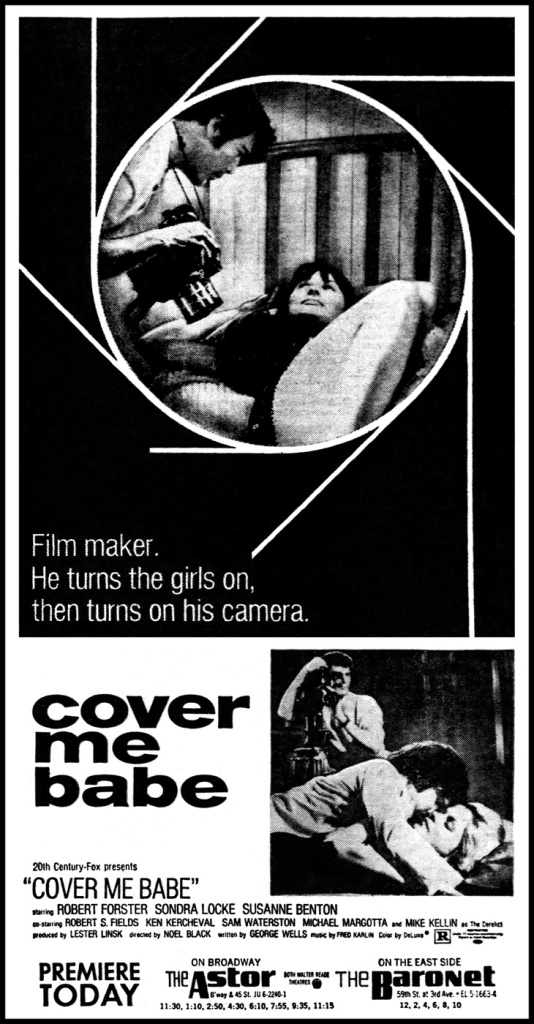
Film Review: Cover Me, Babe (dir by Noel Black)


I don’t know if I’ve ever come across a non-horror film that featured a more off-putting lead character than Tony, the protagonist of 1970’s Cover Me, Babe.

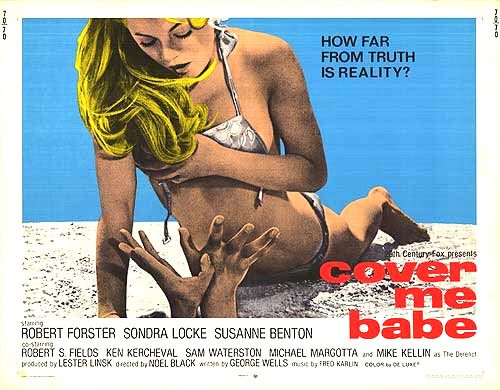
A film student, Tony (Robert Forster, even in 1970, who was too old for the role) aspires to make avant-garde films.  Everyone in the film continually raves about how talented Tony is.  The footage that we see, however, tends to suggest that Tony is a pretentious phony.  The film opens with footage of a student film that Tony shot, one that involves his girlfriend, Melisse (Sondra Locke) sunbathing in the desert and getting groped by a hand that apparently lives under the sand.  It was so self-consciously arty that I assumed that it meant to be satirical and that we were supposed to laugh along as Tony assured everyone that it was a masterpiece.  And, to be honest, I’m still not sure that Cover Me, Babe wasn’t meant to be a satire on film school pretension.  I mean, that explanation makes about as much sense any other.  (Hilariously enough, Tony’s film had the same visual style as the film-within-a-film around which the storyline of Orson Welles’s The Other Side of the Wind revolved.  At least in the case of Welles, we know that his intent was satirical.)

Tony is not only pretentious but he’s also a bit of a prick.  He treats Melisse terribly and he manipulates everyone around him.  He wanders around the city with his camera, filming random people and then editing the footage together into films that feel like third-rate Godard.  He answers every criticism with a slight smirk, the type of expression that will leave you dreaming of the moment that someone finally takes a swing at him.  Tony’s arrogant and he treats everyone like crap but, for whatever reason, everyone puts up with him because …. well, because otherwise there wouldn’t be a movie.  Of course, eventually, everyone does get sick of Tony because otherwise, the movie would never end.

A Hollywood agent (Jeff Corey) calls up Tony and offers to get him work in Hollywood.  Tony is rude to the guy on the phone.  Tony meets a big time producer who could get Tony work.  Tony’s rude to him.  Guess who doesn’t get a job?  Tony has to get money to develop his latest film from one of his professors so he’s rude to the professor.  Guess who doesn’t get any money?  Tony cheats on his loyal girlfriend.  Tony’s cameraman (played by a youngish Sam Waterston) walks out when Tony tries to film two people having sex.  By the end of the movie, no one wants anything to do with Tony.  Tony goes for a run on the beach.  He appears to be alienated and disgruntled.  We’re supposed to care, I guess.

The problem with making a movie about an arrogant artist who alienates everyone around him is that you have to make the audience believe that the artist is talented enough to justify his arrogant behavior.  For instance, if you’re going to make a movie about a painter who is prone to paranoid delusions and obsessive behavior, that painter has to be Vincent Van Gogh.  He can’t just be the the guy who paints a picture of two lion cubs and then tries to sell it at the local art festival.  You have to believe that the artist is a once-in-a-lifetime talent because otherwise, you’re just like, “Who cares?”  The problem with Cover Me, Babe is that you never really believe that Tony is worth all of the trouble.  The film certainly seems to believe that he’s worth it but ultimately, he just comes across as being a jerk who manipulates and mistreats everyone around him.

That said, from my own personal experience, a lot of film students are jerks who treat everyone them like crap.  So, in this case, I think you can make the argument that Cover Me, Babe works well as a documentary.  The fact of the matter is that not every film student is going to grow up to be the next Scorsese or Tarantino or Linklater.  Some of them are going to turn out to be like Tony, running along the beach and wondering why no one agrees with him about George Stevens being a less interesting director in the 50s than he was in the 30s.  As a docudrama about the worst people that you’re likely to meet while hanging out on campus, Cover Me, Babe is certainly effective.  Otherwise, the film is a pretentious mess that’s done in by its unlikable protagonist.  Everyone in the film says that Tony has what it takes to be an important director but, if I had to guess, I imagine he probably ended up shooting second unit footage for Henry Jaglom before eventually retiring from the industry and opening up his own vegan restaurant in Vermont.  That’s just my guess.

The poster has little to do with the film.

Rockin’ in the Film World #4: WILD IN THE STREETS (AIP 1968)


gary loggins's avatarcracked rear viewer

max1

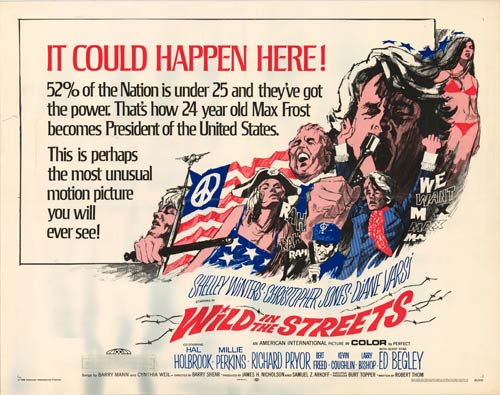
If you think today’s political climate is tumultuous and crazy, wait’ll you get a load of WILD IN THE STREETS. Filmed in the chaotic year 1968, this satirical look at the counter-culture vs the establishment revolves around a power-mad rock star whose call to lower the voting age to 14 results in him becoming President of the good ol’ USA, and sticking it to the over 30 crowd by interring them in concentration camps loaded with LSD-spiked water supplies!

max2

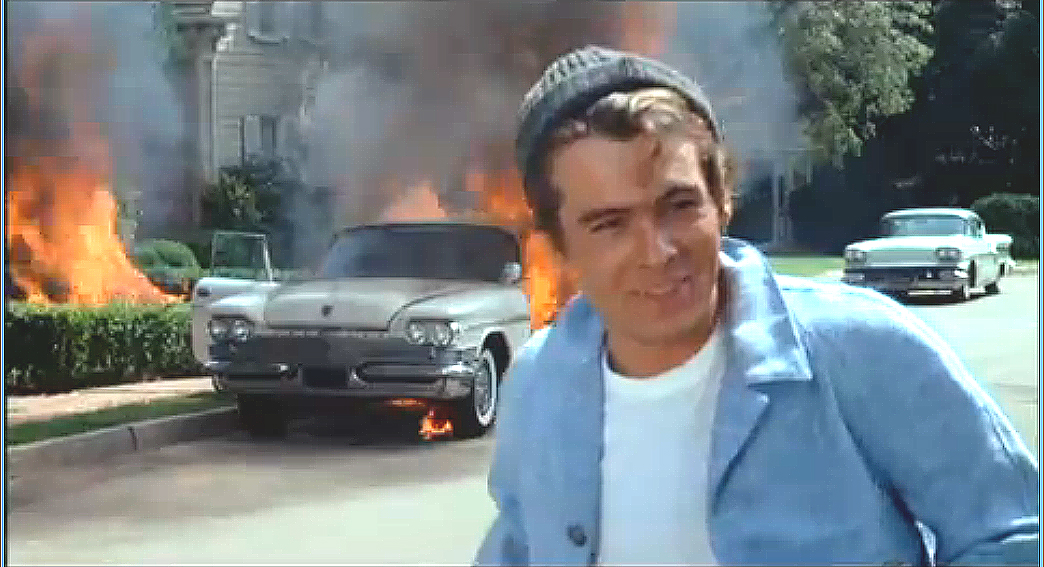
Christopher Jones is Max Frost, née Flatow, the charismatic leader of rock band Max Frost and the Troopers. Pre-credits flashbacks show Max’s unhappy childhood with an overbearing mother (Shelley Winters at her over-the-top best) and abrasive dad (Bert Freed). Max learns to hate all adults and dabbles in making LSD and bombs. After he blows up dad’s car, the rebellious Max leaves home and winds up becoming a mega rock star rivaling the…

View original post 945 more words

Shattered Politics #26: Wild In The Streets (dir by Barry Shear)


Wild_in_the_streets_dvd_cover

I am really not looking forward to turning 30.

Seriously, the great thing about being in your 20s is that everything is set up to specifically appeal to you.  Everyone wants your attention, your money, your tweets, your ideas, you love, and everything else.  And, yes, I understand that most people neither like nor respect my generation but oh well and whatever.  Trust me, the generation coming up behind mine is a hundred times worse.

2008 was a great time to be a politically knowledgeable millennial.  Everyone running for President was desperate to get our vote and they were willing to promise us anything.  And, since my age group voted overwhelmingly for Obama, all of the old elitists in the national media briefly fell in love with us.  (The genius of Obama’s 2008 campaign was to tell us that we were the people that we were waiting for.  Technically, it’s a bit nonsensical but never doubt what you can accomplish by appealing to the ego of the electorate.)

Of course, over the past few years, my generation has essentially been fucked over by both political parties and, since we dared to complain about it, nobody likes us anymore.  But, oh well and whatever.  American culture is basically built around our whims so we really don’t need anyone else’s love.

And, if all this sounds a little bitter or angry, I would point that young people and old people have been at war since time began.  Generational conflict is nothing new.  And if you need proof of that, I suggest watching a film from 1968 called Wild In The Streets.

Wild in the Streets tells the story of Max Frost (Christopher Jones), a rock star who lives in a gigantic mansion with his band and his groupies.   When Max is asked to perform at a campaign appearance for senate candidate Johnny Fergus (Hal Holbrook), he agrees to do so because Fergus supports lowering the voting age.  (When Wild In The Streets was made, you had to be 21 to vote.  So, if your birthday fell on election day, you could cast your first vote and then go have your first legal drink.)  However, at the rally, Max announces that he wants 14 year-olds to have the vote and then performs a song called “14 or fight!”

Max’s song is such a sensation and leads to so many protests that, in a compromise, the voting age is lowered to 15.  Johnny Fergus is elected to the Senate and, before you can say “Blue dog,” promptly starts to ignore the will of the people who supported him.  So, Max arranges for his girlfriend Sally (Diane Varsi) to be elected to the U.S. House.  After spiking the water supply of Washington D.C. with LSD, Sally gets a bill passed and the age requirement for holding political office is lowered to 14!

Of course, in the next election, 24 year-old Max Frost is elected President of the United States.  Soon, anyone over the age of 35 is being sent to re-education camps where they are force-fed LSD.  Max is so ruthless that he even sends his own mother (Shelley Winters) off to re-education.

And, with all the old people gone, everything is perfect for Max.  Except for that fact that 10 year-olds are now demanding the vote…

In many ways, Wild in the Streets feels like a film that could have only been made in 1968.  From the psychedelic direction to the costumes to the hair to music, everything about this movie screams late 60s.  But, at the same time, it’s still a genuinely amusing satire, largely because generational conflict is timeless.  We all think that those older than us are clueless and that those younger are spoiled.  There’s a lot of things in your life that can control.  Sadly enough, getting older is not one of them.

Wild in the Streets is a fun and amusing time capsule.  See it now before the younger generation comes of age and totally fucks up the world.

http://www.youtube.com/watch?v=gs-xc1CKnzY

What could have been: The Godfather


I don’t know about you but I love to play the game of “What if.”  You know how it works.  What if so-and-so had directed such-and-such movie?  Would we still love that movie as much?  Would so-and-so be a star today?  Or would the movie have failed because the director was right to reject so-and-so during preproduction?

I guess that’s why I love the picture below.  Taken from one of Francis Ford Coppola’s notebooks, it’s a page where he jotted down a few possibilities to play the roles of Don Vito, Michael, Sonny, and Tom Hagen in The Godfather.  It’s a fascinating collection of names, some of which are very familiar and some of which most definitely are not.  As I look at this list, it’s hard not wonder what if someone like Scott Marlowe had played Michael Corleone?  Would he had then become known as one of the great actors of his generation and would Al Pacino then be fated to just be an unknown name sitting on a famous list?

(This page, just in case you happen to be in the neighborhood , is displayed at the Coppola Winery in California.)

The production of the Godfather — from the casting to the final edit — is something of an obsession of mine.  It’s amazing the amount of names — obscure, famous, and infamous — that were mentioned in connection with this film.  Below is a list of everyone that I’ve seen mentioned as either a potential director or a potential cast member of The Godfather.  Consider this my contribution to the game of What If….?

Director: Aram Avankian, Peter Bogdonavich, Richard Brooks, Costa-Gravas, Sidney J. Furie, Norman Jewison, Elia Kazan, Steve Kestin, Sergio Leone, Arthur Penn, Otto Preminger, Franklin J. Schaffner, Peter Yates, Fred Zinnemann

Don Vito Corleone (played by Marlon Brando): Melvin Belli, Ernest Borgnine, Joseph Callelia, Lee. J. Cobb, Richard Conte, Frank De Kova, Burt Lancaster, John Marley, Laurence Olivier, Carlo Ponti, Anthony Quinn, Edward G. Robinson, George C. Scott, Frank Sinatra, Rod Steiger, Danny Thomas, Raf Vallone,  Orson Welles

Michael Corleone (played by Al Pacino): John Aprea, Warren Beatty, Robert Blake, Charles Bronson*, James Caan, David Carradine, Robert De Niro, Alain Delon, Peter Fonda, Art Genovese, Dustin Hoffman, Christopher Jones, Tommy Lee Jones, Tony Lo Bianco, Michael Margotta, Scott Marlowe, Sal Mineo, Jack Nicholson, Ryan O’Neal, Michael Parks, Robert Redford, Burt Reynolds, Richard Romanus, Gianni Russo, Martin Sheen, Rod Steiger**, Dean Stockwell

Sonny Corleone (played by James Caan): Lou Antonio, Paul Banteo, Robert Blake, John Brascia, Carmine Caridi, Robert De Niro, Peter Falk, Harry Guardino, Ben Gazzara, Don Gordon, Al Letteiri, Tony LoBianco, Scott Marlowe, Tony Musante, Anthony Perkins, Burt Reynolds***, Adam Roarke, Gianni Russo, John Saxon, Johnny Sette, Rudy Solari, Robert Viharo, Anthony Zerbe

Tom Hagen (played by Robert Duvall): James Caan, John Cassavettes, Bruce Dern, Peter Donat, Keir Dullea, Peter Falk, Steve McQueen, Richard Mulligan, Paul Newman, Jack Nicholson, Ben Piazza, Barry Primus, Martin Sheen, Dean Stockwell, Roy Thinnes, Rudy Vallee****, Robert Vaughn, Jerry Van Dyke, Anthony Zerbe

Kay Adams (played by Diane Keaton): Anne Archer, Karen Black, Susan Blakeley, Genevieve Bujold, Jill Clayburgh, Blythe Danner, Mia Farrow, Veronica Hamel, Ali MacGraw, Jennifer O’Neill, Michelle Phillips, Jennifer Salt, Cybill Shepherd, Trish Van Devere

Fredo Corleone (played by John Cazale): Robert Blake, Richard Dreyfuss, Sal Mineo, Austin Pendleton

Connie Corleone (played by Talia Shire): Julie Gregg, Penny Marshall, Maria Tucci, Brenda Vaccaro, Kathleen Widdoes

Johnny Fontane (played by Al Martino): Frankie Avalon, Vic Damone*****, Eddie Fisher, Buddy Greco, Bobby Vinton, Frank Sinatra, Jr.

Carlo Rizzi (played by Gianni Russo): Robert De Niro, Alex Karras, John Ryan******, Sylvester Stallone

Virgil “The Turk” Sollozzo (played by Al Letteiri): Franco Nero

Lucas Brasi (played by Lenny Montana): Timothy Carey, Richard Castellano

Moe Greene (played by Alex Rocco): William Devane

Mama Corleone (played by Morgana King): Anne Bancroft, Alida Valli

Appollonia (played by Simonetta Steffanelli): Olivia Hussey

Paulie Gatto (played by John Martino): Robert De Niro*******, Sylvester Stallone

—-

* Charles Bronson, who was in his mid-40s, was suggested for the role of Michael by the then-chairman of Paramount Pictures, Charlie Bluhdorn.

** By all accounts, Rod Steiger – who was then close to 50 – lobbied very hard to be given the role of Michael Corleone.

*** Some sources claim that Burt Reynolds was cast as Sonny but Brando refused to work with him.  However, for a lot of reasons, I think this is just an cinematic urban legend.

**** Despite being in his 60s at the time, singer Rudy Vallee lobbied for the role of the 35 year-old Tom Hagen.  Supposedly, another singer — Elvis Presley — lobbied for the role as well but that just seems so out there that I couldn’t bring myself to include it with the “official” list.

***** Vic Damone was originally cast as Johnny Fontane but dropped out once shooting began and announced that the project was bad for Italian Americans.  He was replaced by Al Martino.

****** John P. Ryan was originally cast as Carlo Rizzi but was fired and replaced with Gianni Russo.  Ryan went on to play the distraught father in Larry Cohen’s It’s Alive.  Russo went on to co-star in Laserblast.

******* Robert De Niro was originally cast in this role but dropped out to replace Al Pacino in The Gang That Couldn’t Shoot Straight.  Pacino, incidentally, had to drop out of that film because he was given the role of Michael in The Godfather.