Batman (dir. by Tim Burton)


Here on the Shattered Lens, the love for Batman is very strong. There are too many Batman related articles to fully list, but for a good start, go with Ryan’s Which Way Forward for the Batman Franchise.

This isn’t so much a review for Batman as it’s just me looking back on the film.

I spent the Saturday Morning of June 24th, 1989 standing on a line that snaked around the white walls of the Sunrise Multiplex Cinema in Valley Stream. Thankfully, by the time I arrived, there were only a few people there. Most of them were my friends, so we were close to the door. The following year, the Sunrise would go down in history as being the only movie theatre I’ve ever known with metal detectors after a shooting around the release of The Godfather Part III prompted tighter security. Before then, anyone going into the theatre had a free run of the place. From that incident to the theatre’s shutdown in 2015, you always had to pass the metal detectors.

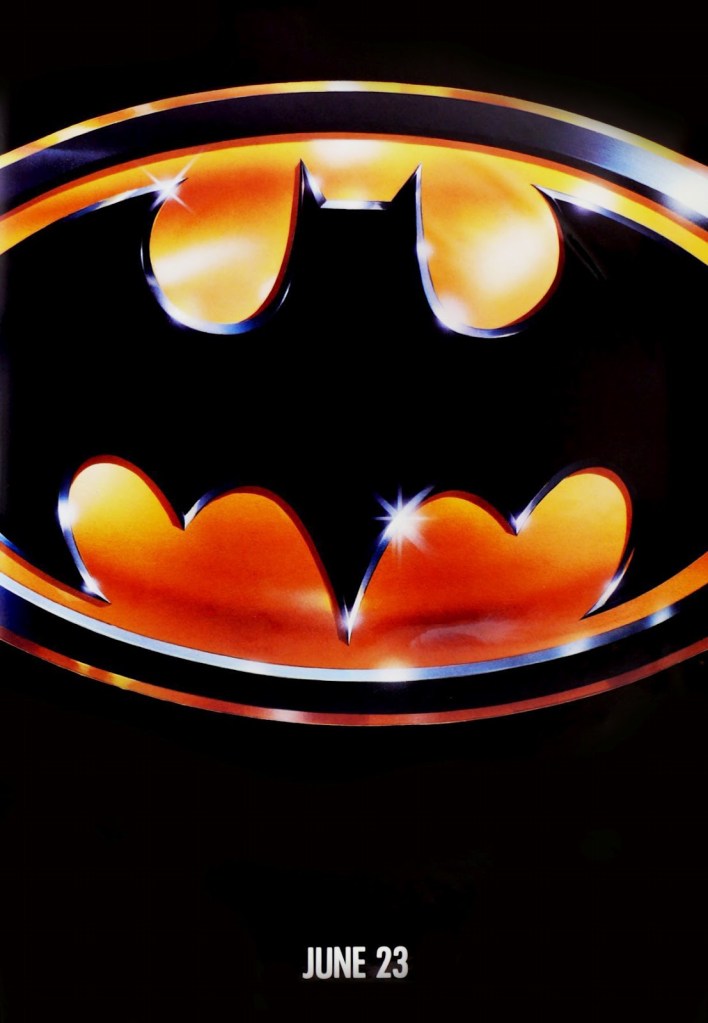
You knew Tim Burton’s Batman was going to be something grand when they first put up the posters in bus stations. The character was so well known that the poster was simply a black and gold Batsymbol with a date – June 23. In my neighborhood, the poster lasted a week before the bus stop’s glass was broken and it was stolen. This was how mad people were for the film. Although merchandise was already available, it moved at an incredible pace. For a film made before pre-Internet, the buzz was just amazing.

“Okay, Everyone, we know you’re looking forward to seeing the movie.”, came the announcement over the theatre’s loudspeaker, which caused a few murmurs from everyone. It was a smooth, business like voice, probably from someone who had never even heard of The Caped Crusader. “We’re going to open up the doors and we want everyone to proceed to the ticket booths in a nice, orderly fashion.”

I was 14 at the time. Batman was the first movie I ever saw without my family. My parents, a cop and a bartender, saw so much of the worst of NYC that they figured the best place for me was home. Still, since I was among friends they knew, I gave me a pass. It was a big deal. My friend Pierre and I had a plan, along with the 4 others that came with us. We’d head in, make for the ticket booth and go right in for our seats near the back right side.. No refreshments were necessary, since we could all go eat at the mall later on after the move was done. To make sure I didn’t miss anything, I had already read the novel for the story beforehand.

Anyone close to the door could see the theatre workers as they approached, keys in hand. The layout of the Sunrise was such that after stepping through the front door, you could cut to your immediate left or right down a open path to separate ticket booth. As the door unlocked, was pushed open and secured, someone from near the middle of the line decided it was time, declaring in a loud scream.

“Batman!!!!!”

It was madness. Utter madness. Bodies piled into the theatre in a mad scramble for the ticket booth. On the way there, I was shoulder blocked and fell to the floor. I instantly curled into a ball to keep from getting trampled, wondering if my parents were right about not letting me out. ‘Here lies Lenny…”, my epitaph would read. “…he died at the movies after being let outside on his own just once.”

Thankfully, I was scooped up to my feet a few seconds later by one of my friends.

“Go on! We’ve got your tickets! Head for the ticket guy, we’ll meet you there!” he yelled over the crowd passing us on sides.

“Okay!!” I’d been to the Sunrise tons of times, so I knew it well. I moved through the crowd, bypassing the concession stand, which was already developing a line of its own. I thought they were going to go in without me and leave me there. I don’t know they did it, but within a few minutes of reaching the ticket taker. most of my group caught up, tickets in hand for all of us.

The actual experience of Batman was a packed crowd with almost non-stop talking throughout. After all, the audience was made up of teens and DC fans that that were ravenous for anything Batman related. Superman had about four films by the time Batman premiered. I think the only real time the entire audience hushed was near the beginning when we first see Batman grab the one robber and they ask him what he is. After that, the crowd pretty much erupted in applause.

Of course, that line would become famous and reused over the years, such as it was with the WB’s Supernatural.

Even before the film was released, the buzz for Batman was immense.

Batman focuses on Gotham City, a grand town with a great deal of crime. Reports are coming in of a mysterious vigilante figure resembling a giant bat that’s taking down random criminals. Crime in Gotham is run by Boss Carl Grissom (Jack Palance, City Slickers), with his right hand man, Jack Napier (Jack Nicholson, The Departed). After discovering that Napier’s spent some quality time with his girl, Alicia (Jerry Hall, Urban Cowboy), Grissom sets him up so that he’ll be caught by the cops. Things don’t go as planned, and after falling into a vat of chemicals, Napier is reborn as The Joker. Can the Dark Knight defeat this new menace?
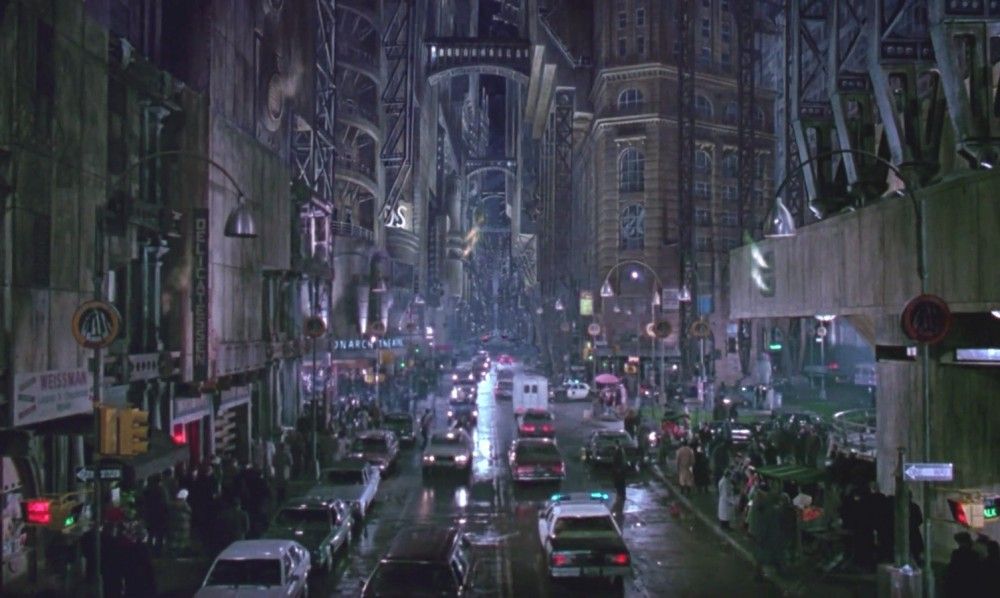
One of Anton Furst’s designs for Batman.

For me, one of the most interesting elements of Tim Burton’s Batman is how Jack Nicholson was the main draw for the film. Nicholson stands front and center in this film. If any real eyebrows were raised, it was over casting Michael Keaton as the Dark Knight. Keaton and Burton worked together on Beetlejuice, so there was some chemistry. However, when the announcement for Keaton being cast in Batman, most people were pretty skeptical. Keaton was known for playing more comedic roles, and playing the Batman required a more serious attitude. However, I’ve always felt that comedians are the most shocking when they take on a serious role. Some examples of this are Patton Oswalt in Big Fan, Robin Williams’ Academy Award winning performance in Good Will Hunting and most recently, Adam Sandler in Uncut Gems. I feel that worked for Keaton, and most viewers underestimated what he could bring to both Bruce Wayne and Batman. As Wayne, Keaton seems a bit subdued. As Batman, he’s a little scary simply because he doesn’t quite look like the kind of individual who would roam the streets at night dressed as a bat. My parents would later argue over Batman’s drop of Jack Napier at Axis Chemicals. I thought it was a situation where he just couldn’t hold on to him. My parents’ viewpoint was that Batman deliberately did it. We never really know for sure, but it did seem a little convenient that Batman couldn’t hold on to Napier. Overall, Keaton’s Batman plays second fiddle to Nicholson’s Joker, who also had a some sway in the design of the nemesis for the film.

Batman’s cast also includes Kim Basinger (L.A. Confidential) as Vicki Vale, Robert Wuhl (Bull Durham), Billy Dee Williams (Nighthawks) and Pat Hingle (Sudden Impact) as Commissioner Gordon, The cast is pretty perfect here, without anyone really falling out of step. Batman stories would grow more serious by the time Nolan would step in, but for the 1980s, it was just fine.

Anton Furst would win an Oscar for Best Art Direction for his design of Gotham City, which was for its time, quite dazzling. On par with some of the designs from Blade Runner and The Crow, Furst’s rendition of Gotham was dark and brooding, compared to the more modern backdrop of Batman Begins. In addition to Gotham’s look, Furst also helped design the Batmobile, which was based off the Chevy Impala (another Supernatural connection). When the film was released on home video, my family caught sight of the Batmobile up close on the street as it delivered VHS Copies to a video store in Manhattan. Although he died some years later, Furst’s work on Batman remains an influence on both the comics and future installments of the movies.

1989 was also a big year for Danny Elfman. His score for Batman would earn him a Grammy, and the main theme would become a definitive one for the Caped Crusader throughout the early 1990. Shirley Walker would build on the theme with her music from Batman: The Animated Series. It was also something of a surprise for Prince. With songs like Trust, Electric Chair and Vicki’s Waiting, Prince’s Batman Soundtrack is full of great hits that you really wouldn’t think would fit in a story like Batman. Still, they manage to do just fine, and even elevate scenes like the Joker’s entry in the Gotham Museum and the Balloon Parade.

Batman is not without a few problems. It gets a little long in the tooth in the film’s second half, particularly in the scenes leading up to the Monarch and Bruce losing his parents. It’s not a terrible slowdown, since it has to set the tone for some of the more spectacular fights later on. It could have been edited just a little tighter. Additionally, when compared to some of the modern versions, 1989’s Batman can feel a little bit dated (to me, anyway). That’s more of a nitpick, or where you stand on the Batman universe as a whole. Everyone has their favorite adaptation on the Caped Crusader.

Burton and Keaton would later reunite in 1992’s Batman Returns, and the franchise on a whole would take a different turn with Joel Schumacher’s takes in 1995’s Batman Forever and 1997 Batman & Robin. 
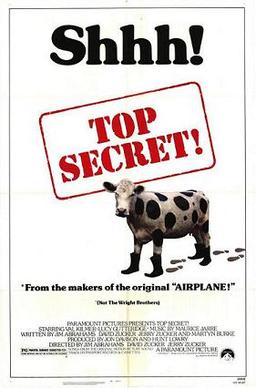
Spring Breakdown: Top Secret! (dir by Jim Abrahams, David Zucker, and Jerry Zucker)


“How silly can you get?” Val Kilmer sings in the 1984 film Top Secret! and the answer would appear to be very silly.  Extremely silly.  Nonsensically silly.  Unbelievable silly.  So silly that it transcends all formerly known types of silliness.  In other words, this is a very silly film but that’s okay because it’s meant to be silly.

Some people, I know, would probably argue that Top Secret! doesn’t really qualify as a Spring Break film but I have to disagree.  Like any good Spring Break film, a good deal of Top Secret! takes place on the beach and Val Kilmer plays Nick Rivers, a singer who is obviously meant to be a parody of the type of singers who used to regularly appear in the beach party movies of the 60s.  Nick’s number one hit song is Skeet Surfin, which celebrates the sport of skeet shooting while on a surf board.  The movie opens with hundreds of handsome young men jumping on surf boards while holding rifles.  I honestly don’t know whether skeet surfing was every an actual sport but I certainly hope that it was because it looks like it would have been a lot of fun.  Certainly, it would perk up the Olympics.

Of course, Nick is not the only person in the film whose life is connected to the beach.  Hillary Flammond (Lucy Gutteridge) spent much of her youth shipwrecked on a beach with Nigel (Christopher Villiers).  Unfortunately, one day, Nigel went out to sea to search for help and he never returned.  Hillary was eventually rescued.  That’s certainly a sadder trip to the beach than Nick’s but still, a beach is a beach.

Hillary and Nick’s paths cross when Nick is invited to perform at a cultural festival in what, in 1984, was known was East Germany.  Hillary is a member of the Resistance while her father, Dr. Paul Flammond (Michael Gough), is being held prisoner by the government and is being forced to design the type of secret weapons that are always at the heart of espionage adventures like this one.  When Nick and Hillary meet, it’s love at first sight.  Nick gets involved in the plan to save Hillary’s father and to thwart the insidious plans of the East German government.  He also finds the time to sing a lot of songs.

The plot of Top Secret! isn’t really easy to describe.  That’s largely because there really isn’t a plot in a conventional sense.  Instead, there’s just one joke after another.  The dialogue is purposefully nonsensical.  The visuals are full of odd details.  The jokes are frequently hilarious and, because they’re so fast and relentless, they’re also next to impossible to adequately describe.  Much of the visual humor simply has to be seen to be understood and appreciated.  For instance, it may sound slightly humorous to say that a scene features a stern-looking army officer answering a giant phone but you have to actually see the film to truly understand just how brilliantly Top Secret! pulls off the gag.

Of course, what really makes the film is work is Val Kilmer, who is young, handsome, and incredibly likable in the role of Nick.  Kilmer delivers every bizarre line with a straight face and an enthusiastic earnestness that makes him the perfect center for all the craziness raging around him.

How silly can you get?  Watch Top Secret! and find out!

Julius Caesar (1970, directed by Stuart Burge)


In ancient Rome, under the direction of Cassius (Richard Johnson), several members of the Senate conspire to kill Julius Caesar (John Gielgud), believing that his death is the only way to preserve the Republic.  Even Caesar’s longtime friend, Brutus (Jason Robards), is brought into the conspiracy.  Unfortunately for the conspirators, after Caesar’s murder, Mark Antony (Charlton Heston) gives his famous speech asking the Romans to lend him their ears and the Roman citizens turn against Caesar’s murderers and instead look to Antony and Octavius (Richard Chamberlain) to lead them.

This was the first adaptation of William Shakespeare’s play to be filmed in color and the assassination of Caesar was portrayed much more graphically than in previous productions.  By the end of the attack, Caesar has been stabbed so many times and there’s so much blood on screen that it doesn’t seem like he should even have the strength to say, “Et tu, Brute?”  Despite the then-modern innovations, this version still feels creaky and stiff.  When Caesar makes his appearance on the Ides of March, all of the conspirators actually stand in a neat line while Caesar enters the Senate.  When Mark Anthony and Brutus make their speeches, the extras playing the Roman citizens looked bored and disinterested.

For most viewers, the appeal of this version of Julius Caesar will be for the cast, which was considered to be all-star in 1970.  Along with Gielgud, Robards, Heston, Johnson, and Chamberlain, the cast also features Robert Vaughn as Casca, Christopher Lee as Artemidorous, Jill Bennett as Calpurnia, and Diana Rigg as Portia.  Surprisingly, it’s Jason Robards, the Broadway veteran, who struggles with Shakespeare’s dialogue, delivering his lines flatly and without much emotion.  Meanwhile, Charlton Heston steals the entire film as Mark Antony, nailing Antony’s funeral oration and proving himself to be much more clever than the conspirators had originally assumed.  (Of course, Mark Antony was the Charlton Heston of his day so I guess it shouldn’t be too much of a surprise that Heston is perfect in the role.)  I also liked Diana Rigg’s performance in the small role of Portia and Robert Vaughn’s devious interpretation of Casca.

Though he plays Caesar here, John Gielgud previously played Cassius in the 1953 version of Julius Caesar, the one with James Mason and Marlon Brando.  That is still the version to watch if you want to see the definitive adaptation of Julius Caesar.

Horror On The Lens: The Haunting of Helen Walker (dir by Tom McLoughlin)


Stop me if this sounds familiar.

In Victorian-era England, a somewhat neurotic young woman is hired to serve as the governess for two children who live in a foreboding estate. Once the governess arrives, she discovers that the children — especially little Miles — can be a handful. She also discovers that there was a governess hired before her, a governess who died under mysterious circumstances. At night, the new governess hears strange noises and soon, she becomes convinced that she’s seen the ghosts of both her predecessor and the old governess’s lover, Peter Quint. Everyone else may think that the new governess has allowed the isolation of the estate to get to her but she’s convinced that the ghosts have possessed the children! She becomes determined to save the children, even at the risk of their own lives….

If that sounds familiar, then you’ve either read Henry James’ Turn of the Screw or you’ve seen one of the several movies that were based on his novella. The Haunting of Helen Walker, which was made-for-television and initially broadcast in 1995, reimagines James’s unnamed governess as Helen Walker, an American woman played by Valerie Bertinelli.

Now, The Haunting of Helen Walker does take some liberties with Henry James’s source material.  The novella was a masterpiece of ambiguity.  The Haunting of Helen Walker is …. less so.  Let’s just say this version doesn’t leave much doubt as to whether or not there’s actually ghosts in the mansion.  That said, it’s still an entertaining made-for-TV movie.

Check out my full review here and watch the film below.

Enjoy!

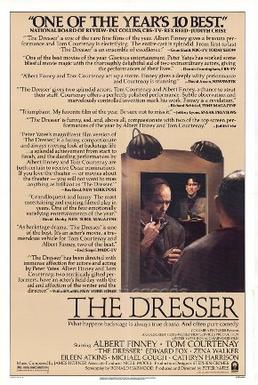
Lisa Reviews An Oscar Nominee: The Dresser (dir by Peter Yates)


(With the Oscars scheduled to be awarded on March 4th, I have decided to review at least one Oscar-nominated film a day.  These films could be nominees or they could be winners.  They could be from this year’s Oscars or they could be a previous year’s nominee!  We’ll see how things play out.  Today, I take a look at the 1983 best picture nominee, The Dresser!)

Taking place during World War II, The Dresser is a story of the theater.

Sir (played by Albert Finney) was once a great and famous Shakespearean actor but that was a long time ago.  Now, he is reduced to playing in regional theaters, traveling across Britain with a company made up of a motley collection of forgotten has-beens and never-weres.  He can still draw an audience, one made up of elderly theater goers who remember seeing him in London and people who are merely looking for a distraction from the war.  While bombs echo outside, Sir alternates between playing Othello and King Lear.  Backstage, Sir talks about the memoir he’s going to write and barks out orders to the members of his company.

Though Sir’s overly florid style of acting may seem old-fashioned, there’s no denying that his talent.  We don’t see much of his performance but, when we do see him, we never doubt his claim that he was once declared to the greatest King Lear to have ever appeared on the British stage.  Onstage, Sir is in complete control.  Offstage, he often struggles to remember where he is or what play he’s going to be performing.  At one point, when he’s meant to be getting ready to play Lear, he puts on his Othello makeup.

Fortunately, Sir has a dresser.  Norman (Tom Courtenay) doesn’t appear to have much of a life outside of taking care of Sir’s every whim.  Perpetually high-strung but blessed with a biting wit and an all-important bottle of Brandy that he takes a drink from whenever Sir gets too difficult to deal with, Norman is the one who holds the theatrical company together and who, most importantly, protects Sir.  When Sir can’t remember who he’s playing, Norman reminds him.  When Sir harasses a young actress, Norman is the one who hushes it up.  When Sir insults another actor (Edward Fox), Norman is the one who brokers a peace.  When it’s time for Sir to play King Lear, Norman is the one who helps Sir to transform into Shakespeare’s most tragic monarch.  Neither Sir nor the rest of the acting company seems to have much respect for Norman. The other actors consider Norman to be an ass-kisser and Sir … well, Sir doesn’t have much respect for anyone.  But for Norman, a gay man living at a time when homosexuality was illegal in Britain, Sir’s theatrical company provides him with the only safe place he’ll ever find.

The Dresser is an adaptation of a stage play.  (A few years ago, another version was produced for the BBC with Ian McKellen as Norman and Anthony Hopkins as Sir.)  It’s a good film, though I imagine that it’ll be best appreciated by people who have actually worked in theater.  Finney and Courtenay are both great and I also liked the performance of Edward Fox.  That said, it’s definitely a filmed play the feels more appropriate for PBS than for a movie screen.  As a result, it seems to be a bit of an odd pick for a Best Picture nomination.  I imagine that, much like Birdman, it benefitted from being a movie about actors and performing.

The Dresser lost Best Picture to Terms of Endearment.  It’s still worth seeing, if just for Courtenay’s final monologue.

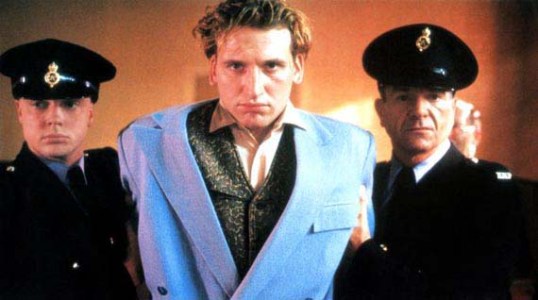
A Movie A Day #44: Let Him Have It (1991, directed by Peter Medak)


The year is 1953.  The place is Croydon.  Derek Bentley (Christopher Eccleston) is 19 years old but has the mental capability of an 11 year-old.  Unable to hold down a job and judged unfit for the national service, Derek drifts into a gang led by 16 year-old Christopher Craig (Paul Reynolds).  When Derek and Craig are caught burglarizing a warehouse, it leads to a tense rooftop confrontation between Craig and the police.  Derek has already been captured by the time that the police demand that Craig hand over his gun.  Bentley shouts, “Let him have it, Chris!”  Craig opens fire, killing one officer.

Because he’s a minor, Craig is only facing a prison sentence for killing the police officer.  But, as a legal (if not mental) adult, Derek will be hung if he’s found guilty.  Under the common purpose doctrine, it doesn’t matter that Derek didn’t actually shoot the gun.  The only thing that matters is what Derek meant when he said, “Let him have it, Chris!”  Derek says that he was telling Craig to hand over his gun.  The Crown says that Derek was ordering Craig to open fire.

Let Him Have It is based on a true story.  The case of Derek Bentley was one of the many cases that eventually led to the death penalty being abolished in the UK.  Let Him Have It was released at the height of a long campaign to secure a pardon for Derek.  That pardon was finally issued in 1998, though it was too late to help Derek Bentley.

Let Him Have It is a powerful and angry docudrama, one that reveals in searing detail how Derek was railroaded by the British legal system.  In his film debut, Eccleston gives a powerful performance as Derek and he is ably supported by both Paul Reynolds and, in the role of Derek’s father, Tom Courtenay.  Let Him Have It leaves little doubt as to why the case of Derek Bentley remained a cause célèbre for 45 years after his initial trial.

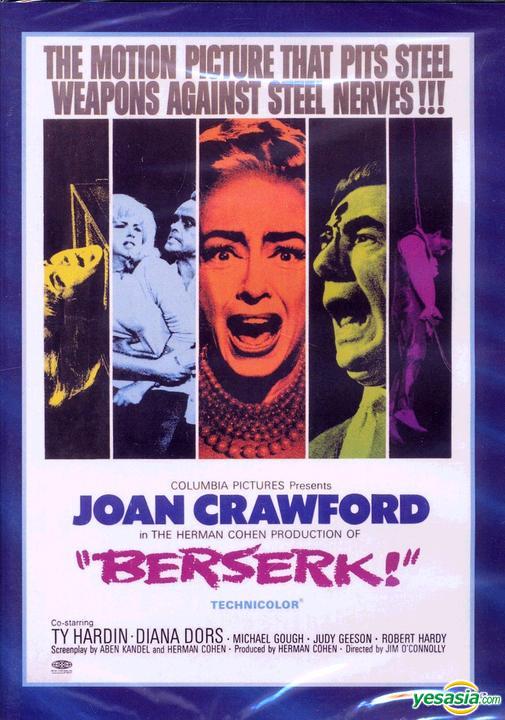
Halloween Havoc!: Joan Crawford in BERSERK (Columbia 1967)


gary loggins's avatarcracked rear viewer

berserk1

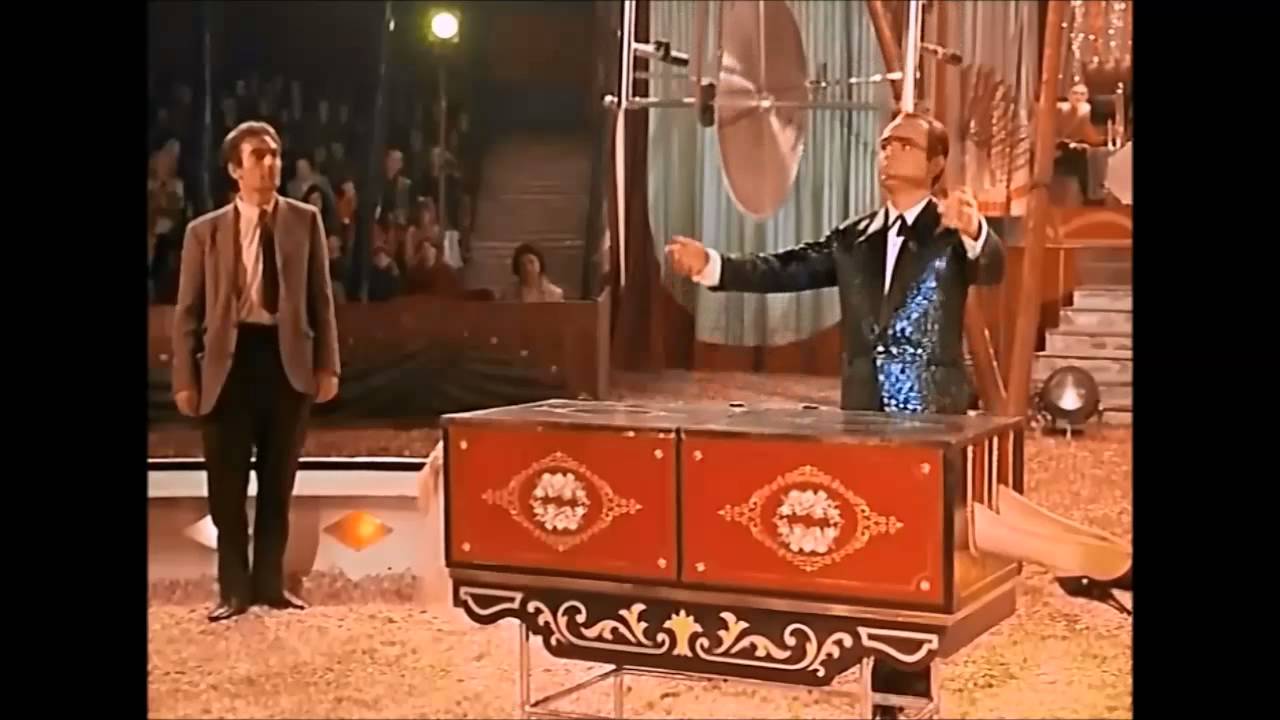
Last year I looked at Joan Crawford’s final film  TROG  during “Halloween Havoc” month, where she played an anthropologist.  This time around, Joan stars in her first movie for schlockmeister Herman Cohen, BERSERK, in which she’s in a more believable role as a circus owner/ringmaster whose big top is plagued by a series of gruesome murders.

berserk2

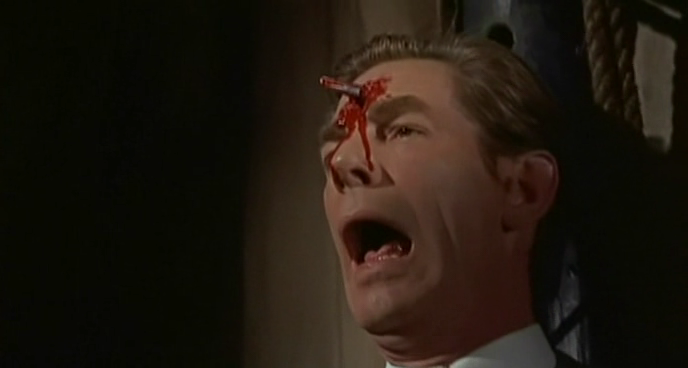
The film starts off with the grisly death of high wire artist Gaspar the Great, whose tightrope breaks, causing him to die from hanging. Frank Hawkins, better known as The Magnificent Hawkins, arrives soon after and replaces Gaspar with his own death-defying act, walking the tightrope while blindfolded over a row of steel spikes. Circus owner Monica Rivers loves the publicity from Gaspar’s demise, which turns off her lover/business partner Durando. Soon Monica takes up with Frank, and Durando winds up with a spike driven through his head!

berserk3

The circus acts think there’s a madman among them…

View original post 293 more words

GODS OF THE HAMMER FILMS 2: Peter Cushing, Christopher Lee, and HORROR OF DRACULA (1958)


gary loggins's avatarcracked rear viewer

hor drac4

(second of a series)

Hammer Films Ltd. knew they were on to something with the release of 1957’s THE CURSE OF FRANKENSTEIN. The Gothic horror was box office gold on both sides of the Atlantic, and Hammer wasted no time finding a follow up. Reuniting CURSE OF FRANKENSTEIN costars Peter Cushing and Christopher Lee with director Terence Fisher, the company set its sights on giving the full Eastmancolor treatment to Bram Stoker’s immortal Count Dracula.

View original post 554 more words

Horror Film Review Repost: The Horror of Dracula (dir by Terrence Fisher)


(As some of our longtime readers might remember, I originally posted this review on October 11th, 2013.  I’m going to be posting reviews of all of the Hammer Dracula films today so I figured I would start things off by reposting my thoughts on the very first of them, 1958’s Horror of Dracula.  Add to that, I happen to really like this review!)

horrorofdracula

Of all the monsters who have appeared in horror cinema, Count Dracula is perhaps the most iconic.  Reportedly, Dracula first appeared on film in 1920, in a silent Russian film that is now considered to be lost.  In 1921, he would appear in a Hungarian film called Dracula’s Death and in 1922, he would be renamed Count Orlok for the German masterpiece Nosferatu.  Indeed, by the time Bela Lugosi gave his famous performance in Tod Browning’s Dracula, the count had been appearing in films for at least 11 years.  In nearly 100 years of filmmaking, a countless number of actors have brought Dracula to life.

We could spend hours debating who was the best Dracula and certainly, there are some worthy contenders.  Bela Lugosi brought a continental sophistication to the role, while John Carradine was properly intimidating and theatrical.  Udo Kier, Gary Oldman, Thomas Kretschmann, Leslie Neilsen, Zandor Vorkov, and Frank Langella have all played the prince of darkness, to varying degrees of success.

Yet for me, as worthy as any of those actors may be, there is only one true Dracula and he was played by Christopher Lee.

Lee famously played Dracula in seven movies for Hammer Films and, though he has often complained about the quality of these films (especially the later ones, which tended to mix Dracula with hippies), they were largely responsible for making Christopher Lee into the iconic figure that he remains today.  It’s also largely due to Lee’s performance that horror fans like me continue to discover and appreciate the films of Hammer today.

As played by Christopher Lee, Dracula was pure evil.  Lee’s Dracula had no use for self-pity and one can only imagine what his reaction would have been if he had ever run into the self-torturing vampires of Twilight.  Lee’s Dracula had no use for doubt or regret.  Instead, he was a determined animal who was driven by a singular lust for blood.

And yet, at the same time, Lee brought an intelligence to the role that was often lacking in previous performances.  Lee’s Dracula may have been an animal but he was a cunning animal.  Whereas it’s easy for me to imagine escaping from the clutches of Bela Lugosi, I know that if Lee’s Dracula wanted me then he would have me.  There’s no escape from Lee’s Dracula.  He’s too quick, determined, and intelligent.

Christopher Lee Is Dracula

His animal nature made Lee’s Dracula frightening but it was his cunning and determination that made him dangerous and, ultimately, even sexy.  (While I’ve read that audiences in 1931 swooned over Bela Lugosi, whatever sex  appeal he may have had is lost on modern viewers like me.)  It has often been argued that Bram Stoker meant for Dracula to be a symbol of all the desires that were repressed by Victorian society.   That’s certainly true when it comes to Christopher Lee’s carnal and viscous portrayal of the character.

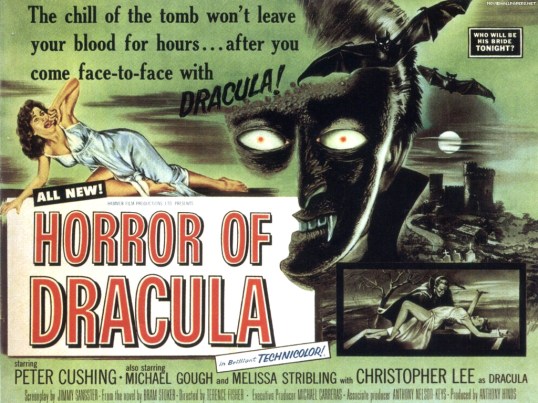
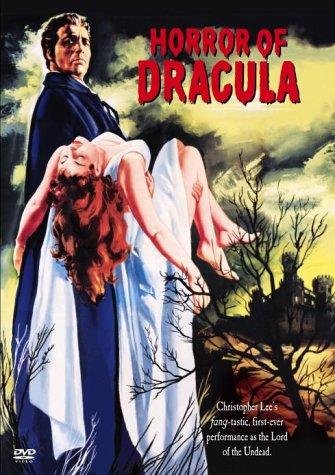
Of the seven Dracula films that Christopher Lee made for Hammer Films, the first remains the best.  Released in 1958 and known as Dracula in the UK and the Horror of Dracula in the US,  it revitalized the horror genre and helped to make stars of both Christopher Lee and Peter Cushing.  Especially when compared to some of the sequels that Hammer subsequently produced, it remains one of the best Dracula films ever made.

Horror of Dracula

The film is a very loose adaptation of Stoker’s original novel.  Jonathan Harker comes to Dracula’s castle in Romania.  Though posing as a librarian, Harker has actually come to the castle to drive a stake through the heart of both Dracula and his vampire bride.  However, no sooner has Harker staked the bride than he’s overpowered and bitten by Dracula.  Significantly, all of this occurs within the first 10 minutes of the film.  As opposed to certain other Dracula films, Horror of Dracula gets straight to the point.  And why shouldn’t it?  After all, anyone watching the film already knows that Dracula’s a vampire so why waste time trying to convince us otherwise?  We don’t watch Dracula for the familiar story as much as we watch to discover how different filmmakers will choose to tell that story.

When Harker’s colleague, Prof. Van Helsing (played with the perfect amount of intensity by Peter Cushing) shows up at the castle, he discovers that Harker is now a vampire and that Dracula is nowhere to be found.

Dracula, needless to say, is out for revenge.  He stalks Harker’s fiancee Lucy, as well as Lucy’s brother Arthur Holmwood (Michael Gough) and his wife Mina (Melissa Stribling).  Much as in Stoker’s original novel, Lucy is eventually turned into a vampire and it’s up to Van Helsing and Arthur to stop both her and her new master.

(Of course, in Stoker’s original novel, Harker is not turned into a vampire and instead marries Mina while the aristocratic Arthur is one of Lucy’s three suitors.  However, I have to say that I always thought the literary Harker was a bit on the dull side and that Arthur was always my favorite character so I’m happy that he gets to be the hero here.)

If I had to pick one film to epitomize everything that I love about the Hammer brand of horror, it would be Horror of Dracula.  As directed by Terrence Fisher, the film moves at an exciting, non-stop pace while the traditionally lush cinematography is almost bombastically colorful.  Cushing and Lee, who were the best of friends off screen, make for formidable opponents, with Cushing embodying good just as effective as Lee embodied evil.  Though it’s been over 50 years since Horror of Dracula was originally released, the film remains effective and, not coincidentally, a lot of fun.

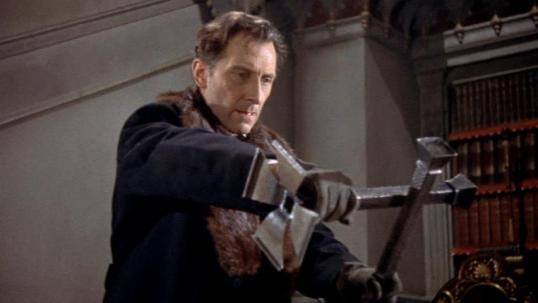
Peter Cushing as Dr. Van Helsing

Quite simply put, this is a film that, for so many reasons, remains a true pleasure to watch.

One final note — I often find myself lamenting that I was born several decades too late and I realize just how true that is whenever I watch a film like Horror of Dracula.  Seriously, I would have loved to have been a Hammer girl, showing off my cleavage and getting hypnotized by Christopher Lee.

Seriously, what more could you want?

Horror Film Review: Horror of Dracula (dir by Terrence Fisher)


horrorofdracula
Of all the monsters who have appeared in horror cinema, Count Dracula is perhaps the most iconic.  Reportedly, Dracula first appeared on film in 1920, in a silent Russian film that is now considered to be lost.  In 1921, he would appear in a Hungarian film called Dracula’s Death and in 1922, he would be renamed Count Orlok for the German masterpiece Nosferatu.  Indeed, by the time Bela Lugosi gave his famous performance in Tod Browning’s Dracula, the count had been appearing in films for at least 11 years.  In nearly 100 years of filmmaking, a countless number of actors have brought Dracula to life.

We could spend hours debating who was the best Dracula and certainly, there are some worthy contenders.  Bela Lugosi brought a continental sophistication to the role, while John Carradine was properly intimidating and theatrical.  Udo Kier, Gary Oldman, Thomas Kretschmann, Leslie Neilsen, Zandor Vorkov, and Frank Langella have all played the prince of darkness, to varying degrees of success.

Yet for me, as worthy as any of those actors may be, there is only one true Dracula and he was played by Christopher Lee.

Lee famously played Dracula in seven movies for Hammer Films and, though he has often complained about the quality of these films (especially the later ones, which tended to mix Dracula with hippies), they were largely responsible for making Christopher Lee into the iconic figure that he remains today.  It’s also largely due to Lee’s performance that horror fans like me continue to discover and appreciate the films of Hammer today.

As played by Christopher Lee, Dracula was pure evil.  Lee’s Dracula had no use for self-pity and one can only imagine what his reaction would have been if he had ever run into the self-torturing vampires of Twilight.  Lee’s Dracula had no use for doubt or regret.  Instead, he was a determined animal who was driven by a singular lust for blood.

And yet, at the same time, Lee brought an intelligence to the role that was often lacking in previous performances.  Lee’s Dracula may have been an animal but he was a cunning animal.  Whereas it’s easy for me to imagine escaping from the clutches of Bela Lugosi, I know that if Lee’s Dracula wanted me then he would have me.  There’s no escape from Lee’s Dracula.  He’s too quick, determined, and intelligent.

Christopher Lee Is Dracula

His animal nature made Lee’s Dracula frightening but it was his cunning and determination that made him dangerous and, ultimately, even sexy.  (While I’ve read that audiences in 1931 swooned over Bela Lugosi, whatever sex  appeal he may have had is lost on modern viewers like me.)  It has often been argued that Bram Stoker meant for Dracula to be a symbol of all the desires that were repressed by Victorian society.   That’s certainly true when it comes to Christopher Lee’s carnal and viscous portrayal of the character.

Of the seven Dracula films that Christopher Lee made for Hammer Films, the first remains the best.  Released in 1958 and known as Dracula in the UK and the Horror of Dracula in the US,  it revitalized the horror genre and helped to make stars of both Christopher Lee and Peter Cushing.  Especially when compared to some of the sequels that Hammer subsequently produced, it remains one of the best Dracula films ever made.

Horror of Dracula

The film is a very loose adaptation of Stoker’s original novel.  Jonathan Harker comes to Dracula’s castle in Romania.  Though posing as a librarian, Harker has actually come to the castle to drive a stake through the heart of both Dracula and his vampire bride.  However, no sooner has Harker staked the bride than he’s overpowered and bitten by Dracula.  Significantly, all of this occurs within the first 10 minutes of the film.  As opposed to certain other Dracula films, Horror of Dracula gets straight to the point.  And why shouldn’t it?  After all, anyone watching the film already knows that Dracula’s a vampire so why waste time trying to convince us otherwise?  We don’t watch Dracula for the familiar story as much as we watch to discover how different filmmakers will choose to tell that story.

When Harker’s colleague, Prof. Van Helsing (played with the perfect amount of intensity by Peter Cushing) shows up at the castle, he discovers that Harker is now a vampire and that Dracula is nowhere to be found.

Dracula, needless to say, is out for revenge.  He stalks Harker’s fiancee Lucy, as well as Lucy’s brother Arthur Holmwood (Michael Gough) and his wife Mina (Melissa Stribling).  Much as in Stoker’s original novel, Lucy is eventually turned into a vampire and it’s up to Van Helsing and Arthur to stop both her and her new master.

(Of course, in Stoker’s original novel, Harker is not turned into a vampire and instead marries Mina while the aristocratic Arthur is one of Lucy’s three suitors.  However, I have to say that I always thought the literary Harker was a bit on the dull side and that Arthur was always my favorite character so I’m happy that he gets to be the hero here.)

If I had to pick one film to epitomize everything that I love about the Hammer brand of horror, it would be Horror of Dracula.  As directed by Terrence Fisher, the film moves at an exciting, non-stop pace while the traditionally lush cinematography is almost bombastically colorful.  Cushing and Lee, who were the best of friends off screen, make for formidable opponents, with Cushing embodying good just as effective as Lee embodied evil.  Though it’s been over 50 years since Horror of Dracula was originally released, the film remains effective and, not coincidentally, a lot of fun.

Peter Cushing as Dr. Van Helsing

Quite simply put, this is a film that, for so many reasons, remains a true pleasure to watch.

One final note — I often find myself lamenting that I was born several decades too late and I realize just how true that is whenever I watch a film like Horror of Dracula.  Seriously, I would have loved to have been a Hammer girl, showing off my cleavage and getting hypnotized by Christopher Lee.

Seriously, what more could you want?