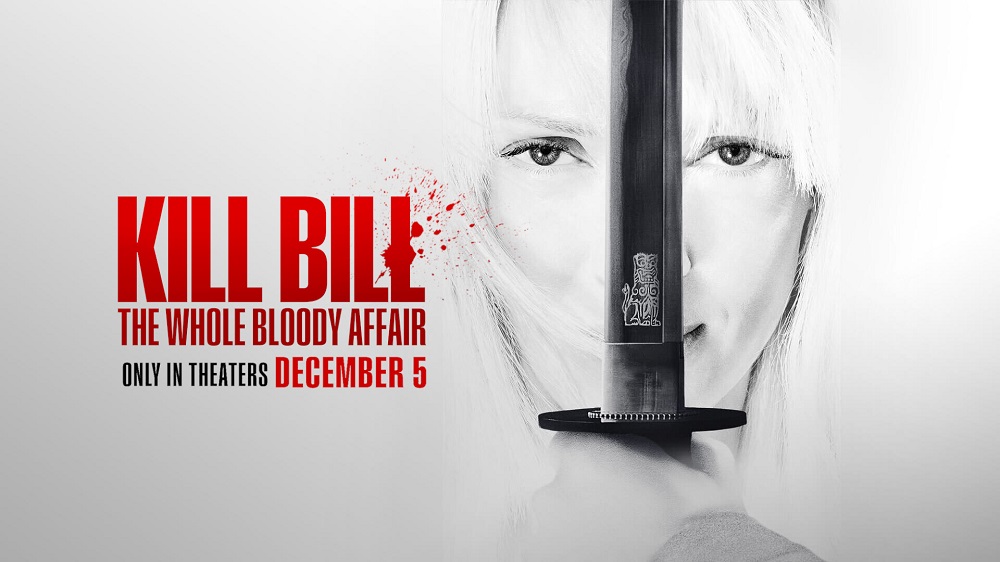
Brad’s thoughts on KILL BILL: THE WHOLE BLOODY AFFAIR!


Anything new from Quentin Tarantino is a big deal at my house. When you consider that it’s been over six years since the auteur released his most recent film, ONCE UPON A TIME IN HOLLYWOOD (2019), I was understandably excited when I saw that the full “extended cut” version of the KILL BILL films, dubbed “The Whole Bloody Affair” was being released to theaters. Then, after seeing the trailer, I became really curious about the new scenes that were added, as well as the different presentations of the previous material. When I originally watched the separate volumes at the movie theater in 2003 and 2004, I enjoyed the first movie slightly more than the second based on the fact that it had more action. Now, I wanted to see how the two volumes flowed as one single film. My wife was working this weekend, so I had some time on my hands and decided to spend about four hours of that time watching KILL BILL: THE WHOLE BLOODY AFFAIR.

First, a quick summary of the film… on the eve of her wedding, a pregnant bride-to-be (Uma Thurman) and her entire wedding party is gunned down by the Deadly Viper Assassination Squad, commanded by her former lover, Bill (David Carradine). Somehow surviving the rehearsal massacre, the Bride, who was once a member of the same assassination squad, sets her sights for revenge on each of the members, beginning with O’Ren Ishii (Lucy Liu), and then moving on to Vernita Green (Vivica A. Fox), Budd (Michael Madsen), Elle Driver (Daryl Hannah), and finally Bill himself. It’s a simple premise, but Tarantino uses that premise as a springboard to share his love of kung fu movies, samurai cinema, spaghetti westerns and grind house fare and create something truly special. I loved the KILL BILL films when they were originally released, and the four hours seemed to go by very quickly today as I had a blast watching this definitive version with a relatively full theater of fans.

After watching KILL BILL: THE WHOLE BLOODY AFFAIR, my first thought is that it wouldn’t be that different if the theater just showed Volume One, had a 15-minute intermission, and then showed Volume Two. This isn’t putting down the new version in any way, but there are not a large number of changes that enhance the overall quality of the film itself, and screening the original volumes back-to-back would provide the context for the “big picture” of the story that was lacking when the movies were released in the separate years of 2003 and 2004. With that said, watching the film in this new version was a lot of fun for me, and it should become the norm moving forward as it is truly Tarantino’s vision. It does flow better, mainly by eliminating the unnecessary, late cliffhanger reveal of the daughter in Volume One, as well as the Bride’s “direct to the camera” update at the beginning of Volume Two.

For those who want to go see this new version, I did want to point out the significant differences I noticed while viewing KILL BILL: THE WHOLE BLOODY AFFAIR. The first sequence where I noticed obvious additions to the film occurred in the anime sequence that introduces the background of O’Ren Ishii. This extended version adds additional footage of the Yakuza assassin Pretty Riki to the sequence, and once O’Ren is a slightly older schoolgirl, we get to see her execute a plan of vengeance against him. I would guess somewhere between five and ten minutes of action was added to the sequence. I enjoyed it in Volume One, and I also enjoyed the extended anime sequence in this new version. Does the sequence really add to the overall quality of the film, though? Even though I enjoyed the new material and am glad it was added, I would say no. The next significant difference I noticed with this version concerns the addition of color to the fight sequence between the Bride and the crazy 88’s in the House of Blue Leaves, as compared to the sequence in Volume One that was shown largely in black and white. As a person who doesn’t enjoy a lot of gore in my movies, it never bothered me that the scene switched from color to black and white once the limbs and heads started getting lopped off. With that said, it was kind of fun watching all those limbs hacked off in glorious color this time around. Finally, there is a post-credits animated sequence called “The Lost Chapter: Yuki’s Revenge” where Gogo Yubari’s twin sister tries to get revenge on the Bride. It lasts about ten minutes or so, but honestly, it didn’t add much to the overall experience for me, and I doubt I’ll ever watch it again. As a completist though, I am glad that I stuck around and watched it. These are the only big changes I noticed while watching THE WHOLE BLOODY AFFAIR. I’m sure there had to be some more changes, but I don’t think they were significant. 

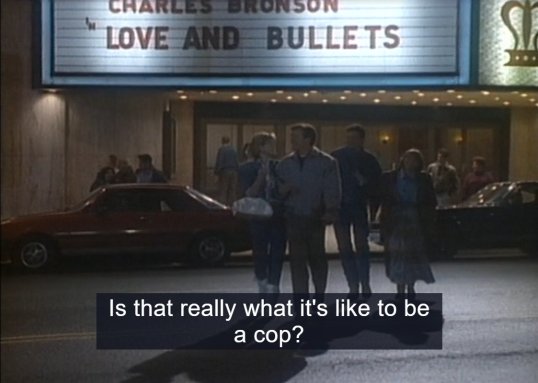
I did want to share some final thoughts I had while watching KILL BILL: THE WHOLE BLOODY AFFAIR this afternoon. I noticed on the opening title card that the movie is dedicated to the great Japanese director Kinji Fukasaku, and you can definitely see his influence all over this film. It also affected me more watching Michael Madsen’s excellent performance as Bill’s brother Budd. Tarantino just knows how to get the best out of Madsen, and considering that he passed away a few months ago, I just really appreciated his work while watching the film. I also enjoyed the multiple shoutouts to my movie hero Charles Bronson in the film. First, there’s a MR. MAJESTYK poster hanging on the wall in Budd’s trailer that is featured often throughout the various shenanigans and fights that take place in the trailer. Second, Charles Bronson passed away in 2003, the year that Volume One of KILL BILL was released. In the final credits of the film, Bronson receives an RIP credit. I’ve always loved the fact that Tarantino loves Charles Bronson, and that’s on full display in KILL BILL: THE WHOLE BLOODY AFFAIR. I would have given anything if Bronson had been in better health as Tarantino was coming into his own as a filmmaker. I have no doubt that he would have been offered a chance to appear in one of the director’s films.

At the end of the day, I had a great time watching KILL BILL: THE WHOLE BLOODY AFFAIR. The four hours flew by, and I truly appreciated seeing Tarantino’s full vision realized on screen. While I do think this should be the definitive version moving forward, I loved the KILL BILL films before today. THE WHOLE BLOODY AFFAIR improves the overall flow of the film and adds some fun new stuff, but my love for the film didn’t really change that much today… it just runs a tad bit deeper.

October True Crime: Murder So Sweet (dir by Larry Peerce)


1993’s Murder So Sweet, also known a Poisoned By The Love: The Kern County Murders (seriously, try to say that ten times fast), tells the story of Steven David Catlin.

Steven David Catlin lived in Bakersfield, California.  Catlin was a career criminal who was married six times and who found some personal redemption for himself as a member of the pit crew for a professional race car driver in Fresno.  Trust me, I’ve lived in enough small, country towns to know that people will overlook a lot as long as someone knows how to work on a car.

One thing that people noticed about Catlin is that the people around him had a habit of dying of mysterious illnesses.  Multiple wives, his adoptive parents, they all died with fluid in their lungs and they left behind not only a medical mystery but also quite a bit of money for Steven David Catlin.  Catlin would always insist on holding a cremation just days after his loved ones passed away.  Not only did that allow Catlin to move on but also kept anyone from being able to do a thorough autopsy.

Eventually, the police figured out that Catlin was just poisoning anyone who got on his nerves or threatened to divorce him.  He wasn’t even a particularly clever poisoner.  He used paraquet, a highly toxic herbicide and he kept the bottle sitting in plain view in his garage.  He might as well have just labeled it his “Poisoning Thermos.”  Catlin was convicted of multiple murders and he was sentenced to die in 1990.  Of course, this being California, Catlin is sill alive and sitting in San Quentin.  This really is a case of “If you lived in Texas, you’d be dead by now.”

In Murder My Sweet, Catlin is played Harry Hamlin, who steals the film as a dumb but charming redneck who walks with a confident swagger and has no fear of hitting on his ex-wife, even after he realizes that she’s trying to convince the police that he’s a murderer.  Helen Shaver played Edie Bellew, the ex who knows better than to trust Catlin.  Her current husband is played by Terence Knox and there’s plenty of scenes of him telling Edie that she needs to back off and that everyone knows that Steve Catlin isn’t a murderer.  In many ways, this is the ultimate Lifetime film in that Edie Bellew not only gets to put her ex-husband in prison but she also proves that her current husband doesn’t know what he’s talking about.

Murder My Sweet takes place in rural California and, as a result, everyone in the film speaks with a shrill country accent and we spend a lot of time in a really tacky beauty parlor.  Indeed, the film portrayal of country eccentricity is so over-the-top that I was tempted to say that it seemed as if the director was trying to rip-off David Lynch.  However, Lynch may have made films about eccentric characters but he never portrayed them as being caricatures.  Lynch loved his eccentrics while this film takes a bit of a condescending attitude towards them.  Still, it’s worth watching for Harry Hamlin’s sleazy turn as Steve Catlin, a guy who enjoys fast cars and making ice cream.

Just don’t eat that ice cream….

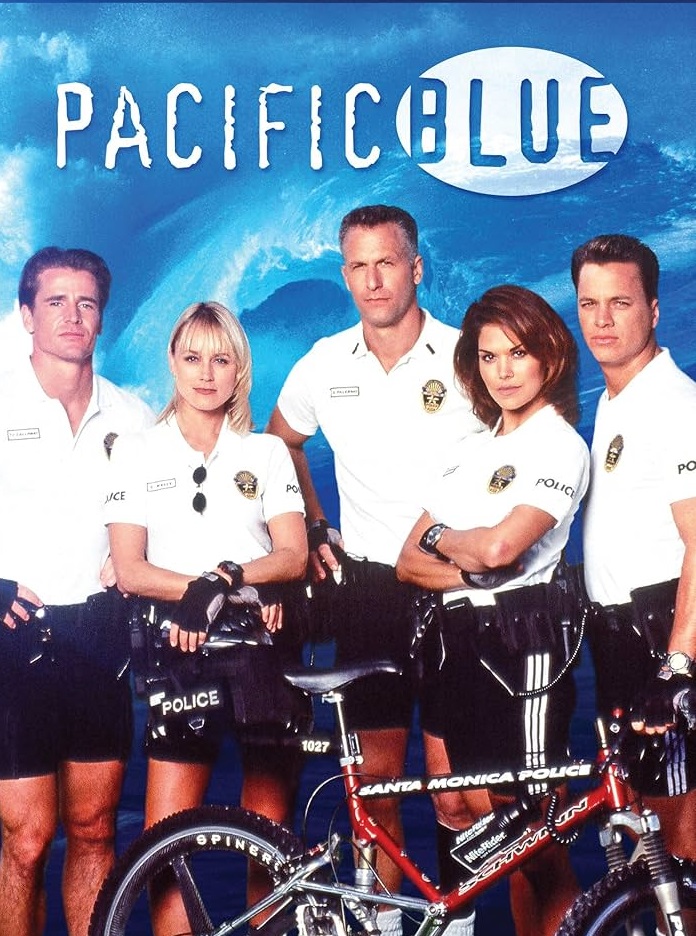
Late Night Retro Television Review: Pacific Blue 2.11 “Deja Vu”


Welcome to Late Night Retro Television Reviews, a feature where we review some of our favorite and least favorite shows of the past! On Tuesdays, I will be reviewing Pacific Blue, a cop show that aired from 1996 to 2000 on the USA Network!  It’s currently streaming everywhere, though I’m watching it on Tubi.

This week, someone is out to frame Palermo!  It couldn’t happen to a nicer guy.

Episode 2.11 “Deja Vu”

(Dir by Michael Levine, originally aired on November 10th, 1996)

Palermo is upset because his former partner is returned to the boardwalk and is now running an arcade.  Gene Savage (Joe Cortese) may have once been a cop but now he’s a paroled ex-con and it was Palermo’s testimony that led to Savage being convicted in the first place.  Palermo suspects that Savage is out for revenge and it turns out that he is.  He tries to frame Palermo for a murder.  Internal Affairs demands Palermo’s badge.

And the thing is …. I know I’m supposed to feel bad for Palermo but I don’t.  Palermo’s a self-righteous jerk.  He’s been a self-righteous jerk since the start of the show.  He acts like riding a bicycle somehow makes him superior to everyone else on the boardwalk.  Finding out that he testified against his partner makes him seem like even more of a jerk.  It’s hard to like a snitch.

This entire episode is built around the idea of Palermo being treated unfairly but I kind of feel like he needed to be taken down a rung or two.  Maybe now, he won’t be so rude when he arrests people.  Maybe he’ll understand that not everyone cares about his whole bicycle thing.  Probably not, though.

While Palermo was dealing with his ex-partner, Cory and Chris dealt with the Good Samaritans, a group of blue beret-wearing citizens who attempted to fight crime on their own.  Andy Miller (Keith Coulouris) was determined to take down the local drug dealer.  When Andy’s partner (Claudette Mink) got shot and nearly died, Andy snapped and grabbed a gun and tried to get revenge himself.  Cory was there to arrest not only the drug dealer but also Andy.  “You’re a danger to the community and yourself!” Cory snapped.

Ugh.  People who ride bicycles shouldn’t try to act like badsses.  Seriously, is there a less likable cast of characters than the Pacific Blue crew?  It’s not a good thing when a cop leaves me rooting for the criminals.

Film Review: Jackie Brown (dir by Quentin Tarantino)


It took me a while to really appreciated Jackie Brown.

I was nineteen and in college when I first watched the movie.  A friend rented it and we watched it with the expectation that it would be another Tarantino film that would be full of violence, fast music, and stylish characterizations.  And, of course, Jackie Brown did have all three of those.  But it was also a far more melancholy film than what we were expecting and compared to something like Kill Bill, Jackie Brown definitely moved at its own deliberate pace.  That’s a polite way of saying that, at times, the film seemed slow.  It seemed like it took forever for the story to get going and, even once it became clear that Jackie Brown (Pam Grier) and Max Cherry (Robert Forster) were going to steal from Ordell Robbie (Samuel L. Jackson), it still felt like an oddly laid back heist.  Robert de Niro, the film’s biggest star, played a guy who seemed to be brain dead.  Bridget Fonda brought an interesting chaotic energy to the film but her character was disposed of in an almost off-hand manner.  The whole thing just felt off.  I appreciated the performances.  I appreciated the music on the soundtrack.  But I felt like it was one of Tarantino’s weaker films.

As I’ve gotten older, I’ve come to better appreciate Jackie Brown.  First released in 1997 and adapted from a novel by Elmore Leonard, Jackie Brown finds Quentin Tarantino at his most contemplative.  Indeed, Tarantino wouldn’t direct anything quite as humanistic until he did Once Upon A Time In Hollywood.  If the heist seemed rather laid back, that’s because Jackie Brown really isn’t a heist film.  It’s a film about aging, starring two icons of 70s exploitation.  Robert Forster was 56 when he played bail bondman Max Cherry while Pam Grier was 48 when she was cast as Jackie Brown, the flight attendant turned smuggler.  Jackie and Max two middle-aged people faced with a world that doesn’t really make much sense to them anymore.  (Obviously, it’s easier for me to understand them now than it was when I was nineteen and I felt like the future was unlimited.)  Max bails people out of jail and it’s obvious that he still has a shred of idealism within him.  He actually does care about the people he gets out of jail and he’s disgusted by Ordell’s callous attitude towards the people who work for him.  Jackie is a flight attendant who, when we first see her, looks like she could have just stepped out of a 1970s airline commercial.  Ripping off Ordell isn’t just something that she’s doing for revenge or to protect herself, though there’s certainly an element of both those motivations in her actions.  This is also her chance to finally have something for her.  Jackie and Max are two lost souls who find each other and wonder where the time is gone.  All of those critics who have wondered, over the years, when Quentin Tarantino would make a mature movie about real people with real problems need to rewatch Jackie Brown.

Of course, it’s still a Quentin Tarantino film.  And that means we get a lot of scenes of Samuel L. Jackson talking.  This is one of Jackson’s best performances.  Ordell is definitely a bad guy and most viewers will be eager to see him get his comeuppance but, as played by Jackson, he’s also frequently very funny and definitely charismatic.  One can understand how Ordell lures people into his trap.  Jackson loves to watch video tapes of women shooting guns.  He allows De Niro’s Louis to crash at his place and the scene where Ordell realizes that Louis is thoroughly incompetent is brilliantly acted by both men.  And then you have Bridget Fonda, as a force of pure sunny chaos.  Jackson, De Niro, and Fonda are definitely a watchable trio, even if the film rightly belongs to Pam Grier and Robert Forster.

The older I get, the more I appreciate Jackie Brown.  This is the film where Tarantino revealed that there was more to his artistic vision than just movie references and comic book jokes.  This film takes Tarantino’s style and puts it in the real world.  It’s Tarantino at his most human.

January True Crime: Shoot First: A Cop’s Vengeance (dir by Mel Damski)


Made for television in 1991 and possessing a rather unwieldy title, Shoot First: A Cop’s Vengeance tells the story of two friends in San Antonio in the early 80s.

Farrell Tucker (Dale Midkiff) and Stephen Smith (Alex McArthur) are both cops.  They entered the police academy together, they graduated as a part of the same class, and they both hope to be partners while working to keep the streets of San Antonio safe.  Tucker is laid back and friendly and not one to worry too much about following all of the regulations.  Stephen Smith, on the other hand, is uptight and, at first, by-the-book.  He grew up in a poverty-stricken, crime-riddled neighborhood and it left a definite impression on him.  He hates crime and criminals but what he really can’t stand is a justice system that seems to be more concerned with the victimizers than with the victims.  Tucker and Smith enjoy spending their time together, drinking at the local cop bars and practicing their shooting on the weekends.  Tucker’s not much of a shot, whereas Smith is a sharpshooter who rarely misses.

At first, no one notices or even cares that some of San Antonio’s less upstanding citizens are getting gunned down in the streets.  But when Smith somehow manages to be first on the scene to a series of shootings, it gets the attention of Internal Affairs.  With Sergeant Nicholas (Terry O’Quinn) investigating the possibility of a cop-turned-vigilante and Chief Hogan (G.D. Spradlin) announcing that no one is above the law, Smith starts to get a bit paranoid and Tucker is forced to consider that his friend could very well be a murderer.

And, of course, Tucker’s right!  The first scene features Tucker confronting Smith and then the majority of the film is told in flashback.  Even if not for that narrative choice, one could guess at Smith’s guilt just from the title of the film.  When Shoot First: A Cop’s Vengeance was released on home video, the title was changed to Vigilante Cop, which made Smith’s guilt even more obvious.  Finally, some viewers will guess that Smith is guilty because the film is based on a true story.  Officer Stephen Smith actually did go on a killing spree, gunning down men who he felt had escaped the law and even sending threatening letters to his chief when the latter announced that vigilante activity would not be tolerated.  Officer Stephen Smith went from being a follower of the rules to someone who attempted to write his own rules.  It’s an interesting story for anyone who wants to google it.

As for the film, it’s adequate without being particularly memorable.  Alex McArthur and Dale Midkiff both give good performance as Tucker and Smith and the cast is full of talented people like Terry O’Quinn, G.D. Spradlin, Bruce McGill, and Lynn Lowry.  Observant viewers will even notice a long-haired Jeremy Davies, showing up for a split-second.  I liked the performance of Loryn Locklin, as the waitress who marries Smith and then discovers that her charming husband actually has some very serious issues.  The main problem with the film is that the story moves a bit too slowly for its own good and some of the Texas accents were more than a little dodgy.  If you’re looking for an action film, this won’t be for you, though the shootings are surprisingly graphic for something that was made for television.  Shoot First: A Cop’s Vengeance is a rather routine telling of an interesting story.

Love On The Lens: Casualties of Love: The Long Island Lolita Story (dir by John Herzfeld)


Poor Joey Buttafuoco!

As seen in the 1993 made-for-TV movie Casualties of Love, Joey is a saintly, salt-of-the-Earth blue collar guy who works as an auto mechanic on Long Island.  He’s also an aspiring drummer, one who struggles with a major cocaine addiction.  When his loving wife, Mary Jo (Phyllis Lyons), threatens to leave him and take the kids unless he cleans up his act, Joey checks into rehab.  Six months later, he leaves rehab clean and sober and dedicated to his family.  All of the other patients lean out of their windows and wish Joey well.  Everyone loves Joey!

Joey, the most handsome and sweetest auto mechanic in the state of New York, does have a problem, though.  A sociopathic teenager named Amy Fisher (Alyssa Milano) has grown obsessed with him and keeps intentionally damaging her car so that she can come hang out at the garage.  When the other mechanics say that Amy is hot, Joey agrees but that’s all he does.  Joey loves his wife.  When Amy tries to kiss him at a carnival, he shoves her away and then kisses his wife to make sure that everyone understand that Joey Buttafuoco is the best guy ever.  When Amy accuses Joey of giving her a STD, everyone realizes she’s lying because Joey would never have an STD in the first place.

And when Amy shoots Mary Jo in the face, the media and the police try to make it seem like Joey is somehow to blame but again, we know that he’s not.  Joey Buttafuoco is a name that means honor and respect.

Uhmm …. yeah.

So, this is story is very loosely based on a true story and by that, I mean that there was a teenager named Amy Fisher who shot a woman named Mary Jo in the face and later said that she was having an affair with her husband, Joey.  Apparently, there were three made-for-TV movies made about the case, all of which premiered in the same month.  Casualties of Love is told from the point of view of Joey and Mary Jo and it fully supports Joey’s initial claim that he never slept with Amy and she was just some obsessed psycho.

While watching this film, I got bored enough to look up the case on Wikipedia and I learned that, after this movie aired, Joey admitted that he did have an affair with 16 year-old Amy Fisher and he subsequently went to jail for statutory rape.  After getting out of jail, Joey divorced his wife and has subsequently been in and out of trouble with the law.  He also become a regular on TV court shows, where he would sue people who failed to pay him for fixing their cars.  My point is, Joey Buttafuoco sounds like a bit of a sleaze in real life.  That makes this film’s portrayal of him as being some sort of Saint of Long Island feel rather dumb.

Actually, it would feel dumb even if the real Joey Buttafuoco was a solid citizen.  Casualties of Love is one of the silliest films that I’ve ever seen, portraying Joey as being a streetwise former cocaine addict who was somehow too naive to realize that it would look bad to spend time in his office alone with Amy.  As Joey, Jack Scalia is very handsome and very sincere and he feels totally miscast as someone who spends hours working underneath the hood of other people’s cars.  Leo Rossi and Lawrence Tierney both show up, mostly so they can say, “Oh, what were you thinking!?” to Joey.  As Amy Fisher, Alyssa Milano gives an amazingly lifeless performance.  Occasionally she talk fast and plays with her hair.  This is the film’s way of letting us know that she’s supposed to be unhinged.  I mean, I do the same thing.  If you’ve got long hair, you’re going to play with it whenever you got bored.  It doesn’t make you crazy.

Unfortunately, though the film may be silly, it’s not much fun.  The direction is workmanlike and the film’s portrayal of Joey and Mary Jo’s marriage is so earnestly bland that the film never even rises to the level of camp.  The film ends with a warning that Amy would soon be eligible for parole.  (Oddly, it also points out that Amy could take college courses in jail, as if that was a bad thing.)  Meanwhile, “Mary Jo is taking it one day at a time.”  Fortunately, Mary Jo eventually took herself out of Joey’s life and filed for divorce.  That’s the happy ending this film lacks.

Late Night Retro Television Reviews: Highway to Heaven 1.14 “Plane Death”


Welcome to Late Night Retro Television Reviews, a feature where we review some of our favorite and least favorite shows of the past!  On Thursdays, I will be reviewing Highway to Heaven, which aired on NBC from 1984 to 1989.  The entire show is currently streaming on Tubi and several other services!

This week, Jonathan and Mark enlist in the War on Drugs.

Episode 1.14 “Plane Death”

(Dir by Victor French, originally aired on January 9th, 1985)

In a small town in California, a man named Charlie Down (Robert Ford) drives his big family car down an isolated car.  One thing that that is immediately noticeable is that Charlie has a gigantic pair of fuzzy dice hanging from his rearview mirror.  That’s rarely a good sign.  The other thing that is immediately noticeable is that a remote control airplane is flying over the landscape.  As the audience will soon learn, the people in this town are obsessed with remote control airplanes.  That’s because drug dealer Jack Harm (Michael Bowen), the son of the local sheriff, is using the airplanes to smuggle cocaine.  When one of the planes crashes, Charlie rushes out to it and grabs the cocaine for himself.  He is pursued by Jack and his gang.  Charlie runs away from them.  An off-screen gunshot is heard.

What Jack doesn’t know is that the man that he murdered is an old friend of Mark Gordon’s (Victor French).  For the past few months, Mark has been on the road with angel Jonathan Smith (Michael Landon).  They’ve been taking care of people all over America.  But right now, they are between assignments.  They show up in town so that Mark can see his friend but, shortly after arriving, Mark is informed that Charlie has gone missing.  It doesn’t take Mark long to figure out what happened.  He announces that he’s going to get revenge, “just like in the Bible, eye for an eye.”

Fortunately, Jonathan is there to keep Mark from doing something that he might regret.  Before Mark can drive down to the local bar, Jonathan arranges for the police and the FBI to show up and take Jack and his gang into custody.  Jack’s father can only watch in disappointment as his son is taken off to prison.  When Mark thanks Jonathan for keeping him from making a mistake, Jonathan replies that he’s sure Mark would have stopped himself from killing anyone.  Mark says that he wouldn’t have been able to stop himself and Victor French’s delivery of the line is so somber and serious that there’s little doubt he was prepared to kill everyone in town.

At Charlie’s funeral, his young son (played by David Faustino) announces that he’s going to become a cop so that no other kids have to feel as bad as he feel right now.  Jonathan says that Charlie would be proud to hear that.  Mark asks Jonathan if the country is ever going to be able to win the war on drugs.

“If they don’t,” Jonathan replies, “they’re may not be a country to worry about.”

Yikes!  Setting aside the ultimate futility of the War on Drugs (which far too often became a war on addicts as opposed to war on the people making money off of them), this episode was actually pretty well-done.  Mark’s intense anger was perfectly portrayed, making him a bit frightening even if you understood his desire for revenge.  Michael Bowen’s superficially friendly psychopath was easy to dislike.  This was one of those episodes where the viewer appreciates the sincerity of the show’s emotions even if the legacy of the War on Drugs has ultimately been one of failure.

Retro Television Reviews: Trial By Fire (dir by Alan Metzger)


Welcome to Retro Television Reviews, a feature where we review some of our favorite and least favorite shows of the past!  On Sundays, I will be reviewing the made-for-television movies that used to be a primetime mainstay.  Today’s film is 1995’s Trial By Fire!  It  can be viewed on YouTube!

Trial By Fire opens with an absolutely heart-breaking scene, in which a teenager named Kip Bouchmeyer (Andrew Kavovit) enters his bedroom, closes and locks the door (and, in the process, locks out his dog, who sits out in the hallway sadly), and then proceeds to shoot himself.

The upper class community in which Kip lived is stunned by his suicide but they are soon also scandalized by reports that Kip had been having an affair with one of his teachers, Paulette Gill (Gail O’Grady).  Paulette denies the rumors but soon, Kip’s friends are coming forward and saying that Kip not only told them about the affair but that some of them spied on Kip while he was with her.  Paulette continues to deny the accusations but still loses her teaching license.  Paulette is put on trial, accused of seducing Kip and setting off the chain of events that led to his death.  The only people who seem to be willing to believe Paulette’s side of the story are Paulette’s husband, Roger (Michael Bowen), and her attorney, Owen Turner (Keith Carradine).

Indeed, it doesn’t take long for Owen to discover that there are several inconsistencies in the stories that the other students are spreading about Paulette and how she behaved as a teacher.  Owen starts to suspect that Kip’s friends met after Kip’s suicide and concocted the story of Kip and Paulette’s affair on their own.  But why would they do that and, more importantly, can Owen convince anyone else?

There have been a lot of movies made about teachers seducing and carrying on affairs with students.  (I wrote about one of them, Murder in New Hampshire, just a few weeks ago.) There have been far less films made about teachers who are falsely accused.  Interestingly enough, Trial By Fire is based on a true story.  Paulette Gill was a real teacher and, just as in the movie, she really was accused of contributing to the death of one of her students.  Because it’s based on a true story, Trial By Fire doesn’t answer every question that was raised by the case.  Though the film leaves no doubt that Paulette was innocent of seducing Kip, the film leaves it to the viewer to decide whether she was the victim of an actual conspiracy or if a bunch of teenagers just had an overactive imagination.  The film also leaves it to the viewer to decide as to whether or not Paulette allowed herself to get too close to her students, even if she didn’t actually have an affair with Kip.  It could be argued that Paulette allowed herself to care too much about Kip and was rather naïve in not realizing how easily gossip can spread in a high school.  But I think it could also be argued that it’s better to care too much than to not care at all.

It’s a good movie, though a rather sad one.  (The image of that dog sitting outside of Kip’s bedroom left me depressed for a full day.)  The cast, which is full of TV regulars, does a good job with their characters.  I especially liked Keith Carradine’s performance as the tough but fair-minded attorney.  Trial By Fire takes a familiar subject and gives it an unexpected spin, leaving the audience to consider what their own complicity would have been if they had found themselves in the same situation.

A Movie A Day #26: The Taking of Beverly Hills (1991, directed by Sidney J. Furie)


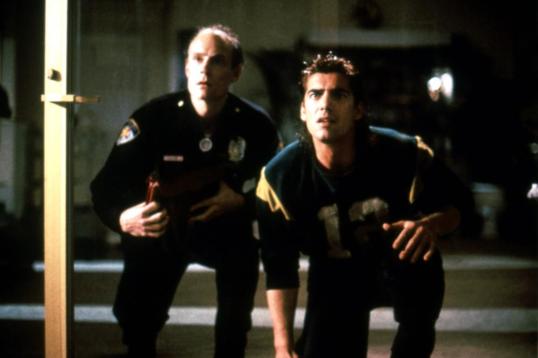
After a toxic chemical spill, Beverly Hills is evacuated.  While its citizens wait in a hotel, their mansions and valuables are guarded by the police and agents of the EPA.  Or so they think.  It turns out that the chemical spill was faked and that both the police and the government agents are in on it.  While the town’s deserted, they’re going to rob everyone blind.  The scheme’s mastermind is Bat Masterson (Robert Davi), the owner of L.A. Rams.  What Masterson doesn’t realize is that one citizen of Beverly Hills stayed behind, his own quarterback, Boomer Hayes (Ken Wahl).  Teaming up with Ed Kelvin (Matt Frewer), the last honest cop in town, Boomer sets out to protect Beverly Hills.

It’s just a dumb as it sounds.  In fact, of the many Die Hard ripoffs that came out in the late 80s and the early 90s, The Taking of Beverly Hills is probably the dumbest, which also makes it one of the most entertaining.  Boomer, who has an impressive mullet, can only speak in football analogies, constantly assuring Ed that it’s only the first down and that they can turn things around after halftime.  When Boomer gets serious, he says, “It’s time to play offense.”  One of the stranger things about The Taking of Beverly Hills is that, unlike working class hero John McClane, Boomer is not an outsider.  He’s in Beverly Hills because he’s rich.  The Taking of Beverly Hills is basically about one rich guy trying to keep another rich guy from robbing a bunch of other rich people.  It’s Die Hard if Hart Bochner had been the hero instead of Bruce Willis.

Keep an eye out for Lee Ving, lead singer of Fear, playing one of the corrupt cops and an uncredited Pamela Anderson cast as a cheerleader.  And keep your ears open for songs like Epic by Faith No More because their presence on the soundtrack (and the associated rights issue) is the reason was this stupidly entertaining movie will probably never get a DVD/Blu-ray release in the United States.

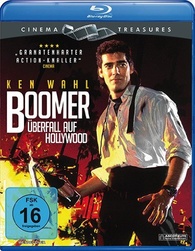
It has been released in Germany, where it was retitled Boomer after the lead character.

It has been released in Germany, where it was retitled Boomer after the lead character.