Welcome to Late Night Retro Television Reviews, a feature where we review some of our favorite and least favorite shows of the past! On Thursdays, I will be reviewing Highway to Heaven, which aired on NBC from 1984 to 1989. The entire show is currently streaming on Freevee and several other services!
This week, things get a little bit sad on the highway to Heaven.
Episode 2.19 “Heaven on Earth”
(Dir by Michael Landon, originally aired on February 26th, 1986)
Now, this episode made me cry!
While visiting an amusement park on their day off, Jonathan and Mark come across a lost six year-old girl named Sarah (Morgan Nagler). Jonathan offers to take Sarah to the park’s security office but Sarah says that she’s not allowed to go anywhere with a stranger. After explaining that he’s a former cop and knows how to deal with lost children, Mark asks Sarah for the name of her mother. After learning that Sarah’s mother is named Nancy, Mark goes to the security office and has them page her. Soon, Sarah and Nancy are reunited. Yay!
Later, as they drive through the desert, Mark and Jonathan are nearly run off the road by a drunk driver. A few moments later, they come across an auto accident. The owner of a jeep swerved to avoid the drunk and instead crashed into a station wagon. Jonathan suddenly tells Mark that they should leave but Mark walks up to the overturned car and discovers that it was being driven by Nancy. Nancy survived the accident but Sarah did not.
Broken-hearted, Mark blames himself. He tells Jonathan that, if he hadn’t been so eager to show off, Sarah and Nancy wouldn’t have left the park when they did and they wouldn’t have been in the car accident. Mark pulls the car over to the side of the road and tells Jonathan to get out. Jonathan reluctantly does so and Mark drives off.
Mark drives until the car runs out of a gas on the outskirts of a small town. The proprietor of a local store tells Mark that the town’s pretty much been dead since the new turnpike was built. There are two gas stations but they’re both closed on Wednesday because the owners like to go fishing together. Reluctantly, Mark goes to the local boarding house and asks for a room for the night.
Mark is shown his room by a helpful girl named Wendy (Alyson Croft). Inside his room, Mark spots a picture of Wendy with Sarah and realizes that Jonathan led him to the boarding house. Later, at dinner, Mark meets Wendy’s father, a divinity student named Tom Ward (Michael Anderson, Jr.) When Wendy goes to call her friend Sarah to find out how the amusement park was, Mark can only sit in silence as Wendy tells her father that Sarah’s family wants to speak to him. Without telling Wendy why, Tom says that he has to go to Sarah’s house. He tells Wendy to get to bed early and then he leaves with his wife and their infant son.
Mark goes back to his room. Wendy pops in and to give him a heater because the furnace is broken. Unfortunately, the heater is also broken and makes an annoying clicking sound. Mark angrily kicks it over before going for a walk.
While standing outside of a church, Mark hears the sirens of fire engines. The Ward house is on fire! The firemen manage to get out Wendy’s grandmother but they say there’s no way to rescue anyone else. Mark rushes into the house, determined to save Wendy. And …. he promptly faints.
When he awakens, he’s with Jonathan. Jonathan says that “the boss” has decided to give Mark the chance to play God. Mark says that he wants everything he wishes to be true and that he wants all of his mistakes to be corrected as if they never happened.
As a result, the town is suddenly thriving but the proprietor of the now 24-hour gas station is dead as a result of having worked himself to death. Wendy is alive but, because Mark wished for her to have everything she ever wanted, she’s now a spoiled brat. And Sarah….
When Mark demands to see Sarah, Jonathan takes him to the cemetery and shows him that Sarah is still dead. Jonathan explains that Sarah’s death was not his fault. It was the fault of the drunk driver and there was nothing Mark could have done to save her.
Mark awakens in the burning house. Not only does he manage to save Wendy’s life but, once he’s released from the hospital’s burn unit, he and Jonathan once again hit the highway….
This was a good episode, though I have to say that the Wards were a lot more forgiving about Mark burning down their house than I would have been. This episode worked largely due to Victor French’s heartfelt performance as Mark. Watching him, it was impossible not to feel his pain. In the end, the message was a good one, though I do think it would have been nice to see the drunk driver punished for his actions.
Welcome to Retro Television Reviews, a feature where we review some of our favorite and least favorite shows of the past! On Sundays, I will be reviewing the made-for-television movies that used to be a primetime mainstay. Today’s film is 1971’s In Search of America! It can be viewed on YouTube!
College student Mike Olson (young Jeff Bridges) returns home and informs his mother (Vera Miles) and his father (Carl Betz) and his annoyingly quirky grandmother (Ruth McDevitt) that he’s dropped out of college. He apologizes for wasting all the money that they spent on tuition but hey, maybe he can make it up to them by taking them on a journey as he drives across America in an old bus.
Uhmmm….
Now, let me just repeat this so that there is no confusion. This absolutely schmuck took his parents’ money, wasted it, dropped out of college, and now he expects everyone to travel with him across America because he’s decided that he’s a part of the counterculture.
And, instead of telling him to go to Hell and get a job, his family agrees.
Oh sure, Mom is a little bit hesitant about Mike’s idea. But Dad is really enthusiastic. He understands the kids and he wants a chance to relive his own youth, before he got tied down with things like paying bills and being a responsible human being. And, of course, if the Hippies were famous for anything, it was their love of upper class, middle-aged people. Just ask the LaBiancas.
And, of course, grandma is totally excited about it because she’s an old person in a made-for-TV movie.
So, they all board the bus and Mike takes them to a music festival so that they can meet some of his friends. For instance, there’s Nick (Sal Mineo), a drop-out who says that he’s more burned out than turned on. There’s Annie (Tyne Daly), who is going to need someone to help deliver her baby. There’s Bodhi (Glynn Turman), who is some sort of doctor. He and grandma bond of their shared quirkiness. And then there’s Kathy (Renne Jarrett), who is at the music festival despite the fact that she’s really sick and on the verge of dying. When Kathy’s parents (Howard Duff and Kim Hunter) show up looking for her, Mike has to decide whether to save her life or respect her wish to do her own thing.
This was obviously meant to be a pilot for a show where the family would travel around the country and I guess get involved in different adventures each week. The main problem is that, while Jeff Bridges seems to be a bit of a hippie in real life, he’s not particularly convincing in this film. He’s way too clean-cut and his family’s decision to follow him across the country never makes the least bit of sense. As for the hippies themselves, they come across as being so shallow that I found myself wanting to donate money to the Nixon campaign.
Welcome to Retro Television Reviews, a feature where we review some of our favorite and least favorite shows of the past! On Tuesdays, I will be reviewing the original Fantasy Island, which ran on ABC from 1977 to 1986. The entire show is currently streaming on Tubi!
Smiles, everyone, smiles! This week, we visit the other side of the Island.
Episode 2.23 “Cornelius and Alphonse/The Choice”
(Dir by Earl Bellamy, originally aired on May 6th, 1979)
This was a bit of an odd episode.
First off, the official title of the show, for this episode, was Fantasy Island Sunday Special. Usually, Fantasy Island aired on Saturdays. This episode, as you can guess by the title, aired on a Sunday. Secondly, this episode does away with both the plane and Tattoo’s signature cry of “Da Plane Da Plane,” and instead has the guests arrive on the island in a hot air balloon. Tattoo (who is once again seen driving his little car, so I guess he finally recovered it after it was stolen earlier in the season) and Mr. Roarke are joined by a second assistant, Cindy (Kimberly Beck, who readers of this site will probably recognize as the likable lead in films like Massacre at Central High and Friday The 13th: The Final Chapter). At one point, Roarke says that “Cindy helps me on this side of the Island.” If nothing else, this episode confirms that Roarke has multiple assistants and the Island is really, really big.
Actually, it’s a good thing that Cindy is there because Cornelius (Red Buttons) and Alphonse (Billy Barty) have kidnapped Tattoo! Cornelius is a former employee of the Island but he was fired for stealing. When he returns to the Island, he says that his fantasy is to just have a pleasant holiday with his friend Alphonse. However, Cornelius’s real fantasy is to get revenge on Mr. Roarke by abducting Tattoo and holding him for ransom!
Of course, anyone who has been paying attention to the show up to this point knows that Cornelius and Alphonse have made a mistake. Mr. Roarke and Tattoo obviously loathe each other. When Mr. Roarke finds out that Tattoo is being held captive in a conveniently deserted castle, he doesn’t really seem that concerned about it. And Tattoo turns out to be such a disruptive presence that Cornelius is soon begging Roarke to take him back. In the end, Roarke demands money to take Tattoo off of their hands and Cornelius and Alphone end up paying off their debt by working in Fantasy Island’s kitchen. Tattoo is amused by the whole thing, despite the fact that Mr, Roarke was essentially willing to let him die.
Meanwhile, two orphans (Kyle Richards and Michael Anderson, Jr.) are given a chance to pick their new parents. They spend time with two sets of prospective parents. (One of the potential fathers is a magician played by a youngish Regis Philbin.) From the start of the fantasy, it’s pretty obvious that they’re going to ask to be adopted by Ruth (Juliet Mills), the head of the adoption agency. And that’s exactly what happens. The episode ends with Ruth and the children boarding a hot air balloon and flying all the way back to America.
As I said, this was a bit of a weird episode, with a new assistant and a hot air balloon. “The other side of the Island” looks a like a theme park. This episode was obviously designed to appeal to children and, for what it’s worth, the IMDb trivia section states that this episode was meant to be a “backdoor pilot” for a version of Fantasy Island that would appeal to children. (I assume Cindy would have been the main character.) Unfortunately, the kidnapping humor is a bit too broad and the adoption storyline is a bit too predictable. Hopefully, next week’s episode will take place on the adult side of the Island.
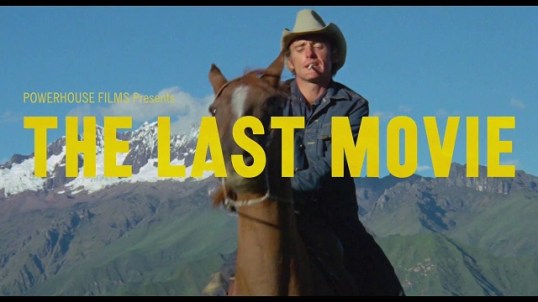
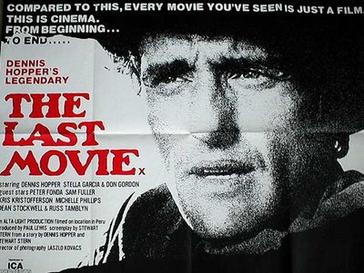
The story behind the making of 1971’s The Last Movie is legendary. It’s also a bit of a cautionary tale.
In 1969, Hollywood was stunned by the box office success of an independent, low-budget counter-culture film called Easy Rider. Easy Rider not only made a star out of Jack Nicholson but it was also the film that finally convinced the studios that the way to be relevant was not to continue to crank out big budget musical extravaganzas like Doctor Doolittle and Hello, Dolly! Instead, it was decided that the smart thing to do would be to hire young (or, at the very least, youngish) directors and basically just let them shoot whatever they wanted. The resulting films might not make much sense to the executives but, presumably, the kids would dig them and as long as the kids were paying money to see them, everyone would continue to get rich. Because Dennis Hopper had directed Easy Rider, he suddenly found himself very much in demand as a director.
Of course, almost everyone in Hollywood knew Dennis Hopper. Long before he became an icon of the counter-culture, Dennis Hopper had been a part of the studio system. John Wayne even referred to Hopper as being his “favorite communist.” Everyone knew that Dennis could be a bit arrogant. Everyone knew that Dennis was very much into drugs and that, as a result, he had a reputation for being a bit unstable. Everyone knew that Dennis Hopper deliberately cultivated an image of being a bit of a wild man and a revolutionary artist. But Dennis Hopper had just directed Easy Rider and Universal was willing to give Hopper some money to go down to Peru and direct his follow-up.
The Last Movie was a film that Hopper had been planning on making for a while. The film’s original script told the story of an aging and broken-down stuntman named Kansas who retires to Mexico and searches for a gold mine with a friend of his. Hopper first tried to get the film going in 1965, with Montgomery Clift in the lead role. After Clift died, Hopper tried to interest John Wayne in the starring role but, though Wayne enjoyed having Hopper in his films so that he could threaten to shoot him whenever Abbie Hoffman said something shocking, he had no interest in being directed by him. When Universal finally agreed to put up the money for the film, Hopper offered the lead role to Jack Nicholson. Nicholson turned it down and told Hopper that it was obvious that Dennis wanted to play the role himself. Dennis decided that he agreed with Nicholson and he cast himself as Kansas. Dennis also made the fateful decision to not only change the story’s setting to Peru but to also film on location.
Dennis and a group of friends flew down to Peru, which, at that time, was the cocaine capitol of the world. Drug use was rampant on the set, with Dennis reportedly being one of the main offenders. The cast and crew filmed during the day and partied at night and no one was particularly sure what the film was supposed to be about. Amazingly, Hopper finished filming on schedule and within budget but, much as he did with Easy Rider, he also overfilmed and ended up with 40 hours of footage. Not wanting to be bothered by the studios, Hopper edited the footage in his compound in Taos, New Mexico. Working slowly and continuing to consume a large amount of drugs and alcohol, Hopper still managed to put together a film that had a straightforward storyline. When Hopper showed his initial cut to filmmaker Alejandro Jodorowsky, the director of El Topo accused Hopper of being too conventional in his approach, which led to Hopper chopping up the film and reassembling it. Finally, after spending over a year working with the footage, Hopper turned in his final edit.
Universal had no idea what to make of the film that Hopper delivered to them. Still, they released it with the hope that the same crowd that loved Easy Rider would embrace The Last Movie. While the film did win an award at the Venice Film Festival, critics hated it and, even worse, audiences stayed away. The film’s reception was so overwhelmingly negative that Hopper found himself largely exiled from Hollywood, with only a few directors (like Francis Ford Coppola) willing to take the chance of working with him. It wasn’t until the 80s, when he finally got clean and sober, that Dennis Hopper was able to reestablish himself as a character actor and, ultimately, a beloved cultural institution.
But what about The Last Movie? Was is it really as bad as the critics claimed? Or was it, as some more recent reviewers have suggested, an unacknowledged masterpiece that was ahead of its time? I recently watched The Last Movie to find out for myself.
Despite its reputation, The Last Movie gets off to a pretty strong start. Samuel Fuller (playing himself) is directing a hilariously over-the-top and violent western in the mountains of Peru. Kansas (Dennis Hopper) is working as a stuntman. He’s fallen in love with a local sex worker named Maria (Stella Garcia). Kansas is meant to be an aging Hollywood veteran, someone who has broken a lot of bones and who carries a lot of aches as a result of his line of work. (One can see why Hopper initially imagined an actor like John Wayne in the role.) He knows that this is going to be his last job and, as we see over the first 25 minutes of the film, he feels alienated from the rest of the cast and crew. Admittedly, Hopper does appear to be a bit too young for the role. The ideal Kansas would have been someone like Ben Johnson, L.Q. Jones, or perhaps Warren Oates. But, still, Hopper does a good job of capturing Kansas’s mixed feelings about the western that’s being filmed around him.
A lot of familiar faces pop up in the film’s fictional western. Dean Stockwell plays an outlaw. Jim Mitchum, Russ Tamblyn and Kris Kristofferson plays his associates. Peter Fonda is the youthful sheriff. Michelle Phillips is the daughter of the town’s banker and apparently, she’s also the girlfriend of one of the outlaws. We watch as the actors pretend to shoot guns and kill each other while the cameras are rolling, just to get up off the ground once “Cut” is yelled. When a local Indian who has been cast as an extra grows upset at the violence, an assistant director explains to him that no one really dies while the cameras are rolling. When shooting wraps, the film company goes home but Kansas stays behind with Maria. One day, the local priest (Tomas Milian) warns Kansas that the local indigenous people have moved into the abandoned film set and are trying to shoot their own movie. Kansas discovers that they have built wooden cameras and wooden boom mics and that their chief is giving orders in the style of Sam Fuller. They’re also firing the guns that the Americans left behind.
The first part of the film works quite well. Hopper’s camera captures the beautiful and isolated Peruvian landscape. The violent western is a pitch perfect and affectionate parody of a generic studio film. Though Hopper is a bit too young for the role, he still does a good job of capturing Kansas’s alienation from his fellow Americans. Even more importantly, the first part of the film seems to have an identifiable theme. The American film crew invaded an isolated part of Peru and changed the culture of the natives without even realizing it. Now, they’ve left but the natives are still dealing with the after effects of the American “invasion.” It’s easy to see, within that part of the story, a critique of both American culture and American foreign policy.
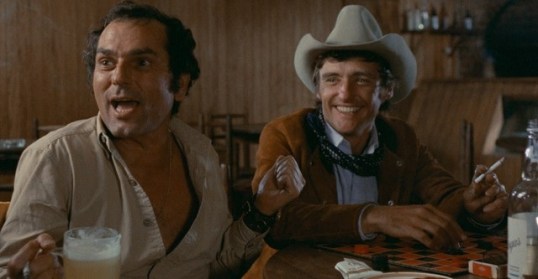
The second part of the film is where things start to fall apart. Kansas meets an old friend named Neville (Don Gordon). Neville has discovered a gold mine in the Peruvian mountains. With Kansas as his partner, he tries to get a businessman named Harry Anderson (Roy Engel) to invest in it. Kansas and Neville try to impress Harry and his wife (Julie Adams, best-known for being stalked by The Creature From The Black Lagoon). Kansas and Neville take the Andersons to a brothel and, in the process, Kansas offends Maria. Kansas then paws Mrs. Anderson’s fur coat and mentions that human beings are covered in hair. For all of their efforts, Harry will not invest, no matter how desperately Neville begs him to reconsider.
The second part of the film drags, with many of the scenes being obviously improvised between Hopper, Gordon, Garcia, Engel, and Adams. Unfortunately, the improved conversations aren’t particularly interesting and they tend to go on forever. Usually a reliable character actor, Don Gordon ferociously chews the scenery as Neville and it doesn’t take long before one grows tired of listening to him yell. (Gordon was far more impressive in Hopper’s Out of the Blue.) With the use of improvisation and overlapping dialogue, the second half of the film tries to feel naturalistic but instead, it’s a migraine-inducing method exercise gone wrong. It’s also during the second part of the film that a “scene missing” title card flashes on the screen, an indication that the discipline that Hopper showed as a director during the beginning of the film is about to be abandoned.
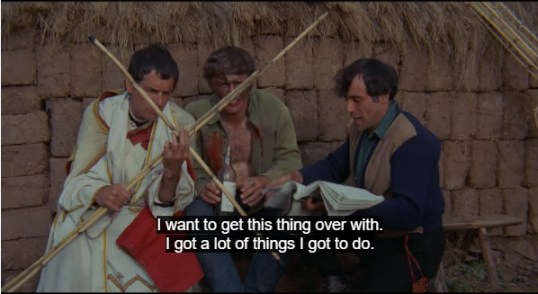
Finally, the third part of the film — well, who knows? The final 25 minutes of the film is collection of random scenes, some of which may be connected and some of which may not. The natives have decided that the only way to properly end their “film” is to kill Kansas. Kansas is shot several times and rides away on his horse. Suddenly, Kansas is back at his home and Maria is taunting him for getting shot. Then, Kansas is riding his horse again. Then suddenly, Dennis Hopper and Tomas Milian are laughing at the camera. A script supervisor tries to get Dennis to look at the shooting schedule while Dennis drinks. This happens:
Milian points out that the blood on Hopper’s shirt is dry. Hopper looks at his shoulder, where Kansas was previously shot, and says that someone needs to add his scar before he can shoot the scene. Ah! So, now we’re acknowledging that it’s all just a movie. Thanks, Dennis! Suddenly, Dennis is Kansas again and he’s collapsing over and over again in the dust. He appears to be dead but no, now he’s Dennis again and he’s standing up and smiling at the camera. And now, he’s singing Hooray for Hollywood. And now, suddenly, Kansas and Neville are talking about The Treasure of the Sierra Madre and then….
Well, let’s just say that it goes on and on before finally ending with a scrawled title card.
It’s a disjointed mess and it’s all the more frustrating because the first 30 minutes of the film is actually pretty good. But then, Dennis apparently remembered that he was supposed to be the voice of the counter-culture and he gave into his most pretentious impulses. Of course, just because a film is a mess, that doesn’t mean that it can’t be entertaining. And again, the first part of the film is entertaining and third part of the film is weird enough that it’ll hold most people’s attention for at least a few minutes. But the middle section of the film is so slow and pointless that it pretty much brings down the entire film.
In the end, what is The Last Movie about? In The American Dreamer(a documentary that was filmed while Hopper was editing The Last Movie in New Mexico), Hopper spends a lot of time talking about revolution and taking over Hollywood but The Last Movie is hardly a revolutionary film. The film is at its most alive when it is focused on the shooting of its fictional western. For all the satirical pokes that The Last Movie takes at the studio system, it’s obvious that Hopper had a lot of affection for Old Hollywood and for directors like Sam Fuller. Kansas may say “Far out,” but he’s hardly a hippie. Even the film’s jumbled finale seems to be saying, “It’s all Hollywood magic!” In the end, the film’s call for a new style of cinema is defeated by its love for the old style of cinema.
Instead, I think The Last Movie works best when viewed as a portrait of paranoia. Hopper himself admitted that he was naturally paranoid and the heavy amount of drugs that he was doing in the 70s didn’t help. One reason why Hopper filmed in Peru and edited in New Mexico was so the studios couldn’t keep track of him and, while directing, he worried about being arrested by the Peruvian secret police. As an actor, Hopper plays Kansas as being someone who views the world with caution and untrusting eyes. He doesn’t trust the other members of the film crew. He loves Maria but he’s still convinced that she’s going to betray him. Even the natives ultimately try to destroy him and the script supervisor tries to get him to stick to the shooting schedule. The film works best as a disjoined portrait of one man’s paranoid and fatalistic world view.
The Last Movie pretty much ended the studio’s attempts to harness the counter-culture by giving money to self-described revolutionaries. The new wave of directors — like Spielberg and Lucas — may have shared Hopper’s then-politics but they weren’t looking to burn down the system. (Hopper himself later became a Republican.) The Last Movie may not have been the literal last movie but it was, for a while at least, the last of its kind.
Welcome to Retro Television Reviews, a feature where we review some of our favorite and least favorite shows of the past! On Tuesdays, I will be reviewing the original Fantasy Island, which ran on ABC from 1977 to 1986. The entire show is currently streaming on Tubi!
Smiles, everyone! Smiles!
Episode 1.10 “The Over-The-Hill-Gang/Poof, You’re A Movie Star!”
(Dir by Earl Bellamy, originally aired on April 15th, 1978)
Uh-oh, Tattoo has a new money-making scheme! It involves a parrot. While the exact details of Tattoo’s schemes are a bit vague, it all involves teaching the parrot how to speak. Again, I’m not sure how exactly that’s going to make Tattoo a lot of money but whatever. I like parrots.
Still, it’s hard not to notice that Tattoo seems to spend a lot of time trying to figure out ways to make extra money. Tattoo is the second-in-command at the world’s most prestigious resort so you have to wonder why he always seems to be so desperate to bring in some extra cash. It’s not like Tattoo is paying rent or even buying his own food. That’s all provided by Mr. Roarke and the island. Add to that, it has been implied that Tattoo is in charge of the island’s finances and that’s not a job that you give to someone who can’t handle his own money. Maybe Tattoo isn’t looking to make money for himself. Maybe Fantasy Island is on the verge of bankruptcy due to Roarke’s habit of giving people free fantasies. Maybe the talking parrot is Tattoo’s latest scheme to save the Island. If that’s the case, then Tattoo really is the secret hero of this series.
I actually wish this episode has spent more time with the parrot because that little throw-away story was still more interesting than the two main stories. Don’t get me wrong. This isn’t a bad episode. It’s just a bit bland.
Shirley Russell (Barbi Benton) comes to the Island with dreams of becoming a movie star. Mr. Roarke simply snaps his fingers and suddenly, Shirley has not only an agent but also hundreds of fans following her everywhere that she goes. She also has a role in a big movie that will be filming on the Island! When the film’s producer (played by a veteran sleazy guy Herb Edelman) tells Shirley that she’ll have to film a nude scene for the movie, Shirley abandons her fantasy and happily reunites with her earnest fiancé. Barbi Benton was likable as Shirley but the fantasy itself was predictable and on the blah side. Shirley’s shock over the proposed nude scene made me wonder if she had actually watched any movies other than The Sound of Music.
The other fantasy dealt with Spencer Randolph (Ray Bolger), an aging bank robber who wanted to pull off one last job with his old gang before marrying a wealthy businesswoman. Bolger’s old gang was made up of familiar Hollywood character actors like Tom Ewell, Foster Brooks, and Phil Foster. Along with getting the old gang back together again, Spencer was also able to foil a blackmail scheme. Again, the storyline was a bit bland but the chemistry between all of the Hollywood veterans was enjoyable. Ray Bolger was just as spry and likable here as he was when he played the Scarecrow in The Wizard of Oz. Interestingly enough, 39 years passed between The Wizard of Oz and this episode of Fantasy Island and Bolger was still younger than Joe Biden is today when he played Spencer Randolph, the leader of the over-the-hill gang.
The first episode of The Martian Chronicles ended with a dying Jeff Spender (Bernie Casey) warning John Wilder (Rock Hudson) that humans settling on Mars would be the worst thing that could ever happen to the once powerful red planet.
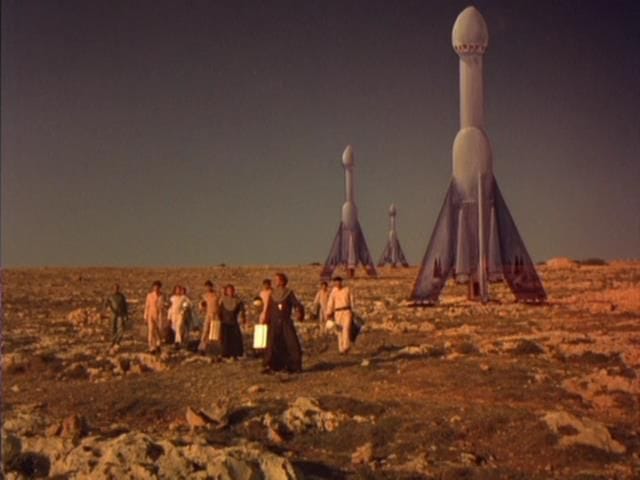
The second episode, called The Settlers, sets about to prove Spender right. By 2004, humans are desperately leaving the war-torn Earth for a new home on Mars. They rename all of the Martian landmarks, honoring the men who died exploring the planet. In one of the few deliberately funny moments of this entire miniseries, it’s revealed that the canal that Briggs threw his beer cans in was eventually named Briggs Canal. There’s one unfortunate shot of a line of miniature space ships that are supposed to be orbiting Mars and waiting for their chance to land. The episode then gets down to showing what the settlers do to Mars.
It’s nothing good. The main town looks like a traveling carnival, full of bars and crime. Many of the people who come to Mars are people who are fleeing something on Earth and Col. Wilder has his hands full trying to keep the peace. All of the Martians are believed to be dead but it turns out that there are still a few out there. Using their mental powers, they disguise themselves as humans. A large part of the second episode deals with a Martian who approached an elderly couple, disguised as their dead son. Even though they know that he’s not really their son, they allow him to live in their home. But, when the Martian goes to the city, he becomes overwhelmed by all the thoughts that bombard his mind. Everyone sees him as being someone that they care about. Even the local priest, Father Peregrine (Fritz Weaver), sees the Martian as being Jesus. (That’s no big deal today but that had to have been controversial in 1980.) Eventually, the Martian becomes so overwhelmed that he dies while a group of humans gawk at him.
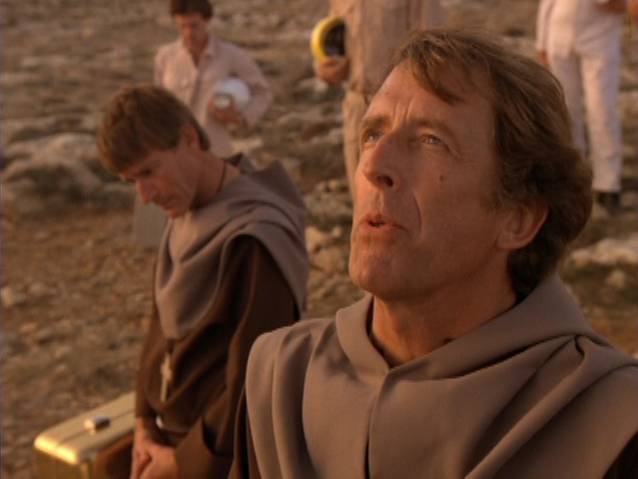
As for Father Peregrine and Father Stone (Roddy McDowall, who spent most of his later years appearing in miniseries like this one), they explore the Martian mountains, searching for three lights that have been reported as hovering in the sky. When they find the lights, the lights explain that they are ancient Martians who long ago abandoned their corporeal bodies. They also somewhat implausibly say that they worship the same God as the two priests. In a departure from Bradbury’s original short stories (in which Bradbury was skeptical about the idea of bringing religion to the Mars), Father Peregrine commits to building a church so that, even on the Red Planet, people can worship.
Finally, Sam Parkhill (Darren McGavin) has achieved his dream of building a restaurant on Mars. He says that, as soon as more Earthlings arrive, he’ll be rich because every trucker will stop off at his place for a bite to eat. When a Martian suddenly shows up in the diner, Parkhill panics and shoots him. When more Martians show up, Parkhill flees. It’s only when the Martians catch up to him does he learn that they’re giving him a grant for half the land on Mars. “Tonight’s the night,” they tell him, “Prepare.” Old Sam Parkhill’s pretty excited until he looks through a space telescope and sees that Earth, the home of his future customers, is now glowing with the sure sign of nuclear fire. I can’t remember how old I was when I first saw this episode on late night Baltimore TV but I do remember being thoroughly freaked out by the scene where Sam watches as a fiery glow encircles the Earth and the planet’s green surface turns brown. It’s the most powerful moment in the miniseries and a fitting visualization of Bradbury’s concerns about the nuclear age.
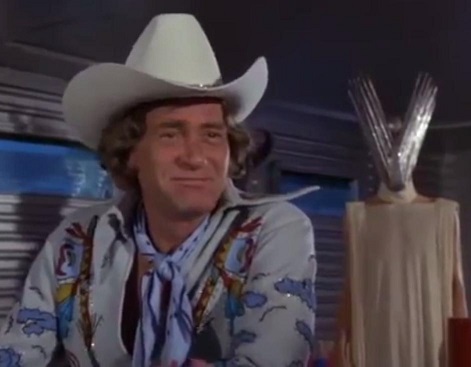
As for the rest of The Settlers, it’s good but it’s not as strong or as cohesive as the first episode. The Martin shapeshifter story is good but the two priests in the mountains felt like they were included to keep religious viewers happy and their segment takes too many liberties with Bradbury’s original material. Then, Darren McGavin returns to the story. dressed like a cowboy and getting chased by a Martian sandship and The Martian Chronicles goes back to being one of the coolest miniseries to ever be broadcast.
With Earth dead, would Mars follow? That was the theme of the next episode of The Martian Chronicles, which we’ll look at tomorrow.
The 1965 biblical epic, The Greatest Story Ever Told, tells the story of the life of Jesus, from the Nativity to the Ascension. It’s probably the most complete telling of the story that you’ll ever find. It’s hard to think of a single details that’s left out and, as a result, the film has a four hour running time. Whether you’re a believer or not, that’s a really long time to watch a reverent film that doesn’t even feature the campy excesses of something like The Ten Commandments.
(There’s actually several different version of The Greatest Story Ever Told floating around. There’s a version that’s a little over two hours. There’s a version that’s close to four hours. Reportedly, the uncut version of the film ran for four hour and 20 minutes.)
Max von Sydow plays Jesus. On the one hand, that seems like that should work because Max von Sydow was a great actor who gave off an otherworldly air. On the other hand, it totally doesn’t work because von Sydow gives an oddly detached performance. The Greatest Story Ever Told was von Sydow’s first American film and, at no point, does he seem particularly happy about being involved with it. von Sydow is a very cerebral and rather reserved Jesus, one who makes his points without a hint of passion or charisma. When he’s being friendly, he offers up a half-smile. When he has to rebuke his disciples for their doubt, he sounds more annoyed than anything else. He’s Jesus if Jesus was a community college philosophy professor.
The rest of the huge cast is populated with familiar faces. The Greatest Story Ever Told takes the all-star approach to heart and, as a result, even the minor roles are played by actors who will be familiar to anyone who has spent more than a few hours watching TCM. Many of them are on screen for only a few seconds, which makes their presence all the more distracting. Sidney Poitier shows up as Simon of Cyrene. Pat Boone is an angel. Roddy McDowall is Matthew and Sal Mineo is Uriah and John Wayne shows up as a centurion and delivers his one line in his trademark drawl.
A few of the actors do manage to stand out and make a good impression. Telly Savalas is a credible Pilate, playing him as being neither smug nor overly sympathetic but instead as a bureaucrat who can’t understand why he’s being forced to deal with all of this. Charlton Heston has just the right intensity for the role of John the Baptist while Jose Ferrer is properly sleazy as Herod. In the role Judas, David McCallum looks at the world through suspicious eyes and does little to disguise his irritation with the rest of the world. The Greatest Story Ever Told does not sentimentalize Judas or his role in Jesus’s arrest. For the most part, he’s just a jerk. Finally, it’s not exactly surprising when Donald Pleasence shows up as Satan but Pleasence still gives a properly evil performance, giving all of his lines a mocking and often sarcastic bite.
The Greatest Story Ever Told was directed by George Stevens, a legitimately great director who struggles to maintain any sort of narrative momentum in this film. Watching The Greatest Story Ever Told, it occurred to me that the best biblical films are the ones like Ben-Hur and The Robe, which both largely keep Jesus off-screen and instead focus on how his life and teachings and the reports of his resurrection effected other people. Stevens approaches the film’s subject with such reverence that the film becomes boring and that’s something that should never happen when you’re making a film set in Judea during the Roman era.
I do have to admit that, despite all of my criticism of the film, I do actually kind of like The Greatest Story Ever Told. It’s just such a big production that it’s hard not to be a little awed by it all. That huge cast may be distracting but it’s still a little bit fun to sit there and go, “There’s Shelley Winters! There’s John Wayne! There’s Robert Blake and Martin Landau!” That said, as far as biblical films are concerned, you’re still better off sticking with Jesus Christ Superstar.
G’day, mates! Let’s take a trek through the wilds of 1920’s Australian outback with , Robert Mitchum Deborah Kerr, and a herd of bouncing sheep in THE SUNDOWNERS. Fred Zinnemann, generally associated with serious, tense dramas like HIGH NOON and FROM HERE TO ETERNITY, lends a lighter touch than usual to this sprawling, almost John Ford-esque tale of an itinerant sheep drover and his family, and the wife who longs to settle into a home of her own.
Mitchum plays Paddy Carmody, a stubborn Irishman who has to keep moving, unable and unwilling to be tied to one place. He’s a wanderer with a fondness for booze and gambling, and Big Bob is perfect for the part. Mitchum’s penchant for dialects make his Aussie accent more than believable, and his facial expressions, especially during the sheep-shearing contest, are priceless. Deborah Kerr is his equal as wife Ida, the tough Earth Mother who’s loyal to Paddy…
Today’s horror on the lens is a 1970 made-for-TV movie called The House That Would Not Die!
In this film, Barbara Stanwyck and Kitty Winn move into a colonial house that is rumored to be haunted! Seances, possession, and scandal follows! There’s time travel, slow mo, an exaggerated wind effects! It’s all kinda silly but kinda fun too.
I recently saw the 1970 film WUSA on Movies TV. After I watched it, I looked Joanne Woodward up on Wikipedia specifically to see where she was born. I was surprised to discover that she was born and raised in Georgia and that she attended college in Louisiana.
Why was I so shocked? Because WUSA was set in New Orleans and it featured Joanne Woodward speaking in one of the most worst Southern accents that I had ever heard. A little over an hour into the film, Woodward’s character says, “What’s all the rhubarb?” And while “What’s all the rhu…” sounds properly Southern, the “…barb” was pronounced with the type of harshly unpleasant overemphasis on “ar” that has given away many Northern actors trying to sound Southern. Hence, I was shocked to discover that Joanne Woodward actually was Southern.
That said, her pronunciation of the word rhubarb pretty much summed up every problem that I had with WUSA. Actually, the real problem was that she said “rhubarb” in the first place. It came across as being the type of thing that a Northerner who has never actually been down South would think was regularly uttered down here. And I will admit that WUSA was made 16 years before I was born and so, it’s entirely possible that maybe — way back then — people down South regularly did use the word rhubarb. But, for some reason, I doubt it. I know plenty of old Southern people and I’ve never heard a single one of them say anything about rhubarb.
As for WUSA, it’s a long and slow film. A drifter named Reinhardt (Paul Newman) drifts into New Orleans and, with the help of an old friend who is now pretending to be a priest (Laurence Harvey), Reinhardt gets a job as an announcer at a right-wing radio station. He reads extremist editorials that he doesn’t agree with and whenever anyone challenges him, he explains that he’s just doing his job and nothing matters anyway.
Reinhardt also gets himself an apartment and spends most of his time smoking weed with long-haired musician types, the exact same people that WUSA regularly denounces as being a threat to the American way. Living in the same complex is Geraldine (Joanne Woodward), a former prostitute who has a scar on her face and who says stuff like, “What’s all the rhubarb?” She falls in love with Reinhardt but finds it difficult to ignore what he does for a living.
Meanwhile, Geraldine has another admirer. Rainey (Anthony Perkins) is an idealistic and neurotic social worker who is regularly frustrated by his efforts to do good in the world. Reinhardt makes fun of him. The local crime boss (Moses Gunn) manipulates him. And WUSA infuriates him. When Rainey realizes that WUSA is a part of a plot to elect an extremist governor, Rainey dresses up like a priest and starts carrying around a rifle.
Meanwhile, Reinhardt has been assigned to serve as emcee at a huge patriotic rally. With Geraldine watching from the audience and Rainey wandering around the rafters with his rifle, Reinhardt is finally forced to take a stand about the people that he works for.
Or maybe he isn’t.
To be honest, WUSA is such a mess of a film that, even after the end credits roll, it’s difficult to figure out whether Reinhardt took a stand or not.
Anyway, WUSA is not a lost masterpiece and I really wouldn’t recommend it to anyone. The film’s too long, there’s too many scenes of characters repeating the same thing over and over again, and neither Newman nor Woodward are particularly memorable. (You know a movie is boring when even Paul Newman seems like a dullard.) On the plus side, Anthony Perkins gives such a good performance that I didn’t once think about the Psycho shower scene while watching him.
As boring as WUSA is, I have to admit that I’m a little bit surprised that it hasn’t been rediscovered. Considering that it’s about a right-wing radio station, I’m surprised that there haven’t been hundreds of pretentious think pieces trying to make the connection between WUSA and Fox News. But, honestly, even if those think pieces were out there, it probably wouldn’t do much for WUSA‘s repuation. According to the film’s Wikipedia page, Paul Newman called it, “the most significant film I’ve ever made and the best.” Paul Newman’s opinion aside, WUSA is pretty dire.









 Through the Shattered Lens