The Girl With The Dragon Tattoo (dir. David Fincher)


I’ve probably gone back and rewritten this review multiple times over the past few hours. I’ve been struggling to come to a final conclusion to how I felt about the film. On one hand it is a hollow crime thriller, all polish and no substance, and on the other it is an exceptionally crafted dark and mysterious tale of sex, corruption and murder that oozes with atmosphere. One could make the case for either, and many critics have argued in favor of one side or the other. After a lot of contemplation, I’ve come to decide that it actually seems to rely on both being hollow and atmospheric, but what continues to conflict me is whether the former can truly be overlooked even if crucial to the final product.

‘The Girl With The Dragon Tattoo’ stars Daniel Craig as Mikael Blomkvist, a journalist who has recently come under a lot of scrutiny after being accused of making up a story about a wealthy executive and losing the case of libel brought upon him. Facing financial and credibility problems he is hired by Henrik Vanger (Christopher Plummer) a wealthy entrepreneur  who wants Mikael to solve a ‘cold case’ that has haunted him for forty years, that being the disappearance of his grand-niece Harriet who he believes was murdered by a member of his corrupt family filled with Nazis and recluses. As Mikael delves deeper into the mystery of her disappearance he hires the assistance of Lisbeth Salander, a goth-hacker with a dark past who has her own personal issues to deal with, specifically a financial guardian who wants sexual favors in order for her to access her money. When they are finally brought together they discover the dark secrets of the Vanger family and its links to a serial murderer case that begins to threaten their own lives.

David Fincher, who directed ‘Zodiac’ and ‘Se7en’, is no stranger to graphic and dark thrillers so it is no surprise that he handles the creation of ‘The Girl With The Dragon Tattoo’ with a level of competence few other directors could have. Along with the help of cinematographer Jeff Cronenweth and being set in Sweden the film has a very dark and cold (often literally) tone, making an atmosphere just as chilling as the subject matter and beautiful to look at. Sadly under the gorgeous and dark visuals and the bleak and mysterious atmosphere there isn’t much to be had. There is a real lack of emotion and soul.

I can only assume that Fincher’s intentions from the beginning were to avoid any real substance, and to make a film just as hollow and sadistic as the story is was trying to tell. There is just about no emotion and so no reason to be attached to anyone except Lisbeth, but our empathy for her stems more from the vial acts we see acted upon her and less from truly knowing who she is, and why she is so emotionally restrained. It is not until the last twenty minutes that she gets any sort of development, but was it too little too late? Again I cannot decide. One could argue that this insight into the character earlier on would have made us care for her more, which I can understand. But I also question whether or not she could have even opened up the way she does at the end without having first gone through the events of the film, in particular the relationship she has with Mikael. Either way, I’m just glad Fincher went with Rooney Mara to play Lisbeth.

It is hard not to compare both film versions of the Lisbeth character, and even harder to choose which was better. This is mainly because both films, although similar in many ways, have very different tones. The Swedish version is a much more straight forward thriller and Rapace’s Lisbeth fits that film in being just a strong and tough individual, though there doesn’t seem to be too much below her surface and most of the development of her past is shown. Mara’s Lisbeth is a much more complex character, and although the film doesn’t give her much depth in terms of story until the very end, Mara gives off hints of a disturbing past just in the way she talks and moves, especially when men get too close to her. In reality she is a much weaker character than in the Swedish version. I personally liked that soft side because it makes her feel more like a vulnerable woman so when she fights back it feels more powerful.

It is this humanization that really helps propel Fincher’s adaptation over the Swedish version in my eyes. Even Daniel Craig, who put on a very good performance, is given a lot more to do and a much more interesting personality. He gives the character a bit of charisma, and wasn’t just a monotonous individual, like in the original, making it easier for us to care for both him and Lisbeth. It also makes their odd but provocative relationship seem more genuine and intimate.

All of this stuff I loved…but then I fall back to feeling like it was all for nothing. I mean it looks pretty, and the mystery is intriguing and the atmosphere is dark and cool, but once it is all over nothing really sticks other than the technical aspects. This isn’t helped by the fact that it over stays its welcome for the last few minutes, even if it adds to the characters. Luckily the pacing is done well enough to never make it feel boring but it does end up being rather anti-climactic. But I feel a second viewing is necessary.

With that said, as conflicted I am about everything else one thing that I can say for certain was fantastic is the score. It was crucial in the creation of the moody and dark atmosphere. Trent Reznor and Atticus Ross, who did the Oscar winning score for ‘The Social Network’, continue to impress and help give the film a pounding and chilling heartbeat. Also the ‘Bondesque’ opening credits, a brilliant animation of dark tar, leather and gothic imagery set to Karen O’s cover of Led Zeppelin’s ‘Immigrant Song’, was absolutely stunning.

So overall I will say that it is an incredibly well-crafted and dark thriller with fantastic visuals and a wonderful performance by Rooney Mara and because of that it certainly deserves a lot of credit but below the surface it is a rather hollow and anti-climactic story making it hard for me to love it as much as I might have wanted to. It also did not help that going into it my anticipation was at an all-time low due to the hype that was built up around it and by how much I liked the original. So for now I’ll just say I enjoyed it for what it was, it certainly is well crafted enough to deserves the praise it is getting, but a second viewing will determine whether or not I truly thought it was a great film. Still I recommend it for those interested.
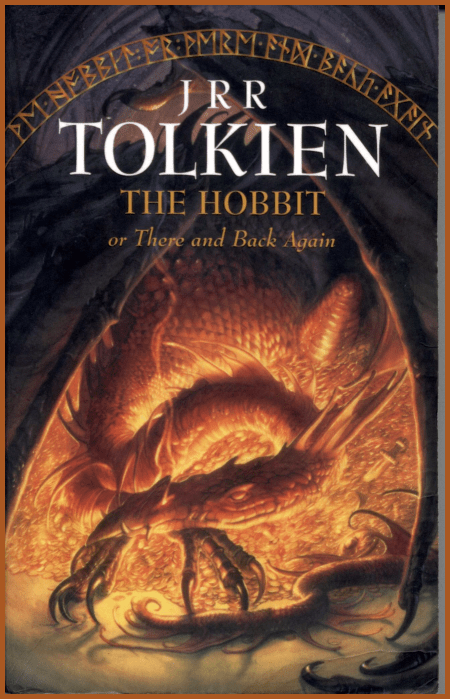
Trailer: The Hobbit: An Unexpected Journey


While Christopher Nolan’s The Dark Knight Rises is the most anticipated summer blockbuster for this upcoming 2012 then it would be safe to say that the most anticipated film for 2012 for some would be Peter Jackson’s The Hobbit: An Unexpected Journey.

This is a film that has been years in the making and even more years in development hell as the rights to J.R.R. Tolkien’s novel, The Hobbit, was entangled through many different studios. Once those entanglements were finally resolved and the film set to be put into production the film suffered more setbacks as budget and script rewrites kept things from starting. The original filmmaker picked to helm this two-part prequel, Guillermo Del Toro, had to back out after years of delays though he still remains as producer and his ideas and conceptual art and design has become the foundation for the film.

The film finally got the greenlight to start filming once Peter Jackson stopped searching for Del Toro’s replacement and took on the role as director once again. While Del Toro was a great choice I think most fans of the original trilogy were glad that Jackson decided to just take up the director’s chair once more. Who else knew the world of Middle-Earth on film better than the man who made what was called the unfilmable novel into the new millenium’s iconic film trilogy.

Like the production of the Lord of the Rings trilogy, Jackson and his geniuses at WETA have been pretty good with showing fans progress made on the films through video blogs released by Jackson himself. With just a year left to go before part one of this two-part prequel premieres we finally have the first official teaser trailer to the film and I must say that it’s great. Even from just snippets shown in the teaser one could see some of Del Toro’s more darker concepts and influence in the film’s look and tone. But then some of it also comes from Jackson himself whose early background as a filmmaker was all about dark, macabre subjects and themes.

The Hobbit: An Unexpected Journey is set for a December 14, 2012 release.

Trailer: 21 Jump Street (Red Band)


Ok, I have to admit that I was a huge fan of the Fox Network early 90’s cop show 21 Jump Street. What can I say other than it was a show about cops who looked like teenagers so using TV logic they go undercover in high school as students to catch bad guys. I mean the show gave birth to Depp and Grieco, nuff said.

It’s been twenty years since that show first first premiered and now we have the long-awaited, much-anticipated film adaptation of said show set for spring of 2012. It’s going to be an action-comedy but still using the same premise as the show, but instead of taking the original characters from the show and just having new actors play them the film just returns to the 21 Jump Street program with a new batch of recruits. So, instead of Johnny Depp and Richard Grieco we get Channing Tataum and Jonah Hill instead. I did read that Depp will appear in this film in a major cameo. Now, here’s to hoping they’re keeping Grieco’s appearance as a major secret.

The first trailer has been released and it’s in glorious red band. So, as I look at the trailer I will assume that this film will either be a very hard PG-13 or a soft R rating.

21 Jump Street has a release date of March 16, 2012.

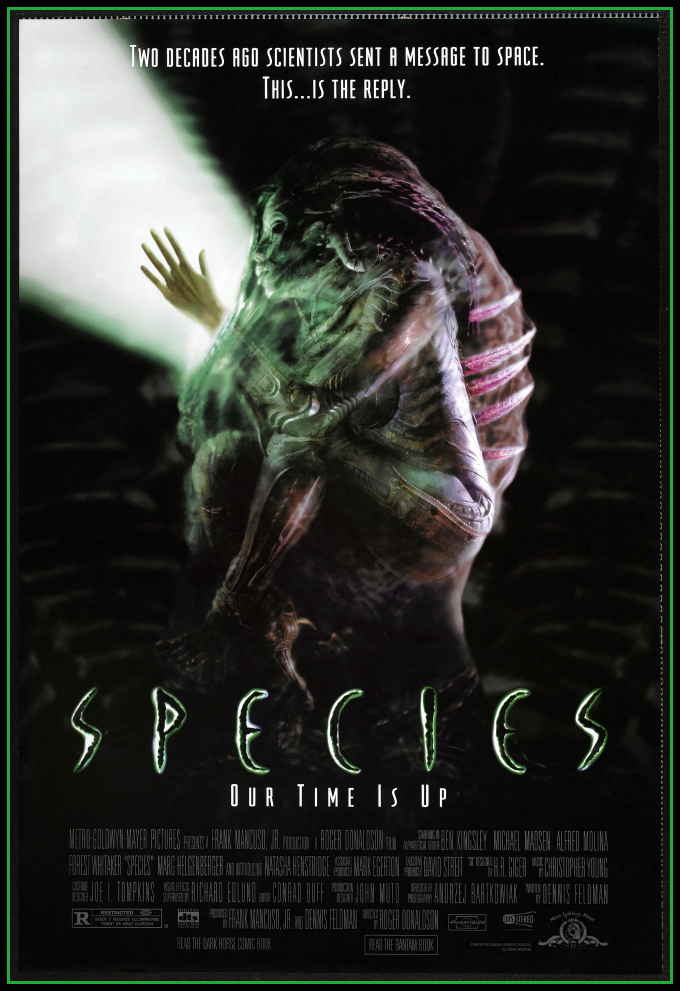
Quickie Horror Review: Species (dir. by Roger Donaldson)


1995’s Species was a studio’s attempt to replicate the start of a new sci-fi/horror franchise like the one begun by Ridley Scott’s Alien. Roger Donaldson was tapped to direct this attempt with a cast that included Sir Ben Kingsley, Michael Madsen, Marge Helgenberger, Forrest Whitaker and Alfred Molina. The lucky gal who gets to play the role of Sil — the half-alien, half-human hybrid — fell on the stunning and gorgeous shoulders of Natasha Henstridge.

Species pulls from so many different sci-fi/horror films and shows from the past that it’s hard to find anything original in the story. There’s stuff from Alien, The Hidden, and even some episodes of The X-Files. The one original twist in this derivate film was the plot of an alien race sending over the genetic markers of its race and instructions on how to recombine it with human DNA to create a form of hybrid. Why the scientists decided to go through with such a seemingly dangerous task is known only to the writer who put pen to paper to create the screenplay. The bulk of the film’s story comes from one the creation of one such human-alien hybrid named Sil (the young version played by Michelle Williams in one of her very first roles) and how her creators and handlers begin to realize that she has an almost desperate need to procreate.

The acting by the select group of experts (Madsen, Helgenberger, Molina, Kingsley and Whitaker) were good enough and no one embarrassed themselves in the end. Henstridge does a fine job of being sexy and hot. It helped that she pretty much was naked through most of the film, or at least put herself in situations to be naked. In fact, Henstridge goes beyond just being the naked eye candy in the film, but does a great job playing the naive adult Sil who escapes her lab-prison as her instincts propel her to find the perfect mate. It’s during this search that much of the film’s gore make their appearance and there’s a bit of it.

The art design of Sil as the evolved alien hybrid came courtesy of the great Swiss surrealist, H.R. Giger who also did the design for the alien creature in Alien. Giger’s biomechanical designs have always been disturbing and beautiful at the same time and he didn’t disappoint with his design of Sil. If there was a quibble on Sil’s final design it was that it still resembled a bit too much of the alien design in Ridley Scott’s Alien. But it was still great to see H.R. Giger still creating such wonderful artwork and designs for people to see. His popularity has always been mostly composed of the elite circles of the artworld and those small, loyal art groups with a penchant for the surreal, weird and disturbing.

In the end, Species was a good sci-fi/horror that didn’t bore too much and for those who enjoy their gore this film had its equal share of the red stuff. Gratuitious nudity and sex from Natasha Henstridge as Sil the alien hybrid and the excellent designs from H.R. Giger gives this film enough good things to look at. It doesn’t bring anything new and pretty much reuses alot of other things from other movies, but Species was good enough albeit derivative of better past films and shows.

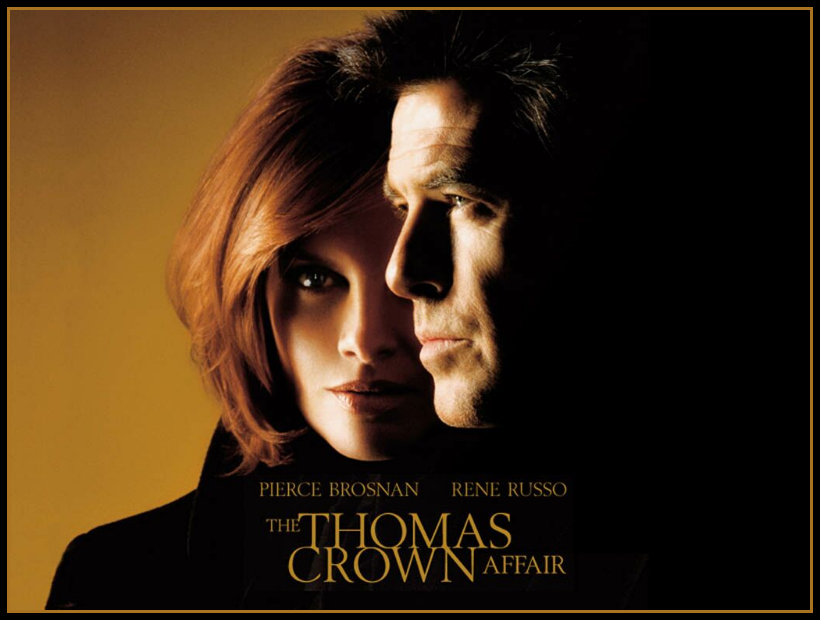
Review: The Thomas Crown Affair (dir. by John McTiernan)


In 1968 there was a little caper film titled The Thomas Crown Affair starring the ever-cool Steve McQueen and a radiant Faye Dunaway. The film was considered hip, cool and sexy in its way during the late 60’s. It took 31 years, but a remake was finally made of this film but this time around starring Pierce Brosnan and Rene Russo in the roles originally played by McQueen and Dunaway. With some great direction from thriller and action filmmmaker John McTiernan, 1999’s The Thomas Crown Affair ends up being the exception to the rule of remakes of older films turning out lesser than the original. This modern and updated version of The Thomas Crown Affair actually surpasses the original McQueen production. McTiernan’s film ably combines humor, thrilling action set pieces, sexy chemistry between the leads and just a beautifully shot film.

Set in New York that never looked as good as shot by McTiernan and his crew, Pierce Brosnan stars and shines as the title character Thomas Crown. Thomas Crown is a suave, roguish and successful businessman who has everything a man could ask for: money, power and any woman he desires.

What does a man like Crown would ever want in life?

The film looks at this and shows that no amount of money in the world could replace the adrenaline rush and thrill of getting acquiring it. Crown does this by staging a complex and elaborate plan to steal a Monet (San Giorgio Maggiore at Dusk) from the NY Metropolitan Arts Museum and do so in the middle of the day. His plan goes off without a hitch and with none the wiser. This heist sequence was actually very fun to watch as McTiernan never lost command of the many threads being weaved to pull off Crown’s plan. McTiernan would one-up this with the climactic finish in the same museum but with a sequence I could only call as the anti-heist.

With the heist completed, the film soon introduces Crown’s foil in the form of Rene Russo as insurance investigator Catherine Banning. Ms. Russo never looked more beautiful, sensual and sexy as she did in this film. Her performance as the determined and crafty Banning more than holds up to Brosnan’s roguish and playful performance as Thomas Crown. From the moment she appears onscreen as the camera slowly pans up her silky-stocking leg and garters, Russo dominated the scene and pretty much commanded attention from everyone. This was especially true whenever she shared the screen with Denis Leary as police detective in charge of investigating the Monet heist. Leary’s always a strong performer in any film he’s in but was pretty much lost in the wake of Russo’s performance when both were on the screen.

The rest of the film was pretty much Crown and Banning trying to get into each others’ heads to find the one advantage that would give them an upper-hand in the “game” they’ve both decided to play. It’s hard to see who is chasing who in the film. Is Banning chasing Crown as her one and only suspect for the theft or is Crown playing her as part of a much more complicated scheme to spice his life. These questions swirl within the frame of the heist investigation and the growing relationship between the two strong-willed characters.

To say that Brosnan and Russo’s on-screen chemistry was strong would be a big understatement. The two pretty much sizzle when together. Whether it’s a playful, flirtation during a nice dinner out on the town to the two steamy dance numbers in the middle of the film. When Crown asks Banning if she wanted to dance or does she want to dance the temperature just went up by degrees. Their love scenes together shows that it could still be done with class and also have a sense of playfulness and fun. It also showed that young couples doing love scenes onscreen have nothing on the mature couple.

There’s not much else to say about McTiernan’s remake of the Thomas Crown Affair than to say that he took a good film, that showcased Steve McQueen’s coolness for everyone to see, and made a much more superior production in every sense. The direction was excellent and the cinematography was beautiful in every second shot. The cast performance was very strong with the two leads in Brosnan and Russo acting their hearts out on the screen. This film shows that remakes really are not bad ideas when put into capable hands. It would be nice to see how the sequel — tentatively titled The Topkapi Affair —  to this film turns out with pretty much the same cast and crew returning. I, for one, will be there to see it when it comes out.

Poll: Who should direct “The Hobbit”?


Now that Guillermo Del Toro has made it official that he’s leaving The Hobbit as director there’s now a scramble to find who will be replacing him on the project. Del Toro was universally hailed as the best choice the first time around when Peter Jackson made it known that he would only produce the two-part film and not get back to directing them. The many delays due to MGM’s financial troubles, script still not completed and casting still not done forced GDT to back away and could shelve the project for good.

The only thing keeping the project afloat is the fact that this project has a major fan-base already clamoring to see it made. With the huge success both critically and commercially of Jackson’s The Lord of the Rings Trilogy this two-part film adaptation of The Hobbit is pretty much a lock to do the same in the hands of the right filmmaker.

Jackson and studio heads holding the rights to the project will not want just any director. While Peter Jackson was still a little-known director and an outsider from the Hollywood scene when he began work on the original trilogy, this time around studio people will want a marketable name or, at the very least, a filmmaker who has the skills to follow Jackson’s work. Guillermo Del Toro was the perfect choice now someone else has to take up the baton.

Some have mentioned Peter Jackson as the only choice if he’d back off comments that he won’t direct but only produce. There’s a camp that say now’s the time to sign Sam Raimi who recently has left another mega-franchise and now available. Raimi is an interesting choice in that knows how to handle huge blockbuster projects and he definitely needs a home-run to follow-up a bad end as helmer of the Spider-Man franchise.

Another name to come up which I would welcome if Jackson doesn’t return as director is Guillermo Del Toro’s fellow countryman and one of his best friends: Alfonso Cuaron. Cuaron has shown himself to be one of his generation’s best. He’s done fantasy as helmer of the third Harry Potter film (universally seen as the best in the franchise) and may see tackling this blockbuster project as a major artistic challenge. I, for one, would hope Cuaron takes the job if offered.

The one dark horse name which has begun making the rumor mill about who may replace GDT is Jackson’s own protege, wunderkind filmmaker Neill Blomkamp. He’s worked with Jackson already and his first feature-length film, District 9, shows he has the storytelling and directing chops. The only drawback to him accepting the job if offered is that this will be a major-budgeted studio film which means it could turn into another Halo-clusterfuck where he commits and the project dies due to problems within the studio.

Other filmmakers have been mentioned like Brad Bird, Jean-Pierre Jeunet, Andrew Adamson, Tim Burton and Peter Weir just to name a few. In the end, my money is on either Jackson just taking the reins on the film if he thinks no one else would give the necessary commitment to the project it deserves, Cuaron takes on the job as a way to challenge himself or Jackson protege Blomkamp tackling something bigger as a way to add more cred to his growing reputation as one of the best young filmmaker of his generation.

Who do you think should take charge of The Hobbit now that Guillermo Del Toro has left?