Horror Film Review: The Vampire Bat (dir by Frank R. Strayer)


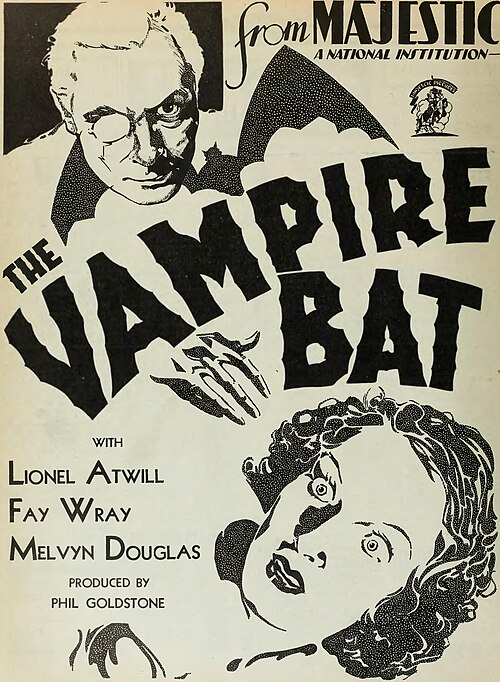
In 1933’s The Vampire Bat, people are dying in a small German village, victims of blood loss.  A woman named Martha Mueller (Rita Carlisle) was recently attacked by a bat, leading to rumors of a vampire.  When the local town eccentric, a twitchy man named Hermann Glieb (Dwight Frye), argues that bats are actually harmless and admits that he likes bats because they are “soft” and “nice,” people start to suspect that he might be the vampire.  Another man named Kringen (George E. Stone) claims that he was attacked by a vampire and insinuates that it was Glieb.  Glieb may seems like a strange man who likes to collect bats but could he be something even more sinister?

Two town leaders have opposite feelings about the claim that a vampire is attacking the town.  Karl Brettschneider (Melvyn Douglas) is the local police inspector and he deals with facts.  He doesn’t believe in superstition and he initially scoffs at the idea that a vampire is attacking the village.  Meanwhile, Dr. Otto von Niemann (Lionel Atwill) is the town’s doctor.  He’s been treating the victims of the bat attacks and he’s even be letting some of his patients live at his home.  Everyone knows that Dr. von Neimann is a kindly man of science.  Karl is even dating Ruth (Fay Wray), one of Otto’s boarders.  But is the doctor as benevolent as everyone assumes?

When answering that question, consider these four facts:

  1.  Dr. von Neimann is the one who encouraged Kringen to spread stories about a vampire haunting the town, despite the fact that Kringen himself said that he didn’t want to start a panic.
  2. Dr. van Niemann is played by Lionel Atwill.
  3. Glieb is played by Dwight Frye.
  4. Karl is played by Melvyn Douglas.

Indeed, for horror fans, the casting of Lionel Atwill gives the game away.  Lionel Atwill appeared in a number of horror films and it was rare that he wasn’t cast as the villain.  (One of his non-villainous role was as the one-armed Inspector Krogh in The Son of Frankenstein.)  From the minute the viewer sees Atwill, he seem to give off sinister vibes and it’s not really a surprise when he turns out to be less than trustworthy.

As for Dwight Frye, horror fans love him for playing a number of unhinged weirdos, like Renfield in the Lugosi-version of Dracula and the torch-bearing servant in Karloff’s Frankenstein.  Frye was good at playing twitchy types but one thing that all of Frye’s characters had in common is that they were pretty much destined to be victims.  Even when Frye played an unlikeable character,  like in Frankenstein, it was obvious that he was going to end up getting killed at the hands of the Monster.

Finally, Melvyn Douglas was the epitome of propriety in every film in which he appeared.  If Douglas thinks that there is something more going on than just a vampire attacking people, there probably is.  And since we know Douglas can’t be the main bad guy, that pretty much just leaves Lionel Atwill.

The Vampire Bat is a short and enjoyable B-movie that puts an interesting spin on the typical vampire legend.  Though the budget may be low, the cast of Atwill, Douglas, Frye, and Wray can’t be beat and all of them give fully committed performances.  Dwight Frye, in particular, gives one of his best performance as the unfortunate Glieb.  As always, Lionel Atwill makes for an entertaining villain.  At its best, The Vampire Bat comments on the power of hysteria.  Convinced that there is a vampire in their midst, the town goes mad and it directs its anger towards those who are seen as being on the outside, men like Glieb.

The Vampire Bat is more than worthy of your Halloween viewing.

Retro Television Review: Death Takes A Holiday (dir by Robert Butler)


Welcome to Retro Television Reviews, a feature where we review some of our favorite and least favorite shows of the past!  On Sundays, I will be reviewing the made-for-television movies that used to be a primetime mainstay.  Today’s film is 1971’s Death Takes A Holiday!  It  can be viewed on YouTube.

For a few days in 1971, no one dies.

The Vietnam War continues but there are no casualties.  There are natural disasters but no one loses their life.  Doctors are stunned.  World leaders start to panic.  An emergency session of the UN is called to debate what to do about living in a world where no one is dying.  One gets the feeling that the world’s leaders prefer it when people are dying in wars and disasters.

Death has taken a holiday.

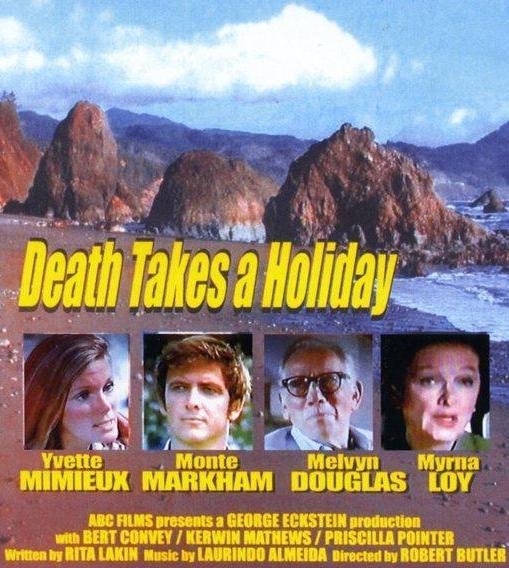
Death (Monte Markham) has become confused as to why humans so desperately want to live despite the fact that the world in which they exist is not always a happy one.  He is particularly confused by the elderly Judge Earl Chapman (Melvyn Douglas), who has suffered multiple strokes and other ailments and yet has always resisted whenever Death has come for him.  Death decides to take his holiday on the isolated beach where the Judge and his family are spending their weekend.  Though Death introduces himself as being David Smith, the Judge recognizes him.  It turns out that the Judge was always aware of death lingering around him and his family.

Death, for his part, has fallen in love with the Judge’s headstrong and rebellious daughter, Peggy (Yvette Mimieux).  In fact, Peggy was meant to die on the beach but, as soon as Death saw her drowning, he decided not to take her and instead allowed her to wash up back on the beach.  Death explains to the Judge that he can only spend so much time on vacation and that soon, people will start dying again.  Death says that he’ll be taking Peggy to the afterlife after the weekend ends.  The Judge tries to change his mind but Death is in love and he wants Peggy to be with him.

An adaptation of a play that inspired both 1934’s Death Takes A Holiday and 1998’s Meet Joe Black, the 1971 version of Death Takes A Holiday is a well-acted and intelligent made-for-television movie, one that eschews heavy-handed drama in favor of being a rather low-key meditation on what it means to both live and to die.  Melvyn Douglas and, as his wife, Myrna Loy both give poignant performances and Douglas even manages to sell the potentially maudlin moment where he explains why he has always clinged to life.  Monte Markham may not be the first actor who comes to mind when you think of someone to cast as the human form of Death but he does a good job in the role and he and Yvette Mimieux have a wonderful chemistry together.  The beach scenery is lovely and the story is an interesting one.  Clocking in at just 73 minutes, this version of Death Takes A Holiday is the best of all of them.

Horror on TV: Ghost Story 1.8 “House of Evil” (dir by Daryl Duke)


Tonight’s episode of Ghost Story is full of stars!

Evil grandpa comes to visit his family and, with the help of voodoo cookies (you read that right), he tries to manipulate his deaf and mute granddaughter into helping him kill everyone!  Grandpa is played by Melvyn Douglas.  His granddaughter is played by Jodie Foster!  And the script was written by none other than Robert Bloch and Richard Matheson!

This episode originally aired on November 10th, 1972.

Love on the Shattered Lens: Rapture (dir by John Guillermin)


The 1965 film, Rapture, is an odd one.

It takes place in France, largely at an isolated home sitting on a cliff above the Brittany coast.  Frederick Larbaud (Melvyn Douglas) is a former judge who has largely retreated from society.  He lives in his house with his teenager daughter, Agnes (Patricia Gozzi) and his promiscuous housekeeper, Karen (Gunnel Lindbloom).  He’s a stern man, one who is obviously struggling to overcome a vaguely defined personal tragedy.  He is very overprotective of his daughter, Agnes.

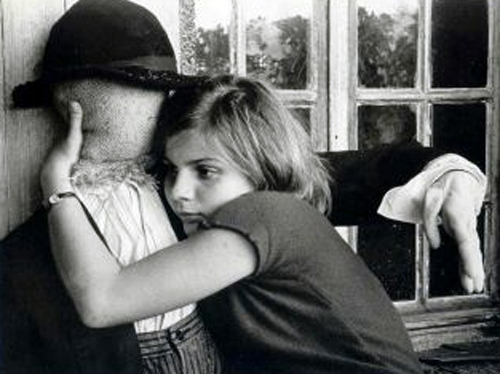
As for Agnes, she alternates between moments of childish immaturity and moments of surprising clarity.  She’s the type who still plays with dolls but who also casually tosses them over the cliff so that they can shatter on the rocks below.  She seems to be naive and innocent but, at the same time, she’s also capable of blackmailing Karen and threatening to tell her father that Karen’s boyfriend sneaks into the house at night.  When the sheltered Agnes gets her father’s permission to make a scarecrow for the garden, she throws herself into the work, even going so far as to flirt with the scarecrow after it’s been built.

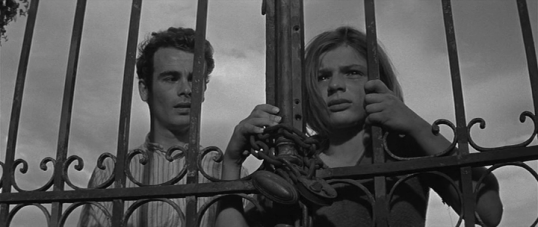
Meanwhile, a sailor named Joseph (Dean Stockwell) has been arrested for getting into a fight during a drunken night on the town.  While he’s being transported to jail, the prison bus runs off the road.  Joseph escapes from the bus and runs up a hill, passing by Frederick, Agnes, and Karen.  Though the police manage to seriously wound Joseph, he still escapes.

Later that night, during a violent storm, Agnes is shocked to see that her scarecrow has vanished.  While she’s out searching for it, she comes across a delirious Joseph.  Because Joseph has stolen the scarecrow’s clothes, Agnes decides that her scarecrow has come to life and, as a result, Joseph belongs to her.  Surprisingly, Frederick expresses no reservations about allowing Joseph to stay at the house while he recovers from his gunshot wound.

Once Joseph recovers, he explains to Frederick what happened and says that he should probably turn himself in and hope for the best.  Frederick, however, disagrees.  It turns out that Frederick has an agenda of his own and part of that agenda is revealing that brutality of the police.  He continues to allow Joseph to hide out at his house but little does Frederick know that Joseph is falling in love with Agnes (and, of course, Agnes still thinks that Joseph is her scarecrow come to life).

Rapture took me by surprise.  When the film started, I honestly thought it was going to be unbearably pretentious and I wasn’t exactly filled with confidence when I discovered that the film was directed by John Guillermin, a prolific British director whose career spanned from the 50s and the 80s but whose overall output is not particularly highly regarded among film historians.  With its obvious debt to Ingmar Bergman, Rapture did not seem like the type of movie that one would expect to be successfully directed by the 1960s equivalent of Taylor Hackford.  And, it should be said, that the first fourth of the film is rather pretentious and a bit silly.  The black-and-white cinematography is frequently gorgeous and atmospheric but Agnes’s eccentricity often feels overwritten and it seems to take forever for Joseph to actually show up at the house.

However, things get better.  The film, itself, doesn’t become any less pretentious but eventually Joseph starts to fall for Agnes and the chemistry between Dean Stockwell and Patricia Gozzi is strong enough that it carries the viewer over the film’s rough spots.  The film becomes less about how strange Agnes is and more about a sheltered girl falling in love for the first time and, freed from the inconsistency that marred her characterization during the first part of Rapture, Patricia Gozzi’s performance starts to click as Agnes becomes relatable and even sympathetic.

The film hits a high point when Joseph and Agnes try to start a life for themselves away from Agnes’s father and we watch a lengthy montage of their steadily deteriorating relationship.  In a manner of minutes, we witness how quickly the intrusion of the real world threatens to cause their too perfect romance to go awry.  Most of the montage is made up of overhead shots and it captures the feeling of two naive lovers being overwhelmed by the difficulties of living in the real world.  With each movement of the camera, we feel Agnes and Joseph’s world getting a little bit more claustrophobic and a little more threatening.

The film ends on a sad note, which shouldn’t come as a surprise to anyone watching.  From the minute that Agnes leads a wounded Joseph into the house, we know that their love is doomed.  That said, it’s still a rather odd ending and one that raises more questions than it answers.  It’s a strange ending for a strange film and it’s one that will stick with you long after you watch it.

Halloween Havoc! Extra: THE VAMPIRE BAT (Majestic 1933) Complete Horror Movie!


gary loggins's avatarcracked rear viewer

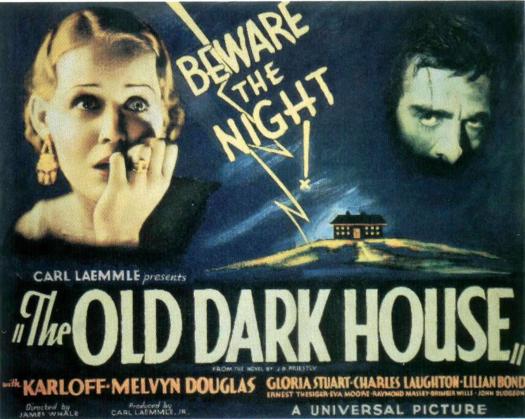
1933’s THE VAMPIRE BAT isn’t a Universal Horror movie, but it sure comes damn close! This independent feature from Majestic Pictures contains a number of Universal Horror stars, including Lionel Atwill , Melvyn Douglas (THE OLD DARK HOUSE ), Lionel Belmore (FRANKENSTEIN ), and a positively Renfield-like performance from the great Dwight Frye – not to mention KING KONG’s main squeeze Fay Wray as our heroine! Majestic also rented some of the standing sets from FRANKENSTEIN and THE OLD DARK HOUSE to film on, giving the film a real Universal feel.

The screenplay by Edward T. Lowe (who wrote Lon Chaney’s 1923 HUNCHBACK OF NOTRE DAME, and the later horror entry HOUSE OF DRACULA) concerns the village of Kleinschloss up in arms over a series of gruesome murders that point to the presence of a vampire in their midst, with Frye’s simple-minded Herman the chief suspect. Turns out the killings…

View original post 39 more words

Happy Birthday Boris Karloff: THE OLD DARK HOUSE (Universal 1932)


gary loggins's avatarcracked rear viewer

William Henry Pratt was born on November 23, 1887, but horror movie icon Boris Karloff was “born” when he teamed with director James Whale for 1931’s FRANKENSTEIN. The scary saga of a man and his monster became a big hit, and Universal Studios boss Carl Laemmle Jr. struck while the horror trend was hot, quickly teaming the pair in an adaptation of J.B. Priestley’s 1927 novel THE OLD DARK HOUSE. This film was considered lost for many years until filmmaker and Whale friend Curtis Harrington discovered a print in the Universal vaults. Recently, a 4K restoration has been released courtesy of the Cohen Film Collection, and a showing aired on TCM this past Halloween. I of course, having never seen the film, hit the DVR button for a later viewing.

THE OLD DARK HOUSE has not only been restored to its former glory, but is a delightful black comedy showcasing…

View original post 994 more words

A Movie A Day #235: Twilight’s Last Gleaming (1977, directed by Robert Aldrich)


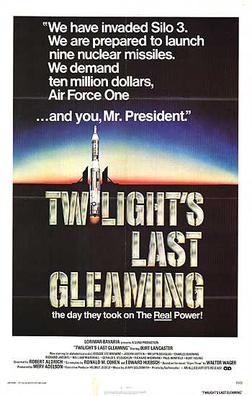
In Montana, four men have infiltrated and taken over a top-secret ICBM complex.  Three of the men, Hoxey (William Smith), Garvas (Burt Young), and Powell (Paul Winfield) are considered to be common criminals but their leader is something much different.  Until he was court-martialed and sentenced to a military prison, Lawrence Dell (Burt Lancaster) was a respected Air Force general.  He even designed the complex that he has now taken over.  Dell calls the White House and makes his demands known: he wants ten million dollars and for the President (Charles Durning) to go on television and read the contents of top secret dossier, one that reveals the real reason behind the war in Vietnam.  Dell also demands that the President surrender himself so that he can be used as a human shield while Dell and his men make their escape.

Until Dell made his demands known, the President did not even know of the dossier’s existence.  His cabinet (made up of distinguished and venerable character actors like Joseph Cotten and Melvyn Douglas) did and some of them are willing to sacrifice the President to keep that information from getting out.

Robert Aldrich specialized in insightful genre films and Twilight’s Last Gleaming is a typical example: aggressive, violent, sometimes crass, and unexpectedly intelligent.  At two hours and 30 minutes, Twilight’s Last Gleaming is overlong and Aldrich’s frequent use of split screens is sometimes distracting but Twilight’s Last Gleaming is still a thought-provoking film.  The large cast does a good job, with Lancaster and Durning as clear stand-outs.  I also liked Richard Widmark as a general with his own agenda and, of course, any movie that features Joseph Cotten is good in my book!  Best of all, Twilight’s Last Gleaming‘s theory about the reason why America stayed in Vietnam is entirely credible.

The Vietnam angle may be one of the reasons why Twilight’s Last Gleaming was one of the biggest flops of Aldrich’s career.  In 1977, audiences had a choice of thrilling to Star Wars, falling in love with Annie Hall, or watching a two and a half hour history lesson about Vietnam.  Not surprisingly, a nation that yearned for escape did just that and Twilight’s Last Gleaming flopped in America but found success in Europe.  Box office success or not, Twilight’s Last Gleaming is an intelligent political thriller that is ripe for rediscovery.

Horror Film Review: Ghost Story (dir by John Irvin)


ghoststory

A Fred Astaire horror movie!?

Yes, indeed.  Ghost Story is a horror movie and it does indeed star Fred Astaire.  However, Fred doesn’t dance or anything like that in Ghost Story.  This movie was made in 1981 and Fred was 82 years old when he appeared in it.  Fred still gave an energetic and likable performance and, in fact, his performance is one of the few things that really does work in Ghost Story.

Fred Astaire isn’t the only veteran of Hollywood’s Golden Age to appear in Ghost Story.  Melvyn Douglas, John Houseman, and Douglas Fairbanks, Jr. all appear in the movie as well.  They play four lifelong friends, wealthy men who have formed an informal little club called The Chowder Society.  They gather one a week and tell ghost stories.  Myself, I’m wondering why these four intelligent and accomplished men (one is a lawyer, another a doctor, another a politician, and another is Fred Astaire) couldn’t come up with a better name than Chowder Society.

(But I guess that’s something that people do up north.  Harvard has something called the Hasty Pudding Club, which just sounds amazingly annoying.)

Unfortunately, the members of the Chowder Society have a deep, dark secret.  Way back in the 1930s, the boys listening to too much jazz and they all ended up lusting after the mysterious and beautiful Eva Galli (Alice Krige).  As Astaire explains it, “We killed her, the Chowder Society.”

(Of course, there’s more to the story.  It was more manslaughter than murder but either way, it was pretty much the fault of the Chowder Society.)

And now, decades later, a woman named Alma (Alica Krige, again) has mysteriously appeared.  When she sleeps with David (Craig Wasson), the son of a member of the Chowder Society, David falls out of a window and ends up splattered on the ground below.  David’s twin brother, Don (also played by Craig Wasson), returns to their childhood home and attempts to make peace with his estranged father.

However, now the member of the Chowder Society are starting to die.  One falls off a bridge.  Another has a heart attack in the middle of the night.  Fred Astaire thinks that Eva has come back for revenge.  John Houseman is a little more skeptical…

I pretty much went into Ghost Story with next to no knowledge concerning what the film was about.  I thought the plot desription sounded intriguing.  As a classic film lover, I appreciated that Ghost Story was not only Fred Astaire’s final film but the final film of Douglas and Fairbanks as well.  Before he deleted his account, I had some pleasant interactions with Craig Wasson on Facebook.   I was really hoping that Ghost Story would be a horror classic.

Bleh.

Considering all the talent involved, Ghost Story should have been great but instead, it just fell flat.  Alice Krige is properly enigmatic as both Alma and Galli and really, the entire cast does a pretty good job.  But, with the exception of exactly three scenes, the film itself is never that scary.  (Two of those scary scenes involve a decaying corpse and it’s not that hard to make decay scary.  The other is a fairly intense nightmare sequence.)  Largely due to John Irvin’s detached direction, you never really feel any type of connection with the characters.  I mean, obviously, you don’t want to see the star of Top Hat die a terrible death but that has more to do with the eternal charm of Fred Astaire than anything that happens in Ghost Story.

Add to that, Ghost Story‘s special effects have aged terribly.  There are two scenes in which we watch different characters fall to their death and both times, you can see that little green outline that always used to appear whenever one image was super imposed on another.  It makes it a little hard to take the movie seriously.

Sadly, Ghost Story did not live up to my expectations.  At least Fred Astaire was good…

The Fabulous Forties #35: That Uncertain Feeling (dir by Ernst Lubitsch)


That_Uncertain_Feeling

The 35th film in Mill Creek’s Fabulous Forties box set was — wait a minute?  I’m on my 35th Fabulous Forties review?  Let’s see — there’s 50 films in the box set so that means that I only have 15 more of these to write and I’ll be done!  And then I can move onto the Nifty Fifties, the Sensation Sixties, the Swinging Seventies, and the Excellent Eighties!  YAY!

Anyway, where was I?

Oh yeah, the 35th film.

First released in 1941, That Uncertain Feeling is a movie about sophisticated people doing silly things.  Socialite Jill Baker (Merle Oberon) gets the hiccups whenever she gets nervous or irritated.  Her trendy friends suggest that she try the new big thing: seeing a psychoanalyst!  At first, Jill is reluctant but eventually, she gives in to the pressures of high society and she goes to visit Dr. Vengard (Alan Mowbray).  Dr. Vengard tells her that her hiccups are a result of her marriage to Larry (Melvyn Douglas) and suggests that the best way to cure them would be to get a divorce.

At first, Jill is horrified at the suggestion.  Whatever will people think if she gets a divorce!?  However, Larry is kind of a condescending jerk.  (Or, at least, he comes across as being a jerk when viewed by 2016 standards.  By 1941 standards, I imagine he’s supposed to be quite reasonable.)  And Jill happens to meet another one of Vengard’s patients, an outspoken pianist named Alexander Sebastian (Burgess Meredith).

Soon, Jill is not only contemplating getting a divorce from Larry but perhaps marrying the eccentric Sebastian as well!  When Larry realizes that Jill is dissatisfied with their marriage and that she is attracted to Sebastian, he gives her a divorce.  He even pretends to be an abusive husband so that she can file for divorce on grounds of cruelty.  (It’s funnier than it sounds.)  Jill and Sebastian get engaged but, once Larry starts to date again, Jill realizes that she’s not quite over her ex…

I was really excited when I saw that The Uncertain Feeling was an Ernst Lubitsch film.  Lubitsch directed some of my favorite Golden Age comedies, films like Ninotchka and Heaven Can Wait.  But That Uncertain Feeling is not quite up to the standard of the other Lubitsch films that I’ve seen.  As played by Burgess Meredith, Sebastian never comes across as being a realistic rival to Larry.  The character is so cartoonishly eccentric that it becomes impossible to see what Jill sees in him.  At the same time, Larry comes across as being such a chauvinist that it’s far easier to understand why Jill would divorce him than why she would ever want to take him back.  The end result is a rare Lubitsch misfire.

However, as long as we’re talking about Lubitsch, make sure to see The Smiling Lieutenant if you get the chance.  Now, that’s a good Lubitsch film…

(And be sure to follow it up with The Love Parade...)

Cleaning Out The DVR #32: Ninotchka (dir by Ernst Lubitsch)


(For those following at home, Lisa is attempting to clean out her DVR by watching and reviewing 38 films by the end of today!!!!!  Will she make it?  Keep following the site to find out!)

Film_ninotchka

Oh my God, I love this movie!

First released in 1939, Ninotchka is many things.  It’s a love story.  It’s a comedy.  It’s a story of international intrigue.  It’s a political satire.  It’s a celebration of freedom.  And, perhaps most importantly, it’s a showcase for one of the greatest actresses of all time, the one and only Greta Garbo!

But you know what?  As great as Garbo is, she’s not the only worthy performer in this film.  Melvyn Douglas plays Garbo’s love interest and his performance is full of charm and class.  And guess who plays the main villain?  BELA LUGOSI!  That’s right — this was one of Lugosi’s few roles that did not require him to play a variation on his famous Dracula.  And, even if he doesn’t have a lot of scenes, Lugosi does a pretty good job in Ninotchka.  It’s interesting to see Lugosi playing an all-too real monster for once.

Ninotchka opens in Paris.  Three Russians are in town and they’re trying to sell some jewelry that was confiscated by the government during the revolution of 1917.  That’s right — they’re communists!  When they first show up in Paris, they make a big deal about hating the decadence of capitalism.  But then they meet Count Leon d’Algout (Melvyn Douglas), who proceeds to introduce them to the wonders of the free market.  Soon, the three of them are holed up in their luxurious hotel, ordering room service and having a nonstop party.

(Leon, incidentally, is working for the original owner of the jewelry.  The jewelry, as you’ve probably guessed, is what Hitchock would have called a macguffin.)

Once it becomes obvious that the first three Russians have been corrupted by western society, Ninotchka (Greta Garbo) is sent to bring them back to Moscow.  Ninotchka is a “special envoy” and, from the minute that she meets Leon, it’s obvious that she’s going to be a lot more difficult to corrupt.  For all of Leon’s charm, he cannot get Ninotchka to smile or drop her “all Marxist business” attitude.

Of course. from the minute that she first appears, we all know that Ninotchka is eventually going to loosen up and come to love both the west and Melvyn Douglas.  But what makes Garbo’s performance truly special is that we like and sympathize with Ninotchka even before she embraces decadence.  Even when Ninotchka is reciting Marxist-Leninist dogma, there’s a playfulness to the way Garbo delivers the lines.

That’s one reason why it’s so much fun to watch as Ninotchka (and Garbo) starts to actually relax and enjoy both Paris and life.  Wisely, the film doesn’t suggest that Paris has changed Ninotchka.  Instead, it merely shows that being in Paris and getting to know Leon has finally allowed her to act like the person that she was all along.

(Before her appearance in Ninotchka, Garbo was known for playing very dramatic roles.  Not only is this film about Ninotchka learning to enjoy herself.  It’s also about Garbo proving that she could play comedy just as well as she could play melodrama.)

Of course, eventually, Ninotchka and the three Russians are forced to return to Moscow and director Ernst Lubitsch does a wonderful job contrasting the glamour of freedom-loving Paris with the drabness of life under communism.  Just when it looks like Ninotchka is going to be forced to spend the rest of her life in her depressing apartment and missing the luxury of being able to wear silk stockings, her boss (Lugosi) tells her that she is being assigned somewhere else.  Ninotchka doesn’t want the assignment but, as Lugosi explains, the revolution doesn’t care what the individual wants.

Will Ninotchka and her friends ever find their way back to freedom and Leon?  Or will she remain trapped in the bureaucracy?  You’ll have to watch the film to find out!

I really liked Ninotchka.  Even 77 years after it was first released, it remains a wonderfully romantic and sweet-natured little comedy.  If you haven’t seen it, you definitely should!

Ninotchka was one of the many great films to be nominated for best picture of 1939.  However, the Oscar went to another famously romantic film, Gone With The Wind.