Note that this isn’t the only review for Contagion.
Arleigh has an in-depth review of the film, which is also available to see, whereas this is more of a summary. As it’s for the same film, I’ve used the same tags that were in Arleigh’s post.
Before I start, I have to say that I haven’t had a theatre be so quiet during a film since I went to see Mirrors, and that was because there was no one there. My showing for Contagion was packed, but no one made a sound throughout the film. I coughed twice (because I had to), and you wouldn’t believe how many heads turned in my general direction. If nothing else, it shows that the movie had some impact to the audience, and that’s always (okay, usually) interesting to see. By the time the movie is over, you will probably pay attention to how many times you touch your face or the objects around you.
If there’s one thing I can give director Steven Soderbergh, it’s that he has a great ability to work with ensemble casts. He did a great job in getting everyone to work together on the Oceans Eleven remake and sequels. He also walked away with a Best Director Oscar for Traffic. His films have the ability to avoid having his stars chew up enough screen time that they appear to be an actual center character. Catherine Zeta-Jones’ had a character who’s story was just as strong as Benecio Del Toro’s.
On this, Contagion is no different. In essence, it’s almost like watching cameos in a miniseries.
Although the film is peppered with various actors, no one person can be considered the main character of the film. Soderbergh is able to get them all to play their roles well. He and Scott Z. Burns – one of the writers on The Bourne Ultimatum and a collaborator with Soderbergh – give us a number of perspectives for this story and damn, the whole thing is very tight overall. The movie has very little wasted space.
Like the story itself, the movie moves at a great pace, opening with Elizabeth Emhoff (Gwenyth Paltrow) on her second day after exposure to the virus after returning from a trip to Hong Kong. This eventually escalates to other infections reported in other areas around the world. In an effort to contain and understand what they’re dealing with, the Center for Disease Control starts an investigation. Lead by Dr. Ellis Cheever (Lawrence Fishburne), he sends Dr. Erin Mears (Kate Winslet) to Minnesota to determine the scale of the problem.
In addition to the CDC’s efforts, the World Health Organization also gets involved, sending their own field agent to Hong Kong, played by Marion Cotillard. Both doctors come up with information that appear to be helpful for the overall investigation in various ways.
The other two angles in the film are through a conspiracy theory blogger / investigative reporter played by Jude Law and Mitch Emhoff (Matt Damon), who has to deal with the impact of his wife’s sickness. Enrico Colantoni, Brian Cranston, Sanaa Lathan, Elliot Gould and Jennifer Ehle round out the cast. It should be noted that Ehle is the daughter of Kenneth Branaugh’s Hamlet actress Rosemary Harris, who looks remarkably like her mother. That’s just something that caught my eye.
In terms of the Kid Factor, I would be hesitant to take kids to see this unless they had a pretty clear handle on death or getting sick. Teens and adults could probably handle the film, but anyone under than that may freak out a little. Mind you, there’s very little gore in this film. When I think about it, there’s not even a whole lot of blood. There is some violence though as the story escalates and humanity goes wild, but it’s not that far a cry from many zombie movies. It’s up to the parents discretion on whether their kids should see this.
I should also point out that the music in this film is also very good. Cliff Martinez, who also worked on the score for Drive (also out this month) did an impressive job with an electronic score that sits in the background of the film, but also fits the pacing of the film well. It’s worth giving it a listen if at all possible. This quick review was actually written to the Contagion score.
Contagion is definitely worth seeing, easily recommended, but if you happen to be particular about germs, note that this may not be the most comfortable film to watch. Don’t be shocked if you end up hugging yourself while watching this in the theatre. With Soderbergh moving away from film directing to pursue other interests, Contagion is a nice final bow to his career.
In a world where almost every season news media both traditional and on-line warn the population of what could be an outbreak of a new super-virus that could cause a new pandemic similar to the Spanish Flu of 1918. This was a pandemic which occurred before transcontinental travel was the norm and the virus still managed to kill 1% of the world’s population. Now, it’s 2011 and with warnings of swine flu, bird flu, Ebola, SARS and any number of infectious diseases still in the public’s consciousness we get a new film from filmmaker Steven Soderbergh which seriously explores a world discovering a new deadly disease and how the world responds and deals with the crisis.
Contagion begins with a simple “Day 2” caption as we see one Beth Emhoff (Gwyneth Paltrow) awaiting her flight to board in O’Hare at Chicago. There’s a bit of character building about this character who we see as already in the early stages of what looks to be the flu. From there Soderbergh does an interesting bit where he lets the camera linger for just a split second longer whenever Beth touches something. Soderbergh does this many times that the audience will soon get used to it and forget the significance of the act. We see Beth get a ride home from a colleague back to her home where she’s welcomed home by her husband Mitch and her young son Clark who runs to her and gives her a big hug.
The story really hits the ground running as Beth and soon those she has come into contact with begin to show similar symptoms and quickly die. The CDC and it’s head administrator, Dr. Ellis Cheever (Laurence Fishburne), soon begin to see a pattern to the deaths and the similarity to their symptoms. We soon see another aspect of the story begin with the arrival of Dr. Erin Mears whose job is to investigate the circumstance which seems to be leading into a cluster case starting with Beth and the area she lives in.
The third aspect of this film throws in internet news blogger Alan Krumwiede (Jude Law) who begins to suspect that several deaths around the world looks to be interconnected in someway and that the government, the CDC and the WHO (World Health Organization) are trying to hide these disturbing facts from the general public. Krumwiede becomes the purveyor of unfiltered news which seems to do more harm than good as more and more people begin to believe his conspiracy theories about what looks to be a growing global pandemic cause by an unknown virus every expert brought in to help cannot seem to figure out.
Let me just first say that to call Contagion a thriller in the traditional sense would be flimsy at best. Soderbergh and the film’s writer, Scott Z. Burns, have made a thriller but in a sense that it skews heavily on using realism and an almost docudrama style to push the film’s narrative. The thriller aspect comes from the notion that this film’s plot is not far off from actually becoming a real event. There’s no usage of dramatic tropes from past disaster and apocalyptic films to manipulate the audience. The film as a thriller would be quite mundane when stacked up against films like Outbreak and The Andromeda Strain. It’s the realness of the story, the events taking place on the screen which gives the film it’s dramatic heft.
We begin to see what Soderbergh is trying to accomplish with this film. How transcontinental travel which took weeks during the 1918 Spanish Flu pandemic now can spread a highly infectious disease in a manner of less than a day’s plane flight over one ocean. The film shows in disturbing detail just how easily we as a people can spread a disease just by doing the most innocuous thing like absently touching one’s face many times a minute then transferring whatever we had to any surface we touch. Contagion definitely will add to the paranoia of those who already have an unhealthy habit of disinfecting everything before they even touch it.
The film doesn’t just touch upon the medical side of solving the growing crisis, but also explores how the governmental response and sociological reaction to the epidemic. For the former we see how protocols and the need to slowly disseminate information to the public only adds to the public’s mistrust of the very agencies created to help them in case of such an event. Soderbergh doesn’t condemn or praise these agencies for their bureaucracy. We see the reason why places like the CDC take their time to finally inform the public as we get the unfiltered and manipulative news blog side of the news media in the form of Krumwiede’s blog. While he does dare to ask the questions other more traditional news organizations fail to ask he also becomes too enamored with how many people read his blog that he’s willing to manipulate the news itself in order to gain more followers.
Contagion hits the second half of the film with the world in full crisis mode and the film taking on a more apocalyptic tone. We see streets in San Francisco full of garbage bags as agencies who used to pick them up have either gone on strike or have stopped their daily runs in fear of infection. Then there are the riots at pharmacies and stores as interstate commerce grounds to a halt and no new supplies of goods and sundries make it to stores. Society itself begin to devolve as everyone and every group start to look after their own and begin to turn on others for the dwindling supplies.
It’s here in the second half that we see the film take on some of the more traditional aspects of a thriller, but even here Soderbergh doesn’t seem to want to linger on the more sensational side of the story. He continues, for good or ill, on the narrative style he began with and that’s to see the epidemic from beginning to conclusion in as clinical a manner as possible. It’s for this reason that at times the more intimate and personal side of the film’s story involving the Emhoff family seemed like it was from a different film. The Emhoff’s end up becoming the heart of the film, but it’s this emotional center that never seemed to fit with the sterile and cold narrative style Soderbergh chose to tell the film’s story.
The performances by the star-studded cast was quite good, but no one person really stood out. If I had to choose one it would have to be Kate Winslet’s Dr. Mears who goes out into the field early in the crisis investigating the early stages of the epidemic. We see her frustration at having to deal with local governmental agencies who fear the hit a quarantine would put on local economies (as if people dying in droves wouldn’t be a bigger hit) and the very danger of contracting the disease itself since having no knowledge of how it works she must use means of protection that may or may not protect her. While her story-arc in the film was just one of several it was her’s which really showed a major impact at how impersonal can be and how no one is truly safe.
Contagion is a film that tells a story about the possibility of such an event occurring and does it well, if not in a very clinical way, but it also shows just how unprepared we truly are when it comes to the smallest of creatures who sees us as nothing more than living forms of intercontinental travel. It’s exploration of such a global crisis in all it’s aspects (medical, research, governmental, media and sociological) makes it seem more like a docudrama more at home in the Discovery Channel, The Science Channel and the like instead of a cinema multiplex. It’s all due to Soderbergh’s storytelling skills that he’s able to pull off such a non-traditional thriller and make people more afraid about their surroundings coming out of the film than they were going into it. It’s not one of Soderbergh’s best films, but it’s a strong offering from him and one of the better films to come out in 2011.
If there’s one type of genre film I always will end up watching (sometimes to my regret if they turn out to be awful) it will be the apocalyptic-themed film. It doesn’t matter if the apocalypse about to hammer down on the planet in the film is nuclear war, some cosmic event, zombies, the Rapture, etc. As long as the world is in the brink of snuffing out I will watch it.
To find out last year that Steven Soderbergh was going to make his next big project just such an apocalyptic film was exciting. He was to take the worldwide, multi-subplot storyline and a huge cast like he did with Traffic and substitute an lethal pandemic virus for the drug war. It’s cast was to include Matt Damon, Marion Cotillard, Kate Winslet, Gwyneth Paltrow, Laurence Fishburne, John Hawkes and Jude Law to name a few. The film was going to be filmed around the world to truly give it that international feel to it.
Contagion will have a release date of September 16, 2011 and if any film really could benefit from a really great viral marketing it would be this.
After joining this site smack dab in the middle of a two month internship followed by my final semester at college I have not had much time to make a post. Luckily for me things have slowed a bit and I have found time to do things other than study…like blog, as I’m about to do now.
I caught this bit of news on a few websites and I couldn’t help but voice my opinion on the matter, which has to do with the casting of the lead for “Bourne Legacy”, which is in essence a spin-off of the original Bourne trilogy. It is being directed by Tony Gilroy who previously directed Oscar nominated “Michael Clayton”, and the quirky rom-com-spy-thriller…thingy, “Duplicity”. However; he is most notably known by fans of the Bourne franchise for working on the screenplays of the first three.
Little is known about “Bourne Legacy” as far as the plot is concerned other than it takes place in the same universe, at roughly the same time (most likely following the events of Ultimatum), and is not a reboot/remake, will not contain Jason Bourne’s character, but his presence in the world will be known by characters within “Legacy”…hence why I consider this to basically just be a spin-off…just one not containing any previously known characters.
I’ve always been skeptical about “Bourne Legacy” and the closer and closer this project gets to actually being made the more and more I wish they would just not make another film tied into that universe, or wait for Greengrass and Damon to come back for a fourth. But this being Hollywood, where studios love to milk popular franchises dry, it is going to be made whether fans or non-fans like it or not. So, the best I can hope for is that they don’t totally mess it up.
I think what has many worried, including myself, is the actor who will be cast in the lead role. More recently speculation as to who the studio might go for has increased with many names being thrown around and at one point Shia LaBeouf’s name was mentioned and I had almost lost just about all faith that they could pull of anything comparable to the original trilogy. (I think it is pretty obvious that I’m not a fan of LaBeouf…) Luckily it seems that he will not test for the film. Within the last few days it seems that the list of possible actors has gotten shorter and below are four guys who the studio want for testing:
(Garrett Hedlund, Joel Edgerton, Dominic Cooper, Luke Evans)
Personally, as a big fan of the first three, the only guy on that list that I can even remotely see playing a character similar to Bourne is Edgerton. He has an edge to him, and doesn’t have the “pretty boy” looks of the other three, a characteristic that I do not associate with Jason Bourne. Not to mention that from what I have seen from these four, Edgerton is the better actor, but of course that is just my opinion and I really haven’t seen enough from any of them to draw any strong conclusions.
Anyway, they will be testing for the role in the first week of April, not sure when we will get an official announcement as to who they pick but it is a decision I eagerly await. I’m trying to keep some faith in this project, hoping they keep the franchise alive long enough for possibly Damon and Greengrass to team up once again.
Personally, I would love for them to cast Edgar Ramirez who was phenomenal in Carlos, and continue the story with his character, who played Paz, a fellow spy tracking Bourne down in the third film where he got little screen time and just about zero lines. I think the best route to take with the story of “Bourne Legacy” would be to start up right after his interactions with Bourne’s character in Ultimatum and have him investigate a bit about the conspiracies below the surface, which eventually leads to him being chased down as he tries to figure it all out, focusing on what happened with Bourne and other Treadstone/Blackbriar agents. This way they could actually set up the return of Matt Damon as Bourne because of course it would all eventually lead back to him.
But who knows. Tony Gilroy is a competent director and great writer, so “Bourne Legacy” does have a chance, it is just that my love of the original Trilogy that has me worried. Still I’ll probably be there opening day…having watched the first three the night before.
What are your thoughts on the short list/”Bourne Legacy”? Who, out of the four, would you choose? Which actor would you choose who isn’t on that list?
This weekend, I saw The Adjustment Bureau, a film that I’ve been looking forward to ever since I first saw the trailer back in November.
In The Adjustment Bureau, Matt Damon plays a New York politician who loses a race for the U.S. Senate and falls in love with Emily Blunt on the same night. Inspired by some advice from Blunt, Damon gives a concession speech which, to me, sounds kinda whiney but apparently, the voters of New York find it to be amazingly compelling. You should understand, of course, that this is a mainstream Hollywood version of the American political system. What that means is that Damon’s character, of course, is a Democrat who would have won that election if not for the fact that apparently, a newspaper ran a photo of him mooning some people in college. Now, seriously, consider that. Not only does this movie start out by asking us to believe that a Democrat could lose a statewide election in New York but it also asks us to believe that he would lose for that reason. Meanwhile, in the real world, Massachusetts (one of the few states more Democratic than New York) is electing a Republican who used to be a Playgirl centerfold to the Senate. Anyway, the film continues to show its political sophistication by having Damon give a speech in which he says that political consultants have too much influence in the American political system and apparently, every voter in New York goes, “Oh my God! He’s right!” I don’t claim to be an expert on politics but seriously, all of the “political” scenes in this film just ring so amazingly false.
Anyway, Damon’s speech is apparently so amazing that his career is revived and soon, he’s being spoken of as a front-runner for the other senate seat (apparently, this film takes place in a world where New York would not only elect one Republican to the Senate but two). In fact, some people are apparently talking him up as a future President. But Damon doesn’t care about that. All he cares about is winning the heart of Emily Blunt.
The Adjustment Bureau, however, has other ideas. What is the Adjustment Bureau? Well, the movie tries to keep it all ambiguous and mysterious but essentially, the members of the Adjustment Bureau are angels and the Chairman they answer to is God. And God has already mapped out Matt Damon’s destiny and Emily Blunt is not meant to be a part of it. (How Calvinistic.) However, Damon insists on pursuing her until eventually, he finds himself being continually pursued by three members of the Adjustment Bureau — the blandly corporate John Slattery, sympathetic Anthony Mackie, and finally the cold and intimidating Terrence Stamp. The whole thing finally culminates in an Inception-like chase through the streets of New York City with Damon insisting that he has free will and the Adjustment Bureau insisting that no, he does not.
What a frustrating film! The plot is intriguing and potentially thought-provoking but the film doesn’t bother with following any of its themes to any sort of real conclusion. In the end, all of the questions raised simply turn out to be an excuse to film Matt Damon being chased across various New York landmarks. Don’t get me wrong. I’m always more than happy to spend money to watch Matt Damon get chased. He looks good running for his life. But still, it’s hard not to look back at the movie and think, “After all that set-up, that’s it?” The Adjustment Bureau is like Inception without that spinning dreidel.
Still, I enjoyed The Adjustment Bureau despite myself and I can’t exactly say that I’m proud of that. With each of its vaguely New Agey themes and its rather simplistic emotional content, this is the type of film that invites me to be cynical. However, I enjoyed the movie even if I did find myself rolling my eyes during some of the more “sincere” moments. A lot of this had to do with the chemistry between Matt Damon and Emily Blunt. They made a likable and cute couple. As well, Mackie, Stamp, and especially Slattery were well-cast as members of the Adjustment Bureau. Director George Nolfi comes up with a few striking images and, if nothing else, he knows how to film people being chased. Then again, it may have just been the fact that I saw this film with a special someone and therefore, I didn’t feel like I had to be cynical. I could just embrace all the emotional silliness in all of its simple-minded glory and as a result, I had a good time.
That said, I don’t think I’ll be seeing The Adjustment Bureau a second time or buying it on DVD. Unlike 0ther guilty pleasures, I don’t imagine this is a film that’s going to hold up well on repeat viewings.
True Grit is probably the most straight-forward film that has ever come from the irony-laced imaginations of Joel and Ethan Coen. Perhaps that’s appropriate since the movie is essentially an homage to that most All-American of all movie genres, the western.
Taking place in 1878, True Grit tells the story of Mattie Ross, a 14 year-old girl (Hailee Stienfeld) whose father is killed by a drifter named Tom Chaney (Josh Brolin). Tom flees into Oklahoma so Mattie goes to Ft. Smith, Arkansas and hires alcoholic, one-eyed U.S. Marshal Rooster Cogburn (Jeff Bridges) to track Chaney down. Cogburn agrees and teams up with a Texas ranger named LeBouef (Matt Damon) who is also looking to capture Chaney for an unrelated crime (and to pick an equally unrelated reward). The three of them form an unlikely and uneasy alliance as they search the harsh wilderness for Chaney, who has hooked up with outlaw Ned Pepper (Barry Pepper). Along the way, reality proves itself to be far less prosaic and ideal and justice turns out to be far less straight forward than Mattie had originally assumed.
As you might expect from a Coen Brothers film, there’s a lot of moral ambiguity on display. Cogburn is a former outlaw who is mainly motivated by his own greed while LeBouef is an arrogant blowhard. Meanwhile, the nominal villains often show more humanity than our “heroes.” Even Tom Chaney appears to be more overwhelmed than evil. This is a western where the “good guys” ambush their enemies and shoot them in the back. Throughout the film, the Coens contrast the beautiful cinematography of Roger Deakins and Carter Burwell’s traditional score with the brutality and violence on-screen.
True Grit is a remake of a 1969 film and Jeff Bridges is getting a lot of attention for taking on a role that was originally played by John Wayne. I haven’t seen the original film so I can’t say if Bridges gives a better performance than Wayne. However, to be honest, Bridges probably gives the least interesting performance in the entire film. I know that a lot of people are raving about his work here but I think those raves are more about the actor and less about the performance itself. When people look back on this movie, they won’t remember Rooster Cogburn as much as they’ll remember Jeff Bridges wearing an eyepatch and slurring his words like your alcoholic cousin on the 4th of July. Bridges gives a good enough performance but there’s nothing here that couldn’t have been done just as well (or better) by either Tommy Lee Jones or Joe Don Baker.
If anything, the movie belongs to Steinfeld who gives a wonderfully focused performance as Mattie and who serves as the perfect audience surrogate. As the two main villains, Brolin and Pepper both give excellent performances and the fact that both of them are almost likable only serves to make them all the more effective as “bad” guys.
True Grit is a good movie because the Coen Brothers aren’t capable of doing any less. Technically, it’s probably one of the best films of 2010. Still, the movie left me vaguely disappointed. For what it is — a straight genre piece — it’s a superior work of craftsmanship. However, from the Coens, I’ve come to expect a bit more.
Here’s some more news from the toadsuckers and dumbfugs who make up the Academy of Motion Pictures Arts and Sciences. These are the people who give out the Academy Awards and who continue to insist that Crash, Titanic, Gladiator, Braveheart, Gandhi, The Sound of Music, Rocky, American Beauty, The Greatest Show on Earth, and How Green Was My Valley were all great films. Yes, those people.
Anyway, along with giving out Oscars for best picture, best director, and all the other awards that the general public actually cares about, the Academy also gives out an Oscar for Best Documentary Feature. Occasionally, this category does get some notice. For instance, there’s always the chance that Michael Moore will win another Oscar and start foaming at the mouth like a rabid dog again and Al Gore might give another award-winning power point presentation in the near future. But for the most part, most people just see Best Documentary as just another roadblock on the journey between Best Supporting Actress and Best Picture.
Which is a shame because Best Documentary is usually a pretty fun category to try to predict. Since hardly anyone has seen (or heard) of the majority of the nominees, you can simply pick one at random, say something vaguely serious-sounding about it, and people will assume that you’re far smarter than you ever possibly could be. For me, the best thing about the documentary category is that, since you’ll probably never actually see most of the films nominated, your final opinion on the winner is often based on the acceptance speech. If the documentarian gives a funny or sentimental speech then suddenly you realize that Gabby: The Girl Who Could Have Been is the greatest freaking documentary ever made. And if his speech is strident or angry or boring then you’ll spend the next week wondering how the Academy could ever honor a piece of trash like Pelosi: Amazon From The Bay.
Anyway, the Documentary Branch of the Academy announced the 15 finalists for the Oscar for Best Feature-Length Documentary of 2010. From these 15, the final five nominees will be determined.
Here’s the list:
“Client 9: The Rise and Fall of Eliot Spitzer,” Alex Gibney, director (ES Productions LLC)
“Enemies of the People,” Rob Lemkin and Thet Sambath, directors (Old Street Films)
“Exit through the Gift Shop,” Banksy, director (Paranoid Pictures)
“Gasland,” Josh Fox, director (Gasland Productions, LLC)
“Genius Within: The Inner Life of Glenn Gould,” Michele Hozer and Peter Raymont, directors (White Pine Pictures)
“Inside Job,” Charles Ferguson, director (Representational Pictures)
“The Lottery,” Madeleine Sackler, director (Great Curve Films)
“Precious Life,” Shlomi Eldar, director (Origami Productions)
“Quest for Honor,” Mary Ann Smothers Bruni, director (Smothers Bruni Productions)
“Restrepo,” Tim Hetherington and Sebastian Junger, directors (Outpost Films)
“This Way of Life,” Thomas Burstyn, director (Cloud South Films)
“The Tillman Story,” Amir Bar-Lev, director (Passion Pictures/Axis Films)
“Waiting for ‘Superman’”, Davis Guggenheim, director (Electric Kinney Films)
“Waste Land,” Lucy Walker, director (Almega Projects)
“William Kunstler: Disturbing the Universe,” Emily Kunstler and Sarah Kunstler, directors (Disturbing the Universe LLC)
If Exit Through the Gift Shop (which is currently my choice for the best film of 2010) had failed to appear on this list, I would have thrown a fit. Luckily, there it is. Will it make the final five? It better.
As for the other finalists, I’ve only seen Restrepo and Waiting for Superman and they’re both deserving of at least a nomination. However, I’m hoping that the film about William Kunstler gets a nomination just because I’m hoping that whoever presents the award this year will mispronounce Kunstler and get the Academy broadcast fined by the FCA.
It’s also interesting to note that I’ve probably gone to more documentaries this year than any other. And yet, I’ve only seen 3 of the 15 finalists. Certainly, I guess I could go see Inside Job this weekend but do I really need a documentary to tell me that the economy is fucked up? Seriously. The trailer — featuring Matt Damon interrogating a bunch of Wall Street types — just comes across as being incredibly smug. Client 9 should be opening up down here in Dallas pretty soon as well and I’ll probably see it but I’m not going to cry if I miss the opportunity to spend two hours with Eliot Spitzer.
To me, the best documentaries of 2010 include — along with Restrepo, Waiting for Superman, and Exit Through The Gift Shop (the best film of 2010, did I mention that?) — Winnebago Man, Joan Rivers: A Piece of Work, The Best Worst Movie, and (arguably) Catfish.
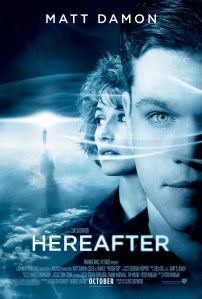
Hereafter is a very serious film about a very serious topic, death. Following three separate but ultimately connected stories, the film attempts to explore death and the question of what happens after death from three different angles — intellectually, emotionally, and spiritually. I really wanted Hereafter to be a great film. So did the film’s makers, which is precisely why Hereafter fails.
The intellectual consideration of death is represented by the character of Marie (Cecile De France), a French journalist who, at the start of the film, drowns in a tsunami and is, for a few minutes, clinically dead. Before she is eventually revived, she has a classic near-death experience: the bright light, the people waiting to greet her, the whole deal. After this experience, Marie is compelled to investigate whether or not there truly is such a thing as an afterlife. As she does so, Marie finds herself shunned by her resolutely secular friends and grows increasingly distant from her skeptical (and rather condescending) boyfriend.
The emotional response to death is represented in the story of twin brothers, Marcus and Jason (played by Frankie and George McLaren). The two boys live in London with their drug-addicted mother and share a strong (and, to be honest, kinda creepy) bond. Jason, while simply trying to return home with some drugs for his detoxing mother, is roughed up by some bullies and ends up running out into the middle of the street. Naturally, since this is a movie, Jason is hit by a truck as soon as he steps off the curb. Jason is killed and Marcus is taken away by social services and put into a foster home. Marcus continues to carry Jason’s cap with him and soon starts tracking down local English psychics in an attempt to talk to his brother again.
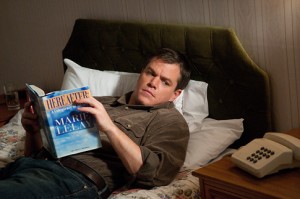
Finally, the spiritual aspect is detailed in the film’s most interesting story. This story features Matt Damon as George Lonegan, a psychic who can speak with the dead. After years of being a minor celebrity, George burned out and went into a self-imposed exile. He now works at a factory while his brother (Jay Mohr, who looks incredibly puffy in this movie) keeps trying to find ways to convince George to get back into the business of talking to dead for fun and profit. After George reluctantly gives a reading to Richard Kind, he finds himself being dragged back into his old life.
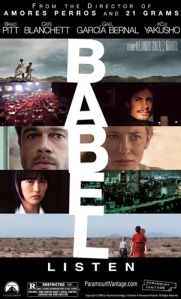
A lot of viewers and critics have compared Hereafter to Alejandro González Iñárritu’s 2006 masterpiece, Babel. Both films follow three separate but connecting stories and both films are concerned with the theme of death and how it connects us all. As well, Babel featured Brad Pitt in a serious role and Hereafter features Matt Damon. The main difference, however, is that Babel was a great film but Hereafter is basically an uneven mess.
Whereas Babel featured three strong stories, Hereafter features 1 compelling story (that would be Damon’s) which is compelling solely because Matt Damon is a talented enough actor that he can apparently perform miracles. He’s probably about as likable as he’s ever been in the role of George but he also wisely plays the role as being just a little bit off. Even though the film makes the mistake of never really going into the details of just what exactly caused George to give up being a psychic, Damon is so good in the role that you’re willing to take him at his word that he had a good reason. Probably the highlight of the film (and one of the few sections to really inspire any sort of real emotional response) is an extended sequence where Damon befriends and the manages to alienate an insecure, single woman played by Bryce Dallas Howard. Damon and Howard have a scene that involves eating while blind-folded that manages to be both powerfully erotic and wonderfully romantic at the same time. If the entire film had been about them, Hereafter would have been a much better movie.
Unfortunately, we’ve got to slog through two other stories.
Cecile La France gives an excellent performance as Marie and the opening tsunami scene is truly terrifying. For someone like me, who cannot swim and risks having a panic attack if she even stands near the deep end of a swimming pool, the tsunami scene was almost impossible to watch. I had to put my hands in front of my eyes and watch the scene through my fingers. However, once she drowns, Marie sees a vision of the afterlife that — as a harbinger of things to come — is rather dull. I mean, with everything that can supposedly be done in movies today, the best that Hereafter can give us is a bland white light. Once Marie returns to Paris and starts her investigation, La France remains a sympathetic presence and the film actually does a pretty good job of showing just how condescending most supposedly “liberal” men are whenever a woman starts to stray from the established orthodoxy. But, unfortunately, her story is just never that interesting. Marie decides to write a book about the afterlife. As a writer myself, I have to say that there is nothing more boring than watching someone else write.
As for Marcus, I was shocked just how little I cared about him or his attempts to contact his brother. I come from a very close family and I have a very strong bond with all three of my sisters and, among them, I am notorious for crying at any movie that deals with that sort of sibling bonding. Yet I sat through the saga of Marcus and Jason without shedding a tear and I felt terrible about it. I really wanted to cry. I really wanted to have some sort of emotional response to the story but I just never believed it. I hate to say this but honestly, a lot of this was due to the fact that the McLaren twins are such bad actors. Director Clint Eastwood has said that he specifically cast them because they weren’t professional actors and therefore, they wouldn’t introduce any false “sentimentality” into the mix. But dammit, it was a sentimental story. Sentiment is not necessarily a bad thing and just because something is sentimental, that doesn’t make it false.
So, what exactly went wrong with Hereafter? The film opens strongly with a terrifying tsunami and the final 30 minutes are also undeniably touching (if also a bit contrived). It’s everything that happens in between those two points that ruins Hereafter. Director Eastwood, obviously looking to avoid that dreaded curse of being sentimental, keeps the whole film very low-key and realistic. Other than the opening tsunami, there are no big wow moments but to be honest, isn’t that what movies are for? If you’re going to make a movie that specifically shuns the wow moment, you better have something compelling (a perfect script or an entire cast giving a compelling performance as opposed to just a handful of them) to take its place. Hereafter doesn’t and, as a result, the movie drags. This, honestly, has got to be one of the slowest, most boring movies I’ve ever seen. If director Eastwood’s westerns and actions films can all be seen as homages to Sergio Leone and Don Siegel, I think Hereafter must be an homage to some of Andy Warhol’s intentionally dull films. Whereas Warhol, at the very least, gave us Joe Dallesandro to look at, Eastwood gives us Jay Mohr. It’s not a fair trade.
I don’t know how much of Hereafter should be blamed on Eastwood and how much should be blamed on the script written by Peter Morgan. Here’s a quote from Morgan that appeared in The Hollywood Reporter:
“It’s quite spiritual material, and quite romantic, too. It’s the sort of piece that’s not easy to describe and in the hands of different filmmakers could end up as wildly different films. Quite unlike some of my other material, which I think there were only certain ways that you could shoot it. It’s really not just another boring Hollywood movie with the same old boring Hollywood actors, although I see the point that the public and sick of paying $10.00 to see a movie with same old faces and the same gramma of story telling.”
And to that, all I can say is “Shut up, Peter Morgan!”
This is not spiritual material as much as it’s just a bunch of vaguely New Age platitudes being delivered by a mainstream screenwriter who apparently doesn’t have the guts to come down either firmly for or against an afterlife. This is the type of feel-good BS that leads to thousands of people every year giving up their life savings to some fraud who claims he can deliver messages from beyond. Morgan’s script goes out of its way not to actually define the afterlife. Is it heaven or is it Hell? Is there a God? Do the worthy go to Heaven? Are souls saved? Or are they just ghosts who are waiting for us to be willing to let them go? These are all questions that would have been considered by a good film but Hereafter doesn’t consider them. Oh, don’t get me wrong. It pretends to bring them up but only so the movie can shrug and go, “I guess nobody knows.” And to that I say, either take a position or don’t expect everyone else to pay money just to listen to you duck the question because you’re too scared of alienating mainstream critics or audiences.
(Myself, I do believe that those who love us are always with us in some way even if I don’t believe in a literal afterlife. And while I know that answer might seem vague, you should also consider that I’m not the one spending millions of dollars to make a movie celebrating that vagueness.)
Morgan’s script also make its a point to incorporate real-life events into his contrived narrative. As a result, the London Subway bombings and the Thailand Tsunami are both used as convenient plot points in much the same way that The Curious Case of Benjamin Button used Hurricane Katrina. I felt it was ghoulish when Button did it and, the more I think about it, it’s equally ghoulish in Hereafter. It’s hard not to feel that the film’s saying, “Too bad all those real people died but what’s important is how these events impacted the lives of a bunch of fictional characters.”
Hereafter’s main problem is that it simply tries too hard to be great. You get the feeling that every scene and line has been calculated to make you go, “Wow, what genius!” As a result, even the scenes that work still somehow feel very dishonest. The end result is a very insincere film about some very sincere concerns.
Steven Soderbergh has always been an indepedent-minded filmmaker from the time broke-out with his Sex, Lies and Videotape and up to his dabbling into microbudgeted, HD-shot films like Bubble and The Girlfriend Experience. In-between such arthouse fares he’s also managed to churn out commercial-friendly works like the Ocean’s Trilogy and to a certain extent both Erin Brockovich and Traffic.
While he surely has earned the ability to choose his projects his last major production didn’t pan out as some have thought it would. I’m talking about the passion project and, one I call the ego-project, epic biopic about Che Guevara which ran so long that it had to be released as two films: The Argentine and Guerrilla. His latest studio offering in The informant! also didn’t light up the box-office or even do marginally well.
Hopefully, the announcement broken by The Playlist site about his upcoming major project will change this pattern. Soderbergh has put on the fast-track the production of a film from Scott Z. Burns’ Contagion script. He will direct this action-thriller which some have labeled as Traffic meets The Stand/Outbreak. The premise of the script details the reaction of the cast of characters to a developing viral pandemic which goes global. The film will take place across four continents and already has snagged quite a talented rollcall of actors: Matt Damon, Marion Cotillard, Kate Winslet and Jude Law. We’re sure to get more news about further cast developments the closer to the start of filming.
While I like Soderbergh’s “Sundance” films I also think that he can make commercially-entertaining films and has proven that he could with the Ocean’s series. Here’s to hoping that he could create an action-thriller w/ some horror aspects to it with this latest project. It’s always exciting to see a director try on a new genre and see how well they do in it. I’m betting on Soderbergh hitting a home run instead of fouling out.
 Note that this isn’t the only review for Contagion.






 Through the Shattered Lens