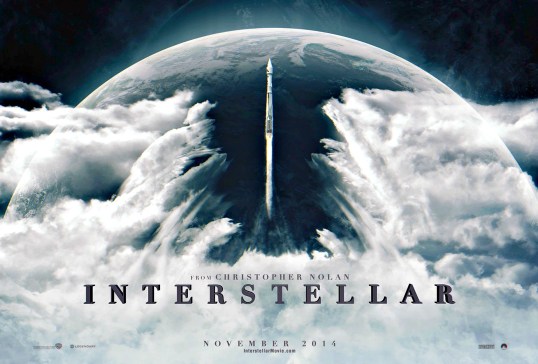
Will Interstellar be as much a game changer as Kubrick’s own 2001: A Space Odyssey? Some are already hyping that it may just be on that very level.
Now, let’s not crown Christopher Nolan upcoming film (his first since concluding his Dark Knight trilogy) as an instant classic when we haven’t seen anything outside of the trailers released. Yet, the teases and brief explanation of the film’s plot hints at something that may just turn out to be incredible.
I know at least one person here at Through the Shattered Lens who is bursting at the seams at trying not to overhype the film for himself. It may just be a losing battle if his reactions to this latest Interstellar trailer is any indication.
Interstellar is set for a limited release on November 5, 2014 (70mm and 35mm film formats) then wide on November 7, 2014 on digital format.
“When you’re 17, every day is war.” — Tagline of The Battle of Shaker Heights (2003)
Anyone here remember Project Greenlight? It’s a show that used to be on HBO and Bravo, in which Matt Damon and Ben Affleck would arrange for a director and screenwriter to get a chance to make their low budget feature film debuts. The catch, of course, is that a camera crew would then follow the director as he (and all of the Greenlight “winners” were male) struggled to get the film made. Mistakes would be made. Money would be wasted. Producer Chris Moore would randomly show up on set and start yelling. In short, it was typical reality show drama with the catch being that the film itself would then be released in a theater or two.
Well, after being consigned to footnote status for the past nine years. Project Greenlight is coming back for a fourth season and a lot of people are pretty excited about it. And why not? I own the first two seasons of Project Greenlight on DVD and I’ve watched the third season on YouTube. It’s a lot of fun, mostly because all of the directors, with the exception of season 3 winner John Gulager, turned out to be so incredibly inept. (Gulager is one of the few Project Greenlight success stories — not only did his movie, Feast, come across as being made by a professional but he’s actually had a career post-Greenlight.) It all makes for good televised drama.
However, it doesn’t necessarily make for a good movie.
Case in point: 2003’s The Battle of Shaker Heights.
The Battle of Shaker Heights is about a creepy 17 year-old named Kelly (played by the reliably creepy Shia LaBeouf). His mother (Kathleen Quinlan) is an artist. His father (William Sadler) is a former drug addict who, despite having been clean for 6 years, still has to deal with his son’s constant resentment. Kelly is a high school outcast who spends all of his spare time thinking and talking about war. Every weekend, he takes part in war reenactments. At night, he works in a 24-hour grocery store where he doesn’t realize that he’s the object of Sarah’s (Shiri Appleby) affection.
(Why Sarah has so much affection for Kelly is a good question. Maybe it’s the scene where he throws cans of cat food at her…)
At a reenactment of the Battle of the Bulge, Kelly meets and befriends Bart (Elden Hansen), which leads to him meeting Bart’s older sister, Tabby (Amy Smart). Tabby is an artist, because the film isn’t imaginative enough to make her anything else. (We’re also told that she’s a talented artist and it’s a good thing that we’re told this because otherwise, we might notice that her paintings are the type of uninspired stuff that you can buy at any county art fair.) Kelly decides that he’s in love with Tabby but — uh oh! — Tabby’s getting married. Naturally, she’s marrying a guy named Minor (Anson Mount). Imagine how the film would have been different if his name had been Major.
As a film, the Battle of Shaker Heights is a bit of a mess. It never establishes a consistent tone, the dialogue and the direction are all way too heavy-handed and on the nose, and Shia LaBeouf … well, he remains Shia LaBeouf. In some ways, Shia is actually pretty well cast in this film. He’s an off-putting actor playing an off-putting characters but the end of result is an off-putting film.
Of course, if you’ve seen the second season of Project Greenlight, then you know that The Battle of Shaker Heights had an incredibly troubled production. Neither one of the film’s two directors were particularly comfortable with dealing with the more low-key human aspects of the story. Screenwriter Erica Beeney was not happy with who was selected to direct her script and basically spent the entire production whining about it to anyone who would listen. (Sorry, Erica — your script was one of the film’s biggest problems. When you actually give a character a name like Minor Webber, it means you’re not trying hard enough.) Finally, Miramax took the completed film away from the directors and re-edited it, removing all of the dramatic scenes and basically leaving a 79-minute comedic cartoon.
So, in the end, Battle of Shaker Heights is not a very good film. But season two of Project Greenlight is a lot of fun!
And what better way to kick off the 90s than by taking a look at a film from 1992 that very few people seem to have ever heard of?
School Ties takes place in the 1950s, which of course means that everyone dresses like either James Dean in Rebel Without A Cause or Troy Donaue in A Summer Place. It also means that the soundtrack is full of the same songs that tend to turn up in every film about the 1950s. David Greene (Brendan Fraser) is a working-class teen from Pennsylvania* who wins a football scholarship to attend an exclusive prep school in Massachusetts. At first, David struggles to fit in. Not only are all of his classmates rich but they’re also extremely anti-Semitic. However, David wins them over by playing hard on the football field and hiding the fact that he’s Jewish. However, when the jealous Charlie Dillon (Matt Damon) discovers that David is a Jew, he reveals his secret and David is forced to confront his prejudiced classmates.
School Ties is one of those extremely well-intentioned films that’s never quite as good as you might hope. With the exception of David and Charlie, the characters are all pretty thinly drawn and there’s more than a few subplots that really don’t really work. For instance, Zeljko Ivanek shows up playing a sadistic French teacher who harasses one of Fraser’s friends (played by Andrew Lowery) and, as I watched Ivanek drive Lowery to the point of a nervous breakdown over proper verb conjugation, it occurred to me that I knew Ivanek was evil as soon as he showed up wearing his little bow tie and his beret. (It’s also interesting how French teachers are always evil in films like this.)
That said, the message of School Ties is still a timely one. On the surface, the message of “Don’t be an intolerant, prejudiced prick,” might seem pretty simplistic and self-explanatory. However, every day we’re confronted with evidence that there are still people out there who don’t understand this simple concept. As such, it’s a message that can stand being repeated a few times.
(Seriously, don’t be an intolerant, prejudiced prick.)
When seen today, School Ties is mostly interesting for who appears in it. For instance, Matt Damon, Ben Affleck, and Cole Hauser all show up here, 5 years before they would all co-star in Good Will Hunting.One of the anti-Semitic students is played by Anthony Rapp who, a year later, would appear with Affleck and Hauser in Dazed and Confused. Fraser’s sympathetic roommate is played by Chris O’Donnell. As for Brendan Fraser himself, it’s a bit odd to see him playing such a dramatic role but he’s convincing and believable as a football player. It’s a good-looking cast and yes, you better believe that there’s a fight scene that takes place in a shower. If you’ve ever wanted to see Brendan Fraser and Matt Damon wrestling each other while naked — well, this is the film to see.
—-
* Interestingly enough, David’s family lives in Scranton, Pennsylvania so I guess David could very well have gone to elementary school with Joe Biden and he may have family working at Dunder-Mifflin.
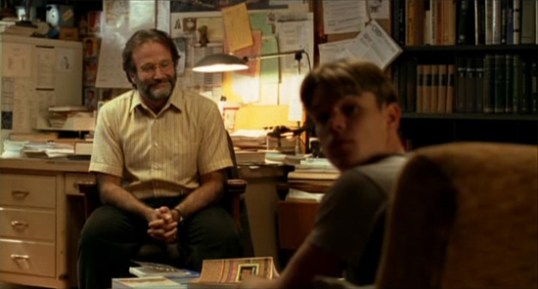
After being nominated three times, Robin Williams finally won an Oscar for his performance as Dr. Sean McGuire in 1997’s Good Will Hunting. The first time I ever watched Good Will Hunting, I was 16 years old and I loved it. 12 years later, I rewatched it for this review and, oddly enough, I did not love it. In fact, I barely even liked it. However, one thing that I did better appreciate the second time around was the performance of Robin Williams.
Good Will Hunting was, of course, written by its two stars, Matt Damon and Ben Affleck. It tells the story of Will Hunting (Matt Damon), a self-taught math genius who, as a result of being abused as a child, is full of anger and refuses to allow anyone to get close to him. His only true friend is Chuckie Sullivan (Ben Affleck), a construction worker. Will works as a janitor at MIT and, when he’s caught secretly solving a complex math problem, he’s taken under the wing of Prof. Gerard Lambeau (Stellan Skarsgard). While Will pursues a volatile romance with a med student named Skylar (Minnie Driver, who is good in an underwritten role), Lambeau arranges for Will to become a patient of psychologist Sean McGuire (Robin Williams). The recently widowed Sean helps Will to come to terms with his abusive childhood and deal with his anger issues. When Skylar tells Will that she’s moving to California, Will is forced to decide whether to follow her or to just push her away like he does with everyone else.
I can still remember that the first time I ever saw Good Will Hunting, I had such a crush on Will Hunting. After all, he looked like Matt Damon. He was smart but he could still stand up for himself. He was a jerk but that was just because he needed the right girl in his life. When he finally talked about being abused by his foster father, my heart broke for him and I just wanted to be there for him while he cried. When he drove off to see Skylar in that beat-up car of his, I thought it was such a romantic moment. Like, seriously — Oh. My. God.
That was the first time I saw the movie.
However, when I recently rewatched the film for this review, I had a totally different reaction to Will Hunting. Maybe it’s because I’m older now and I’ve had to do deal with real-life versions of the character but this time, I actually found myself very much not charmed by Will Hunting and his condescending verbosity. Whereas originally it seemed like he pushed the away the world as a defensive mechanism, it now seemed like Will was basically just a sociopath. People in both the audience and the movie assumed that, because he was so smart, there had to be something more to Will than just bitter negativity but actually, there was less. And even Will’s intelligence seemed to be more the result of the fact that director Gus Van Sant and screenwriters Damon and Affleck were kind enough to surround Will with less-than-articulate characters to humiliate. It’s easy to be the smartest person in the room when you’re surrounded by strawmen. I got the feeling that we were supposed to impressed because Will cites Howard Zinn at one point but, really, Howard Zinn is pretty much the historian of choice for phony intellectuals everywhere.
(In the interest of fairness, I guess I should admit that I may be biased because I once dated a phony intellectual who was always citing Howard Zinn, despite having not read anything that Zinn had ever written. Don’t get me wrong. He owned a copy of A People’s History of the United States and he always made sure it was sitting somewhere where visitors could see it but he had never actually opened it. I imagine he has since moved on to Thomas Piketty.)
Instead, I found myself reacting far more positively to the character of Chuckie Sullivan. Chuckie may not have been a genius but at least he was capable of holding down a job, actually cared about his friends, and was capable of communicating with people without trying to destroy their self-esteem. If I had been Skylar, I would have dumped Will and spent my last few months in Boston enjoying the working class pleasures of Chuckie Sullivan.
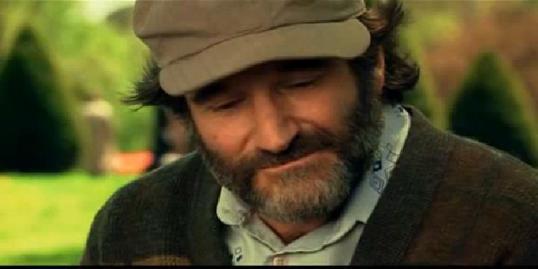
But here’s the thing — the main reason that we believe, despite all evidence to the contrary, that there is good inside of Will Hunting is because Sean Maguire tells us that there is. As I rewatched Good Will Hunting, I was surprised by just how good Robin Williams’s performance really was. The compassionate psychologist has become such a stock character that there’s something truly enjoyable about watching an actor manage to find nuance and individuality in the familiar role. Sean is such a kind and likable character (and Robin Williams gives such an empathetic performance) that we’re willing to give Will the benefit of the doubt as long as he is. In Good Will Hunting, Robin Williams once again had the beard that gave him gravitas in Awakenings. But he also had the saddest eyes. It’s the eyes that you remember as you watch the film because it’s those eyes that tell us that Sean has had to overcome the type of pain that Will Hunting will never be capable of understanding.
It’s those eyes, more than anything, that convince us that there might be some good in Will Hunting.
Remember when The Monuments Men was everyone’s pick for the best film of 2013?
It may be hard to remember now, especially now that the film has actually been released and dismissed by most critics. But, during the summer of 2013, all of the people at Goldderby and AwardsDaily were convinced that The Monuments Men would be a major player at the Oscars. Sure, the thinking went — 12 Years A Slave and August: Osage County would be major contenders but the surest bet for a win was The Monuments Men.
With the benefit of hindsight, it’s easy to laugh but, at the time, the logic behind this assumption seemed sound.
After all, The Monuments Men not only tells a true story but it also takes place during the only good war, World War II. It’s directed by George Clooney, who is the epitome of a star.. The film features supporting performances from Matt Damon, Cate Blanchett, Bill Murray, Jean Dujardin, Bob Balaban, Hugh Bonneville, and John Goodman. The film also has a valuable message about the importance of culture and how tyrants always try to control and suppress the imagination.
So, who can really blame all the usual suspects for deciding, without having actually seen the movie, that The Monuments Men would be great? Even when the film’s release date was moved from December of 2013 to February of 2014, it was assumed that it was only being moved because 12 Years A Slave was such a great film that no movie — not even The Monuments Men — could hope to compete with it for the title of best film of 2013.
“The Monuments Men?” they all said, “It’ll be the best film of 2014…”
And then, finally, The Monuments Men was released and we all got a chance to see it and…
Well, it turns out The Monuments Men was not quite what everyone was expecting. It’s not quite bad but, at the same time, it’s also not quite good. Instead, it simply is.
To its credit, The Monuments Men attempts to tells a worthy story. During the final days of World War II, Frank Stokes (played by George Clooney) leads a seven-man team of art historians who are tasked with both recovering art stolen by the Nazis and keeping allied soldiers from accidentally destroying Europe’s culture while trying to save it. Stokes and his team find themselves forced to deal with both soldiers who resent being told what they can and can not blow up and with a competing team of Russians who are eager to take as much art as they can back to Moscow.
The film makes a very relevent point about both the importance of art and why it must be preserved and protected for future generations. As the proud recipient of a degree in art history, I really wanted to like The Monuments Men. Especially considering what our President recently had to say about those of us who majored in art history, this is a film that I wanted to see succeed.
Unfortunately, The Monuments Men does not succeed. It’s an almost painfully old-fashioned film, one that features every single wartime film cliché imaginable and which never manages to be as interesting as the story its trying to tell. We like the monuments men because they’re played by actors like Bill Murray and John Goodman but we never get to know any of them as individuals and, as a result, their story falls flat.
A lot of the blame has to rest with the director. As I watched The Monuments Men, I found myself thinking about the other films that George Clooney has directed. Confessions of A Dangerous Mind is memorable largely for Sam Rockwell’s lead performance but, otherwise, the film tries way too hard to be wacky. Good Night and Good Luck is sincere but rather simplistic. Leatherheads is a comedy that’s not that funny. And finally, there’s The Ides of March, a film which thinks it’s a lot smarter than it actually is. I think, when it comes to George Clooney, there’s a tendency to be so blinded by his charisma that we tend to assume that he can do anything, including direct. However, if one can manage to ignore Clooney the star while considering Clooney the filmmaker, it becomes obvious that he’s actually a rather unimaginative director whose good intentions often times disguise the fact that he’s not much of a story teller.
That, ultimately, is the main problem with The Monuments Men. The film is full of effective scenes and charismatic actors but they never quite gel to form a compelling narrative. At one point in the film, Bill Murray and Bob Balaban are sent to one part of Europe while Goodman and Dujardin are sent to another. We get a handful scenes featuring each team. Murray and Balaban bond with a scared German. Dujardin and Goodman deal with a teenage sniper. Suddenly, in the next scene, Clooney drives up to an army camp in a jeep and there’s Murray, Balaban, Goodman, and Dujardin all standing outside a tent, waiting for him. How did they all get back together? Where is the camp located? Did either team accomplish what they were sent out to do? The film never tells us.
(Meanwhile, the less said about a lengthy subplot featuring a lot of awkward interaction between Matt Damon and Cate Blanchett the better.)
As I said before, it’s not that The Monuments Men is a bad film. It’s just such a disappointing one.
For our latest entry in the 44 Days of Paranoia, we take look at the film that the Academy named the best picture of 2006, Martin Scorsese’s The Departed.
The Departed takes the plot of the 2002 Hong Kong film Infernal Affairs and transports it to Boston. For years, crime lord Frank Costello (Jack Nicholson) has ruled South Boston with an iron fist. However, police Captain Queenan (Martin Sheen) and his assistant, Sgt. Dignan (Mark Wahlberg) think that they have finally found a way to take Costello down. They recruit police academy trainee Billy Costigan (Leonardo DiCaprio) to go undercover and infiltrate Costello’s organization. To help establish his cover, Costigan drops out of the academy and does time in prison on a fake assault charge.
Meanwhile, Costello has an agent of his own. Years earlier, Colin Sullivan (Matt Damon) was specifically recruited and trained by Costello to become a mole inside the Massachusetts State Police. Sullivan soon finds himself also working under Queenan.
While the amoral Sullivan finds it easy to deal with his dual role of being both a cop and a criminal, the far more emotionally unstable Costigan has a much more difficult time of it. Not helping is the fact that Costello turns out to be a legitimate madman who spends half of his time dismembering people and the other half serving as a secret informant to the FBI. While Sullivan smoothly works his way up the ranks, Costigan pops pills and becomes more and more paranoid.
Eventually, both Costigan and Sullivan are ordered to uncover the double agents in their respective organizations. What they don’t realize is that, even as they both attempt to learn the other’s identity, they are both seeing the same woman, psychiatrist Madolyn (Vera Farmiga.)
In the scene below, which happens to be my favorite from the entire film, Costigan and Madolyn make love after Madolyn assures Costigan that she doesn’t have a cat. That makes sense when you consider that Costigan is essentially a rat.
I have to admit that, as much as I did appreciate certain parts of the film, I was still disappointed the first time I saw The Departed. It wasn’t so much that the movie itself was bad as much as it was the fact that it didn’t live up to the standard set by previous Scorsese films. The film seemed to somehow be both conventional and overly busy at the same time, with the constantly moving camera and the propulsive soundtrack feeling more like they were more the result of a director trying to be like Scorsese than Scorsese himself. While I appreciated the comedic relief of Alec Baldwin’s performance as Queenan’s rival on the force and I thought that Matt Damon made a compelling villain, both Leonardo DiCaprio and Martin Sheen seemed to have been bitten by the overacting bug. It was hard not to feel somewhat disappointed that, after waiting for over three decades to be honored by the Academy, Scorsese finally won his Oscar for The Departed.
However, with subsequent viewings, The Departed has grown on me. Once I was freed up from the expectations that come from watching a Scorsese film for the first time, I was able to enjoy The Departed for what it actually was, a very well-made and entertaining crime drama that occasionally flirted with being something more.
Watching The Departed for a second time, I was better able to appreciate the sly humor of Jack Nicholson’s performance. As played by Nicholson, Frank Costello becomes both the devil incarnate and a somewhat pathetic relic who is incapable of understanding that his time has passed. Watching Nicholson for a second time also led to me better appreciating Martin Sheen’s performance. Since Nicholson and Sheen are meant to the equivalent of the angel and the devil sitting on Damon and DiCaprio’s shoulders, it was necessary for Sheen to be as virtuous as Nicholson was demonic.
By the time that I watched The Departed for the third time, it was a lot more obvious to me that the entire film was, more or less, meant to be a satire. What Nicholson’s criminal empire and Sheen’s police force have in common is that neither one of them works the way that they’re supposed to. If there’s anything to be learned from the film, it’s that nothing means much of anything. (The Coen Brothers would be proud.)
Finally, after multiple viewings, it becomes obvious that The Departed is very much a Scorsese film. Even if his direction isn’t quite as showy as viewers have come to expect, there’s still enough little touches and details that remind us that this film was made by a master. To cite the obvious example that everyone cites, just watch for the X’s that always somehow manage to appear on the wall or the carpet before anyone in the film dies. With multiple viewings, It also became obvious to me that even if this film was set in Boston and not New York and even if the characters were Irish and not Italian, this film was still thematically pure Scorsese, dealing with themes of guilt, identity, punishment, and martyrdom.
Like all worthwhile films, The Departed is one that grows better with subsequent viewings.
In 2009, director Neill Blomkamp gave us District 9, a quiet film that amazed with its visuals of an Earth populated by refugee aliens from space. Produced by Peter Jackson and Carolynne Cunningham, the film was a great success in some ways for both the director and its lead, Sharlto Copley. Both Copley and Blomkamp reunite in Elysium, also adding Matt Damon, Jodie Foster, Alice Braga, William Fichtner & Diego Luna.
I’ll admit that on seeing the film, I was impressed by the visuals, but my hype machine was cranked just a little too high. Any disappointments with the film are the result of my expectations after seeing the trailer. I thought I was going to see something similar to the upcoming game Watch Dogs, where maybe Matt Damon’s character would be able to hack & control a whole network, using it as he saw fit. He’d flip cars, crash planes and cause all sorts of interesting mayhem. The kid in me jumped in his seat at the thought of that.
What I got, however, wasn’t quite that. It came off feeling like a cooler, much better written version of 1995’s Johnny Mnemonic. This isn’t a bad thing by any means. The first hour of the film was very solid, but the second half shifted gears somewhat (at least for me, anyway).
Elysium is the tale of Max Da Costa (Damon), a former car thief who lives and works on Earth in the year 2154. The world is divided into an even greater scale of the Have’s and Have-Not’s. Most live on the overpopulated planet under horrid working conditions, run down pavelas and broken down roads. Those who can afford it can buy a ticket to live on Elysium, a large habitat orbiting the planet, filled with Mansions and other luxury homes. The houses also contain medical systems that can cure any ailment. When Max suffers an accident on the job that leaves him with only 5 days left to live, his immediate goal is to get to Elysium to cure himself. With the help of his friend Julio, Max meets up with a former associate from his crime days for a job that could give him what he needs. In order to complete his mission, Max is outfitted with an exosuit that makes him stronger. Considering that most of his enemies are robot sentries, the suit becomes a necessary asset.
Elysium is protected by Delacourt (Foster), who makes sure that any unauthorized ship is diverted. When Max’s job directly intervenes with plans of her own, she enlists the aid of Kruger (Copley), a somewhat unstable mercenary to clean things up. Will Max be able to heal himself? That’s what you’ll need to see to find out.
Visually, the movie is pretty good. Elysium itself is a marvel. If there was ever a Mass Effect movie to be made, effects makers wouldn’t have any problems recreating the Citadel space station, based on what you see here. Robot Police using futuristic weapons are well rendered, though they don’t really have the cool factor of something like say, I, Robot or Total Recall. It’s minimal in some ways, but effective. For a budget of just $115 Million, Blomkamp and his crew knew where to put the money.
Musically speaking, I did a bit of searching and found that supposedly the score comes from newcomer Ryan Amon, who Blomkamp found on YouTube. The music does the film some justice, though it isn’t anything sweeping and grand. It does what it needs to for the film, at least that’s how I felt. I hope to see more in the future from Amon, actually.
Cast wise, Damon is effective as always and I’ll admit that I liked Jodie Foster in this one, though she didn’t seem like she was given too much to do. The same almost applies to Alice Braga, who plays Da Costa’s childhood friend, Frey. Both Diego Luna and Wagner Moura (as Spider, Max’s former associate) had some interesting moments. The standout by far is Sharlto Copley. His Afrikaans accent is pretty strong, and almost makes it hard for you to catch what he’s saying, but he’s creepy. If the Simpsons’ Groundskeeper Willy somehow caught rabies, his mannerisms would probably be what you get from Copley in this film. Very wild stuff there. He and the effects are the best parts of the film for me.
On the second half of the film, I felt as if the film shifted from a drama to an action film, but I don’t know. There was something odd about it. It wasn’t new for me – District 9 did the same thing in it’s 2nd half, but Elysium seemed as if with all the robots and all the guards, some of the events occurred just too easily and without their intervention. I didn’t get a feeling that there was danger around every corner, but that’s just me and it’s a very minor gripe on my part. There weren’t too many cheer moments for me (and by “cheer moments”, I refer to those scenes where you want to yell something but keep yourself in check – or forget to do so and yell anyway like with Pacific Rim). It was a little generic for me, despite the original and fresh elements leading up to it in the setting and Da Costa’s sense of purpose.
Overall, Elysium gives the audience an interesting situation, and populates it with at least 2 good characters (in Kruger and Da Costa). See it for the visuals and the solid first half, but don’t expect the story to be the best thing in the world. Just enjoy it for the escapism.
The race for Awards Season film releases has begun to heat up with trailers for American Hustle and The Butler already showing some major front-runners for the major awards at the end of the year.
We now have another trailer release for a film that looks to join in on all the end of the year awards scramble. It’s the latest film from George Clooney (doing a trifect as writer, director and actor) which sports an impressive ensemble cast that includes Matt Damon, Cate Blanchett, John Goodman, Bill Murray, Jean Dujardin and Bob Balaban.
The Monuments Men is based on the true story of archivers, museum directors, art restorers turned soldiers tasked with saving the cultural and fine arts treasures stolen by Hitler’s Nazi forces during World War II. As the war begins to turn again the Nazi’s this group of unconventional soldiers must prevent these treasures from being destroyed as part of Hitler’s “scorched earth” policy when it comes to the cultures he has deemed unworthy.
The film itself is adapted from the book The Monuments Men: Allied Heroes, Nazi Thieves and the Greatest Treasure Hunt in History by Robert M. Edsel. There’s a camp out there who doesn’t look at Clooney’s work as anything but OScar-bait whenever they come around every other year, but there’s no denying that the man can direct and act. The question now is whether The Monuments Men will finally give Clooney that final push into getting his first Best Director Oscar.
The Monuments Men is set for a December 18, 2013 release date.
I know it’s been done and written for what seems like hundreds of times that Neill Blomkamp was given the chance to direct a planned live-action film adaptation of the highly popular video game franchise Halo. Seeing how his directorial full-feature debut with District 9 proved that Peter Jackson was correct in trying to give the mega-budgeted project to the young South African, but also set Blomkamp as filmmaker who had given himself that rare commodity in Hollywood: the ability to pick and choose his next projects.
He could easily have taken the money and accolades from that first film and taken the first major action project sent his way, but Blomkamp took that rare commodity and decided to do another sci-fi film that combined not just his flair for action and gritty sci-fi visuals, but what looks to be his storytelling style of using current sociological problems (immigration, class divide, etc…for his latest film) as themes for his film.
Elysium arrives with a new trailer from TriStar Pictures and it’s parent company Sony Pictures. The first trailer gave a taste of the ideas that drive the film’s plot. This second (and much longer trailer) gives us a much more detailed look into the film’s three main characters played by Matt Damon, Jodie Foster and Sharlto Copley. It also gives us a longer look at the two contrasting art designs for society on Earth and that on Elysium.
Oh, did I also mention that the trailer almost makes it seem that it could be a trailer-run for any future Mass Effect live-action film. I saw more than one instance of what could be the use of “biotics” in the trailer by Sharlto Copley’s Kruger character.
Elysium is set to arrive in theaters on August 9, 2013 in both regular and IMAX screens.
It’s not often that a filmmaker makes such a major splash in the industry with their initial full-length film becoming not just a commercial success but one which gained widespread critical-acclaim. South African filmmaker Neill Blomkamp is one such filmmaker. Initially tapped by Peter Jackson to direct the planned HALO film adaptation Blomkamp ended up doing District 9 (based off of his own short film Alive in Joburg).
The film became the sensation of San Diego Comic-Con 2009 which raised the hype for it’s inevitable release a month later. It’s now been 4 years since District 9 and we finally get a chance to see the first official trailer (a 10-minute film reel was shown to invited industry and press which showed a bit more of what the film will be about) for Blomkamp’s much awaited follow-up to his hit first film.
Elysium looks to continue Blomkamp’s attempt to bring social awareness to the scifi genre and do so with a mixture of real-world gritty realism and scifi fantasy. just looking at the trailer the space station Elysium where all the rich and privilege live in a paradise-setting look like an amalgam of the HALO ringworlds and the Citadel Station from Mass Effect.
It’s still months away, but just this teaser of a trailer has just raised Elysium to the top of my list for most awaited films of 2013. If it’s as good or better than District 9 then Blomkamp will cement himself as one of his generation’s best instead of a flash in the pan like so many of his contemporaries.
Elysium is set for a wide release date of August 9, 2013.





 Through the Shattered Lens