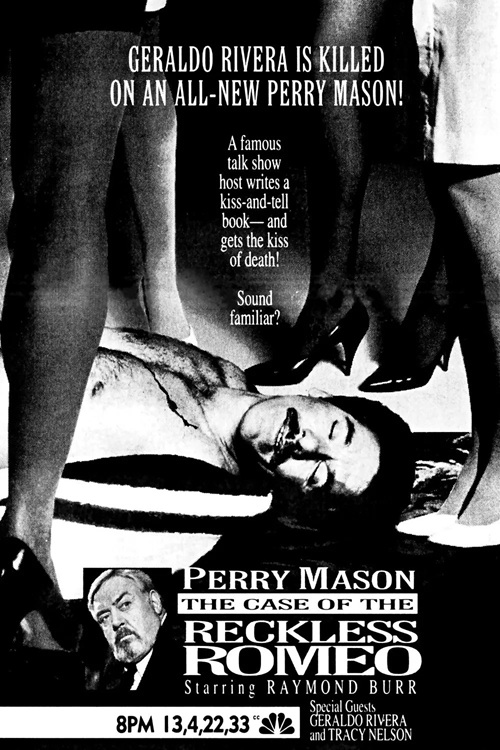
Sleazy talk show host Ted Mayne (Geraldo Rivera) writes a tell-all book about all of the famous women with whom he has had affairs. One of the women, Roxanne Shields (Amy Steel), is filmed threatening to kill him with a knife. When Ted is later found stabbed to death, Roxanne is arrested. Luckily, Perry Mason (Raymond Burr) is willing to take the case and reveal the true killer of the reckless Romeo.
This was one of the last of the Perry Mason movies. (Burr only did four more after this before he died.) The plot is okay, even if this is the third movie to feature Ken (William R. Moses) getting in trouble with the mob while investigating the the murder. It didn’t take me long to guess who the murderer was but the scene where Perry got his courtroom confession was still really well-done. Not surprisingly, the main pleasure of this film was seeing Geraldo Rivera as the victim. Geraldo may have been a terrible actor but he was still totally believable as a sleazy talk show host who went out of his way to embarrass every woman that he had ever had sex with. Geraldo is in the film long enough for you to get sick of him and then he goes away and isn’t seen again. That’s the way it should always be with Geraldo Rivera.
Perry does a few more courtroom tricks than usual in this movie. As the hapless district attorney, Kenneth Kimmins is no David Ogden Stiers. He’s not even Scott Baio. It’s really enjoyable to watch him get continually outsmarted by Perry. Raymond Burr was obviously not doing well physically when he made this movie but it’s still fun to watch him trick witness after witness into identifying the wrong woman.
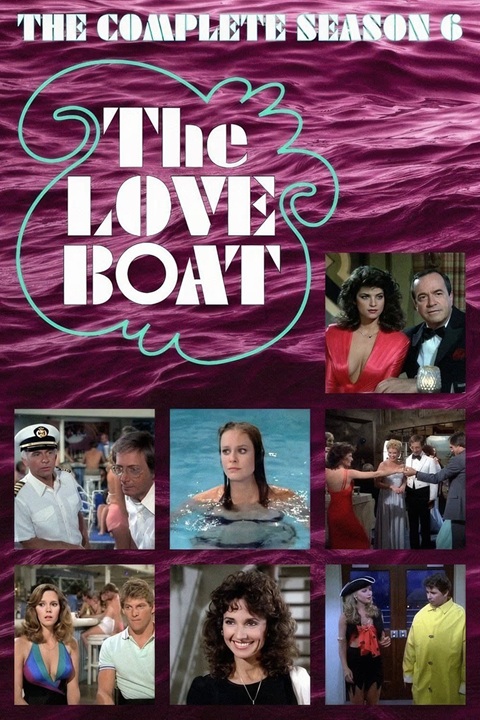
Welcome to Retro Television Reviews, a feature where we review some of our favorite and least favorite shows of the past! On Wednesdays, I will be reviewing the original Love Boat, which aired on ABC from 1977 to 1986! The series can be streamed on Paramount Plus!
The Love Boat promises something for everyone!
Episode 6.26 “The Professor Has Class/When The Magic Disappears/We, The Jury”
(Dir by Richard Kinon, originally aired on April 2nd, 1983)
I sent a message to my friend Jason, letting him know about this week’s episode of The Love Boat.
“This week’s episode featured a Van Patten and a Van Dyke!” I wrote.
He wrote back, “Two Dicks?”
“No, one Dick and a Barry.”
Dick Van Patten plays The Great Stellini. He’s upset that his daughter (Mary-Margaret Humes) wants to marry Joey Gardiner (Barry Van Dyke), a novice magician. The Great Stellini thinks that Joey wants to steal all of his tricks. His daughter teaches Stellini a lesson by actually disappearing during their stage show. Stellini is humiliated but he learns an important lesson about letting go and also supporting younger magicians.
Meanwhile, Anne Meara played Jerry Stiller’s former landlady. Anne was using Jerry for damaging her property. Gopher decided that a jury made up of the crew should decide the case. Huh? Why? That makes no sense. But you know what? Anne Meara and Jerry Stiller were so cute together that it didn’t really matter.
Finally, a 91 year-old professor (Sam Jaffe) was upset to discover that one of his former students (Bettye Ackerman) was going to replace him. Luckily, everyone fell in love. Sam Jaffe was one of the great character actors and it was kind of nice to see him on this show, acting opposite his wife, Bettye Ackerman. This was Jaffe’s final performance and he had a twinkle in his eye. He seemed to be having fun.
2000’s The Stalking of Laurie Show takes place in Pennsylvania, a wonderful state as long as you don’t count Philadelphia. Even more specifically, the film takes place in Pennsylvania Dutch country. An Amish man occasionally appears, sitting in his buggy when it moves down the road. One character, a lunkhead named Butch (Rel Hunt), goes to an Amish coffeeshop while his girlfriend is committing a horrific murder.
The Amish don’t play a huge role in The Stalking of Laurie Show, which is ultimately a story of a murder amongst high school students. Still, seeing them in the background is a reminder of a simpler life and also a reminder that not everyone is consumed by hate. That’s a welcome reminder because this film, much like our present world, is full of irrational hate.
Michelle Lambert (Marnette Patterson) is, at least when the film starts, the queen of her high school. Everyone wants to be her friend and everyone fears getting on her bad side. She’s a master manipulator, someone who obviously feels that she has the right to take whatever she wants. And yet, when we first meet her, it’s hard not to feel at least a little sympathy for her. Her homelife isn’t the best. She doesn’t get along with her father. She’s very protective of her younger siblings. Despite appearances, she’s not rich. The only reasons she has expensive clothes and makeup is because she’s very good at shoplifting. When I was a teenager, I was very good at shoplifting too so I could …. well, I don’t want to say that I related to her because there is a difference between pocketing purple eyeshadow and stealing an entire wardrobe. As well, it soon becomes clear that Michelle has a mean streak that no amount of a bad family life could justify.
Michelle takes a new student, innocent Laurie Show (Jennifer Finnigan) under her wing and, for a while, she and Laurie are best friends. But then, when Michelle’s lunkhead boyfriend Butch takes an interest in Laurie, things change. Michelle is fiercely jealous of Butch and soon, Michelle and her friends are conspiring on ways to humiliate Laurie. When Michelle gets pregnant, she drops out of school, moves into a trailer with Butch, and eventually alienates almost all of her friends after she attacks Laurie in a bowling alley parking lot. Only Tabitha (Joanne Vannicola) remains loyal to Michelle. Soon Tabitha and Michelle are plotting Laurie’s death….
Agck! It’s a disturbing story, especially since it’s true. Michelle and Tabitha murdered Laurie Snow in December of 1991, just five days before Christmas. (There’s some debate as to whether or not Butch took part in the actual murder or not.) Michelle is currently in prison while Tabitha, a juvenile at the time of the murder, was paroled in 2019. Today, of course, Michelle and her friends would have hounded Laurie online, sending her anonymous messages, filming every fight between the two of them, and telling her to “kill yourself.” Every time I read about a teenager who committed suicide due to cyberbullying, my immediate response is that they didn’t kill themselves. They were murdered. Anyone who would taunt a fragile person to the point of suicide is as guilty as if they pulled the trigger or tightened the noose themselves. And don’t give me any of that, “They didn’t know it would happen” crap either. In every case, they knew what they were doing.
As for the film itself, it’s definitely sensationalized. Marnette Patterson fully embraces the melodrama as Michelle, at first playing her as just being a standard mean girl before then going totally over-the-top as Michelle’s grip on reality becomes more and more loose. Jennifer Finnigan is sympathetic as Laurie and Jessica Greco gives a good performance as a friend of Laurie’s who is also drawn into Michelle’s crowd. If the film wasn’t based on a true story, it would probably be a camp classic. But since it is based on a true story, it works best as a plea for people to stop turning a blind eye to bullying. That’s not a bad message.
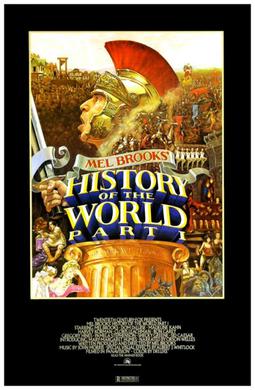
Overlong, wildly uneven, gimmicky too a fault, and often laugh out loud funny with a mix of jokes that range from the crude to the sublimely clever to the surprisingly sentimental, The History of the World, Part I is the ultimate Mel Brooks films.
Narrated by Orson Welles and featuring five historical stories and a collection of coming attractions, The History of the World Part I follows man from his caveman origins to the French Revolution and the thread that ties it all together is that humanity always screws up but still finds a way to survive. Moses (Mel Brooks) might drop and break one of the three tablets listing the 15 Commandments but he’s still able to present the other ten. Stand-up philosopher Comicus (Mel Brooks) might make the mistake of poking fun at the weight of Emperor Nero (Dom DeLuise) but he still makes his escape with Josephus (Gregory Hines), Swiftus (Ron Carey), and Miriam the Vestal Virgin (Mary-Margaret Humes) and ends up serving as the waiter at the Last Supper. (“Jesus!”) The Spanish Inquisition may have been a catastrophe but it also gave Torquemada (Mel Brooks) a chance to show off his performance skills. The French Revolution may have been a bloodbath but the future still held promise. Ask for a miracle and he’ll show up as a white horse named Miracle, no matter what era of history you’re living in.
The humor is very Mel Brooks. During the Roman Empire sequence, Madeline Kahn plays Empress Nympho. Jackie Mason, Harvey Korman, Cloris Leachman, Spike Milligan, Jan Murray, Sammy Shores, Shecky Greene, Sid Caesar, Henny Youngman, and Hugh Hefner all make cameo appearances. Carl Reiner is the voice of God. John Hurt plays Jesus. The film ends with the promise of a sequel that will feature “Jews in Space.” Not every joke lands. The entire caveman sequence feels forced. But when the film works — like during The Inquisition production number — it’s hard not get caught up in its anything-goes style. The entire Roman Empire sequence is probably more historically accurate than the typical Hollywood Roman epic. That’s especially true of Dom DeLuise’s naughty performance as Emperor Nero.
Mel Brooks is 99 years old today and he says that he has at least one more film to give us, a sequel to Spaceballs. I’m looking forward to it! I’m also looking forward to rewatching and enjoying all of the films that he’s already given us. The History of the World, Part I may not have initially enjoyed the critical acclaim of his earlier films but, in all of its anarchistic glory, it’s still pure Mel Brooks.
Welcome to Retro Television Reviews, a new feature where we review some of our favorite and least favorite shows of the past! On Fridays, I will be reviewing Half Nelson, which ran on NBC from March to May of 1985. Almost all nine of the show’s episodes can be found on YouTube!
This week, Rocky gets involved with a case that’s all about obsession!
Episode 1.6 “Nose Job”
(Directed by Arthur Allan Seidelman, originally aired on April 19th, 1985)
Way back in March, when I watched the pilot for Half Nelson, one thing that I immediately noticed was the chemistry between Joe Pesci and Victoria Jackson. In the pilot, it was pretty clear that Annie O’Hara (played by Jackson) had a crush on Rocky (played, of course, by Pesci) and it was actually kind of cute. The streetwise Rocky and the spacey Annie seemed like they could be an interesting couple and I was actually looking forward to seeing how that storyline developed.
Unfortunately, it didn’t develop. In the episodes immediately following the pilot, both Annie and Rocky’s boss, Chester (Fred Williamson), were sidelined so that the show could focus on Rocky interacting with Beau (Dick Butkus) and Kurt (Bubba Smith). Annie was relegated to staying at the office and answering the phone while Rocky flirted with each week’s guest star. That was definitely a missed opportunity. While Smith and Butkus both provided adequate comedy relief, it’s still hard not to feel that the show often focused so much on them that performers like Dean Martin, Fred Williamson, and Victoria Jackson were pushed to the side.
In this week’s episode, Detective Hamill (Gary Grubbs) asks Annie to go on a date with him and Rocky encourages her to accept, so I guess the potential Rocky/Annie romance is officially dead. At first, Annie doesn’t want to date Hamill because she thinks he’s “a jerk.” (Gary Grubbs, who is one of those actors that most people will immediately recognize even if they don’t know his name, has such an amiable presence that it’s hard to understand where Annie got that idea from.) However, in return for Hamill helping him out with this week’s case, Rocky convinces Annie to give Hamill a shot. Annie and Hamill are a couple by the end of the episode. Yay! Who doesn’t love a romantic ending?
As for this episode itself, it opens with Rocky, Beau, and Kurt providing security on the set of a film. The film appears to be about a revolution in Latin America. April Gray (Mary-Margaret Humes) is playing the lead role, a revolutionary who wears a red beret. (Seriously, it looks like a great film.) When April is nearly run over by an out-of-control truck, Rocky becomes convinced that someone is stalking her. When he discovers that the truck’s accelerator was rigged with surgical string, he decides that a plastic surgeon, Dr. Jonathan Gaines (Jon Cypher), is trying to kill her.
However, before he can accuse Dr. Gaines, he has to find out if April has actually had plastic surgery. As opposed to just asking her, Rocky takes her out on a date. (Beau and Kurt come along as well, so that they can check out the other actresses in the cast and see if any of them had plastic surgery as well.) The only way that Rocky can convince her to go out with him is to take her to an exclusive club. But how can Rocky get reservations!? Fear not, it’s Dean Martin to the rescue! It turns out that Dean is co-owner of the club so he puts down his martini glass for a few minutes and makes a phone call. It’s kind of nice that Dean actually got to be involved in the case this week. Dean’s appearances on this show never last for more than a minute or two and it’s obvious that he wasn’t in the best shape when he filmed them but still, it’s fun to watch him and Pesci act opposite of each other. Pesci always seem to be in awe of Dean.
Before the date, Rocky has to teach Beau and Kurt how to discreetly look for surgery scars. This leads to him showing them how to peak behind someone ears while dancing with them. With the help of Annie, he shows how pretending to lose a contact lens can provide a chance to get on the floor check out someone’s legs for scars. (Unfortunately, the scene is rather awkwardly blocked and framed and, in a few shots, it appears as if Rocky is basically looking straight up Annie’s skirt.) Beau and Kurt are impressed. Chester is less impressed, especially when he catches Rocky crawling around Annie’s legs. Chester yells at Rocky and then goes in his office. And that concludes Fred Williamson’s role in this episode.
During the date, Rocky spots the surgical scars behind April’s ears, indicating that she’s had plastic surgery. It turns out that April not only got a nose job from Dr. Gaines but she also briefly dated him. Rocky realizes that Gaines is now trying to kill her but, as always, everyone tells Rocky that he doesn’t have enough evidence to prove anything. Let’s see. Gaines was on the set when the truck went out of control. The truck’s accelerator was tied down with surgical string. Gaines was the only person on the set with a job that would give him easy access to surgical string. It’s hard not to feel that everyone’s being too quick to dismiss Rocky’s suspicions here.
In fact, Dr. Gaines is so obviously guilty that it’s also pretty obvious that there has to be someone else involved as well. About halfway through the episode, we learn that the film’s director (played by Timothy Bottoms) also used to date April! In fact, he’s the one who paid for her nose job!
Half Nelson really has not turned out to be the lost classic that I was hoping it would be. The pilot was strong but the episodes after that have struggled to really establish a consistent identity for the show. Watching this show, one gets the feeling that the show’s producers couldn’t decide if they wanted to do a comedy or a drama. As I already mentioned, the focus on the antics of Dick Butkus and Bubba Smith pretty much left the rest of the talented cast with little to do. It’s easy to see why Half Nelson did not last longer than two months.
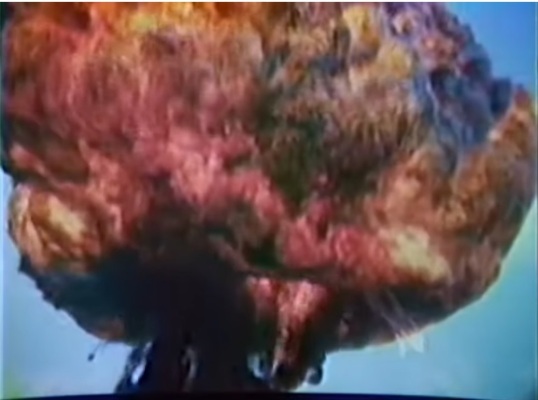
That said, this was actually a pretty good episode. Yes, there were plenty of detective show clichés but both Jon Cypher and Timothy Bottoms were convincing as the show’s two villains and Joe Pesci’s New York persona provided a nice contrast to the sleek phoniness of Hollywood and Beverly Hills. There was even an exciting car chase, which was entertaining even if it was ultimately a bit superfluous to the plot. Plus, the episode featured Rocky throwing a bomb more seconds before it exploded. This is what the explosion looked like:
Seriously, did Rocky just nuke L.A.!?
This was an entertainingly melodramatic episode. You could see hints of the show that Half Nelson could have been if only it could have maintained a consistent tone.


 Through the Shattered Lens