Now that we are halfway to October, I decided to share my personal favorite cover from The Tomb of Dracula.
The Tomb of Dracula was a comic book that ran for 70 issues, from 1972 to 1979. It was published by Marvel and it’s generally considered to be one of the best of the horror comics. It was also the first comic book to feature the character of Blade, who was later brought to life by Wesley Snipes in one of the first successful films to be based on a Marvel comic.
I’m a Tomb of Dracula fan and a collector. I’ve got nearly every issue of Tomb of Dracula and it’s companion magazine, Dracula Lives. Below is my favorite cover:
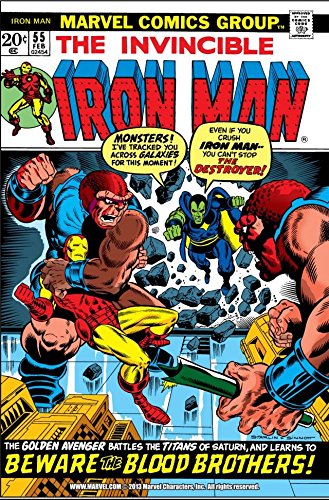
50 years ago, in Iron Man #55, both Drax the Destroyer and Thanos made their first appearances.
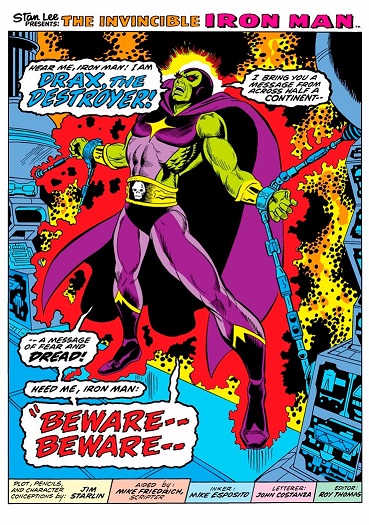
Iron Man #55 opens with Drax the Destroyer being held prisoner on Thanos’s mobile prison planet. This Drax is far different from the Drax who became famous as a result of being a part of the MCU. This Drax is a former Earthling who was killed by Thanos but then resurrected and given one mission, to kill Thanos. There’s nothing funny, not even unintentionally, about his Drax. Knowing that Drax will not stop until he has destroyed him, Thanos has chained Drax up and spends his spare time taunting him. Just because Thanos is evil, that doesn’t make him smart.
Drax sends out a mental message to Iron Man, despite the fact that he and Iron Man have never met. Tony Stark agrees to help Drax because Drax’s messages are so powerful that Tony can’t even attend a business meeting. After suiting up as Iron Man, Stark flies out to Thanos’s prison planet. Along the way, Drax tells him the abbreviated details of Thanos’s origin and Thanos’s love of death.
Iron Man’s fist meeting with Thanos is not particularly auspicious.
Thanos thinks so little of Iron Man that he assigns the moronic aliens known as the Blood Brothers to battle Iron Man. Iron Man is able to free Drax, the Blood Brothers are easily defeated, and Thanos makes a hasty retreat. Drax thanks Iron Man, shakes his hand, and then heads after Thanos. And I suppose Iron Man gets back to Earth somehow.
Thanos and Drax were created by Jim Starlin, who wasn’t even Iron Man’s regular writer. When the planned story for Iron Man #55 ended up running behind schedule, Starlin was assigned to create a filler story. Thanos and Drax were both characters that Starlin had invented for a planned-but-never-written sci-fi epic in college. Starlin reused them and their origins in Iron Man #55.
Though thrown together at the last minute, Iron Man #55 predicted the future of Marvel in a way that, even at the time, few realized. When Starlin took over Captain Marvel, he reused both Drax and Thanos and crafted an epic space opera that was later reused during phase one of the MCU. For all the credit that was given to Kevin Feige, the Russo brothers, Stan Lee, and countless others, the MCU owes much of its success to Jim Starlin.
And it all began with Iron Man #55 running behind schedule.
IRON MAN #55 (October, 1972) Writer: Jim Starlin/Mike Friedrich Penciler: Jim Starlin Inker: Mike Esposito Letterer: John Costanza Editor: Roy Thomas
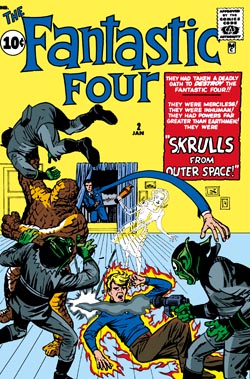
Just a few months after introducing themselves to the world, the Fantastic Four appear to be on a crime rampage! The Thing swims out to an oil rig and knocks it over with one punch. The Human Torch melts a memorial. The Invisible Girl steals jewelry. And when New York suffers a huge blackout, witnesses report seeing an arm stretching it’s way into a powerplant and flipping the off switch!
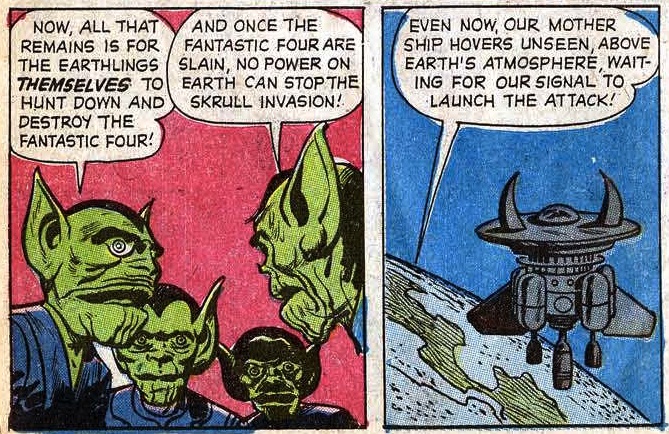
The Fantastic Four claim that they’re innocent and it turns out that they are. Four shape-shifting aliens, known as the Skrulls, have traveled to Earth and are pretending to be the Fantastic Four so that the government will turn on them and it will be easier for the Skrulls to take over the planet. Fortunately, Mr. Fantastic figures out what’s going on. Not only does he fool the Skrull commanders by showing them back issues of Journey Into Mystery and Strange Tales and saying that they’re actual newspapers about the monsters that exist on earth but he also hypnotizes three of the Skrulls on Earth and convinces them that they are cows.
I’ve always liked the Skrulls and it’s always bothered me that they seemed to lose almost every war that they got involved in. How could the Kree defeat the Skrulls? And was it necessary to add insult to injury by having Galactus eat their homeworld? The Skrulls just could not catch a break and I think that’s one reason why they’ve always been popular. With their ability to change their shape and adopt the powers of the heroes that they’re imitating, the Skrulls should have been unstoppable. They should have conquered this planet a long time ago. But the Skrulls, for all of their powers, could just never seem to get it together. To paraphrase Uncle Ben, with great power comes truly rotten luck.
Fantastic Four #2 was not only the first appearance of the Skrulls but it was also the first instance of a Marvel super hero team thwarting an invasion of Earth. (Eventually, Earth being invaded would become a monthly occurrence in the Marvel Universe.) The issue also introduced a major Marvel theme. The Fantastic Four may have saved the world from Mole Man just a few weeks before the Skrulls arrived but it didn’t take long for the general public to turn on them. It was a lesson that would later also be learned by Spider-Man and the X-Men. The general public is extremely fickle when it comes to its super heroes.
And it all started with four shape-shifters coming to Earth. The Skrulls may never win but Marvel still owes much to them.
Fantastic Four Vol. 1 No. 2
(September, 1962)
“The Fantastic Four Meets The Skrulls From Outer Space”
Script: Stan Lee Pencils: Jack Kirby Inks: George Klein Letters: John Duffy
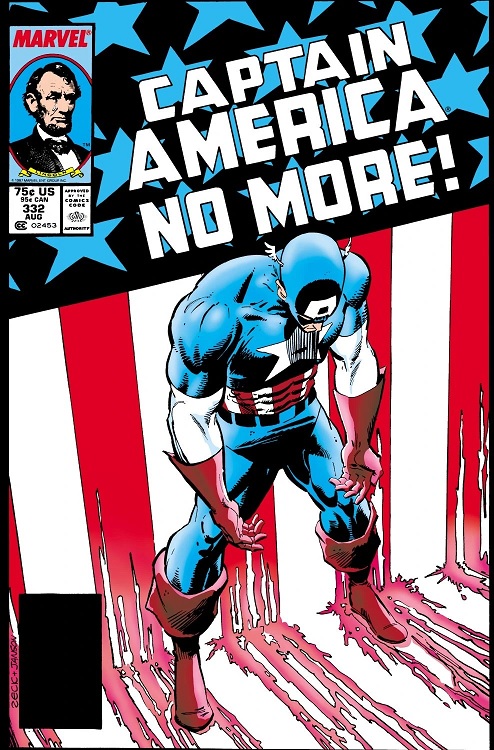
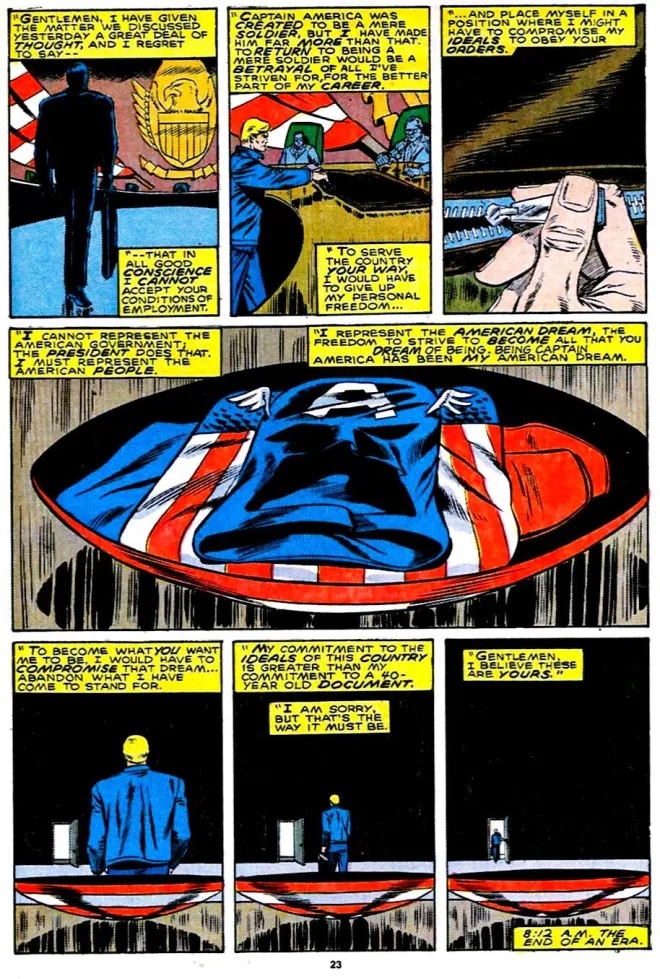
Captain America #332 (August, 1987) opens with Captain America, the living symbol of the USA, being summoned to the Pentagon. A group of faceless bureaucrats known as The Commission tell Captain America that it is time for him to become an official agent of the U.S. Government. They argue that Steve Rogers would not even be Captain America if he hadn’t enlisted in the armed forces and been injected with the super soldier formula. It’s time for Steve Rogers to stop acting as a free agent and serve his government. And, if Steve can’t do that, the Commission can find someone to take his place, someone who understands the importance of following orders. Maybe even someone like the Super-Patriot, who is busy fighting a group of terrorists while Steve is at the meeting.
Steve thinks it over and then does the only thing that his conscience will allow.
He quits.
Of course, this wasn’t the first time that Steve Rogers quit being Captain America. In the 1970s, he was so disillusioned to discover that the President was a part of a secret conspiracy that he resigned his commission and briefly called himself The Captain. Eventually, he returned to being Captain America, just as he would do the second time that he quit. After The Commission named recruited Super Patriot to carry the shield, Steve didn’t have much choice but to take it back.
Still, this moment defined what Steve Rogers was all about. He wasn’t about serving the government or enforcing anyone’s particular policy. He was about America and the ideals that he felt it should stand for. And if that meant defying his government, that’s what he would do.
It was a great moment.
Captain America Vol. 1#332 (August, 1987)
“The Choice”
Writer — Mark Gruenwald Penciler — Tom Morgan Inker — Bob McLeod Colorist — Ken Feduniewicz Letterer — Diana Albers Editor — Don Daley
Why is that relevant? Well, Moon Knight is a 6-episode miniseries based on a character who made his debut in the pages of Marvel comics. The character has a loyal following of readers but the Disney miniseries has introduced him to a whole new group of people, many of whom have never even held a comic book, let alone read one. I’m one of those people. If not for the miniseries, I wouldn’t have the slightest idea who Moon Knight is because, for the most part, I’ve never been a comic book reader. I would have to imagine that if I was a comic book reader, it would bug the Hell out of me that people who have never read a comic book are now suddenly acting as if they’re experts on all of the various costumed characters who have been published by Marvel and DC over the past few decades. I can remember how upset I was when everyone suddenly decided that they were an expert on Dario Argento and Italian horror just because they had read some lame article on the remake of Suspiria. No, I wanted to say, you haven’t done the work!
Unfortunately, that’s the way of the world now. With the current pop cultural dominance of the MCU and the DCEU, everyone’s a super hero fan regardless of whether or not they’ve ever read a comic book. And, with the explosion of social media over the past decade, everyone is now in a position to present themselves as being an expert regardless of whether they’re tweeting their own thoughts or just plagiarizing what they’ve read on Wikipedia. It doesn’t matter whether the topic is politics, television, history, science, religion, or comic books. Everyone now claims to be an expert and, as the old saying goes, when everyone’s an expert, no one’s an expert. Again, if that annoys the Hell out of you, I sympathize.
Perhaps you can take some consolation in the fact that, even though I watched all six episode of Moon Knight today, I hardly feel like an expert as far as the character is concerned. For the most part, I enjoyed Moon Knight but I would be lying if I said that I was always able to follow what was going on. Oscar Isaac plays Marc Spector, a mercenary who is mortally wounded in Egypt but who is revived by Khonshu (voiced by F. Murray Abraham), the Egyptian God of the Moon, who tasks Spector with protecting humanity from evil or something like that. Sometimes, however, Spector becomes Steven Grant, a mild-mannered and neurotic Brit who works in a museum gift shop and who is haunted by strange dreams. When Grant discovers that he’s actually Spector, this leads to him meeting Spector’s wife, Layla (May Calamawy) and also having to battle Arthur Harrow (Ethan Hawke), a fanatical cult leader who is trying to get his hands on ancient scarab that will …. let him do stuff, I guess. Harrow’s evil, Moon Knight’s good, and I guess that’s all we really need to know. Moon Knight is basically a typical MCU “let’s all fight over the artifact” story, with the main twist being that all of the Gods are Egyptian instead of Norse and the hero has dissociative identity disorder and might actually very well be a patient at psychiatric hospital.
With all that in mind, Moon Knight is actually pretty entertaining. It’s biggest strength, not surprisingly, is Oscar Isaac, who appears to be having a ball playing several different versions of the same character. When he’s Marc Spector, he gets to play at being a grim and serious action hero. When he’s Steve Grant, he gets to play a comedic bumbler who gets the chance to prove that he’s stronger and more capable than anyone gave him credit for. Isaac does a good job with both roles and the show is at its best when it’s just Isaac arguing with himself. Playing a villain in an MCU production is often a thankless task but Hawke’s brings the right edge of fanaticism to Arthur Harrow and F. Murray Abraham voices Khonshu with the just the right combination of righteous indignation and weary frustration. The show makes good use of its Egyptian setting and the fourth and fifth episodes are enjoyably surreal as they delve into the corners of Spector’s mind.
Unfortunately, the show’s conclusion leaves a bit to be desired. After all that build-up, it all pretty much leads to a standard MCU street battle and the possibility of more Moon Knight action in the future. That said, I enjoyed the show for what it was. Turn off your mind, relax, and float across the Duat, as the old saying goes.
In 2009, the crusading newspaper publisher, J. Jonah Jameson, was elected Mayor of New York City. At least, that’s what happened in Amazing Spider-Man #591.
It didn’t turn out well, of course. Mayor Jameson spent too much time obsession on Spider-Man and not enough time fixing the subways. He was bombastic, stubborn, and refused to admit when he was wrong. That shouldn’t have taken anyone by surprise. New Yorkers knew what they were getting when they voted for him but they elected him anyway. Of course, in 2009, the idea of a buffoon like J. Jonah Jameson ever holding a major political office seemed like a fantasy. Today, Jonah would fit right in with the majority of the people in Washington.
As mayor, Jameson ended up getting manipulated by both Doctor Octopus and the Green Goblin. It’s no wonder that Mayor Jameson failed to even finish his first term before having to resign.
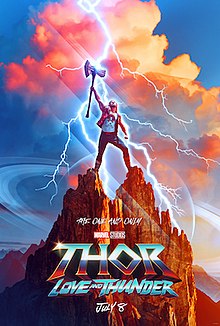
Thor is one of the more remarkable success stories of the MCU.
He started out as the kind of boring super hero whose origin didn’t make much sense and who felt a bit out-of-place with the other Avengers. (It was always funny to him how quickly they all were to accept the fact that Norse mythology was based on reality.) But, thanks to director Taika Waititi and actor Chris Hemsworth, he’s been transformed into one of the most beloved characters in the MCU. Waititi and Hemsworth both realized Thor was a ludicrous character and the best way to handle that would be to embrace the silliness of it all.
That was the approach that they took with Thor: Ragnarok and it appears to be the same approach they’ll be taking with Thor: Love and Thunder. And, of course, Chris Pratt and the Guardians of the Galaxy are the perfect people to help them do that!
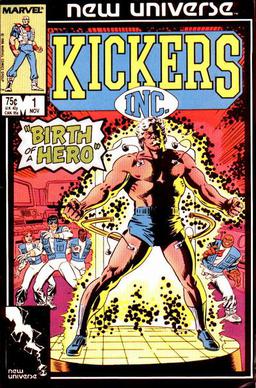
That’s how the Marvel described it’s new line of comic books, New Universe, is 1986. The brainchild of Jim Shooter, New Universe was launched to celebrate the 25th anniversary of Marvel. Consisting of 8 titles that were specifically advertised as not being a part of the regular Marvel universe, New Universe was advertised as featuring heroes who existed in the real world and who dealt with real world issues. The plots would be realistic. There would be no aliens or superhuman technology. The superheroes would have powers but they would react to them in the same way that normal people would. The stories would play out in real time, with a month passing from issue to issue. It was the world outside your window! According to Marvel: The Untold Story by Sean Howe, no one other than Jim Shooter thought New Universe was a good idea and, as Shooter became more and more obsessed with the New Universe, artists like John Byrne grew to resent Shooter’s focus on it.
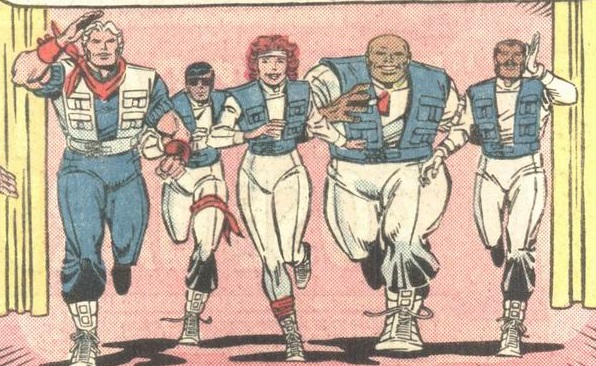
Among the New Universe titles released in 1986, there was Kickers, Inc. According to Kickers, Inc., the world outside your window featured a football team called The New York Smashers whose top players, after retiring from football, became a crime-fighting group called Kickers, Inc. They were led by Mr. Magnificent, who had super strength as the result of super technology (and who, therefore, featured two things that Jim Shooter said would not be present in the New Universe titles) and who became a hero after his brother was killed by gangsters who were tying to pressure Magnificent into throwing the Super Bowl. That may not sound much like the world outside your window but, of course, Kickers, Inc. was not originally created with New Universe in mind. Kickers, Inc. was originally envisioned as being a regular Marvel series but when Shooter learned about it, he insisted that it be modified into a New Universe title. Creator Tom DeFalco wasn’t interested in doing a realistic comic book series about superpowered football players and he left the book after only a 3 issues.
Like almost all of the New Universe titles, Kickers, Inc. was canceled after just 12 issues. It turned out that comic book readers, many of whom used comics to take a break from the real world, didn’t have much interest in super heroes existing in the world outside their window. Strangely, the promise that new popular Marvel characters would appear in the New Universe books didn’t bring readers over. (Again according to Sean Howe’s book, John Byrne and several other artists celebrated the death of the New Universe by gathering in Byrne’s backyard and setting a pile of New Universe books on fire.) The New Universe debacle led to Jim Shooter leaving Marvel but, despite it all, the New Universe and its characters have occasionally been revived over the years and the idea of exploring how the real world would react to the presence of super heroes is one that has run through not the MCU but instead the Snyderverse.
Kickers, Inc. may not have been a success but at least it gives us some idea of what may lay in store for whichever team loses the Super Bowl this year. The losing players may not leave with a super bowl championship but they may gain an entirely new career opportunity.



 Through the Shattered Lens