The Border (1982, directed by Tony Richardson)


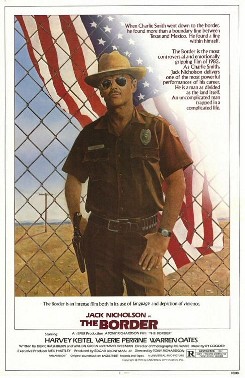
Charlie Smith (Jack Nicholson) gets a job with the Texas border patrol and goes from scrounging in a California trailer park to living the high life in a duplex in El Paso.  His wife (Valerie Perrine) is looking forward to spending all the money that he’ll be making as a border agent.  But then Charlie discovers that his bigoted superior (Warren Oates!) and his partner (Harvey Keitel) are running a human smuggling ring.  When the baby of a young Mexican woman (Elpidia Carrillo) is kidnapped and sold to an illegal adoption ring, Charlie is finally forced to take a stand.

The Border seems to be one of Jack Nicholson’s forgotten films and it really can’t compete with some of the other movies that Nicholson was making around the same time.  Compared to films like The Shining, Terms of Endearment, and The Postman Always Rings Twice, The Border really does feel and look like a poorly paced made-for-TV movie.  British director Tony Richardson doesn’t really seem to know what type of movie he wanted The Border to be or what he wanted to say about immigration.  This is the type neo-Western that Sam Peckinpah could have worked wonders with but Tony Richardson just doesn’t seem to have any feel for the material.

Still, Jack Nicholson is pretty good here, playing the type of weary character that he specialized in during the pre-Batman portion of his career.  I especially liked the scenes that he shared with Valerie Perrine, who gave a good performance as someone who viewed buying a waterbed as being the height of luxury.  Harvey Keitel’s performance sometimes felt too familiar.  He’s played a lot of similar villains but he and Nicholson act well together.

And finally, Warren Oates in this movie, bringing his rough-hewn authenticity to his role.  This was the last of Oates’s films to be released before his premature death.  Blue Thunder and Tough Enough were both released posthumously.  Warren Oates is an actor who was only 52 when he died.  Whenever I see him onscreen, I think of all the great performances he would have given if he had only made it through the 90s.
Welcome Home, Soldier Boys (1971, directed by Richard Compton)


Talk about embarrassing!  When Lisa told me that today was Joe Don Baker’s birthday, I decided that I would review Speedtrap, as 1977 car theft movie that Lisa and I watched last week.  But, when I took a look at the imdb to double check the name of the character that Baker played in Speedtrap, I discovered that I had already reviewed it!

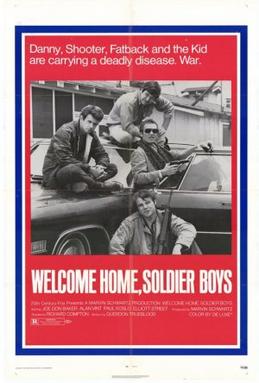
Instead of talking about Speedtrap a second time, I’m going to recommend one of Joe Don Baker’s early films.  In Welcome Home, Soldier Boys, Baker stars as Danny, the leader of a group of Green Berets who have just returned from Vietnam and can no longer find a place in society.  Danny, Kid (Alan Vint), Shooter (Paul Koslo), and Fatback (Elliott Street) go on a cross-country road trip.  After they kill a prostitute (Jennifer Billingsley) who demanded more money than they were willing to pay, they visit many sites from their youth.  They go to a high school basketball team.  They spend some time in a sleazy motel.  (Geoffrey Lewis plays the desk clerk.)  They get into a fight with a mechanic (Timothy Scott) over the price of some auto repairs.  After being cheated by one too many people and realizing that no one cares about the sacrifices that they made for their country, they put on their uniforms and violently take over a small town, leading the National Guard to show up to take them all out.

Welcome Home, Soldier Boys is a pretty ham-fisted anti-war allegory and the plot sometimes meanders too much for its own good.  With its road trip violence, its a dry run for director Richard Compton’s far more cohesive Macon County Line.  The movie still packs a punch, due to the efforts of the cast and the violent ending.  The movie is full of familiar characters actors, who are all convincing in their roles but it really is dominated by Joe Don Baker’s hulking intensity.  Danny is the dark side of the amiable country boys that Joe Don Baker would play in so many other movies.  Danny is angry but, as a stranger in a strange land, he’s sometimes sympathetic.  Ultimately, Danny wants the respect that was given to the returning soldiers of the previous generation.  Instead, he comes back to country that doesn’t want much to do with him or his friends.  Returning from serving overseas and still trying to deal with the things that he saw in overseas, Danny feels lost in and rejected by his home country.  It’s one of Baker’s best performances.

Horror on TV: One Step Beyond 3.17 “Dead Man’s Tale” (dir by John Newland)


On tonight’s episode of One Step Beyond, a down-on-his-luck writer checks into an Alaskan motel with his wife.  After glancing through a cheap guidebook, the writer is inspired to write a story.  After the story is published, the writer is shocked to discover that the story he thought of as being fiction might actually be true!

This episode originally aired on January 17th, 1961.  Alaska had been a state for a little over a year when this episode was broadcast.  It was still a land of mystery.

(For many of us, it still is!)

Retro Television Reviews: The Screaming Woman (dir by Jack Smight)


Welcome to Retro Television Reviews, a feature where we review some of our favorite and least favorite shows of the past!  On Sundays, I will be reviewing the made-for-television movies that used to be a primetime mainstay.  Today’s film is 1972’s The Screaming Woman!  It  can be viewed on YouTube!

In this made-for-tv movie from 1972, the great Olivia de Havilland plays Laura Wynant. Laura is a wealthy woman who has just been released from a mental institution. She goes to her country estate to recuperate but, as soon as she arrives, she starts to hear a woman’s voice in the back yard.

“help me …. help me….” the voice cries.

Laura looks around and she soon realizes that the voice is coming from the ground! A woman has been buried alive in the backyard and will soon die if not rescued! At first Laura tries to dig up the woman on her own but her hands are crippled by arthritis. An attempt to get a neighborhood child to help her dig just leads to Laura being confined to her home, under doctor’s orders. No matter how much Laura tries to get the people around her to listen for the sound of the woman crying for help, everyone just assume that Laura must be imagining things.

Further complicating things is the fact that the person who put the woman in the ground is still out there. And, when he discovers that Laura has been hearing voices, he decides that maybe he needs to do something about both Laura and the screaming woman….

The Screaming Woman is an effective psychological thriller and, considering that it was made for early 70s network television, surprisingly suspenseful. If the film were remade today, I imagine it would try to keep us guessing as to whether or not Laura was hearing an actual woman or if it was all in her mind.  However, by revealing early on that Laura actually is hearing what she thinks she’s hearing, The Screaming Woman puts us right into Laura’s shoes and we share her frustration as she desperately tries to get someone — anyone — to take her seriously. It helps that Laura is played by Olivia de Havilland, who gives a very sympathetic and believable performance. De Havilland, who started her career appearing in Errol Flynn movies back in the 30s and who most famously played Melanie in Gone With The Wind, was one of the longest-lived stars of Hollywood’s Golden Age, living to the age of 104 and winning two Academy Awards for Best Actress.

The film is based on a short story by Ray Bradbury. In the story, it’s a little girl — as opposed to an old woman — who hears the voice. I haven’t read the short story so I don’t know how else it compares to this adaptation but, as a film, The Screaming Woman is an entertaining and creepy thriller and, when viewed today, it serves as a reminder of what a good actress Olivia De Havilland truly was.  She takes a simple thriller and turns it into a meditation on aging and the one person’s determination to do the right thing even when the entire world seems to be against her.

Hanging By A Thread (1979, directed by Georg Fenady)


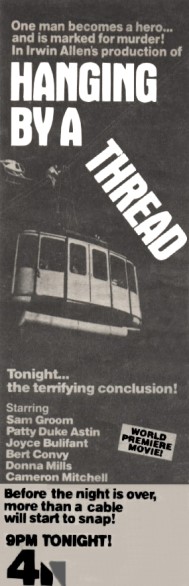
A group of old friend who call themselves the Uptowners’ Club (yes, really) want to go on a picnic on top of a remote mountain.  The only problem is that they have to ride a cable car up to the mountain and there are reports of potentially bad weather.  It’s not safe to ride in a cable car during a thunderstorm.  Drunken ne’er-do-well Alan (Bert Convy) doesn’t care and, since his family owns both the mountain and the tramway, his demands that he and his friends be allowed to ride the cable car are met.  One lightning strike later and the members of the Uptowners’ Club are stranded in a cable car that is perilously suspended, by only a frayed wire, over treacherous mountain valley.

With no place to go, there’s not much left for the members of the Uptowners’ Club to do but bicker amongst themselves and have lengthy flashbacks that reveal every detail of their own sordid history.  Paul (Sam Groom) is angry with Alan because Alan is now engaged to his ex-wife (Donna Mills).  Sue Grainger (Patty Duke) is angry with everyone else because they don’t want to admit how their old friend Bobby Graham (Doug Llewellyn) actually died.  The other members of the Uptowners’ Club are angry because there’s not much for them to do other than watch Duke and Convy chew on the scenery.  Because of the supposedly fierce winds, someone is going to have to climb out on top of the cable car and repair it themselves.  Will it be Paul or will it be cowardly drunk Alan?  On top of everything else, Paul is set to enter the witness protection program and has got hitmen who want to kill him.

This made-for-TV disaster movie was produced by Irwin Allen.  Are you surprised?  It’s also three hours long and amazingly, Leslie Nielsen is not in it.  It’s hard to understand how anyone could have produced a cable car disaster film and not given a role to Leslie Nielsen.  Cameron Mitchell’s in the film but he’s not actually in the cable car so it’s a missed opportunity.  Any film that features Patty Duke detailing how her friends got so drunk that they ended up killing the future host of The People’s Court is going to at least have some curiosity value but, for the most part, Hanging By A Thread gets bogged down by its own excessive runtime and lack of convincing effects.  Hanging By A Thread came out at the tail end of the 70s disaster boom and it shows why the boom didn’t continue into the 80s.

Cave-In! (1983, directed by Georg Fenady)


Sen. Kate Lassiter (Susan Sullivan) is visiting a cave in order to determine whether it’s safe to leave it open to the public.  Giving the senator and her group the grand tour is Gene Pearson (Dennis Cole), who is not only a park ranger but who is also Kate’s ex-boyfriend.  The question as to whether or not the cave is safe for the general public is answered by a sudden cave-in, which leaves Kate, Gene, and the others trapped.  Now, Gene has to lead the group across often dangerous terrain to safety.

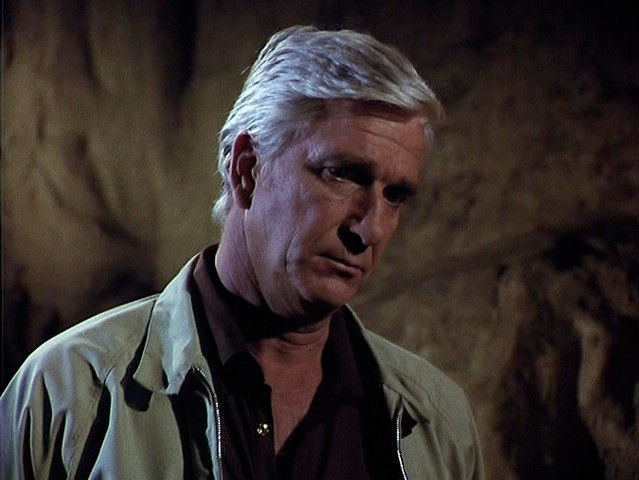
Along with Kate, the group includes a bitter cop named Joe Johnson (Leslie Nielsen!), his wife Liz (Julie Sommars), arrogant Prof. Harrison Soames (Ray Milland), and the professor’s shy daughter, Ann (Sheila Larkin).  Joe and Liz are struggling to keep their marriage together.  Prof. Soames refuses to allow his daughter to have a life of her own.  The six of them are going to have to somehow work together if they’re going to survive this cave-in!  Of course, they’re not alone.  There’s a seventh person in the cave.  Tom Arlen (James Olson) is a dangerous convict who was in the cave hiding out from the police.  Now, he’s trapped along with everyone else.

Cave-In is a pretty standard disaster movie.  Produced by Irwin Allen, it was originally filmed in 1979 but it didn’t air on NBC until 1983.  By that time, Airplane! had pretty much reduced the disaster genre to a joke.  Ironically, Leslie Nielsen himself has a starring role in Cave-In, playing exactly the type of character that he parodied in both Airplane! and Police Squad.  At the time he filmed Cave-In, Neilsen was still a dramatic actor but by the time the movie aired, his deadpan style was firmly associated with comedy.  Even when his dialogue is serious, the natural instinct is to laugh.

Cave-In gets bogged down by flashbacks.  Even though everyone should be concentrating on making their way to safety, it instead seems that they’re too busy obsessing on their backstory.  Since no one’s backstory is that interesting, the flashbacks don’t do much to liven up the film and, unfortunately, a cave-in just isn’t as compelling as a fire in skyscraper or an upside down boat.

On the plus side, every disaster movie needs an arrogant bastard who makes escape unnecessarily difficult and, in the 70s, no one played a better arrogant bastard Ray Milland.  Otherwise, Cave-In is a forgettable entry from the final days of the disaster genre.

Horror on the Lens: The Screaming Woman (dir by Jack Smight)


Today’s horror on the lens is The Screaming Woman, a 1972 made-for-TV movie that’s based on a Ray Bradbury short story.

Olivia de Havilland plays Laura Wynant, who has just returned home from a stay at a mental institution.  Soon after her arrival, Laura starts to hear a woman crying for help.  Laura becomes convinced that the woman has been buried alive on her property but, because of her debilitating arthritis, she can’t dig the woman up on her own.  And, because of her own mental history, no one believes her when she tries to tell them about what she’s hearing!

The Screaming Woman features screen legend Olivia De Havilland giving a sympathetic performance as Laura.  It also features two other luminaries of the golden age of Hollywood — Joseph Cotten and Walter Pidgeon — in supporting roles.  It’s a good little thriller so watch and enjoy!

(And of course, I should mention that the great Olivia De Havilland is still with us, 103 years old and living in France.)

A Movie A Day #316: 52 Pick-Up (1986, directed by John Frankenheimer)


Harry Mitchell (Roy Scheider) is a businessman who has money, a beautiful wife named Barbara (Ann-Margaret), a sexy mistress named Cini (Kelly Preston), and a shitload of trouble.  He is approached by Alan Raimey (John Glover) and informed that there is a sex tape of him and his mistress.  Alan demands $105,000 to destroy the tape.  When Harry refuses to pay, Alan and his partners (Clarence Williams III and Robert Trebor) show up with a new tape, this one framing Harry for the murder of Cini.  They also make a new demand: $105,000 a year or else they will release the tape.  Can Harry beat Alan at his own game without harming his wife’s political ambitions?
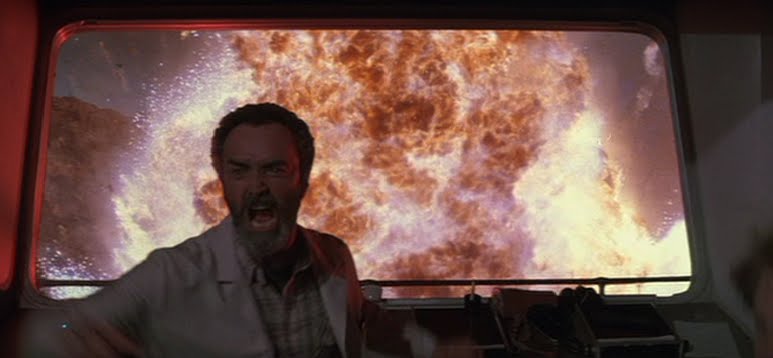

Based on a novel by the great Elmore Leonard and directed by John Frankenheimer, 52 Pick-Up is one of the best films to ever come out of the Cannon Film Group.  Though it may not be as well-known as some of his other films (like The Manchurian Candidate, Seconds, Black Sunday, and Ronin), 52 Pick-Up shows why Frankenheimer was considered to be one of the masters of the thriller genre.  52 Pick-Up is a stylish, fast-paced, and violent thriller.  John Glover is memorably sleazy as the repellent Alan and the often underrated Roy Scheider does an excellent job of portraying Harry as a man who starts out smugly complacent and then becomes increasingly desperate as the story play out.

One final note: This movie was actually Cannon’s second attempt to turn Elmore Leonard’s novel to the big screen.  The first attempt was The Ambassador, which ultimately had little to do with Leonard’s original story.  Avoid The Ambassador but see 52 Pick-Up.

Embracing the Melodrama #31: When Time Ran Out (dir by James Goldstone)


If I had been alive in the 70s, I would have been terrified if I had ever found myself in the same general location of Paul Newman, William Holden, Ernest Borgnine, Red Buttons, Jacqueline Bisset, or Burgess Meredith.  Just based on the movies that they spent that decade appearing in, it would appear that disaster followed them everywhere.

Just consider:

Both Paul Newman and William Holden were trapped in The Towering Inferno. 

Ernest Borgnine and Red Buttons both ended up taking an unexpected Poseidon Adventure together.

Jacqueline Bisset was a flight attendant in the first Airport and nearly got killed by a mad bomber.

And finally, Burgess Meredith was a passenger on The Hindenburg.

Seriously, that’s a dangerously disaster-prone bunch of thespians!

So imagine how terrifying it must have been on the set of the 1980 film When Time Ran Out when all 6 of those actors — along with a lot of other disaster film veterans — were first gathered in one place.  People were probably running for their lives, both on-screen and off.

Lava3

When Time Ran Out takes place on an island in the South Pacific.  Shelby Gilmore (William Holden, playing yet another ruthless but essentially good-hearted businessman) owns a luxury resort that happens to be sitting dangerously close to an active volcano.  Oil rigger Hank Anderson (Paul Newman) is convinced that the volcano is about to erupt but Shelby’s son-in-law, Bob Spangler (James Franciscus), refuses to listen and claims that even if the volcano does blow, the resort will be safe.

(As a sidenote, why were William Holden’s son-in-laws always too blame in disaster movies?  First, you had Richard Chamberlain in The Towering Inferno and now, it’s James Franciscus in When Time Ran Out…)

Suspended over a volcano

Suspended over a volcano

You can just look at the film’s title (When Time Ran Out!) and guess that Bob is probably wrong.  However, Bob has other things on his mind.  First off, he’s cheating on his neurotic wife (Veronica Hamel) with a native islander (Barbara Carrera) who happens to be married to the hotel’s general manager, Brian (Edward Albert).  Brian also happens to be Bob’s half-brother and is therefore owed at least half of Bob’s fortune but nobody but Bob realizes that.

And, of course, there are other colorful guests at the hotel who will soon find themselves either fleeing from or drowning in molten lava.  There’s a white-collar criminal (Red Buttons) who is being pursued by a detective from New York (Ernest Borgnine, of course).  There’s also two retired tightrope walkers (Burgess Meredith and Valentina Cortese) and you better believe that there’s going to be a scene where one of them is going to have to walk across a plank that happens to be suspended over a river a lava…

Told ya!

Told ya!

Eventually, that volcano does erupt and…well, let’s just say that When Time Ran Out is no Towering Inferno as far as the special effects are concerned.  The scene where one random fireball flies out of the volcano and heads for the resort is particularly amusing for all the wrong reasons.  Not only does the volcano apparently have perfect aim but it’s also painfully obvious that the fireball is streaking across a matte painting.  This is the type of film where, when people plunge into a river lava, they do so with heavy lines visible around their flailing bodies.  That, along with the cast’s obvious lack of interest in the material, adds up to make When Time Ran Out a film that is memorable for being so ultimately forgettable.

The Horror!

The Horror!

(It’s odd to consider that this film was directed by the same James Goldstone who directed such memorable films as Rollercoaster and Brother John.)

When Time Ran Out is something of a historical oddity because it was the last of the old 70s all-star disaster films.  (This may have been released in 1980 but it’s a 70s film through and through.)  The movie was such a monumental failure at the box office that it pretty much ended an era of disaster films.

For that reason, it also feels like an appropriate film with which to close out the 70s.  Tomorrow, we’ll continue to embrace the melodrama with the 1980s.

when time