This October, I’m going to be doing something a little bit different with my contribution to 4 Shots From 4 Films. I’m going to be taking a little chronological tour of the history of horror cinema, moving from decade to decade.
Today, we take a look at the first half of the 1920s.
4 Shots From 4 Horror Films
The Cabinet of Dr. Caligari (1920, dir by Robert Wiene)
1980’s Alligator begins in 1968. While on vacation in Florida, a teenage girl named Marisa Kendall purchases a baby alligator named Ramon. When she returns home to Chicago, her jerk of a father flushes Ramon down the toilet.
12 years pass. Marisa (Robin Riker) becomes a herpetologist. As for Ramon, he actually survives being flushed down the toilet and thrives in the sewer. He eats the carcasses of animals that had been a part of an experiment involving a growth serum. The serum had the desired effect of making the animals bigger but it also increased their metabolism to the extent that they became aggressive and had to eat constantly. Evil industrialist Slade (Dean Jagger) is convinced that, by tossing the carcasses in the sewer, he’s ensured that no one will ever find out about the experiments. Instead, he’s turned Ramon into a giant alligator who is always hungry. Soon, the super-intelligent alligator is ambushing and eating sewer workers.
Burned-out Detective Dave Madison (Robert Forster) teams up with Marisa to solve the mystery of why so many body parts are turning up in the sewers. It’s not easy. No one wants to admit that there might be a giant alligator living under the city. Everyone wants to believe that’s just an urban legend. But, after a tabloid reporter (Bart Braverman) manages to snap a few photographs of Ramon before being devoured, the police are forced to deal with the fact that they’ve got an alligator on their hands. As Slade continues to try to cover up his involvement, big game hunter Colonel Brock (Henry Silva) comes to town and announces that he will be capturing the alligator.
Directed by Lewis Teague and written by John Sayles, Alligator is a dark comedy disguised as a horror film. While numerous people get eaten and the film ends on a properly ominous note, Alligator is obviously not meant to be taken seriously. The cast is full of good actors who send up their own images. That’s especially true in the case of Henry Silva, who appears to be having a blast as the hyper macho Colonel Brock. Robert Forster, meanwhile, delivers his lines with a self-aware weariness that seems a bit more appropriate for a noir hero than a film about a detective investigating a giant alligator. One reason why the film works is because Forster, Silva, and the rest of the cast understood exactly what type of film they were appearing in and they delivered their overheated lines with just enough wit to let the viewer know that the film was in on the joke. The big and somewhat stiff-looking alligator may not look entirely real and it may move somewhat awkwardly but ultimately, it’s the most likable character in the movie. It just wants to relax in the sewers but, every few minutes, someone else is bugging him.
When first released, Alligator struggled at the box office but it has since gone on to become a cult favorite. Quentin Tarantino is a self-described fan and he had said he was inspired to cast Robert Forster as Max Cherry in Jackie Brown after seeing him as Dave Madison in this film. That’s not bad for a movie about a giant alligator!
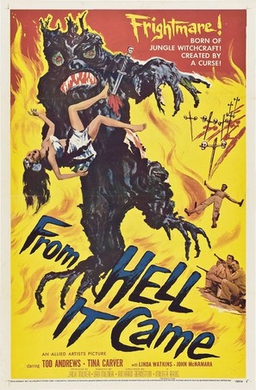
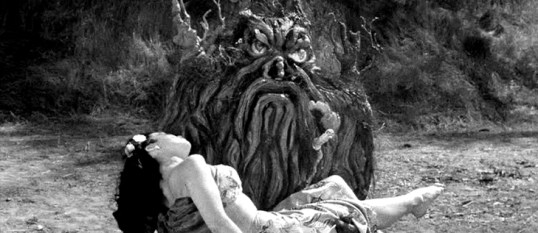
Sometimes, you’ll come across something that simply defies easy description. It’s something that actually has to be seen to be believed. I could describe to you the monster at the center of 1957’s From Hell It Came but I don’t know that, even with my extensive vocabulary, I really have the capability to capture just how absurd and weird this thing is.
In this case, a picture says more than a thousand words ever could:
The monster in From Hell it Came is a walking tree that has a rather angry (not to mention immobile) face. After Prince Kimo is framed for the murder of his father, the chief of a tribe that lives on a South Sea island, he is sentenced to execution. He announces that he will seek revenge on everyone who framed him. He’s then stabbed in the heart and encased in the trunk of a hollow tree. (Apparently, the knife is left in his heart which seems kind of unnecessary but who am I to argue?) Later, Kimo comes back as a walking tree who tosses his enemies into quicksand. The knife is still sticking out of the tree, which would suggest that Kimo was physically transformed. However, the native insist that Kimo has actually become one of their legendary monsters, the fearsome Tabanga.
Along with the natives, there is also a group of American doctors on the island. They’ve been sent to conduct research and to also give the natives medicine to help them deal with an outbreak of the plague. The natives don’t trust the medicine. They trust the magic of their medicine men. Since this film came out in 1957, the doctors react to this by rolling their eyes and talking down to everyone. If there’s one thing that has remained consistent over the decades, it’s that the worst way to get people to do anything is to talk down to them.
The doctors are the first to discover the tree stump that will eventually become the Tobanga. They take the stump back to their laboratory, where they discover that the stump is radioactive due to some nearby atomic tests. The next day, the stump comes to life and leaves the laboratory. One of the most interesting things about this film is that the scientists are skeptical about the natives claim that the tree stump is one of their legendary monsters come to life but they are willing to accept that radiation created a walking stump. Radiation bringing a tree stump to walking life actually makes even less sense than magic doing it.
While the tree is killing its enemies, the American doctors deal with their own drama. For instance, Dr. Terry Mason (Tina Carver), is a woman and that greatly disturbs her male colleagues, all of whom can’t understand why she’s not currently married and raising a family. Meanwhile, Mrs. Mae Kilgore (Linda Watkins, an American actress who played the role with an amazingly bad British accent) owns the local trading post and is not happy about having a killer tree wandering around the island. Mrs. Kilgore is prone to saying things like, “I saw the bloomin’ thing!”
In the end, the Americans finally figure out how to deal with the murderous tree. “Your American magic is better,” the current chief of the natives says. “Hell yeah!” I shout in response, “AMERICA!” From Hell It Came is a thoroughly ludicrous movie but, once you watch it, you’ll never forget that tree.
Who wouldn’t love to see a movie where a youngish Jack Nicholson played a French soldier who, while searching for a mysterious woman, comes across a castle that’s inhabited by both Dick Miller and Boris Karloff?
In Roger Corman’s 1963 film The Terror, New Jersey-accented Jack Nicholson is the least believable 19th century French soldier ever. However, it’s still interesting to watch him before he became a cinematic icon. His performance here is rather earnest, with little of the sarcasm that would later become his trademark. Boris Karloff is, as usual, great and familiar Corman actor Dick Miller gets a much larger role than usual. Pay attention to the actress playing the mysterious woman. That’s Sandra Knight who, at the time of filming, was married to Jack Nicholson.
Reportedly, The Terror was one of those films that Corman made because he still had the sets from his much more acclaimed film version of The Raven. The script was never finished, the story was made up as filming moved alone, and no less than five directors shot different parts of this 81 minute movie. Boris Karloff’s scenes were filmed first, with the other actors performing in front of a body double during their scenes. Among the many directors who filmed bits and pieces of TheTerror: Roger Corman, Jack Hill, Monte Hellman, Francis Ford Coppola, Coppola’s roommate Dennis Jakob, and even Jack Nicholson himself! (Despite this number of directors involved, Corman received the sole directorial credit.) Perhaps not surprisingly, the final film is a total mess but it does have a definite historical value.
(In typical Corman fashion, scenes from The Terror were later used in the 1968 film, Targets. In that film, Karloff plays a version of himself, an aging horror actor who watches The Terror and dismisses it as being “terrible.”)
As some of our regular readers undoubtedly know, I am involved in a few weekly live tweets on twitter. I host #FridayNightFlix every Friday, I co-host #ScarySocial on Saturday, and I am one of the five hosts of #MondayActionMovie! Every week, we get together. We watch a movie. We tweet our way through it.
Tonight, at 9 pm et, Deanna Dawn will be hosting #ScarySocial! The movie? The Descent Part 2!
If you want to join us this Friday, just hop onto twitter, start the movie at 9 pm et, and use the #ScarySocial hashtag! It’s a friendly group and welcoming of newcomers so don’t be shy.
2011’s JerusalemCountdown opens with the world on the verge of destruction. Israel and a nuclear-armed Iran are negotiating in Washington and not everyone wants the two countries to be at peace.
In Chicago, Daniel (Carey Scott) watches the news of the summit and then looks out his window as his unfriendly and glowering neighbor comes and goes from his house. Daniel worries that his neighbor is up to something. He could be a member of a terrorist cell! Daniel’s wife (Jaci Velasquez) tells him to stop worrying about things that he can’t control but that’s easier said than done.
FBI agent Eve (Anna Zielinski) is approached by her father (Stacy Keach), a former intelligence agent who warns her that the end times are approaching.
Another intelligence agent, Shane Daughtery (David A.R. White) is contacted by a burned-out arms dealer (Lee Majors), who informs him that a group of terrorists are planning on setting off a series of bombs and plunging the world into war. The arms dealer is assassinated by a man who keeps reciting passages from the Book of Revelations. Meanwhile, CIA bigwig Jack Thompson (a seriously miscast Randy Travis) continually tells Shane that he can’t share too much information with him because it’s all classified….
JerusalemCountdown is a faith-based film that also tries to be an action film. In fact, I would say that far more emphasis is put on action than on faith. Until the final few minutes of the film, there’s really not much focus put on religion, other than Daniel briefly praying when he finds himself trapped in the neighbor’s house and a scene where a librarian scolds Shane and Eve for not knowing about the Ten Commandments. One major commandments, by the way, is Thou Shalt Not Kill but Shane and Eve manage to kill quite a few people in this film. Of course, they were all bad people and Shane and Eve are trying to keep the world from being plunged into a world war so I’m willing to cut them some slack.
The cast, as you may have noticed, has a number of familiar faces in it. It’s largely a nostalgia cast, the type that’s designed to make people over the age of 60 say, “Lee Majors is in this!” With the exception of Randy Travis, none of the “stars” have a particularly large role. One gets the feeling that Stacy Keach filmed his scenes in a handful of hours, collected his paycheck, and then got out of there. It’s amazing to me that Eric Roberts is somehow not in this film.
As for the film itself, it’s competently made and David A.R. White is one of the better actors amongst the Pureflix regulars. (White has even managed to maintain a semblance of dignity through five God’s Not Dead films.) That said, the film itself moves a bit slowly and the low-budget keeps the action from being as memorable as it could be. There’s a cool helicopter crash but otherwise, it’s never as exciting as it obviously wants to be and there’s a lot — and I do mean A LOT — of filler-type scenes of people talking on their phones while driving from one location to another. The plot itself feels a bit muddled and there’s a lot of loose ends left dangling, as if the film was meant to be a set up for a sequel that never came.
Welcome to Late Night Retro Television Reviews, a feature where we review some of our favorite and least favorite shows of the past! On Fridays, I will be reviewing Freddy’s Nightmares, a horror anthology show which ran in syndication from 1988 to 1990. The entire series can be found on Plex!
This week, there’s a new threat in town!
Episode 1.11 “Do Dreams Bleed?”
(Dir by Dwight H. Little, originally aired on January 8th, 1989)
There’s a new serial killer in Springwood!
We don’t really learn much about the Chopper, other than he attacks people with an axe. When the episode begins, high school football star John Warring (Damon Martin) is dealing with dual trauma of having not only found the Chopper’s latest victim but also being the number one suspect. His grades start to slip. (As was so often the case on this show, his parents are conveniently out-of-town.) He fears that he’s going to lose his girlfriend, Roni (Sarah Buxton). Not even John’s coach, Coach Gacey (Jeff McCarthy), is much help. That’s probably because Coach Gacey actually is the Chopper, not that anyone figures that out. Driven mad by his dreams, John finds himself being taken away to an asylum.
(Really? Coach Gacey? He should have been the number one suspect based on his name alone.)
The second half of the episode follows Ronni as she now starts to have nightmares. She wants to believe that John is innocent but her dreams indicate that she has her doubts. Eventually, John escapes from prison and is able to save Ronni from Coach Gacey. However, when the police arrive, they just assume that Coach Gacey was trying to save Ronni and that John is the Chopper. Ronni is so shaken by the entire experience that she no longer knows what’s true and what’s not.
Wow, that’s dark!
This was actually a pretty good episode. For once the two stories had coherent plots, with Ronni’s story logically building off of John’s. The dream sequences were effectively creepy, director Dwight Little kept the action moving at a good pace, and even the dark ending felt earned as opposed to forced on the narrative. I would have liked to have heard Freddy’s thoughts on Springwood having a new serial killer (instead, during the host segments, Freddy just did his usual bad jokes) but otherwise, this was a surprisingly good episode.
In 1910, Thomas Edison produced what is thought to be the first ever film version of Mary Shelley’s Frankenstein! Clocking in at 12 minutes and 41 seconds, this film was directed by J. Searle Dawley and stars Charles Ogle as the monster.
Admittedly, the surviving prints of this 107 year-old movie are not in the greatest condition. But I still think it’s effectively surreal and, in its way, quite creepy. While it always takes a while for modern audiences to get used to the more theatrical acting styles of the silent films, Charles Ogle still makes for a very memorable monster. I especially enjoy the tinted scenes where the monster comes to life. In the video below, it start around the 2:18 mark and it’s truly a scene that I love!
In this episode of Hammer House of Horror, Julia Foster plays a tabloid reporter who is assigned to investigate an unconventional weight loss program. Foster discovers that weight loss is actually the last thing that the clinic is concerned with. This is an enjoyable macabre episode, one the features a particularly nasty twist.
The Thirteenth Reunion originally aired in the UK on September 20th, 1980.




 Through the Shattered Lens