What’s an Insomnia File? You know how some times you just can’t get any sleep and, at about three in the morning, you’ll find yourself watching whatever you can find on cable or streaming? This feature is all about those insomnia-inspired discoveries!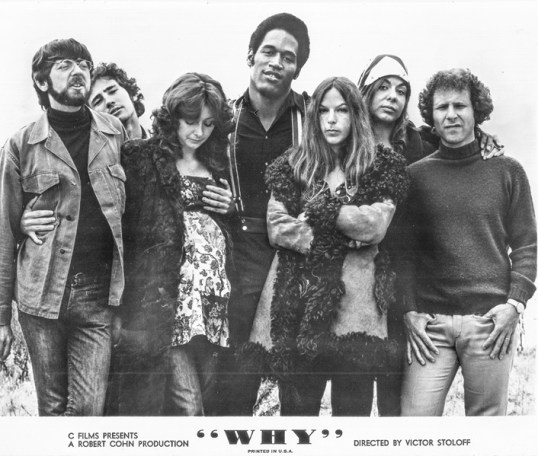
If you’re having trouble getting to sleep tonight, you can always go over to either YouTube or Tubi and pull up Why, an obscure film from 1973 that has a semi-interesting cast.
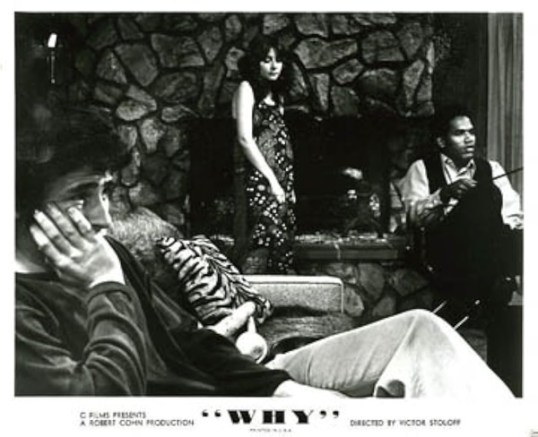
The plot of Why is simple. Six people gather at their psychiatrist’s mansion for group therapy. Dr. Peter Carlson (played by Herb Goldberg, an actual psychiatrist) asks the members of the group questions and asks them to do things like try to imagine a moment that made them truly happy. The members of the group discuss their problems and …. well, that’s pretty much it.
Who is in the group? Jeannie Berlin plays Gail, a single mother who has been rejected by her family because she had an out-of-wedlock child with a black man. Cathy Bleich plays Jennifer, who claims to be a teacher but who is also a pathological liar. Linda Gillen is Christine, a rich teenager who is two-months pregnant and who is implied to be addicted to heroin. Danny Goldman plays Bill, a suicidal gay man. Musician Tim Buckley plays musician Glenn, who can’t get over his band breaking up. And, playing a professional athlete named Bud, is O.J. Simpson. “I smoke dope,” Bud says at one point before going on to explain why he thinks its important to be a good role model.
Why is an odd film. It starts out with a lengthy animated sequence (complete with a hippie-style song) and then settles into being a stagey film that feels more like an extended acting exercise than an actual narrative. It’s a talky film and some of the monologues work while others fall flat. The best performances are given by Danny Goldman, Tim Buckley, and Linda Gillen but I imagine most people who watch this film will be giving most of their attention to O.J. Simpson, who talks about resenting the pressure to always be perfect. In the end, there are no real break-throughs and one could argue that makes this the most realistic depiction of therapy ever filmed.
Reportedly, the film start out as a short film starring O.J. Simpson and Tim Buckley that was commissioned by Technicolor to see if video could be transferred to film. The decision was made to expand the short into a feature. The actors improvised during rehearsal and those improvs served as the basis for the script. Again, this will probably be most interesting to people looking for hints into what it was like inside of O.J. Simpson’s head. (O.J.’s character comes across as being friendly but guarded and quick to get angry about women in general.)
Again, it’s a talky film. At times, it’s a rather boring film. Many of the monologues start out strong but they tend to go on and on. Why might cure you of your insomnia. That said, the film is interesting from a historical point of view. It’s all very 70s, revealing a group of people trying to navigate a world that was still trying to figure out where they stood in the years immediately following the turmoil of 60s. The characters have a brand new world ahead of them and none of them know if that’s a good thing or a bad thing. Some things never change.
Previous Insomnia Files:
- Story of Mankind
- Stag
- Love Is A Gun
- Nina Takes A Lover
- Black Ice
- Frogs For Snakes
- Fair Game
- From The Hip
- Born Killers
- Eye For An Eye
- Summer Catch
- Beyond the Law
- Spring Broke
- Promise
- George Wallace
- Kill The Messenger
- The Suburbans
- Only The Strong
- Great Expectations
- Casual Sex?
- Truth
- Insomina
- Death Do Us Part
- A Star is Born
- The Winning Season
- Rabbit Run
- Remember My Name
- The Arrangement
- Day of the Animals
- Still of The Night
- Arsenal
- Smooth Talk
- The Comedian
- The Minus Man
- Donnie Brasco
- Punchline
- Evita
- Six: The Mark Unleashed
- Disclosure
- The Spanish Prisoner
- Elektra
- Revenge
- Legend
- Cat Run
- The Pyramid
- Enter the Ninja
- Downhill
- Malice
- Mystery Date
- Zola
- Ira & Abby
- The Next Karate Kid
- A Nightmare on Drug Street
- Jud
- FTA
- Exterminators of the Year 3000
- Boris Karloff: The Man Behind The Monster
- The Haunting of Helen Walker
- True Spirit
- Project Kill
- Replica
- Rollergator
- Hillbillys In A Haunted House
- Once Upon A Midnight Scary
- Girl Lost
- Ghosts Can’t Do It

 Through the Shattered Lens