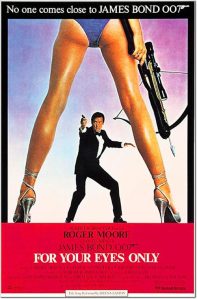
James Bond Review: For Your Eyes Only (dir. by John Glen)


For Your Eyes Only marks a few changes in the way EON Productions wanted to go with James Bond.  With Moonraker being so over the top, the producers decided to go a little more low key and practical. After working on the 2nd unit for Moonraker and a few other Bond Films, John Glen would step up to the plate as the director for this and every 007 film leading up to Goldeneye. Instead of John Barry working on the music, Bill Conti would take over here, which ended up being a very different kind of sound for the film, one fitting of the early 80s.

For Your Eyes Only opens with an interesting start, having Bond visit the grave of his wife, Tracy, who was killed during the events in Her Majesty’s Secret Service. Bond is informed that his helicopter is ready, but when he climbs inside, he finds that it’s under the control of someone with a serious grudge, and though we can’t see his face, we’re to assume he could be Ernst Starvo Blofeld. Supposedly, the scene, which ends with Bond reclaiming control of the helicopter and dropping the would be Blofeld into a chimney pipe, was a jab at writer Kevin McClory. Over the years, the Thunderball lawsuit caused some rifts between McClory and EON Productions. The statement made with For Your Eyes Only was that EON could come up with plenty of great stories without having to use a signature villain like Blofeld. They’d been successful with two movies back to back using Richard Kiel as the henchman Jaws, and probably felt they were doing pretty well. In reponse, McClory would give the Thunderball another try in the bond film Never Say Never Again (which isn’t part of the EON produced Bond films, and won’t be found in any of their Bond Blu-Ray / DVD compilations.

Similar to Tomorrow Never Dies, the story starts with a boat being attacked and sunk. Bond is asked to retrieve a targeting system from the ship and return it to Britain before the Russians do the same. One of the great things about the time period is that since it was pretty much the Cold War, everything was a black ops -sneak in, sneak out – scenario to avoid World War III and nukes being fired by both sides.

The Bond Girl for this film is Melina Havelock (Carole Bouquet), who I really liked here. After her parents are gunned down on their boat, she picks up a bow and arrow to take revenge. As a result, she manages to run into Bond on a number of occasions and had a real sense of calm to her (or as calm as one could be when facing a giant fellow in a scuba suit). The villain of the story, Kristatos was played by Julian Glover, who I enjoyed in Indiana Jones and the Last Crusade and currently on Game of Thrones. I didn’t care much for him in Harry Potter and the Chamber of Secrets as Hagrid’s pet spider, Aragog. One thing to note about Glover is that at one point, he was approached to actually play Bond after Connery left. An interesting casting choice if you notice him is Charles Dance as one of the henchmen and Fiddler On the Roof’s Topol, who played a former business partner of Kristatos’. I found that kind of fun, that you could see these actors here in 1981 that people are familiar with to some degree. The year this came out, Liam Neeson was in Excalibur, for example.

The story features a number of good moments, particularly a great snow skiing chase, a mountain climb as well as a fight between Bond and some hockey players. There’s even a well filmed underwater sequence. Of the Roger Moore Bond films, I always thought of this one and The Spy Who Loved Me as two of his best. With the mission being as small as it is, there wasn’t a lot of room for anything as wild as Moonraker. It’s a pretty tight, practical film that doesn’t rely too much on the gadgetry of the other films. It should also be pointed out that like The Spy Who Loved Me, the signature car for Moore’s Bond is still a Lotus, as I don’t believe the Aston Martins made an appearance until The Living Daylights. That was a little of a letdown for me, but otherwise, the film is beautiful.

Tomorrow, The Shattered Lens takes on Octopussy, a film that showcases just how deadly the circus can be when James Bond is involved. We’ll leave you with the theme song to For Your Eyes Only, sung by Sheena Easton.
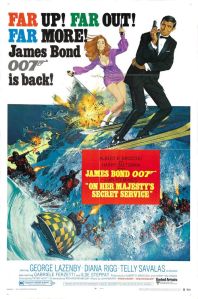
James Bond Review: On Her Majesty’s Secret Service (dir. by Peter Hunt)


By the time Sean Connery was done with You Only Live Twice, he grew tired of being Bond. After all, he’d played the role since 1962 and the ‘70s were on their way. Five movies would do that to you. After that film was done (or near the end of filming it), Connery made it known that he was done with the character and wouldn’t be returning for another installment. Imagine the impact of that. That’s like Daniel Radcliffe having said “You know what? Potter is a tosser and I’ve had it.”, Leaving right after the Order of the Phoenix. That’s not an easy role to fill.

This was the challenge that Albert Broccoli and Harry Saltzman faced in getting On Her Majesty’s Secret Service made. Before watching the movie, I watched one of the documentaries on the casting. It turns out that among the individuals that they wanted to play Bond, Timothy Dalton was offered the role. However, since he was only about 22 at the time, he felt he was too young to play the suave secret agent. The producers eventually went with George Lazenby, who was famous in Australia for commercials, but had the look they were shooting for.

To help push the changes, the marketing team concentrated on everything being “different” and “new”. The idea was that you were still getting James Bond and everything within his universe, but that the kind of Bond you were getting was something awesome. This is evidenced in the trailer and many of the promotion materials.

Broccoli and Saltzman did a search for a leading lady that would be able to support Lazenby. To this end, they recruited The Avengers star Diana Rigg. Her role as Emma Peel (which was later played by Uma Thurman in the box office adaptation) was well-known, and was used as the basis of her ability to work on an action / drama piece like Bond 6. Her character, Countess Teresa di Vicenzo remains one of the best Bond Girls on film (to me, anyway), because of how cold she is from the start of the film. he same could be said of Pussy Galore in Goldfinger, but then again, Lazenby’s Bond is somewhat different from Connery’s. Additionally, Savalas’ Blofeld came across as very dynamic, and between the two, they help to keep the story exciting when Lazenby’s talking lulls others (like the women at his dinner table) to sleep. I don’t think it’s Lazenby’s fault too much. All of the other Bonds either starred in films, like Daniel Craig or television shows, like Moore and Brosnan. For someone who just came off of commercials, Lazenby did a better than expected job, but after 5 Connery films, it’s a hell of a feat to try to take that place in people’s minds.

On Her Majesty’s Secret Service is the story of how James Bond sought out Ernst Starvo Blofeld  and managed to fall so head over heels in love that he got married. That’s basically it. In between, there’s beautiful snow in Switzerland, but OHMSS is at it’s heart very much a love story. It should also be noted that as this is the first film without Connery, there’s a lot of references to Connery’s tenure as Bond and some of these are smile inducing. Right from the start, when Lazenby’s Bond tries to save the countess from drowning herself, he gets caught up in a fight. By the time he’s able to defeat the thugs, she’s run off. No running into his arms, no “Oh..James!” embrace. All of this leads him to look at the camera and exclaim that this type of thing “never happened to the other fellow”. I liked that, I have to admit. There’s also an interesting scene where Bond decides to resign from MI6 and packs his suitcase. The items that he takes out of this drawer are ones from the first 3 films, complete with the musical cues to match them. Much of the first half of the movie works on paying homage to what was done before while trying to get everyone situated with Lazenby.

The movie moves from the beach to where he finds the Countess. After a little 60s coercion (“Talk!” *smack*), She reveals who she is and spends the evening with him, but by the next morning, she’s run off. That morning, on leaving the hotel, he’s kidnapped and is taken to the Countess’ father. The father explains to Bond that like Merida in Pixar’s Brave, Teresa is a bit spirited and that she should be wed. He even goes so far to offer Bond a million dollars, but Bond states that he enjoys the Bachelor’s taste of freedom, but does decide to follow through if the father can provide information on the whereabouts of Blofeld. This leads Bond to an office and an elaborate safe cracking sequence, the results of which give him information on genealogy. Impersonating the person who’s office he was in, he manages to sneak into an establishment in Switzerland that studies about allergies and how to cure them (but may be doing more nefarious deeds).

One cute part about the genealogy is that we’re shown the Bond Family Crest, which comes complete with the family motto “Orbis Non-Suffici”, which translates into “The World is Not Enough” This would later become the title of a future Brosnan film.

We come to find that what Blofeld really is doing is that he’s brainwashing the women he has at the center for use in planting biological weapons around the world. After an escape on skis and a snowy car chase, Bond is eventually able to stop Blofeld and his henchwoman (or at least wound him, anyway). This all leads up to one of the best endings ever devised for a Bond film, because it catches you completely off guard. If there’s any reason to keep this film on your shelf to watch, it’s because it was daring enough to avoid giving the audience the Bond ending you always see, with him heading off with the girl for one that’s ultimately more emotional and/or meaningful. To date, I feel that only Craig’s Casino Royale (which in essence owes a lot to OHMSS) comes close to actually providing something similar. It only falters in that Royale has Bond’s loss focusing him on the notion that he can’t have anyone in his life out of a lack of trust. On Her Majesty’s Secret Service gives the better reason that Bond simply has too many enemies in his life to warrant the connections others have, which makes him almost a sad character in a way.

Lazenby’s performance as Bond is a mix of hit and miss. From an action point of view, I thought he was pretty good. From an acting point of view, he played it a little too much by the book for me, which made me think that he wasn’t really the most exciting Bond there was. He didn’t have Timothy Dalton’s sense of darkness, Roger Moore’s wit, Brosnan’s narcissism or Craig’s coldness. He was just a guy who knew a lot and could punch you in the face if the need arose. Where Lazenby excelled were his interactions with Rigg. As a love story, OHMSS works just fine. As a Bond film, it’s like drinking coffee without any milk in it. You’re still given the same flavor, but it doesn’t quite taste the same. Perhaps this is why he didn’t stick around for Diamonds are Forever, which the producers did have him in mind for.

Musically, John Barry was back on board, and having to come up with something that defined the “New Bond”, he came up with an entirely new theme song. The music for On Her Majesty’s Secret Service is actually pretty damn good, and actually serves to became as much of an Official Theme as “007”, used in From Russia With Love – which actually happens to be my 2nd favorite Bond theme next to “A View to a Kill”.

Tomorrow, the Shattered Lens tackles Connery’s return to form in Diamonds are Forever. Below is the vocal theme for On Her Majesty’s Secret Service, “All the time in the World” by Louis Armstrong. Enjoy.

James Bond Review: Thunderball (dir. by Terence Young)


The Shattered Lens is taking on all of the Bond Films, one a day until the U.S. Release of Skyfall on November 9th. Today, we approach the fourth Bond Picture, Thunderball. Before I start, I should note that this film actually has a bit of controversy behind it. Thunderball had the potential to become one of the first Bond films, but a law suit in 1961 stating that Ian Fleming’s novel for the story was based on the screenplay for the film. Producer Kevin McClory was able to win the lawsuit and hold on to the rights. This would later result in 1983’s Never Say Never Again, with Sean Connery returning to play the same role in the same story as he did in 1965. In the meantime, Dr. No, From Russia With Love and Goldfinger were released with great success.

Before watching the movie, I watched a 1965 documentary from NBC called “The Incredible World of James Bond”, which talked about Ian Fleming, James Bond, and the overall popularity of the character. By the time Goldfinger came out, you’d find lines around theatres all around the world. People were buying colognes and watches – if it had 007 written on it, it was an easy sale. Both the books and the movies were doing extremely well. So with Thunderball being the latest release, it was similar to having perhaps the next Harry Potter or Twilight film on the way. I also learned that Q (Desmond Llewelyn) actually has a name, Major Boothroyd. That was cool to discover.

I wish I could say that I enjoyed Thunderball.  It’s the only Bond film I’ve never seen and the production values for the film were some of the most elaborate around at the time of it’s release. They went out of their way to create submersible machines and other equipment, but the fact that so much of the film took place underwater really caused me to lose interest in what was going on. Granted, it may be fun for many people, but I really wanted to them to give me a few more locales under than the major underwater harpoon fight that occurs near the film’s action climax. Both Tom Jones’ theme song (which describes Bond’s approach to things) and John Barry’s score help to set the mood of the story.

Thunderball continues the SPECTRE story started with Dr. No. Originally, this was supposed to be SMERSH, but that was a real group, much like the KGB or CIA. For movie purposes, SMERSH became SPECTRE to avoid giving any of the Bond stories an anti-nation slant. This would also be done with Quantum of Solace, the organization being something private rather than being any kind of counter intelligence group. This time around, the story opens with Bond attending the funeral of one of the SPECTRE members, and on seeing his wife getting into a car on her own (something I didn’t see as wrong), he follows her to her home to confront her. It’s revealed that the widow is actually the SPECTRE agent (I wasn’t expecting the punch that revealed it), and in the fight Bond ends up killing him. He makes a quick exit and uses a jet pack to get out of the building, where his Aston Martin is waiting for him. It was kind of interesting to see that there was that kind of technology in the 60s.

SPECTRE agent Emilio Largo (Adolfo Celi) is given the task to acquire two Nuclear weapons and decides he’s going to blow up Miami if he doesn’t get his way. Bond is assigned to stop him, and along the way he meets Domino (Claudine Auger), who assists him on this.

At the time of it’s release, Thunderball was a major hit and even won an Academy Award. It managed to come out at the height of Connery’s career as the secret agent. It does suffer from one or two flaws. As most of the story takes place on or near a beach, there are tons of underwater sequences, including a full out battle. Even Finding Nemo took some time to stay on the surface once in a while. This doesn’t make Thunderball a terrible film at all, it simply focuses the story on one element. I would have liked a little more variety.

Q’s gadgets for Bond this time around included a Geiger Counter, a rebreather, an underwater camera, and a personal flare gun, all for the life aquatic.

Overall, Thunderball’s a good film to watch if you’re doing what we’re doing here and are watching the films in a series. You may find yourself a little bothered by the amount of underwater scenes, but the movie still manages to keep some of the spy vibe of the earlier films. Below is Tom Jones’ theme to the film. Tomorrow, the Shattered Lens will take on the David Niven / Peter Sellers version of Casino Royale.

James Bond Review – Goldfinger (dir. by Guy Hamilton)


The Shattered Lens continues the Bond Marathon leading up to the release of Skyfall with 1964’s Goldfinger. Normally, one would figure that the third film in a series is the one with the most danger of ruining everything. You’ve already had two successful stories and you’re asking audiences to come back for yet another round. Yet Goldfinger manages to be considered a favorite by many, and even managed to be the first 007 film to win an Academy Award (for Sound Effects). It does this by expanding on what was already done.

Building on the format that From Russia With Love started, Goldfinger opens with the gun barrel animation and Bond already on a mission. As he reaches what looks like an oil field under the cover of night, he manages to sabotage it (with a little help from C4 or possibly C3, given the time) and arrive back in a neighboring town before it explodes. Heading to his hotel room, he finds a young lady waiting for him who tries to capture his attentions before he catches sight of a thug in the reflection of her eyes. In the fight that ensues, Bond’s quick thinking and a bathtub full of water makes all of the difference. This prologue will become commonplace in all of the EON Production Bond films save for Dr. No (of course) and Quantum of Solace, which gives you the gun barrel at the end of that film.

Sean Connery reprises his role as MI6’s best agent, finding himself in Miami, where he interrupts the card game of one Auric Goldfinger (Gert Frobe), cheating with the help of Jill Masterson (Shirley Eaton). When Bond is caught off guard and knocked out, he wakes up to find Jill dead in her bed, covered in gold paint. The scene actually sparked a number of rumors that Eaton had died in the process of filming it, and as it was mentioned in the film, without leaving a free space near the base of the spine, the actress suffered “skin asphyxiation”. This was later tested on the Discovery Channel’s Mythbusters, and while skin doesn’t “breathe” the way Fleming wrote, your sweat can’t get out of clogged pores. You end up dying of heat stroke. Guess my science teachers were right there, to a degree. The image is so popular, it was even referenced by Quantum of Solace, though Oil was the substance of choice used there.

Bond is given the mission to track Goldfinger and figure out what he’s up, but not without a quick visit to Q Branch. It’s here where we find James’ new car, the Aston Martin DB5, and are introduced to one of longest professional relationships between an automotive company and a production one. Aston Martin would go on to cover nearly every Bond film save for a few (Goldeneye quickly comes to mind), but I’ll profile that relationship in a separate article. The car is outfitted with machine guns, oil slicks, smoke screens and even an ejector seat, believe it or not. Among the gadgets he’s given are two trackers (one large and one small). In terms of the overall series, this is the point where 007 seemingly becomes more of a gadget hound than relying on his actual abilities. I always felt that the ones in From Russia With Love supported him just when he needed it. In Goldfinger, they come across as utility belt like items, though functional all the same.

One of the other standouts in the film is Goldfinger’s henchman, OddJob (Harold Sakata). With a bowler hat that served as a razor disc, he’s one of the most iconic villains in the series, perhaps second only to Richard Kiel’s Jaws. Tomorrow Never Dies and even Goldeneye went on to use henchmen (or henchwomen in Famke Jassen’s case) to great effect.

In going after Goldfinger, Bond runs into Tilly Masterson (Tania Mallet), who mistakenly tries to kill him. They’re eventually caught an in classic 007 Fashion, Bond is placed in a situation that causes one to ask why no one has ever tried to kill him outright. The laser scene that has Bond tied to a table features one of the most famous lines in Goldfinger. When Bond asks Auric if he expects him to talk because of the laser that’s due to cut him in two, Goldfinger stops, turns to face him and exclaims, “No, Mister Bond! I expect you to die!” Needless to say, Goldfinger changes his mind after Bond mentions “Operation Grand Slam”, a plot to seemingly rob Fort Knox. It’s only later that we find that Goldfinger isn’t out to rob the reserve, he’s planning on detonating a nuclear weapon in it that would make all of the nation’s gold radioactive (and all of his gold worth billions, as a result). This is all showcased in a grand sequence involving Pussy Galore’s flight team and some knockout gas. As a kid, I loved it.

Finally, what Bond film would be complete without a Bond Girl? For Goldfinger, we have Honor Blackman’s Pussy Galore. In doing some research on this, I found that according to an article in Empire Magazine, in order to get the name by the American censors, the movie producers took them out to dinner. They decided to not interfere with the name, but it was never exactly listed in any of the US marketing promos. I’d always wondered about that, myself.

As a Bond Girl, Pussy was great in that she handled herself well with both weapons and hand to hand combat. Honor Blackman was well versed in Judo, so her action scenes with Sean Connery were easy to make. Cold and to the point, Pussy Galore wasn’t the “crying over a broken nail” type, but this being the 60’s, they still had the character succumb to Bond’s advances. Personally, I’m not exactly cool with that, but understand that given the time period and possibly the audience, it had to be written as such. Future Bond Girls would make up for it. At least it was good to see that there was a Bond Girl who could stand toe to toe with Bond.

Regarding the casting, one thing that’s also interesting to note that Gert Frobe, who played Goldfinger had a heavy German accent, so heavy in fact that his lines had to be dubbed by someone else. All of the Bond regulars from previous films make a return – Desmond Llewelyn as Q, Lois Maxwell as Miss Moneypenny, in particular. Felix Leiter would be played by a different actor (my favorite being David Hedison from License to Kill).

The impact of Goldfinger has been huge over the years. It’s one of the films everyone usually recalls, and even famed Video Game creator Hideo Kojima pays homage to the film by way of the theme song used in it’s game “Metal Gear Solid 3: Snake Eater”, as the game takes place in the same time period as Goldfinger.

Overall, Goldfinger remains one of the strongest parts of the 007 saga. Tomorrow, the Shattered Lens takes on Thunderball, the Fourth Connery film and the controversy surrounding it. I’ll leave you with Shirley Bassey’s iconic theme to the film.

Quick Review: The Master (dir. by Paul T. Anderson)


If I had a choice between watching the worst of Paul T. Anderson’s films and the best of Paul W.S. Anderson’s films, P.T. would win just about every time. Unless of course it’s about Event Horizon. I love that film, but that’s for a different review.

Sometimes, you walk into a movie expecting one thing, and are given something completely different. I decided to see Paul Thomas Anderson’s The Master on a whim. It is as amazing as it is strange. Most of the movies I’ve seen lately have been event based, but it was nice to catch a film that seemed more character driven. The film’s protagonist, Freddy Quell is as unorthodox as they come, and I wouldn’t be shocked in the least to see Joaquin Phoenix get some major recognition for this. It’s not without it’s problems, though I’d see it again in a heartbeat.

I’ll be the first to admit that I’m not terribly qualified for a movie like this – it’s very “art house”, much like Refn’s Drive and Von Trier’s Melancholia (one of which I own and the other I love). A lot of it for me felt like the story wasn’t really going anywhere, though I loved the character interactions. Reviewing a film like this requires a bit more depth and understanding of cinema on a whole than what I currently have. For me,  there are moments where it almost feels like Anderson said..”Well, they did this…” with someone asking him “And then…?” right after every new point. By the time you’re done with the film, you may ask yourself just what it was you just saw (or what was the point of it, more or less). Then again, I had a similar feeling with the first half of Melancholia and adore that film because of it’s second half. What rescues The Master are the performances, particularly Phoenix’s, that help raise the movie when it threatens to sputter. This, along with the cinematography, really adds to things. The film is beautiful, especially when viewed in the 70MM format. There are some great wide-angle shots, the framing is sweet and the focus is brilliant considering you’re not watching a digital presentation. That’s at least what I took from it, visually. Anderson can make a film look beautiful.

If you can catch a 70MM showing, definitely try to do so.

Okay, that’s sweet, but what is the movie about? 

The Master is basically the story of Freddy Quell, a former Naval officer who doesn’t quite walk a straight road. He has a penchant for two things – an explosive temper and the ability to make moonshine out just about any liquid. From his first line, one gets the idea that something is just a little off with him, and it confused me a little in the opening scenes. I guess what I expected was a little different from what I got. Watching someone compulsively masturbate on a beach will do that to you.

Freddy, who finds himself in some odd jobs and situations, stumbles his way onto a boat and finds himself the next morning the guest of one Lancaster Dodd (Philip Seymour Hoffman), the leader of a group that follow a movement called “The Cause”. Dodd asks Freddy to stay and make more of his special brew. This becomes the start of a journey for both individuals. Freddy comes to find that Dodd is quite the interesting person, being invited to have his entourage stay with different friends and share with them the way he’s found to improve upon the human condition. There is a beautiful 10 minute question and answer auditing session between Dodd and Quell that’s a great example of the acting and focus in the film. Everyone seemed to go all out with their performances, which comes to no surprise given how well There Will Be Blood turned out. Amy Adams also has a good role as Dodd’s wife, supporting him through his plans in a number of ways. Having worked with Phillip Seymour Hoffman in the past, they seem to have some great chemistry together. Much of what she did was a little shocking for me, but she handled her scenes very well.

In trying to save Freddy from himself and his reckless ways, The Master doesn’t quite lead the audience where they think it’ll go. Not that it has to, mind you. However, if you’re walking into the film expecting something grand by the end of the film, you may find yourself somewhat disappointed. At least, my audience didn’t seem to voice a lot of good words for the story, though most of what I did hear was praise for the actors. I loved it, but it was just started to lose me in the last 15 minutes. However, the performances are such a standout that you really can’t ignore the film. I’m almost certain that come awards time, The Master will be in the mix.

Video Game Review: Borderlands 2 (by Gearbox Software / 2K Games)


2K Games and Gearbox Software have finally unleashed the sequel to it’s successful IP, Borderlands on game consoles, and wow, it’s wonderful to return to this universe. Some of my friends on Xbox Live introduced me to the original game and we had quite a bit of fun making our way through it. It was easy to have the sequel on our must play lists.

Here’s what you need to know about Borderlands. The game exists within a barren wasteland known as Pandora. In this place, we have The Vault. If found and opened, it will yield an unimaginable treasure, and as a result, Vault Hunters come from far and wide to seek it out. Along the way, you end meeting some strange characters and fighting against weirder ones. What set Borderlands apart was that it was something of a shooter / Role Playing Game and that it also contained a massive amount of weaponry. Working off of an XP system, you can upgrade your character by killing any enemies you find on the landscape, which is normal for any RPG, but the amount of different weapons in the game was massive.

It was rare to run into the same gun twice.

Borderlands 2 basically picks up where the last game left off in terms of development. Gearbox has introduced four new types of characters to work with, new landscapes and guns. Since the graphics engine is more akin to games like XIII and maybe even The Legend of Zelda: The Wind Waker, the game moves very fast and there’s little lag online when playing with 3 other players in a Co-Op battle.

The guns in the game all have attributes of their own, such a reload factors, damage strength and scope strength (if they have them). Some guns can be used as grenades when they use up a clip. Others have Elemental qualities (which I love), in that they can set enemies on fire, shock them with lightning or shoot corrosive acid. As you level up in the game, so the available weapons, so you’ll find yourself selling or discarding the ones you’ve carried along for more powerful upgrades – unless of course you happen to own one revolver or two that you just can’t part with. Trust me, that happens.

The four characters in Borderlands 2 are the Siren (my personal favorite), who has a focus on Elemental Ability and healing factors on the battlefield. The Gunzerker is pure brute force, can duel wield weapons and can beat an animal senseless with his melee tactics. The Commando can send out a sentry turret as a backup in battle. The Assassin, new to Borderlands, has tactics similar to Ghost Recon: Future Soldier, where he can blend in with the background and send out a decoy to confuse the enemy. His sword allows for massive melee damage when he’s out of ammo.

The skill tree system in Borderlands 2 has been upgraded from the first game as well. There are upgrade paths for every character with a limited amount of points to use, which help ensure that once you fully fill a skill tree – say one that allows you to cause elemental damage to everyone in the environment when using a Siren’s Phaselock ability – you’ll want to play the game over again to work on another path. It helps to shape just how you want your character to go, and is really fun when working in a team environment. One character can focus on healing the team, while another can be pure attack. If you have communication between your players, there’s no limit to how well you can do in a battle.

If Borderlands has any limitations, it’s that you can’t benefit from having your Single Player character work in a Co-Op environment. For example, if you have a level 20 Gunzerker, he can jump into a friend’s game who is only at the start and be a major effect on the battlefield, but it gives that high level character next to nothing in XP as they’re only fighting characters that are far weaker than them. Additionally, the high level character won’t benefit from any of the missions in the game (after all, they’ve already gone through them in their own game) In a way, it’s very smart, because it helps newer players level up, but the best way to go through a Co-Op game is to start from the very beginning together. This way, you all can level up around the same time and move forward as a group.

Overall, Borderlands 2 is a fantastic game to play if you have a team to work with, moves very quick and has no shortage of ammo or enemies to blast away to your heart’s content.

Quick Review: Premium Rush (Dir. by David Koepp)


I have a love / hate relationship with David Koepp.

Loved The Shadow, Stir of Echoes, Angels & Demons, Panic Room, Jurassic Park and The Lost World (even to see him get eaten by a T-Rex while running down a busy street). I hated War of the Worlds (I’m sorry, but there’s no way Justin Chatwin’s character could have made it through that film), Mission: Impossible and Indiana Jones and the Kingdom of the Crystal Skull. Sometimes he hits the mark, and other times he misses.

Premium Rush falls somewhere in between. I really don’t have a whole lot to say about it. It’s mostly very good, particularly the bike riding scenes, but overall, the story could have been a little stronger and Michael Shannon (to me, anyway) felt really out of place here. It’s one of those movies where you pluck your brain out of your head and place it in the seat next to you. As long as you don’t give the movie too much thought and just enjoy the ride that’s presented to you, you’ll do just fine. At only 90 minutes, it moves very quickly and you’ll find yourself at the end before you really know it. I’ve seen this type of film before with Thomas Michael Donnelly’s Quicksilver, starring Kevin Bacon and 1993’s Airborne, directed by Castle Producer and former X-Files alum, Rob Bowman.

Wilee (Joseph Gordon-Levitt) is the best bike messenger around. He’s so good that he rides a ‘fixee’, a bike with no brakes, no sets of gears other than the basics and where the pedals always move (no cruising). Weaving in and out of traffic, he makes his way through each delivery with lots of style. There are these decision points that happily reminded me of both my bike riding times and motorcycle ones where Wilee has to find the next available angle to ride through. Scenes like that help to keep the action moving, when it happens. Premium Rush also showcases some great areas of Manhattan as they travel around. It’s a great looking film in that sense, with low cuts of bike wheels and jumps, but again, you’re either riding through the city and hoping they don’t hit, or you’re off the bike waiting to find out if they’ll jump onto another one again.

Basically, the story is that Wilee is given a special package that he needs to deliver, and a corrupt cop is on his tail, played over the top by Michael Shannon. That’s all there is to it. Get the package where it needs to go. Levitt does well in the film, as does Dania Ramirez and Aasif Mandvi. If there’s anyone in the movie who didn’t quite gel with me, it would be Michael Shannon. Shannon’s a good actor, and he’s not bad here, just really animated. It felt like a role that would have been better suited for Willem Dafoe or someone strange like that. I never felt any kind of fear or even worry when Shannon was around. He came off more like a bumbling crook in a film like Baby’s Day Out”, than someone who really needed what Wilee was carrying.

Koepp is getting better at directing, but some of the writing is a little off. The film suffers from the same problem that Green Lantern had with it’s climax or Tron: Legacy did with some of it’s parts. You have a few scenes where it could have been stronger had things moved in one direction, but then veers off. The impact just isn’t as great. I won’t go into detail on what they are, but for me, I saw a few things that could have been changed (or at least one in particular).

Overall, Premium Rush is a fun film that may get you wanting to ride after seeing it, but just don’t ask a lot of it. Just get your popcorn, sit back and enjoy where it all goes.

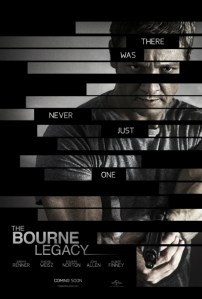
Quick Review: The Bourne Legacy (dir. by Tony Gilroy)


After completing The Bourne Ultimatum, Director Paul Greengrass and Actor Matt Damon were probably asked if they’d ever come back to do another. When you look at the overall story, Bourne’s journey was pretty complete, and Damon voiced that he’d only consider doing another if Greengrass did. After Greengrass bowed out, the notion of another chapter in the Bourne saga was dead in the water.

Universal had other ideas, deciding on moving forward and having the trilogy’s screenwriter, Tony Gilroy direct The Bourne Legacy. No stranger to making films, Gilroy is more known for making “slow burn” features like Duplicity and one of my favorites, Michael Clayton. If he were working on a remake to “All the President’s Men”, I’d be certain it was a perfect fit. For Bourne, however, we get something of a different result. Not a terrible one, but possibly not the one that everyone was hoping for. This almost makes sense, considering that even the Bourne novels themselves were taken over by Eric Van Lustbader after Robert Ludlum’s death.

The Bourne Legacy takes place during the same time period as The Bourne Ultimatum. The story expands not on what happened to Bourne post Ultimatum, but what happened to the programs in place in the aftermath of Bourne’s visit to New York. We find Aaron Cross (Jeremy Renner), part of a separate program that goes beyond Treadstone and Blackbriar, making his way through a snowy Alaskan wilderness. The new breed of agents (assets, as they’re referred to in the Bourne Universe) are genetically augmented by way of meds they call “Chems”. The Chems give the assets the edge they need to do what they do.

This bothered me a little, because Jason Bourne got by with none of that for years, but I chalk that part of the storyline to the notion that Gilroy has this thing for Pharmaceuticals and Chemicals. Michael Clayton’s antagonist worked for a Chemical Company. Duplicity’s spies were trying to steal secrets from a pair of what seemed like pharmaceutical companies. The reasoning behind Cross’ need for the Chems is made clear through the story, but it was a strange angle to go on, I felt.

During the course of Aaron’s trip, the Powers That Be, played by, Stacy Keach, Donna Murphy and an underused Edward Norton decide that Bourne’s actions (along with Joan Allen’s Pamela Landy) are going to cause all of their programs some serious trouble and decide to wipe the slate clean. Cross needs to both escape this while still finding a way to get a hold of the Chems he needs to stay at peak performance. That’s the idea behind the Bourne Legacy in a nutshell.

On a casting level, The Bourne Legacy is actually very good. Both Renner and Rachel Weisz handle their parts well, I thought (for what they were given). A few of the cast members return from the previous Bourne films, but their appearances are so brief that it may leave you feeling as if they were just a piece of leftover film from the Original Trilogy. If there’s anyone who feels out of place, it would have to be Edward Norton. He comes across in this movie like he wasn’t sure what he wanted to take on and decided to just do this to pass the time.

The action in the Bourne Legacy is on par with the other films, but this being Gilroy, there’s more of a distance between the action and the drama.  When I really think about it, there’s about the same amount of it as there was in The Bourne Identity or Supremacy – neither one of those were die hard action films – but the potential to wish for more is greater with Legacy. This is especially true with the way it was advertised. Just about every action scene in the film is in the trailer. That said, Gilroy has gotten better at being able to handle these scenes. A few more films like this and he should do really well in the future.

Just like Michael Clayton, however, the movie ends so abruptly that you may blink a few times in protest. Gilroy needs to work on that part.

So overall, The Bourne Legacy wasn’t a story that was needed, nor does it really add too much more to the Bourne Universe over all, but it’s nice to return to the espionage that surrounds it. Here’s hoping that this could give something more for Renner, Gilroy and the rest of the team.

Scenes I Love: The Shootout from Michael Mann’s “Heat”.


The shootout in Michael Mann’s “Heat” (1995) remains one of the best ever filmed, in my opinion. Mann himself even tried topping it in Miami Vice (which is good in it’s own right), but this scene (which occurs some minutes in) is so loved, Rockstar Games actually developed a mission in Grand Theft Auto 4 to mimic it.

A group of bank robbers, led by Neal McCauley (Robert DeNiro) finally take down their score, only to find that the police squad out to get them has been tipped off. The video starts as the robbery begins. Vincent Hanna (Al Pacino), along with his team arrive just as the crew is coming out of the bank with the money. The rest is mayhem, with the gunfire sounds echoing all around. Elliot Goldenthal’s score for the piece sets the tone for the robbery, a piece called Force Marker (along with Brian Eno).

What I wouldn’t give to catch this in a theatre somewhere. Enjoy.

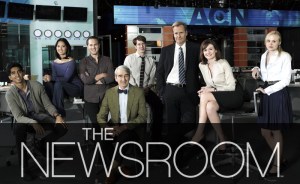
Review: The Newsroom S1:E4 – “I’ll Try to Fix You”


The key to Episode 4 of The Newsroom’s season really comes down to the last 10 to 15 minutes. The episode seems light and even and then by the end everyone is moving in a mad scramble to get the news out. Very nice to see that, honestly.

This episode, entitled “I’ll Try to Fix You” has the News Night 2.0 team closing out 2010 and celebrating the impending New Year. It’s more or less a lighthearted, fun episode. Mac approaches Will in his office, letting him know that her boyfriend Wade wants to speak with him on something. Wade informs Mac that he’s missing a major headline.

Neal appears to have this weird obsession over Bigfoot, which becomes a running theme in this episode. It’s cute in that it comes up a number of times here, very similar to the story about the Chicken in The Social Network. Maggie finds Jim still working to find any major stories they may have missed. After a little light flirting (well, it seemed that way), Don shows up and Maggie has to go. A lightly inebriated Don decides to set up Maggie’s roommate, Lisa, with Jim for New Year’s. In the middle of selling Jim, Lisa’s phone goes off with a Rod Stewart song. After what happened with the email fiasco, I found myself recalling that because sooner or later, that ringtone would need to come back into this episode. Maggie appears to have something of an issue with Lisa and Jim, but again, she’s with Don. I kind of wish she’d make up her mind already.

Wade tells Will that the House cut 80% of the DOJ budget, and the three go over whether this is a story to run with. When Wade leaves, Mac and Will have a slight argument over Wade. Mac’s a line in particular that made me laugh, “How do you introduce the Netflix queue of crazy divorced women with digitally remastered breasts you spend your nights with?”, which works in the argument between the two.

Will heads out to the party, and finds Sloan Sabbith. Eyeing the group, they have a short exchange on whether he should mingle and who he should mingle with. He heads out and speaks to Nina Howard and finds out she’s a Gossip Columnist. Rather than going with the New Year kiss, Will starts to lecture her on what she does, stating she “knows right from wrong” and that it’s “it’s a form of pollution.” The attempt to civilize Nina ends up with a drink in his face. Poor guy has no luck whatsoever.

Charlie and Will reconvene the following morning to find that he’s on Page Six of the New York Post. Will clears the air with Charlie on this and moves on to the morning meeting. Of the topics that weren’t discussed, they decide to run with both the notion that the Republicans believe that Obama is out to take away their guns or gun rights. The broadcast goes on to show that there really hasn’t been any kind of legislation to show that this is the current plan.

Maggie and Lisa have a brief discussion on Jim, and Maggie comes to Jim’s defense when Lisa points out that he’d think she’s dumb. Again, this is going to come to a head later on.

Mac, along with a woman named Carrie (played by Kathryn Hahn, who I haven’t seen since Step Brothers), head to his apartment. When she goes to change her clothes and informs him she has a joint in her purse, he discovers a pistol and they have words. I’m not sure if Hahn’s going to come back, but it would be interesting to have her come back as a foil to Mac.

As Will and Sloan go over the next broadcast, she beams and asks him how the night went. Will informs her that her friend was packing heat. Sloan tells him he has to stick with her because she’s a little obsessive. Olivia Munn has some great moments back and forth between Jeff Daniels in this episode, and so far her character still seems to be the only one without any romantic issues.

With Will’s chances in the dating scene spiraling downward and making headlines, Don proves how much of an ass he is by giving Maggie a news blip that causes her to call Jim. While she has Jim on the phone, Don calls Lisa, who’s phone rings in the background with the Rod Stewart song. I personally can’t wait for Don to get punched outright in the face. That will be the highlight of the season for me.

After being called in on Saturday, Will finds everyone in the office going over the particulars of the Bigfoot story. Will meets with Charlie and Mac over Will being in the newspapers when it comes to light that AWM (their parent company) has been flaming him the entire time. Charlie admits about the meeting with Leona and Mac blows up because the only way that the 3 Year no work clause could have taken effect would have been if it were changed in the contract. The contact that Will changed to allow him to fire Mac also allows AWM to keep him from working anywhere else.

Just when you think it’s going to keep going on, the story explodes into high gear with the iNews blip on the shooting of Congresswoman Gabrielle Giffords. All hands are on deck as they race to get the story together and everyone prepped. It shines as easily the biggest highlight of the episode and smacked the complaining, “Not This relationship stuff again” sigh I had right off my face. During the broadcast, it comes out that CNN and NPR are going with the story that Giffords died that day. Ironically enough, CNN had the very same problem just a week or two ago, incorrectly reporting that the “Obamacare” Heath Reform vote didn’t pass before Justice Roberts’ vote came through.

When Reese shows up onto the floor and calls Will out to declare Giffords dead just as everyone else does, who shows up to actually save the day but Don of all people. Talk about jaw drop!! He’s the last person I would have expected to have come in to help this group. Will calls in Mac and Charlie to thank them in a cursing tirade, and gives Neal a chance on his Bigfoot story. With all of this done to Coldplay’s “Fix You”, it plays out so damn well that you may almost forget all of the other scenes you were watching beforehand. It’s a fantastic final few minutes that showcases what the Newsroom is about.

My only worry is that they’re moving so fast with these news reports that by the time the season is over, they could conceivably end up in the Present Time. How they’re going to come up with news after doing that is going to require a few rabbits and hats. Overall, a well done episode.