Lee Marvin didn’t get many chances to show his comedic side; in fact, I can only think of two off the top of my head: the John Wayne/John Ford outing DONOVAN’S REEF (1963) and the 1976 spoof THE GREAT SCOUT AND CATHOUSE THURSDAY (I’ll be charitably silent about 1969’s PAINT YOUR WAGON!). Then there’s the comedy western CAT BALLOU, for which Marvin won an Oscar in the dual roles of drunken, broken down outlaw Kid Shelleen and hired killer Tim Strawn. Marvin’s marvelous, but if the truth be told, it wasn’t much of a stretch for Marvin to play a hard drinker and a macho tough guy… there’s a little bit of Lee in both personas!
We know we’re in for a good time right off the get-go when the fabled Columbia Torch Lady morphs into an animated, six-gun packin’ cowgirl, a sure sign not to take things too seriously…
I decided that, in 2017, I would review a movie a day and I nearly succeeded. I didn’t review a movie on the day Chris Cornell died. I missed a few days in March due to a sinus infection. Including the review that I’m posting below, I reviewed 356 movies in 2017. According to the year-end stats, my most popular reviews were for Heavy Metal Parking Lot, Slaughter, Body Chemistry 3, Body Chemistry 4, and Beatlemania.
Since tomorrow will be the start of a new year, this is going to be the end of my A Movie A Day experiment. In 2018, I’ll still be watching movies and posting reviews on this site but this is my final daily review. For my final Movie A Day, I picked the greatest movie of all time, The Delta Force!
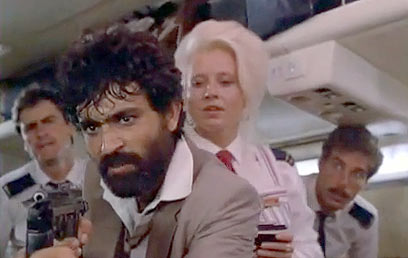
Produced by Cannon Films, The Delta Force starts in 1980, with a helicopter exploding in the desert. America’s elite special missions force has been sent to Iran to rescue the men and women being held hostage in the embassy. The mission is a disaster with the members of Delta Force barely escaping with their lives. Captain Chuck Norris tells his commanding officer, Col. Lee Marvin, that he’s finished with letting cowardly politicians control their missions. Chuck heads to Montana while Lee spends the next few years hitting on the bartender at his local watering hole.
In 1985, terrorists led by Robert Forster hijack an airplane and divert it to Beirut. Among those being held hostage: Martin Balsam, Shelley Winters, Lainie Kazan, Susan Strasberg, Kim Delaney, and Bo Svenson. The great George Kennedy plays a priest named O’Malley who, when the Jewish passengers are moved to a separate location, declares himself to be Jewish and demands to be taken too. Jerry Lazarus is a hostage who spends the movie holding a Cabbage Patch doll that his daughter gave him for luck. Former rat packer Joey Bishop plays a passenger who says, “Beirut was beautiful then. Beautiful.” Fassbinder favorite Hanna Schygulla is the stewardess who refuses to help the terrorists because, “I am German!”
In America, General Robert Vaughn activates The Delta Force to rescue the hostages and take out the terrorists. As Lee Marvin prepares everyone (including Cannon favorite, Steve James and, in a nonspeaking role, Liam Neeson) to leave, the big question is whether Chuck Norris will come out of retirement for the mission. Of course, he does. Even better, he brings his motorcycle with him.
Anyone who has ever seen The Delta Force remembers Chuck’s motorcycle. Not only did it look incredibly cool but it was also mounted with machine guns and it could fire missiles at cowardly terrorists. It didn’t matter whether you agreed with the film’s politics were or whether you even liked the movie, everyone who watched The Delta Force wanted Chuck’s motorcycle. As the old saying goes, “You may be cool but you’ll never be Chuck Norris firing a missile from a motorcycle cool.”
The Delta Force is really three different films. One film, shot in the style of a disaster film, is about the hostages on the plane and their evil captors. The second film is Lee Marvin (in his final movie role) preparing his men to storm the airplane. The third movie is Chuck Norris chasing Robert Forster on his motorcycle. Put those three movies together and you have the ultimate Cannon movie. The Delta Force was even directed by Cannon’s head honcho, Menahem Golan. (Years earlier, Golan also directed Operation Thunderbolt, an Israeli film about the raid on Entebbe, which features more than a few similarities to The Delta Force. Golan received his first and only Oscar nomination when Operation Thunderbolt was nominated for Best Foreign Language Film.)
The Delta Force is also the ultimate 80s movie. It opens with the Carter administration fucking everything up and it ends with the Reagan administration giving Lee Marvin and Chuck Norris the greenlight to blow up some terrorists. There is not much nuance to be found in The Delta Force but it still feels good to watch Chuck beat the bad guys. Top that off with a shameless score from Alan Silvestri and you have one of the greatest action movies of all time.
At the end of The Delta Force, as cans of Budweiser are being passed out to rescued hostages, an extra is clearly heard to shout, “Beer! America!” Then everyone sings America The Beautiful.
Emperor of the North Pole is the story of depression-era hobos and one man who is determined to kill them.
The year is 1933 and Shack (Ernest Borgnine) is one of the toughest conductors around. At a time when destitute and desperate men are riding the rails in search of work and food, Shack has declared that no one will ride his train for free. When Shack is first introduced, the sadistic conductor is seen shoving a hobo off of his train and onto the tracks. Shack smiles with satisfaction when the man is chopped in half under the train’s wheels.
A-No.1 (Lee Marvin) is a legend, the unofficial king of the hobos. A grizzled veteran, A-No. 1 has been riding the rails for most of his life. (The title comes from the hobo saying that great hobos, like A-No. 1, are like the Emperor of the North Pole, the ruler of a vast wasteland). A-No. 1 is determined to do what no hobo has ever done, successfully hitch a ride on Shack’s train. He even tags a water tower, announcing to everyone that he intends to take Shack’s train all the way to Portland.
If A-No. 1 did not have enough to worry about with Shack determined to get him, he is also being tailed by Cigaret (Keith Carradine), a young and cocky hobo who is determined to become as big a legend as A-No. 1. Cigaret and A. No. 1 may work together but they never trust each other.
Like many of Robert Aldrich’s later films, Emperor of the North Pole is too long and the rambling narrative often promises more than it can deliver. Like almost all movies that were released at the time, Emperor of North Pole attempts to turn its story into a contemporary allegory, with Shack standing in for the establishment, A-No. 1 representing the liberal anti-establishment, and, most problematically, Cigaret serving as a symbol for the callow counter culture, eager to take credit for A-No. 1’s accomplishments but not willing to put in any hard work himself.
As an allegory, Emperor of the North Pole is too heavy-handed but, as a gritty adventure film, it works wonderfully. Lee Marvin is perfectly cast as the wise, no-nonsense A-No. 1. This was the sixth film in which Marvin and Borgnine co-starred and the two old pros both go at each other with gusto. Carradine does the best he can with an underwritten part but this is Borgnine and Marvin’s film all the way. Marvin’s trademark underacting meshes perfectly with Borgnine’s trademark overacting, with the movie making perfect use of both men’s distinctive screen personas. As staged by Aldrich, the final fight between Shack and A-No. 1 is a classic.
Even at a time when almost every anti-establishment film of the early 70s is being rediscovered, Emperor of the North Pole remains unjustly obscure. When it was first released, it struggled at the box office. Unsure of how to sell a movie about hobos and worrying that audiences were staying away because they thought it might be a Christmas film, 20th Century Fox pulled the movie from circulation and then rereleased it under a slightly altered name: Emperor of the North. As far as titles go, Emperor of the North makes even less sense than Emperor of the North Pole. Even with the title change, Emperor of the North Pole flopped at the box office but, fortunately for him, Aldrich was already working on what would become his biggest hit: The Longest Yard.
Keep an eye out for Lance Henriksen, in one of his earliest roles. Supposedly, he plays a railroad worker. If you spot him, let me know because I have watched Emperor of the North Pole three times and I still can’t find him.
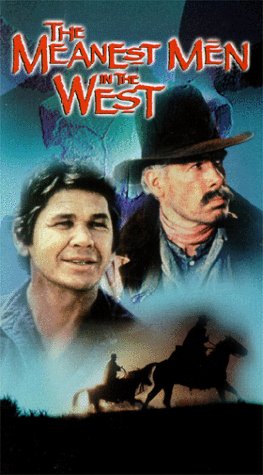
The Meanest Men In The West may “star” Charles Bronson and Lee Marvin and Sam Fuller may be credited as being one of the film’s two directors but don’t make the same mistake that I made. Don’t get too excited.
There was once a TV western called The Virginian. Starring James Drury as a ranch foreman, The Virginian ran for nine seasons on NBC. A 1962 episode, which was written and directed by Sam Fuller, featured Lee Marvin as a sadistic outlaw who kidnapped The Virginian’s employer, a judge played by Lee J. Cobb. Five years later, another episode features Charles Bronson as a less sadistic outlaw who kidnapped the Judge’s daughter.
The Meanest Men In The West mixes scenes from those two episode with western stock footage, a bank robbery that originally appeared in The Return of Frank James, an intrusive voice-over, and an almost incoherent prologue, all in order to tell an entirely new story. Now, Charles Bronson and Lee Marvin are brothers and rivals. After Marvin snitches on Bronson’s plan to rob a bank, Bronson blames his former friend, The Virginian. In order to get the Virginian to come to his hideout, Bronson kidnaps Cobb’s daughter. The Virginian manages to convince Bronson that he didn’t betray him, just to arrive back at the ranch and discover that Cobb has been kidnapped. Meanwhile, Bronson and his gang set off after Marvin and his gang. It ends with Charles Bronson, in 1967, shooting at Lee Marvin, who is still in 1962.
The Meanest Men In The West is so clumsily edited that the same shot of Charles Bronson holding a gun is spliced into a dozen different scenes. Filmed on different film stocks, the Bronson scenes and the Marvin scenes look nothing alike and, since the two episodes were filmed five years apart, James Drury literally ages backwards over the course of the film.
The Meanest Men In The West is for Charles Bronson and Lee Marvin completists only. I think Bronson and Marvin are two of the coolest individuals who ever existed and even I had a hard time making it through this one. If you do watch it, keep an eye out for a young Charles Grodin, thoroughly miscast as a tough outlaw.
A quartet of macho mercenaries – Lee Marvin , Burt Lancaster , Robert Ryan , and Woody Strode – cross the dangerous Mexican desert and attempt to rescue a rich man’s wife kidnapped by a violent revolutionary in writer/director Richard Brooks’ THE PROFESSIONALS, an action-packed Western set in 1917. The film’s tone is closer to Sergio Leone’s Spaghetti Westerns than the usual Hollywood oater, though Leone’s trilogy wouldn’t hit American shores until a year later.
Rich rancher J.W.Grant (screen vet Ralph Bellamy ) hires the quartet to retrieve wife Maria (Claudia Cardinale) from Jesus Raza (Jack Palance ), formerly a captain in Pancho Villa’s army, now a wanted bandito. Marvin is the stoic leader, a weapons expert who once rode with Raza for Villa, as did Lancaster’s explosives whiz. Ryan plays a sympathetic part (for a change) as the horse wrangling expert, while Strode is a former scout and bounty hunter adept…
Nick Devlin (Lee Marvin) is a veteran enforcer for the Chicago mob. His latest assignment has taken him out of the city and sent him to the farmlands of Kansas. Nick is the third enforcer to be sent to Kansas, all to collect a $500,000 debt from a local crime boss named Mary Ann (Gene Hackman). The first one ended up floating face down in the Missouri River. The second was chopped up into sausages at the local slaughterhouse. Nick might have better luck because he once had an affair with Mary Ann’s wife, Clarabelle (Angel Tompkins).
When Nick tracks down Mary Ann to demand the money, he discovers that Mary Ann and his brother Weenie (Gregory Walcott, best remembered for his starring role in Plan 9 From Outer Space) are running a white slavery ring. Kidnapping girls from a nearby orphanage, Mary Ann and Weenie keep them naked and doped up in a barn. One of the girls, Poppy (Sissy Spacek, in her film debut), looks up at Nick and says, “Help me.” Nick takes Poppy with him, claiming that he’s holding her for collateral until he gets the money.
The main attraction here is to see two iconic tough guys — Lee Marvin and Gene Hackman — fighting over Sissy Spacek, who is only slightly less spacey here than in her breakthrough role in Badlands. In Prime Cut, the ruthless Chicago mobster turns out to have more of a conscience than the rural good old boys who work for Mary Ann and Weenie. Nothing sums up Prime Cut better than the scene where Lee Marvin, wearing a black suit, and Sissy Spacek are pursued through a wheat field by a thrasher that’s being driven by a roly-poly farmer wearing overalls. Prime Cut is both an exciting crime film and a trenchant satire of both the American heartland and the type of gangster movies that made Lee Marvin famous.
The 1950’s were a time of change in movies. Television was providing stiff competition, and studios were willing to do anything to fend it off. The bigger budgeted movies tried 3D, Cinerama, wide-screen, and other optical tricks, while smaller films chose to cover unusual subject matter. The following five films represent a cross-section of nifty 50’s cinema:
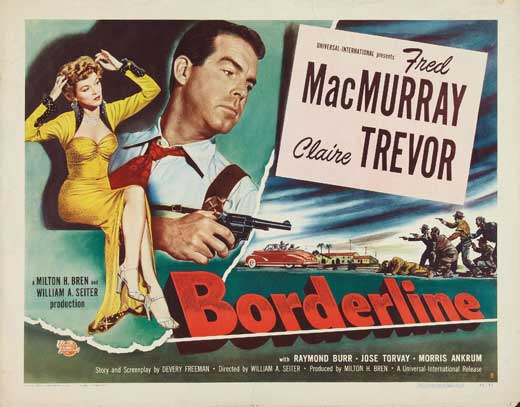
BORDERLINE (Universal-International 1950; D: William A. Seiter)
BORDERLINE is a strange film, straddling the borderline (sorry) between romantic comedy and crime drama, resulting in a rather mediocre movie. Claire Trevor plays an LAPD cop assigned to Customs who’s sent to Mexico to get the goods on drug smuggler Pete Ritchey (Raymond Burr , being his usual malevolent self). She’s tripped up by Ritchey’s rival Johnny Macklin (Fred MacMurray , channeling his inner Walter Neff), and taken along as he tries to get the dope over the border. What she doesn’t know is he’s also…
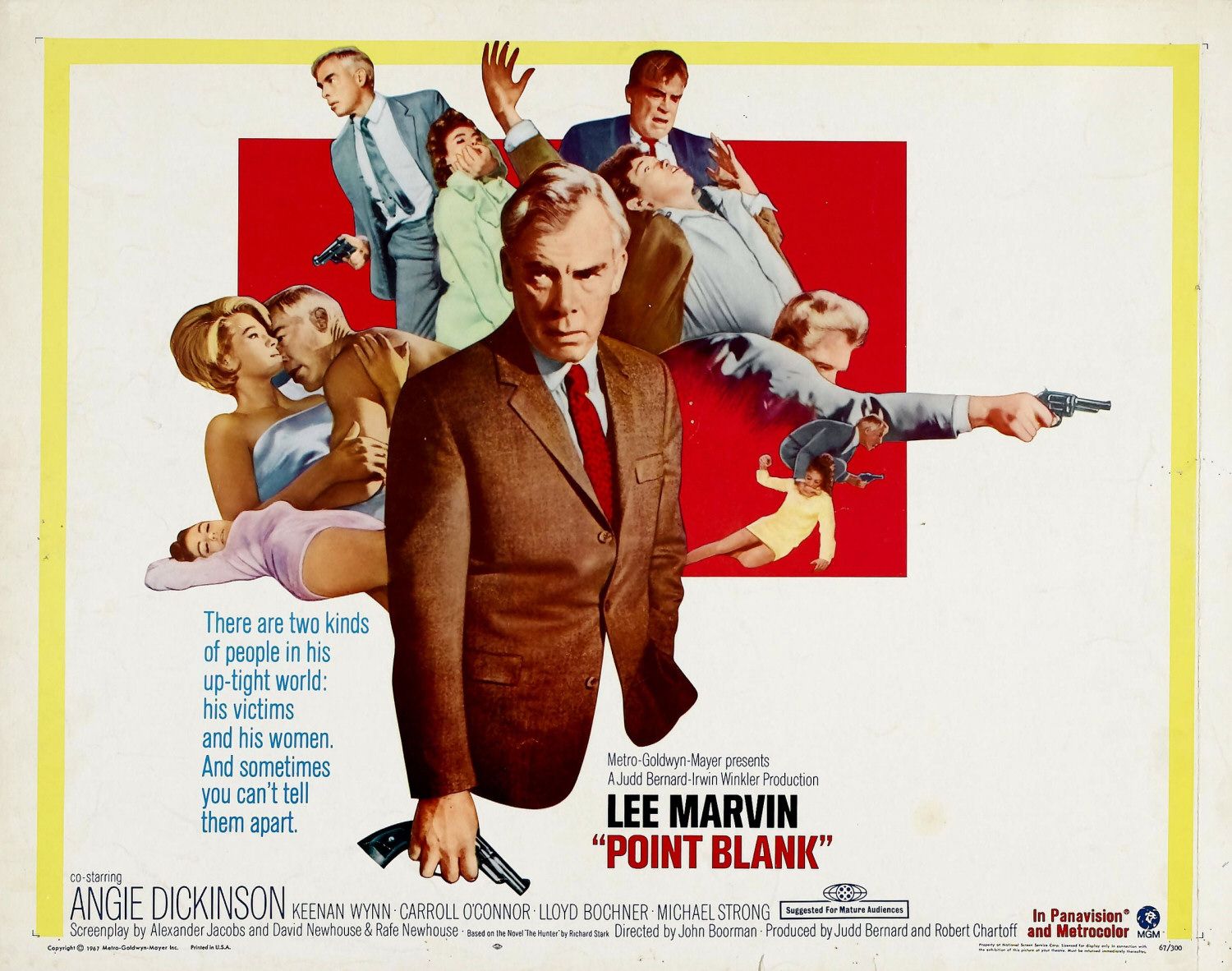
Lee Marvin was one tough son of a bitch both onscreen and off, awarded the Purple Heart after being wounded by a machine gun blast in WWII. The ex-Marine stumbled into acting post-war, and Hollywood beckoned in the 1950’s. His imposing presence typecast him as a villain in films like HANGMAN’S KNOT, THE BIG HEAT , and BAD DAY AT BLACK ROCK. A three season stint in TV’s M SQUAD brought Marvin more acclaim, and he solidified that with his Oscar-winning role in CAT BALLOU, parodying his own tough-guy image. Marvin was now a star that could call his own shots, and used that clout in POINT BLANK, throwing out the script and collaborating with a young director he had faith in, John Boorman.
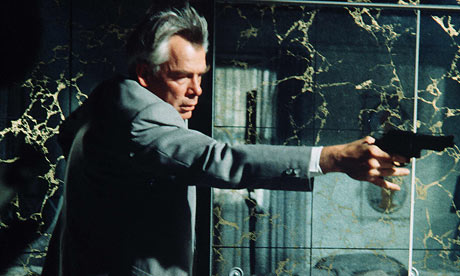
POINT BLANK is a highly stylized revenge drama centering on Marvin’s character of Walker. The nightmarish opening sequence shows how Walker was left for dead on deserted Alcatraz Island by…
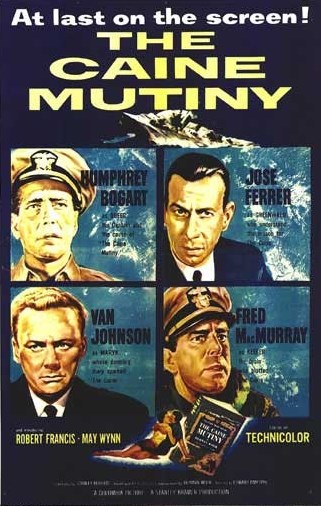
It’s the 1940s and World War II is raging. The U.S. Navy is model of military discipline and efficiency. Well, except for the U.S.S. Caine, that is. The Caine is something of a disorganized mess, where no one takes his job seriously and sailors have names like Meatball (Lee Marvin) and Horrible (Claude Akins). The men love Lt. Commander DeVriess (Tom Tully), largely because he has given up on trying to enforce any sort of discipline. However, DeVriess has recently been relieved of his command. As he leaves, Meatball gives him a new watch, a gift from all the men. DeVriess admonishes them, snapping that the gift is violation of Naval regulations. He then puts the watch on his wrist and leaves the ship.
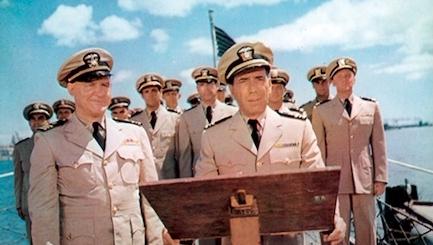
DeVriess’s replacement is Captain Francis Queeg and, at first, we have reason to be hopeful because Captain Queeg is being played by Humphrey Bogart. Surely, if anyone can get this ship into shape, it’ll be Humphrey Bogart! From the moment he arrives, Queeg announces that he’s going to enforce discipline on the Caine and if that means spending hours yelling at a man for not having his shirt tucked in, that’s exactly what Queeg is prepared to do. However, it also quickly becomes apparent that the awkward Queeg has no idea how to talk to people. He is also overly sensitive and quick to take offense. Whenever Queeg makes a mistake (and he does make a few), he’s quick to blame everyone else.
Realizing that the men are turning against him, Queeg even begs his officers for their help. He asks them if they have any suggestions. They all sit silently, their heads bowed as Queeg somewhat poignantly rambles on about how his wife and his dog both like him but the crew of the Caine does not.
Queeg’s officers are a diverse bunch, none of whom are quite sure what to make of Queeg or the state of the Caine. Ensign Willie Keith (Robert Francis) is a wealthy graduate of Princeton University who, at first, likes Queeg but quickly comes to doubt his abilities. On the other hand, Lt. Steve Marsyk (Van Johnson) has doubts about Queeg from the start but, as a career Navy man, his natural instinct is to respect the chain of command above all else.
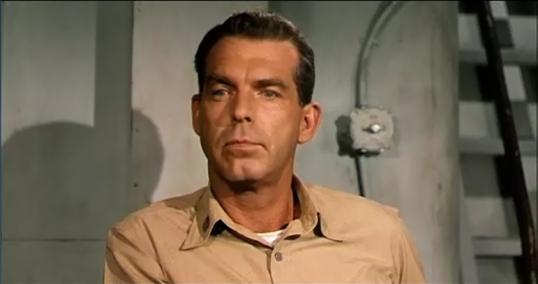
And then there’s Lt. Tom Keefer (Fred MacMurray). Keefer is a self-styled intellectual, a novelist who is always quick with a snarky comment and a cynical observation. (If The Caine Mutiny were remade as a B-horror film, Lt. Keefer’s name would probably be Lt. Sardonicus.) From the minute the viewers meet Lt. Keefer, our inclination is to like him. After all, he seems to be the only person in the film who has a sense of humor. If we had to pick someone to have dinner with, most of us would definitely pick the erudite Tom Keefer over the humorless and socially awkward Francis Queeg. As such, when Keefer starts to suggest that Queeg might be mentally unstable, our natural impulse is to agree with him.
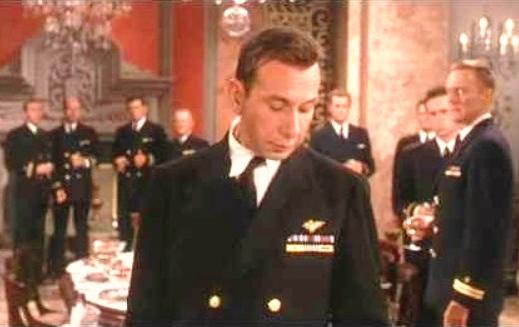
It’s Tom Keefer who first suggests that it may be necessary to take the command away from Queeg. And yet, when it comes time to take action, it’s Keith and Marsyk who do so while Keefer stands to the side and quietly watches. And, once the Caine arrives back in the U.S., it Keith and Marsyk who are court martialed. Will they be found guilty of treason or will their lawyer, Lt. Barney Greenwald (Jose Ferrer), prove that Queeg was unfit for command?
Made in 1954 and based on a novel by Herman Wouk, The Caine Mutiny is one of those big and glossy 1950s productions that holds up a lot better than you might expect. The film has its flaws. In the role of Keith, Robert Francis is a bit on the dull side and a subplot in which he courts May Wynn feels unneccessary and only serves to distract from the main story. But, for the most part, it’s an intelligent and well-directed film. Humphrey Bogart turns Queeg into a pathetic and lonely figure and you can’t help but feel sorry for him when he talks about how his dog loves him. Van Johnson also does well as Marsyk, effectively portraying a well-meaning character who is in over his head. Jose Ferrer gets a great drunk scene at the end of the film and, of course, you can’t go wrong with Lee Marvin as a smirking sailor, even if Marvin only appears for a handful of minutes.
But for me, my favorite character (and performance) was Fred MacMurray’s Tom Keefer. Technically, Keefer is not meant to be a likable character. He’s totally passive aggressive. He’s pretentious. He’s smug. At times, he’s rather cowardly. And yet, Tom Keefer remains the most memorable and interesting character in the entire film. He gets all of the good one-lines and MacMurray delivers them with just the right amount of barely concealed venom. (“If only the strawberries were poisoned…” he says as he considers dinner aboard the Caine.) It’s a great role and Fred MacMurray gives a great performance. And you know what? I don’t care how bad a character he may have been. I still want to read Tom Keefer’s book!
The Caine Mutiny was nominated for best picture of 1954. However, it lost to On The Waterfront.
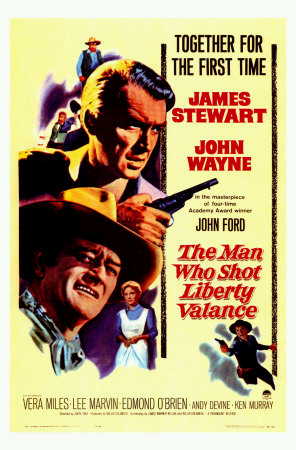
“When the legend become fact, print the legend.” — Maxwell Scott (Carleton Young) in The Man Who Shot Liberty Valance (1962)
Though I understand and respect their importance in the history of both American and Italian cinema, I have never really been a huge fan of westerns. Maybe its all the testosterone (“A man’s got to do what a man’s got to do…”) or maybe it’s all the dust but westerns have just never really been my thing.
However, I will always make an exception for The Man Who Shot Liberty Valance, which is not just a great western but a great film period.
But you already knew that. It’s a little bit intimidating to review a film that everyone already knows is great. I even opened this review with the exact same quote that everyone uses to open their reviews of The Man Who Shot Liberty Valance. To a certain extent, I feel like I should have found a quote that everyone hasn’t already heard a thousand times but then again, it’s a great quote from a great film and sometimes, there’s nothing wrong with agreeing with the critical consensus.
The Man Who Shot Liberty Valance opens with a train stopping in the small western town of Shinbone. The residents of the town — including newspaper editor Maxwell Scott (Carleton Young) — are shocked when Sen. Rance Stoddard (James Stewart) and his wife Hallie (Vera Miles) get off the train. Sen. Stoddard is considered to be a front-runner to become the next Vice President of the United States. Scott is even more shocked to discover why the Stoddards are in town. They’ve come to Shinbone to attend the funeral of an obscure rancher named Tom Doniphon (played, in flashback, by John Wayne).
Sitting in the funeral home with Doniphon’s coffin (and having reprimanded the local mortician for attempting to steal Tom’s boots), Rance tells Scott why he’s come to pay respect to Tom Doniphon. We see, in flashback, how Rance first came to Shinbone 25 years ago, an idealistic lawyer who — unlike most of the men in the west — refused to carry a gun. We see how Rance was robbed and assaulted by local outlaw Liberty Valance (a wonderfully intimidating and bullying Lee Marvin), we discover how Rance first met Hallie while working as a dishwasher and how he eventually taught her how to read, and we also see how he first met Tom Doniphon, the only man in town strong enough to intimidate Liberty Valance.
At first, Rance and Doniphon had an uneasy friendship, epitomized by the condescending way Doniphon would call Rance “pilgrim.” Doniphon was in love with Hallie and, when he attempted to teach Rance how to defend himself, he was largely did so for Hallie. Rance, meanwhile, was determined to bring law and society to the west.
And, eventually, Rance did just that. When Shinbone elected two delegates to the statehood convention in the territory’s capitol, Rance attempted to nominate Doniphon for the position but Doniphon refused it and nominated Rance instead, explaining that Rance understood “the law.” When Liberty Valance attempted to claim the other delegate spot, Rance and Doniphon worked together to make sure that it instead went to newspaper editor Dutton Peabody (Edmond O’Brien). And when Liberty Valance attempted to gun Rance down in the street, Rance shot him.
Or did he?
That’s the question that’s at the heart of The Man Who Shot Liberty Valance. However, as a film, The Man Who Shot Liberty Valance is far less interested in gunfights than it is in politics. Perhaps the most important scene in the film is not when Rance and Liberty meet out on that dark street. Instead, it’s the scene at the statehood convention where the reformers (represented by Rance) and the cattlemen (represented by John Carradine) battle over who will be the territory’s delegate to Washington. Between John Carradine orating, the horses riding in and out of the hall, Edmond O’Brien drinking, James Stewart looking humble, and John Wayne glowering in the background, this is one of the best political scenes ever put on film.
When Rance first arrives in the west, there is no political system in place. With the exception of the ineffectual town marshal (Andy Devine), there is no law. The peace is kept by men like Tom Doniphon and, oddly enough, by Liberty Valance as well. (Whether he realizes it or not, Shinbone’s fear of Liberty has caused the town to form into a community.) What little official law there is doesn’t matter because the majority of the Shinbone’s citizens can’t read.
When Rance arrives, he brings both education and the law. He makes Shinbone into a town that no longer needs Liberty Valance but, at the same time, it no longer need Tom Doniphon either. Hence, it’s Rance Stoddard who goes from dishwasher to U.S. Senator while Tom Doniphon dies forgotten. Rance represents progress and unfortunately, progress often means losing the good along with the bad things of the past.
(It’s no coincidence that when Rance and Hallie return to Shinbone, the first person that they see is the former town marshal, who no longer wears a star and who, we’re told, hasn’t for years. Time has passed by.)
It’s a bittersweet and beautiful film, one that features four great performances from Stewart, Wayne, Marvin, and Vera Miles. Personally, I like to think that maybe Sen. Stoddard had a daughter who married a man named Smith and maybe they had a son named Jefferson who later made his way to the Senate as well.




 Emperor of the North Pole is the story of depression-era hobos and one man who is determined to kill them.

 The Meanest Men In The West may “star” Charles Bronson and Lee Marvin and Sam Fuller may be credited as being one of the film’s two directors but don’t make the same mistake that I made. Don’t get too excited.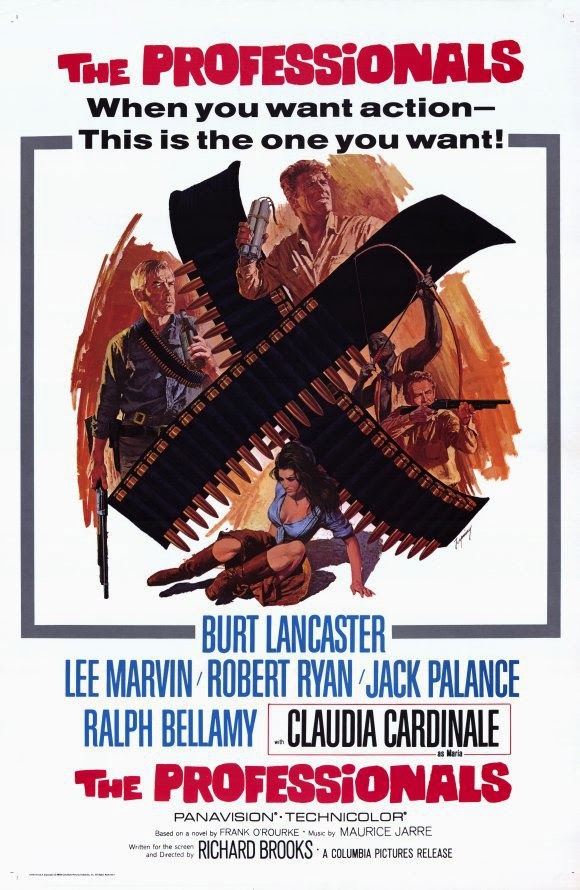

 Nick Devlin (Lee Marvin) is a veteran enforcer for the Chicago mob. His latest assignment has taken him out of the city and sent him to the farmlands of Kansas. Nick is the third enforcer to be sent to Kansas, all to collect a $500,000 debt from a local crime boss named Mary Ann (Gene Hackman). The first one ended up floating face down in the Missouri River. The second was chopped up into sausages at the local slaughterhouse. Nick might have better luck because he once had an affair with Mary Ann’s wife, Clarabelle (Angel Tompkins).
 Through the Shattered Lens