Late Night Retro Television Review: Pacific Blue 3.7 “Repeat Offenders”


Welcome to Late Night Retro Television Reviews, a feature where we review some of our favorite and least favorite shows of the past! On Tuesdays, I will be reviewing Pacific Blue, a cop show that aired from 1996 to 2000 on the USA Network!  It’s currently streaming everywhere, though I’m watching it on Tubi.
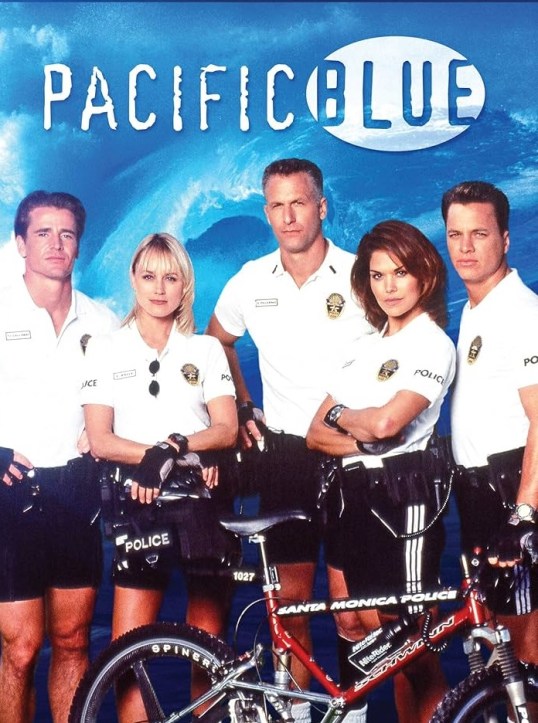
It’s a Chris epiosde. *Yawn*

Episode 3.7 “Repeat Offenders”

(Dir by Charles Siebert, originally aired on September 28th, 1997)

When this show first started, Chris Kelly was introduced as being a hotshot Navy pilot who was forced into reserve status due to her eyesight.  In this episode, it’s revealed that she actually left active duty because she was involved in an accident that was the fault of her commanding officer.  Rather than testify against him and run the risk of being crucified on the stand and then run out of the Navy, she instead took the blame.

Five years later, she discovers that another Navy pilot, Rebecca Santori (Liza Snyder), is facing the same dilemma.  Her commanding officer — who was also Chris’s commanding officer — screwed up and Santori is being pressured to take the blame.  Chris encourages Santori to fight for her right to fly.  Cory suggests that Chris is pressuring Snantori because Chris feels guilty about giving up when she was in the same position.  Cory suggests that Chris is putting Santori’s career at risk just to deal with her own anger and resentment.  Chris says that’s not true and the show seems to expect us to take her word for it.  Fortunately, things do work for Santori.  She is cleared in the accident and Chris is vindicated when its determined that their commanding officer has a long history of incompetence.

This storyline had potential but Chris is just such a one-note character that it’s hard to get excited about anything involving her.  Every week, it seems like Chris finds something new to get upset about and every week, anyone who suggests that Chris isn’t being totally honest about her motivations has to deal with the Chris Kelly glare of death.  In order to remain sympathetic while glaring at people and telling them that they’re idiots, you have to have some shred of charisma.  Chris does not and whenever she’s at the center of an episode, even when she’s in the right as with this one, I just find myself thinking about how much I would dread to have to work with her on a daily basis.

As for the other storyline, thieves are targeting foreign tourists on the boardwalk.  Palermo and TC put on Hawaiian shirts and pretend to be foreign tourists.  The thieves get arrested.  Yay.  How exciting.  Bike patrol does it again.
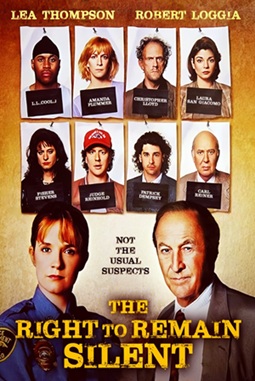
The Right To Remain Silent (1996, directed by Hubert de La Bouillerie)


It’s one very busy night at a police station.  Everyone who is brought in from off the streets has the right to remain silent but no one exercises it.  Rookie cop Lea Thompson listens to everyone’s stories.  LL Cool J is the documentarian who thought it would be smart to put on Klan robes and a hood and try to infiltrate a demonstration undercover.  Patrick Dempsey is the drunk who killed a kid.  Carl Reiner comes in and confesses to mercy killing his wife.  Christopher Lloyd is homeless.  Fisher Stevens is a trans streetwalker.  Judge Reinhold, I don’t even know what he was supposed to be.  Reinhold actually plays two characters in this film and he’s miscast in both roles.  Amanda Plummer is a pizza delivery person who shoots someone in self-defense.  No one asks for a lawyer.  No one lies about what they did.  Instead, they just talk and talk and talk and talk some more.  Thompson listens while Robert Loggia, as the chief, growls about donuts.

The Right To Remain Silent is based on a play and that is its downfall.  Instead of being a story about a rookie cop and her first night on the job, it’s just a collection of rambling stage monologues.  Some of the actors, like Carl Reiner and Christopher Lloyd, do okay.  Most of them still seem to be acting for the folks sitting in the back row.  It ultimately doesn’t add up too much because the stories are too predictable to make much of an impression.  Everyone in this film had the right to remain silent and I wish they had exercised it.

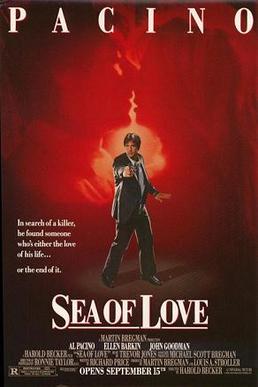
Sea of Love (1989, directed by Harold Becker)


In New York City, someone is ritualistically murdering the men who are placing rhyming personal ads in a tabloid newspaper.  Assigned to the case is Frank Keller (Al Pacino), an alcoholic burn-out whose wife just left him for another cop.  Keller and his partner (John Goodman) decide to go undercover.  Frank places a rhyming personal ad of his own and then goes to a restaurant to see who shows up.  When Helen Cruger (Ellen Barkin) answers the ad, it leads to a relationship between Frank and Helen.  Frank is falling for Helen but what if she’s the murderer?

Sea of Love is a superior thriller, even though it doesn’t really work as a mystery.  As soon as you see a certain person’s name in the cast list, you’re going to guess who the killer is because that person is always the killer.  Sea of Love isn’t really about the mystery, though.  It’s about people looking something that’s missing from their lives and realizing that the world is passing them by.  The movie works because of the performances of Al Pacino and Ellen Barkin, cast as two lonely middle-aged people who are desperately looking for some sort of connection.  Helen and Frank are both in their 40s and wondering if their current situation is really as good as it’s going to get.  The film uses Frank’s fear that Helen could be the killer as a metaphor for the fear that anyone feels when they are first starting to open up to someone.  Both Pacino and Barkin give emotionally raw and poignant performances.  I don’t think I’ve ever seen Al Pacino look as miserable as he did for the majority of Sea of Love.  This was Pacino’s first film role after the disaster of Revolution and the movie’s box office success was revived Pacino’s career and convinced him to give movies a try again.

Director Harold Becker captures the feel of New York at its grittiest and least welcoming and Richard Price’s script is full of priceless dialogue.  This is one of the rare films in which everyone has something intelligent or meaningful to say.  Featuring a strong supporting cast and career-best performances from Ellen Barkin and Al Pacino, Sea of Love is much more than just another cop film.

Late Night Retro Television Review: Friday the 13th: The Series 2.25 “The Prisoner”


Welcome to Late Night Retro Television Reviews, a feature where we review some of our favorite and least favorite shows of the past! On Fridays, I will be reviewing Friday the 13th: The Series, a show which ran in syndication from 1987 to 1990. The entire series can be found on YouTube!

This week, Johnny goes to prison!

Episode 2.25 “The Prisoner”

(Dir by Armand Mastroianni, originally aired on June 5th, 1989)

After Johnny Ventura’s father is killed by an invisible man….

Wait, what’s Johnny doing here?

No, don’t get me wrong.  I understand why Johnny’s there, mostly because I have the benefit of hindsight.  I know that Johnny is going to replace Ryan during the third season and this episode was obviously designed to get the audience used to the idea of Johnny being a part of the show.  The majority of the episode follows Johnny as he’s sent to prison, having been framed for murdering his own father.  The culprit is another prisoner, Dayton Railsback (Larry Joshua).  Dayton has a kamikaze pilot’s jacket that allows him to turn invisible whenever blood is spilled on it.  Whenever Dayton’s invisible, he sneaks out of the prison and searches for some money that he stole ten years earlier. Johnny is the only person in the prison who knows what Railsback is doing so soon, he’s being targeted by the invisible man.

While Johnny is dealing with life in prison, Micki, Ryan, and Jack are attempting to prove that Railsback is the murderer.  It’s a bit odd because the three of them — our stars! — are barely in the episode and, when they do appear, they’re just hanging out in the antique shop.  They talk about all of the investigating that they’ve been doing but we don’t actually see them doing it.  Watching the episode, one gets the feeling that John D. LeMay, Robey, and Chris Wiggins all shot their scenes in one day and then left on an extended vacation.  They showed up just long enough to establish this as being an episode of Friday the 13th, despite the fact that almost the entire episode is about Johnny.

Needless to say, it was a bit of a disjointed episode.  The show kept jumping from Johnny in prison to Railsback killing people outside of prison to everyone hanging out in the antique shop and it was a bit difficult to keep track of who was planning what.  Myself, I was surprised at how quickly the show went from Johnny’s father being murdered to Johnny getting tossed into prison.  We don’t even see Johnny’s trial.  Johnny was passed out when his father was shot and, quite frankly, it seems like he could have made a very credible argument that he was framed.  (The invisible Railsback puts the gun in Johnny’s hands but he doesn’t manipulate Johnny into pulling the trigger so it’s not like there would have been any powder residue on Johnny’s fingers.)  Johnny and his father appeared to have a pretty good relationship so you really have to wonder what type of case the prosecution made.  The episode ends with Johnny killing Railsback and then being released from prison.  So, is Johnny going to have to on trial again?  I mean, he just stood there while Railsback burned to death.

Weird episode.  It didn’t do too much for me.  I’m going to miss Ryan once season 3 starts.

Lisa Reviews An Oscar Winner: Unforgiven (dir by Clint Eastwood)


The 1992 Best Picture winner, Unforgiven, begins as a story of frontier justice.

In Kansas, a young and cocky cowboy who calls himself the Schofield Kid (Jaimz Woolvett) rides up to an isolated hog farm.  He’s looking for Will Munny (Clint Eastwood), a notorious outlaw with a reputation for being a ruthless killer.  Instead, he just finds a broken down, elderly widower who is trying to raise two young children and who can barely even manage to climb on a horse.  Will Munny, the murderer, has become Will Munny the farmer.  He gave up his former life when he got married.

The Schofield Kid claims to be an experienced gunfighter who has killed a countless number of men.  He explains that a group of sex workers in Wyoming have put a $1,000 bounty on two men, Quick Mike (David Mucci) and his friend, Davey Bunting (Rob Campbell).  Quick Mike cut up one of the women when she laughed at how unimpressively endowed he was.  While Davey didn’t take part in the crime, he was present when it happened and he didn’t do anything to stop it.  The local sheriff, a man named Little Bill Daggett (Gene Hackman), had Davey give the woman’s employer several horses as compensation.  The Kid wants Munny to help him collect the bounty.

At first, Munny refuses to help the Kid.  But, when he realizes that he’s on the verge of losing his farm, Munny changes his mind.  He and his former partner, Ned Logan (Morgan Freeman), join with the Kid and the three of them head to Wyoming.  Along the way, they discover that the Kid is severely nearsighted and can hardly handle a pistol.

Meanwhile, in the town of Big Whiskey, Wyoming, Little Bill ruthlessly enforces the peace.  He’s a charismatic man who is building a house and bringing what many would consider to be civilization to the Old West. When we first meet Little Bill, he seems like a likable guy.  The town trusts him.  His deputies worship him.  He has a quick smile but he’s willing to stand his ground.  But it soon becomes apparent that, underneath that smile and friendly manner, Bill is a tyrant and a petty authoritarian who treats the town as his own personal kingdom.    Little Bill has a strict rule.  No one outside of law enforcement is allowed to carry a gun in his town.  When another bounty hunter, English Bob (Richard Harris), comes to town to kill the two cowboys, Little Bill humiliates him and sends him on his way but not before recruiting Bob’s traveling companion, writer W.W. Beauchamp (Saul Rubinek), to write Bill’s life story.  Bill’s not that much different from the outlaws that he claims to disdain.  Like them, Bill understands that value of publicity.

Unforgiven starts as a traditional western but it soon becomes something else all together.  As the Schofield Kid discovers, there’s a big difference between talking about killing a man and actually doing it.  Piece-by-piece, Unforgiven deconstructs the legends of the old west.  Gunfights are messy.  Gunfighters are not noble.  Davey Bunting is the only man in town to feel guilty about what happened but, because he’s included in the bounty, he still dies an agonizing death.  Quick Mike is killed not in the town square during a duel but while sitting in an outhouse.  Ned and Munny struggle with the prospect of going back to their old ways, with Munny having to return to drinking before he can once again become the fearsome killer that he was in the past.  And Little Bill, the man who says that he’s all about taming the west and bringing civilization to a lawless land, turns out to be just as ruthless a killer as the rest.  A lot of people are dead by the end of Unforgiven.  Some of them were truly bad.  Some of them were good.  Most of them were in the wrong place at the wrong time.  Everyone’s got it coming, to paraphrase Will Munny.

With its violent storyline, deliberate pacing, and its shots of the desolate yet beautiful western landscape, Clint Eastwood’s film feels like a natural continuation of the Spaghetti westerns that he made with Sergio Leone.  (Unforgiven is dedicated to both Leone and Don Seigel.)  Unforgiven was the first of Eastwood’s directorial efforts to be nominated for Best Picture and also the first to win.  It’s brutal meditation on violence and the truth behind the legends of the American frontier.  Eastwood gives one of his best and ultimately most frightening performances as Will Munny.  Gene Hackman won his second Oscar for playing Little Bill Daggett.

Unforgiven holds up well today.  Hackman’s Little Bill Dagget feels like the 19th century version of many of today’s politicians and unelected bureaucrats, authoritarians who claims that their only concern is the greater good but whose main interest is really just increasing their own power.  Unforgiven remains one Clint Eastwood’s best films and one of the best westerns ever made.  Leone would have been proud.

Retro Television Review: Miami Vice 2.16 “Little Miss Dangerous”


Welcome to Retro Television Reviews, a feature where we review some of our favorite and least favorite shows of the past!  On Mondays, I will be reviewing Miami Vice, which ran on NBC from 1984 to 1989.  The entire show can be purchased on Prime!

The power has returned, my mood is better, and my wrist has healed.  It’s time to get back to the reviews!

Episode 2.16 “Little Miss Dangerous”

(Dir by Leon Ichaso, originally aired on January 31st, 1986)

There’s a serial killer stalking the red light district of Miami, haunting cheap motels, dark alleys, and neon-lit sex clubs.  Men are turning up dead all over the place, brutally stabbed and then set on fire.  Occasionally, a crude drawing is left behind.  Castillo announces that every member of the Squad will be working a 12-hour shift until the killer is brought to justice.  He says that they may be looking for a pimp or a prostitute who is looking for revenge.

Of course, every prostitute knows and likes Sonny Crockett.  And again, this leads to the question of how exactly Sonny is able to work undercover when everyone in Miami knows who he is.  For that matter, all of the prostitutes also seem to know that Gina and Trudy are working Vice as well, despite the fact that Gina and Trudy’s regular gig to go undercover as high-priced escorts.  How do these people ever succeed at going undercover?  Everyone knows them!  I guess that’s to be expected, though, when you’ve only got 6 detectives working Vice in a city as big as Miami.

Tubbs meets a Jackie (played by singer Fiona), a young runaway who swears that she’s 18 and who says that she’s happy working as a prostitute because her body is just a commodity.  Tubbs becomes obsessed with protecting the spacey but seemingly innocent Jackie, especially after he becomes convinced that Jackie’s pimp, Cat (Larry Joshua), is the murderer.  Except, of course, Cat isn’t the killer.  Jackie is!  When Tubbs takes Jackie to a safehouse (which, of course, is also an art deco mansion), she snaps.  As Crockett tries to break down the locked front door and Cat crashes into the house on his motorcycle, Jackie starts a fire and approaches Tubbs.  But, instead of killing the only man who hasn’t tried to use her body, Jackie instead holds a gun to her head.  This is another episode that ends with an off-screen gunshot.  Interestingly, we never see Crockett actually get into the safehouse to rescue Tubbs from the fire.  Instead, the ending is abrupt and the viewer, while having no doubt that Tubbs will escape the fire, knows that Tubbs will now carry Jackie’s scars as his own.

What an unsettling episode.  This was Miami Vice at its most surreal and dream-like, with almost all of the action taking place at night and both Fiona and Larry Joshua giving edgy performances as two self-destructive people who live in the shadows of a wealthy American city.  For once, the entire Vice Squad gets in on the action, though Tubbs is clearly the one at the center of the story.  This episode reminds us that Tubbs is not quite as cynical and emotionally closed-off as Crockett but maybe, for the sake of his sanity, he should be.  Little Miss Dangerous is a journey into the heart of Miami darkness.

The TSL’s Horror Grindhouse: The Burning (dir by Tony Maylam)


Among some horror fans, the 1981 film, The Burning, has long had a reputation for being one of the best of the many films to come out of the early 80s slasher boom.

I have to admit that the first time I saw it, my thought process went something like this:  Oh great, more campers …. I can’t wait to see all of these people die …. God, these campers are annoying …. Thank God I never went to summer camp …. Wait, is that Jason Alexander …. when is the killer going to show up …. oh hey, that is Jason Alexander …. if I wanted to sit through a bunch of silly summer camp hijinks, I wouldn’t have gone searching for a horror film …. goddammit, was it really necessary for Jason Alexander to moon the camera …. wow, this movie is boring …. I don’t know who said this was scary but seriously …. oh God, now it’s turning into a movie about rafting …. I’ve about had it …. this movie is so bor–OH MY GOD WHAT THE HELL JUST HAPPENED! AGCK!  THERE GO HIS FINGERS OH MY GOD….

Seriously, The Burning is a film that requires a bit of patience.  You got to sit through a lot of silliness before you actually get to the horror but once you do …. oh my God!  It’s intense.  The killer in The Burning is Cropsy, a former groundskeeper who was set on fire by a bunch of campers years ago.  Now, he’s everyone’s worst nightmare — a madman with gardening shears.  It takes a while for Cropsy to really get into the spirit of things.  In fact, for a good deal of The Burning, no one is even talking about Cropsy, which is always a mistake when you’re trying to make a movie about a killer in the woods.  A young camper named Alfred (Brian Backer) keeps thinking that he see Cropsy sneaking around the camp but nobody believes him, largely because Cropsy doesn’t ever do anything to let people know that he’s back and ready to demonstrate how gardening tools can be used as an instrument of revenge.

However, once Cropsy actually gets going, he is terrifying!  The Burning is a good example of the type of horror movie that was made before the Nightmare on Elm Street series introduced the idea that killers could not only talk but also tell a lot of corny jokes.  Cropsy doesn’t speak.  Crospy doesn’t joke.  All Cropsy does is kill.  What makes Cropsy especially disturbing is that — much like the killer in The Prowler — he seems to get a lot of joy out of killing as brutally as possible.  He’s not Jason or Michael, killers who killed because that’s all they knew how to do.  Cropsy plots and calculates and hides and is basically everyone’s campfire nightmare come to life.

Now, as I said before, it does take Cropsy a while to get started.  And we do end up spending a lot of time watching campers do stupid things.  Yes, Jason Alexander is one of the campers.  He not only has hair but I think he’s supposed to be a teenager in this film.  He was 21 when the film was shot and he looks like he’s about 35.  He delivers his lines in such a way that it’s impossible not to think of The Burning as being a lost episode of Seinfeld where George Costanza goes camping.  On the plus side, he does get some vaguely funny lines, which is more than his co-stars get.

Speaking of co-stars, keep an eye out for Holly Hunter.  She was dating Jason Alexander at the time (as well as rooming with Frances McDormand) and she makes her film debut as one of the campers.  She gets one line.  “What if they don’t come back?”  It’s a good question.  What if they don’t?  (Cue dramatic music!)

Anyway, The Burning is a slasher film that requires some patience but when it needs to be scary, it gets the job done.  (The gore effects are by the one and only Tom Savini and yes, they are shocking and a bit disturbing.  If you’ve ever wanted to know what losing four fingers at once would look like, this is the film for you.)  It’s a bit too padded for its own good but Cropsy is an effective villain and the movie actually catches you by surprise regarding who survives and who doesn’t.  Amazingly, there was never a sequel to The Burning.  Personally, I don’t think it’s too late.  I want to see Jason Alexander return to the camp and finish Cropsy off, once and for all!