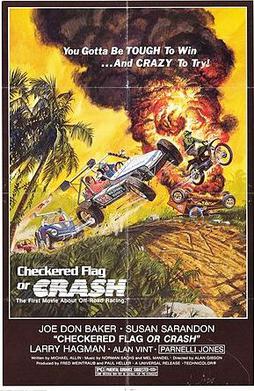
Joe Don Baker stars at “Walkaway” Madden, a race car driver who got that name because he has always managed to walk away from every crash. When Madden agrees to compete in an off-road race through the Philippines, he is not happy to discover that his sponsor has arranged for a female journalist named C.C. Wainwright (Susan Sarandon) to accompany him and record his adventures. Walkaway’s a good ol’ boy and C.C.’s an independent woman but wouldn’t you know it, they’re in love by the end of the race.
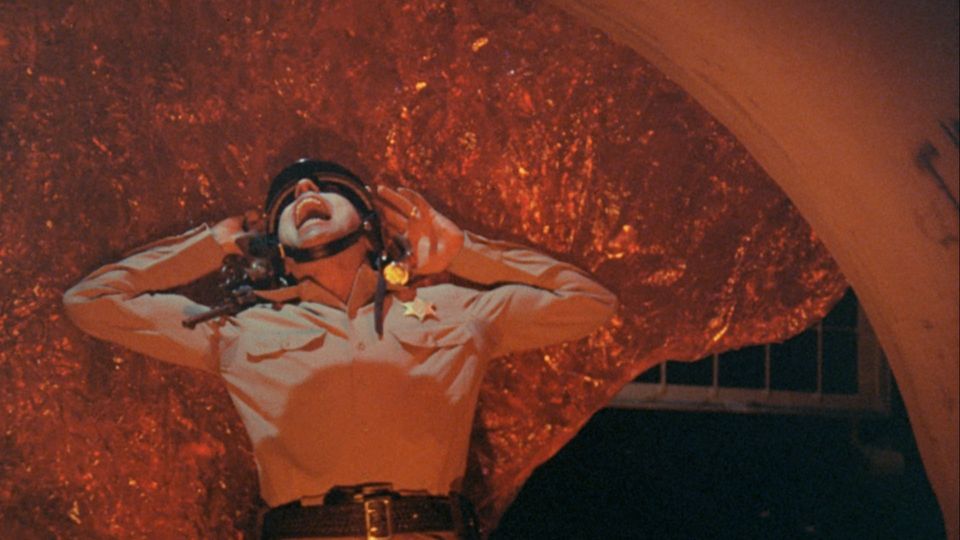
This has one of the most simple plots that I’ve ever seen. Madden and C.C. race through the jungle and there’s never really any doubt about how the race is going to end because all of the other drivers are terrible, except for Madden’s former partner, Doc Pyle (Alan Vint). A manic Larry Hagman plays Bo Cochran, the promoter who put the race together, and gets the majority of the film’s laughs. When I watched this movie, I thought it had been made to capitalize on the success of Smokey andtheBandit but then I saw that CheckeredFlag actually came out a few months before Burt Reynolds and Jackie Gleason hit the drive-in circuit. The young Susan Sarandon is a lively presence and she has a surprising amount of chemistry with Joe Don Baker, ideally cast here as a good ol’ boy who likes to drive fast. The movie doesn’t hold many surprises but the game cast keeps it watchable.
Director Alan Gibson was a Canadian filmmaker who had previously worked for Hammer films, directing the last of their Dracula films before he eventually found himself in the Philippines, working with Larry Hagman, Susan Sarandon, and Joe Don Baker.
Welcome to Retro Television Reviews, a feature where we review some of our favorite and least favorite shows of the past! On Sundays, I will be reviewing the made-for-television movies that used to be a primetime mainstay. Today’s film is 1972’s Getting Away From It All! It can be viewed on YouTube.
For Fred Clark (Larry Hagman) and Mark Selby (Gary Collins), life is New York City just isn’t that much fun anymore. The weather is terrible. The traffic cannot be navigated. The only people ruder than the cabbies are the doormen. Fred and Mark have come up with the perfect plan. They’ve decided to move to a small country town and purchase a house on a small island. In fact, they’re going to buy the entire island! It’s surprisingly cheap. Fred and Mark don’t ever really stop to wonder why the island is available for so little money. Seriously, if you’re buying an island, you should probably ask yourself those questions.
Mark’s wife, Alice (E.J. Peaker), is enthusiastic about the idea. Less excited is Fred’s wife, Helen (Barbara Feldon). Helen enjoys living in the city and having a nice job in an office building. She gets along with her boss (played by Jim Backus, one of many veteran actors to show up in a small role in this film). Perhaps hoping that Fred will change his mind once he’s confronted with the reality of actually living in the country, Helen finally gives in.
It does turn out that the island is not quite the paradise that Fred and Mark were expecting. The only way to get out to the island is in a leaky rowboat. The house is falling apart and, as Helen is disgusted to learn, it also doesn’t have indoor plumbing. There’s no electricity either but fortunately, the local handyman is working on it. His name is Herbie and he’s played by a very young and thin Randy Quaid. If you’ve ever wanted to hear Randy Quaid speak with an exaggerated New England accent, this is the film for you. There’s nothing convincing about Quaid’s accent but it still seems only fair, considering all of the Yankee actors who have butchered the Southern accent over the years.
Just when it looks like Fred and Mark have managed to make the Island livable, they get a disturbing letter. As the new owners of the Island, they owe 20 years worth of back taxes. As Fred puts it, the tax bill is more than either of them can afford. If they can’t raise the money, the town will take back the Island. Fred and Mark consider trying to get jobs but it turns out that neither one of them knows much about being fisherman. They then decide to charm the town into nullifying the tax bill. That turns out to be more difficult than either man imagines.
Getting Away From It All is a comedy that deals with a universal theme, the desire to escape from the harshness of everyday life and find a perfect place to which to escape. That said, the film’s main reason for existing is a parade of comedic cameos. Jim Backus, Vivian Vance, Joe E. Ross, Burgess Meredith, Paul Hartman, and J. Pat O’Malley all appear in small roles, appearing just long enough for 1972 viewers to say, “Hey, I recognize that person!” The end result is a rather shallow film that has a few chuckle-worthy moments. (Again, Randy Quaid pretending to be from Maine has to be worth something.)
In the end, for all of the film’s celebration of getting away from it all, it’s hard not to feel that Gary, Mark, Alice, and Helen will all end up back in Manhattan sooner than later. Some people are just city folks.
Welcome to Retro Television Reviews, a feature where we review some of our favorite and least favorite shows of the past! On Sundays, I will be reviewing the made-for-television movies that used to be a primetime mainstay. Today’s film is 1973’s Blood Sport! It can be viewed on YouTube.
David Birdsong (played by Gary Busey, who was 29 at the time) is a high school senior with a potentially bright future ahead of him. He’s the quarterback of his high school’s football team and it looks like he’s on the verge of leading his team to an undefeated season. He’s getting recruited by all the big schools. Scouts are coming to his games to watch him play. He also has one of the highest GPAs at his school, though it’s suggested that might have more to do with his importance to the football team than his actual study skills.
“Don’t you have anything else you want to do with your life?” his high school principal (David Doyle) asks him and David’s reaction indicates that he’s never really given it much thought. From the time he was born, David’s father, Dwayne (Ben Johnson), has been shaping his son to become a star athlete. Dwayne is happiest when he’s watching David play, whether on the field or in the highlight reels that he keeps down in the basement. When Dwayne sees that his son isn’t on the field, he’s the type of father who will get out of the stands and argue with the coach on the sidelines. Dwayne continually tells David not to stay out too late. The one time that David does, Dwayne slaps him hard enough to send his son to the floor.
Coach Marshall (Larry Hagman) is determined to get his undefeated season, no matter how hard he has to push his players. The coach is the type who is convinced that his players respect him for his stern ways and his long-winded speeches but little does he realize that they all secretly despise him. When one of his players drop dead of a heart attack during practice, Coach Marshall demands that the player stop being lazy and get up. When he realizes that the player is never going to get up, Coach Marshall angrily asks, “Why did this have to happen now!?” Later, at a pep rally, Coach Marshall announces that his team had a private meeting and agreed that they would win the final game in the player’s memory. The team is disgusted but the rest of the town loves their coach.
David is never happier than when he’s on the field, playing football and being cheered by both the crowd and his team. But, through it all, he sees reminders that the future in uncertain. On the sidelines, David spots an injured player, watching the game with the knowledge that his dreams of getting a scholarship have ended. When David visits a college, he’s reminded that being the best high school player doesn’t mean much in college and when he says that he’s a quarterback, he is told that his coach will ultimately decide who he is and David will accept the coach’s decision because David isn’t being offered a scholarship to think for himself.
When the film originally aired in 1973, it was called Birdsong but the title was changed to BloodSport for both subsequent showings and for a European theatrical release. Blood Sport is the more appropriate title because, even though the main character is named David Birdsong, the film is ultimately about all of the athletes who are expected to put their health at risk for the people on the sidelines. It’s not just football that’s a blood sport, the film suggests. It’s the entire culture that has sprung up around it, the one that cheers when players are at their best but which also looks away at the times when the players need the most help.
At 29 years of age, Gary Busey is a bit too old to be totally convincing as a high school senior but he still does a good job of capturing David’s gradual realization that he’s never really had any control over his own life. Ben Johnson and especially Larry Hagman also give good performances as the two men who are living vicariously through David’s accomplishments. Hagman is so believably obnoxious as the coach that you’ll want to cheer when someone finally finds the guts to stand up to him and tell him to just shut up for a minute.
The film ends on an ambiguous note, leaving many questions open about David’s future. One hopes that he’s started to find the strength necessary to live his own life but it’s ultimately hard to say. In the end, nothing is guaranteed, no matter how far you can throw a football.
Welcome to Retro Television Reviews, a feature where we review some of our favorite and least favorite shows of the past! On Sundays, I will be reviewing the made-for-television movies that used to be a primetime mainstay. Today’s film is 1973’s The Alpha Caper! It can be viewed on YouTube!
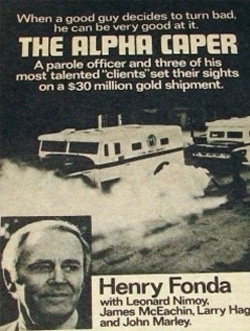
After years of faithful service and hard work, parole officer Mark Forbes (Henry Fonda) is on the verge of mandatory retirement. He’s spent his entire career playing by the rules and taking orders and helping recently released criminals go straight. For all of his service, all he’s gets is a small party and a cheap retirement gift.
Still, Mark is on the job when he gets a call that one of his parolees, Harry (Noah Beery, Jr.), is currently in the middle of a stand-off with the cops. Mark goes to the crime scene, where he discovers that Harry was trying to rob a warehouse full of weapons. He also discovers that Harry is dying, as the result of being shot by the police. Before Harry passes, he tells Mark that he and three other ex-cons were plotting to steal a shipment of gold bars.
Mark decides to carry out Harry’s plan. Working with Mitch (Leonard Nimoy), Tudor (Larry Hagman), and Scat (James McEachin), Mark comes up with a plan to rob the armored cars that are going to be transporting the gold. While Tudor and Scat are quick to join up with Mark, Mitch is a bit more hesitant. In the end, though, they all decide to work together. The plan they come up with is a clever one but its main strength is that it’s being spearheaded by Mark, a man who no one would ever expect to commit a crime. No one but his colleague and friend, Lee (John Marley), that is.
I watched The Alpha Caper last night, with my friend Phil, Janeen, and Spiro. To be honest, I selected the film because the title led me to suspect that it would be a science fiction film of some sort. I was a little surprised when it turned out to be a crime thriller but I was even more surprised by just how good the film itself turned out to be. Cleverly plotted and well-acted by the entire cast (and featuring a scruffy Leonard Nimoy playing a role that’s about as far from the coldly logical Mr. Spock as one can get), The Alpha Caper is an entertaining crime film but it’s also surprisingly poignant. Mark is someone who feels that he’s lived his entire life without taking a single risk and, as a result, he has nothing to show for it. He compares his situation to the mythical Kilroy of “Kilroy was Here” graffiti fame. Kilroy will always be remembered, even though no one is really sure who he was. Mark fears that he’s destined to be forgotten. The robbery is Mark’s way of announcing that “Mark Forbes was here.” The film ends on a surprisingly touching, if rather bittersweet, note.
The Alpha Caper originally aired on ABC on October 6th, 1973. It was apparently meant to be a pilot for an anthology show that would be called Crime. The series wasn’t picked up but, two years later, The Alpha Caper was theatrically released in Italy. Today, it can be seen on YouTube. Like Mark Forbes and Kilroy, the film has not been forgotten.
Welcome to Retro Television Reviews, a feature where we review some of our favorite and least favorite shows of the past! On Sundays, I will be reviewing the made-for-television movies that used to be a primetime mainstay. Today’s film is 1975’s Sarah T — Portrait of a Teenage Alcoholic. It can be viewed on YouTube!
In 1975, two years after shocking audiences in and receiving an Oscar nomination for The Exorcist, Linda Blair played Sarah Travis. Sarah is fourteen years old. She has a high IQ. She lives in a nice suburban home. She has an older sister named Nancy (Laurette Sprang) and she makes a good deal of money working as a babysitter. Sarah lives with her mother, Jean (Verna Bloom) and her stepfather, Matt (William Daniels). She misses her father, a chronically unemployed artist named Jerry (Larry Hagman). Jerry is the type who will complain about how no one is willing to give him a chance while he’s day drinking early in the morning. Jerry’s an alcoholic. That’s one of the many things that led to Jean divorcing him. (Matt is fairly regular drinker as well but it soon becomes apparent that he can handle his liquor in a way that Jerry cannot. Matt has a glass of Scotch after work. Jerry has his daughter by a slushy so he can pour his beer in the cup.) Jean is always quick to keep Sarah from drinking. When someone offers her a drink at a party, Jean replies that Sarah only drinks ginger ale.
Of course, the name of this movie is Sarah T. — Portrait of a Teenage Alcoholic so we already know that Jean is incorrect about that. When we first meet Sarah, she is fourteen and she’s been regularly drinking for two years. She’s even worked out a system where she gets liquor delivered to the house and then tells the deliveryman that her mother is in the shower but she left the money for the booze on the dining room table. Like many alcoholics, Sarah has become very good at tricking people and hiding her addiction. Of course, Sarah doesn’t think that she’s an alcoholic but …. well, again, just check out the title of the film.
When Sarah goes to a party with Ken (Mark Hamill, two years before Star Wars), the handsome captain of the school’s swim team, she ends up having too much to drink. Nice guy Ken not only takes her home but also takes the blame, telling Jean and Matt that he was the one who gave Sarah the alcohol. Jean, convinced that this is the first time that Sarah has ever gotten drunk, forbids her from spending any more time with Ken. In the morning, Jean comments that Sarah will probably have a terrible hangover and maybe that’s punishment enough. The joke, of course, is on Jean. Sarah doesn’t even get hangovers anymore.
Soon, Sarah’s grades start to slip and she starts to skip class so that she can drink. Still blaming Ken for all of Sarah’s problems, Jean finally takes Sarah to a psychologist, Dr. Kitteridge (Michael Lerner). Dr. Kitteridge announces that Sarah is an alcoholic and recommends that she start attending A.A. meetings. Sarah does go to one meeting, in which she meets a surprisingly cheerful 12 year-old alcoholic. However, Sarah still has a way to go and so does the movie. I mean, we haven’t even gotten to the scene where Sarah begs a group of older boys to give her the bottle of wine that they’re clumsily tossing in the air. By the end of the film, she’s even managed to hurt poor, loyal Ken.
Myself, I hardly ever drink. Some of that is because, like Sarah, I’m the daughter of an alcoholic and a child of divorce and I’ve seen firsthand how difficult it can be to live with an addiction. (My Dad has been sober for five years and I am so proud of him!) Of course, another reason why I hardly ever drink is because my tolerance for alcohol is amazingly low. I get drunk off one sip of beer. Long ago, I realized my life would be a lot easier and simpler if I just didn’t drink and so I don’t. Watching the film, I wondered if I was watching what my life would have been like if I had gone the opposite route. Would I have ended up like Sarah T?
Probably not. Sarah T is one of those films that was obviously made with the best of intentions but it just feels inauthentic. A lot of that is due to the performance of Linda Blair, who often seems to be overacting and trying too hard to give an “Emmy-worthy” performance. There’s not much depth to Blair’s performance and, as a result, the viewer never really buys into the story. At her worse, Blair brings to mind Jessie Spano shouting, “I’m so excited!” during that episode of Saved By The Bell. (Blair was far better served by B-movies like Savage Streets, in which she got to kick ass as a vigilante, than by films like this.) As well, the film’s portrayal of A.A. is so cheerful, upbeat, and positive that it almost felt like a Disney version of Intervention. Who are all of these happy addicts? I wondered as I watched the scene play out.
Because I’ve been a bit critical of his acting abilities in the past, I do feel the need to point out that Mark Hamill gives the best performance in this film. He plays Ken as being a genuinely decent human being and it’s hard not to sympathize with him as he gets in over his head trying to deal with Sarah. If Blair plays every emotion on the surface, Hamill suggests that there’s a lot going on with Ken. Deep down, he knows that he can’t help Sarah but he still feels like he has to try. Though Blair may be the star of the film, it’s Hamill who makes the biggest impression.
As a final note, this film was directed by Richard Donner, who is best-known for directing The Omen, Superman and Lethal Weapon. This was Donner’s final made-for-TV film before he moved into features. There’s nothing particularly special about Donner’s direction of Sarah T. If anything, the film’s pacing feels a bit off. Fortunately, just as Linda Blair would get to prove herself as one of the queens of exploitation cinema and Mark Hamill would go on to achieve immortality as Luke Skywalker, Donner would get plenty of opportunities to show himself to be one of Hollywood’s premier, big budget maestros.
As for Sarah T., I would recommend watching it on a double bill with Go Ask Alice.
Everyone has one movie or two that hit them so hard it caused them to develop habits. It could be shaking your shoes to confirm no spiders are in them, counting the seconds after a lightning strike for the thunder, or checking the back seat of your car before you get into it, just in case. Some movies kind of imprint themselves on you in different ways.
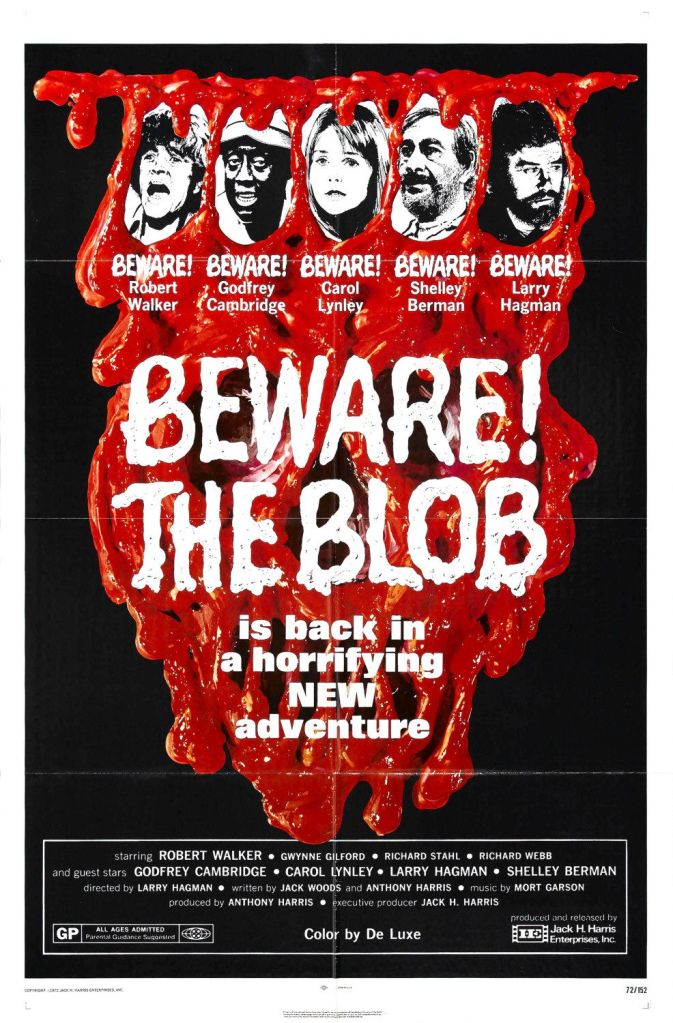
Beware! The Blob (or Son of The Blob in some circles) was the most terrifying film I saw as a kid. I watched it in front of my grandmother’s living room tv that had a little alarm clock on the floor beneath it. Unlike Friday the 13th and Halloween, where I could rationalize my fears, Beware! The Blob had me fearing the summer and any open crevice we had. On any visits to our local video store (in the Pre-Blockbuster days), I’d pick out video games to rent and could see the box for the film in the horror section. I’d never walk over there, even in my early teenage years.
Most consider the 1958 original a Classic, and Chuck Russell’s 1988 update often goes toe to toe with John Carpenter’s The Thing on the Best Remakes list. Beware! The Blob will probably never make that list, but it’s not a total loss, given a recent rewatch. The film’s greatest strengths are in the casting and the special effects. From a cinema history/trivia standpoint, the film marks one of the earliest credits for Cinematographer Dean Cundey. Cundey worked as a 2nd Unit Cinematographer for the film, particularly with the animal shots in the opening and later on. That might not sound like much, but Cundey would go on to be picked by Debra Hill to help out on Halloween in 1978. From there, he had The Fog, Halloween II, The Thing, Romancing the Stone, Back to the Future, Big Trouble in Little China, Who Framed Roger Rabbit?, and Jurassic Park, to name a few.
With 14 years since the first film, there were some tech upgrades to how the blob was made. A large plastic balloon was used for some scenes (particularly the bowling alley sequences). Additionally, silicone was added to a drum to allow for the “blob pov” during the bowling alley sequences. In most sequences, a red dyed powder mixed with water was used. To make sure the audience was aware the Blob was close, a high whistle would sound, giving anyone with even the slightest bit of tinnitus some cause to look over their shoulder. Academy Award Winner Tim Baar (The Time Machine) and Conrad Rothmann worked on the effects, along with Cundey.
In his film directing debut, Larry Hagman (TV’s I Dream of Jeannie, Dallas) weaves a tale of horror lurking through a town peppered with parties, hobos, a boy scout team, an angry bowling alley owner, some dune buggy aficionados and a sheriff (Richard Webb, The Phantom Stagecoach) who’s a little confused about some of the events happening in town. To his credit, it’s amazing to see who Hagman assembled here, as he called in some friends to join in on the fun. Comedian Godfrey Cambridge. Cindy Williams, just a few years shy ofAmerican Graffiti. Gerrit Graham, about two years before Phantom of the Paradise. Sid Haig (The Devil’s Rejects) is here as well. You can even spot Hagman in the film as one of three hobos squaring off with the Blob. It should be noted that the other two hobos with him are Burgess Meredith (Clash of the Titans) and Del Close (Chuck Russell’s The Blob).
The film flows like it’s namesake, with some chapters having little do to with anything – Dick Van Patten’s boy scouts, while funny, could have had one of their scenes cut for speed. It’s not incredibly terrible, but it’s exactly great, either. Most of the script, written by Anthony Harris, was tossed with ad-libbing done on set. Despite all this, it does looks like the cast enjoyed themselves making the film. It has that going for it, at least.
Sid Haig was caught unaware in Larry Hagman’s Beware! The Blob
Chester, A construction worker from the Arctic (Cambridge) is getting his camping gear stowed away when his wife, Marlene (Marlene Clark, The Beast Must Die) discovers a thermos in their freezer. He explains he performed some work and brought home a piece of what the found in the Arctic. Setting it on a countertop, the couple forget about the thermos, which pops open. The newly released blob absorbs a fly and a kitten before moving on to larger prey. Before we know it, Chester is having problems with his TV – which happens to be playing the original 1958 movie – as it slithers into his favorite recliner. It’s a sequence that’s burned into my mind. I always check a chair before sitting in it. Some check for thumbtacks, I check for alien goo.
When Lisa (Gwynne Gilford, Masters of the Universe & actor Chris Pine’s Mom) discovers Chester with his new friend, she dashes out and heads to her boyfriend, Bobby (Robert Walker, Easy Rider). By the time the couple return to Chester’s place, they find the house empty. Can the couple convince the cops and the town of the danger ahead before it’s too late? Most of Beware! The Blob‘s scenes are set up in a way where people are completely oblivious of it until it’s touched them, causing said individual to slip and fall into the camera. The climax of the film takes place in a bowling alley, which is actually impressive for the techniques used, but even with the casting, you might spend more time laughing than anything else. Perhaps that’s my way of rationalizing the film years later.
At the time of this writing, Beware! The Blob is currently available to watch on the Plex streaming service. We’re also labeling this an Incident – out of respect to the kitten – and returning the timer to Zero.
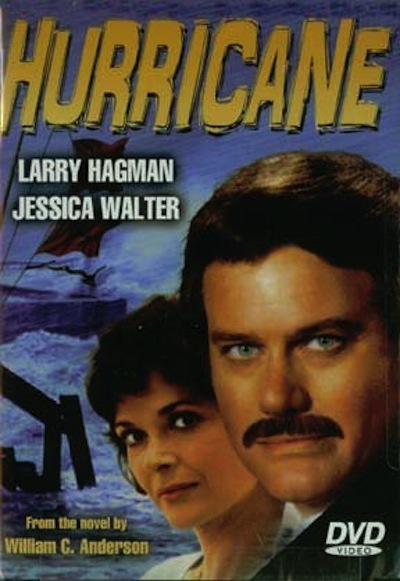
Hurricane Hilda is crashing down on the Gulf Coast and everyone in its path is about to get all wet. While Will Geer and Michael Learned try to warn everyone about the approaching hurricane, coast guard pilot Martin Milner observes the storm from the air and tires to rescue everyone in its path. Some people listen and some people don’t. Milner’s own father, played by Barry Sullivan, ends up getting stranded in a cabin while Larry Hagman and Jessica Walter play a married couple on a boat who find themselves sailing straight into the storm. On temporarily dry land, Frank Sutton (a.k.a. Gomer Pyle’s Sgt. Carter) plays a homeowner who refuses to evacuate because he’s convinced that he knows everything there is to know about hurricanes. He and the neighbors have a drunken party while waiting for the storm. When Patrick Duffy and his wife announce that they’re heading for safety, Sutton demands that they come in and have a beer with him. When Hilda finally makes landfall, some survive and some don’t.
Hurricane is a by-the-numbers disaster movie. It was made after The Poseidon Adventure and during the same year as The Towering Inferno and it hits all the usual disaster movie beats. Survival is determined by karma, with Hilda going after anyone who was too big of a jerk during the first half of the movie. It’s predictable stuff but it does feature footage from an actual hurricane so it’s at least not too dragged down by any of the bad special effects that always show up in made-for-TV disaster films.
This is one of those films where the cast was probably described as being all-star, even though most of them were just TV actors who needed a quick paycheck. Seen today, the film feels like a MeTV reunion special. Years before they played brothers in Dallas, both Larry Hagman and Patrick Duffy appeared in Hurricane, though neither of them shares any scenes. Will Geer and Michael Learned were starring on The Waltons when they appeared in this movie and they’re in so few scenes that they probably shot their scenes over a weekend before returning to Walton’s Mountain. The best performance is from Frank Sutton, who died of a heart attack just a few weeks after this movie aired. He’s a convincing hothead, even if he doesn’t have Gomer around to yell at.
Hurricane may be bad but it’s still not as terrible as most made-for-TV disaster movies. People who enjoy watching TV actors pretending to stare at a tidal wave of water about to crash down on them will find this film to be an adequate time waster.
As I wrote yesterday, I recently decided to sit down and watch every episode of the horror anthology series, Night Gallery. Yesterday, I watched and reviewed the pilot movie. Tonight, I watched the first episode of the weekly series.
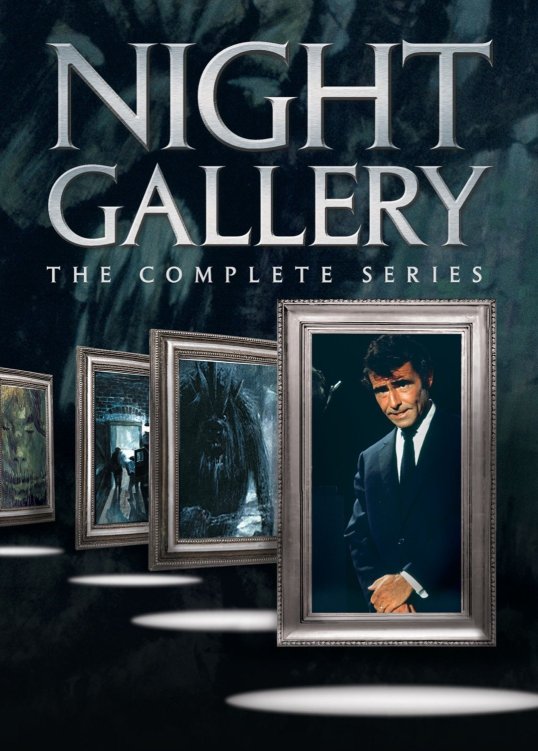
Though the pilot originally aired in 1969, Night Gallery did not start to air as a regular series until December of 1970. The first episode of season one was broadcast on December 16th, 1970. As all of the episodes did, it stated with Rod Serling walking through a dimly lit museum and inviting the audience to look at a macabre painting. Each painting was inspired by a different story. Or were the stories inspired by the paintings? To be honest, I don’t think the show ever made that clear.
The first episode featured two stories, both of which dealt with mad scientists.
The Dead Man (written and directed by Douglas Heyes)
The first segment was The Dead Man, an enjoyably atmospheric if somewhat difficult-to-follow story about a scientist, a young man with an amazing ability, and the woman who is torn between the two of them.
Carl Betz plays Max Redford, a doctor who has discovered that, under hypnotic suggestion, John Michael Fearing (Michael Blodgett) can simulate any medical condition, no matter how severe. When Max reveals his discovery to his associate, Dr. Talmadge (Jeff Corey), Talmadge is concerned that Fearing will suffer permanent damage as a result of Max’s experiments. Nonsense! Max explains. All he has to do is give Fearing the proper signal and he’ll pop right out of his condition, as good as new.
Max decides to put Fearing to the ultimate test by having him simulate death. However, when Fearing goes under, he dies for real. Was it just an accident or did Max — who suspects that Fearing was having an affair with his wife (Louise Sorel) — secretly mean for Fearing to die?
The Dead Man raises some intriguing questions about life, death, and medical ethics. It also has a quartet of good performances with Carl Betz doing an especially good job as Max. Michael Blodgett showed up in a lot of early 70s films and TV shows and he was always convincing as a decadent hedonist. The entire segment is full of creepy atmosphere but the ending is a bit of a let down. After a great set-up, the segment just kind of fizzles out.
The Housekeeper (written by Heyes, directed by John Meredyth Lucas)
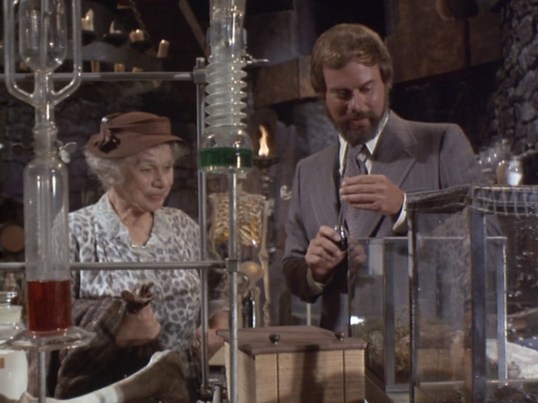
In the second segment, our mad scientist is named Cedric Acton (Larry Hagman). Whereas Max Redford, in the previous segment, was misguided, Cedric Acton is just crazy. Through the use of black magic (it involves a frog), Cedric has been experimenting with soul and brain transference. (There’s an oinking chicken and a clucking pig in his laboratory, just in case anyone’s wondering how the experiments are going.)
Because Cedric loves his wife’s body but hates her personality, he wants to put the soul of his kindly housekeeper (Jeanette Nolan) into the body of his wife, Carlotta (Suzy Parker). At first, the experiment is a success but things get complicated and …. well, I’m not really sure what it all leads to because this is one of those stories that just kind of ends without really offering up any type of resolution.
The Housekeeper is meant to be a comedy but it’s a bit too mean-spirited to really work. This segment really calls out for karma to intervene and for Cedric’s soul to end up in something else’s body but instead it just ends with Cedric continuing his experiments. It’s more than a little dissatisfying. Larry Hagman does a good job playing Cedric, though. He’s convincingly crazy.
Especially after the pilot, it’s hard not to be disappointed by the first episode of Night Gallery. Both stories had potential but they were let down by weak endings. Oh well. Hopefully, tomorrow’s episode will be an improvement!
So, you want to be a rock and roll star? Then listen now to what I say: just get an electric guitar and take some time and learn how to play. And when your hair’s combed right and your pants fit tight, it’s gonna be all right.
If you need any more help, try watching these four films:
The Idolmaker (1980, directed by Taylor Hackford)
The Idolmaker is a movie that asks the question, “What does it take to be a star? Who is more interesting, the Svengalis or the Trilbys?” The year is 1959 and Vinny Vacari (Ray Sharkey, who won a Golden Globe for his performance but don’t let that dissuade you from seeing the movie) is a local kid from New Jersey who dreams of being a star. He has got the talent. He has got the ambition and he has got the media savvy. He also has a receding hairline and a face like a porcupine.
Realizing that someone who looks like him is never going to make hundreds of teenage girls all scream at once, Vinny instead becomes a starmaker. With the help of his girlfriend, teen mag editor Brenda (Tovah Feldshuh) and a little payola, he turns saxophone player Tomaso DeLorussa into teen idol Tommy Dee. When Tommy Dee becomes a star and leaves his mentor, Vinny takes a shy waiter named Guido (Peter Gallagher) and turns him into a Neil Diamond-style crooner named Cesare. Destined to always be abandoned by the stars that he creates, Vinny continually ends up back in the same Jersey dive, performing his own songs with piano accompaniment.
The Idolmaker is a nostalgic look at rock and roll in the years between Elvis’s induction into the Army and the British invasion. The Idolmaker has some slow spots but Ray Sharkey is great in the role of Vinny and the film’s look at what goes on behind the scenes of stardom is always interesting. In the movie’s best scene, Tommy performs in front of an audience of screaming teenagers while Vinny mimics his exact moments backstage.
Vinny was based on real-life rock promoter and manager, Bob Marcucci. Marcucci was responsible for launching the careers of both Frankie Avalon and Fabian Forte. Marcucci served as an executive producer on The Idolmaker, which probably explains why this is the rare rock film in which the manager is more sympathetic than the musicians.
Breaking Glass (1980, directed by Brian Gibson)
At the same time that TheIdolmaker was providing American audiences with a look at life behind-the-scenes of music stardom, Breaking Glass was doing the same thing for British audiences.
In Breaking Glass, the idolmaker is Danny (Phil Daniels, who also starred in Quadrophenia) and his star is an angry New Wave singer named Kate (Hazel O’Connor). Danny first spots Kate while she is putting up flyers promoting herself and her band and talks her into allowing him to mange her. At first, Kate refuses to compromise either her beliefs or her lyrics but that is before she starts to get famous. The bigger a star she becomes, the more distant she becomes from Danny and her old life and the less control she has over what her music says. While her new fans scare her by all trying to dress and look like her, Kate’s old fans accuse her of selling out.
As a performer, Hazel O’Connor can be an acquired taste and how you feel about Breaking Glass will depend on how much tolerance you have for her and her music. (She wrote and composed all of the songs here.) Breaking Glass does provide an interesting look at post-punk London and Jonathan Pryce gives a good performance as a sax player with a heroin addiction.
That’ll Be The Day (1973, directed by Claude Whatham)
Real-life teen idol David Essex plays Jim MacClaine, a teenager in 1958 who blows off his university exams and runs away to the Isle of Wright. He goes from renting deckchairs at a resort to being a barman to working as a carny. He lives in squalor, has lots of sex, and constantly listens to rock and roll. Eventually, when he has no other choice, he does return home and works in his mother’s shop. He gets married and has a son but still finds himself tempted to abandon his family (just as his father previously abandoned him) and pursue his dreams of stardom.
Based loosely on the early life of John Lennon, the tough and gritty That’ll Be The Day is more of a British kitchen sink character study than a traditional rock and roll film but rock fans will still find the film interesting because of its great soundtrack of late 50s rock and roll and a cast that is full of musical luminaries who actually lived through and survived the era. Billy Fury and the Who’s Keith Moon both appear in small roles. Mike, Jim’s mentor and best friend, is played by Ringo Starr who, of all the Beatles, was always the best actor.
That’ll Be The Day ends on a downbeat note but it does leave the story open for a sequel.
Stardust (1974, directed by Michael Apted)
Stardust continues the story of Jim MacClaine. Jim hires his old friend Mike (Adam Faith, replacing Ringo Starr) to manage a band that he is in, The Straycats (which includes Keith Moon, playing a far more prominent role here than in That’ll Be the Day). With the help of Mike’s business savvy, The Stray Cats find early success and are signed to a record deal by eccentric Texas millionaire, Porter Lee Austin (Larry Hagman, playing an early version of J.R. Ewing).
When he becomes the breakout star of the group, Jim starts to overindulge in drugs, groupies, and everything that goes with being a superstar. Having alienated both Mike and the rest of the group, Jim ends up as a recluse living in a Spanish castle. Even worse, he gives into his own ego and writes a rock opera, Dea Sancta, which is reminiscent of the absolute worst of progressive rock. Watching Jim perform Dea Sancta, you understand why, just a few years later, Johnny Rotten would be wearing a homemade “Pink Floyd Sucks” t-shirt.
Stardust works best as a sad-eyed look back at the lost promise of the 1960s and its music. Watch the movie and then ask yourself, “So, do you really want to be a rock and roll star?”
Jack Stanton (John Travolta) is the charismatic governor of an unnamed Southern state. After spending his entire life in politics, Jack is finally ready to run for President. Even more ready is his equally ambitious wife, Susan (Emma Thompson). Jack proves himself to be a strong candidate, a good speaker who understands the voters and who has the ability to project empathy for almost anyone’s situation. He’s managed to recruit a talented and dedicated campaign staff, including the flamboyant Richard Jemmons (Billy Bob Thornton), Daisy Green (Maura Tierney), and journalist Henry Burton (Adrian Lester). Henry is the son of a civil rights leader and, as soon as they meet, Jack talks about the first time that he ever heard Henry’s father speak. Within minutes of first meeting him, Henry believes in Jack.
The problem, however, is that there are constant hints that Jack may not be worthy of his admiration. There’s the fact that he’s a compulsive womanizer who is given to displays of temper and immaturity. When one of Jack’s old friends reveals that Jack may have impregnated his daughter, Jack and Susan respond with a pragmatic ruthlessness that takes Henry by surprise.
When one of Jack’s mistresses threatens to go public, Henry is partnered up with Libby (Kathy Bates) and sent to dig up dirt on her and her sponsors. When the former governor of Florida, Freddie Picker (Larry Hagman), emerges as a threat to derail Jack’s quest for the nomination, Henry and Libby are again assigned to research Picker’s background. Libby is perhaps the film’s most interesting character. Recovering from a mental breakdown, Libby has no trouble threatening to shoot one political opponent but she’s still vulnerable and idealistic enough that it truly hurts her when Jack and Susan repeatedly fail to live up to her ideals. As an out lesbian, Libby is perhaps the only character who has no trouble revealing her true self and, because of her honesty, she is the one who suffers the most.
First released in 1998 and based on a novel by Joe Klein, Primary Colors is an entertaining and ultimately rather bittersweet dramedy about the American way of politics. John Travolta and Emma Thompson may be playing Jack and Susan Stanton but it’s obvious from the start that they’re meant to be Bill and Hillary Clinton. And while it takes a few minutes to get used to Travolta’s attempt to sound Southern, this is ultimately one of his best performances. As played by Travolta, Jack Stanton is charming, compassionate, self-centered, and ultimately, incredibly frustrating. One reason why Primary Colors works is because we, as an audience, come to believe in Jack just as much as Henry does and then we come to be just as disillusioned as Libby. Emma Thompson’s performance is a little less obviously based on Hillary. Unlike Travolta, she doesn’t attempt to imitate Hillary’s voice or mannerisms. But she perfectly captures the steely determination.
Primary Colors captures both the thrill of believing and the inevitability of disillusionment. It’s definitely a film that I will rewatch in the days leading up to 2016.