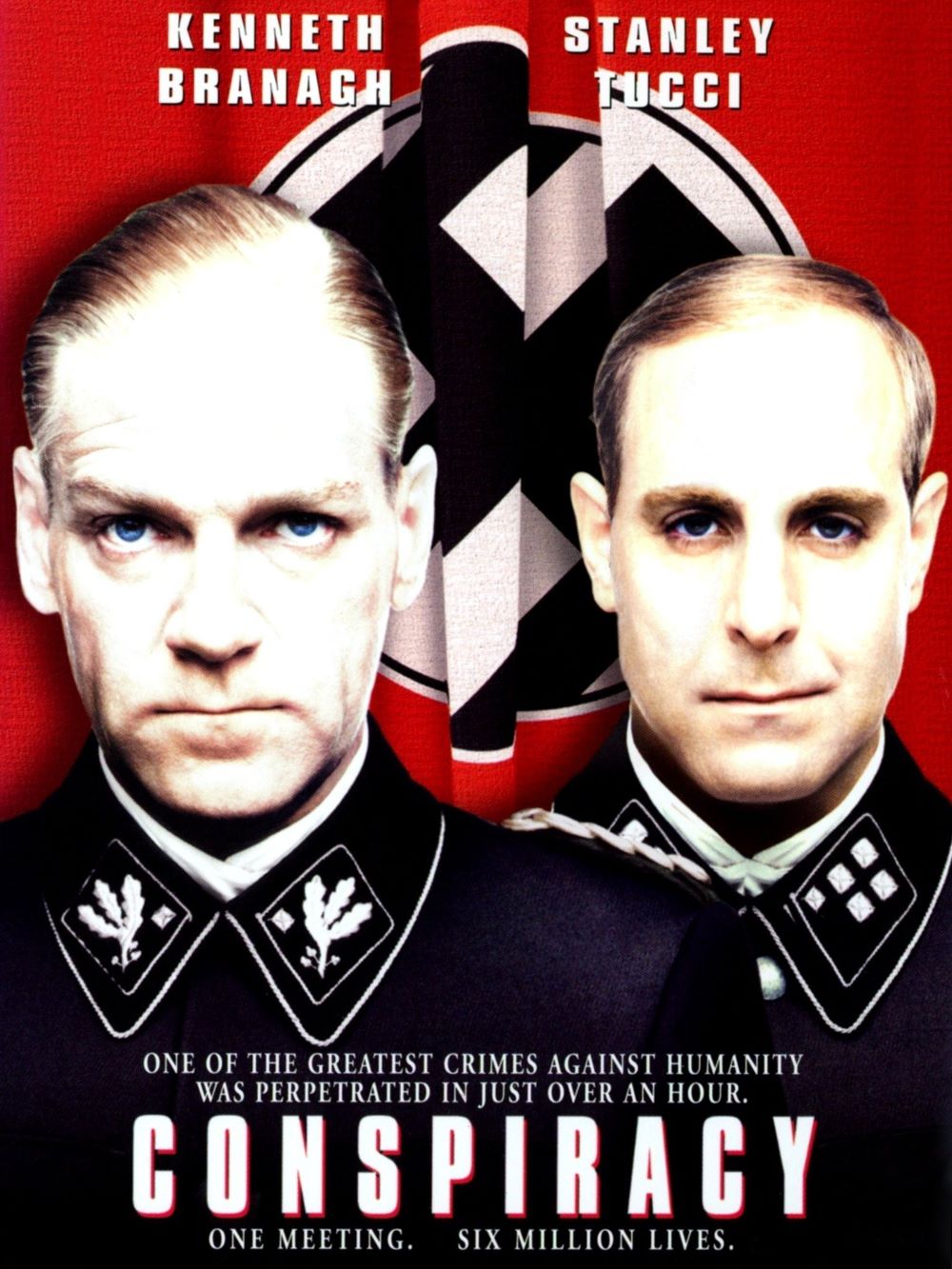
Review: Conspiracy (dir. by Frank Pierson)


“We will not sterilize every Jew and wait for them to die. We will not sterilize every Jew and then exterminate the race. That’s farcical.” — Reinhardt Heydrich

HBO’s Conspiracy (2001) masterfully dramatizes the infamous Wannsee Conference, held on January 20, 1942, where high-ranking Nazi officials orchestrated the Final Solution. The film’s running time mirrors the historical meeting itself, distilling one of the darkest moments in history into a single, chilling sitting that balances historical fidelity, psychological insight, and dramatic restraint. The premise is stark and deceptively simple: a group of men, most of whom had never previously met, gather in a sun-drenched villa outside Berlin to discuss systematic mass murder while enjoying fine food and polite conversation. This contrasting setting, rendered with careful attention to period detail, powerfully underscores what Hannah Arendt called the “banality of evil.” In Conspiracy, evil is not the property of villainous caricatures, but of functionaries and technocrats—chillingly rational and disturbingly mundane.

Much of the film unfolds in real time, utilizing dialogue taken from the sole surviving minutes of the Wannsee Conference. Screenwriter Loring Mandel and director Frank Pierson avoid unnecessary embellishments, allowing the facts and the conversations themselves to carry the full, horrifying weight. Kenneth Branagh gives an Emmy-winning performance as Reinhard Heydrich, the orchestrator and presiding presence at the conference. Branagh’s portrayal is both urbane and authoritative, presenting Heydrich as a figure whose affable composure thinly veils his unwavering commitment to genocide. There is no soaring rhetoric or overt menace; Heydrich’s evil is presented with administrative casualness, making it all the more chilling.

Stanley Tucci is equally compelling as Adolf Eichmann, Heydrich’s logistical right hand and the architect of the machinery of death. Tucci infuses Eichmann with a quiet efficiency and bureaucratic pride—a portrait of a man more attached to process than morality, disturbingly bland in his demeanor. The supporting cast is no less impressive. Colin Firth, as Dr. Wilhelm Stuckart, portrays a legal architect of Nazi race law who appears increasingly unsettled as the agenda shifts from disenfranchisement to extermination. Each attendee is rendered with psychological nuance. Some are disturbingly enthusiastic about their roles, while others are quietly apprehensive, yet ultimately complicit. These subtle gradations of doubt, ambition, and opportunism animate the film’s psychological landscape.

The dialogue, rooted in the actual transcript and skillful dramatic writing, eschews melodrama. The horror emerges not through spectacle, but in analytic exchanges about logistics, quotas, and definitions—the cold calculus of genocide. The men’s debates around how to classify mixed-race Jews, whether sterilization is preferable to extermination, and who should be spared create a bureaucratic puzzle as vile as its intent. Their discussions are delivered in a neutral, even mundane tone, which heightens the chilling reality of what they are planning. Pierson’s direction is restrained; the film never leaves its confined setting, emphasizing the claustrophobic mood of collective complicity. The camera lingers on faces rather than violence, building tension through small gestures—a glance, a pause, the clinking of glassware. The impact of what is said is matched only by the weight of what goes unsaid, until Heydrich, in a quietly devastating moment, makes the true purpose explicit.

More than a simple history lesson, Conspiracy meditates on themes of collective guilt, moral responsibility, and the terrifying ease with which ordinary people become accessories to atrocity. The film is haunted by bureaucracy; if everyone is “just following orders” or “simply doing their job,” the boundaries of blame blur and diffuse. The characters’ debates skillfully skirt the language of murder, favoring euphemisms such as “evacuation” or “resettlement.” This allows viewers to witness, in real time, the kind of moral erosion that enables atrocity on a massive scale. The dry, matter-of-fact tone of the film deepens its emotional impact, forcing the audience to comprehend that such horrors were conjured not in a frenzy, but in calm administrative exchanges over lunch.

For both historians and general audiences, Conspiracy earns praise for its meticulous adherence to historical detail. The screenplay closely follows the Wannsee minutes, and the film’s design choices—muted score, period-accurate costumes, and careful pacing—all serve to render bureaucratic evil as mundane and unremarkable. This unwavering restraint, however, does impose certain limits. The film’s dramatic arc is inherently subdued; the absence of conventional action or narrative tension makes it unfold like an extended negotiation rather than a traditional drama. Some viewers may find this lack of overt conflict stifling or static, resulting in a work that feels more “important” than “entertaining,” but this is clearly by design.

Conspiracy received widespread acclaim for both its historical gravity and psychological depth. Branagh and Tucci, in particular, were celebrated for their nuanced performances. The film is often cited as a model example of how the “banality of evil” operates—not through monsters, but through functionaries in tailored uniforms, sipping wine and rationalizing extermination. For those unfamiliar with the events, the manner in which these men discuss matters of life and death with casual detachment is shocking. As one critic noted, “Most people believe they know what evil looks like… But in Conspiracy, men of true evil met in pristine, gorgeous surroundings… and go about their business leisurely… with a smile and barely a hint of remorse.”

Within the canon of Holocaust cinema, Conspiracy stands apart from films like Schindler’s List or The Pianist, which focus on the suffering and survival of victims. Instead, it occupies a space similar to Downfall and the earlier Die Wannseekonferenz, dramatizing not the machinery of genocide but the mindsets of its architects. By confining itself to dialogue and implication, the film compels viewers to reflect on how civilization’s facades both enable and obscure horror.

The film’s lingering effect is not found in dramatic catharsis or tears, but in an enduring sense of discomfort. Conspiracy dramatizes not just a choice among evil options, but the ease with which those choices become rote procedure and social negotiation. The silence in the final act, as the men calmly disperse after codifying genocide, lands with a cold, almost procedural finality. The closing captions, briefly summarizing the fates of those present, deliver a sobering message: accountability was sporadic, often delayed, and never guaranteed.

Conspiracy is not casual entertainment, nor is it meant to be. Instead, it is essential viewing for anyone interested in the psychology of atrocity, the peril of bureaucratic amorality, and the enduring question of how ordinary people become complicit in extraordinary evil. With a screenplay of surgical precision, outstanding ensemble cast (especially Branagh and Tucci), and a director committed to understatement, HBO’s film demonstrates how history’s darkest decisions are forged not in chaos, but in chilling consensus. To those seeking to understand not only what happened at Wannsee, but how, Conspiracy offers an unblinking and quietly devastating answer.

Film Review: Conspiracy (dir by Frank Pierson)


The 2001 film, Conspiracy, takes place at a villa on the outskirts of Berlin.  It’s a lovely villa and, as we can see during the film’s opening moments, it’s about to play host to a meeting of very important people.

The date is January 20th and the year is 1942.  Having conquered much of Europe, Nazi Germany is now at war with the Allies.  Reinhard Heydrich (Kenneth Branagh), the young chief of the Reich Security Main Office and the man who many feel will eventually succeed Adolf Hitler as the leader of the Third Reich, has been directed to call a conference so that he and his deputy, Adolf Eichmann (Stanley Tucci), can “discuss” ways to solve “the Jewish question.”  One-by-one, representatives of the Reich’s bureaucracy show up at the villa.

At the start of the meeting, the men discuss various ways to force the Jews out of Germany and all of the occupied territories.  The men chose their words carefully, speaking in euphemisms and doing their best to sound like concerned government officials.  The men know what they’re talking about but they still seem to feel the need to avoid coming right and saying it.  As they talk, it becomes clear that everyone is trying to stay in Heydrich’s good graces while, at the same time, avoiding the fact that they understand the truth about what Germany is doing.  It’s not until halfway through the meeting that Heydrich and Eichmann reveal that Germany’s policy has already been determined and that concentration camps with gas chambers have already been designed and built.  The meeting is less about discussing the policy and more about getting each man at the meeting to sign off on it.  The unspoken subtext is that each man is being tested to determine who will support (and, if need be, help to cover up) the Final Solution and who will have to be otherwise dealt with.

Based on the actual minutes of the meeting, Conspiracy is film that is perhaps even more important now than when it was first released.  It’s a film that explores not only the banality of evil but also seeks to answer the question of why no one in Hitler’s government forcefully objected to the Final Solution.  (Many, of course, claimed not to know what was going on.  This film reveals just how little credibility that claim had.)  Some of the men go along because they understand not going along would mean the end of their careers and maybe their lives.  Some of the men agree because, as members of the military, they believe in supporting their country’s leadership, regardless of what that leadership represents.  Some of the men agree because they want to stay in Heydrich’s good graces.  These men represent a society where anti-Semitism is so normalized that it is accepted as a given and, while some of the men are not as outspoken in their prejudice as the others, it’s clear that all of them view the Jewish people as being a unique problem.  Those who do raise concerns do so only out of worry of what will happen to them if the rest of the world discovers what Germany is planning.  Heydrich insists that there is no need to worry because Germany will win the war.  Some of the men at the Conference are clearly not convinced of Germany’s pre-destined victory but not a single one has either the morality or the courage to refuse to endorse the Final Solution.  The film ends with a series of title cards, letting us know what became of the men who attended the Wannsee Conference.  Heydrich was assassinated during the war.  Eichmann fled to South America and hid there until he was captured by Israel in 1960.  Many of the men were executed for war crimes but a surprising number of them were either acquitted or never put on trial and went to live peacefully after the war.

Well-directed by Frank Pierson, Conspiracy has a distinguished cast who brings the historical characters to terrible life.  It’s one thing to read about what was said and planned at the Conference.  It’s another thing to actually hear those words spoken aloud and it’s a reminder that the evil of the Holocaust was not an accident nor was it something that took its perpetrators by surprise.  It was something that meticulously planned by human beings who were fully aware of what they were doing.  Kenneth Branagh makes for an arrogant and intimidating Heydrich while Stanley Tucci plays Eichmann as being the type of bureaucratic robot who is incapable of seeing human beings as anything more than just dwindling numbers on a report.  Colin Firth and David Threlfall make strong impressions as two of the more weary members of the Conference, as does Ian McNeice in the role of the type of crude, career-driven government functionary who has survived by pretending to be dumb.

At a time when anti-Semitism is on the upswing and Holocaust denialism is being mainstreamed, Conspiracy is an important film.  When others say that the Holocaust didn’t happen or that it doesn’t matter, Conspiracy defiantly says, “Yes, it did and yes, it does.”

Insomnia File #43: Legend (dir by Brian Helgeland)


What’s an Insomnia File? You know how some times you just can’t get any sleep and, at about three in the morning, you’ll find yourself watching whatever you can find on cable? This feature is all about those insomnia-inspired discoveries!

If, last night, you were having trouble getting to sleep around two in the morning, you could have turned over to HBO and watched the 2015 British gangster film, Legend.

Tom Hardy is Reggie Kray.  Arrogant, handsome, charming, and dangerous to know, Reggie is a club owner who is also an up-and-coming gangster in 1960s London.  Scotland Yard has him under surveillance.  The East End both fears and respects him.  American gangsters want to do business with him.

Tom Hardy is also Ronny Kray!  Ronny is the ugly twin, the one who lives in a trailer and has just been released from a psychiatric institution.  Ronny is openly gay at a time when that was still illegal in the UK.  Driven by jealousy of Reggie and a desire to prove himself superior to everyone who has ever judged or looked down on him, Ronny is determined to make sure that he and his brother become the top gangsters in London.

Together …. they solve crimes!

No, actually, they do the exact opposite.  They commit a lot of crimes.  Ronny is willing to shoot anyone in the head.  Reggie tries to be a bit more respectable.  He even attempts to run a legitimate nightclub.  Reggie understand that sometimes, the threat of violence is more effective than violence itself.  Reggie and Ronny are about as close as siblings can be, even if they do spend a lot of time beating each other up.

Frances Shea (Emily Browning) is the sister of Reggie’s driver, Frankie (Colin Morgan).  She’s sixteen when she meets and falls in love with Reggie Kray.  Reggie loves her too and he even marries her.  (Of course, he has to do a stint in prison first.)  Reggie swears to Frances that he’s going to go straight and that they’re going to have a normal life.  Deep down, Frances know that will never happen so, while her husband and brother-in-law conquer London, she copes with pills.  Lots and lots of pills.

For an American viewer like myself, British gangster films are always fun to watch because they’re just as violent as American gangster films but, at the same time, everyone’s always dressed impeccably and stopping in the middle of all the mayhem to have a cup of tea.  Legend is based on a true story, which turns out to be both its greatest strength and its greatest weakness.  On the one hand, it’s fascinating to see the film’s recreation of London in the early 60s.  On the other hand, the film never convinces us that we should really care about the Krays.  This isn’t a case where, like the Corleones, the Krays are tragic figures who can’t escape their destiny.  Tom Hardy does a great job playing Reggie and he’s an adequate Ronny but you can never quite escape the feeling that the two brothers are just — to use one of their own preferred insults — two wankers who aren’t really worth all the trouble.  This is a film that you watch and you ask yourself, “Why should we care?”  Beyond the novelty of the Krays being twins, the film really can’t provide an answer.

Still, I happen to be fascinated by the early 60s so I enjoyed the film as a historical recreation.  Legend isn’t a bad film.  It’s just somewhat underwhelming.

Previous Insomnia Files:

  1. Story of Mankind
  2. Stag
  3. Love Is A Gun
  4. Nina Takes A Lover
  5. Black Ice
  6. Frogs For Snakes
  7. Fair Game
  8. From The Hip
  9. Born Killers
  10. Eye For An Eye
  11. Summer Catch
  12. Beyond the Law
  13. Spring Broke
  14. Promise
  15. George Wallace
  16. Kill The Messenger
  17. The Suburbans
  18. Only The Strong
  19. Great Expectations
  20. Casual Sex?
  21. Truth
  22. Insomina
  23. Death Do Us Part
  24. A Star is Born
  25. The Winning Season
  26. Rabbit Run
  27. Remember My Name
  28. The Arrangement
  29. Day of the Animals
  30. Still of The Night
  31. Arsenal
  32. Smooth Talk
  33. The Comedian
  34. The Minus Man
  35. Donnie Brasco
  36. Punchline
  37. Evita
  38. Six: The Mark Unleashed
  39. Disclosure
  40. The Spanish Prisoner
  41. Elektra
  42. Revenge

Pirates of the Caribbean: On Stranger Tides (Super Bowl TV Spot)


The more I read about and see stuff on this fourth film on the Disney action-adventure franchise the more I’m really looking forward to Pirates of the Caribbean: On Stranger Tides.

This Super Bowl tv spot shows some new scenes that wasn’t in the official trailer released a little over a month ago. One thing I am glad to see is more Ian McShane as Blackbeard. I’m also glad that there’s still no Orlando Bloom and Keira Knightley to be seen in this film. Yes, I know that they declined to be in it (that or Bruckheimer finally got the hint that it was these two who bogged down the first two sequels).

In the end, this third sequel will live or die on the performance of Depp returning as Capt. Jack Sparrow. I’d bet on Captain Jack returning to his roguish self and making this fourth film a fun ride the way the first two sequels weren’t.

Pirates of the Caribbean: On Stranger Tides is set for a May 20, 2011 release.