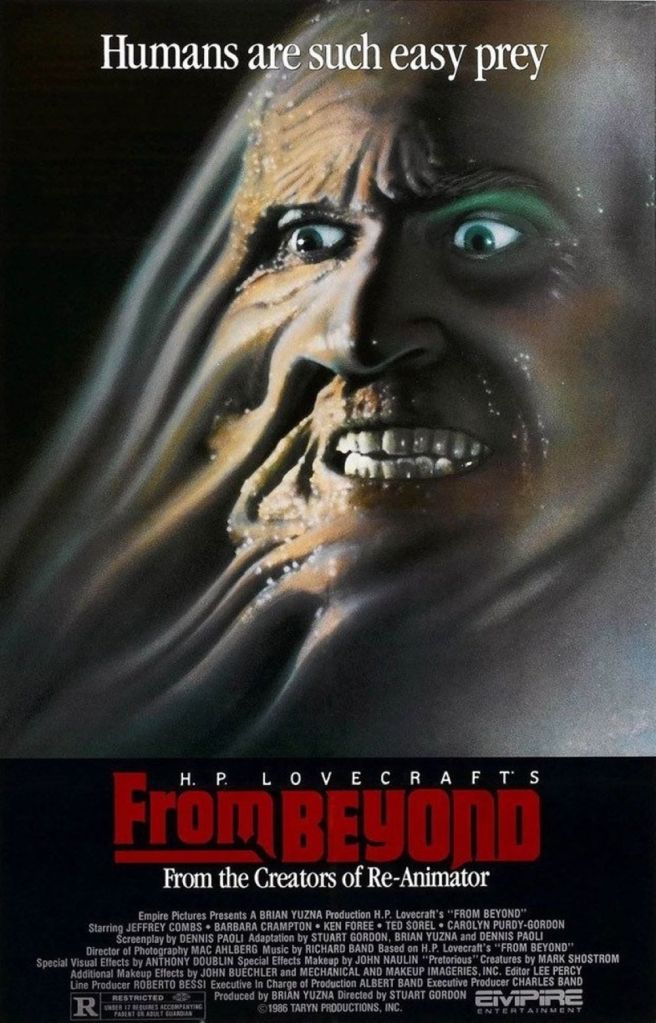
Horror Review: From Beyond (dir. by Stuart Gordon)


“You’re diving deeper than any sane man ever should.” — Dr. Katherine McMichaels

Stuart Gordon’s From Beyond (1986) stands as a darker, moodier follow-up to his breakout Lovecraft adaptation, Re-Animator (1985). At its core is the Resonator, a bizarre scientific contraption designed to stimulate the pineal gland—allowing its users to glimpse eerie creatures and dimensions normally invisible to the naked eye. When Dr. Crawford Tillinghast (Jeffrey Combs) activates the device, it unleashes horrors not just upon the world but also within the minds and bodies of those involved, blurring the line between reality and nightmare in a way both terrifying and hypnotic.

Just like with Re-Animator, Gordon used H.P. Lovecraft’s short story From Beyond as a foundation but expanded the narrative significantly by injecting his own creative vision and filling in what Lovecraft left unexplored. Lovecraft’s original story is a brief, eerie vignette about stimulating the pineal gland to perceive alternate dimensions and terrifying alien creatures—minimalistic and atmospheric, leaving much to the imagination. Gordon reimagines this premise into a fully fleshed-out narrative, adding complex characters like the obsessive Dr. Edward Pretorius and the rational yet vulnerable Dr. Katherine McMichaels. He enriches the story with body horror, psychological torment, and a deeper thematic exploration of sexuality, obsession, and the fragility of the mind. This creative expansion transforms the story into something far more personal and tangible, blending cosmic horror with primal human fears and desires.

This tonal shift stands in stark contrast to Re-Animator, which thrives on anarchic gore, slapstick comedy, and a playful mad-scientist energy. From Beyond trades much of the humor for a somber, unsettling atmosphere drenched in slime, grotesque transformations, and claustrophobic dread. The characters are more grounded in psychological trauma, and the film’s pacing emphasizes creeping unease rather than chaotic spectacle. Gordon’s use of stark, hallucinatory lighting and saturated colors enhances this otherworldly feeling, while practical effects bring a tactile horror to life that heightens the visceral and emotional impact. The horror isn’t just external—it’s internal, a fracture of reality and self.

One of the most notable ways From Beyond separates itself from Gordon’s earlier work is in its overt intertwining of sexuality and horror. The Resonator doesn’t just expose alien creatures; it unlocks primal lust and repressed desires in its users. Scenes imbued with uneasy erotic tension, especially involving Barbara Crampton’s character, make sexuality a core source of vulnerability and terror. This blend of eroticism and nightmare adds depth and psychological complexity, exploring how intimate human experiences can be distorted into something terrifying. It’s a thematic boldness that would become highly influential beyond Western cinema.

Indeed, the film’s fusion of sexual subtext, body horror, and psychological unease foreshadowed themes embraced by late 1980s and early 1990s Japanese horror hentai anime. Works such as Angel of Darkness (Injū Kyōshi) combined explicit eroticism, grotesque body transformations, and supernatural horror in ways reminiscent of From Beyond’s style and tone. This synergy helped define a subgenre of adult horror anime where the boundaries between pleasure and terror, desire and monstrosity, are constantly blurred—cementing From Beyond not only as a cult classic in horror but also as an inspirational bridge to pioneering adult animation in Japan.

Visually and atmospherically, the film is a masterpiece of practical effects and immersive storytelling. The slime-drenched creatures, anatomically warped bodies, and constant visual flow between nightmare and distorted reality create a hallucinatory experience. The climax offers a frenetic, visceral battle that embodies the film’s core themes of madness, transformation, and cosmic terror, leaving viewers with a lingering sense of unease and wonder.

Stuart Gordon’s direction also employs incredibly effective subjective perspectives, with many scenes shot from the characters’ points of view. This technique immerses viewers in the unfolding madness and heightens the sensory overload that defines the film’s experience. There is a famously unsettling point-of-view shot from the mutated Crawford as he perceives a brain inside a doctor’s head and gruesomely attacks. Such moments amplify the film’s exploration of altered perception and the treacherous expansion of human senses.

Despite these strengths, the film is not without flaws. Ken Foree’s character, Bubba Brownlee, while providing moments of grounded streetwise humor, sometimes comes off as a caricature that leans into stereotypical portrayals of Black men as taboo or outlier figures in horror cinema. This portrayal feels somewhat jarring against the film’s otherwise nuanced tone and may evoke discomfort.

Additionally, From Beyond can feel comparatively stiff and sluggish next to Re-Animator, lacking some of the earlier film’s darkly comic energy. The story often relies on a series of increasingly grotesque set pieces that feel more like shock showcases than a cohesive narrative arc. Some performances, including Jeffrey Combs’ lead, occasionally seem overly intense without sufficient emotional variation, and the film sometimes slips into melodrama that undercuts its impact. Furthermore, although ambitious in visualizing Lovecraftian horrors, budgetary constraints are occasionally evident, diminishing some of the awe those moments seek to inspire.

Ultimately, Gordon’s From Beyond is a significant Lovecraft adaptation that showcases the power of expanding upon source material with bold creativity. Moving beyond Lovecraft’s sparse prose, Gordon infuses the story with rich characters, psychological depth, explicit body horror, and mature explorations of sexuality. This results in a haunting, distinctly unsettling film that not only stands as a high point in Gordon’s career but also resonates far beyond its American horror roots, shaping international horror aesthetics and inspiring future genres. It is a disturbing, thrilling journey to the dark spaces just beyond human perception—a cinematic experience that lingers in the mind long after the screen fades to black.
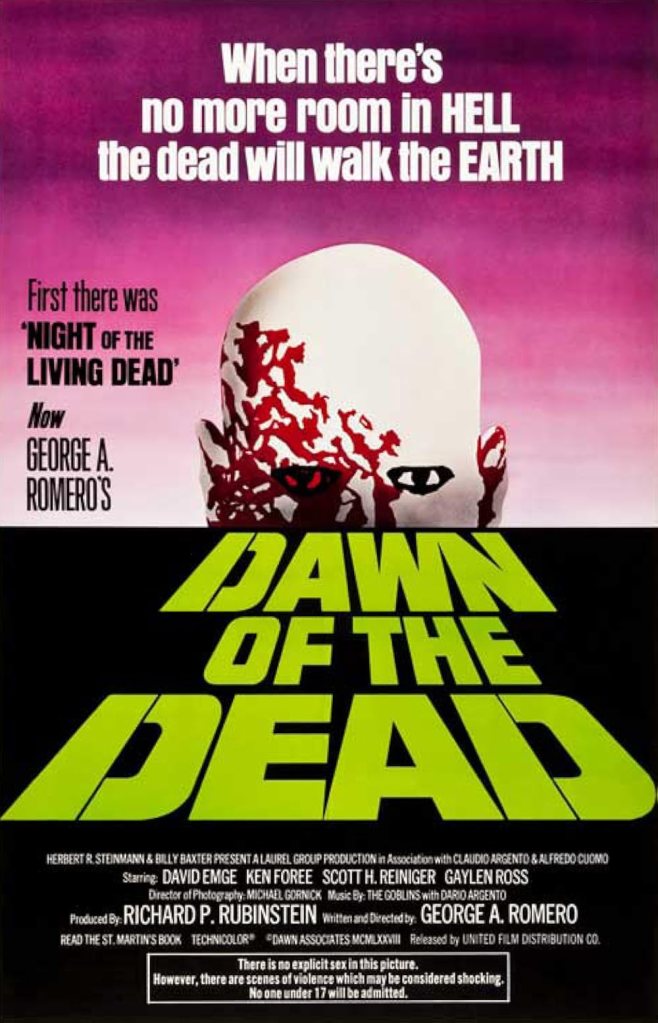
Horror Review: Dawn of the Dead (dir. by George A. Romero)


“When the dead walk, señores, we must stop the killing… or lose the war.”

In 1968, horror cinema was irrevocably changed by the emergence of George A. Romero’s vision, signaling the beginning of a transformative era for the genre. Romero, who had spent much of his early career making industrial and educational films, shifted gears dramatically by crafting Night of the Living Dead, an independent film that did more than just scare audiences—it shattered the conventions of horror. This was a film that rejected the glossy, Gothic monsters of studios like Universal and Hammer, replacing them with raw, unvarnished depictions of human decay and social collapse. The fear Romero invoked was no longer supernatural; it was born from human frailty and social upheaval.

Night of the Living Dead introduced audiences to an entirely new kind of monster: the zombie, not as a mystical or alien infection, but as the reanimated corpse of an ordinary person. This change was more than cosmetic. It shifted the source of horror from “the other” to a reflection of ourselves. Death itself had become weaponized, turning friend into foe in the most visceral way imaginable. The infection was no longer a far-off fantasy but an internal threat. Although the word “zombie” was scarcely spoken in Romero’s first three Dead films, the concept solidified into the cultural lexicon, haunting audiences with the idea that anyone—even the people closest to us—could become the enemy.

Despite the landmark impact of Night of the Living Dead, it would take a decade before Romero was able to produce its sequel. The first film’s shocking violence and disturbing social commentary made Hollywood studios wary of financing a continuation. However, a breakthrough came when Italian horror maestro Dario Argento learned of Romero’s plans and offered to co-finance Dawn of the Dead under the condition that he would receive European distribution rights and be allowed to edit a version for his audience. This international collaboration proved pivotal, allowing Romero to create what many consider not just a sequel but a towering masterpiece of horror cinema.

Released in 1978, Dawn of the Dead solidified Romero’s reputation as a visionary filmmaker willing to confront uncomfortable truths. The Motion Picture Association of America refused the film an R-rating due to its graphic content, and Romero opted to release it unrated to avoid association with the X-rating, which was then primarily linked to pornography. While this restricted the number of theaters willing to show the film, it did not hinder its success. The movie drew large audiences hungry for a horror story that dared to depict society’s unraveling with brutal honesty.

From its opening, Dawn of the Dead confronts viewers with the chaos midst societal collapse rather than building toward it. Traditional authority figures—news anchors, government officials, police—are portrayed as overwhelmed, often ineffective, and sometimes themselves sources of danger. The film’s opening sequence, set inside a frenzied television newsroom, captures this chaos vividly; reporters and producers struggle to maintain composure while the world outside falls apart. This scene encapsulates one of Romero’s central themes: the erosion of trust in institutions during extreme crisis. As media credibility falters, survivors are left in an informational vacuum, further imperiling their ability to cooperate or find sanctuary. This mistrust resonates strongly today, echoing recent real-world crises where institutional failure has worsened public panic and political division.

A critical early sequence—the tenement raid—brilliantly illustrates the film’s social complexity. The conflict here stems not only from the undead but from a clash of cultures: the low-income inhabitants hold tightly to their traditions, especially the respect and mourning of their dead, while the government, scientists, and law enforcement—detached “outsiders”—seek to destroy the infected bodies coldly as threats. This refusal to recognize the residents’ humanity and cultural practices sparks a brutal firefight, symbolizing the broader breakdown of social cohesion. Romero uses this conflict to show that the apocalypse is fueled as much by misunderstandings and institutional coldness as by the undead threat itself.

Within this crumbling world, the film centers on four survivors who become our guides through Romero’s apocalyptic landscape: Roger (Scott Reiniger) and Peter (Ken Foree), two disillusioned Philadelphia SWAT officers who desert after that violent raid; Stephen (David Emge), a helicopter pilot; and Fran (Gaylen Ross), a television producer. These characters represent the fractured remnants of a society that once clung to institutions but is now adrift. Their escape from Philadelphia aboard a stolen news helicopter is less a triumphant flight than a retreat into uncertainty.

Their destination is a suburban shopping mall near Monroeville, Pennsylvania. The mall, abandoned but intact, quickly becomes their fortress. Clearing out the zombies inside and barricading the doors seems like a triumph—an oasis amid apocalypse. The survivors revel in a surreal form of luxury that stands in stark contrast to the danger outside. For a time, they indulge in consumer comforts previously unattainable: fine clothes, gourmet food, and even jewelry. This phase is both a coping mechanism and a critique. Romero uses the mall setting as a dark mirror to American consumer culture. The shoppers turned zombies wander these halls as if drawn by habit, herding toward the very symbols of consumption that once defined the pre-apocalyptic world.

Romero’s critique extends beyond consumerism run amok; he exposes consumerism itself as a new religion for America. In the 1970s, as economic and social uncertainties shook the nation, megamalls emerged as the new temples of worship where consumer habits became ritualistic acts of devotion. The film’s setting drives home this analogy—the mall is not simply a marketplace but a sacred space where the rituals of buying and consuming provide meaning and identity. The zombies’ relentless, automatic wandering through the mall’s stores reflects a zombified devotion to these rituals, implying that consumerism has replaced spiritual and community values, offering hollow salvation in its place.

This portrayal is not accidental but deliberately satirical. The mall is a gilded cage, symbolizing consumerism’s dominance over American identity. Even in the apocalypse, the survivors replicate the rituals of capitalism, clinging to items of superficial value and meaning. The zombies’ mindless shuffling through stores like Woolworth’s and the food court underscores this grotesque cycle. Romero’s message is sharp: consumerism is a kind of death, a trance that distracts from and perhaps accelerates societal decay. The film implies that in America, the line between life and death blurs within the walls of the shopping mall because it is there that life’s priorities have long been warped.

While consumerism forms a visible backdrop, Dawn of the Dead probes deeper, exposing a darker undercurrent: humanity’s inherent violent nature as the real engine of destruction. The undead are monstrous and fearful, but they lack the complexity and self-destructiveness of the living. Throughout the film, Romero presents violence not as a rare failing but as a baseline condition of human behavior. The survivors themselves struggle to suppress impulses of aggression, paranoia, and selfishness that grow more toxic over time.

Roger’s reckless bravado during their clearing of the mall leads to a fatal bite from a zombie, making his death a metaphor for the cost of unchecked aggression. The living kill as readily as the dead, but with purpose and calculation that is often more destructive. The raiding biker gang that ultimately invades the mall appears as a harsh symbol of this self-inflicted violence. Unlike the zombies, whose threat is instinctive, the bikers wield cruelty consciously, plundering and destroying the survivors’ fragile sanctuary. Their incursion shatters any illusion of security and exposes the futility of individualistic survival strategies when cooperation is absent.

The unraveling of the survivors’ cohesion over the course of the film underscores one of Romero’s most bleak insights: humanity’s greatest enemy is itself. Even small groups that depend on trust and unity quickly fragment amid fear and scarcity. Despite the severity of their predicament, the four protagonists are often consumed by petty grievances, distrust, and self-preservation. Romero suggests that unless cooperation becomes a collective imperative, survival is impossible. The dead multiply endlessly, but it is the living who ensure society’s demise by turning against each other first.

Romero’s Dawn of the Dead also marks the cinematic arrival of Tom Savini, whose pioneering make-up effects would forever transform horror filmmaking. Savini and members of his team not only crafted many of the film’s grisly effects but also played some of the biker gang antagonists, blending artistry and performance. While the gore in Dawn can appear somewhat garish or cartoony on film, largely due to lighting effects and the practical limits of makeup technology at the time, Savini’s work set the standard for modern horror effects. His techniques and vision became the bedrock of the gore genre, influencing decades of horror cinema thereafter. His legacy continued as he later directed the 1990 remake of Night of the Living Dead, bringing Romero’s seminal vision to a new generation with his signature effects sensibility.

Ken Foree’s portrayal of Peter anchors the film emotionally; his performance balances toughness with vulnerability, capturing a man grappling with the collapse of law and societal norms while striving to retain his humanity. Scott Reiniger’s Roger provides a volatile contrast—impulsive, reckless, and ultimately tragic—as his aggression leads directly to his downfall. David Emge’s Stephen and Gaylen Ross’ Fran round out the core survivors, expressing pragmatism, grief, and the desperate need for connection as their world crumbles. Their dynamic interactions highlight Romero’s warning: human connection in times of extremity is fragile and fraught, undermined by fear and mistrust.

Romero’s expert use of sound and music further elevates the film. The eerie muzak playing through the mall’s PA system contrasts sharply with the groans of the undead and sudden bursts of violence, creating a haunting dissonance between normalcy and chaos. This effective sound design emphasizes the thematic conflict between consumerist detachment and encroaching apocalypse.

Beyond its horror, Dawn of the Dead serves as a time capsule of late-1970s American socio-political anxieties. America was reeling from the disillusionment of Vietnam, shaken by the Watergate scandal, and grappling with urban decay and economic malaise. The film vividly captures this zeitgeist: a society where institutions are distrusted, violence is normalized, and consumerism both numbs and destroys. Romero’s criticism extends to Cold War paranoia, reflected in his depiction of apocalypse not as a sudden cataclysmic event but a slow, grinding decline fueled by human self-destruction.

Romero’s directing style—unpolished at times but unflinching—adds authenticity to the film’s grim message. His use of long takes, handheld camera work, and naturalistic performances grounds the supernatural in the everyday, making the horror tangible. The bleak humor sprinkled throughout, such as the zombies’ fascination with the mall’s siren and muzak, darkens the tragedy with satirical bite.

Dawn of the Dead does not offer easy hope. Its ending—marked by betrayal, destruction, and resignation—echoes Romero’s worldview: humanity’s baser instincts, left unchecked, will always undermine salvation. Yet, in this stark vision lies an ironic beauty: survival is not only about killing or hiding but the recognition of our shared flaws and the possibility, however slim, of striving beyond them.

In conclusion, Dawn of the Dead remains a masterpiece of horror, combining groundbreaking practical effects, compelling performances, and incisive social commentary to create a film that is as relevant today as it was nearly fifty years ago. Romero’s work challenges viewers to confront the monsters within us all and questions whether human nature’s violent and consumerist impulses might prove more lethal than any undead army. Its enduring legacy lies not just in its scares but in its profound understanding of societal collapse and the fragile bonds that sustain civilization.

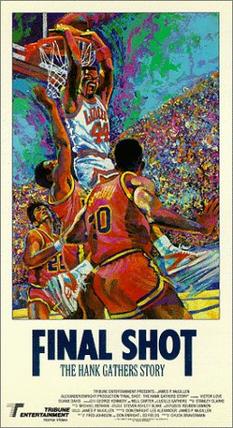
Final Shot: The Hank Gathers Story (1992, directed by Charles Braverman)


Hank Gathers is one of the most intriguing “what if?” stories of modern basketball.  Growing up in the Raymond Rosen Projects of Philadelphia, Hank stayed out of trouble by playing basketball.  An outstanding high school player, he went first to USC before transferring to Loyola Marymount.  Along with his friend Bo Kimble, he was a stand-out player at Loyola.  However, on March 4th, 1990, the 23 year-old Gathers collapsed during a game with Portland and died on the court, the victim of an abnormal heartbeat.  His last recorded words were, “I don’t want to lay down!”  Gathers set records in college.  Would he have done the same in the NBA?  Sadly, we’ll never know but he definitely had the talent and the ability to be one of the best.

Final Shot is a by-the-numbers biopic of Hank Gathers, focusing on his life in the projects and his friendship with Bo Kimble.  Victor Love plays Gathers while Kimble is played by Duane Davis and they both give good performances.  Their friendship feels real and when Hank helps Bo recover from a broken leg and when Bo worries about Hank’s recently diagnosed heart condition, the scenes are sincere in a way that lifts the film above the normal biopic clichés.  Nell Carter and George Kennedy both have good roles as well, Carter as Hank’s mother and Kennedy as Hank’s high school coach and mentor.  This is the type of role that Kennedy could have played in his sleep so I appreciated that he actually gave a believable performance.

Final Shot is a made-for-TV movie so it doesn’t dig too deeply into Gathers’s life outside of basketball, the way that college treat their athletes, or the systems that made playing basketball Hank’s only way of escaping the projects.  For what it is, though, it’s a fitting tribute.

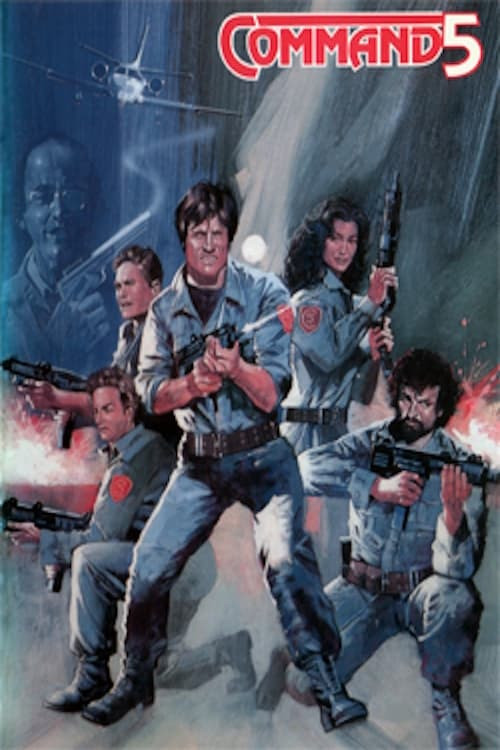
Command 5 (1985, directed by E.W. Swackhamer)


Morgan (Stephen Parr) is a mysterious government operative who puts together a special paramilitary force to take on extreme threats.  He says that only misfits are allowed to join his group because they have the edge he needs.  Smith (William Russ) is a wild Texan who drives like a maniac.  Psychiatrist Winslow (Sonja Smits) can fire an Uzi better than any man.  Kowalski (John Matuszak) is a demolitions expert who listens to Beethoven.  Jack Coburn (Wings Hauser) is a rebellious detective who is good with a throwing knife.

After a montage of their extensive training and a scene where our heroes take a look at the bullet-proof RV that they’ll be traveling the country in, the movie finally gets down to business.  A motorcycle-riding terror cult led by Delgado (Gregory Sierra) has taken an entire town hostage and is threatening to kill everyone unless they’re given a flight out of the country.  Our heroes drive their bulletproof van into town and try to defeat the bad guys.  There’s one good scene where the RV is driving down the town’s main street and getting hit nonstop with bullets.  The scene was obviously ripped off from the end of Clint Eastwood’s The Gauntlet but it’s still exciting to watch.  Otherwise, the action in this one is pretty rudimentary.

I guess Command 5 was supposed to be a pilot for television show that never went into production.  It is very much a television production.  There’s a lot of shooting but no blood.  Wings Hauser is less dangerous than usual.  The whole thing ends with Command 5 looking forward to adventures that were never to come.  Watching the pilot, you can see why it never became a show.  The characters were all thinly-written and never seemed to have much of a connection with each other and Hauser and Russ both seemed to be competing to be the loose cannon of the group.  This one is for Wings Hauser completists only.

October True Crime: D.C. Sniper (dir by Ulli Lommel)


Over a three week period, in 2002, a sniper shot 27 people in Maryland, Virginia, and Washington, D.C., killing 17 of them.  For that three week period, the nation lived in fear of an unknown evil that was traveling the highways and killing people seemingly at random.  Even though the murders occurred in the area surrounding our nation’s capitol, there was very much a feeling that the sniper could turn up anywhere and at anytime.  There was a lot of speculation about who the sniper was, with many theorizing that it was Al Quaeda while others argued that the killer was just another home-grown serial killer with a grudge.

When John Allen Muhammad and Lee Malvo were eventually arrested, it turned out that both sides were correct.  Muhammad was an American-bred spree killer, a man who had a grudge against the entire world and who brainwashed a teenage Lee Malvo into serving as his accomplice.  However, Muhammad also turned out to be a terrorist, someone who admired Osama Bin Laden and sympathized with Al Quaeda, even if he never personally had any contact with the group itself.

When Muhammad went on trial for the murders, there was never really any doubt that he would be found guilty and given the death penalty.  There was also little doubt that Ulli Lommel would eventually make a movie about him.

Ulli Lommel was a German director who got his start working with the legendary Rainer Werner Fassbinder.  Lommel starred in several of Fassbinder’s early films and went on to have a successful directorial career in Germany.  Eventually, he came to the U.S., where he married heiress Suzanna Love and hung out with people like Andy Warhol.  In the U.S., Lommel continued to direct.  He was responsible for some of the first documentaries about punk rock.  His film Cocaine Cowboys featured Andy Warhol playing himself.  His horror films, The Boogeyman and the Devonsville Terror, may not have been beloved by critics but they both quickly amassed cult followings.  However, after getting divorced from Love, Lommel seemingly disappeared until he reemerged in the 2000s as a director who specialized in cheap, direct-to-video true crime films.  Lommel directed films about Richard Ramirez, Son of Sam, Gary Ridgway, the Zodiac Killer, and many others.  While most critics dismissed Lommel’s later films as being exploitive trash, Lommel claimed that he was using the serial killer genre as a way to explore and expose the hypocricy of American society.

Myself, I love the idea of a crazy auteur so nothing would make me happier than to be able to declare that there was some sort of overlooked genius to Lommel’s later films.  However, from what I’ve seen of them, I have to say this is a rare case where I find myself agreeing with the critics.  For the most part, Lommel’s later films were trash.  While I have no doubt that Lommel probably was being serious in his belief that his serial killer films had a deeper meaning, the majority of them were cheaply made and dramatically incoherent.

That said, D.C. Sniper actually is one of Lommel’s better serial killer films.  A lot of that is due to the intense and intimidating performance of Ken Foree in the role of John Allen Muhammad.  Foree is credited with co-writing the script and the scenes in which he discusses his resentments while staring straight at the camera are truly frightening and they probably do capture what was going on in Muhammad’s head at the time of the killings.  The scenes between Muhammad and Lee Malvo (played by Tory N. Thompson) also have a creepy feeling of authenticity to them as we watch as Muhammad turns Malvo into a killer.  In the scenes with Thompson, Foree plays Muhammad as being alternatively nurturing and fearsome and again, one gets the feeling that the scenes are probably close to the truth.

That said, it’s still a Lommel film, which means that the budget is low, there’s a lot of meandering shots of people driving from one location to another, and the majority of the film looks like it was filmed on a phone.  When the film isn’t following Muhammad, it’s following an FBI agent (Christopher Kiesa), who is working undercover as a tourist.  The FBI agents wanders around various D.C. monuments and takes pictures.  We hear his voice-over, in which he explains that he’s more worried about his runaway daughter, who is apparently being turned into an “internet slut” by her boyfriend.  At one point, the FBI agent stands at the Potomac River and wonders if George Washington would be considered a terrorist by modern standards.  Lommel himself plays the FBI’s enigmatic partner, a detective known as the Cowboy due to his choice of headgear.  As one point, the Cowboy promises that he will help the FBI agent find his daughter.  The plotline is dropped after that and we don’t hear another word about it, leaving us to wonder why it was even brought up in the first place.

In the end, D.C. Sniper is good Lommel just because regular Lommel is so bad.

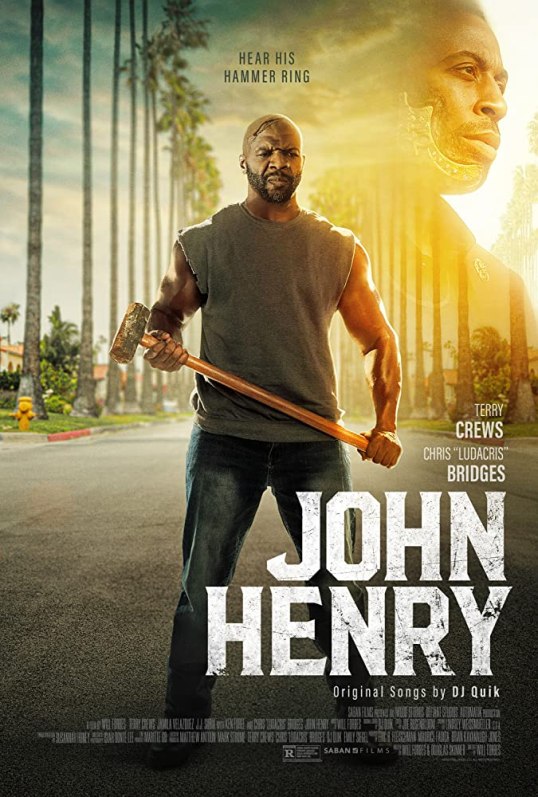
The Films of 2020: John Henry (dir by Will Forbes)


John Henry tells the story of a man named …. well, John Henry.  He’s played by Terry Crews and he lives in South Los Angeles with his father, BJ Henry (Ken Foree).  BJ may have to carry an oxygen tank around with him but he still has enough strength to shout, “My dick is legendary,” so good for him.

(Actually, it may sound like I’m being snarky and, to a certain extent, I am.  But having Ken Foree play Terry Crews’s father is actually a brilliant piece of casting.)

John Henry used to be into the gang lifestyle but now he’s gone straight.  We see flashbacks to his former life and how he used to hang out with his cousin, Hell (Ludacris).  When John accidentally shot Hell in the face, he decided to retire from crime and he also swore off carrying a gun.  Hell, on the other hand, just got a fancy gold-plated jaw.  Years later, Hell is a crime lord and John Henry is wandering around with sledgehammer.

When a Honduran refugee named Berta (Jamila Velazquez) show up at John Henry’s house, on the run from Hell’s crew, BJ’s reaction is to kick her out.  But John Henry, being the gentle giant with a sledgehammer, allows her to stay.  When Hell and his crew show up, it leads to violence, death, and …. well, that’s pretty much it.

John Henry is an odd film.  The tone is literally all over the place as the film swerves from being a comic book film to a serious drama to a comedy to a Spaghetti western.  It takes a lot of skill to take that many different tonal shifts and turn them into a coherent movie and unfortunately, that really doesn’t happen with John Henry.  The minute you start to get used to the idea of the film being an over-the-top comic book film, it suddenly tries to be a meditation on violence and guilt.  As soon as you’re getting used to the idea of it being a drama, Ludacris shows up with a huge hunk of medal on his face.  It’s hard to keep track of what exactly the film is saying because the film itself doesn’t seem to know.  I guess that could be forgiven if the film’s action managed to maintain a steady pace but instead, this felt like one of the longest 91-minute films that I’ve ever watched.

However, as our longtime readers should know by now, I’m not a fan of excessive negativity so let’s take a few moments to discuss what did work.  I already mentioned the casting of Terry Crews and Ken Foree.  They’re fun to watch together.  Ludacris’s gold-plated jaw is an amusing detail and it’s unfortunate that the film didn’t have more similarly odd details like that.  I also liked the opening credits, which basically told the film’s story in a comic book form.  The credits were fun and they hinted at what this film could have been if it had been better-paced and had fully embraced its camp potential.

John Henry played in some theaters before the pandemic outbreak.  It later found a home on Netflix and it’s in the process of developing a bit of a cult reputation.  Reportedly, there will be a sequel so I guess it’s not time to take John Henry to the graveyard just yet.

Feeling the Burn: Death Spa (1989, directed by Michael Fischa)


Michael (William Bumiller) owns the hottest health club in Los Angeles but that may not stay true if he can’t do something about all the guests dying.  Members get baked alive in the sauna.  Another is killed when a malfunctioning workout machine pulls back his arms and causes a rib to burst out of one side of his body.  Shower tiles fly off the wall and panic a bunch of naked women.  A woman loses her arm in a blender and a man is somehow killed by a frozen fish.  Strangely, all of the deaths don’t seem to hurt business as people still keep coming to the gym.  Surely, there are other, safer health clubs in Los Angeles.
Michael suspects that his brother-in-law, David (Merritt Butrick), might be to blame for all of the trouble.  David is good with computers and since this movie is from 1989, that means that he can do anything.  (David is described as being a “hacker,” which may be the first time that overused term was used in a film.)  Michael feels that David has never forgiven him for the suicide of his sister.  Two useless cops show up to investigate the murders while the spa gets ready for Mardi Gras night.

This incredibly cheesy horror movie used to be a mainstay on HBO, where young viewers like me appreciated all of the gore and slightly older viewers appreciated all of the nudity.  Viewed today, Death Spa is a real nostalgia trip.  From the leg warmers to the bulky computers to the choreographed workout routines, this is a movie that could only have been made in the 80s.  The plot is beyond stupid but some of the gore effects were well-executed and that scene where the frozen fish comes to life continues to amaze.  Sadly, this was Merritt Butrick’s last film.  The actor, who was best known for playing Captain’s Kirk’s son in The Wrath of Khan and The Search for Spock, died the same year that Death Spa was released.

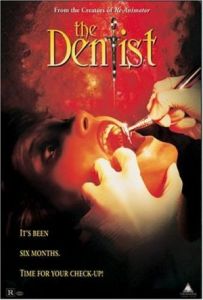
A Movie A Day #274: The Dentist (1996, directed by Brian Yuzna)


Alan (Corbin Bernsen) may be a wealthy dentist in Malibu but he still has problems.  He has got an IRS agent (Earl Boen) breathing down his neck.  His assistant, Jessica (Molly Hagan), has no respect for him.  His demanding patients don’t take care of their teeth.  His wife (Linda Hoffman) is fucking the pool guy (Michael Stadvec).  When Alan feels up a beauty queen while she’s passed out from the nitrous oxide, her manager (Mark “yes, the Hulk” Ruffalo) punches him and then goes to the police.  Under pressure from all sides, Alan loses his mind and a crazy dentist with a drill means a lot of missing teeth.
“You’re a rabid anti-dentite!” Kramer once yelled at Jerry Seinfeld and even people who were not already uneasy about going to dentist will be after watching Corbin Bernsen stick his drill in Earl Boen’s mouth.  The scene where Alan tells a group of dental students to yank out their patients’ teeth represents everyone’s worst fear of what dentists talk about when there aren’t any innocent bystanders around.  The Dentist may be predictable but Corbin Bernsen gives the performance of his career, playing the nightmare of anyone who has ever had a toothache.

Of course, good health begins with healthy teeth and real-life dentists provide a valuable service.  Take it from Robert Wagner:

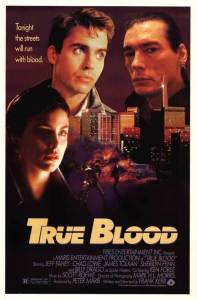
A Movie A Day #104: True Blood (1989, directed by Richard Kerr)


Ten years after being wrongly accused of murdering a cop, Raymond Trueblood (Jeff Fahey) returns to the old neighborhood.  Ray has just finished a stint with the Marines and he is no longer the irresponsible hoodlum that he once was.  He wants to rescue his younger brother, Donny (Chad Lowe), from making the same mistakes that he made.  But Donny now hates Ray and is running with Ray’s former friend, Spider Masters (Billy Drago).  Spider is also responsible for framing Ray for killing the cop.  When he is not trying to save his brother, Ray falls in love with Jennifer Scott (Sherilyn Fenn), a tough waitress who is soon being menaced by Spider.

Like Crime Zone, True Blood is typical of the type of B-movies that Sherilyn Fenn was stuck in before being cast as Audrey Horne in Twin Peaks.  It’s a nothing part but Fenn is authentic and sincere in the part and, as usual, Fenn’s performance is one of the best things about the movie.

Overall, True Blood is predictable but it is still better than the typical late 80s B-movie.  Chad Lowe is never believable as a member of a street gang but Jeff Fahey does a good Clint Eastwood impersonation as Ray and Billy Drago is, as always, a great villain.  Fans of Dawn of the Dead will want to keep an eye out for Ken Foree as one of the detectives investigating Ray.

Scenes I Love: Dawn of the Dead (Original 1978)


I know this latest “Scenes I Love” is quite an extended one. It’s pretty much the entire opening to the original George A. Romero classic where we see the four main leads of the story introduced dealing with the crisis that’s been on-going around them for what could be weeks.

I could have easily taken so many smaller scenes from this extended sequence and used them as favorites since they’re all that and more. This sequence was Romero at his best as a screenwriter. While some of the heavy handedness would later plague his writing in his later zombie films in this one they take on the right balance. He’s telling the audience through the screaming outbursts, arguments and general chaos of every scene that we as a society were fucked the moment the zombie apocalypse began. It doesn’t matter whether it’s the civilian expert trying to explain how to deal with the crisis in such logical terms while everyone around him reacts with irrational outbursts of disagreements. Or it could be how the police and the civilians they’re sworn to protect and serve become warring tribes on opposite sides when the true enemy is shambling all around them.

This makes the crippled priest’s words in the end of the scene even more telling.