Lisa Reviews An Oscar Nominee: Moonstruck (dir by Norman Jewison)


Nominated for Best Picture of 1987, Moonstruck is a film about love, romance, New York City, and being Italian.

Loretta Castorini (Cher) is a widow and a bookkeeper who lives with her parents, Cosmo (Vincent Gardenia) and Rose (Olympia Dukakis) in Brooklyn.  When her boyfriend, Johnny (Danny Aiello), asks Loretta to marry him, Loretta says yes even though she knows that, while she likes him, she’s not really in love with him.  After he proposes, Johnny reveals that he has to go to Sicily to see his “dying” mother.  He asks Loretta to pay a visit to his estranged brother, Ronny (Nicolas Cage), and invite him to the wedding.  Loretta, a strong believer in family and the importance of following tradition, agrees.

Loretta finds Ronny working in the bakery that he owns.  Ronny is not thrilled to learn that his brother has gotten engaged.  Ronny reveals that he has a wooden hand.  He lost his real hand when he accidentally placed it in a bread slicer while having a conversation with Johnny.  After he lost his hand, Ronny’s then-fiancée left him.  Ronny has never forgiven Johnny for the loss of his hand.  “I lost my hand!  I lost my bride!”  Ronny yells to the heavens.  Loretta, however, immediately understands that Johnny actually hurt his hand to get his fiancée to break up with him.  A conversation at Ronny’s apartment leads to the two of them impulsively sleeping with each other.  The next day, Ronny promises to never bother Loretta again if she agrees to go the opera with him.

What the guilt-stricken Loretta doesn’t know is that her father is having an affair himself and it turns out that Cosmo and Mona (Rose Gilette) enjoy the opera as well.  Meanwhile, Rose finds herself tempted by a lecherous college professor named Perry (John Mahoney).

There’s a lot of stereotypes to be found in Moonstruck.  Of course, passionate Ronny loves the opera.  Of course, the simple but well-intentioned Johnny abandons his fiancée so that he can rush to Sicily to be with his “dying” mother who, it turns out, isn’t dying at all.  Of course, Loretta slaps Ronny and tells him to snap out of it.  (I should note that I’m a fourth Italian myself so I could definitely relate to some of this film.  I’ve never liked opera, though.)  Fortunately, the film’s cast is so perfectly chosen and John Patrick Shanley’s script so adroitly maintains the balance between the broad comedy and the small dramatic moments that it doesn’t matter that all of the characters are a bit stereotypical.  The film comes to a wonderful life.  It’s impossible not love these characters, flaws and all.  Cher and Olympia Dukakis deserved the Oscars that they both won for this film.  Vincent Gardenia deserved the nomination that he received.  Nicolas Cage, Danny Aiello, and John Mahoney were not nominated but they should have been.  In particular, John Mahoney is heart-breaking in his small role, playing the type of lecherous character that most films would have just portrayed as being a cardboard buffoon.  As for Nicolas Cage, Moonstruck is a film that features both his trademark eccentricity and his ability to show the real and vulnerable human being underneath all of the bluster.  Moonstruck is a film about the search for love and the glory of finding it.  It’s a wonderfully romantic film, even if almost all of that love seems to involve infidelity.  As directed by Norman Jewison, Moonstruck not only celebrates falling in love but also celebrates being lucky enough to do so in New York City.  It’s a love letter not just to its characters but to the city as well.

Moonstruck was nominated for Best Picture but it lost to a far more epic production, The Last Emperor.



Retro Television Review: Miami Vice 2.16 “Little Miss Dangerous”


Welcome to Retro Television Reviews, a feature where we review some of our favorite and least favorite shows of the past!  On Mondays, I will be reviewing Miami Vice, which ran on NBC from 1984 to 1989.  The entire show can be purchased on Prime!

The power has returned, my mood is better, and my wrist has healed.  It’s time to get back to the reviews!

Episode 2.16 “Little Miss Dangerous”

(Dir by Leon Ichaso, originally aired on January 31st, 1986)

There’s a serial killer stalking the red light district of Miami, haunting cheap motels, dark alleys, and neon-lit sex clubs.  Men are turning up dead all over the place, brutally stabbed and then set on fire.  Occasionally, a crude drawing is left behind.  Castillo announces that every member of the Squad will be working a 12-hour shift until the killer is brought to justice.  He says that they may be looking for a pimp or a prostitute who is looking for revenge.

Of course, every prostitute knows and likes Sonny Crockett.  And again, this leads to the question of how exactly Sonny is able to work undercover when everyone in Miami knows who he is.  For that matter, all of the prostitutes also seem to know that Gina and Trudy are working Vice as well, despite the fact that Gina and Trudy’s regular gig to go undercover as high-priced escorts.  How do these people ever succeed at going undercover?  Everyone knows them!  I guess that’s to be expected, though, when you’ve only got 6 detectives working Vice in a city as big as Miami.

Tubbs meets a Jackie (played by singer Fiona), a young runaway who swears that she’s 18 and who says that she’s happy working as a prostitute because her body is just a commodity.  Tubbs becomes obsessed with protecting the spacey but seemingly innocent Jackie, especially after he becomes convinced that Jackie’s pimp, Cat (Larry Joshua), is the murderer.  Except, of course, Cat isn’t the killer.  Jackie is!  When Tubbs takes Jackie to a safehouse (which, of course, is also an art deco mansion), she snaps.  As Crockett tries to break down the locked front door and Cat crashes into the house on his motorcycle, Jackie starts a fire and approaches Tubbs.  But, instead of killing the only man who hasn’t tried to use her body, Jackie instead holds a gun to her head.  This is another episode that ends with an off-screen gunshot.  Interestingly, we never see Crockett actually get into the safehouse to rescue Tubbs from the fire.  Instead, the ending is abrupt and the viewer, while having no doubt that Tubbs will escape the fire, knows that Tubbs will now carry Jackie’s scars as his own.

What an unsettling episode.  This was Miami Vice at its most surreal and dream-like, with almost all of the action taking place at night and both Fiona and Larry Joshua giving edgy performances as two self-destructive people who live in the shadows of a wealthy American city.  For once, the entire Vice Squad gets in on the action, though Tubbs is clearly the one at the center of the story.  This episode reminds us that Tubbs is not quite as cynical and emotionally closed-off as Crockett but maybe, for the sake of his sanity, he should be.  Little Miss Dangerous is a journey into the heart of Miami darkness.

Embracing the Melodrama Part II #70: Staying Alive (dir by Sylvester Stallone)


StayingaliveOh my God, this is so bad.

The 1983 film Staying Alive is a sequel to Saturday Night Fever.  That’s right, Tony Manero’s back!  And, if possible, he’s even dumber than before.

Actually, that’s not fair.  The whole point of Saturday Night Fever was that Tony really was not that dumb.  He was poorly educated.  He was a prisoner of his culture and his economic situation.  If he acted stupid, it was because he lived in a world that distrusted intelligence.  If he was selfish, it was because that was his way of dealing with his own insecurities.  If we got frustrated with him, it’s because we knew he was capable of more than he realized he was.  In Saturday Night Fever, John Travolta gave such good performance and Tony was such a carefully drawn character that we forgave him for the many times that he let us down.

But, in Staying Alive, Tony is just an idiot.  Somehow, he’s managed to escape Brooklyn.  He now works as a waiter and a dance instructor and goes on auditions for Broadway shows.  He has no contact with his old friends.  (He never even mentions the night that one of them jumped off a bridge.)  He lives in one of those scary New York flophouses — apparently the same one that Travis Bickle called home in Taxi Driver — but otherwise, Tony’s doing pretty well for himself.  The only problem is that Tony is now a complete and total moron.

That really is the only conclusion that one can draw from John Travolta’s performance here.  It’s not just that Travolta gives a bad performance in a role for which he was once nominated for an Oscar.  It’s that Travolta gives such a bad performance that he actually transcends the accepted definition of bad.  He resurrects all the tics from his Saturday Night Fever performance but he goes so overboard with them that you feel like you’re watching someone do an imitation of John Travolta playing Tony Manero than actually watching John Travolta.

Speaking of self-parody, Staying Alive was directed by Sylvester Stallone.  Now, I know that when you think of the ideal director for a dance movie, Sylvester Stallone is probably the first name that comes to mind.

As for the film itself, Tony gets a job working in the chorus of a Broadway show called Satan’s Alley and, wouldn’t you know it, he eventually replaces the male lead.  Tony finds himself torn between the bitchy (and, somewhat inevitably, British) star of the show (Finola Hughes) and his long-suffering, on-and-off again girlfriend Jackie (Cynthia Rhodes).

Jackie, incidentally, is also the lead singer in a band.  The band’s guitarist, Carl, is in love with her.  Guess who plays Carl?  Frank Stallone!  That’s right, the director’s brother.  There is a hilarious scene where Carl plays guitar while shooting a death glare at Tony.  Frank really nails that death glare.

But, ultimately, the main appeal of Staying Alive is that we get to see Satan’s Alley, which is probably the most unintentionally hilarious fake Broadway show to ever be immortalized on film.  Satan’s Alley is about one man’s journey into Hell and… well, that really sums it up, doesn’t it?  If you asked someone who has never danced, never listened to music, and perhaps never actually stepped outside of their bedroom to write a Broadway musical, chances are that they would come up with something like Satan’s Alley.

And they’d probably cast Tony Manero as the lead!

http://www.youtube.com/watch?v=eEhzjIjmICM

Embracing the Melodrama Part II #57: Saturday Night Fever (dir by John Badham)


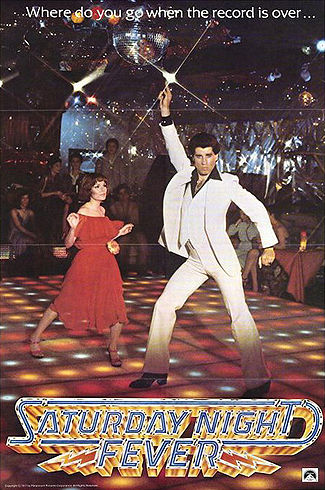
Saturday_night_fever_movie_posterHere’s a little bit of trivia about the iconic 1977 film Saturday Night Fever.

First off, according to the imdb, Saturday Night Fever was the first mainstream Hollywood film to ever use the term “blow job.”  That actually took me by surprise.  I mean, with all of the risks that the major studios took in the 70s, it still took them until 1977 to have someone say “blow job” in a movie?  But somehow, it seems appropriate that it would turn up in Saturday Night Fever.  We tend to think of Saturday Night Fever as being a movie where the soundtrack is nonstop disco and John Travolta dances in that iconic white suit.  But actually, Saturday Night Fever is a film about four guys who neither understand nor respect women.

When Tony (John Travolta), Joey (Joseph Cali), Double J (Paul Pape), and Bobby (Barry Miller) go down to that disco, it’s because they want to get laid.   Joey and Double J take turns having sex with insecure Annette (Donna Pescow) and, afterwards, Tony scornfully ask her if she‘s proud of herself.  When Bobby discovers that his girlfriend is pregnant, he is so terrified of having to be a father that he becomes suicidal.  As for Tony, he looks down on the women who are so eager to dance with him.  When he enters a dance contest with Stephanie (Karen Lynn Gorney), he can’t handle the fact that she wants more out of her life than just being his latest partner.

So, it makes sense that this would be the first mainstream movie to feature someone talking about a blow job because that’s what these boys are obsessed with.  Sexually primitive, hypocritically puritanical, and emotionally repressed, a blow job is all the intimacy that these boys can handle.

Another piece of trivia: while John Travolta was always the first choice for Tony Manero, several actors were seen for the roles of Joey and Double J.  At one point, both Ray Liotta and David Caruso were nearly cast in the role of Tony’s friends.  Imagine this: in some alternative universe, while white-suited John Travolta rules over the dance floor, Ray Liotta and David Caruso are standing in the background and cheering him on.

Of course, if Liotta and Caruso had been cast, it would be a totally different movie.  Whenever you watch Saturday Night Fever, you’re surprised by how much John Travolta totally dominates the film.  Even though the film devotes a good deal of time to Annette, Stephanie, Bobby and to Tony’s brother who has recently left the priesthood, Tony Manero is the only character that you remember.  That’s largely because Travolta is the only one of them who gives a truly memorable performance.

In theory, it’s easy to laugh at the thought of Travolta in that white suit, striking a dramatic pose on that cheap-looking dance floor.  But then you watch the film and you realize that Travolta truly did give a great performance.  And, to your surprise, you don’t laugh at Tony with his white suit because you know that the only time Tony has any control over his life is when he’s dancing.  He may work in a paint store.  He may regularly get slapped around by his family.  He may not be very smart or sensitive.  But when Tony’s dancing, he’s a king and you’re happy that he at least has one thing in his life that he can feel good about.

Even if he is kind of a jerk.

Of course, it helps that Tony is a really good dancer.  There’s actually a lot more going on in Saturday Night Fever than you might think but ultimately, it’s a dance movie and it’s one of the best.

Lisa Watches An Oscar Nominee: The Verdict (dir by Sidney Lumet)


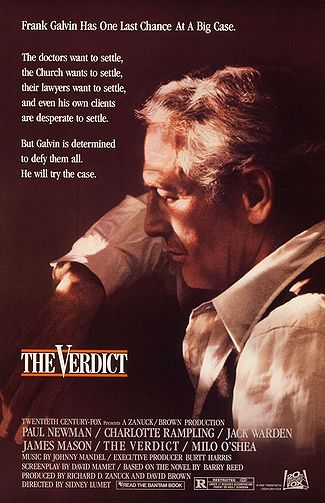
Verdict1

Speaking of the good, old-fashioned star power of Paul Newman, The Hustler and Butch Cassidy and the Sundance Kid were not the only films to receive an oscar nomination as the result of his charisma.  There’s also The Verdict, a 1982 best picture nominee that would probably be forgotten if not for Paul Newman’s performance.  However, since Paul Newman did play the lead role in The Verdict and he did give an amazing lead performance, The Verdict was nominated for best picture and, 33 years later, it ended up on TCM where I just watched it.

That’s the power of good acting.

Paul Newman plays Frank Galvin, a Boston-based attorney.  At one time, Frank was a lawyer at an elite firm.  But he has since fallen on hard times.  Now, he’s the type of attorney who crashes funerals and hands out his card.  He spends his spare time at his favorite bar, playing pinball and telling long jokes while stumbling about in a drunken haze.  In many ways, Frank represents everything that people hate about personal injury attorneys but, since he’s played by Paul Newman, you know that he’s going to turn out to be a good guy.

Frank only has one friend left in the world, his former mentor Mickey (Jack Warden).  Looking to help Frank out, Mickey sends Frank a medical malpractice suit.  A woman at a Catholic Hospital was given an anesthetic during child birth that has led to her now being brain dead.  Both the woman’s family and the Archdiocese are looking for a settlement.  The family needs the money to pay for her medical care.  The Archdiocese just wants the case to go away.  All Frank has to do is accept whatever settlement deal is offered…

However, something has changed for Frank.  He’s visited the comatose woman and, looking at her trapped in a vegetative state, he’s decided that the hospital needs to be held responsible for its mistake.  He rejects the settlement and takes the case to court, looking for both justice for the victim and redemption for himself.

That’s easier said than done, of course.  The Archdiocese has hired Ed Concannon (James Mason, perfectly cast), one of the best and most powerful attorneys in Boston.  Ed has a huge legal team working on the case.  Frank has Mickey.  As well, the Judge (Milo O’Shea) makes little effort to hide his contempt for Frank.

Probably the only bright spot in Frank’s life is that he’s met a woman.  Laura (Charlotte Rampling) meets him in a bar and soon, they’re lovers and Frank is confiding in her about the case.  What he doesn’t suspect is that Laura herself is a spy, hired by Concannon.

It looks like all is lost but then Frank discovers that there is one nurse (Lindsay Crouse) who might be willing to tell the truth about what happened at the hospital…

In many ways, The Verdict is a predictable film.  From the minute we first meet him, we know that Frank is going to be redeemed.  From the minutes that we hear about the case, we know who we’re supposed to root for and who we’re supposed to hiss.  Just about every courtroom cliché is present, right down to a surprise witness or two…

But no matter!  The Verdict may be predictable but it works.  As he proved with 12 Angry Men, Director Sidney Lumet knew how to make legal deliberations compelling and the entire film is full of small but memorable details that elevate it above its simplistic storyline.  As a director, Lumet gets good performances from his cast and, as a result, this is a film where the hero is flawed and the antagonists aren’t necessarily evil.  Even the Bishop of the Archdiocese of Boston (who, in most films, would have been a cardboard villain) is given a scene where he’s allowed to show some humanity.

And, of course, Paul Newman is great in the role of Frank.  When we first meet Frank, he looks and sounds terrible.  Indeed, it’s strange to see Paul Newman playing a character who is essentially such a loser.  (Even Eddie Felson in The Hustler had an appealing swagger about him.)  It’s during the scenes where Frank considers the woman in a coma that Newman starts to reveal that there’s more to Frank than what’s on the rough surface.  By the end of the film, Frank may be a hero but Newman doesn’t play him as such.  He’s still has that alcoholic rasp in his voice and his eyes still betray hints of insecurity and a fear that, at any minute, he’s going to screw up and mess everything up.  It’s a great performance, one for which Newman received a nomination for best actor.

Speaking of star power, Bruce Willis also shows up in The Verdict.  He’s an extra who appears as an observer in the courtroom.  He’s sitting a few rows behind Paul Newman.  (He’s also sitting beside Tobin Bell, the Jigsaw Killer from the Saw films).  It’s probably easiest to spot Willis towards the end of the film, when the verdict is read.  Bruce breaks out into a huge grin and almost looks like he’s about to start clapping.  Bruce only gets about 10 second of screen time but he acts the Hell out of them!

Thanks to Paul Newman, The Verdict is a memorable and entertaining film.  Be sure to watch it the next time it shows up on TCM.