Days of Paranoia: Edmond (dir by Stuart Gordon)


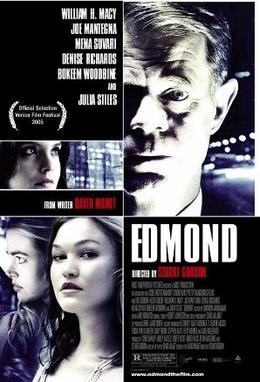
Based on a one-act play by David Mamet, 2005’s Edmond tells the story of Edmond Burke (William H. Macy).

Edmond shares his name (if not the actual spelling) with the philosopher Edmund Burke.  Edmund Burke was a strong believer that society had to put value in good manners to survive and that religious and moral institutions played an important role in promoting the idea of people treating each other with respect and decency.  Edmund Burke knew what he believes and his writings continue to influence thinks to this day.  Edmond Burke, on the other hand, doesn’t know what he believes.  He doesn’t know who he wants to be.  All he knows is that he doesn’t feel like he’s accomplished anything with his life.  “I don’t feel like a man,” he says at one point to a racist bar patron (played by Joe Mantegna) who replies that Edmond needs to get laid.

On a whim, Edmond steps into the shop of a fortune teller (Frances Bay), who flips a few Tarot cards and then tells Edmond that “You’re not where you’re supposed to be.”  Edmond takes her words to heart.  He starts the night by telling his wife (played by Mamet’s wife, Rebecca Pidgeon) that he’s leaving their apartment and he won’t be coming back.  He goes to the bar, where he discusses his marriage with Mantegna.  He goes to a strip club where he’s kicked out after he refuses to pay $100 for a drink.  He goes to a peep show where he’s frustrated by the glass between him and the stripper and the stripper’s constant demand that he expose himself.  He gets beaten in an alley by three men who were running a three-card monte scam.  Edmond’s problem is that he left home without much cash and each encounter leads to him having less and less money.  If he can’t pay, no one wants to help him, regardless of how much Edmond argues for a little kindness.  He pawns his wedding ring for $120 but apparently, he just turns around and uses that money to buy a knife.  An alley-way fight with a pimp leads to Edmond committing his first murder.  A one-night stand with a waitress (a heart-breaking Julia Stiles) leads to a second murder after a conversation about whether or not the waitress is actually an actress leads to a sudden burst of violence.  Edmond ends up eventually in prison, getting raped by his cellmate (Bookem Woodbine) and being told, “It happens.”  Unable to accept that his actions have, in one night, led him from being a businessman to a prisoner, Edmond says, “I’m ready to go home now.”  By the end of the film, Edmond realizes that perhaps he is now where he was meant to be.

It’s a disturbing film, all the more so because Edmond is played by the likable William H. Macy and watching Macy go from being a somewhat frustrated but mild-mannered businessman to becoming a blood-drenched, racial slur-shouting murderer is not a pleasant experience.  Both the play and the film have generated a lot of controversy due to just how far Edmond goes.  I don’t see either production as being an endorsement of Edmond or his actions.  Instead, I see Edmond as a portrait of someone who, after a lifetime of being willfully blind to the world around him, ends up embracing all of the ugliness that he suddenly discovers around him.  He’s driven mad by discovering, over the course of one night, that the world that is not as kind and well-mannered as he assumed that it was and it all hits him so suddenly that he can’t handle it.  He discovers that he’s not special and that the world is largely indifferent to his feelings.  He gets overwhelmed and, until he gets his hands on that knife, he feels powerless and emasculated.  (The knife is an obvious phallic symbol.)  It’s not until the film’s final scene that Edmond truly understands what he’s done and who he has become.

Edmond is not always an easy film to watch.  The second murder scene is truly nightmarish, all the more so because the camera remains on Edmond as he’s drenched in blood.  This is one of William H. Macy’s best performances and also one of his most disturbing characters.  That said, it’s a play and a film that continues to be relevant today.  There’s undoubtedly a lot of Edmonds out there.
Embracing The Melodrama: The God Committee (dir by Austin Stark)


First released (after being delayed by the COVID lockdowns) in 2021, The God Committee tells the story of a group of doctors faced with a difficult decision.

They’re the so-called God Committee, the ones who have been tasked with deciding which one of their patients will be receiving a new heart.  When the original “next name on this list” suddenly dies while being prepped for surgery, it comes down to three other possibilities.  One is a cranky old woman who has said that she doesn’t even want a new heart.  Another is a middle-aged, obese Black family man who suffers from bipolar disorder and who, years earlier, attempted to commit suicide.  And finally, there’s a young white guy who is famous for his addictions and his wild lifestyle.  He’s just arrived at the hospital, in critical condition.  Normally, his history of cocaine addiction would rule him out as a possible recipient but his father (Dan Hedaya) is rich and the hospital is in desperate need of money.

“I’m not going to let a good heart go to waste,” the brilliant Dr. Andre Boxer (Kelsey Grammer) says and he has a point.  Most candidates for a heart transplant die before a suitable heart is found.  This heart, taken from a teenage boy was hit by a car while returning home from a date, is a good one but it won’t stay viable forever.  Boxer, who is scheduled to leave the hospital in another month to set up his own private practice, is torn between the candidates.  Dr. Valerie Gilroy (Janeane Garofalo) and Father Dunbar — a disbarred lawyer-turned-priest — both feel the heart should go to the patient whose father can afford to fund the hospital.  Even if the decision is made just for the money, it’ll still do some good.  Dr. Jordan Taylor (Julie Stiles), who is Dr. Boxer’s former lover, is not so sure.  Psychiatrist Dr. Allen Lau (Peter Kim) recuses himself from voting for personal reasons and Nurse Wilkes (Patricia R. Floyd) eventually casts a vote that takes everyone by surprise.

While the God Committee debates who should get the heart, the film occasionally flashes forward.  Dr. Boxer, who is now dying and in need of a heart transplant himself, is working on a project that, if successful, will revolutionize the organ transplant business.  But will he survive long enough to see it completed?  Dr. Taylor, now in charge of the God Committee, tracks him down and asks him if he’s ready to see his son.  Though it takes a while for us to understand why and how, the decision that Doctors Boxer and Taylor made in the past will continue to have repercussions in the present.

The God Committee is based on a play.  Even if I didn’t already know that, I would have guessed as much from watching the film.  The God Committee is type of melodrama that tends to work better on stage than on film.  The artificiality of the stage allows for a story to be a bit overbaked and heavy handed.  On the other hand,  as a film, The God Committee‘s arguments are stacked so heavily to one side that it weighs down the plot.  It’s not enough for the rich candidate to be a former drug addict.  He also has to beat his pregnant girlfriend and leave her with a roadmap of cuts crisscrossing across her face.  It’s not for the good candidate to simply be a nice guy with a family.  Instead, he’s presented as being almost saintly.  There’s nothing subtle about it.

Fortunately, the talented cast steps up and keeps the story from going off the rails, with Julia Stiles, Colman Domingo, and Kelsey Grammer especially bringing some much-needed shading and nuance to their roles.  Grammer especially does well as the genius who can save lives and change the world but who struggles to connect with anyone on an emotional level.  In the end, The God Committee works due to the strength of its performers, all of whom bring their characters to multi-layered life and who remind us that it’s never easy to play God.

Live Tweet Alert: Join #FridayNightFlix for 10 Things I Hate About You!


As some of our regular readers undoubtedly know, I am involved in a few weekly live tweets on twitter.  I host #FridayNightFlix every Friday, I co-host #ScarySocial on Saturday, and I am one of the five hosts of #MondayActionMovie!  Every week, we get together.  We watch a movie.  We tweet our way through it.

Tonight, at 10 pm et, I will be hosting #FridayNightFlix!  The movie? 1999’s 10 Things I Hate About You!

Heath Ledger and Julia Stiles are too good to be true in this charming romantic comedy!

If you want to join us this Friday, just hop onto twitter, start the movie at 10 pm et, and use the #FridayNightFlix hashtag!  I’ll be there tweeting and I imagine some other members of the TSL Crew will be there as well.  It’s a friendly group and welcoming of newcomers so don’t be shy.

10 Things I Hate About You is available on Prime!

See you there!

Film Review: Hamlet (dir by Michael Almereyda)


What if Hamlet was a hipster douchebag?

That appears to be the question at the heart of the 2000 film adaptation of William Shakespeare’s most famous play.  In this adaptation, a young Ethan Hawke plays a Hamlet who is no longer a melancholy prince but who is instead a film student with a petulant attitude.

As you probably already guessed, this is one of those modern day adaptations of Shakespeare.  Denmark is now a Manhattan-based corporation.  Elsinore is a hotel.  Hamlet ponders life while wandering around a Blockbuster and, at one point, the ghost of his father stands in front of a Pepsi machine.  While Shakespeare’s dialogue remains unchanged, everyone delivers their lives while wearing modern clothing.  It’s one of those things that would seem rather brave and experimental if not for the fact that modern day versions of Shakespeare have gone from being daring to being a cliché.

At the film’s start, the former CEO of the Denmark Corporation has mysteriously died and his brother, Claudius (Kyle MacLachlan), has not only taken over the company but he’s also married the widow, Gertrude (Diane Venora).  Hamlet comes home from film school, convinced that there has been a murder and his suspicions are eventually confirmed by the ghost of his father (Sam Shepard).  Meanwhile, poor Ophelia (Julia Stiles) takes pictures of flowers while her brother, Laertes (Liev Schreiber), glowers in the background.  Polonius (Bill Murray) offers up pointless advice while Fortinbras (Casey Affleck) is reimagined as a corporate investor and Rosencrantz (Steve Zahn) wears a hockey jersey.  Hamlet spends a lot of time filming himself talking and the Mousetrap is no longer a player but instead an incredibly over-the-top short film that will probably remind you of the killer video from The Ring.

I guess a huge part of this film’s appeal was meant to be that it featured a lot of people who you wouldn’t necessarily think of as being Shakespearean actors. Some of them did a surprisingly good job.  For instance, Kyle MacLachlan was wonderully villainous as Claudius and Steve Zahn was the perfect Rosencrantz.  Others, like Diane Venora and Liev Schreiber, were adequate without being particularly interesting.  But then you get to Bill Murray as Polonius and you start to realize that quirkiness can only take things so far.  Murray does a pretty good job handling Shakespeare’s dialogue but that doesn’t change the fact that he’s totally miscast as the misguided and foolish Polonius.  One could easily imagine Murray in the role of Osiric.  Though it may initially seem a stretch, one could even imagine him playing Claudius.  But he’s simply not right for the role of Polonius.  Murray’s screen presence is just too naturally snarky for him to be convincing as a character who alternates between being a “tedious, old fool” and an obsequious ass kisser.

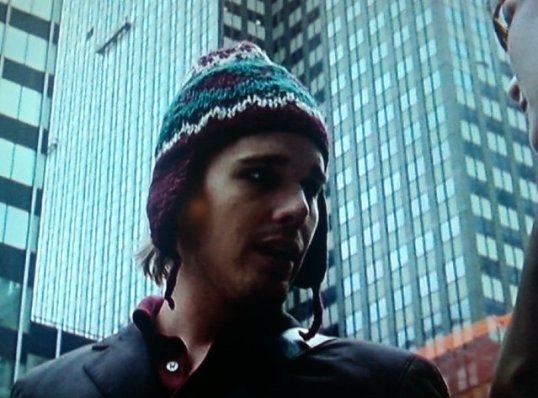
Considering that he spends a large deal of the movie wearing a snow cap while wandering around downtown Manhattan, Ethan Hawke does a surprisingly good job as Hamlet.  Or, I should say, he does a good job as this film’s version of Hamlet.  Here, Hamlet is neither the indecisive avenger nor the Oedipal madman of previous adaptations.  Instead, he’s portrayed as being rather petulant and self-absorbed, which doesn’t necessarily go against anything that one might find within Shakespeare’s original text.  Hawke’s not necessarily a likable Hamlet but his interpretation is still a credible one.

At one point, while Hamlet thinks about revenge, we see that he’s watching Laurence Olivier’s version of Hamlet on television.  There’s Olivier talking to Yorick’s skull while Hawke watches.  It’s a scene that is somehow both annoying and amusing at the same time.  On the one hand, it feels rather cutesy and more than a little pretentious.  At the same time, it’s so over-the-top in its pretension that you can’t help but kind of smile at the sight of it.  To me, that scene epitomizes the film as a whole.  It’s incredibly silly but it’s so unapologetic that it’s easy to forgive.

Cleaning Out The DVR: O (dir by Tim Blake Nelson)


(Lisa is currently in the process of cleaning out her DVR!  This could take a while.  She recorded the 2001 high school film O off of Cinemax on July 6th.)

Tell me if this sounds familiar.

O (Mekhi Phifer) is one of the only black students attending an exclusive high school in South Carolina.  Despite a past that involves petty crime and drugs, O appears to have his life on the right track.  As the captain of school’s basketball team, O is the most popular student at his school.  Everyone looks up to him.  Everyone wants to be him.  He’s even dating Desi (Julia Stiles), the very white daughter of the school’s very white headmaster (John Heard).  At a school assembly, Coach Duke Goulding (Martin Sheen) describes O as being like a son to him.  When O is awarded the MVP trophy, he shares it with his teammate, Michael Cassio (Andrew Keegan).

Watching all of this with seething jealousy is Hugo Gaumont (Josh Hartnett).  Hugo is a teammate of O’s.  In fact, he even thought that he was O’s best friend.  That was before O shared his award with Michael.  Making Hugo even more jealous is that he happens to be the son of the coach.  For every kind word that Duke has for O, he has a hundred petty criticisms for Hugo.  Whereas O has overcome drug addiction and is proclaimed as a hero for doing so, Hugo is secretly doing steroids, trying to do anything to improve himself as a player and hopefully win everyone’s love.

So, Hugo decides to get revenge.  Working with a nerdy outcast named Roger Calhoun (Elden Hansen), he manipulates O into thinking that Desi is cheating on him with Cassio.  He also tricks Cassio into getting into a fight with Roger, leading to Cassio getting suspended from the team.  To top it all off, Hugo gets O hooked on drugs, once again.  Finding himself consumed by a violent rage that he thought he had under control, O starts to obsess on determining whether or not Desi has been faithful to him…

If that sounds familiar, that’s because O is basically Othello, transported to modern times and involving privileged teenagers.  Even though the whole modernized Shakespeare thing has become a bit of a cliché, it actually works pretty well in O.  Hugo’s obsessive jealousy of the “cool kids” feels right at home in a high school setting and director Tim Blake Nelson and writer Brad Kaaya do a fairly good job of transporting Shakespeare’s Elizabethan melodrama to the early aughts.

(Actually, O was filmed in 1999 but it sat on the shelf for two years.  After a spate of school shootings, distributors were weary about releasing a film about high school students trying to destroy each other.)

Admittedly, O has its share of uneven moments.  Martin Sheen, playing the type of role that always seems to bring out his worst instincts as an actor, goes so overboard as the coach that he threatens to sink almost every scene in which he appears and Rain Phoenix is miscast as Hugo’s girlfriend.  Even Julia Stiles struggles a bit in the role of Desi.  However, both Mekhi Phifer and Josh Hartnett are perfectly cast as O and Hugo.  Phifer brings just the right amount of arrogant swagger to the role while Hartnett is a sociopathic marvel as Hugo.  Tim Blake Nelson’s direction is occasionally overwrought, relying a bit too heavily on a groan-inducing metaphor about taking flight and claiming the spotlight.  However, both Nelson and the film deserve some credit for not shying away from directly confronting and portraying the source material’s cultural and racial subtext.

O is hardly perfect but it is always watchable and, at its best, thought-provoking.

Film Review: Jason Bourne (2016, dir. Paul Greengrass)


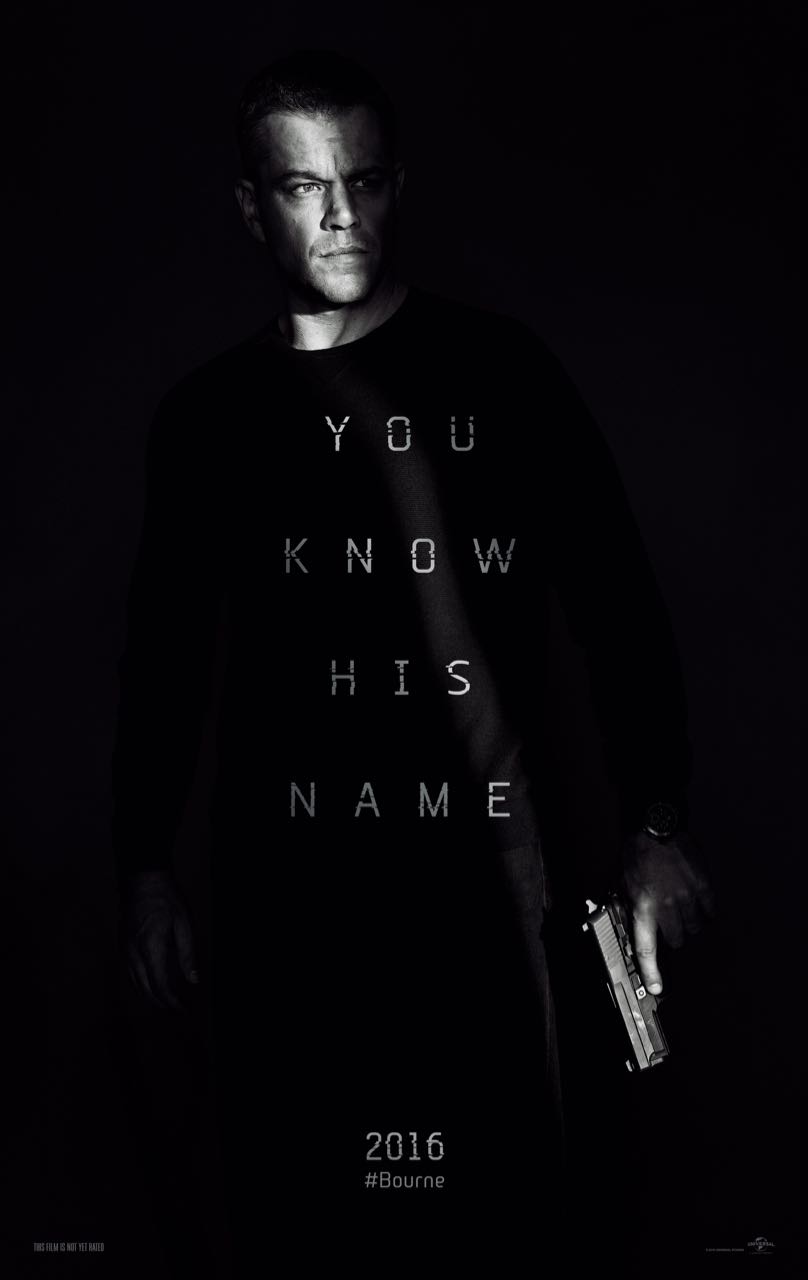
Jason_Bourne_Poster_1

I most certainly do know his name. It’s John Rambo. I kept thinking of that fake ad for a Rambo style movie from Grand Theft Auto: Vice City throughout the film.

Take the beginning of Rambo III (1988), and make it the whole movie. That being tracking him down to bring him in, so he can be sent out on a mission. Throw in that surveillance thing from the TV Show Person of Interest. Add a little of the 60 Minutes fueled paranoia about technology that filled the movie Blackhat (2015). Copy the ending of Terminator: Genisys (2015), but make it about swapping out love interests to reboot the franchise. Make sure to shake the camera a bunch, put in unnecessary zooms, and editing that at times gets so frantic you lose track of what is happening. Endless action must be there too since people paid to see spectacle rather than just setup. That’s Jason Bourne in a nutshell. It is a film cobbled together from elements you are already familiar with from other films, you get some action for your money, and then are sequel baited before the credits roll.

Don’t see it in theaters like I did. If you are a big movie lover or an action junkie, then check it out on DVD. If you aren’t, then don’t watch it in any form whatsoever. It’s not worth it for the casual viewer.

That’s my short review, which I know I can’t be the only one who likes to read about a film that is brand new.

Now if you want to hear more about the film, then read on. I will do my best without physical access to the film, or proper screenshots. I refuse to use promotional ones. I want to be able to show you goofs like making an IP Address be internal by being 192 at the start, but still making the second number 256 for no reason at all. They won’t show that kind of thing in promo material. I will also spoil the ending that really isn’t a spoiler. You already know simply by the fact that there are clearly planned sequels that can’t exist without Bourne.

————————–

First, I have to confess that I did not see the last entry in the series. I have seen all the ones before that, but not the Jeremy Renner one. I doubt it makes any difference, but I thought you should know.

The movie starts off the way Casino Royale (2006) does by giving us a recap of Bourne’s previous kills. Just like Bond, it means he is in, and isn’t going to get back out again. That’s when it cuts to him fighting in an organized fight club type thing a la Rambo to get away from it all. At the same time, we are introduced to the two main people who will be chasing after Bourne. That’s Heather Lee played by Alicia Vikander and the director of the CIA played by Tommy Lee Jones.

Bourne is in Greece, which is in turmoil. They get hot his trail very quickly courtesy of Julia Stiles who makes a return, so she can lead Lee to Bourne before making sure she gets shot and killed. No joke. She hacks her way into a system they are monitoring to find Bourne herself, they catch on, they catch up, and she gets shot. There’s your setup for the movie. Bourne is drawn back into things whether he likes it or not while he is being hunted.

The next important thing isn’t really important at all, but will take up time in the movie nonetheless. It’s Tommy Lee Jones harassing a tech giant that he apparently gave money to so that he could start his company. He wants him to put in a backdoor in his very popular social network so that the CIA can spy on everyone. Yes, they do bring up Snowden because of course they do. This part of the story exists in the movie, but honestly plays very little into things except to give a purpose for drawing Bourne into something good rather than simply being the super solider who came in from the cold. It’s how Lee and Tommy Lee Jones handle the situation that tells Bourne where he stands, and sets up the sequel.

At a certain point the action takes over the film completely. Yes, there is quite a bit of fast-paced tracking sequences early on, but by the time the real action starts, you get to see a SWAT van act like a snow plow going down the street knocking cars left and right. I went with two friends, and neither of them could stop talking about the action. Things like “how did they do that” kept coming up. Obviously it’s a mix of practical effects and CGI, but there is just so much of it filled with quick cuts that you are overwhelmed as they were. It made me long for something simple like The Dark Knight (2008). However, I want to make it clear that I never lost a sense of space. That’s a deathblow to action sequences. It’s when the film isn’t shot properly so that instead of understanding the space in which the action takes place and the relation between the characters, you wind up with a bunch of disconnected actions scenes. I never felt that way watching this movie.

In the end, the tech giant is nearly assassinated, but rescued, and only gets shot in the chest. Tommy Lee Jones is killed off in a scene that reminded me of when RoboCop confronted Ronny Cox. Heather Lee is now situated as a go-between Bourne and the people who want to use him. They barely scratch at those special behind the scenes people with some flashbacks and a few documents. I figure that is what we will get a more fleshed out version of in the follow-up films.

That’s my longer review. Bourne walks away not telling Lee how she will get in touch with him. She does get into her car, and picks up some sort of device, but I honestly don’t recall what it was. The point is, she is both the new point-man, and probably a love interest down the road.

If that sounds like something you want to see, then more power to you!

Jason Bourne Is Back


Jason Bourne is back and uses the biggest sporting event to showcase in an action-packed tv spot why people should care that he’s back.

Yes, we know who he is. He definitely knows who he is, but this time around it looks like he remembers everything. If that’s the case then the CIA may be in for another beating Paul Greengrass-style with all the shaky-cam we can shake a stick at.

Looks like, if this tv spot is any indication, that Jason Bourne wasn’t taking it easy physically while he was gone. He definitely didn’t skimp on the lifting.

Jason Bourne is set for a July 29, 2016 release.

Horror Film Review: The Omen (dir by John Moore)


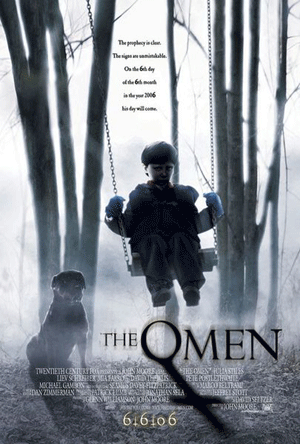
The_Omen_2006_poster

There’s really only one reason to see the 2006 remake of The Omen and that’s the fact that the priest who convinces Ambassador Thorn to adopt the Antichrist is played by the great Giovanni Lombardo Radice.

If you’re a fan of Italian horror, you’ll immediately know who Radice is and, whenever he appears in The Omen, you’ll be momentarily excited.  After all, Radice is an actor who has given memorable performances in films made by iconic directors like Lucio Fulci, Ruggero Deodato, Antonio Margheriti, Michele Soavi, and Martin Scorsese.  He’s appeared in everything from City of the Living Dead to Cannibal Apocalypse to The House On The Edge of the Park to Stagefright to Gangs of New York.  As both a horror icon and an excellent actor who has always been gracious and friendly to his fans, Giovanni Lombardo Radice is one of those actors who movie bloggers like me are always happy to see in any film.

(And, if anyone deserves a role in a Quentin Tarantino film, it’s Giovanni Lombardo Radice.)

And Radice gives a really great performance in The Omen.  He plays the role with just the right combination of menace and regret.  When he first appears, you can tell that he’s determined to get Robert Thorn to adopt Damien but that he’s not particularly happy about having to do it.  He may be one of the bad guys but he’s a bad guy with a conscience.  Later, when Radice makes a second appearance, it momentarily re-energizes the film.  He’s just got such a unique screen presence that, whenever he’s on-screen, Radice reminds you of the film that you want The Omen to be.

As for the rest of the remake — well, it’s all kind of pointless.  The film is largely a scene-by-scene remake of the first Omen and, unfortunately, it never quite answers the question of why the film needed to be remade in the first place.  The Gregory Peck role is played by Liev Schrieber while his wife is played by Julia Stiles.  The doomed photographer is played by David Thewlis.  Mia Farrow shows up in the role of the sinister nanny and Mia actually does a pretty good job but whenever she was delivering her lines, it was impossible for me not to imagine a remake of The Final Conflict where Ronan Farrow plays Damien.

Otherwise, the same characters die as in the original film and, often times, they die in the exact same way.  It’s really almost lazy how little the remake changes from the original.  And, ultimately, it makes the entire movie feel more than a little pointless.  You’re left with the feeling that the only reason the Omen was remade was so that it could be released on June 6th, 2006 (a.k.a. 6-6-06).

So, when it comes to The Omen, stick with the original but watch the remake for Giovanni Lombardo Radice.

Back to School #56: 10 Things I Hate About You (dir by Gil Junger)


10_things_i_hate_about_you_final_poster

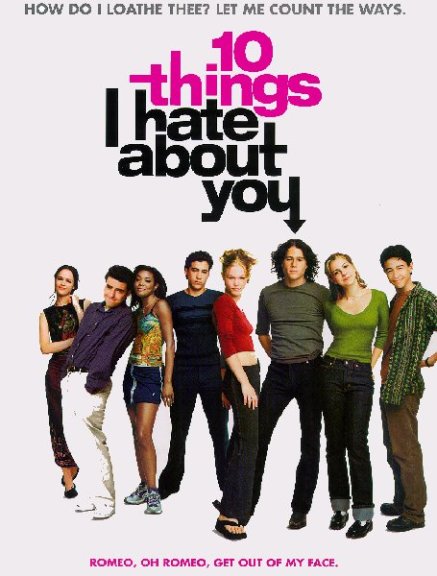
A few nights ago, my sister Erin and I watched the 1999 high school-set romantic comedy 10 Things I Hate About You for like the hundredth time.  Seriously, we love this movie so much and, in fact, just about everyone that we know seems to love it as well.  10 Things I Hate About You is one of those films that brings people together.  If you like this movie, I’ll probably like you.

(Want to see true displays of spontaneous sisterhood?  Go to Girlie Night at the Alamo Drafthouse when they’re showing 10 Things I Hate About You.  You will walk out of the movie with a hundred new best friends.)

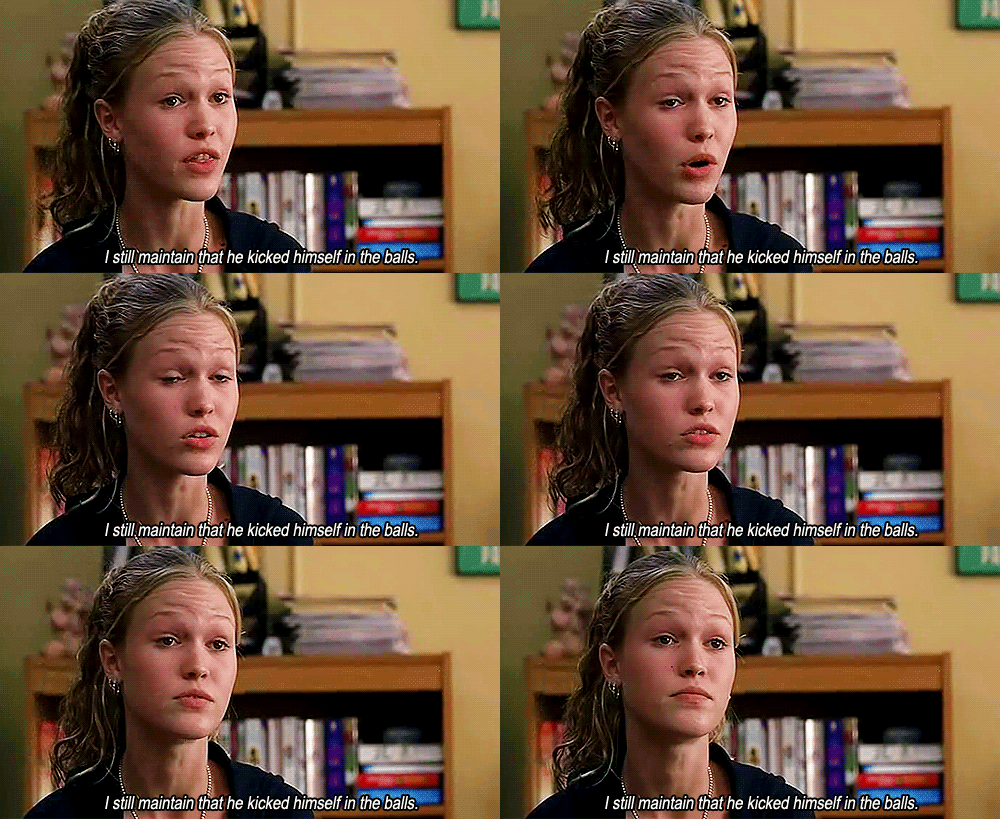
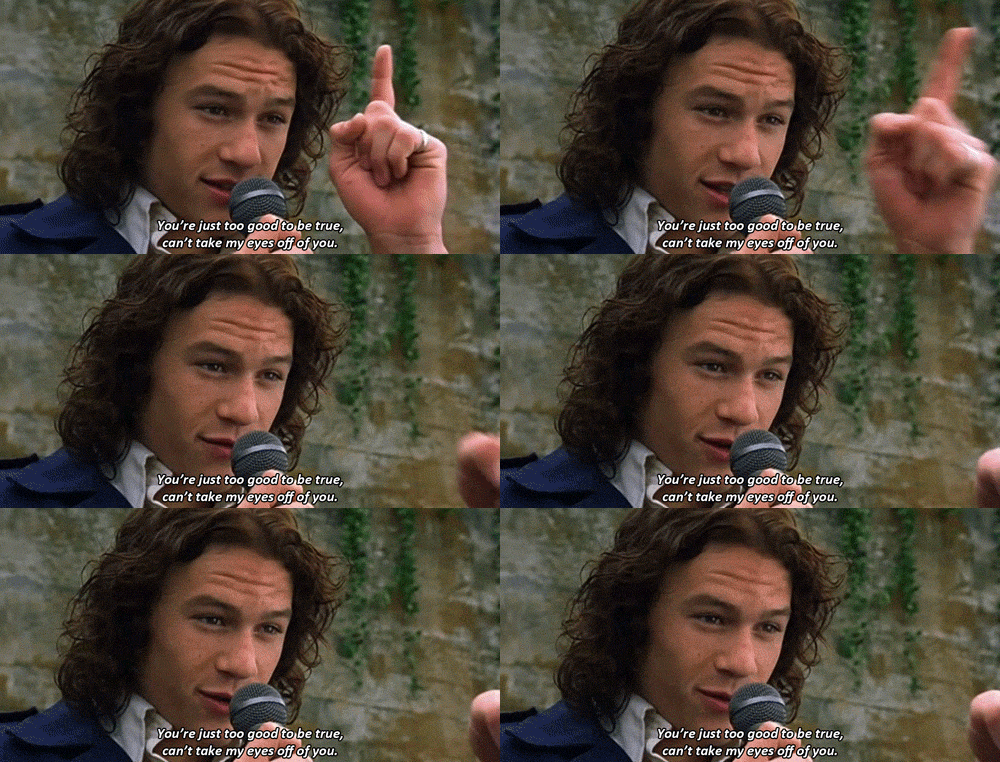
Why do people love 10 Things I Hate About You?  There’s a lot of reasons.  I love Heath Ledger singing Can’t Take My Eyes Out Of You.  I love watching Joseph Gordon Levitt at his most adorable.  I love that it’s a film about two sisters, largely because I have three older sisters and there is so much about the scenes between Kat (Julia Stiles) and Bianca (Larisa Oleynik) to which I could relate.  I love the film’s quirky sense of humor and its unapologetically big heart.  I love the way the film’s script expertly balances cynicism with sentimentality and humor with warmth.  I love the fact that movie takes in place in beautiful houses and features beautiful people wearing beautiful clothes.  What Erin and I especially love about this film is that, as played by Julia Stiles, Kat is just a kickass chick.

flawless-queen-kat-stratford-16681703

Of course, there’s a reason for that.  Much as how the superficially similar Clueless was adapted from Jane Austen’s Emma, 10 Things I Hate About You is adapted from Shakespeare’s play The Taming of the Shrew.  Oddly enough, Shakespeare’s plays seem to translate well into stories about high school.  Maybe it’s because his characters are so often motivated by jealousy, romance, and — it must be said about some — by pure stupidity.  10 Things I Hate About You is definitely one of the best of the teen Shakespeare films.

Taking place at an upper class high school, 10 Things I Hate About You opens with Cameron James (Joseph Gordon-Levitt) arriving for his first day at Padau High School and quickly befriending the only slightly less adorable Michael Eckman (David Krumholtz).  Cameron wants to ask out the beautiful and innocent Bianca (Larisa Oleynik) but Bianca’s overprotective father (played by Larry Miller) has decreed that Bianca can only date if her older sister Kat (Julie Stiles) is also dating.  The problem is that all of the boys at school are scared of the outspoken Kat.

So, Cameron convinces the hilariously vapid male model Joey Donner (Andrew Keegan) to pay the school rebel, Patrick Verona (Heath Ledger, so handsome and charismatic and sexy), to ask Kat out on a date.  Joey, you see, wants to date Bianca as well but Cameron is sure that he can win Bianca away from Joey…

Yes, it’s all a little bit complicated but then again, Shakespeare often is.  For that matter, so is high school.

10 Things

What matters is that all of this leads to a collection of classic scenes and classic dialogue.  What’s my favorite scene from 10 Things I Hate About You?  There’s so many that it’s difficult to narrow it down to just one.  There’s the huge party where Joey continually strikes a pose and a drunk Kat ends up dancing on a table.  There’s the wonderful scene where Patrick serenades Kat.  Or how about when Kat reads the poem that gives the film its title.  But for me, my favorite scene is that one where, after spending nearly the entire film as rivals, Kat and Bianca finally talk to each other as sisters.  Bianca demands to know why Kat won’t go to the prom.  Kat tells Bianaca about her own previous history with Joey.  It’s a low-key and heartfelt scene, wonderfully played by both Larisa Oleynik and Julia Stiles, and I love it just because I’ve had similar conversations with all of my sisters.

planet-loser

I suppose this is where I should make some clever comment about having “10 things I love about 10 Things I Hate About You” but actually, there’s more like a 100 things I love about 10 Things I Hate About You.

This movie makes me happy every time I see it.

And, really, what else can you ask a film to do?

tumblr_ms08c08EbP1sezoa7o1_250


6 Obscure Films Of 2013: The Call, Copperhead, It’s A Disaster, See Girl Run, UnHung Hero, Would You Rather


Well, it’s that time of year when I look at the list of the films that I’ve seen over the past 12 months and I realize that there’s quite a few that I haven’t gotten around to reviewing yet.  Here are my thoughts on six of them.

The Call (dir by Brad Anderson)

Abigail Breslin is kidnapped by a serial killer.  While trapped in the trunk of the killer’s car, Breslin manages to call 911.  Breslin’s call is answered by Halle Berry, a veteran operator who is recovering from a trauma that — by an amazing and totally implausible coincidence — was caused by the same guy who has just kidnapped Breslin.

Before it became a feature film, The Call was originally developed as a weekly TV series and, as I watched, it was easy to imagine weekly episodes that would all feature a different guest star calling 911 and needing help.  For the first hour or so, The Call is well-made and acted but undistinguished.  However, during the final 30 minutes, the entire film suddenly goes crazy with Breslin running around in her bra, Berry turning into a blood thirsty vigilante, and the killer suddenly getting very verbose.  However, those 30 minutes of pure insanity were just what The Call needed to be memorable.  There are some films that definitely benefit from going over-the-top and The Call is one of them.

Copperhead (dir by Ronald Maxwell)

Copperhead is a historical drama that takes place during the Civil War.  In upstate New York, farmer Abner Breech (Billy Campbell) is ardently opposed to both the Civil War and the union cause.  In most movies, this would make Abner the villain but, in Copperhead, he’s portrayed as being a man of principle who, by refusing to compromise on his views, is ostracized and ultimately persecuted by the rest of his village.  Abner’s views also bring him into conflict with his own son, who is pro-Union.

Copperhead is a slow-moving film that features some rather good performances along with some fairly bad ones.  However, I’m a history nerd so I enjoyed it.  It certainly tells a different story from what we’ve come to expect from American films about the Civil War.

It’s A Disaster (dir by Todd Berger)

Of the six films reviewed in this post, It’s A Disaster is the one to see.  In this darker than dark comedy, Julia Stiles brings her new boyfriend (David Cross) to Sunday brunch with 6 of her closest friends.  During the brunch, terrorists explode a dirty bomb in the city.  With everyone trapped inside the house and waiting for the world to either end or somehow revert back to normal, long-simmering resentments come to the forefront.

To say anything else about It’s a Disaster would be unfair so I’ll just say that it’s a very funny film, featuring excellent work from both Stiles and Cross.  If Jean-Paul Sartre was alive and writing today, he would probably end up writing something very similar to It’s a Disaster.

See Girl Run (dir by Nate Meyer)

Bleh!  That’s probably the best description I can give you of this film.  It’s just a whole lot of bleh.

Emmie (Robin Tunney) is unhappy with her boring marriage so she runs back to her Maine hometown, stops wearing makeup and washing her hair, and pines for her high school boyfriend, Jason (Adam Scott), who works at a sea food restaurant.  Jason also happens to be friends with Emmie’s depressed brother, Brandon (Jeremy Strong).  It’s the same basic plot as Young Adult, just with no humor and a lot more talking.  In Young Adult, it was hard not to admire Charlize Theron’s wonderfully misguided character.  In See Girl Run, you just want to tell Robin Tunny to take a shower, put on some clothes that don’t look like they were stolen from a hospital storage closet, and stop whining all the time.

It’s difficult to put into words just how much I hated this movie.  This is one of those films that critics tend to describe as being “a film for adults.”  I have to agree — this is a movie for really boring, depressing adults who like to talk and talk about how their lives haven’t worked out.  If See Girl Run is what being an adult is like, I’ll just continue to be an immature brat, thank you very much.

UnHung Hero (dir by Brian Spitz)

So, this is not only the worst documentary of 2013 but it’s also quite probably one of the worst documentaries ever made.  The film opens with footage of Patrick Moote (who claims to be a comedian) asking his girlfriend to marry him.  As Moote goes on (and on) to tell us, she turns down his proposal and then dumps him because, according to her, his penis is too small.  Moote spends the rest of the film talking to various people and asking them whether size really matters.

Well, he could have just asked me and saved a lot of time.  I’m sorry if this endangers any fragile male egos but yes, size does matter.  If Moote’s penis really is as tiny as he claims it is, I probably would have turned down his proposal as well.  Then again, Moote could be hung like Jamie Foxx and I’d probably still refuse to marry him because, quite frankly, he’s the whiniest and most annoying person that I’ve ever seen.  He’s like an even less charming version of Morgan Spurlock.  What Patrick Moote never seems to understand is that size matters but personality matters even more.

Would You Rather (dir by David Guy Levy)

Would you rather have a root canal or sit through this piece of crap?  Having seen Would You Rather, I can tell you that it’s not an easy question to answer.

Jeffrey Combs plays a sadistic millionaire who invited a bunch of strangers (including Brittany Snow, John Heard, June Squibb, and Sasha Grey) to his mansion and forces them to play an elaborate and deadly game of Would You Rather.  Unfortunately, none of the characters are interesting, the film’s sadism is more boring than shocking, and talented actor Combs is totally wasted as the one-note villain.