Retro Television Review: Miami Vice 5.5 “Borrasca”


Welcome to Retro Television Reviews, a feature where we review some of our favorite and least favorite shows of the past!  On Mondays, I will be reviewing Miami Vice, which ran on NBC from 1984 to 1989.  The entire show can be purchased on Prime!

This week, Vice helps the communists once again.

Episode 5.5 “Borrasca”

(Dir by Vern Gillum, originally aired on December 9th, 1988)

Martillo Borrasca (Juan Fernandez) is a drug dealer who uses the money to fund anti-communist revolutionaries in his native South American country.  Castillo, Tubbs, and Switek want to arrest him, especially after Barrisco and his men use a machete to hack an undercover cop to death.  CIA agent Reese (Brion James) wants the Vice Squad to lay off Barrisco because Barrisco is working to overthrow a communist.

Personally, I’m on Reese’s side.  Sure, Borrasca is a bad guy and he deserves to be punished for his crimes but the communist dictators in South and Central America were just as bad.  Just because they quoted Marx and spouted a lot of anti-imperialist propaganda, that didn’t change the fact that they oppressed their own people and many of them were involved in the drug trade themselves.  This episode aired long before the rise of Hugh Chavez but one need only look at the state of Venezuela today to see that the CIA perhaps had a point.

Castillo, of course, doesn’t see it that way.  He assassinated Barrisco while the latter is trying to make an escape via helicopter.  “I have a code,” Castillo says.  Really, Castillo?  That’s your code?  Assassinate a drug dealer but don’t do anything about the dictators who would have allowed the Russians to plant nuclear missiles in their countries?

This episode was actually pretty routine.  How many times have we been through the whole “The Vice Squad is after a drug dealer who has friends in the government” thing?  On the one hand, I always appreciate Miami Vice’s cynicism about the War on Drugs.  On the other hand, it’s frequent defense of communism has always been one of the show’s more glaring blind spots.  Communists make just as much money from the drug trade as capitalists.

Crockett was not in this episode.  Instead, Tubbs worked with Switek.  It was nice to see Switek get to more than usual but, in the end, this was definitely a Castillo episode.
 

Horror Film Review: Suburban Sasquatch (dir by Dave Wascavage)


In 2004’s Suburban Sasquatch, Bigfoot is stalking the suburbs.

Bigfoot appears out of thin air.

Bigfoot vanishes whenever he’s feeling stressed or local Native American badass Talla (Sue Lynn Sanchez) starts shooting arrows at him.

Bigfoot pulls off arms and legs and tosses them in the air.

Bigfoot likes to drag his victims off to a cave where he apparently just leaves them laying around.

Bigfoot has to eat.

Bigfoot has really big tits.

Yes, you read that last one correctly.  Groucho Marx once said that he wouldn’t be seeing a movie starring Victor Mature and Hedy Lamarr because, “‘I never go to movies where the hero’s tits are bigger than the heroine’s,” and let’s just say that Victor Mature had nothing on the Suburban Sasquatch.  The sasquatch costume itself is covered in coarse, dark fur except for its belly and chest, both of which are left pretty much bare.  It makes me wonder where exactly the production purchased the sasquatch costume.  The film was apparently shot in Pennsylvania and Pennsylvania seems like it’s a bit too blue collar to be home to an S&M-themed furry community but who knows?

(Maybe the costume was ordered from Austin.)

As for the film, it’s basically just the Suburban Sasquatch killing people.  It was obviously made for next to no money and the dialogue is just bad enough to leave you wondering whether or not the director was specifically trying to satirize no-budget, direct-to-video horror films or if he was just trying to do what he could with what he had available.  Personally, I couldn’t hep but smile at the fact that no one seemed to be that panicked about a Sasquatch being on the loose.  Throughout the film, people continue to wander around outside as their friends and neighbors aren’t getting ripped apart by Bigfoot.

(“Actually, Lisa, it’s not Bigfoot.  It’s a Suburban Sasquatch.”  I don’t care.  Everyone keeps looking at his footprints and gasping.  He’s Bigfoot.)

A few other things I liked about Suburban Sasquatch:

The special effects, especially the scenes of blood-spraying, appear to have been done with MS Paint.

There were only two cops in the entire town and they were both useless.

Reporter Rick Harlan (Bill Ushler) kept showing up at the crime scenes and talking about how the people had the right to know about the killings but he didn’t really put much effort into getting the word out there.

Suburban Sasquatch likes to rip off people’s limbs and smash their heads, all in full MS Paint glory.  But, somehow, whenever the bodies are found, the limbs have reattached and the heads are no longer smashed.

The character of Talla, assigned by her Native American ancestors to kill the sasquatch, was incredibly badass, even if she was something of a stereotype.  Seriously, if I was told that I had to be someone from Suburban Sasquatch, I would want to be Talla because she shows up, shoots her arrows, tells Rick to get lost, and then she goes somewhere else and shoot even more arrows.  She’s the one character in the film who is actually actively trying to do something.

Finally, I should not that there’s an online rumor that the late Neil Hope, who played Wheels on Degrassi High, appeared in Suburban Sasquatch but I definitely didn’t see him and, considering that Hope apparently spent his entire post-Degrassi life in Canada, I have a hard time believing that he hopped down to Pennsylvania to appear in a nothing-budget film.  One of the first victims does have a Wheels-style mullet but I’m pretty sure that wasn’t Neil Hope as Hope himself was sporting a bald look at the time this film was made.  (That said, on Degrassi: The Next Generation, Jimmy, Spinner, Craig, and Marco did play in a band called Downtown Sasquatch and Jimmy and Spinner briefly owned a clothing store called Squatch Wear.)

Suburban Sasquatch came out in 2004 and probably would have been forgotten if not for Joel McHale featuring a clip from it on The Soup.  Much like Bigfoot himself, the film lives on.

Film Review: Executive Decision (dir by Stuart Baird)


In 1996’s Executive Decision, terrorists hijack an airplane.  Their leader, Nagi Hassan (David Suchet) demands that the U.S. government not only give him and his men safe passage but that they also release Hassan’s commander, Jaffa (Andreas Katsulas).

In Washington D.C., it is decide to use a stealth plane to transport Col. Austin Travis (Steven Seagal) and his men into the passenger plane.  Accompanying them will be Dr. David Grant (Kurt Russell), a consultant for U.S. Intelligence.  Dr. Grant is the world’s leading expert on Hassan, even though neither he nor anyone else is even sure what Hassan looks like.  Travis distrusts Grant because he’s a civilian and also because he holds Grant responsible for a botched raid on a Russian safehouse in Italy.  Dr. Grant is going to have to prove himself to Col. Travis because Travis doesn’t have any time for people who can’t get the job done.  And Travis is determined to get on that plane and save all those passengers.

In other words, Travis is a typical Steven Seagal character and, for the first fourth of this movie, Seagal gives a typical Steven Seagal performance.  He delivers his line in his trademark intimidating whisper, he glares at everyone else in the film, and essentially comes across as being a total douchebag who can still handle himself in a fight..  However, when it’s time to board the airplane through a docking tunnel, something goes wrong.  Everyone — even nervous engineer Dennis Cahill (Oliver Platt) is able to slip through the stealth plane’s docking tunnel and get into the hijacked airplane cargo hold without being detected.  But the two planes are hit by severe turbulence.  Suddenly, it becomes apparent the one man is going to have to sacrifice his life and close the hatch before the docking tunnel decompresses.

David, already in the cargo hold, looks down at Austin in the tunnel.  “We’re not going to make it!”

“You are!” Austin replies before slamming the hatch shut and getting sucked out of the tunnel.  (There’s your Oscar Cheers Moment of 1996!)  After all that build-up, Steven Seagal exits the film early and now, it’s up to Kurt Russell and what’s left of Austin Travis’s men to somehow stop the terrorists.  Not only do they have to stop Hassan but they also have to do it before the Air Force — which has no way of knowing whether or not any of their men were able to get on the plane before the tunnel fell apart — shoots down the airliner.

(If the airplane looks familiar, that’s because Lost used the same stock footage whenever it flashed back to the plane crash that started the show.)

It’s actually a rather brilliant twist.  When this film came out, Seagal was still a film star.  He played characters who always got the job done and who were basically infallible.  He wasn’t a very good actor but he did manage to perfect an intimidating stare and that stare carried him through a lot of movies.  No one would have expected Seagal to die within the first 30 minutes of one of his movies and when Col. Travis, who the film has gone out of its way to portray as being the consummate warrior, is suddenly killed, there really is a moment where you find yourself wondering, “What are they going to do now?”  In just a matter of minutes, Executive Decision goes from being a predictable Steven Seagal action film to a genuinely exciting and clever Kurt Russell thriller.  For once, Russell is not playing a man of action.  He’s an analyst, a thinker.  And, to the film’s credit, he uses his mind more than his brawn to battle Hassan’s terrorists.  With excellent support from Halle Berry (as a flight attendant who discreetly helps out David and the soldiers), Oliver Platt, B.D. Wong, Whip Hubley,  David Suchet, Joe Morton, and even John Leguizamo (as Travis’s second-in-command), Executive Decision reveals itself to be an exciting and ultimately rewarding thrill ride.

And to think, all it took was sacrificing Steven Seagal.

#MondayMuggers presents KINJITE: FORBIDDEN SUBJECTS (1989) starring Charles Bronson!


Every Monday night at 9:00 Central Time, my wife Sierra and I host a “Live Movie Tweet” event on X using the hashtag #MondayMuggers. We rotate movie picks each week, and our tastes are quite different. Tonight, Monday February 10th, we’re watching KINJITE: FORBIDDEN SUBJECTS starring Charles Bronson!

Back when I was a teenager, I would always get the entertainment section out of dad’s Sunday paper so I could check out the movie listings and see if there was a new movie I wanted to see. I would also look for information about my favorite movie star, Charles Bronson. Nowadays, we know about new movies months, even years, in advance, but back then I would first learn about them from the entertainment section of dad’s paper. I remember one Sunday in early 1989, seeing an advertisement for a new Charles Bronson film called KINJITE: FORBIDDEN SUBJECTS. It was the first time I had ever heard of the film. I knew I wasn’t going to get to see it at the movies because it was only playing in Little Rock, and it was rated R, but I was excited anyway because I knew it would be on its way to video pretty soon! 

In KINJITE: FORBIDDEN SUBJECTS, Charles Bronson plays police lieutenant Crowe. He deals with the sleaziest criminals in Los Angeles on a daily basis and it’s starting to take a toll on his personal life. He’s currently personally invested in bringing down an underage prostitution ring led by Duke (Juan Fernandez) and Lavonne (Sy Richardson). When a Japanese businessman’s young daughter is kidnapped by Duke, Crowe decides he must do everything in his power to get her back to her family. 

Here is some interesting trivia about the film:

  1. Beginning with DEATH WISH II (1982) Charles Bronson made 8 films for the infamous Cannon Group. KINJITE: FORBIDDEN SUBJECTS was the last of those films. The others are 10 TO MIDNIGHT (1983), DEATH WISH 3 (1985), MURPHY’S LAW (1986), ASSASSINATION (1987), DEATH WISH 4: THE CRACKDOWN (1987), and MESSENGER OF DEATH (1988). 
  2. Director J. Lee Thompson directed Charles Bronson in 9 different films, with KINJITE: FORBIDDEN SUBJECTS being the final film he ever directed. Charles Bronson loved working with the same directors once he got comfortable with them. Thompson, who directed classics like THE GUNS OF NAVARONE (1961) and CAPE FEAR (1962), always made sure Bronson’s low budget Cannon films were filmed in a competent and professional manner. 
  3. Nicole Eggert plays a teen prostitute in this film and Amy Hathaway plays Charles Bronson’s daughter. Both were appearing in popular sitcoms at the time. Eggert was starring in CHARLES IN CHARGE and Hathaway was in MY TWO DADS. 
  4. The bad guy in the film is played by Juan Fernandez. He’s played some great villains in his day. Actor James Woods told me this about Juan, “The irony is that Juan Fernandez is one of the nicest actors I’ve ever worked with, and yet one of the most truly frightening villains. His work in SALVADOR was superb. A lovely, talented man.” 
  5. Perry Lopez, who plays Bronson’s partner in the film had worked with Bronson twice before. He appeared with Bronson in the excellent 1954 western DRUM BEAT, and also in 1987’s DEATH WISH 4: THE CRACKDOWN. 

So join us tonight to for #MondayMuggers and watch KINJITE: FORBIDDEN SUBJECTS! It’s on Amazon Prime.

I’ve included the trailer below:

#MondayMuggers – Why FEAR CITY (1984)?


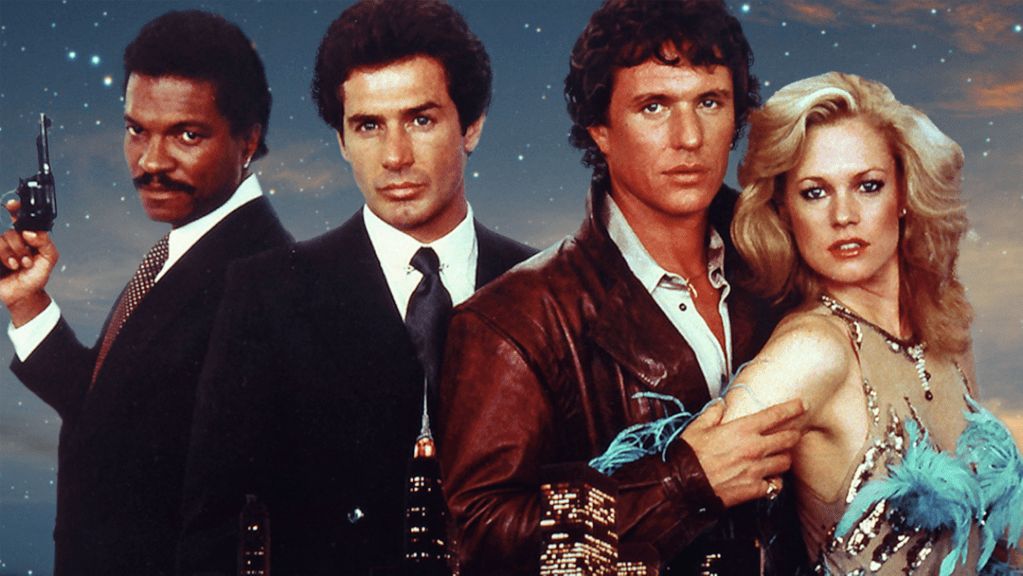
Every Monday night at 9:00 Central Time, my wife Sierra and I host a “Live Movie Tweet” event on X using the hashtag #MondayMuggers. We rotate movie picks each week, and our tastes are quite different. Tonight, Monday January 27th, we’re watching FEAR CITY starring Tom Berenger, Billy Dee Williams, Jack Scalia and Melanie Griffith.

So why did I pick FEAR CITY, you might ask?

  1. I’m a huge fan of Tom Berenger. SOMEONE TO WATCH OVER ME (1987 with Mimi Rogers), SHOOT TO KILL (1988 with Sidney Poitier), MAJOR LEAGUE (1989 with Charlie Sheen), and LAST OF THE DOGMEN (1995 with Barbara Hershey) are some of my very favorite films. He’s an outstanding actor and screen presence. Tom Berenger is one of those actors who I always enjoy seeing on screen.
  2. FEAR CITY is directed by Abel Ferrara. Abel Ferrara is one of those directors who makes movies about the very worst in society. His films MS. 45 (1981), KING OF NEW YORK (1990), and BAD LIEUTENANT (1992) are all movies that intrigued me greatly as I was trying to discover who I was growing up in the 80’s and early 90’s. 
  3. The sleaze is off the charts in FEAR CITY, with so many big-time stars, and set in New York City of the 1980’s. From everything I’ve read, this a time capsule of a place that no longer exists. If I ever make it to New York City, I’ll be greeted with a place that’s designed more like Disney World. I think it’s interesting to see the city as presented here!
  4. I also think it will be interesting to see what it’s like to experience a movie like FEAR CITY as part of a group. I discovered this film as a teenager in the 80’s. I remember being a little embarrassed as I watched the film, especially with its large serving of nudity (from big stars) and graphic violence. I’ve watched films in groups with the most extreme graphic violence imaginable and no one batted an eye. I’m looking forward to seeing how this plays out.

So join us tonight to for #MondayMuggers and watch FEAR CITY! It’s on Amazon Prime.

Movie A Day #178: Kinjite: Forbidden Subjects (1989, directed by J. Lee Thompson)


This is the one where Charles Bronson sodomizes a guy with a dildo.

Don’t worry, though.  Bronson does it off-screen and the guy was abusing Nicole Eggert so he had it coming.

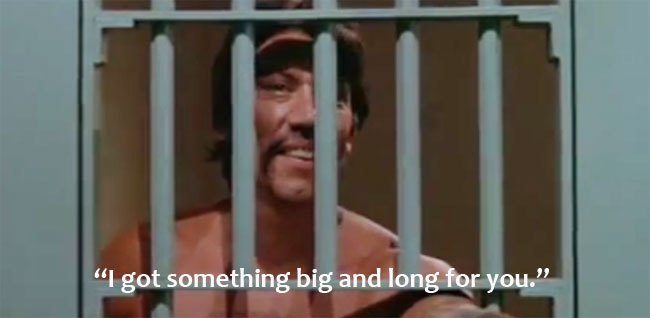
In Kinjite, Bronson plays Lt. Crowe, a tough LAPD vice cop who hates two groups of people: pedophiles (which is cool, who doesn’t hate them?) and the Japanese (which is not cool).  Not only does Crowe sodomize a pervert but he also forces a pimp to eat a gold watch and later, with the help of his partner, he holds another man over the edge of a balcony, just to have that man accidentally slip out of his shoes and plunge to his death.  Finally, Crowe tosses a convict into a prison cell, where another prisoner (played by Danny Trejo, in what may have been his film debut) announces that he’s “got something big and long for you.”  Crowe chuckles, “That’s justice” and then walks away.

Danny Trejo in Kinjite

Of the many strange films that Bronson made for Cannon Films, Kinjite may be the strangest.  The main plot involves Crowe searching for and rescuing the kidnapped daughter of a Japanese businessman (James Pax).  Before his daughter was kidnapped, the businessman groped Crowe’s fifteen year-old daughter on a city bus.  The entire movie seems to be building up to the moment that Crowe, who is portrayed as being overprotective of his daughter, discovers what the businessman did but that moment never comes.  There are numerous scenes of the businessman in Japan but they do not have anything to do with the rest of the plot.  Strangely, neither Crowe’s daughter nor his wife (played by Peggy Lipton) are ever menaced by the bad guys.  What type of Charles Bronson movie is this?

In Bronson’s defense, he was 71 year-old when he made this movie and, off screen, his wife Jill Ireland was battling the cancer that would eventually take her life.  Bronson can be excused for not appearing to be overly invested in Kinjite: Forbidden Subjects.  (Since Kinjite means Forbidden Subjects in Japanese, the actual title of this movie is Forbidden Subjects: Forbidden Subjects.)  No one appears to have made much of an effort on Kinjite, though Bronson’s stunt double gets a good work out.  Kinjite is full of scenes where Bronson throws a punch in close-up but his first in never actually shown connecting with anyone.  Most of the action scenes are clumsily filmed so that Crowe keeps his back to the camera.   All Kinjite needs is a supporting turn from Troy McClure and a cameo from McGarnagle and it would be perfect viewing for The Simpsons.

Kinjite would be the final film that Bronson made for Cannon Films.  It would also be the last Bronson film to be directed by J. Lee Thompson.  After Kinjite, Bronson appeared in two more feature films: Sean Penn’s The Indian Runner (which, if not for Penn’s pretentious direction, could have launched Bronson on a second career as a first-rate character actor) and a final Death Wish film.  Bronson returned to television, appearing in three made-for-TV movies before retiring in 1999.  Bronson died in 2003 but, as long as there are people who enjoy a good action movie, he will never be forgotten.

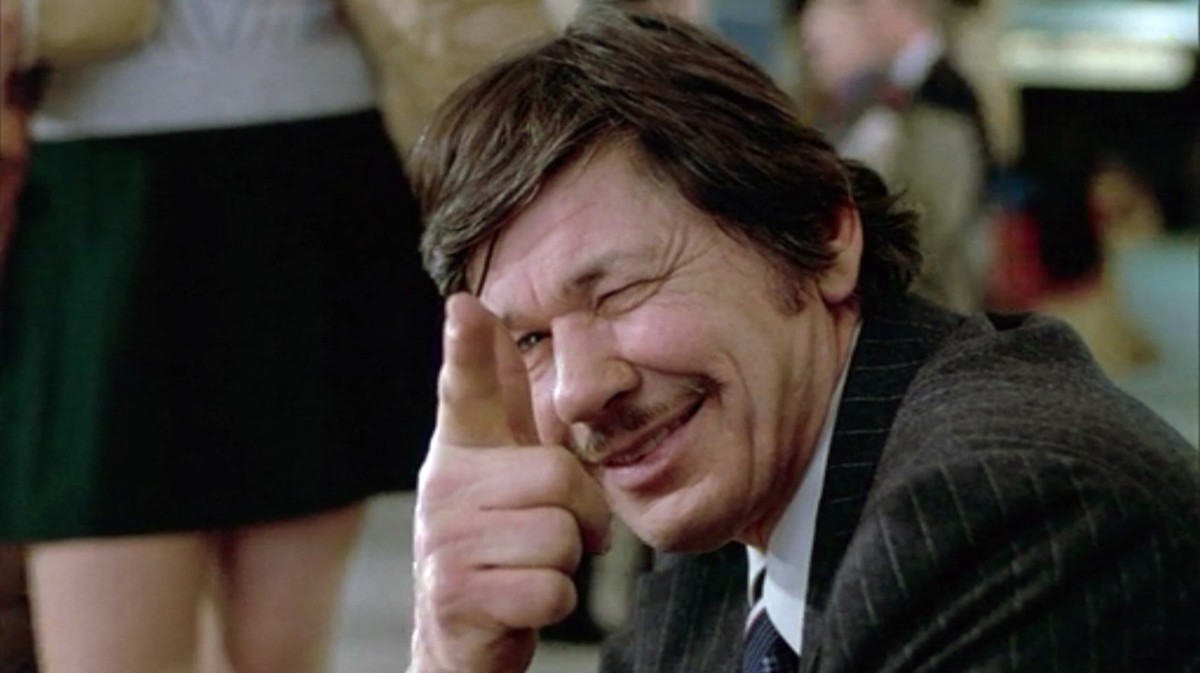
This scene is not from Kinjite but it’s still pretty fucking cool.