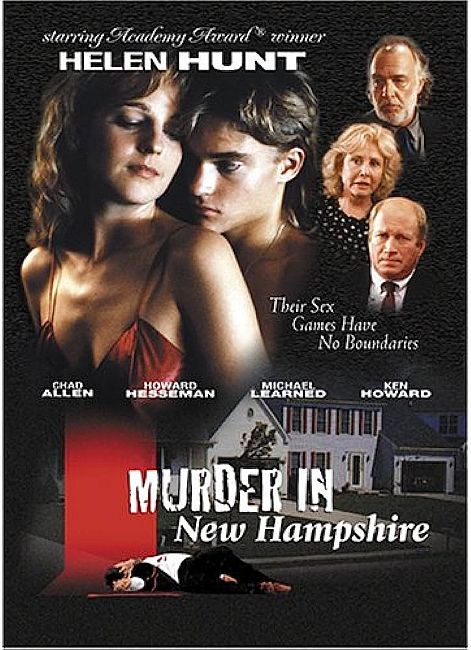
Welcome to Retro Television Reviews, a feature where we review some of our favorite and least favorite shows of the past! On Sundays, I will be reviewing the made-for-television movies that used to be a primetime mainstay. Today’s film is 1991’s Murder In New Hampshire: The Pamela Smart Story! It can be viewed on YouTube!
When Pamela Wojas (Helen Hunt) first became engaged to Gregg Smart (Hank Stratton), she thought that they would never get older or settle down to a conventional life. She thought that Gregg would always have long hair and that they would spend the rest of their lives following Van Halen around the country. But then Gregg got a job with a New Hampshire insurance company and he cut his hair. And then Pam failed in her attempts to get hired by the local news station and instead, she ended up accepting a job as the part-time media director at a local high school.
Pam spearheaded the school’s anti-drug campaign and ended up working closely with two students in particular, Billy Flynn (Chad Allen) and Cecelia Pierce (Riff Reagan). Billy and Pam bonded over their shared love of Van Halen and soon, they were having an affair. Was Pam just trying to relive her youth or was she already setting up Billy to murder her husband?
Based on the true story that also inspired Gus Van Sant’s To Die For, Murder In New Hampshire jumps back and forth through time. The film opens with Gregg being shot and killed by Billy and one of his friends. It then cuts to a courtroom, where a prosecutor (Howard Hesseman) tells the jury that Gregg was murdered on the orders of his own wife. A very conservatively and modestly-dressed Pam sits in the courtroom and provides quite a contrast to the far more wild and hedonistic Pam who we see in the film’s frequent flashbacks. While Gregg settles comfortably into life as a suburban insurance agent, Pam continually tries to hold onto her past. While Gregg wins awards for selling the most insurance, Pam tells Billy that Gregg beats her and that he’s dangerous.
It’s difficult to watch Murder In New Hampshire without comparing it To Die For. They both tell the same story and they even use the same flashback structure. But if To Die For presented Nicole Kidman as being a soulless killer who was driven by her obsession with being a star, Murder In New Hampshire suggests that Pam’s main motivation was that she just couldn’t handle the idea of settling down and living a conventional, suburban life. As well, To Die For presented Joaquin Phoenix’s gunman as being someone who was essentially incapable of thinking for himself. In Murder In New Hampshire, Billy is far more active character. Though he is undoubtedly manipulated by Pam, Billy is still portrayed as someone who made his own decision to get involved in Pam’s schemes. If To Die For is a stylized satire of the true crime genre, Murder In New Hampshire is the epitome of what was being satirized.
That said, Murder In New Hampshire is a good example of the true crime genre, largely due to Helen Hunt’s wonderful performance as Pam Smart. Hunt plays Pam as someone who has never grown up and who is so scared of being required to that she’ll even resort to murder to pull it off. While Murder In New Hampshire never quite escapes the shadow of To Die For, it’s still an effective film when taken on its own terms.
What’s an Insomnia File? You know how some times you just can’t get any sleep and, at about three in the morning, you’ll find yourself watching whatever you can find on cable? This feature is all about those insomnia-inspired discoveries!
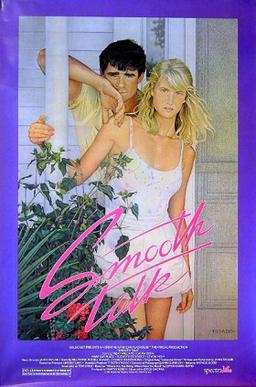
If you were having trouble getting to sleep around one in the morning last night, you could have turned over to This TV and watched Smooth Talk, a disturbingly creepy coming-of-age film from 1985.
Connie Wyatt (played by Laura Dern in one of her first film roles) is fifteen years old and ready to discover the word. It’s the summer and, for Connie and her friends, that means going to the mall, trying to capture the attention of the cute boys who go to their school, and lying to her parents about where she goes at night. (She tells them that she and her friends have been going to the same movie, night-after-night.) She likes it when the boys in the mall smile at her but not when the stranger honk their car horn at her whenever she walking at night. Connie thinks of herself as being an independent adult, even though she’s not sure what that means.
Connie does know that she doesn’t want to be like her mother (Mary Kay Place). Her mother, who claims that she was once a great beauty herself, complains that all Connie does is indulge in “trashy daydreams.” Her mother tells Connie to be careful about who she flirts with and constantly demands that Connie stay home and help to paint the house.
Connie also doesn’t want to be like her older sister, June (Elizabeth Berridge). June is obviously her mother’s favorite. June never sneaks out. June never rebels. Whenever Connie and her mother argue, June always take their mother’s side.
In fact, the only member of her family that Connie’s close with is her father (Levon Helm). Her father is always cheerful and always in a good mood. Somehow, the constant tension in the house never seems to get to him and he never seems to be worried about anything. He’s nice but he’s hardly an authority figure.
And then there’s an older man (Treat Wiliams). When we first see him, he’s sitting outside of a diner and casually watching all of the teenage girls as they walk by. (We all know the type.) When he sees Connie and her friends, he looks over at Connie and tells her, “I’m watching you.” Later, when Connie is alone at her house, the man pulls up in front of her house and starts to talk to her.
His name, he explains, is Arnold Friend. “A. Friend,” he puts it. That’s what he wants to be to her. When she asks how old he is, he says that he’s 18, though he’s clearly closer to 30. He’s handsome and he’s charming but there’s something off about him. He shows Connie his car. “Arnold Friend” is written on the side. “33, 19, 17,” is written on the back. Written next to a dent: “A woman driver did this.” Sitting in the car is a friend of Arnold’s, a man who hides his face behind a portable radio.
“He’s strange,” Arnold explains with a sly smile, before suggesting that Connie get in the car with them…
Smooth Talk is based on a short story by Joyce Carol Oates and, oh my God, is it ever creepy! The first half of the movie plays out like a typical coming-of-age teen film but then Arnold shows up in that car and the film turns into a nightmare. I spent almost the entire movie cringing, mostly because I once was Connie Wyatt, the only real difference being that I was even younger when I decided that I understood how the world worked better than my parents and I started rebelling. As I watched the movie, I found myself wondering what I would have done if Arnold Friend had pulled up in front of my house. Would I have gotten in the car or what I would have run back into the house, locked the door, and called the police? I’d like to think I would have done the smart thing but … no. Doing the smart thing would have meant admitting that the adults were right and there were situations that I couldn’t control or even really understand.
Laura Dern was 18 years old when she played 15 year-old Connie and she gave an amazing and naturalistic performance. When Treat Williams first appeared as Arnold, I thought that he was overacting but, as the film progressed, I came to see that he was actually perfectly cast and giving exactly the type of performance that the movie’s story needed. Arnold Friend, who speaks in outdated slang and always seems to be trying just a little bit too hard, has to be a slightly ridiculous figure because otherwise, no one would drop their guard enough to get into his car. As I watched the movie, I realized that it was a mistake to think of Arnold as being a human being. Instead, he’s a nightmare come to life.
Smooth Talk was a deeply unsettling film about growing up in an increasingly dangerous world. It’s right up there with Out of The Blue, Christiane F, and Blue Velvet among nightmarish coming-of-age stories.
Ordinary Miracles (2005) – This movie begins with a judge hearing a case of two foster parents who want to give up their foster daughter back into the system because she is too much for them. What they tell the judge she has done is pretty minor and if they are foster parents then they should have been able to handle it. Anyways, the judge grants their wish, but unfortunately is stuck because she has no where else to put her but into juvenile prison.
With that over with, some blonde shows up to plead her case as the judge is leaving for a vacation of sorts. This lady was obviously hired because of her angelic appearance, but she’s just plain annoying. I say this because she harasses the judge about helping the girl. She says she cares deeply about what happens to her. She didn’t care enough to show up to the case under the guise that her department is too busy. Fine, but if you care so much about her, then instead of bothering the judge, do something about it yourself! Instead, she guilts the judge into taking the girl out of holding to try and foster the girl herself.
The rest is pretty typical. There’s the boyfriend who’s the bad influence. The judge tries to do research into her past to find her missing parents. And the girl goes through some adjustment issues. There’s also a minor subplot with the judge’s parents as well. Nothing particularly interesting or great. It’s just decent.
The only thing that bothered me, other than the blonde, was the supposed visit from the ghost of the daughter’s dead mother. It’s almost like they were planning to do more with it, but didn’t. She has a nightmare near the beginning of the film that we are told was actually her talking to someone. Later we actually see the ghost of her mother talk to her. I don’t really know what the point of that was. It doesn’t add anything and feels out of place.
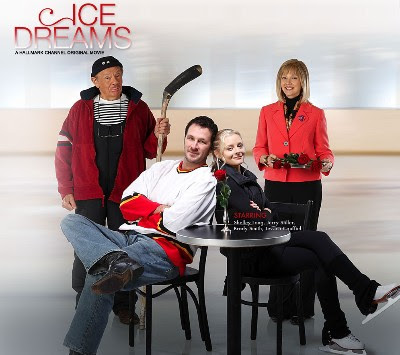
Ice Dreams (2010) – There are quite a few characters here so I’m going to try and give you the gist. You have an ice rink that isn’t doing well financially and looks run down. It’s run by two guys. One who is there for comic relief and a couple of speeches. The other is the male romantic interest who really runs the place. Then you have a girl who used to skate and is allowed to skate at the rink after hours. She is having financial difficulties. Another lady is trying to help her daughter get into skating. Then you have the mother of the girl who skates at night trying to come back into her life.
The romantic interest helps to setup the after hours skater as a coach for the young girl. He and her become an item. The skating rink is brought up to snuff. The mother comes back into the life of her daughter. Everything raps up nicely.
This one is definitely a straight average Hallmark movie. The only thing is that it is cluttered with a few too many characters. However, that kind of helps to give a reason for the film to keep going without feeling padded out.
This one’s okay.
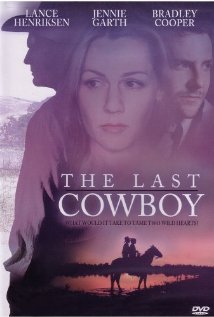
The Last Cowboy (2003) – This is one of those movies where there really isn’t anything to talk about except it’s problems and little noteworthy things. The plot is that the patriarch of the family has died and the inheritance is a bit of a mess for the family. Basically it’s all an excuse just to have Jennie Garth and Lance Henrikson bash heads till they find a way to keep the Texas ranch and be family again.
Okay, now the other stuff. First, this actually has Bradley Cooper in it. Well before he did The Hangover. He is barely in the movie, but you can tell he had talent even here. And yes, he looks even more boyish.
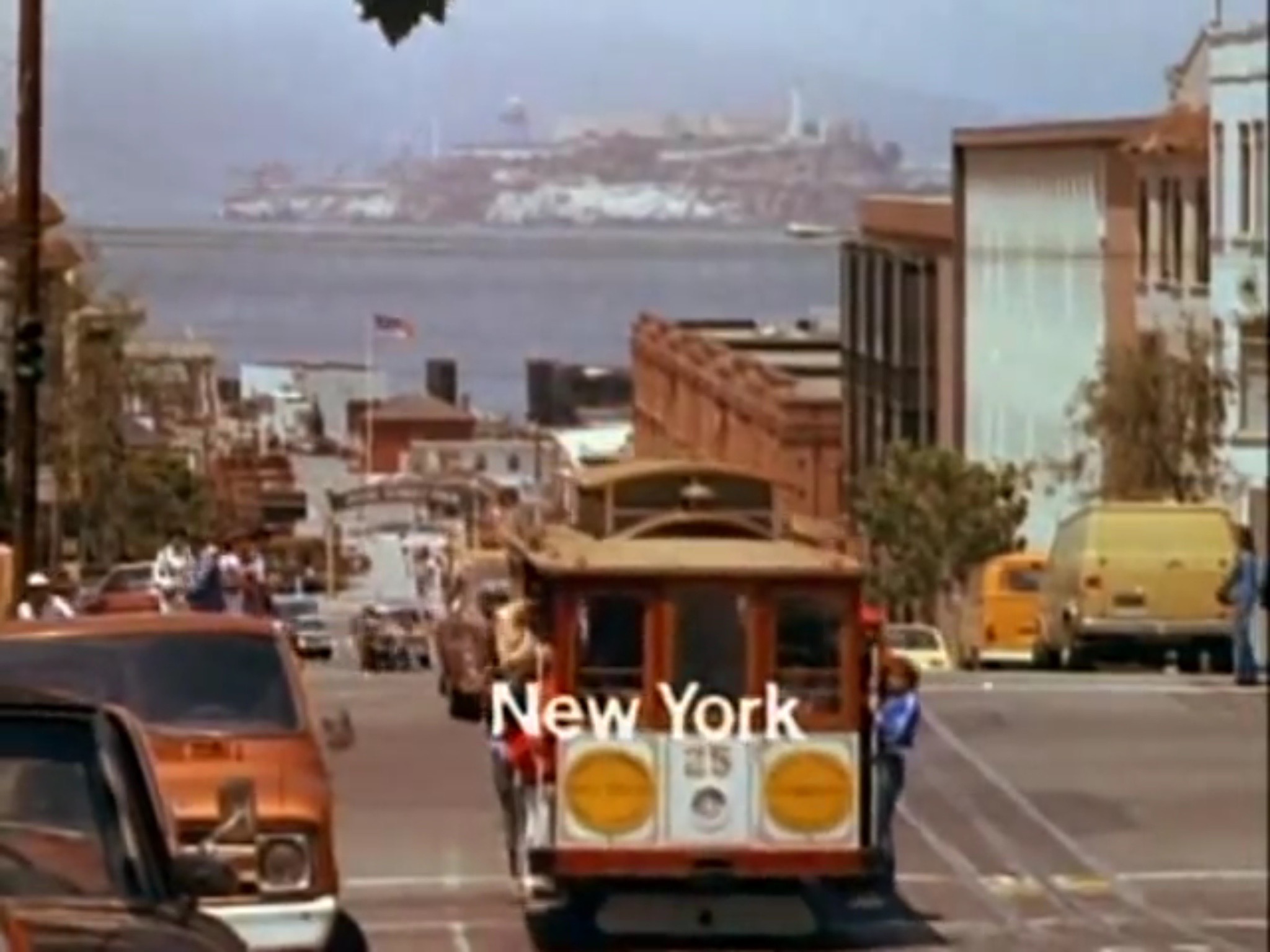
Second, the movie takes place in Texas. However, it was clearly filmed in California. Maybe if you don’t know the open spaces of California that well then it might not be as obvious, but I am familiar with the big parks in the Bay Area. Every time they try to say they are in Texas it’s like this shot from Attack Of The Killer Tomatoes! (1978).
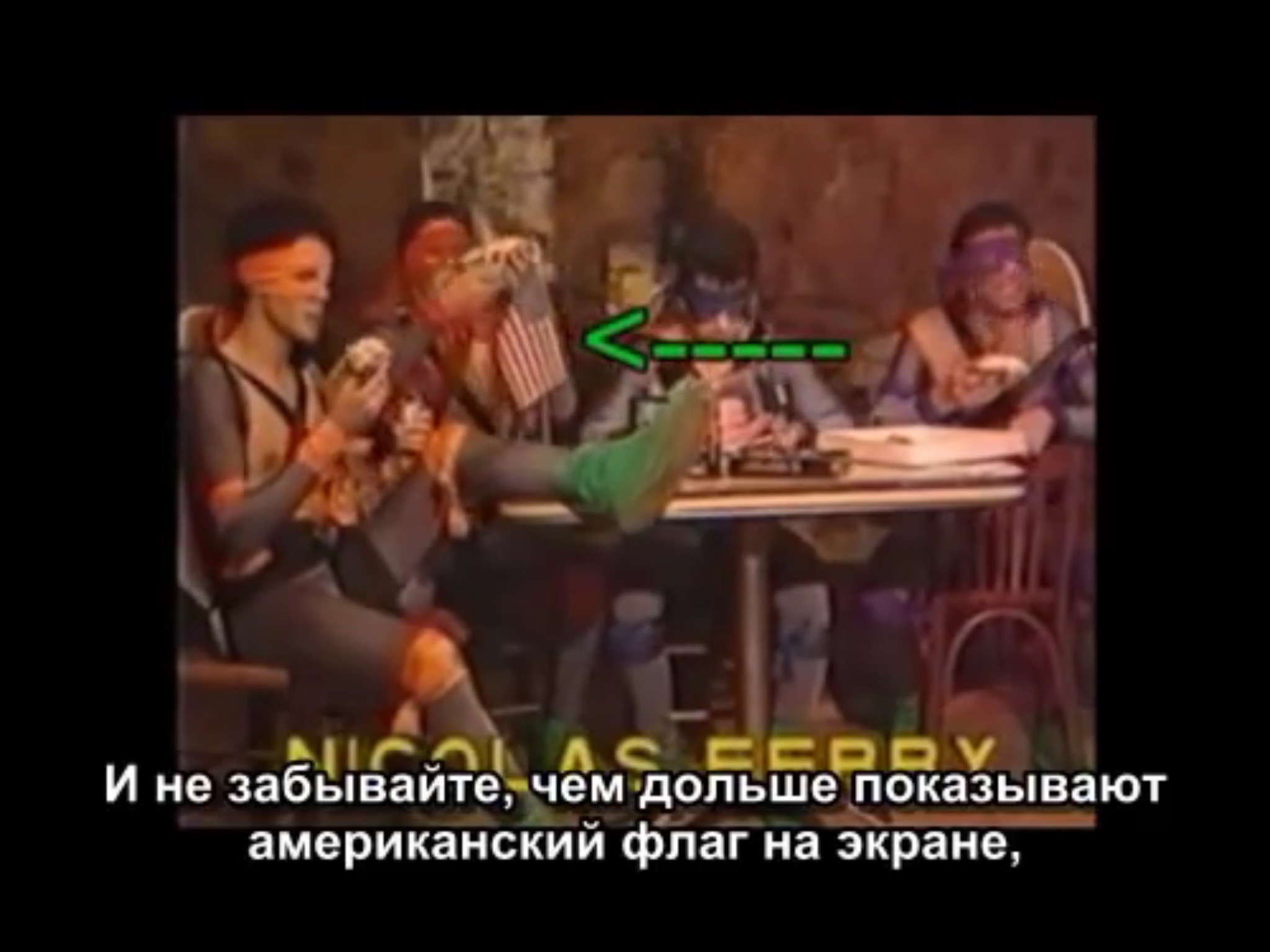
There’s even a scene where we see a Texas license plate and it’s like when a foreign film puts an American flag in the scene so we totally believe they are Americans. Like this shot from the Argentinian porno spoof of the Teenage Mutant Ninja Turtles.
There is a great scene near the end of the movie when the barn burns. Lance Henrikson goes in and comes out with his arm on fire. He just walks over to the two other people nonchalantly. In fact, he begins to just stand there like he doesn’t even care before one of the other actors puts it out with his hat. That’s badass!
The only other thing is a weird censorship issue. I remember when they muted the word “butt” in Mystery Woman: Game Time (2005). In this they mute two uses of the word “ass” and one use of the word “jackass”. It’s in the movie because you can hear them say the words around it and mouth “ass” and “jackass”, but it falls silent on those words. Makes me wonder if maybe Hallmark has become more conservative then they were when they first switched from an explicitly religious station to what they are now. However, later in the film someone says the word “jackass” and it isn’t censored. Figure that one out cause I don’t know what happened.
This one is okay if you can keep yourself from saying, “It’s fucking California!,” every time they show “Texas”. I know I did.
Uncorked (2009) – I usually don’t mention the directors of these Hallmark movies, but this one was done by David S. Cass Sr. who has done many of the ones I have reviewed so far. Notably, he did Class (2010) and Keeping Up With The Randalls (2011). Both of those movies had miscast leads. This one has one obvious miscast that almost ruins the movie. There’s something else in addition to it that truly ruins it, but let me summarize first.
This is yet another movie about how a woman with a successful job in the city who isn’t happy and avoids an unhappy relationship to end up in the country with another man. This time it’s wine country. The guy has a kid so that means he was once married. I really wonder what screenwriters would do if they didn’t have cancer and drunk drivers to kill off spouses and parents in movies. In this case, it’s cancer. She is in town for a convention and ends up spending some time with him since he is a bit of a local celebrity. She loses out on one business opportunity, gets another, but leaves it to go back to him and put her business skills to use to help his winery.
Sounds fine when I summarize it like that, but it has two big problems. The first is the casting of the male lead. Just take a look at him.
This guy should be playing a serial killer like a murderous lumberjack, not a romantic lead. At least not with that facial hair and his sizable build. In fact, he made me think of Eric Freeman in the now infamous Garbage Day scene from Silent Night, Deadly Night Part 2 (1987).
The second problem comes when you reach these two lines:
Girl: “I’ve only know you for four days.”
Boy: “It seems like so much more.”
No, no it doesn’t. It seems like you spent even less than four days together. I kept pausing it to look at the running time because I was wondering how this film was going to make us believe they should be together with so little time spent together. It was a real problem for me.
Also, we never get as convinced that she should be unhappy with where she is in life as we do in other Hallmark movies. Usually it’s kind of obvious, but here you wonder why she couldn’t have made that part of her life work rather than making a sea change.


 Through the Shattered Lens