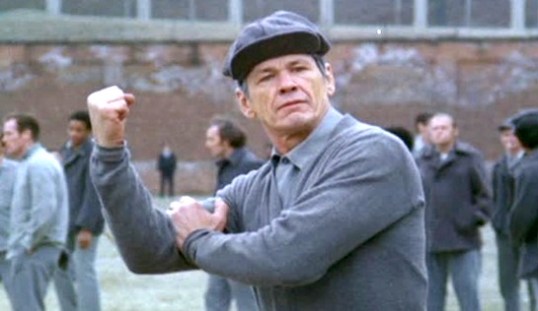
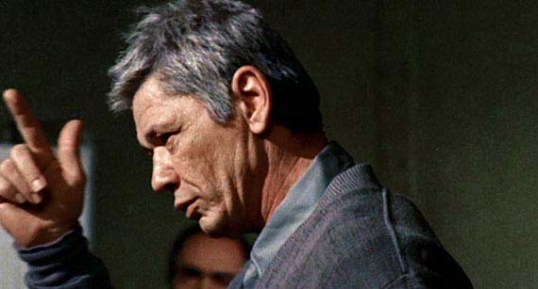
That is Charles Bronson, playing real-life mob informant Joe Valachi and making a gesture that expresses the way many people feel about the world right now. Valachi, in both the film and real life, was a bit player in the Cosa Nostra, a driver and an occasional hitman who was lucky enough to marry the daughter (played by Bronson’s real-life wife, Jill Ireland) of one of the bosses. In prison for smuggling heroin, Valachi runs into one of those bosses, Vito Genovese (Lino Ventura). Genovese, convinced that Valachi has broken the code of omerta, gives Valachi the kiss of death. Valachi kisses him right back and then becomes a rat.
Valachi’s 1963 testimony to the U.S. Senate was the public’s first glimpse into life in the Mafia. Many of the cliches that have since appeared in every mob movie or television show were the result of Valachi’s testimony and Peter Maas’s subsequent book, The Valachi Papers. (In the “Test Dream” episode of The Sopranos, Tony can be seen holding a copy of The Valachi Papers.)
Over the years, doubts have been raised about both the validity of Valachi’s testimony and his claim that he only turned rat because Genovese put a contract on his life. The film version of The Valachi Papers takes Valachi’s claims at face value, telling Valachi’s story in a series of flashbacks.
The Valachi Papers is often compared to another mob movie that came out in 1972, The Godfather, though there’s really not much of a comparison to be made. Whereas The Godfather was a family saga, The Valachi Papers is much more concerned with the day-to-day operations of the Mafia. It never comes close to matching The Godfather‘s epic feel and the cheap production values don’t help. (Keep an eye out for the twin towers of the World Trade Center, anachronistically towering over depression-era New York City.)
Storywise, The Valachi Papers actually has more in common with Goodfellas than with The Godfather. Like Henry Hill, Joe Valachi is not a major player. He’s just a working man whose employer happens to be the Mafia. Stylistically, of course, The Valachi Papers has nothing in common with Goodfellas. If not for the violence and some the language, it would be easy to mistake The Valachi Papers for an old made-for-TV movie.
The best thing about The Valachi Papers is Charles Bronson as Joe Valachi. When The Valachi Papers was made, Bronson was a huge draw in Europe but was still largely unknown in the United States. It was not until Death Wish came out, two years later, that Bronson became a star. He does a good job as Joe Valachi. In a way, it’s the perfect role for Bronson, who was a genuine tough guy who, like Valachi, spent decades working in the trenches before eventually becoming a household name.
I don’t think Charles Bronson ever would have turned informant, though.
In this episode of The Twilight Zone, bitter millionaire Paul (Joseph Wiseman, who also played the title character in Dr. No around the same time that this episode as shot) offers three people safety from a nuclear war on one condition. They must apologize to him for insults that are both real and imagined.
This episode originally aired on January 12th, 1962.
Hi there! As you may already know, in the days leading up to the release of Skyfall, we’re going to be looking at the previous films in the James Bond franchise. Today, we take a quick look at the first of the “official” James Bond films — 1962’s Dr. No.
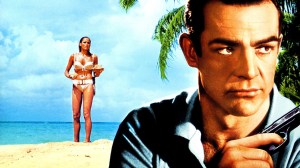
Dr. No is a film of many firsts. It was the first film to be adapted from one of Ian Fleming’s original novels. (Though it was not the first adaptation, that honor going to the 1954 made-for-tv version of Casino Royale). It was, of course, the first Bond film to be produced by the legendary team of Harry Saltzman and Albert Broccoli. It featured the first true Bond girl, with Ursula Andress playing Honey Rider and spending the entire film in an iconic white bikini. Dr. No featured the first appearance of both M and Miss Moneypenny (played, respectively, by Bernard Lee and Lois Maxwell). That iconic theme music made its first appearance in Dr. No as well. However, most importantly, Dr. No featured the first appearance by Sean Connery in the role of James Bond. Even more than Andress’ white bikini, Connery is the reason why Dr. No proved to be the rather unlikely launching pad for one of the most succesful film franchises in cinematic history.
Dr. No, in fact, is a film that contains so many historic firsts that, often, it seems like reviewers tend to neglect the film itself and, instead, chose to concentrate on the film’s legacy. And indeed, 50 years after it was first released, it’s difficult to watch Dr. No without viewing everything about it in relation to what the James Bond franchise would eventually become. Instead of evaluating the film on its own individual merits, the tendency is to watch Dr. No and to spend a lot of time thinking things like: That’s the first time the world ever heard Sean Connery say, “Bond, James Bond.” We tend to forget that, when Connery and director Terrence Young actually made Dr. No, they had no way of knowing that 22 sequels would follow. They didn’t know that they were making film history.
Dr. No begins with a shooting in Jamaica. John Strangeways, the British Intelligence station chief, is ambushed and gunned down by three assassins. Shortly afterward, in a surprisingly brutal scene, his secretary is also assassinated. In response, James Bond is summoned to the offices of MI6. When he receives the summons, Bond is busy gambling and seducing Sylvia Trench (Eunice Grayson). Sylvia, incidentally, was originally meant to be a character who would pop up in all of the subsequent Bond films. Basically, she would have functioned as Bond’s girlfriend, the loyal woman who waited at home while Bond went to exotic countries and slept with every other woman in the world. Perhaps wisely, this idea was abandoned after just two movies but still, Bond’s initial meeting with Sylvia (and the audience) is such an iconic moment that words simply won’t do it justice. Here it is, for your viewing pleasure:
This scene has to rank as one of the best intro scenes in film history. In just a few brief minutes, this scene tells us everything that we need to know about both James Bond and, even more importantly, Sean Connery’s interpretation of the character. In this scene, Connery’s Bond is the epitome of narcissistic charm, giving just a hint of the determined cruelty lurking right underneath the surface. It’s especially interesting to compare Connery’s Bond here to Daniel Craig’s interpretation of the character. Whereas Craig’s Bond often seems to be on the verge of having a nervous breakdown, Connery is established in his first scene as being a cool and calm professional. Craig may be the ideal Bond for our troubled reality but Connery will always be the Bond of our dreams and fantasies.
Bond is sent to Jamaica, where he teams up with CIA agent Felix Leiter (played by Jack Lord). Again, it’s interesting to compare this version of Felix Leiter with Jeffrey Wright’s more-recent interpretation of Felix. Whereas Jack Lord’s Felix Leiter is a cool, calm professional (a bit like an asexual version of Connery’s Bond, to be honest), Jeffrey Wright’s Felix often seems to be mired in self-loathing. Both interpretations are perfectly legitimate (and Felix is usually such a superfluous character that just about any interpretation will do). Instead, they’re interesting largely because of the way that each one of them epitomizes the decade in which each film was made.
With the help of Leiter, Bond quickly figures out that Strangeways’ death is linked to the mysterious, Dr. No (Joseph Wiseman), who has his own private island near Jamaica. The natives claim that a dragon guards the island but Bond, never one to let something like that stop him (especially when it’s always his allies — like the unfortunate Quarrel — who get killed in these films, as opposed to him) sneaks onto the island. It’s here that he first spies Honey Rider (Ursula Andress) walking along the beach. Again, Honey’s introduction is such an iconic scene that, rather than try to describe it, it’s better just to show it:
For all the talk of how the Bond girls were often sexist stereotypes, I would have loved to have been an old school Bond girl. Seriously, they got to be all sexy, they got to make love to James Bond, and occasionally, they got to help save the world. Seriously, what fun!
I’ve spent so much time talking about James Bond and Honey Rider that I haven’t left much room for Dr. No. But that’s okay because, to be honest, Dr. No is not really that interesting of a villain. As opposed to future Bond villains, Dr. No is something of a bland character. Joseph Wiseman plays him with a lot of menace and he has a few over the top moments but it doesn’t matter because there’s really nothing to distinguish Dr. No from any other megalomaniac that’s ever shown up in a low budget spy movie. He’s a perfectly acceptable villain but he’s not an extremely memorable one. (Perhaps if Christopher Lee had accepted the role when it was offered to him, Dr. No would have been a bit more of an effective character.) Rest assured that Dr. No does have an impressive secret headquarters and, that once he does capture Bond and Honey, he takes his time to explain all of his evil plans as opposed to doing something sensible like killing them.
So, how does Dr. No hold up 50 years after first being released?
Surprisingly well.
Despite having a weak villain, Dr. No is still a lot of fun. As opposed to future Bond films, Dr. No was a low-budget affair and, at it’s best, it comes across as an appealing B-movie. Ultimately, the film is best known for introducing audiences to Sean Connery in the role of James Bond and perhaps that is for the best because Connery truly is the best thing in Dr. No. Five decades later, you can still see why the world was so intrigued with both the actor and the character.
Tomorrow, we’ll take a look at one of my personal favorite films of all time — From Russia With Love!