Stephen King turned 70 last month, and the Master of Horror’s grip on the American psyche is stronger than ever, thanks to the unprecedented horror hit IT!, now playing at a theater near you. King’s macabre novels have been adapted for the screen since 1976’s CARRIE with varying degrees of success; some have been unabashed genre classics, others complete bombs, most lie somewhere in the middle.
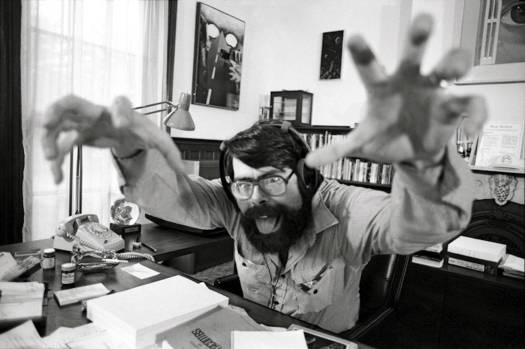
Top: Stephen King 1983 Bottom: John Carpenter 1983
Director John Carpenter had a string of successes beginning with 1978’s seminal slasher film HALLOWEEN, but his 1982 remake of THE THING, now considered a masterpiece of the genre, was a box office disappointment. Carpenter took on King’s novel CHRISTINE as a work-for-hire project. I recently watched it for the first time, and think not only is it one of the best adaptations of King’s work to hit the screen, it’s one of Carpenter’s best horror…
What’s an Insomnia File? You know how some times you just can’t get any sleep and, at about three in the morning, you’ll find yourself watching whatever you can find on cable? This feature is all about those insomnia-inspired discoveries!
Last night, if you were suffering from insomnia around 2:30 in the morning, you could have turned over to Flix and watched Stag, a dreary film from 1997!
And I know what you’re saying. “Really, Lisa? I could have watched a dreary film! WHY DIDN’T SOMEBODY TELL ME!?” Well, sorry. Your loss. Maybe next time you won’t be so quick to resist the call of insomnia…
Anyway, Stag eventually turns out to be pretty bad but it actually has a pretty good opening. A bunch of rich guys get together in a big house and throw a bachelor party. Whenever one of them first appears on screen, they get a freeze frame that tells us their name and gives us a few biographical facts.
For instance, one coke-snorting character is introduced as “Jon DiCapri: Soap opera star, spokesman for “Stars Against Drugs.” A drunk guy begging for money is identified as “Timan Bernard: Accountant, Author of ‘Ethics in Business.'” The pensive fellow standing by the window and a smoking a cigarette is “Daniel Kane: Gulf war veteran, post traumatic stress disorder,” while the guy running around in a wig and lingerie is “Ed Labenski: Contractor, church treasurer.” My personal favorite of the introductions belonged to the guy with the neck tattoo and the terrible teeth. We’re told that he’s “Pete Weber: Drug dealer, extortionist. Self employed.”
Of course, Pete Weber is also Andrew McCarthy, playing a character who is far removed from the world of Pretty In Pink and St. Elmo’s Fire. And Daniel Kane is actually Kevin Dillon, taking part in the type of misogynistic hi-jinks that would later be celebrated in Entourage. Jon DiCapri is actually William McNamara, who will always be remembered for his memorable death scene in Dario Argento’s Opera. As for Timan Bernard, he’s played by John Henson, who was the host of that terrible Wipeout show that was on the air forever despite the fact that nobody in the world would admit to watching it.
And they’re not the only ones at this bachelor party! The bachelor himself is played by John Stockwell, the director of movies like Cheaters, Crazy/Beautiful and In The Blood. His best friend is played by Mario Van Peebles. Even distinguished character actor Ben Gazzarra is at this bachelor party!
As I said, the film starts out well enough, with the men all acting like idiots and pretty much confirming everything that I’ve always suspected about bachelor parties. But then the strippers show up and there’s a highly improbable accident and soon there are two dead bodies bleeding out on the linoleum floor of John Stockwell’s house. The rest of the movie is pretty much the men yelling at each other and arguing about what they should do. Some fear going to jail. Some want to frame someone else. Some want to cover up the accident. A few suggest calling the police but then Andrew McCarthy rips the landline phone out of the wall and, since this movie was made in the 90s, that is literally all he has to do to keep everyone from contacting the outside world.
Despite some decent performances, the film turned out to be pretty tedious. That said, as I watched it, I found myself wondering how my girlfriends and I would have handled a similar situation. What if we were throwing a bachelorette party and suddenly Magic Mike ended up lying in the middle of the floor with a broken neck? To be honest, I get the feeling we’d probably handle it in roughly the same way as the characters in Stag. We would just be a lot more passive aggressive about it.
“Oh my God, is that guy dead!?”
“I don’t know but that’s what I think Heather said. But it’s all Amy’s fault and … Bitch, everyone says it’s your fault so unless everyone in the entire world is wrong … whatever, Amy.”
“Oh my God, what are we going to do with him?”
“I don’t know but Vanessa said that maybe we should say that he like never showed up at the party and then she said that Jen said that … oh my God, are those new earrings!?”
“Yeah, do you like them!?”
“They’re so pretty! Anyway, Jen said that maybe you should like go bury him somewhere…”
“Oh my God, Jen said I should go bury him!?”
“Well, I didn’t hear for sure but Tina said that she heard Vanessa say that Jen said that you should go bury him…”
“That bitch! I am so going to kick her ass! Oh my God!”
But anyway, the body would eventually get buried. Just not by me.
Haywire was an action film that came out in 2011. It briefly got a lot of attention because it starred MMA fighter Gina Carano in her feature film debut and it was directed by Steven Soderbergh. I have to admit that I didn’t care much for Haywire. Some of that is because Gina Carano herself didn’t seem to be a very good actress but my main issue with the film was with Steven Soderbergh. Don’t get me wrong — I know that Soderbergh can be a genius. However, he’s also a remarkably pretentious filmmaker. Sometimes that pretension works, like with The Girlfriend Experience. But, in the case of Haywire, all the pretension served to do was to make a thin story even more annoying.
John Stockwell, on the other hand, is a director who is the very opposite of pretentious. Whereas Soderbergh often makes genre films that try too hard to be art, Stockwell makes genre films that are so unapologetic about being genre that they often become art despite themselves. Stockwell may never be as acclaimed as Soderbergh but, on the whole, he’s a much more consistent filmmaker.
Take In The Blood for instance. In the Blood came out earlier this year, got thoroughly mediocre reviews, and disappeared from theaters pretty quickly. When I watched it last night, I had very low expectations.
But you know what?
In the Blood isn’t bad.
In fact, it’s a perfectly entertaining and, ultimately, rather empowering film.
In In The Blood, Gina Carano plays Ava. Ava, we quickly learn, has led a difficult life. Raised in extreme poverty by a father who taught her early how to fight and how to defend herself, Ava is a former drug addict. When she goes to rehab, she meets and falls in love with fellow addict Derek (Cam Gigandet). Once they’re both clean, Ava and Derek marry despite the concerns of Derek’s wealthy father (Treat Williams).
For their honeymoon, Derek and Ava go to the type of Caribbean island where bad things always happen in movies like In The Blood. They meet Manny (Ismael Cruz Cordova), who agrees to be their guide on the island. One night, Manny takes them out to a club where Ava ends up getting into a huge fight with literally everyone on the dance floor, including a local gangster played by Danny Trejo. The next morning, Manny takes them zip lining but Derek ends up plunging from the zip line and crashing down to the ground below. He’s rushed to the hospital where he promptly vanishes.
Despite being ordered to return to America by police chief Luis Guzman, Ava is determined to figure out what has happened to her husband and she’s willing to beat up the entire island to do it…
Obviously inspired (much like almost every other low-budget action film released over the past few years) by Taken, In The Blood is a familiar but enjoyable burst of pulp fiction. As opposed to Soderbergh’s approach to Haywire, Stockwell doesn’t worry about trying to disguise the genre roots of In The Blood. Instead, he simply tells the story and he tells it well. In The Blood is a film that’s full of beautiful island scenery, villainous character actors, and enjoyable melodramatic dialogue. The pace never falters and the action is exciting. In a few years, the club fight scene will be remembered as a classic of action cinema.
And best of all, Gina Carano kicks ass! In The Blood gives her a chance to show what she can actually do when she has a director who is willing to get out of her way. As opposed to Haywire, where she often seemed to get lost amongst all of Soderbergh’s showy techniques, Gina Carano gives a confident and determined performance in In The Blood. After having to sit through countless action films where every female character is either a victim or a pawn, there is something so wonderful about seeing a movie where a woman gets to do something more than whimper and beg. Regardless of how predictable the film’s plot may be, the fact that it’s a woman — as opposed to a man — who is getting to kick ass (and look good while doing it!) serves to make In The Blood something of a minor masterpiece of the pulp imagination.
If nothing else, In The Blood shows that sometimes it’s best to keep things simple.
I don’t know if I can describe how much my girlfriends and I loved Crazy/Beautiful when it first came out in 2001. We saw it in the theaters, we rewatched it when it came on cable, and after I bought it on DVD, we watched it at my house. We loved the movie because we all dreamed of having a sensitive, hot boyfriend like Carlos Nunez (played by Jay Hernandez), who would love us no matter how obnoxious or bratty we may have been. Even if we sometimes got annoyed with her, we still all related to out-of-control Nicole (Kirsten Dunst), who everyone in the world had given up on but who ultimately just wanted her father to pay as much attention to her as he did to his new wife and his new baby. We liked the film because we wanted to be both crazy and beautiful.
And, of course, there was all the sex, all of it filmed in beautiful soft-focus with the camera always suggesting that it was showing more than it actually was. Crazy/Beautiful was one of those films that made you feel grown up while still being very careful not to lose its PG-13 rating.
Yes, back in the day, I loved Crazy/Beautiful.
And you know what?
It may just be the nostalgia talking but I still love it. I recently rewatched Crazy/Beautiful and, despite the fact that I was now watching as a “critic” as opposed to a 15 year-old with issues, I quickly fell under the film’s spell. There’s just something about Crazy/Beautiful that I simply cannot resist.
It’s a beautiful film. Director John Stockwell has made a career out of making movies about pretty people hanging out on pretty beaches and Crazy/Beautiful has a lot of both. When Carlos, a responsible high school senior who lives in East Los Angeles and who is hoping to attend the U.S. Navy Academy, first meets Nicole, she’s doing community service by picking up trash on the beach. What Carlos doesn’t find out until later is that Nicole is the daughter of U.S. Rep. Tom Oakley (played, somewhat inevitably, by Bruce Davison). Nicole is haunted by her mother’s death and feels that her well-meaning but ineffectual father has abandoned her. At first, her relationship with Carlos seems to be yet another part of her rebellion but soon, both she and Carlos are madly in love.
Can Carlos save Nicole from herself? Can Nicole love Carlos without leading him down the path of self-destruction? Will Nicole and her father ever reconnect? Will … oh, who cares? You already know the answers. Crazy/Beautiful is less about the story and more about how the story is told. Stockwell keeps the story moving along and fills the screen with colorful and romantic images that make Crazy/Beautiful into the perfect teenage daydream. He also makes perfect use of the undeniable chemistry between Jay Hernandez and Kirsten Dunst. Both of the stars give such good performances that you really do come to care about the characters that they are playing and hope that things work out for them. Kirsten Dunst, in particular, gives a brave performance and doesn’t shy away from playing up Nicole’s abrasiveness. It takes courage to play a character who can be unlikable. It takes talent to make that unlikable character sympathetic and, fortunately, Kirsten Dunst shows a lot of both in Crazy/Beautiful.
Originally, my 32nd entry in my Back To School series was going to be Made In Britain, a film about a 16 year-old Neo-Nazi played by Tim Roth. And, while I still suggest that you track down and watch Made In Britain (mostly for Roth’s amazing performance in the lead), I have to admit that, as I rewatched it, I found myself really struggling to find a way to fit it into the Back to School theme. Made in Britain is a good film about a juvenile delinquent but it just didn’t seem like it was right for this series. Maybe I’ll revisit it when I do my long-threatened series of “Europe Is As Messed Up As America” series of film reviews.
Instead, I decided to close out the 1983 portion of this series by taking a look at Losin’ It. Along with Risky Business and All The Right Moves, Losin’ It is one of the three films released in 1983 that starred Tom Cruise as a high school senior who is obsessed with losing his virginity. Much as in Risky Business, Cruise’s initial plan is to hire a prostitute. And much like in All The Right Moves …. well, actually Losin’ It doesn’t have much in common with All The Right Moves beyond the presence of Cruise. For that matter, it doesn’t really have much in common with Risky Business either. Whereas All The Right Moves was a coming-of-age drama and Risky Business was a satire on capitalism, Losin’ It is pretty much a straight comedy.
And an amazingly generic one at that!
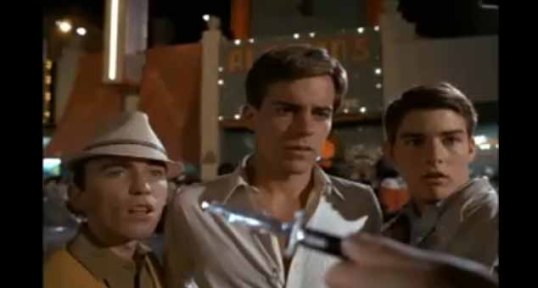
Set in 1965 and featuring a soundtrack that appears to exist solely to remind you that the film is set in 1965, Losin’ It tells the story of four teenage boys who go down to Tijuana, hoping to get laid. There’s Woody (Tom Cruise), who is the nice guy who smiles all the time. There’s Spider (played by future director John Stockwell), who we’re told doesn’t have to pay for it but wants to go down to Tijuana so he can see a “donkey show.” (If you don’t know what a donkey show is, I’m sure it can be looked up on Wikipedia.) And then there’s Dave (Jackie Earle Haley), who is short, loud-mouthed, and idolizes Frank Sinatra to the extent that he even wears a Sinatra-style fedora. Tagging along is Dave’s younger brother Wendell (John P. Navin, Jr.), who is too young to get into any Mexican brothels but is hoping to buy some fireworks that he can then sell at school.
Anyway, they may think that they’re just going to Mexico but it soon turns out that they’re on a collision course with wackiness! Dave and Wendell end up being held hostage in an auto junkyard. Spider gets in a fight with a bunch of Marines and ends up in a Mexican jail. And Woody — well, listen, we all know that there’s no way fresh-faced, All-American Tom Cruise is going to lose his virginity in a dirty old brothel! Instead, he ends up pursuing a tentative romance with Kathy (Shelley Long), a newlywed who has come down to Tijuana to get a quickie divorce.
(Do they still give out quickie divorces in Tijuana or is that just something that happens in the movies? I’m just asking for future reference…)
Anyway, of the Tom Cruise Must Get Laid Trilogy, Losin’ It is easily the most generic and forgettable but that doesn’t necessarily mean that it’s a terrible movie. Curtis Hanson keeps the action moving at a steady pace (and, if that sounds like faint praise, just try sitting through a film with an unsteady pace) and the cast is likable. Tom Cruise is the one who gets all of the attention on the back of the DVD and he’s likable enough but really, if I had been alive and a film critic in 1983, I probably would have picked the handsome and charismatic John Stockwell as the one most likely to become a star.
Instead, 31 years later, Tom Cruise is the star (albeit a fading one) and John Stockwell is the one directing movies about life on the beach.
It’s a strange world.
Jackie Earle Haley, John Stockwell, and Tom Cruise
For today’s entry in the 44 Days of Paranoia, I want to take a quick look at a very good movie from the year 2000 that not many seem to know about, Cheaters.
During my senior year of high school, I always wore a short skirt on any day that I had a test in my algebra class.
Why?
Because I was a cheater.
Back when I was still a student, I always struggled when it came to my math classes. It wasn’t that I couldn’t do the work as much as it was that the work just bored me. Whenever my teacher was talking about square roots and x+y and all the rest, I was usually busy daydreaming about anything other than what I was supposed to be learning.
Fortunately, my sister Erin had been one year ahead of me in high school and had saved all of her old tests and quizzes. Since we both had the same algebra teacher, I started using her old tests as a study guide. It quickly became obvious that our teacher was simply reusing the same tests from year-to-year. While the order of the problems might occasionally change, the solutions remained the same.
Every test day, I would wear a skirt and, right before class, I would write the answers on my thigh. If the teacher walked by my desk while I was taking the test, I would just pull down on my skirt. Fortunately, the teacher was a male so even if he did suspect that I was cheating, it’s not like he could tell me to lift up my skirt or, for that matter, even get caught trying to look down at my legs.
And that’s how I managed to pass algebra without ever paying attention to anything that was said in class. I know that I should probably feel guilty about cheating but, to be honest, I don’t. If I had it to do all over again, I would do the exact same thing.
Perhaps that’s why I related to the character of Jolie Fitch in Cheaters.
Jolie (played by Jena Malone) is a junior at Chicago’s Steinmetz High. Jolie is one of the only students at Steinmetz to be more interested in academics than athletics. She also idolizes English teacher Jerry Plecki (Jeff Daniels). When Steinmetz’s buffoonish principal (Paul Sorvino) forces Jerry to take the unwanted job of coaching the school’s Academic Decathlon team, Jolie volunteers to help Plecki recruit an unlikely team of misfits and outsiders.
At the regional competition, the Steinmetz team just barely qualifies to move onto the state competition. However, no one on the team feels that they have a shot at beating the team from the far wealthier Whitney Young Magnet High School. As quickly becomes obvious, Whitney Young specifically goes out of their way to recruit the smartest students they can find and, as a result, they have won the state competition for five years straight.
Angered over the smugly elitist attitude of Whitney Young’s coach, Plecki obsessively pushes his team to study and prepare. However, with the state competition quickly approaching, the Steinmetz Team comes into possession of a copy of the test for the state finals. Obsessed with defeating Whitney Young, Plecki suggests that the students cheat. After being pressured by both Plecki and Jolie, the rest of the team agrees to do so.
When Steinmetz subsequently wins state, the Whitney Young coach immediately demands an investigation into how Steinmetz could have possibly made such a dramatic improvement in just the period of a few months.
However, the rest of Chicago is charmed by the story of how the Steinmetz team came out of nowhere to win and Plecki and his students become celebrities. However, when one spiteful student threatens to reveal the secret, both Plecki and his team are forced to scramble to cover up their cheating and prevent the truth from being exposed.
Cheaters is based on a true story, though I can’t tell you for sure how closely the filmmakers stuck to the facts of the case. (If you look at the film’s imdb page, you’ll find a lot of negative comments left by a lot of angry students from Whitney Young). However, what I can say is that Cheaters felt true. By that, I mean that Cheaters captured both the importance of competition in high school and the fact that, when you’re a teenager, everything is a drama and, as a result, it’s a lot easier to justify things that, as an adult, you would refuse to ever consider.
When I was high school, I was involved with both the Drama Club and Speech and Debate and watching Cheaters brought back a lot of memories. Cheaters gets all of the small details right — everything from the combination of exhaustion and exhilaration that comes from competing at an all-day tournament to the awkward attempts of “mature” adults to understand why winning is so important when you’re in high school.
Cheaters is also blessed with some excellent performances. As Whitney Young’s smug coach, Robert Joy is properly loathsome. Paul Sorvino brings some much-needed comic relief to the film and the scene where he awkwardly dances to the theme from Rocky is priceless.
The film, however, is truly dominated by Jena Malone and Jeff Daniels. As the film’s nominal protagonists, Malone and Daniels both give wonderfully nuanced performances. When the film starts, you find yourself rooting for both of them because not only are they likable performers but their characters seem so sincere in their desire to win. However, as the film progresses, we start to see the small chinks in their armor. We see how obsessed Jolie is with protecting Plecki. Meanwhile, Plecki goes from being an almost idealized teacher to being something of a megalomaniac. By the end of the film, we realize that we know far less about Jerry Plecki then we thought we did. Jeff Daniels gives a performance that forces us to draw our own conclusions about Plecki and his motivations.
Some people might question reviewing a film like Cheaters in a series about conspiracy-themed films. However, though it may not be as obvious as with a film like Three Days Of The Condor or JFK, Cheaters is a conspiracy film. Beyond the conspiracy to win the Academic Decathlon by cheating, Cheaters is about the much more subtle conspiracy that will always cause students who go to schools like Steinmetz to be viewed as being less important than the students at a school like Whitney Young. Cheaters is a film about a conspiracy, the conspiracy of cultural and economic elitism.
It’s a conspiracy that, Cheaters suggests, leaves many people with only two options: surrender or cheat.
During the late 1970s and early 1980s, one could hardly step into a theater during the fall or winter movie season without seeing a trailer for the newest Stephen King adaptation. His name had become synonymous with cinematic horror, and nearly every year brought a new film promising supernatural terror or psychological unease.
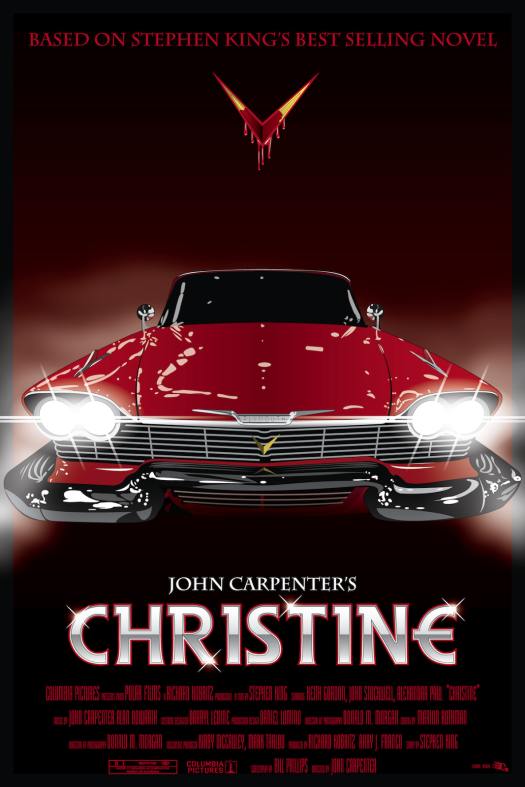
Among this wave of adaptations came a 1983 film that united two masters of the genre—Stephen King, the reigning literary giant of horror, and John Carpenter, the filmmaker who had already cemented his reputation with Halloween and The Thing. Their collaboration resulted in the sleek, deadly story of a boy and his car: Christine.
The film opens on the assembly line of a Plymouth factory in 1957, immediately signaling that something is off about this particular 1958 Plymouth Fury. From the first note of the retro rock soundtrack to the gleam of that deep crimson paint, Carpenter frames the car with both nostalgia and menace. The lighting in this opening feels almost clinical—bright, sterile, mechanical—yet Christine’s red sheen cuts violently through it, a visual omen that this machine is infused with something beyond metal and chrome. Carpenter wastes no time making it clear that this car is not an inanimate prop; it’s a living entity from the moment it’s born.
We’re soon introduced to the film’s human core—Arnie Cunningham (Keith Gordon), a shy, bookish teenager tormented by bullies and smothered by his controlling parents, and his best friend Dennis Guilder (John Stockwell), the confident star athlete who often looks out for him. One afternoon, during their drive home from school, Arnie spots a rusting, decrepit Plymouth Fury in the front yard of an old man named Roland D. LeBay. Where Dennis sees a heap of junk, Arnie sees perfection. Ignoring his friend’s concerns—and later, his parents’ outrage—Arnie buys the car and names it Christine.
As Arnie begins restoring Christine to her former glory, a transformation occurs—not just in the car, but in Arnie himself. The once timid, acne-scarred teenager grows into a confident, even arrogant young man, donning slicker clothes, sharper speech, and a darker aura. Christine becomes his obsession, his refuge, and ultimately, his identity.
Carpenter crafts this metamorphosis with eerie precision, pairing the car’s physical renewal with Arnie’s psychological decay. The cinematography shifts accordingly—the lighting grows darker, drenched in neon reds and shadowy blues, mirroring Christine’s two faces: seductive allure and demonic possession. Carpenter’s score, a pulsing blend of electronic rhythm and minimalistic dread, underscores these shifts. It functions almost like Christine’s heartbeat—steady, mechanical, and ominously sensual.
Between the vintage rock tracks that accompany Arnie’s moments of infatuation and the electronic motifs that follow Christine’s predatory stalks, Carpenter manipulates sound to blur the lines between teenage romance and supernatural horror. Every rev of the engine feels rhythmic, almost musical, as if the car itself communicates through vibration and tone rather than words.
Arnie’s newfound confidence even earns him Leigh Cabot (Alexandra Paul), the most desired girl in school—a relationship that initially feels like a symbol of his triumph. But Christine is no fairy tale. When Arnie’s bullies vandalize his beloved car, the story turns from eerie to vengeful.
In a now-iconic sequence, Christine repairs herself before Arnie’s stunned eyes—the crumpled metal expands, glass re-forms, headlights ignite like eyes opening from a nightmare. Carpenter lights the scene with a soft, golden underglow that turns mechanical resurrection into a hauntingly beautiful transformation. It’s both horrifying and hypnotic—a perfectly scored ballet of vengeance set to the hum of machinery and the director’s unmistakable electronic pulse.
What follows is a furious killing spree. Christine prowls the night streets for retribution, a creature of fire and gasoline more alive than metal should ever be.
While Carpenter’s adaptation diverges from King’s novel, it remains faithful to its emotional and thematic essence. King’s book delves deeply into the idea of objects absorbing the evil of their owners, suggesting that malevolence can linger in things as much as in people. Carpenter, however, turns the focus inward.
His version becomes a tragic character study—a battle for Arnie’s soul between the cold, seductive power of obsession and the fragile warmth of human connection. In one corner stands Christine, the car that offers Arnie unconditional love but demands total possession. In the other are Dennis and Leigh, desperate to save the friend they’re rapidly losing to something they can’t fully understand.
Carpenter’s signature touches—his electronic score, minimalist framing, and cynical tone—imbue the film with a dark romanticism. Christine is less a haunted object than a femme fatale: a mechanized embodiment of jealousy and desire. The film’s atmosphere bridges two eras, combining the nostalgic vibe of 1950s Americana with the grim realism of Reagan-era suburbia.
By the end, Christine becomes both a story of supernatural obsession and a commentary on teenage identity—the hunger to shed weakness, to command respect, and to control one’s fate, even at the cost of one’s soul.
Upon its release in December 1983, Christine performed modestly at the box office but was far from a failure. Over time, it has developed a strong cult following, cherished by both Carpenter devotees and Stephen King fans. Though often overshadowed by Carpenter’s heavier-hitting works like The Thing or Escape from New York, Christine remains one of his most technically polished films. It also stands as a fascinating bridge between studio horror and Carpenter’s independent sensibilities—where the shine of a Hollywood production mingles with the grit of a B-movie heart.
If Christine teaches any lesson, it’s that love and possession are two sides of the same coin. Arnie’s tragedy lies not in falling for the wrong woman, but in falling for one that burns with literal hellfire. In Carpenter’s vision, the road to damnation isn’t paved with good intentions—it’s lined with chrome, lit by headlights, and always hungry for one more ride.

 Top: Stephen King 1983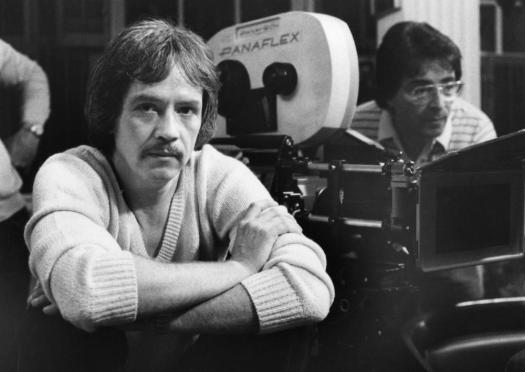





 Through the Shattered Lens