The TSL’s Daily Horror Grindhouse: Deathdream (dir by Bob Clark)


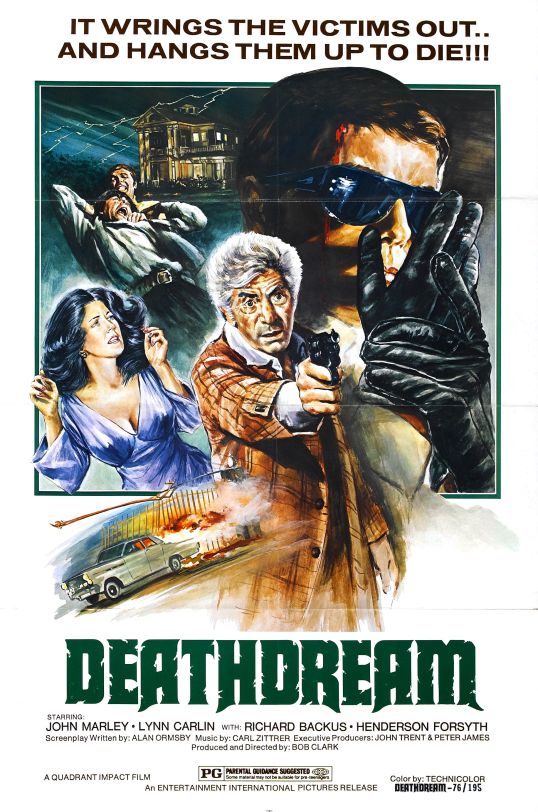
deathdream_poster_01

The 1974 film Deathdream opens with American soldier Andy Brooks (played by Richard Backus) on patrol in Vietnam. When he’s suddenly shot by an unseen sniper, he hears his mother’s voice calling out to him, telling him that he promised to come home. With the voice filling his head, Andy closes his eyes.

Sometime later, back in America, Andy’s family has been informed that Andy was killed in action. His father (John Marley, who you might recognize as the man who played Jack Woltz in The Godfather) and his younger sister (Anya Ormsby) have managed to accept the fact that Andy is dead but his mother (Lynn Carlin) remains in denial. Oddly enough, his mother is apparently proven to be correct in her doubts when Andy suddenly shows up at the front door.

The family (and, eventually, the entire community) welcomes Andy home but it quickly becomes apparent that Andy has returned as a far different person than when he left. Now pasty and emotionless, Andy spends most of his day sitting around listlessly. It’s only at night that Andy seems to have any energy and he spends those hours wandering around town and hanging out in the local cemetery.

It quickly becomes apparent to his father that Andy is no longer quite human. However, his devoted mother continues to insist that nothing is wrong with Andy and, once it becomes apparent just what exactly Andy is doing in order to survive, she becomes just as fanatical about protecting him as his father is about destroying him.

Not surprisingly, Deathdream is more than just a zombie film.  When Andy suddenly shows up on his family’s doorstep, he’s more than just a decaying monster.  He’s also a metaphor for the unease that viewers in the 70s would have felt about the state of American society.  (Of course, in many ways, contemporary viewers share that same unease.)  Andy goes off to war and it literally robs him of his humanity.  I would also argue that, in its way, Deathdream serves as a satire of the type of complacent society that sends young people off to fight for their lives and then expects them to come back exactly the same as they were before they left.  No matter how strange Andy’s behavior becomes, the people around him are willing to either ignore it or make excuses for it.  Andy’s mother emerges as a stand-in for everyone who willfully refuses to acknowledge the human consequences of war.

Deathdream is one of those wonderful horror films that deserves to be better known than it is. Deathdream was an early credit for the legendary effects artist Tom Savini and, while the film itself is not especially gory, Savini’s work can definitely be seen in the scenes where Backus’s body slowly decays. Screenwriter Alan Ormsby and director Bob Clark (who later went on to direct the far different A Christmas Story) perfectly creates and maintains a deceptively low-key atmosphere of perpetual unease while the cast elevates the entire film. Backus makes for an all-too plausible ghoul and Marley is great as a man struggling to understand what his son has become. The film is totally stolen, however, by Lynn Carlin who is both poignant and frightening as Andy’s devoted mother.

If you haven’t discovered Deathdream yet, this Halloween is the perfect season to do so.
http://www.youtube.com/watch?v=4oUyCQ0A3cs

Horror Film Review: The Car (dir by Elliot Silverstein)


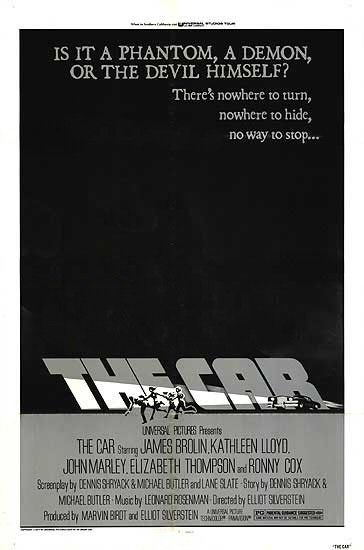
The_Car_movie_poster

“THE CAR IS IN THE GARAGE” 

— Captain Wade Parent (James Brolin) in The Car (1977)

Yes, that’s right!  The car is in the garage and it’s hunting for blood!

The Car is a pretty stupid movie that doesn’t really work but at least it’s enjoyably stupid.  From the minute I started watching this movie, I knew that the only way I could recommend it would be if James Brolin shouted, “The car is in the garage!” at some point.  When he did, I had to cheer a little.  I love being able to recommend a movie.

The Car takes place in the small desert town of Santa Ynez.  Nothing much ever seems to happen in Santa Ynez, which perhaps explains why the police force is so large.  (Why wouldn’t you want to be a police officer in a town with no crime?  It wouldn’t be a very demanding job.)  Sheriff Everett Peck (John Marley) keeps the peace and sends his time talking about how much he hates bullies.  Wade Parent (James Brolin) is his second-in-command and has a 70s pornstache.  Wade’s best friend is Deputy Luke Johnson (Ronny Cox), a recovering alcoholic with impressive sideburns.  And then there’s a few dozen other cops.  Seriously, this tiny town has a HUGE police force.

One day, however, the police finally get something to do.  A black Lincoln Continental has suddenly appeared, stalking the roads around the town.  It doesn’t have a licence plate and the windows are tinted a dark red so it’s impossible to see who — if anyone — is driving.  Stranger still, the car’s doors have no handles.  When the car does show up, it seems to appear out of nowhere and once it’s run someone over, it seems to vanish just as quickly.

When the car first appears, it runs down two cyclists.  A few hours later, it kills an obnoxious hippie hitchhiker (John Rubinstein).  The only witness was alcoholic wife beater Amos Clements (R.G. Armstrong).  When Amos goes to the police, the car tries to run him over as well but instead, it ends up killing Sheriff Peck.

Now, Wade is in charge and he has to do something about the car.  Unfortunately, Wade’s girlfriend, Lauren (Kathleen Lloyd), made the mistake of screaming insults at the car when the car attempted to run down the school marching band.  Now, the car is stalking her.  Meanwhile, Luke is convinced that the car is being driven by none other than devil.  Wade says that’s impossible.  Luke points out that the car refuses to drive through consecrated ground.

And eventually, the car does show up in the garage…

The Car is one of the stupider of the many Jaws ripoffs that I’ve seen.  You’ll be rooting for the car through the entire film, which is good since the car kills nearly everyone in Santa Ynez.  (If any of them were likable, The Car wouldn’t as much fun to watch.)  It’s dumb but the film does have an appropriately silly ending and James Brolin does get to yell, “The car is in the garage!”

So, there is that.

Film Review: The Greatest (1977, dir by Tom Gries and Monte Hellman)


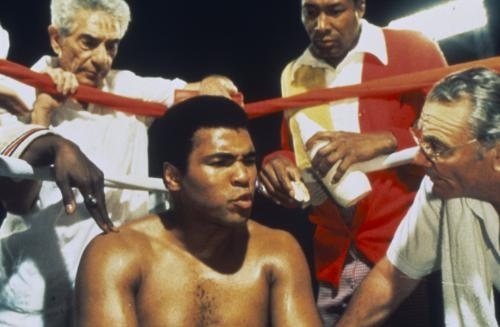
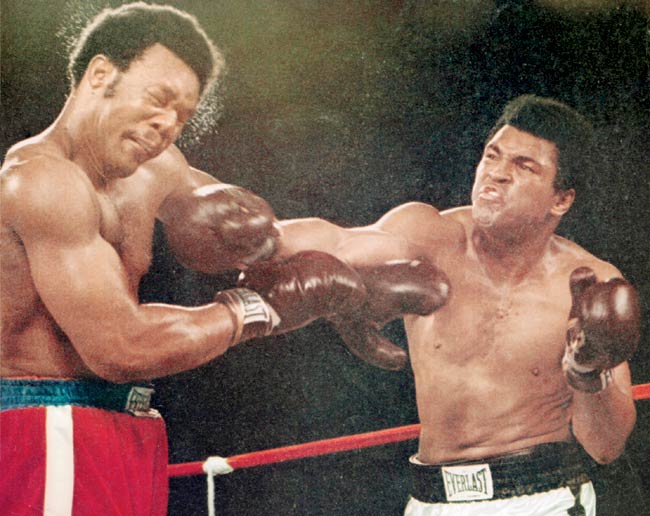
the_greatest_1977_portrait_w858The Greatest opens with 18 year-old Cassius Clay (played by Chip McAllister as a teenager and, as an adult, by Muhammad Ali himself) winning the light heavyweight gold medal at the 1960 Rome Olympics.  Returning home to Kentucky, Clay discovers that not even a gold medal can protect him from racism.  Angered after a restaurant refuses to serve him and his friend, Clay throws his gold medal into the Ohio River.  Under the training of Angelo Dundee (Ernest Borgnine), Clay turns pro and defeats Sonny Liston (Roger E. Mosley) for the heavyweight championship.  Inspired by Malcolm X (James Earl Jones), Clay also joins the Nation of Islam and changes his name to Muhammad Ali.  As heavyweight champion, Ali battles not only his opponents in the ring but racism outside of it.  The Greatest follows Ali as he loses his title for refusing to be drafted and concludes with the famous Rumble in the Jungle, where Ali won the title back from George Foreman.

Sadly, Muhammad Ali has never been the subject of a truly great feature film.  Even Michael Mann’s Ali failed to really capture the mystique that made Ali into such an iconic figure.  The Greatest is interesting because Ali plays himself.  Unfortunately, The Greatest proves that Ali may have been a great showman but he was not a natural actor.  You only have to watch the scene where Ali tries to hold his own with Robert Duvall to see just how stiff an actor Muhammad Ali really was.  Ali’s best scenes are the ones where he is trash talking his opponents or training.  The film opens with Ali jogging while George Benson sings The Greatest Love Of All, a scene that is made all the more poignant when you compare the athletic and confident Muhammad Ali of 1977 with the frail, Parkinson’s stricken Ali of today.

29Muhammad-Ali-1Instead of recreating any of Ali’s legendary fights, The Greatest instead uses actual footage of the matches.  The real life footage is the best part of the film.  After all these years, Ali’s fights against Sonny Liston, Joe Frazier, Ken Norton, and George Foreman remain exciting to watch.  Otherwise, The Greatest is too episodic and low budget to do justice to Muhammad Ali’s story.

If you want to see a truly great film about Ali and his legacy, watch the 1996 documentary When We Were Kings, 2009’s Facing Ali or 2013’s The Trials of Muhammad Ali.  Ali is such an iconic figure that it may be impossible for any feature film to properly do justice to his life and legacy.  These three documentaries come close.

(Director Tom Gries died during the filming of The Greatest.  The movie was completed by Monte Hellman.)

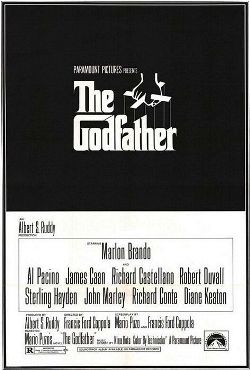
Shattered Politics #31: The Godfather (dir by Francis Ford Coppola)


Godfather_ver1

“I got something for your mother and Sonny and a tie for Freddy and Tom Hagen got the Reynolds Pen…” — Kay Adams (Diane Keaton) in The Godfather (1972)

It probably seems strange that when talking about The Godfather, a film that it is generally acknowledged as being one of the best and most influential of all time, I would start with an innocuous quote about getting Tom Hagen a pen.

(And it better have been a hell of a pen because, judging from the scene where Sollozzo stops him in the street, it looked like Tom was going all out as far as gifts were concerned…)

After all, The Godfather is a film that is full of memorable quotes.  “Leave the gun.  Take the cannoli.”  “I’m going to make him an offer he can’t refuse.”  “It’s strictly business.”  “I believe in America….”  “That’s my family, Kay.  That’s not me.”

But I went with the quote about the Reynolds pen because, quite frankly, I find an excuse to repeat it every Christmas.  Every holiday season, whenever I hear friends or family talking about presents, I remind them that Tom Hagen is getting the Reynolds pen.  Doubt me?  Check out these tweets from the past!

[tweet https://twitter.com/LisaMarieBowman/status/411891527837687810  ]

[tweet https://twitter.com/LisaMarieBowman/status/280387983444697088 ]

That’s how much I love The Godfather.  I love it so much that I even find myself quoting the lines that don’t really mean much in the grand scheme of things.  I love the film so much that I once even wrote an entire post about who could have been cast in The Godfather if, for whatever reason, Brando, Pacino, Duvall, et al. had been unavailable.  And I know that I’m not alone in that love.

But all that love also makes The Godfather a difficult film to review.  What do you say about a film that everyone already knows is great?

Do you praise it by saying that Al Pacino, Robert Duvall, James Caan, Diane Keaton, Marlon Brando, John Cazale, Richard Castellano, Abe Vigoda, Alex Rocco, and Talia Shire all gave excellent performances?  You can do that but everyone already knows that.

Do you talk about how well director Francis Ford Coppola told this operatic, sprawling story of crime, family, and politics?  You can do that but everyone already knows that.

Maybe you can talk about how beautiful Gordon Willis’s dark and shadowy cinematography looks, regardless of whether you’re seeing it in a theater or on TV.  Because it certainly does but everyone knows that.

Maybe you can mention the haunting beauty of Nina Rota’s score but again…

Well, you get the idea.

Now, if you somehow have never seen the film before, allow me to try to tell you what happens in The Godfather.  I say try because The Godfather is a true epic.  Because it’s also an intimate family drama and features such a dominating lead performance from Al Pacino, it’s sometimes to easy to forget just how much is actually going on in The Godfather.

The Godfather tells the story of the Corleone Family.  Patriarch Vito Corleone (Marlon Brando) has done very well for himself in America, making himself into a rich and influential man.  Of course, Vito is also known as both Don Corleone and the Godfather and he’s made his fortune through less-than-legal means.  He may be rich and he may be influential but when his daughter gets married, the FBI shows up outside the reception and takes pictures of all the cars in the parking lot.  Vito Corleone knows judges and congressmen but none of them are willing to be seen in public with him.  Vito is the establishment that nobody wants to acknowledge and sometimes, this very powerful man wonders if there will ever be a “Governor Corleone” or a “Senator Corleone.”

Vito is the proud father of three children and the adopted father of one more.  His oldest son, and probable successor, is Sonny (James Caan).  Sonny, however, has a temper and absolutely no impulse control.  While his wife is bragging about him to the other women at the wedding, Sonny is upstairs screwing a bridesmaid.  When the enemies of the Corleone Family declare war, Sonny declares war back and forgets the first rule of organized crime: “It’s not personal.  It’s strictly business.”

After Sonny, there’s Fredo (John Cazale).  Poor, pathetic Fredo.  In many ways, it’s impossible not to feel sorry for Fredo.  He’s the one who ends up getting exiled to Vegas, where he lives under the protection of the crude Moe Greene (Alex Rocco).  One of the film’s best moments is when a bejeweled Fredo shows up at a Vegas hotel with an entourage of prostitutes and other hangers-on.  In these scenes, Fred is trying so hard but when you take one look at his shifty eyes, it’s obvious that he’s still the same guy who we first saw stumbling around drunk at his sister’s wedding.

(And, of course, it’s impossible to watch Fredo in this film without thinking about both what will happen to the character in the Godfather, Part II and how John Cazale, who brought the character to such vibrant life, would die just 6 years later.)

As a female, daughter Connie (Talia Shire) is — for the first film, at least — excluded from the family business.  Instead, she marries Sonny’s friend Carlo Rizzi (Gianni Russo).  And, to put it gently, it’s not a match made in heaven.

And finally, there’s Michael (Al Pacino).  Michael is the son who, at the start of the film, declares that he wants nothing to do with the family business.  He’s the one who wants to break with family tradition by marrying Kay Adams (Diane Keaton), who is most definitely not Italian.  He’s the one who was decorated in World War II and who comes to his sister’s wedding still dressed in his uniform.  (In the second Godfather film, we learn that Vito thought Michael was foolish to join the army, which makes it all the more clear that, by wearing the uniform to the wedding, Michael is attempting to declare his own identity outside of the family.)  To paraphrase the third Godfather film, Michael is the one who says he wants to get out but who keeps getting dragged back in.

And finally, the adopted son is Tom Hagen (Robert Duvall).  Tom is the Don’s lawyer and one reason why Tom is one of my favorite characters is because, behind his usual stone-faced facade, Tom is actually very snarky.  He just hides it well.

Early on, we get a hint that Tom is more amused than he lets on when he has dinner with the crude Jack Woltz (John Marley), a film producer who doesn’t want to use Johnny Fontane (Al Martino) in a movie  When Woltz shouts insults at him, Tom calmly finishes his dinner and thanks him for a lovely evening.  And he does it with just the hint of a little smirk and you can practically see him thinking, “Somebody’s going to wake up with a horse tomorrow….”

However, my favorite Tom Hagen moment comes when Kay, who is searching for Michael, drops by the family compound.  Tom greets her at the gate.  When Kay spots a car that’s riddled with bullet holes, she asks what happened.  Tom smiles and says, “Oh, that was an accident.  But luckily no one was hurt!”  Duvall delivers the line with just the right attitude of “That’s my story and I’m sticking to it!”  How can you not kind of love Tom after that?

And, of course, the film is full of other memorable characters, all of whom are scheming and plotting.  There’s Clemenza (Richard S. Catellano) and Tessio (Abe Vigoda), the two Corleone lieutenants who may or may not be plotting to betray the Don.  There’s fearsome Luca Brasi (Lenny Montana), who spends an eternity practicing what he wants to say at Connie’s wedding and yet still manages to screw it up.  And, of course, there’s Sollozzo (Al Lettieri, playing a role originally offered to Franco Nero), the drug dealer who reacts angrily to Vito’s refusal to help him out.  Meanwhile, Capt. McCluskey (Sterling Hayden) is busy beating up young punks and Al Neri (Richard Bright) is gunning people down in front of the courthouse.  And, of course, there’s poor, innocent, ill-fated Appollonia (Simonetta Stefanelli)…

The Godfather is a great Italian-American epic, one that works as both a gangster film and a family drama.  Perhaps the genius of the Godfather trilogy is that the Corleone family serves as an ink blot in a cinematic rorschach test.  Audiences can look at them and see whatever they want.  If you want them and their crimes to serve as a metaphor for capitalism, you need only listen to Tom and Michael repeatedly state that it’s only business.  If you want to see them as heroic businessmen, just consider that their enemies essentially want to regulate the Corleones out of existence.  If you want the Corleones to serve as symbols of the patriarchy, you need only watch as the door to Michael’s office is shut in Kay’s face.  If you want to see the Corleones as heroes, you need only consider that they — and they alone — seem to operate with any sort of honorable criminal code.  (This, of course, would change over the course of the two sequels.)

And, if you’re trying to fit a review of The Godfather into a series about political films, you only have to consider that Vito is regularly spoken of as being a man who carries politicians around in his pocket.  We may not see any elected officials in the first Godfather film but their presence is felt.  Above all else, it’s Vito’s political influence that sets in motion all of the events that unfold over the course of the film.

The Godfather, of course, won the Oscar for best picture of 1972.  And while it’s rare that I openly agree with the Academy, I’m proud to say that this one time is a definite exception.

What could have been: The Godfather


I don’t know about you but I love to play the game of “What if.”  You know how it works.  What if so-and-so had directed such-and-such movie?  Would we still love that movie as much?  Would so-and-so be a star today?  Or would the movie have failed because the director was right to reject so-and-so during preproduction?

I guess that’s why I love the picture below.  Taken from one of Francis Ford Coppola’s notebooks, it’s a page where he jotted down a few possibilities to play the roles of Don Vito, Michael, Sonny, and Tom Hagen in The Godfather.  It’s a fascinating collection of names, some of which are very familiar and some of which most definitely are not.  As I look at this list, it’s hard not wonder what if someone like Scott Marlowe had played Michael Corleone?  Would he had then become known as one of the great actors of his generation and would Al Pacino then be fated to just be an unknown name sitting on a famous list?

(This page, just in case you happen to be in the neighborhood , is displayed at the Coppola Winery in California.)

The production of the Godfather — from the casting to the final edit — is something of an obsession of mine.  It’s amazing the amount of names — obscure, famous, and infamous — that were mentioned in connection with this film.  Below is a list of everyone that I’ve seen mentioned as either a potential director or a potential cast member of The Godfather.  Consider this my contribution to the game of What If….?

Director: Aram Avankian, Peter Bogdonavich, Richard Brooks, Costa-Gravas, Sidney J. Furie, Norman Jewison, Elia Kazan, Steve Kestin, Sergio Leone, Arthur Penn, Otto Preminger, Franklin J. Schaffner, Peter Yates, Fred Zinnemann

Don Vito Corleone (played by Marlon Brando): Melvin Belli, Ernest Borgnine, Joseph Callelia, Lee. J. Cobb, Richard Conte, Frank De Kova, Burt Lancaster, John Marley, Laurence Olivier, Carlo Ponti, Anthony Quinn, Edward G. Robinson, George C. Scott, Frank Sinatra, Rod Steiger, Danny Thomas, Raf Vallone,  Orson Welles

Michael Corleone (played by Al Pacino): John Aprea, Warren Beatty, Robert Blake, Charles Bronson*, James Caan, David Carradine, Robert De Niro, Alain Delon, Peter Fonda, Art Genovese, Dustin Hoffman, Christopher Jones, Tommy Lee Jones, Tony Lo Bianco, Michael Margotta, Scott Marlowe, Sal Mineo, Jack Nicholson, Ryan O’Neal, Michael Parks, Robert Redford, Burt Reynolds, Richard Romanus, Gianni Russo, Martin Sheen, Rod Steiger**, Dean Stockwell

Sonny Corleone (played by James Caan): Lou Antonio, Paul Banteo, Robert Blake, John Brascia, Carmine Caridi, Robert De Niro, Peter Falk, Harry Guardino, Ben Gazzara, Don Gordon, Al Letteiri, Tony LoBianco, Scott Marlowe, Tony Musante, Anthony Perkins, Burt Reynolds***, Adam Roarke, Gianni Russo, John Saxon, Johnny Sette, Rudy Solari, Robert Viharo, Anthony Zerbe

Tom Hagen (played by Robert Duvall): James Caan, John Cassavettes, Bruce Dern, Peter Donat, Keir Dullea, Peter Falk, Steve McQueen, Richard Mulligan, Paul Newman, Jack Nicholson, Ben Piazza, Barry Primus, Martin Sheen, Dean Stockwell, Roy Thinnes, Rudy Vallee****, Robert Vaughn, Jerry Van Dyke, Anthony Zerbe

Kay Adams (played by Diane Keaton): Anne Archer, Karen Black, Susan Blakeley, Genevieve Bujold, Jill Clayburgh, Blythe Danner, Mia Farrow, Veronica Hamel, Ali MacGraw, Jennifer O’Neill, Michelle Phillips, Jennifer Salt, Cybill Shepherd, Trish Van Devere

Fredo Corleone (played by John Cazale): Robert Blake, Richard Dreyfuss, Sal Mineo, Austin Pendleton

Connie Corleone (played by Talia Shire): Julie Gregg, Penny Marshall, Maria Tucci, Brenda Vaccaro, Kathleen Widdoes

Johnny Fontane (played by Al Martino): Frankie Avalon, Vic Damone*****, Eddie Fisher, Buddy Greco, Bobby Vinton, Frank Sinatra, Jr.

Carlo Rizzi (played by Gianni Russo): Robert De Niro, Alex Karras, John Ryan******, Sylvester Stallone

Virgil “The Turk” Sollozzo (played by Al Letteiri): Franco Nero

Lucas Brasi (played by Lenny Montana): Timothy Carey, Richard Castellano

Moe Greene (played by Alex Rocco): William Devane

Mama Corleone (played by Morgana King): Anne Bancroft, Alida Valli

Appollonia (played by Simonetta Steffanelli): Olivia Hussey

Paulie Gatto (played by John Martino): Robert De Niro*******, Sylvester Stallone

—-

* Charles Bronson, who was in his mid-40s, was suggested for the role of Michael by the then-chairman of Paramount Pictures, Charlie Bluhdorn.

** By all accounts, Rod Steiger – who was then close to 50 – lobbied very hard to be given the role of Michael Corleone.

*** Some sources claim that Burt Reynolds was cast as Sonny but Brando refused to work with him.  However, for a lot of reasons, I think this is just an cinematic urban legend.

**** Despite being in his 60s at the time, singer Rudy Vallee lobbied for the role of the 35 year-old Tom Hagen.  Supposedly, another singer — Elvis Presley — lobbied for the role as well but that just seems so out there that I couldn’t bring myself to include it with the “official” list.

***** Vic Damone was originally cast as Johnny Fontane but dropped out once shooting began and announced that the project was bad for Italian Americans.  He was replaced by Al Martino.

****** John P. Ryan was originally cast as Carlo Rizzi but was fired and replaced with Gianni Russo.  Ryan went on to play the distraught father in Larry Cohen’s It’s Alive.  Russo went on to co-star in Laserblast.

******* Robert De Niro was originally cast in this role but dropped out to replace Al Pacino in The Gang That Couldn’t Shoot Straight.  Pacino, incidentally, had to drop out of that film because he was given the role of Michael in The Godfather.

Lisa Marie Laughs and Cries Over Love Story (dir. Arthur Hiller)


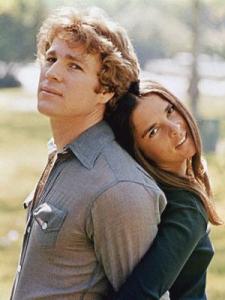
They are so freaking pretty!

I’ve discovered something as I’ve pursued my mission to see every single film ever nominated for best picture.  Quite a few of the nominees (perhaps the majority of them) are no longer impressive because they’ve simply become dated by the passage of time.  We can still watch these films and understand (and believe) that they were probably quite groundbreaking and impressive when initially released.

And then there’s the films like the 1970 best picture nominee, Love Story.  These are the nominees that you quickly realize were never good.  These are the films that were nominated because they either dominated the box office or perhaps they just lucked out and were released in a bad year for cinema in general.  At least that’s what we tell ourselves.  In all honesty, the circumstances of how they came to be nominated are often enigmatic and shrouded in mystery.  I have yet to read a single critic — from either 1970 or the present day — who has had a single kind thing to say about Love Story and, after sitting through it last night, I can say that for once, me and the critical establishment are in agreement.

The plot of Love Story is pretty simple and I’m going to go ahead and include the entire story here because quite frankly, it’s impossible to spoil something this predictable.  Oliver (Ryan O’Neal) meets Jenny (Ali MacGraw).  Oliver is a rich jock who is attending Harvard.  Jenny is a poor music student.  Upon first meeting her, Oliver calls Jenny a “bitch.”  Jenny calls Oliver “a dumb jock.”  Oliver falls in love with Jenny.  Jenny calls Oliver “a dumb jock.”  Oliver and Jenny get married.  Oliver’s father (Ray Milland) disapproves.  Jenny’s father (John Marley) is just kind of confused.  Cut off from the family fortune, Oliver struggles to provide for Jenny.  (Apparently, the 70s were a tough time to be a graduate of Harvard Law School.)  Jenny and Oliver have a fight.  Oliver cries.  Jenny says, “Love means never having to say you’re sorry,” which seems to be an underhanded way of admitting that most guys aren’t ever going to say that anyways.  Oliver is happy.  Jenny comes down with a never-named terminal illness and dies.  The end.

I know that I’m supposed to watch a movie like Love Story and just shrug my shoulders and go, “Oh well, it’s not very good but I’m a girl so I’ll love it unconditionally.”  And God knows, I tried my best,  I tried so very hard to just shut down my mind and give control over to my heart.  Because, believe it or not, I’m just a dorky, asthmatic romantic.  I’m the type of girl who gets all giggly and excited when she gets flowers, despite all of my allergies.  I can remember every sunset I’ve ever watched.  The rare times we actually do have a winter down here in Texas, I’m all about the snowball fights that end with a long, passionate kiss.  I love Valentine’s Day and I remember anniversaries.  I still have every gift that I’ve ever been given, even the really cheap and ugly things that I wouldn’t be caught dead wearing in public.  Every trinket, every stuffed animal, every card, every piece of jewelery, every note, every article of lingerie, every movie ticket — if it’s an artifact of a past or current relationship, I have it all safely stored in a place of honor. 

Yes, I adore everything that Love Story was selling and yet, as I watched Love Story, I felt myself growing more and more cynical with each passing moment.  Fortunately, the movie only last 99 minutes because if it had gone on for a few 120, I probably would have ended up “an old maid…closing up the library!” like Donna Reed in It’s a Wonderful Life.  The problem with Love Story isn’t that it’s not romantic; it’s that it takes the standard clichés of romance and embraces them to such an extent that I didn’t feel as if I was being manipulated by the film as much as I felt like I was being brutally violated by it.

Seriously, the entire time I was watching, I felt like the film was screaming at me, “Look at how beautiful they are!  Look at that sunset!  Listen to that music!  Cry, damn you, cry!”  Never mind the fact that MacGraw and O’Neal — pretty as they are to look at — generate close to zero chemistry.  Never mind that  MacGraw responds to being terminally ill by laying in bed with her hair artfully spread on the pillow behind her while director Arthur Hiller practically bathes her in a warm, saintly glow.  Never mind that “Love means never having to say you’re sorry,” doesn’t make any freaking sense at all.  Trust me, if you love me and yet you still insist on acting like an asshole, you sure as Hell have to apologize to me. 

On the plus side, the film’s got one of those overdone, lush soundtracks; the type that can make you cry as long as you don’t pay attention to what’s happening on-screen.  (That said, Taylor Swift is nowhere to be found.)  Ryan O’Neal is surprisingly likable as Oliver but Ali MacGraw — oh my God, where do I begin?  Actually, I don’t think I will because there’s simply no way I can explain just how bad of a performance she gives here.  Instead, I’ll just point out that Love Story also features the film debut of Tommy Lee Jones.  He’s credited as Tom Lee Jones here and he plays Oliver’s roommate.  He’s an on-screen for about 12 seconds and he delivers exactly one line. 

Needless to say, he pretty much steals the entire film.

6 Trailers While You Wait


So, I’m currently still working on my review of Black Swan, which I saw this weekend and loved so much that I ended up having an asthma attack at the end of it.  But anyway, as we wait for me to discover articulation, why not check out 6 more of my favorite grindhouse and exploitation film trailers?

1) Deathdream (a.k.a. Dead of Night)

Now, this is an interesting debut film from the prolific Canadian director Bob Clark (the man who later gave the world both Black Christmas and A Christmas Story).  A young soldier is killed in Viet Nam and shows up back in his hometown one night later without a soul.  The allegory is pretty obvious but it’s still effectively done and crawls under your skin.  This film was also one of Tom Savini’s early films.  The soldier’s father is played by John Marley who later appeared in The Godfather with a horse’s head in his bed.

2) Delinquent Girl Boss: Worthless To Confess

I’ve never seen this movie.  I just like the title.

3) The Black Cat

Director Lucio Fulci made this film around the same time he was making his more famous zombie films but it never got the same attention, despite starring David Warbeck.  I love the cat — he’s so cute and he reminds me of my own cat.  Plus, he’s quite effective at killing people.

4) School of the Holy Beast

Apparently, this is a nunsploitation film from Japan!  That nunsploitation was a very popular genre in Italy, Spain, and Ireland makes sense when you consider that those are three of the most Catholic countries on the planet.  But Japan?

5) The Blood Splattered Bride

The trailer for the 1971 Italian lesbian vampire film goes on for a bit too long but I think it has nice atmospheric feel to it (the same can be said of the film itself). 

6) The Dead Pit

Since we started with a zombie film, let’s end with one as well.  The Dead Pit is pretty silly but I enjoyed it and would happily star in a remake.  Plus, the trailer’s line about “the thickness of the door” just amuses me on so many levels.