Embracing the Melodrama Part II #119: Shutter Island (dir by Martin Scorsese)


Shutter IslandThe 2010 film Shutter Island finds the great director Martin Scorsese at his most playful.

Taking place in 1954, Shutter Island tells the story of two detectives, Teddy Daniels (Leonardo DiCaprio, giving an excellent performance that, in many ways, feels like a test run for his role in Inception) and Chuck Aule (Mark Ruffalo, also excellent), who take a boat out to the Ashecliffe Hospital for The Criminal Insane, which is located on Shutter Island in Boston Harbor.  They are investigating the disappearance of inmate Rachel Solando, who has been incarcerated for drowning her three children.

Ashecliffe is one of those permanently gray locations, the type of place where the lights always seem to be burned out and the inmates move about like ghostly visions of sins brought to life.  It’s the type of place that, had this movie been made in the 50s or 60s, would have been run by either Vincent Price or Peter Cushing.  In this case, the Cushing role of the cold and imperious lead psychiatrist is taken by Ben Kingsley.  Max Von Sydow, meanwhile, plays a more flamboyantly sinister doctor, the role that would have been played by Vincent Price.

When a storm strands Teddy and Chuck on the island, they quickly discover that neither the staff nor the patients are willing to be of any help when it comes to tracking down Rachel.  As Teddy continues to investigate, he finds himself stricken by migraines and haunted by disturbing images.  He continually sees a mysterious little girl.  He has visions of his dead wife (Michelle Williams).  A horribly scarred patient in solitary confinement (Jackie Earle Haley) tells him that patients are regularly taken to a lighthouse where they are lobotomized.  When Teddy explores more of the island, he comes across a mysterious woman living in a cave and she tells him of even more sinister activity at Ashecliffe.  Meanwhile, Chuck alternates between pragmatic skepticism and flights of paranoia.

And I’m not going to share anymore of the plot because it would be a crime to spoil Shutter Island.  This is a film that you must see and experience for yourself.

This is one of Martin Scorsese’s most entertaining films, an unapologetic celebration of B-movie history. He knows that he’s telling a faintly ludicrous story here and, wisely, he embraces the melodrama.  Too many directors would try to bring some sort of credibility to Shutter Island by downplaying the film’s more melodramatic moments.  Scorsese, however, shows no fear of going over the top.  He understands that this is not the time to be subtle.  This is the time to go a little crazy and that’s what he does.

Good for him.
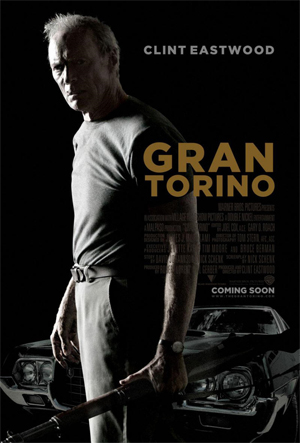
Embracing the Melodrama Part II #113: Gran Torino (dir by Clint Eastwood)


Gran_Torino_posterWalt Kowalski (Clint Eastwood) is a grumpy man.  And by that, I mean that he’s extremely grumpy.  Remember how grumpy Bill Murray was in St. Vincent?  He’s got nothing on Walt Kowalski.

Walt served in the Korean War and, five decades later, his experiences still haunt him.  After the war, he lived in Detroit and he worked on an assembly line.  He’s since retired but he still loves his old Ford Gran Torino, a car that he could very well have helped to build.  His wife has recently passed away and his children are eager to move him into a nursing home.  Walt is slowly smoking himself to death and the only person who visits him regularly is an earnest young priest (Christopher Carley, playing the ideal priest).

Just as Walt’s life has changed as he’s gotten older, so has his neighborhood.  The neighborhood is now dominated by Hmong immigrants.  When Walt catches Thao Vang Lor, a 16 year-old Hmong, attempting to steal his car, it leads to an unlikely friendship between Walt, Thao, and Thao’s sister, Sue.  When the same local gang that put Thao up to stealing Walt’s car subsequently attacks Sue, Thao wants revenge but Walt says that if Thao kills a man, it’s something that he’ll never recover from.  After locking Thao in his house, Walt goes off to confront the gang on his own…

And, since Walt is played by Clint Eastwood, you’d be justified in thinking that Walt’s confrontation would amount to a lot of quips and violence.  But actually, it’s the exact opposite.  Gran Torino does not find Eastwood in the mood to celebrate violence.  Instead, the film is a meditation on both the cost of violence and the impossibility of escaping one’s own mortality.

Whenever people talk about the 2008 Oscar race, the focus always seems to be on the snubbing of  The Dark Knight.  However, I would say that Gran Torino (among other films) was snubbed even more than The Dark Knight.  After all, The Dark Knight may have missed out on best picture but it still received 8 nominations and won an Oscar for Heath Ledger.  Gran Torino, on the other hand, received not a single nomination.

Don’t get me wrong.  I’m not arguing that Gran Torino deserved a best picture nomination.  It’s a fairly predictable film and some of the symbolism, particularly during Walt’s final confrontation with the gang, gets a bit too heavy-handed.  (Any time a character spontaneously strikes a crucifixion pose in a movie, you know that things are starting to get out of hand.)  But I would argue that Clint Eastwood definitely deserved a nomination for best actor.  In many ways, Walt is a typical Eastwood character but, right at the moment when we’re expecting him to behave like every other Eastwood character that we’ve ever seen, Walt surprises us by doing something completely different.  As a director, Eastwood subverts our expectations of Clint Eastwood as both an actor and a character.  As a result, the audience is taken by surprise by Walt, if not by the film’s plot.

I remember, at the time the film was released, there was some speculation that Gran Torino would be the last time we ever saw Clint Eastwood onscreen.  That proved to be false, as he subsequently starred in Trouble With The Curve.  However, even if it wasn’t his final acting role, Gran Torino still serves as the perfect monument to Eastwood’s unique screen presence.