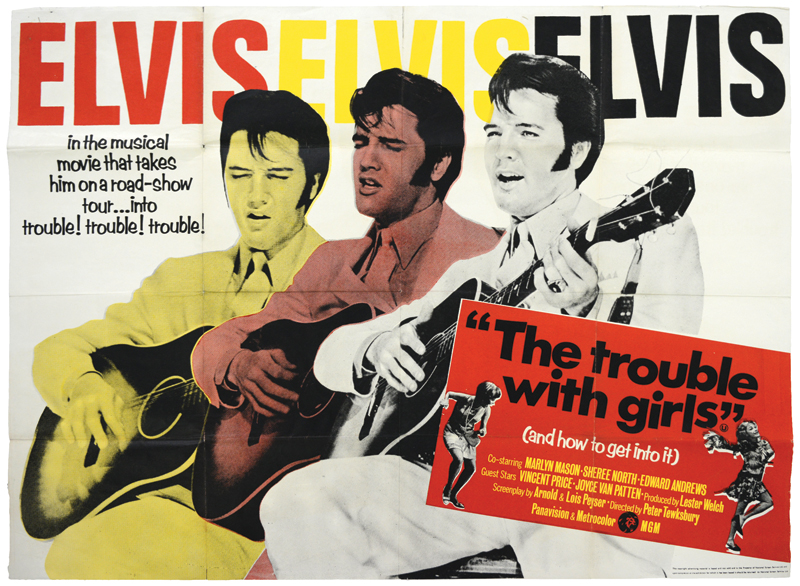
Elvis Aron Presley was born on this date in 1935. The King of Rock’N’Roll got the older generation “All Shook Up” when he burst on the national scene in 1956 with hits like “Heartbreak Hotel” and “Hound Dog”. He also made his first film that year, the Western LOVE ME TENDER, and was an immediate box office sensation. His following three films, LOVING YOU, JAILHOUSE ROCK , and KING CREOLE, were well done, but after his stint in the Army, and the success of 1961’s BLUE HAWAII, Presley’s 60’s movies followed a strict formula, thanks to manager Col. Tom Parker, with interchangeable titles like KISSIN’ COUSINS, HARUM SCARUM, and DOUBLE TROUBLE.
By the late 60’s, things had changed. The Beatles were top of the pops, the psychedelic revolution was in full effect, and Elvis hadn’t had a hit record in a few years. The movies were still profitable, but lacked energy. Presley’s 1968…
For tonight’s excursion into the world of televised horror, here is the 6th episode of the 2nd season of Thriller!
Introduced by Boris Karloff, Masquerade tells the story of a married couple (Elizabeth Montgomery and Tom Poston) who find themselves checking into a creepy boarding house. If the house looks familiar, that’s because it’s the same house that was used in Psycho!
The house is occupied by a family of cannibals. And who plays the patriarch of this dangerous clan? The always wonderful, theatrical, and intimidating John Carradine!
And, of course, there’s a fun little twist at the end!
This episode originally aired on the day before Halloween, October 30th, 1961.
The 1933 Universal horror film, The Invisible Man, never seems to get as much attention as Frankenstein, Dracula,The Wolf Man, or The Mummy. Perhaps it’s because the invisible man really isn’t a supernatural monster. He’s just a scientist who has turned himself invisible and is now going mad as a result. Or maybe it’s because there have been so many crappy films that have used invisibility as a plot point that the reputation of the original Invisible Man suffers by association.
For whatever reason, The Invisible Man never seems to get spoken about in the same breathless, gleeful manner as some of the other Universal monsters. But I have to admit that, though I usually can’t stand movies about invisibility, I rather like The Invisible Man.
Based on a novel by H.G. Wells, The Invisible Man opens with a mysterious man (played by Claude Rains) arriving in a small English village. He checks into a small inn and soon, everyone in the village is scared of him. It’s not just his haughty attitude or his habit of ranting about his own superiority. There’s also the fact that he is literally covered, from head to toe, in bandages. He always wears gloves and dark glasses. He insists that he’s doing important research and demands to be left alone.
The inn keeper (Forrester Harvey) and his histrionic wife (Una O’Connor) put up with the mysterious man until he falls behind on his rent. However, once confronted, the mysterious man announces that he’s not going anywhere. When the police and a mob of villagers arrives, the man starts to laugh like a maniac. He unwraps the bandages around his head and…
THERE’S NOTHING UNDERNEATH!
Well, there is something there. It’s just that the man is invisible so no one can see what’s underneath. It turns out that the man is Dr. Jack Griffin, a chemist who has been missing for several days. He’s created an invisibility serum but he can’t figure out how to reverse the effects. Even worse, the serum is driving him insane. Griffin’s fiancée, Flora (Gloria Stuart), and her father, Dr. Cranley (Henry Travers), are searching for Jack but Jack doesn’t particularly want to be found. Jack is more interested in exploring how he might be able to use invisibility to conquer the world…
The Invisible Man is historically important because it was the film that brought Claude Rains to Hollywood. Rains has previously made films in the UK but this was his first American film. Think of how different film history would have turned out if The Invisible Man had, as originally planned, starred Boris Karloff. Without Claude Rains coming to America, who would have played Louis in Casablanca? Who would have played Sen. Paine in Mr. Smith Goes To Washington or Alex Sebastian in Notorious? Of course, we don’t really see Claude Rains’s face until the very end of The Invisible Man. Instead, we just hear his voice but what a voice Claude had! He delivers his dialogue with just the right amount of malicious sarcasm.
I like The Invisible Man. For modern audiences, it’s not particularly scary. (Though I do find the idea of being unknowingly followed by an invisible person to be a little unnerving…) However, unlike a lot of other old horror films, you can watch The Invisible Man and see why it would have been scary to an audience seeing it for the very first time. In 1933, a time when film was still a relatively new medium and audiences had yet to become jaded by special effects, here was a man unwrapping his bandages to reveal that there was nothing underneath! That had to have freaked people out!
The Invisible Man was directed by James Whale and the film features the same demented sense of humor that distinguished The Bride of Frankenstein. The villagers are portrayed as being so hysterical that you can’t help but think that maybe Griffin has a point about being surrounded by fools. By the time the local constable declares, “What’s all this then?,” you can’t help but start to sympathize with Jack Griffin.
There’s been a lot of bad invisibility movies made but The Invisible Man is not one of them. It may not be as well remembered as some of the other Universal horrors but it’s definitely one worth seeing.
1935‘s The Bride of Frankenstein is usually described as being a sequel to Frankenstein, but I think it would be better to call it a continuation. In much the same way that all modern YA adaptations seem to be split into two parts, Universal split Mary Shelley’s Frankenstein into two separate films. The bare basics of The Bride of Frankenstein‘s plot — the monster learns to talk and demands that his creator build him a mate — can all be found in the original novel.
(Of course, in the original novel, the monster somehow learns how to speaks like an Oxford grad and Dr. Frankenstein destroys the female monster before bringing her to life. The monster responds by killing Elizabeth. Seriously, Frankenstein is a dark book.)
Bride of Frankenstein features one of my favorite openings of all time. Lord Byron (Gavin Gordon) and Percy Bysshe Shelley (Douglas Walton) are praising Mary Shelley (Elsa Lanchester) and the story that she’s told about how a dedicated scientist played God and created life. Mary informs them that she’s not finished and then proceeds to tell them the rest of the story. It’s a great opening because it lets us know that the rest of what we’re seeing is taking place directly inside of Mary’s mind. It frees the film from the constraints of realism and allows director James Whale to fully indulge his every whim, no matter how bizarre. When you’re inside someone else’s imagination, anything can happen and that’s certainly the feeling that you get as you watch The Bride of Frankenstein.
The Bride of Frankenstein opens with that burning windmill and a wounded Henry Frankenstein (Colin Clive) being carried back to his wife, Elizabeth (Valerie Hobson, replacing Mae Clarke). Gone is the original film’s coda, in which Elizabeth announces that she’s pregnant. And why shouldn’t it be gone? It felt awkward in the first movie and, like any good writer, Mary Shelley is fixing her story as she goes along.
While Henry is recovering, he is approached by a former mentor, Dr. Pretorious (Ernest Thesiger). Dr. Pretorious is undoubtedly an eccentric and definitely a little bit crazy but he believes in Frankenstein’s work. In fact, Dr. Pretorious has even created life on his own! He’s created a bunch of tiny people that he keeps in several glass jars. They’re impressive but, sadly, they’ll never conquer the world. Pretorious wants Frankenstein to, once again, work with him to create life. As Pretorious explains it, it’s time to usher in a new age of “God and monsters!”
(Interestingly enough, one of Pretorious’s henchmen is played by Dwight Frye, who previously played Frankenstein’s henchman, Fritz, in the first film. Frye dies in both films. Reportedly, Universal bestowed upon him the nickname, “The Man of a Thousand Deaths.” It can perhaps be argued that Dwight Frye was both the Steve Buscemi and the Giovanni Lombardo Radice of Universal horror.)
Meanwhile, the monster (Boris Karloff, credited with just his last name because, just four years after Frankenstein and the Mummy, he was already an icon) has survived the burning windmill. He’s lonely, he’s afraid, and he actually kills more people in The Bride of Frankenstein than he did in Frankenstein. And yet, he’s still the film’s most sympathetic character. With everyone constantly trying to kill him, you can understand why the monster is quick to attack every human being that he sees. He’s almost like a dog who, after years of abuse, automatically growls and bears his teeth at anyone that he sees.
And yet, the monster does eventually find a friend. A blind hermit (O.P. Heggie) invites the monster into his own home. (Of course, the hermit does not know who the monster is. He just assumes that monster is a normal man who does not know how to speak.) As time passes, the hermit teaches the monster how to say a few words and also tells the monster that there is nothing worse than being lonely. The monster learns that “Friend good.” The monster even learns how to smoke a cigar and Heggie and Karloff play these roles with such warmth (Bride of Frankenstein is not only the film where the Monster learns to talk, it’s also the one where he learns to smile) that you really start to dread the inevitable scene where everything goes wrong.
And that scene does arrive. Two hunters stop by the hermit’s shack and immediately attack the Monster. The Monster flees. The shack burns down. The hermit is led away from his only friend, apparently destined to be lonely once again.
Eventually, of course, the Monster does get his bride. The Bride is such an iconic character that it’s easy to forget that she only appears in the final ten minutes of the film. Elsa Lanchester plays both Mary and the Bride. She screams when she sees the Monster. “We belong dead,” the Monster replies and my heart breaks a little every time.
So, which is better? Frankenstein or The Bride of Frankenstein? I don’t think it’s necessary to choose one or the other. To use a metaphor that might be appreciated by Henry and Dr. Petorious, Frankenstein is the brain while The Bride of Frankenstein is the heart. They’re two good films that, when watched together, form one great film.
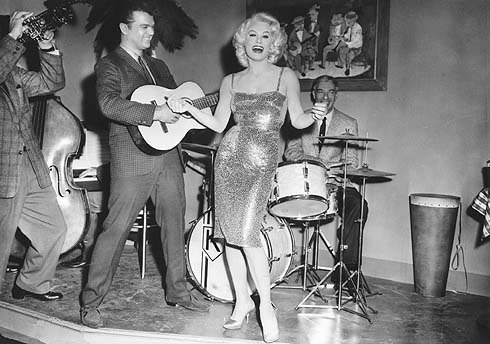
Let’s get it out of the way right now- SEX KITTENS GO TO COLLEGE is bad. Real bad. Like mind-numbingly bad. Despite the presence of sex kittens Mamie Van Doren and Tuesday Weld, this movie is a smelly litter box in desperate need of cleaning. It’s an Albert Zugsmith extravaganza, so you know right off the bat it’s gonna be a stinker. Zugsmith had once been a producer at Universal, overseeing prestige films like WRITTEN ON THE WIND and TOUCH OF EVIL. But when he went into independent productions, Zugsmith chose to go the low-budget exploitation route and even though he managed to attract some well-known names, his little epics usually stunk to high heaven.
The movie revolves around the talents of Mamie Van Doren, a beautiful creature whose best assets weren’t her acting. She plays Dr. Mathilda West, a genius hired to take over the science department at Collins College. Thinko, a supercomputer/robot type thing…
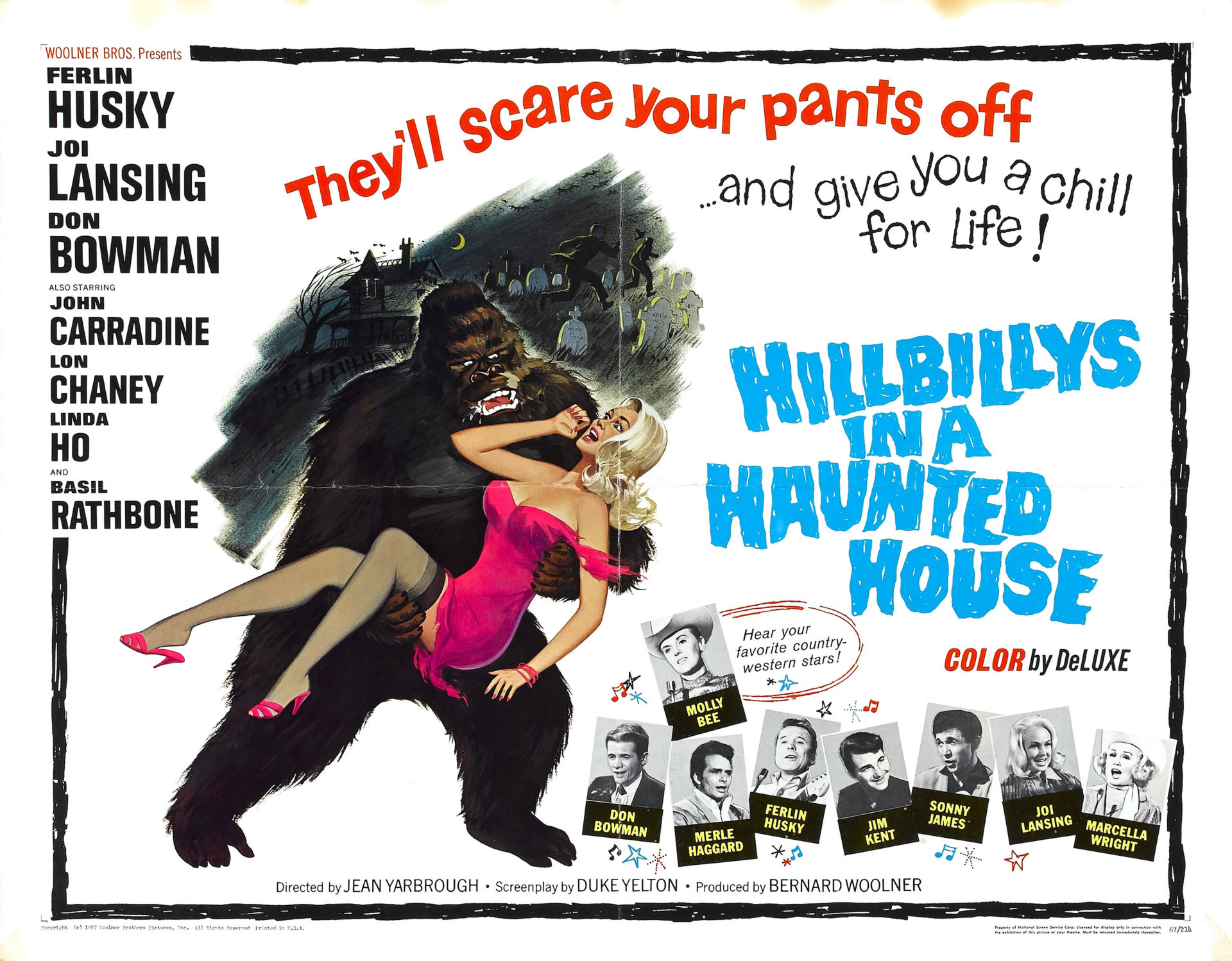
Let’s face it, HILLBILLYS IN A HAUNTED HOUSE is a lousy excuse for a movie. The acting is atrocious, the script derivative and juvenile, and the direction nearly non-existent. It’s a scare comedy that’s neither scary nor funny, and if you’re not a fan of 60’s style Country & Western music you’ll absolutely hate it. The only reason this Woolner Brothers drive-in dreck is remembered today is the presence of horror icons Basil Rathbone , John Carradine, and Lon Chaney Jr as the villains. But even this trio of terror can’t save the movie.
The plot (such as it is) concerns country entertainers Woody Weatherby (Ferlin Husky, a classic country singer who can’t act), Boots Malone (blonde bombshell Joi Lansing), and Jeepers (country comic Don Bowman) forced to spend the night in the eerie Beauregard Mansion. There put through the usual fright paces with ghosts (obvious sheets on strings), a “weird-woof” (as Jeepers…
Last night, as a part of my effort to clean out my DVR by watching and reviewing 38 movies in 10 days, I watched the 1956 Best Picture winner, Around The World In 80 Days.
Based on a novel by Jules Verne, Around The World In 80 Days announces, from the start, that it’s going to be a spectacle. Before it even begins telling its story, it gives us a lengthy prologue in which Edward R. Murrow discusses the importance of the movies and Jules Verne. He also shows and narrates footage from Georges Méliès’s A Trip To The Moon. Seen today, the most interesting thing about the prologue (outside of A Trip To The Moon) is the fact that Edward R. Murrow comes across as being such a pompous windbag. Take that, Goodnight and Good Luck.
Once we finally get done with Murrow assuring us that we’re about to see something incredibly important, we get down to the actual film. In 1872, an English gentleman named Phileas Fogg (played by David Niven) goes to London’s Reform Club and announces that he can circumnavigate the globe in 80 days. Four other members of the club bet him 20,000 pounds that he cannot. Fogg takes them up on their wager and soon, he and his valet, Passepartout (Cantinflas) are racing across the world.
Around The World in 80 Days is basically a travelogue, following Fogg and Passepartout as they stop in various countries and have various Technicolor adventures. If you’re looking for a serious examination of different cultures, this is not the film to watch. Despite the pompousness of Murrow’s introduction, this is a pure adventure film and not meant to be taken as much more than pure entertainment. When Fogg and Passepartout land in Spain, it means flamenco dancing and bullfighting. When they travel to the U.S., it means cowboys and Indians. When they stop off in India, it means that they have to rescue Princess Aouda (Shirley MacClaine!!!) from being sacrificed. Aouda ends up joining them for the rest of their journey.
Also following them is Insepctor Fix (Robert Newton), who is convinced that Fogg is a bank robber. Fix follows them across the world, just waiting for his chance to arrest Fogg and disrupt his race across the globe.
But it’s not just Inspector Fix who is on the look out for the world travelers. Around The World In 80 Days is full of cameos, with every valet, sailor, policeman, and innocent bystander played by a celebrity. (If the movie were made today, Kim Kardashian and Chelsea Handler would show up at the bullfight.) I watch a lot of old movies so I recognized some of the star cameos. For instance, it was impossible not to notice Marlene Dietrich hanging out in the old west saloon, Frank Sinatra playing piano or Peter Lorre wandering around the cruise ship. But I have to admit that I missed quite a few of the cameos, much as how a viewer 60 years in the future probably wouldn’t recognize Kim K or Chelsea Handler in our hypothetical 2016 remake. However, I could tell whenever someone famous showed up on screen because the camera would often linger on them and the celeb would often look straight at the audience with a “It’s me!” look on their face.
Around The World in 80 Days is usually dismissed as one of the lesser best picture winners and it’s true that it is an extremely long movie, one which doesn’t necessarily add up to much beyond David Niven, Cantinflas, and the celeb cameos. But, while it may not be Oscar worthy, it is a likable movie. David Niven is always fun to watch and he and Cantinflas have a nice rapport. Shirley MacClaine is not exactly believable as an Indian princess but it’s still interesting to see her when she was young and just starting her film career.
Add to that, Around The World In 80 Days features Jose Greco in this scene:
Around The World In 80 Days may not rank with the greatest films ever made but it’s still an entertaining artifact of its time. Whenever you sit through one of today’s multi-billion dollar cinematic spectacles, remember that you’re watching one of the descendants of Around The World In 80 Days.
For the last few days, I’ve been desperately trying to clean out my DVR. Ever since this year began, I have been obsessively recording movies and now, I suddenly find myself with just a few hours of space left! Now, I know that the simple solution would be to just start erasing stuff but that’s just not the way I do things. I recorded that stuff so you better believe I’m going to watch and review every single minute of it!
Last night, I did a quick count and discovered that I have 38 movies to watch before I can officially declare the DVR to have been “cleaned out.” While that may sound like a lot, it’s not if you consider that — by watching and reviewing 4 movies a day — I can have the whole job done by the end of the next week! That’s my plan and my challenge to myself. Can I watch and review 38 movies in 10 days?
Let’s find out!
So, I started things out by watching the 1937 film, Captains Courageous.Captains Courageous was aired on TCM as a part of their 31 Days of Oscar. Not only was Captains Courageous nominated for best picture but it won Spencer Tracy his first Oscar. Tracy was one of the quintessential American actors so it’s interesting to note that he won his first Oscar for playing a Portuguese fisherman who speaks in exaggeratedly broken English.
Spencer Tracy may have won the Oscar for Best Actor but his role is really a supporting one. Instead, Captains Courageous is about an extremely spoiled, obnoxious, and annoying 15 year-old named Harvey Cheyne (Freddie Bartholomew). From the minute that Harvey first appears on screen, it’s difficult to like him. The son of a rich businessman (Melvyn Douglas), Harvey is hated by everyone. His family’s butler rolls his eyes whenever Harvey calls for him. His classmates (and, of course, Harvey attends a snooty private school) want nothing to do with him. When his father takes him on a trans-Atlantic cruise, even the sailors seem like they want to toss him overboard.
However, before they get a chance to give him one quick shove over the railing, Harvey does their job for them. He falls overboard and he nearly drowns before being rescued by a fisherman named Manuel (Spencer Tracy). Manuel takes him back to the fishing schooner, where that ship’s captain (Lionel Barrymore) refuses to believe that Harvey is rich. Since the rest of the crew quickly decides that they dislike Harvey as much as everyone else does, the captain saves Harvey from being thrown back overboard by “hiring” him as a fisherman. And, of course, the captain makes Manuel responsible for him.
Though initially hostile, Harvey and Manuel slowly start to bond. Harvey learns about the importance of hard work and starts to grow up. And, eventually, it all leads to tragedy. That’s just how things work in the movies.
As you can probably guess from the plot description above, there’s not a subtle moment to be found in Captains Courageous but, as is so often the case with 1930s Hollywood, that’s actually what makes the film appealing. Captains Courageous wears its sentiment on its sleeve and it makes for an interesting contrast to the more cynical films of today. While it takes a while to get used to seeing Spencer Tracy giving such a theatrical performance, he does eventually win you over. Freddie Bartholomew is vulnerable enough to you can forgive his character for being so obnoxious. Meanwhile, Lionel Barrymore and Mevlyn Douglas are well-cast in their supporting roles and, if you keep an eye open, you’ll see everyone from John Carradine to a young Mickey Rooney working on the schooner. Ultimately, Captains Courageous is a well-made and likable coming-of-age film that still holds up today.
THE SHOOTIST is John Wayne’s valedictory statement, a final love letter to his many fans. The Duke was now 69 years old and not in the best of health. He’d had a cancerous lung removed back in 1964, and though the cancer was in remission, Wayne must’ve knew his days were numbered when he made this film. Three years later, he died from cancer of the stomach, intestines, and spine. There were worries about his ability to make this movie, but Wayne loved the script and was determined to do it. The result is an elegy to not only the aging actor, but to the Western genre as a whole.
The movie begins with footage of older Wayne westerns (EL DORADO, HONDO, RED RIVER, RIO BRAVO) narrated by Ron Howard (Gillom). “His name was J.B. Books…he wasn’t an outlaw. Fact is, for a while he was a lawman…He had a credo that…
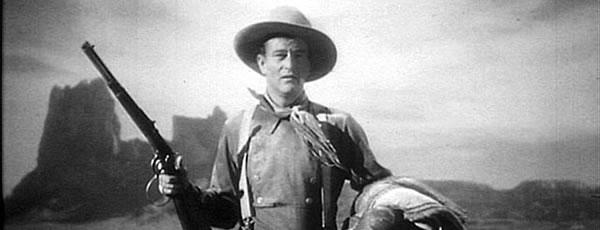
If you think the characters and Western tropes in STAGECOACH are familiar, you’re right. But let’s be clear… STAGECOACH introduced many of these now-clichéd devices to film, and is one of the enduring classics of the American West. Director John Ford was well versed in Westerns, having cut his professional teeth on them during the silent era. This was his first sound Western and Ford was determined to reinvent the genre, with much more adult themes than the usual Saturday matinée kiddie fare. He succeeded with a daring story featuring an outlaw and a prostitute as his heroes, and exceeded his goal by creating a brand new Hollywood star in the process: John Wayne.
Wayne had been a football player for the USC Trojans when an injury caused him to lose his scholarship. Through some university connections, he was able to gain employment in the film industry as a prop…





 Through the Shattered Lens