Horror Film Review: C.H.U.D. (dir by Douglas Cheek)


There’s something living under the streets of New York City.

That’s the basic idea behind 1984’s C.H.U.D., a film that opens with an upper class woman and her little dog being dragged into the sewers by a creature the reaches out of a manhole.  People are disappearing all over the city but the authorities obviously aren’t revealing everything that they know.  Even after the wife of NYPD Captain Bosch (Christopher Curry) disappears, the city government doesn’t seem to be too eager to dig into what exactly is happening.

Instead, it falls to two activists.  Photographer George Cooper (John Heard) specializes in taking picture of the homeless, especially the one who live underground in the New York subways.  He’s like a well-groomed version of Larry Clark, I guess.  Social activist A.J. “The Reverend” Shepherd (Daniel Stern) runs a homeless shelter and is convinced that something is preying on the most vulnerable citizens of New York.  When the police won’t do their job, George and the Reverend step up!

So, what’s living in the sewers?  Could it be that there actually are cannibalistic humanoid underground dwellers out there?  Everyone in New York City has heard the legends but, much like stories of the alligators in the Chicago sewers, most people chose not to believe them.  Or could the disappearance have something to do with the cannisters labeled Contamination Hazard Urban Disposal that are being left in the sewers by the Nuclear Regulatory Commission?  Wilson (George Martin) of the NRC says that they would never purposefully mutate the people living underground but Wilson works for the government so who in their right mind is going to trust him?

C.H.U.D. is a horror film with a social conscience.  It’s very much an 80s films because, while you have Shepherd running around and attacking everyone for not taking care of the most vulnerable members of society, the true villain is ultimately revealed to be the members of a regulatory agency.  Instead of finding a safe way to get rid of their nuclear waste, they just found a sneaky way to abandon it all in New York and obviously, they assumed no one would care because …. well, it’s New York.  Everyone in the country knows that New York City isn’t safe so who is going to notice a few underground monsters, right?

The idea behind C.H.U.D. has a lot of potential but the execution is a bit lackluster.  For every good C.H.U.D. kill, there’s long passages where the story drags.  Considering that Heard spent most of his career typecast as the type of authority figure who would dump nuclear waste under New York City, it’s actually kind of interesting to see him playing a sympathetic role here.  Daniel Stern, on the other hand, is miscast and rather hyperactive as Shepherd.  You really do want someone to tell him to calm down for a few minutes.  Watching C.H.U.D., one gets the feeling that it’s a film with an identity crisis.  Is it a horror film, an action flick, a work of social commentary, or a dark comedy?  There’s no reason why it can’t be all four but C.H.U.D. just never really comes together.  It ultimately feels more like a mix of several different films instead of being a film made with one clear and coherent vision.

In the end, Death Line remains the film to see about underground cannibals.
Shattered Politics: The Front Runner (dir by Jason Reitman)


Based (loosely, I assume) on a true story, 2018’s The Front Runner tells the story of a politician named Gary Hart (played by Hugh Jackman).

The year is 1987 and former U.S. Sen. Gary Hart is preparing to announce that he will be seeking the Democratic nomination for the Presidency of the greatest nation of all time, the United States!  (YAY!)  Hart is widely seen as the front runner, for both the nomination and the general election.  He’s got the youth vote sewn up.  He’s energetic.  He’s supposed to be intelligent.  We are told that he is handsome and charismatic.  (I say “told” because, in this film, they seem to be informed attributes as Hugh Jackman is given a truly terrible haircut and his performance here is a bit on the dull side.)  Hart announced his candidacy while standing in the Rocky Mountains.  His wife (Vera Farmiga) is behind him, even if she chooses not to join him on the campaign trail.  His campaign manager (J.K. Simmons) is welcoming new and idealistic volunteers to the campaign headquarters and encouraging them to remember that all of the difficulties of the campaign will be worth it after Gary Hart is elected president.  As for the press, they’re investigating long-standing rumors that Hart is a womanizer.  “Follow me around, you’ll get bored,” Hart says.  So, two reporters from the Miami Herald (Bill Burr and Steve Zissis) do just that they catch a young woman named Donna Rice (Sara Paxton) apparently staying over at Gary Hart’s Florida townhouse.

“It’s nobody’s business!” Hart snaps, when asked about his private life and it’s obvious that the film expects us to take Hart’s side.  The problem, as Hart’s campaign manager points out, is that a lot of people are volunteering for Hart’s campaign and have sacrificed a lot to help him out and now, if Hart doesn’t figure out some way to deal with the story, it looks like it was all for nothing.  Even if Hart didn’t cheat with Rice, he still showed remarkably poor judgment in spending time alone with her in Florida while his wife was back in Colorado.  The film argues that the press went overboard pursuing the story and perhaps they did.  The press tends to do that and really, no politician has any excuse not to realize that.  But, even if we accept the argument that the press acted unethically, that doesn’t exactly exonerate Gary Hart, though this film certainly seems to think that it does.  To a certain extent, this film reminded me a bit of James Vanderbilt’s Truth, in which it was assumed we would be so outraged that Cate Blanchett’s Mary Mapes was fired for producing a story about George W. Bush’s time in the National Guard that we would overlook that Mapes and CBS news tried to build a major story around a bunch of obviously forged documents.

(Of course, if Hart had been running today, I doubt the scandal would have ended his campaign.  If anything, Donald Trump’s personal scandals seemed to play to his advantage when he ran in 2016 and 2024.  To a find a 21st Century equivalent to Hart’s scandal, you’d probably have to go all the way back to John Edwards in 2008.  Of course, Edwards was cheating on his wife while she was dying of breast cancer, which makes Edwards a special type of sleaze.)

As for the film itself, director Jason Reitman tries to take a Altmanesque approach, full of overlapping dialogue and deceptively casual camera moments.  There are a few moments when Reitman’s approach work.  The start of the film, in which the camera glided over hundreds of journalists reporting from outside the 1984 Democratic Convention, was so well-handled that I briefly had hope for the rest of the film.  Reitman gets good performances from dependable veterans like J.K. Simmons and Alfred Molina.  But, at the heart of the film, there’s a massive blank as Hugh Jackman gives an oddly listless performance as Hart.  The film expects us to take it for granted that Gary Hart would have been a good President but there’s nothing about Jackman’s performance to back that up.  It’s odd because, typically, Hugh Jackman is one of the most charismatic actors around.  But, as Gary Hart, he comes across as being petulant and a bit whiny.

It’s an interesting story but ultimately, The Front Runner doesn’t do it justice.


Icarus File No. 20: Tough Guys Don’t Dance (dir by Norman Mailer)


The 1987 film, Tough Guys Don’t Dance, opens with Tim Madden (Ryan O’Neal) talking to his father, tough Dougy (Lawrence Tierney).  Dougy has stopped by Tim’s New England home to let Tim know that he has decided stop chemotherapy and accept his eventual death from cancer because, as Dougy puts it, “Tough guys don’t dance.”  The tone of Dougy’s voice is all we need to hear to know that, in his opinion, his son has spent way too much time dancing.

Tim is an ex-convict turned writer and, when we first see him, he’s obviously had a few rough nights.  He explains to Dougy that he woke up after a bender with his ex-girlfriend’s name tattooed on his arm, blood all over his jeep, and two heads dumped in his marijuana stash.  Tim says that he’s hopeful that he’s not the murderer but he can’t be sure.  He’s been drinking and doping too much.  He suffers from blackouts.  He’s not sure what happened.

The majority of the film is made up of flashbacks, detailing Tim’s affairs with a number of women and also his odd relationship with the town’s police chief, Luther Regency (Wings Hauser).  Luther is married to Tim’s ex-girlfriend, Madeleine (Isabella Rossellini), who long ago accompanied Tim on a trip to North Carolina where they hooked up with a fundamentalist preacher (Penn Jillette) and his then-wife, Patty Lariene (Debra Sundland).  (Tim found their personal ad while casually skimming the latest issue of Screw, as one does I suppose.)  Patty Lariene eventually ended up married to Tim, though she has recently left him.  As for Madeleine, she has never forgiven him for a car accident that they were involved in.  Is Tim capable of loving anyone?  Well, he does say, “Oh God, oh man,” repeatedly when he discovers that his wife has been having an affair.

Tim tries to solve the murders himself, finding that they involve not only him and Luther but also Tim’s old prep school friend, Wardley Meeks III (John Bedford Lloyd) and also some rather stupid drug dealers that Tim hangs out with.  The plot is almost ludicrously convoluted and it’s tempting to assume that the film is meant to be a parody of the noir genre but then you remember that the film is not only based on a Norman Mailer movie but that it was directed by Mailer himself.  Mailer, who was the type of public intellectual who we really don’t have anymore, was blessed with a brilliant mind and cursed with a lack of self-awareness.  There’s little doubt that we are meant to take this entire mess of a film very seriously.

And the film’s theme isn’t hard to pick up on.  By investigating the murders, Tim faces his own troubled past and finally comes to understand why tough guys, like his father, don’t hesitate to take action.  Tough guys don’t dance around what they want or need.  That’s a pretty common theme when it comes to Mailer.  Tim Madden is not quite an autobiographical character but he is, by the end of the story, meant to represent the type of hard-living intellectual that Mailer always presented himself as being.  Unfortunately, Ryan O’Neal wasn’t exactly an actor who projected a good deal of intelligence.  And, despite his lengthy criminal record off-screen, O’Neal’s screen presence was somewhat docile.  That served him well in films like Love Story and Barry Lyndon.  It serves him less well in a film like this.  It’s easy to imagine O’Neal’s Tim getting manipulated and, in those scenes where he’s supposed to be a chump, O’Neal is credible enough in the role.  It’s far more difficult to buy the idea of Tim actually doing something about it.

Indeed, it’s hard not to feel that co-star Wings Hauser would have been far more credible in the lead role.  But then, who would play Luther Regency?  Hauser gives such a wonderfully unhinged and out-there performance as Luther that it’s impossible to imagine anyone else in the role.  Maybe Hauser could have played both Tim and Luther.  Now that would have made for a classic film!

Tough Guys Don’t Dance is weird enough to be watchable.  The dialogue is both raunchy and thoroughly humorless, which makes it interesting to listen to, if nothing else.  The moments that are meant to be funny are so obvious (like casting noted atheist Penn Jillette as a fundamentalist) that it’s obvious that the moment that feel like clever satire were actually all a happy accident.  As far as Norman Mailer films go, this one is not as boring as Wild 90 but it also can’t match the unhinged lunacy of a frustrated Rip Torn spontaneously attacking Mailer with a hammer at the end of the unscripted Maidstone.  It’s a success d’estime.  Mailer flew too close to the sun but the crash into the ocean was oddly entertaining.

Previous Icarus Files:

  1. Cloud Atlas
  2. Maximum Overdrive
  3. Glass
  4. Captive State
  5. Mother!
  6. The Man Who Killed Don Quixote
  7. Last Days
  8. Plan 9 From Outer Space
  9. The Last Movie
  10. 88
  11. The Bonfire of the Vanities
  12. Birdemic
  13. Birdemic 2: The Resurrection 
  14. Last Exit To Brooklyn
  15. Glen or Glenda
  16. The Assassination of Trotsky
  17. Che!
  18. Brewster McCloud
  19. American Traitor: The Trial of Axis Sally

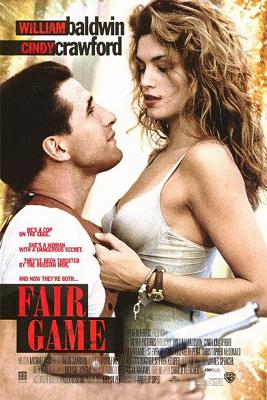
Insomnia File No. 7: Fair Game (dir by Andrew Sipes)


What’s an Insomnia File? You know how some times you just can’t get any sleep and, at about three in the morning, you’ll find yourself watching whatever you can find on cable? This feature is all about those insomnia-inspired discoveries!

Fair_game

On Tuesday night, if you were suffering from insomnia at midnight, you could have turned over to HBO Signature (commonly listed as HBOSIG) and watched Fair Game, a remarkably mindless action film from 1995.

Originally, my plan was to start this review of Fair Game by telling you, in quite a bit of detail, just how sick I am of the Russian Mafia.  Seriously, Russian mobsters have become the default villain for lazy crime films everywhere.  And, quite frankly, I’m getting bored with them.  I’m bored with how the head Russian mobster is always described as being “former KGB” and is always found sitting in the back room of restaurant, wearing an overcoat and smoking filterless cigarettes.  I am bored with how his main henchman is always some big guy with a crew cut and that guy always has a thin sidekick who wears his hair in a pony tail and has a bad mustache.  I’m sick of the overexaggerated accents of American and British accents trying to sound Russian and the way they’re always listening to EDM while driving.  It’s all so predictable and tedious.

But then I considered that Fair Game was made 20 years ago.  Even if the villains are Russian mobsters and even if they are some of the least interesting Russian mobsters in cinema history, it’s totally possible that, when Fair Game, was made, there was still some sort of novelty about the Russian Mafia.

However, even if we give Fair Game a pass on using the cliché of the Russian mob, the villains still weren’t particularly interesting.  Kazak (Steven Berkoff) is … well, the film isn’t really that clear on what Kazak’s big plan is but he has a lot of henchmen and they certainly do end up killing a lot of people.  Kazak runs his operations off of a yacht that belongs to a Cuban criminal named Emilio (Miguel Sandoval).  Emilio is in the process of getting divorced and attorney Kate McQuean (model Cindy Crawford, who made her film debut here and has never played a leading role since) is determined to repossess his boat.  So, Kazak decides that the perfect solution would be to murder Kate…

Which makes absolutely no sense.  Kazak doesn’t want anyone to discover his operation so he decides to blow up a good portion of Miami, all in pursuit of one person.  Wouldn’t it make more sense for Kazak to just blow up the boat and buy a new one?

Anyway, as the film opens, Kate is out jogging when suddenly someone driving by in a car opens fire on her.  She ends up getting grazed in the arm, not that it seems to bother her.  She wears a bandage for a few scenes but it soon vanishes.  Kate is all business so, even after getting shot, she still goes into the office and starts to make plans to repossess that yacht.  Personally, if anyone ever shot at me, I would probably be so freaked out that I would never leave the house again.

Now, you may be thinking that Kate was shot because of Kazak but actually, it turns out that the shooting was just a random thing that happened.  Apparently, the shooter was trying to shoot someone else and Kate just happened to be in the wrong place at the wrong time.  So, we never find out who actually shot Kate and that really bothered me, as that seems to be kind of a huge plot point to bring up and then refuse to resolve.

Anyway, Kate meets a detective named Max Kirkpatrick (William Baldwin) and, soon, they’re on the run from Kazak’s assassins.  The majority of the film is made up of Max and Kate running from one location to another.  One thing that really bothered me was that literally everyone that Max and Kate talked to ended up getting killed just a few minutes later.  At one point, Kate flirts with a computer service expert to get him to help them out.  The scene is played for laughs but then, five minutes later, that same innocent technician guy is being brutally tortured by a bunch of Russians and, though we don’t see it happen, it’s safe to assume that he was eventually murdered by them.  And no point do Max or Kate appear to feel any guilt or concern about the number of innocent people who are killed just for associating with them.

Anyway, Fair Game is a completely mindless film that has a rather nasty streak of sadism to it.  (I imagine, when this film was released, it probably set a record for close-ups of people getting shot and stabbed in the crotch.)  William Baldwin and Cindy Crawford both have perfect bodies and give totally wooden performances, which leads to them having a dimly-lit sex scene that is both physically hot and emotionally cold at the same time.

(I have no idea what entropy at absolute zero means but it sounds like a pretty good description of the chemistry between Cindy Crawford and William Baldwin in Fair Game.)

One good note: Salma Hayek has a small role as Max’s ex-girlfriend.  Whenever she shows up in the movie, she starts screaming at everyone.  I don’t blame her.

Fair Game

Previous Insomnia Files:

  1. Story of Mankind
  2. Stag
  3. Love Is A Gun
  4. Nina Takes A Lover
  5. Black Ice
  6. Frogs For Snakes