October True Crime: In Broad Daylight (dir by James Steven Sadwith)


On July 10th, 1981, Kenneth Rex McElroy was gunned down in Skidmore, Oklahoma.  He was shot while sitting in his truck.  Over 40 bullets were fired into the truck but only two actually hit McElroy.  His fourth wife, Trena (who Kenneth first met when she was 12 and he was 35), was sitting beside him at the time but was not hit by any bullets.  McElroy was 47 years old when he was gunned down in broad daylight.  There were reportedly 46 witnesses who saw the shooting occurred.  When interrogated by the police, not a single one said that they saw anything.  Quite a few did mention that Ken McElroy had gotten exactly what he deserved.

Ken McElroy was a high dropout, a barely literate career criminal who rustled cattle, burned down houses, raped his fourth wife when she was just 12, and then killed her family’s dogs in order to intimidate them into not pressing charges against him.  He was known as the town bully, a surly man who had 17 children with 6 different women and who would shoot anyone who disagreed with him.  Whenever he was charged with a crime, he would intimidate the witnesses into not testifying against him.  In 1980. he got angry at a store owner after one of his kids was accused of shoplifting candy.  McElroy shot the man and was put on trial for attempted murder.  For once, he was convicted but he was freed on bail while awaiting appeal.  When it become apparent that McElroy would not be going to prison for a while, the citizens of Skidmore….

Well, I should probably chose my words carefully.  The truth of the matter is that no one has even been charged with or convicted of killing Ken McElroy.  It is known that several citizens did have a meeting a few night before McElroy’s death and that they discussed what they could best do to keep McElroy from hurting anyone else.  It’s also knoqn that, a week before he was shot, McElroy walked into the local bar with his rifle and dared anyone who wanted him dead to come get him.  Does that mean that a group of concerned citizens took it upon themselves to dispense vigilante justice?  That’s what Trena always claimed but again, no one was every charged, indicted, or convicted.  The death of Ken McElroy remains officially unsolved.

Perhaps that’s why the names were changed for the 1991 made-for-television movie In Broad Daylight.  Brian Denney may be playing a character named Len Rowan but, for anyone familiar with the case, it’s obvious that he’s playing Ken McElroy just as Marcia Gay Harden is obviously playing Tena McElroy, even if her character is called Adina.  The film doesn’t change the name of the town and it doesn’t change the circumstances that led to McElroy’s death.  W watch as McElroy intimidates the owners of a grocery store (played by Cloris Leachman and John Anderson) and even attempts to bully the local police (represented here by Chris Cooper).  The film features a gun-toting crowd surrounding Len Rowan’s vehicle but it’s shot in such a way that their faces are blurry.

In Broad Daylight was filmed in Texas and it definitely captures both the beauty and the potential danger that comes with living in a rural community.  Everyone in town knows everyone else.  There’s a strong sense of community but, because the community is so small and isolated, it’s easy for a man like Len Rowan to bully the entire town.  Some of the actors lean a bit too hard into their country accents.  (Lord protect us from Yankees trying to sound Southern.)  But the main members of the supporting cast  — Cloris Leachman, John Anderson, Chris Cooper, Marcia Gay Harden — all give convincing performances.  As for Brian Dennehy, he’s absolutely horrifying as the astoundingly cruel Len Rowan.  Dennehy plays Len as being a man who might not exactly intelligent (the real Ken McElroy dropped out of school early) but who is positively brilliant at intimidating people.  Dennehy plays Rowan as if he has a death wish.  All of his threats and his speeches make it clear that he’s just daring someone to shoot him.  Even when he realizes he’s about to get shot while sitting in his truck, he sit there and accepts the inevitable.  Perhaps even he was getting sick of dealing with himself.

After watching In Broad Daylight, it’s easy to understand why no one came forward as a witness.  By his own actions, Ken McErloy was destined to die violently.  A few people just decided to speed things up a little.  Who knows who?
On Stage On The Lens: The Andersonville Trial (dir by George C. Soctt)


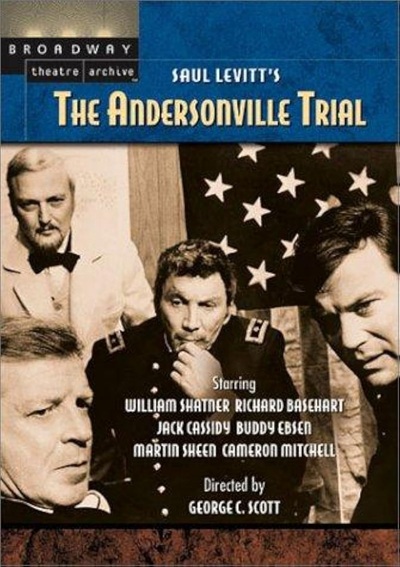
1970’s The Andersonville Trial takes place in one muggy military court room.  The year is 1865.  The Civil War is over but the wounds of the conflict are still fresh.  Many of the leaders of the Confederacy are still fugitives.  Abraham Lincoln has been dead for only a month.  The people want someone to pay and it appears that person might be Captain Henry Wirz (Richard Basehart).

Originally born in Switzerland and forced to flee Europe after being convicted of embezzlement, Henry Wirz eventually ended up in Kentucky.  He served in the Confederate Army and was eventually named the commandant of Camp Sumter, a prison camp located near Andersonville, Georgia.  After the war, Captain Wirz is indicted for war crimes connected to his treatment of the Union prisoners at the camp.  Wirz and his defense counsel, Otis Baker (Jack Cassidy), argue that the prison soon became overcrowded due to the war and that Wirz treated the prisoners as well as he could considering that he had limited resoruces.  Wirz points out that his requests for much-needed supplies were denied by his superiors.   Prosecutor Norton Chipman (William Shatner) argues that Wirz purposefully neglected the prisoners and their needs and that Wirz is personally responsible for every death that occurred under his watch.  The trial is overseen by Maj. General Lew Wallace (Cameron Mitchell), the same Lew Wallace who would later write Ben-Hur and who reportedly offered a pardon to Billy the Kid shortly before the latter’s death.  Wallace attempts to give Wirz a fair trial, even allowing Wirz to spend the trial reclining on a couch due to a case of gangrene.  (Agck!  The 19th century was a scary time!)

The Andersonville Trial started life as a 1959 Broadway production.  On stage, George C. Scott played Chipman, an experience he described as difficult because, even though Chipman was nominally the play’s hero, Wirz was actually a much more sympathetic character.  When the play was adapted for television in 1970, Scott returned to direct.  Admittedly, the television version is very stagey.  Scott doesn’t make much effort to open up the play.  Almost all of the action is confined to that courtroom.  We learn about the conditions at Fort Sumter in the same way that the judges learned about the conditions.  We listen as the witnesses testify.  We listen as a doctor played by Buddy Ebsen talks about the deplorable conditions at Fort Sumter.  We also listen as a soldier played by Martin Sheen reports that Wirz has previously attempted to suicide and we’re left to wonder if it was due to guilt or fear of the public execution that would follow a guilty verdict.  We watch as Chipman and Baker throw themselves into the trial, two attorneys who both believe that they are correct.  And we watch as Wirz finally testifies and the play hits its unexpected emotional high point.

As most filmed plays do, The Andersonville Trial demands a bit of patience on the part of the viewer.  It’s important to actually focus on not only what people are saying but also how they’re saying it.  Fortunately, Scott gets wonderful performances from his ensemble cast.  Even William Shatner’s overdramatic tendencies are put to good use.  Chipman is outraged but the play asks if Chipman is angry with the right person.  With many of the Confederacy’s leaders in Canada and Europe, Wirz finds himself standing in for all of them and facing a nation that wants vengeance for the death of their president.  Wirz claims and his defense attorney argues that Wirz was ultimately just a soldier who followed orders, which is what soldiers are continually told to do.  The Andersonville Trial considers when military discipline must be set aside to do what is morally right.

Admittedly, when it comes to The Andersonville Trial, it helps to not only like courtroom dramas but to also be a bit of a history nerd as well.  Fortunately, both of those are true of me.  I found The Andersonville Trial to be a fascinating story and a worthy production.

14 Days of Paranoia #3: The Lincoln Conspiracy (dir by James L. Conway)


When it comes to conspiracy theories involving presidential assassinations, the theories surrounding JFK may get all the attention but it’s the theories surrounding the death of Abraham Lincoln are usually far more plausible.

Unless, of course, it’s the theories that are pushed in the 1977 docudrama, The Lincoln Conspiracy.

A mix of documentary-style narration and really cheap-looking historical reenactments, The Lincoln Conspiracy essentially indicts almost everyone who was alive in 1865 as being a part of either the conspiracy or the subsequent cover-up.  Really, it’s remarkable how many historical figures are implicated in this film.

With the Civil War coming to a close, President Lincoln (John Anderson) hopes to pursue a generous reconstruction policy for the former Confederate States.  Secretary of War Edwin Stanton (Robert Middleton), Senator Ben Wade (Dick Callinan), and a host of other are all opposed to this plan, both because they want vengeance and they also want to make as much money as possible off of the Southern cotton fields.  They come up with a plan to impeach Lincoln but, in order to draw up the articles, they have to make sure that Lincoln is not seen for a few days.  When Col. Lafayette Baker (John Dehner) discovers that an actor named John Wilkes Booth (Bradford Dillman) is planning on kidnapping Lincoln, Stanton and his conspirators decide to give Booth their unofficial support.  However, when the plan changes at the last minute and Stanton decides that it would actually be a bad idea to kidnap Lincoln, an angry Booth decides to just kill Lincoln, Andrew Johnson, and William Seward.

Booth succeeds in shooting Lincoln and making his escape.  The other members of Booth’s group all fail in their assignments.  Andrew Johnson becomes president.  Though grievously wounded, William Seward survives.  Booth flees to Canada and …. oh, you thought Booth died?  No, that was just a look alike who was shot by a bizarre soldier named Boston Corbett.  By allowing everyone to believe that Booth was killed, Stanton is able to cover up any role he and his allies played in inspiring the assassination.  Unfortunately, Col. Baker keeps a diary and it seems like he might be planning on revealing the truth but he dies mysteriously before he can.

(And, to give the film some credit, Col. Baker’s sudden death at 41 was an odd one.  And, though it’s not really explored in the film, Boston Corbett, the man who shoot Booth, really was a weirdo who was described by contemporaries as being a religious fanatic who castrated himself and claimed to hear the voice of God.)

It’s a big conspiracy theory that is presented in The Lincoln Conspiracy.  In fact, it’s a bit too big to really be taken seriously.  The film pretty much accuses everyone in Washington of having a part in the assassination.  The film itself has the cheap look of a community theater production and the use of Dr. Samuel Mudd as a narrator only adds to the film’s silliness.  If you’re a fan of gigantic and thoroughly implausible conspiracy theories, as I am, the film is entertaining in its way.  If nothing else, Bradford Dillman certainly looks like how most people probably imagine John Wilkes Booth to have looked.  Otherwise, The Lincoln Conspiracy is far-fetched and not at all realistic, which is why I assume that a lot of people in 1977 probably believed every word of it.

Previous entries in 2025’s 14 Days Of Paranoia:

  1. The Fourth Wall (1969)
  2. Extreme Justice (1993)

Scalplock (1966, directed by James Goldstone)


In this comedic western, gambler Benjamin Calhoun (Dale Robertson) wins big in a poker game.  Not only does he walk away with several thousand dollars but he also now owns his own railroad, the BP;S&D.  Calhoun celebrates the biggest win of his career by tossing ten dollar bills at the townspeople, recruiting a worshipful young assistant (Bob Random), and commandeering a private railcar that belongs to wealthy Burton Standish (John Anderson).  In the car, he finds Marta Grenier (Diana Hyland), a “working woman,” who has been hired to provide company for Standish.

Calhoun and Marta ride off to check out Calhoun’s new railroad.  What he discovers is that the railroad that he won is not only not completed but the workers are striking because they haven’t been paid in two weeks.  The quick-thinking Calhoun offers to make all of the workers part-owners of the railroad.  With construction once again starting, Calhoun tries to figure out how to keep his new business open.  He also meets a strong-headed storekeeper named Joanna Royce (Sandra Smith).

When Standish finally shows up, it turns out that he was originally planning on buying the BP;S&D.  Will Calhoun hold onto the railroad and honor the promise he made to the workers or will he sell out to Standish?

For all the talk about completing the railroad, Scalplock ends with most of the work undone.  That’s because Scalplock was a pilot for The Iron Horse, a television series that lasted for two seasons in the 60s.  Scalplock (and The Iron Horse) is mostly a showcase for Dale Robertson, a low-key but always convincing actor who specialized in westerns.  Usually, Robertson was cast as an upstanding citizen and law enforcement agent.  In Scalplock, he’s playing the type of genial rogue that James Garner played on Maverick and later in The Rockford Files.  Robertson is likable in Scalplock and even convinces us that Calhoun would choose his workers over a quick payday.  Fan of the genre will enjoy Scalplock, as long as they don’t get too invested in witnessing that last track of rail laid into the ground.

Dale Robertson, who started his career in the 40s, continued to act through the 90s, though usually as a guest star instead of a series lead.  Robertson eventually retired to Oklahoma where he owned a ranch that was home to over 200 horses.  He passed away in 2013 at the age of 89.

The Further Adventures of Jedadiah Leland In The Internet Archive


Tonight, I returned to the Internet Archive.  The last time I was there, I had promised that I would come back and play a game called Sex Olympics.  I was not really being serious when I wrote that but, as I have learned over the past few days, when you promise your editor that you are going to review a game called Sex Olympics, she is not going to let you off the hook until you do it.

However, before playing Sex Olympics, I decided to run another scenario through President Elect (1987, Strategic Simulations, Inc.).  

1 President Elect

The last time I played President Elect, I simulated the current election and the game predicted that Donald Trump would win 535 electoral votes and 56% of the popular vote.  (For the record, Hillary did win the District of Columbia.)  This time, I decided to see what would have happened if, in 1980, the GOP had not selected Ronald Reagan and instead given their nomination to North Carolina Senator Jesse Helms.

According to the simulation, independent candidate John Anderson would have received a lot more votes than the 5 million he won in the actual election:

2 President Elect3 President Elect4 President Elect

(For the record, in the actual election, Ronald Reagan won 50% of the popular vote, Jimmy Carter took 41% and John Anderson received 6.6%.)

But what would the electoral college look like?

7 President Elect

In the simulation, John Anderson won the most electoral votes with 233.  But it takes 270 electoral votes to win the election.

That’s not good.

6 President Elect

There you have it!  Jimmy Carter would have come in third but he still would have been elected President.  Jesse Helms would have returned to the Senate and John Anderson would have been screwed over.

Once that was settled, I was ready to play Sex Olympics (1990, Free Spirit Software, Inc).

8 Sex Olympics

In Sex Olympics, you are legendary porn actor and intergalactic superstud Brad Stallion.  You have been recruited to represent Earth in the Sex Olympics.  Your goal is to go from planet to planet and do it with as many aliens as possible.  But you have to be clever and you have to be quick because your main competition is Dr. Dildo and he appears to be much better at this than you are.

When the game starts, you are here:

9 Sex Olympics

You have a blond assistant named Sandie, who you can either ask questions or screw.  Since Sandie never had much to say whenever I tried to talk to her, I went with screw.

11 sex olympics

Yeah, that’s hot.

Unfortunately, neither talking to nor screwing Sandie helped me with my main problem.  I could not figure out how to get out of the damn room!  I clicked on both doors.  I clicked on the window.  I pushed the “e” key for east and the “n” key for north.  I tried to call someone on the phone.  No matter what I did, the same thing happened:

10 Sex Olympics

Finally, I figured out that you had to click use and then click a very specific place on the door on the west wall if you wanted to go outside.  Clicking on go and then the door won’t work.  Clicking on use and then clicking on door won’t work.  No, you have to click on use and then click exactly on the door knob if you want to go outside.

I bet this crap never happens to Dr. Dildo.

Once I finally managed to get outside, I found the Big Thruster waiting for me.

12 sex olympics

Inside Big Thruster, I discovered all the planets that I could go to in my effort to defeat Dr. Dildo and prove Earth’s carnal superiority:

13 Sex Olympics

Let’s go to the big red one.  Why not?

14 Sex Olympics

The big red planet turned out to be planet of volcanoes.  This did not look promising but at least there was a village in the valley below.

15 Sex Olympics

I was heading into the village when suddenly…

16 Sex Olympics

That dog looks really mean!  Forget this, I’ll just go back to Big Thruster and visit another planet!

17 Sex Olympics

This little white planet looks promising.  Let’s see what it’s like.

18 Sex Olympics

Is that an igloo?  Let’s see if anyone’s down there!

19 Sex Olympics

This is a lot better than that killer dog on the volcano planet!  Let’s heat this igloo up!

20 Sex Olympics

“Inge has nothing to say.”  That line pretty much sums up the entire game.

21 Sex Olympics

Oh, I have to manually tell the game that I want to remove my clothes?  Sorry, I just assumed that it was implied.

22 Sex Olympics

Is it usually this difficult to have sex with a blue-skinned alien on an ice planet!?

Things got a lot more difficult when I was suddenly told that I had been arrested for indecent exposure and sent back to Earth!

23 Sex Olympics

I don’t have time for this!  I’m trying to defend the honor of Earth!

24 Sex Olympics

Good for Dr. Dildo.

Eventually, I was released from jail and I was sent back to where it all started.

25 Sex Olympics

And that’s when I said forget it.  This is too much trouble for a planet that is not even willing to support me.  Dr. Dildo can have the medal.  Brad Stallion is retired!

After being left disappointed by Sex Olympics, I decided to try playing a game called Survival In New York City (Keypunch, 1986).  

27 Survival in New York City

Survival in New York City is a text adventure game from Keypunch, a company that was notorious for stealing other people’s games and releasing them without any designer credits.  That appears to be the case of Survival in New York City.

It’s still not a bad game.  You wake up in an alley in New York City with no memory of who you are or how you got there.

28 survival in new york city

Your goal is to not get killed while exploring New York.  That is easier said than done.

29 Survivla in New York City

A piece of advice: Don’t go near the teenagers until you have figured how to get a gun.

I played Survival In New York a few times.  I got further every time but I still ended up dying.  Sometimes, I was killed by teens.  Sometimes, I was killed by Hell’s Angels.   It is a game that I will be playing again.

After that grim journey through New York, I decided to finish off my visit by playing a classic, Lemonade Stand (1973, Minnesota Educational Computing Consortium).

30 Lemonade 2

30 Lemonade

Lemonade Stand was the very first business simulation game.  You have a lemonade stand.  Every day, you decide how much lemonade to make, how many signs to make, and how much to charge per glass.  If you do a good job, you make money.  If you do a bad job, you go out of business and have to live with the shame of failure for the rest of your life.

For some reason, I decided to open my lemonade stand on a cloudy day.

31 Lemonade

Because of the bad weather, I did not sell any lemonade on that day or the next.  Finally, on the third day, I decided to take a chance and see what would happen if I tried to sell on a cloudy day.  It was time to take a risk.

32 Lemonade

I know that some people would say, “With a 50% chance of rain, why even try?”  I’ll tell you why.  In this country, you gotta make the money first. Then when you get the money, you get the power. Then when you get the power, then you get the women.

Besides, what’s the worse that could happen?

33 Lemonade

At this point, I did what any gamer would do when the game was not going his way.  I quit and started over.

34 Lemonade

Sunny!  Now, this is more like it!

35 Lemonado

I took a chance.  I invested all of my money in making lemonade.  Unfortunately, that left me no money for advertising.

36 Lemonade

I ended up throwing out 70 glasses of lemonade but I still made a profit.  That’s the important thing.  Now, my fate and the fate of my lemonade business depended on tomorrow’s weather.

37 Lemonade

Oh yeah, baby!  Hot and dry!

38 Lemonade

I had learned my lesson from yesterday.  I made less glasses but I paid for two signs.  And I charged a little more because it’s hot and dry.  People are suffering out there.  They need my lemonade and I need their money.

39 Lemonade

$4.15 in profit!  I am a business genius!  Get out of my way, Bill Gates!  Look out, Warren Buffett!  There’s a new player on the block!

But then I asked myself, “When did this crazy business become all about money?”  It was supposed to be about the lemonade.  I had made my money and proven my point.  Taking my $4.15 with me, I pressed ESC and retired from the lemonade game.

I never looked back.

After that, I left the Internet Archive.  I was through exploring for the night but I knew that I would come back in the future and simulate another presidential election or attempt to survive in New York City or maybe I would even get back in the lemonade business.

But you can forget about the Sex Olympics.

Dr. Dildo can have that medal.

Thank You, Mr. Peckinpah: Ride the High Country (1962, directed by Sam Peckinpah)


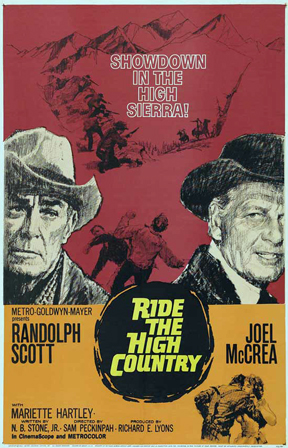
rideIt’s the turn of the 20th century and the Old West is fading into legend.  When they were younger, Steve Judd (Joel McCrea) and Gil Westrum (Randolph Scott) were tough and respect lawmen but now, time has passed them by.  Judd now provides security for shady mining companies while Gil performs at county fairs under the name The Oregon Kid.  When Judd is hired to guard a shipment of gold, he enlists his former partner, Gil, to help.  Gil brings along his current protegé, Heck Longtree (Ron Starr).
On their way to the mining camp, they spend the night at the farm of Joshua Knudsen (R.G. Armstrong) and his daughter, Elsa (Mariette Hartley).  Elsa is eager to escape her domineering father and flirts with Heck.  When they leave the next morning, Elsa accompanies them, planning on meeting her fiancée, Billy Hammond (James Drury), at the mining camp.

When they reach the camp, they meet Bill and his four brothers (John Anderson, L.Q. Jones, John Davis Chandler, and the great Warren Oates).  Billy is a drunk who is planning on “sharing” Elsa with his brothers.  Gil, Judd, and Heck rescue Elsa and prepare for a final confrontation with the Hammond Brothers.  At the same time, Gil and Heck are planning on stealing the gold, with or without Judd’s help.

Ride the High Country was actually Sam Peckinpah’s second film but it’s the first of his films to truly feel like a Sam Peckinpah film.  (For his first film, The Deadly Companions, Peckinpah was largely a director-for-hire and had no say over the script or the final edit.)  Peckinpah rewrote N.B. Stone’s original script and reportedly based the noble Steve Judd on his own father.  All of Peckinpah’s usual themes are present in Ride the High Country, with Judd and, eventually, Gil representing the dying nobility of the old west and the Hammond brothers and the greedy mining companies representing the coming of the “modern” age.  Ride The High Country‘s final shoot-out and bittersweet ending even serve as a template for Peckinpah’s later work in The Wild Bunch.

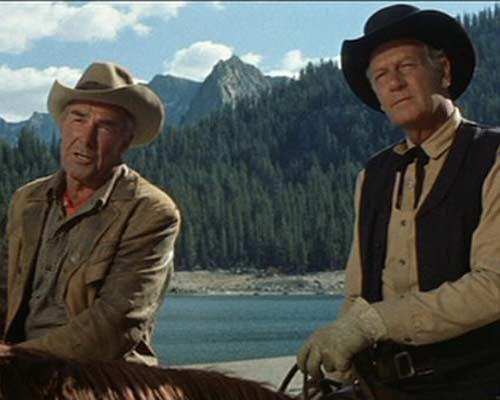
Much like the characters they were playing, Randolph Scott and Joel McCrea were two aging veterans on the verge of retirement.  For these two aging stars, who had starred in countless westerns before this one, Ride The High Country would provide both fitting farewell and moving tribute.  This would be the last chance that either of them would have to appear in a great movie and both of them obviously relish the opportunity.  The best moments in the film are the ones where Judd and Gil just talk with the majestic mountains of California in the background.

Among the supporting cast, Ron Starr and Mariette Hartley are well-cast as the young lovers but are never as compelling as Gil or Judd.  Future Peckinpah regulars R.G. Armstrong, L.Q. Jones, and Warren Oates all make early appearances.  Seven years after playing brothers in Ride the High Country, L.Q. Jones and Warren Oates would both appear in Peckinpah’s most celebrated film, The Wild Bunch.

The elegiac and beautifully-shot Ride The High Country was Sam Peckinpah’s first great film and it might be his best.

Randolph Scott and Joel McCrea in Ride The High Country

Randolph Scott and Joel McCrea in Ride The High Country

Horror on TV: The Twilight Zone 2.18 “The Odyssey of Flight 33”


TheTwilightZoneLogo

Remember how this morning’s movie — Robot Monster — featured dinosaurs?

Well so does tonight’s episode of The Twilight Zone!  In The Odyssey of Flight 33, a commercial airline flight somehow flies straight into the past, where they see …. dinosaurs!  Now, I’ll be honest here.  These are not dinosaurs like the dinosaurs in Jurassic World.  But I imagine for 1961, those dinosaurs were pretty impressive!

And this episode holds up as well.  I especially love the ambiguous ending.

The Odyssey of Flight 33 originally aired on February 24th, 1961.

Embracing the Melodrama Part II #43: The Stepmother (dir by Howard Avedis)


stepmotherJust looking at the poster for the 1972 film The Stepmother, I bet you think it’s a pretty scandalous and sordid film.  I mean, there’s a picture of a woman wearing a black bra and there’s a tagline that reads, “She forced her husband’s son to commit the ultimate sin!”

CIP_Logo

Well, perhaps not surprisingly considering that this is a Crown International film, The Stepmother‘s poster and tagline have very little do with the actual film.  Yes, the film does feature a stepmother and, during the final 20 or so minutes of the film, her stepson does finally show up and she does end up sleeping with him.  It’s consensual.  There’s no forcing involved.  And, as far as the ultimate sin part is concerned — well, her husband has been doing a lot worse.

The film itself is actually about the husband.  Frank Delgado (Alejandro Rey) is a wealthy architect who is also insanely jealous of his new wife, Margo (Katherine Justice).  Whenever he suspects that Margo is cheating on him, he ends up killing someone.  And, as a matter of fact, even when he doesn’t think Margo is cheating on him, he ends up killing someone.  Frank, of course, has to find a way to cover up all of his various murders.  It doesn’t help that Inspector Darnezi (John Anderson) is constantly snooping around.  And then, once he discovers that his stepson actually has slept with Margo (as opposed to all the people he killed just because he assumed they had slept with Margo), Frank is forced to decide whether or not to kill his own son.

The Stepmother is available in about a dozen Mill Creek boxsets and it’s fun in a 1972 sort of way.  Frank and all of his friends are decadent rich people so you could argue that the film is meant to be a portrait of the immorality of the 1%.  (That would actually be a pretty stupid argument but it’s one that you could make if you’re trying to impress someone who hasn’t read this review.)  Director Howard Avedis tries to liven up the plot by including a lot of artsy touches that don’t really add up to much but which are still fun to watch.  Occasionally, he’ll toss in a freeze frame for no particular reason.  As well, Frank has a habit of hallucinating.  He continually sees his first victim running across the beach in slow motion.  Make a drinking game out of it.  Every time it’s obvious that The Stepmother was trying to fool people into thinking it was a European art film, take a drink.

To be honest, the most interesting thing about The Stepmother is that it is the only Crown International film to have received an Oscar nomination!  That’s right!  The Stepmother was nominated for Best Original Song.  The name of the song was Strange Are The Ways Of Love.  You can listen to it below if you want.  Feel free to dance.

Anyway, that’s The Stepmother for you.  It’s not my favorite Crown International film but, as a historical oddity, it’s still worth watching.

http://www.youtube.com/watch?v=lKO-U5J4Vrs