Music Review: Pink Floyd — The Wall (dir by Alan Parker)


1982’s Pink Floyd — The Wall is a film that I have mixed feelings about.

Some of that is due to my feelings about Pink Floyd.  On the one hand, I can’t deny their talent and I do like quite a few of their songs, if they do all tend to be a bit on the portentous side. On the other hand …. Roger Waters!  Bleh, Roger Waters. Waters was one of the founders of Pink Floyd and, for a while, the band’s de facto leader.  He’s also a rabid anti-Semite and a defender of Vladimir Putin’s.  That said, I’ve discovered that I can justify listening to Pink Floyd by remembering that the rest of the band hates Roger Waters as well and that Waters himself eventually left Pink Floyd.  Waters’s bandmate, David Gilmour, has flat-out called Roger Waters an anti-Semite.  Last year, when we had a total eclipse of the sun, I was happy to be able to play the last two tracks of Dark Side of the Moon while enjoying the early and temporary evening.  It just felt appropriate.

Outside of Dark Side of the Moon, The Wall is probably Pink Floyd’s best-known work.  (When I was younger, I can remember my Dad playing it whenever he was driving across the country.)  A concept album about how much it sucks to be a wealthy Englishman, The Wall is one of those albums and films that are beloved by people who consider themselves to be alienated.  Even more so than the average Pink Floyd album, The Wall was the brainchild of Roger Waters and, when the movie version was made in 1982, Waters wrote the screenplay.  That said, I think you can argue that, much as with Tommy, The Wall was ultimately more about the vision of the film’s director than that of the man who wrote the songs.

The Wall is definitely an Alan Parker production.  It’s big.  It embraces the sordid.  It’s stylish almost to the point of parody.  Every image has been carefully constructed by a director who got his start doing commercials and whose main goal was to get an immediate audience reaction.  Much like Parker’s Midnight Express or Evita, it’s a film that grabs your attention while you’re watching it and only afterwards do you stop consider that there really wasn’t much going on underneath the surface.

Pink (Bob Geldof) is a self-loathing rockstar who is haunted by his childhood in post-WWII Britain and whose marriage is failing.  He’s building a wall, brick-by-brick, to keep himself separated from pain but the price of becoming comfortably numb is to be so alienated that you imagine becoming a neo-Nazi who orders his followers to follow the Worm.  The imagery is powerful.  The animated sequences by Gerald Scarfe still make quite an impression, especially the marching hammers.  The score features songs like Another Brick In The Wall, Comfortably Numb, and Run Like Hell.  The film is relentless, full of downbeat imagery that is often excessive but which Parker understood would appeal to the film’s target audience.  Indeed, it’s such an overwhelming film that it’s easy to overlook the fact that, even before he transformed into a fascist, Pink is a drab character and his main problem seems to be that he can’t seem to find anything good to watch on television.

That said, I have to admit that, despite myself, I do like The Wall.  It’s just so shameless that it’s hard not to enjoy the silliness of it all.  Add to that, Comfortably Numb is a great song.  (Another Brick In The Wall is also a great song though perhaps not for the reasons that Waters thought it was.)  The Wall is a monument to the joys of cinematic excess.
A Shock To The System (1990, directed by Jan Egleson)


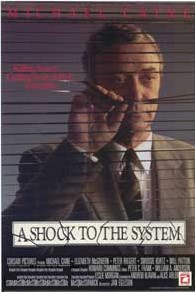
Graham Marshall (Michael Caine) has spent years toiling away as an executive at an advertising firm and being nagged by his wife (Swoosie Kurtz), who claims that Graham doesn’t have enough of a killer instinct to get ahead.  When Graham is passed over for a promotion that he felt was promised to him, Graham starts to reconsider everything that he once believed.  While Graham is waiting for the train to take him home, he is approached by an obnoxious panhandler who always asks him for money.  That night, instead of ignoring the panhandler, Graham shoves him in front of the train.  When no one notices that Graham has murdered the panhandler, Graham decides to get revenge on everyone who he blames for the sorry state of his life.

With each murder, Graham rises higher in the company and he feels better about his life.  But each murder brings to Graham a new set of complications that he has to clean up.  Lt. Laker (Will Patton) thinks that Graham is responsible for all of the deaths that have recently occurred but he doesn’t have the evidence to charge him.  His murder spree brings him a chance of romantic redemption with Stella (Elizabeth McGovern) but soon, even she suspects that Graham might actually be a killer.  Luckily for him, Graham learns that he can get away with his crimes because the system is set up to protect men like him.

A Shock To The System is a pitch-black comedy that benefits from the casting of Michael Caine in the lead role.  Caine is one of the few actors who can make a resentful and bitter sociopath likable and he does that in A Shock To The System.  Graham starts out beaten down by the world and being passed over for younger executives like Bob Benham (Peter Reigert) but, by the end of the film, he’s become as ruthless a killer as Jack Carter.  Just as in Get Carter, A Shock To The System features Michael Caine making evil very compelling.

Horror Film Review: The Lawnmower Man (dir by Brett Leonard)


The 1992 horror/sci-fi hybrid, The Lawnmower Man, tells the story of two men.

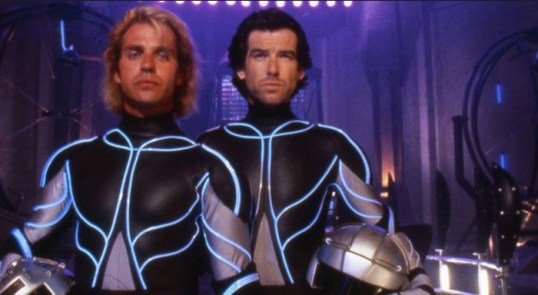
Dr. Lawrence Angelo (played by Pierce Brosnan) is a scientist who is experimenting with ways to make less intellectually inclined people smarter. Dr. Angelo is kind of a burn out. You can tell he has issues because he needs to shave, he’s always sitting in the dark, and he’s never without a cigarette. You look at Dr. Angelo and you just imagine that he smells like smoke, bourbon, and lost dreams.

Jobe (Jeff Fahey) is the kind-hearted but intellectually disabled man who lives in a shack and spends his time mowing everyone’s lawn. Hence, he’s known as the …. wait for it …. THE LAWNMOWER MAN!

Together, Dr. Angelo and Jobe solve crimes!

No, not really. Instead, Dr. Angelo decides to experiment on Jobe. This leads to Jobe not only becoming smarter but also quicker to anger. Soon, Jobe is developing psychic abilities. He can move things with his mind. He can magically set people on fire. Basically, he can do whatever the script needs for him to do at the moment. Jobe is soon tormenting everyone who once bullied him. Father McKeen, the pervy priest, gets set on fire. Jake, the gas station attendant, is put into a catatonic state. An abusive father get run over by a lawnmower.

Dr. Angelo knows that Jobe is out-of-control and that the experiment has to be reversed. However, the sinister group behind Angelo’s research wants to use Jobe as a weapon because …. well, because they’re evil and that’s what evil people did back in 1992. Jobe, however, has other plans. He wants to become pure energy so that he can rule over a virtual world….

Or something like that. To be honest, it’s kind of difficult to really figure out what’s going on in The Lawnmower Man. The movie shares its name with a Stephen King short story but it has so little in common with its source material that King reportedly sued to get his name taken out of the credits. (Considering some of the films that King has allowed himself to be associated with, this is kind of amazing.) The film tries to be a satire, a slasher film, a conspiracy film, and a technology-gone-crazy film all in one and the end result is one big mess.

Along with all of that, The Lawnmower Man is also a time capsule of when it was made. A good deal of the film takes place in Jobe’s virtual reality universe, which looks a lot like a mix of Doom and Second Life. I imagine the film’s special effects may have seen impressive way back in the 20th Century but, seen today, they’re rather cartoonish, if occasionally charmingly retro.

On the plus side, the film does have an interesting cast. Pierce Brosnan is never convincing as burn-out but he tries so hard that he’s still fun to watch. Underrated actors like Jenny Wright, Geoffrey Lewis, Dean Norris, and Troy Evans all get a chance to show what they can do in minor roles. Finally, you’ve got the great Jeff Fahey, giving a far better performance than the script perhaps deserves. Though the film may be a mess, there’s something undeniably fun watching Jeff Fahey’s Jobe go from being meek to being a megalomaniac.

It’s a silly film and not one that’s meant to be watched alone. This is a film that has to be watched with a group of your snarkiest friends. Watch it the next time you’re looking for an excuse to avoid doing the yard work.

Film Review: Out of Bounds (dir by Richard Tuggle)


Just a country boy

Born and raised in South Des Moines

He took the midnight bus to anywhere….

That’s the story of Darryl Cage, the protagonist of the 1986 film, Out of Bounds.  Played by Anthony Michael Hall, Darryl is an Iowa farm boy who goes to Los Angeles to live with his brother.  Unfortunately, when his flight lands, Darryl’s suitcase is switched with another one that’s full of cocaine!  Darryl becomes an accidental drug mule and end up getting his brother killed!  WHAT A DUMBASS!

So now, Darryl is on the run.  He’s a small town farmer in the big city, trying to avoid bad guy Roy (Jeff Kober) and the police, led by Lt. Delgado (Glynn Turman).  Fortunately, Darryl meets an aspiring actress named Dizz (Jenny Wright).  Dizz gives him a makeover and introduces him to the Los Angeles club scene.  Siouxsie and the Banshees make a cameo appearance at one club.  They perform one song and fortunately, it’s Cities in the Dust.  Unfortunately, they don’t actually get involved in the plot of the film.  I would have liked to have seen Siouxsie beat up Jeff Kober.  But it doesn’t happen.

Out of Bounds is one of the many films that came out in the mid-to-late-80s in which the actors who were (somewhat unfairly) considered to be Brat Packers attempted to prove that they were capable of doing more than just projecting teen angst.  Judd Nelson and Ally Sheedy, for instance, starred in a forgettable neo-noir called Blue City.  Andrew McCarthy starred in an interesting but ultimately uneven film called Kansas.  Emilio Estevez not only starred in Wisdom but he directed it too.  And Anthony Michael Hall starred in Out of Bounds.

Anthony Michael Hall was best-known for playing nerdy characters in Sixteen Candles and The Breakfast Club and it’s probable that he was attempting to escape being typecast when he took his role in Out of Bounds.  This was Anthony Michael Hall’s chance to play an action hero!  Unfortunately, Anthony Michael Hall made the same mistake that many of his peers made while trying to give the performance that would allow them to break free of the Brat Pack label.  He tried too hard.  While Glynn Turman, Jeff Kober and Jenny Wright obviously understood the type of  rather silly movie that Out of Bounds was going to be and they modified their performances accordingly, Anthony Michael Hall apparently tried to duplicate the method intensity of Marlon Brando or James Dean.  In other words, Hall took the film far more seriously than it deserved to be taken.

Out of Bounds get off to a bad start as soon as it opens with Anthony Michael Hall on the farm in Iowa.  There’s absolutely nothing about the young Anthony Michael Hall that leaves on with the impression that he’s ever spent any time on a farm.  Everything about him screams Hollywood before he even lands in Los Angeles.  Hence, it gets difficult to really buy him as being the wide-eyed innocent that everyone else views him as being.  Since a good deal of the film’s plot is dependent upon Hall being naïve, that’s a problem.  He may be a farm boy but he certainly doesn’t freak out after shooting someone.  He’s also somehow learned how to throw a knife straight into someone’s gut.  Out of Bound‘s director, Richard Tuggle, directed two films for Clint Eastwood so he obviously knew how to frame a fight scene but Hall is so miscast that it’s impossible to really get into the movie.

The film is pretty much stolen by Jenny Wright and Jeff Kober.  Kober is properly menacing and, just as she did in Near Dark and I, Madman, Jenny Wright works wonders with a role that could have just been formulaic.  Jenny Wright has apparently retired from acting.  Jeff Kober still shows up in movies and on television, usually playing villains.  (Earlier this year, he played yet another drug trafficker on General Hospital.)  Watching them give compelling performance in a film like Out of Bounds, it’s hard not to feel that both of them deserved bigger career than they had (or, in Kober’s case, still have).

The film is also stolen by its soundtrack, which is very 80s but in the best possible way.  Adam Ant, The Smiths, the aforementioned Souixsie and the Banshees, they all make an appearance and provide the film with a bit of narrative momentum that it would otherwise lack.  Watching the film, 80s Los Angeles comes across like a fun place.  No wonder Darryl Cage wanted to stay even though everyone was trying to kill him.

Out of Bounds is ultimately pretty forgettable and it didn’t make Anthony Michael Hall into an action star.  But, that’s okay.  Like a lot of former Brat Packers, he’s proven himself to be a reliable character actor.  There is life after high school.  Even more importantly, there’s also life after Iowa.

The TSL’s Horror Grindhouse: I, Madman (dir by Tibor Takacs)


In the 1989 horror film, I, Madman, Jenny Wright stars as Virginia.  Virginia’s an aspiring actress who makes ends meet by working in a used bookstore.  (I’m not sure how much money the typical used bookstore employee makes but I have to say that Virginia’s apartment is absolutely to die for.)  Virginia is also dating a police detective named Richard (Clayton Rohner), who is handsome and sweet and looks good in a suit.  In fact, the only problem with Richard is that he thinks that Virginia spends too much time reading trashy horror novels.  According to him, they give her nightmares and they cause her imagination to run wild.

Richard’s not going to be happy to discover that Virginia has a new favorite author.  His name is Malcolm Brand and, despite the fact that Virginia says that he’s better than Stephen King, he’s a mysteriously obscure author.  In fact, no one but Virginia seems to have ever heard of him.  Virginia has just finished reading Brand’s first book, Much of Madness, More of Sin.  Now, she simply has to find his second book, which was called I, Madman.

(Personally, I think Much of Madness, More of Sin is a brilliant title.  I, Madman on the other hand is a little bit bland, as far as titles go.)

When Virginia finally tracks down a copy of the book, she discovers that it is all about this mad scientist who falls in love with an actress.  Because the scientist is horribly disfigured, the actress rejects him.  So, the scientist starts killing people and stealing pieces of their faces, all so he can patch together a new face for himself.

It’s while she’s reading the book the strange things start to happen in Virginia’s life.  For instance, the people around her start dying.  When she witnesses one of her neighbors being murdered, she swears that the murder was committed by a man who had no nose …. just like in the book!  Richard thinks that she’s letting her imagination run wild but Virginia soon comes to wonder if maybe she’s being stalked by the real Malcolm Brand….

I, Madman is an entertaining little horror film, one that sometimes comes across as being an extended episode of something like Tales From The Crypt.  From the minute the movie started with Virginia curled up on her couch in her underwear, reading a trashy novel with her oversized reading glasses on and a storm raging outside, I was like, “Oh my God, they made a movie out of my life!”  And really, this is one of the reasons why I, Madman makes such a good impression.  As played by Jenny Wright, Virginia serves as a stand-in for every horror fan who has ever read a scary novel and immediately imagined themselves as either the protagonist or the victim.  If you’ve ever had a nightmare after reading Stephen King or watching a horror movie, you’ll be able to relate to Virginia.  Both Jenny Wright and Clayton Rohner give likable and quirky performances in the lead role and they’re surrounded by capable of character actors.

The film itself is a bit of an homage to the suspense classics of the past.  It’s easy to compare Malcolm Brand’s novel to The Phantom of the Opera while a scene in which Virginia watches her neighbor play piano brings to mind Hitchcock’s Rear Window.  When Virginia imagines herself as a character in one of Brand’s stories, the film even manages to work in some stop-motion animation.  All in all, I, Madman is an entertaining horror film, perfect for October and any other season.

Horror Film Review: Near Dark (dir by Kathryn Bigelow)


The 1987 film Near Dark is the story of two American families.

The Coltons are a family of ranchers living Oklahoma.  Loy Colton (Tim Thomerson) is the patriarch, keeping a watchful eye on his children, Caleb (Adrian Pasdar) and Sarah (Marcie Leeds).  Caleb is a cowboy and a nice guy, even if he does seem to be a little bit too naive for his own good.  After Caleb disappears one night, Loy and Sarah start their own search, traveling across the back roads of the Southwest.

The other family may not share any biological relation to one another but they definitely share blood.  They’re a group of outcasts who have found each other and now spend their nights searching for people who can satisfy their hunger.  They’re vampires, even though that’s not a word that they tend to use.  (In fact, for all the blood-sucking that goes on throughout the film, the term “vampire” is never actually heard.)  At night, they’re all-powerful but during the day, even the slightly exposure to the sun can set them on fire.

The patriarch of this family is Jesse Hooker (Lance Henriksen), a scarred war veteran.  Jesse will do anything to protect the members of his family but he expects each of them to pull their weight.  At one point, when Jesse is asked how old he is, he says that he fought for the South and that the South lost.

Jesse’s girlfriend is Diamondback (Jenette Goldstein), who is just as ruthless as Jesse.  Filling the role of oldest son is Severen (Bill Paxton), a cocky gunslinger with a quick smile and cruel sense of humor.  Homer (Joshua Miller) appears to be a 12 year-old boy but he’s actually one of the older and more violent members of the family.  And then there’s Mae (Jenny Wright), the rebellious daughter.

Mae is the one who first met and bit Caleb.  She’s the one who turned Caleb into one of them, though it takes Caleb a while to not only discover but also understand what he’s become.  When Caleb tries to escape from Mae and his new family, he becomes violently ill.  He can no longer eat human food but, at the same time, he can’t bring himself to hunt.  Instead, he’s forced to drink whatever blood Mae can provide for him.  Even when Jesse’s group attacks a redneck bar, one cowboy manages to escape, specifically because Caleb cannot bring himself to kill him.

What is Caleb to do?  He can’t return to his old family, as much as he may want to.  (It doesn’t help that Homer has developed an obsession with Caleb’s sister, Sarah.)  At the same time, his new family says that they’re going to kill him unless he starts hunting for blood.  They only thing keeping Caleb alive is the fact that Mae likes him and even she’s telling him that he’s going to have to hunt.

Meanwhile, Loy continues his own hunt, the hunt for his son….

Long before she became the first female director to win an Oscar for The Hurt Locker, Kathryn Bigelow directed this stylish vampire film.  Visually, Bigelow emphasizes the emptiness of the Southwestern plains.  Looking at the desolate landscape, it’s easy to believe that Jesse and his family could use them to successfully hide from the rest of the world.  It’s also just as easy to believe that a well-meaning but not particularly bright young man like Caleb could get lost and not be able to find his way home.  Bigelow turns the vampire family into a group of modern-day outlaws, crossing the land in their sun-proofed vehicles and trying to stay one step ahead of modern-day posses made up by concerned families and law enforcement officers who don’t know what they’re getting into.

Even if not for Bigelow’s stylish direction, the film would be a classic for just the cast alone.  Henriksen, Paxton, and Goldstein all previously appeared in James Cameron’s Aliens and they have a camaraderie that feels real.  In fact, the vampires work so well together that it’s impossible not to kind of admire them.  They’ve got it together and, even when faced with an army of police officers determined to make them step out into the sunlight, they don’t lose their sardonic sense of humor.  The much missed Bill Paxton’s performance is a hyperactive marvel, both menacing and sexy at the same time.  Meanwhile, Jenny Wright and Adrian Pasdar have a likable chemistry as Mae and Caleb while Tim Thomerson makes Loy’s love and concern for his son feel so real that adds an unexpected emotional depth to the overall movie.  The script, written by Eric Red and Bigelow, is full of quotable dialogue and the cast takes full advantage of it.

Near Dark is vampire classic and definitely one to watch this Halloween season.

4 Film Reviews: Bridge To Silence, The Chocolate War, Kiss The Bride, Wedding Daze


Last week, I watched six films on This TV.

Which TV?  No, This TV!  It’s one of my favorite channels.  It’s not just that they show a lot of movies.  It’s also that they frequently show movies that are new to me.  For instance, last week, This TV introduced me to both Prison Planet and Cherry 2000.

Here are four other films, two good and two not so good, that This TV introduced to me last week.

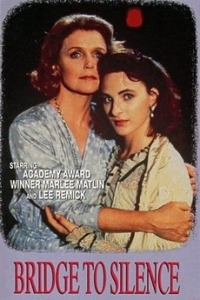
First up, we have 1989’s Bridge to Silence.

Directed by Karen Arthur, Bridge To Silence was a made-for-TV movie.  Lee Remick plays Marge Duffield, who has a strained relationship with her deaf daughter, Peggy (Marlee Matlin).  After Peggy’s husband is killed in a traffic accident, Peggy has a nervous breakdown.  Marge and her husband, Al (Josef Sommer) take care of Peggy’s daughter, Lisa, while Peggy is recovering.  However, even as Peggy gets better, Marge still doesn’t feel that she can raise her daughter so Marge files a lawsuit to be named Lisa’s legal guardian.  While all of this is going on, Peggy is starring in a college production of The Glass Menagerie and pursuing a tentative romance with the play’s director (Michael O’Keefe).

Bridge to Silence is one of those overwritten but heartfelt melodramas that just doesn’t work.  With the exception of Marlee Matlin, the cast struggles with the overwrought script.  (Michael O’Keefe, in particular, appears to be miserable.)  The film’s biggest mistake is that it relies too much on that production of The Glass Menagerie, which is Tennessee Williams’s worst play and tends to be annoying even when it’s merely used as a plot device.  There’s only so many times that you can hear the play’s director refer to Peggy as being “Blue Roses” before you just want rip your hair out.

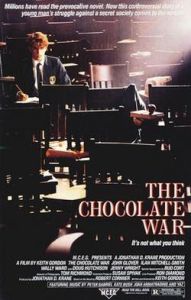
Far more enjoyable was 1988’s The Chocolate War.

Directed by Keith Gordon, The Chocolate War is a satirical look at conformity, popularity, rebellion, and chocolate at a Catholic boys school.  After the manipulative Brother Leon accidentally purchases too much chocolate for the school’s annual sale, he appeals to one of his students, Archie Costello (Wallace Langham), to help him make the money back.  Archie, who is just as manipulative as Leon, is the leader of a secret society known as the Vigils.  However, Archie and Leon’s attempt to manipulate the students runs into a roadblack when a new student, Jerry Renault (Illan Mitchell-Smith) refuses to sell any chocolates at all.  From there, things get progressively more complicated as Archie tries to break Jerry, Jerry continues to stand up for his freedom, and Leon … well, who knows what Leon is thinking?

The Chocolate War was an enjoyable and stylish film, one that featured a great soundtrack and a subtext about rebellion and conformity that still feels relevant.  John Glover and Wallace Langham both gave great performances as two master manipulators.

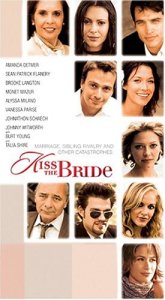
I also enjoyed the 2002 film, Kiss The Bride.

Kiss The Bride tells the story of a big Italian family, four sisters, and a wedding.  Everyone brings their own personal drama to the big day but ultimately, what matters is that family sticks together.  Directed by Vanessa Parise, Kiss The Bride featured believable and naturalistic performances from Amanda Detmer, Talia Shire, Burt Young, Brooke Langton, Monet Mazur, and Parise herself.

I have to admit that one reason why I liked this film is because it was about a big Italian family and it featured four sisters.  I’m the youngest of four sisters and, watching the film, I was reminded of my own big Irish-Italian family.  The movie just got everything right.

And then finally, there was 2006’s Wedding Daze.

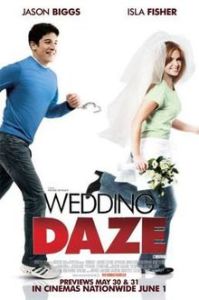
Wedding Daze is a romantic “comedy.”  Anderson (Jason Biggs) asks his girlfriend to marry him, just to have her drop dead from shock.  Anderson’s best friend is afraid that Anderson will never get over his dead girlfriend and begs Anderson to not give up on love.  Anderson attempts to humor his friend by asking a complete stranger, a waitress named Katie (Isla Fisher), to marry him.  To everyone’s shock, Katie says yes.

From the get go, there are some obvious problems with this film’s problem.  Even if you accept that idea that Katie would say yes to Anderson, you also have to be willing to accept the idea that Anderson wouldn’t just say, “No, I was just joking.”  That said, the idea does have some comic potential.  You could imagine an actor like Cary Grant doing wonders with this premise in the 30s.  Unfortunately, Jason Biggs is no Cary Grant and the film’s director, comedian Michael Ian Black, is no Leo McCarey.  In the end, the entire film is such a misjudged failure that you can’t help but feel that Anderson’s ex was lucky to die before getting too involved in any of it.

Embracing the Melodrama Part II #73: St. Elmo’s Fire (dir by Joel Schumacher)


St_elmo's_fire

Oh my God!  Aren’t rich, white people just like the worst!?

Actually, usually I would never say something like that.  I usually find class warfare to be tedious and I personally think poor people can be just as annoying as rich people.  I had no interest in the whole Occupy Wall Street thing and I once referred to V For Vendetta as being V For Vapid.

No, I may not be much of a class warrior but then again, that may be because I never met any of the characters at the center of the 1985 film St. Elmo’s Fire.  Seriously, if anything could turn me into a slogan-spouting, window-smashing revolutionary, it would be having to deal with any of the self-centered, entitled characters in St. Elmo’s Fire.

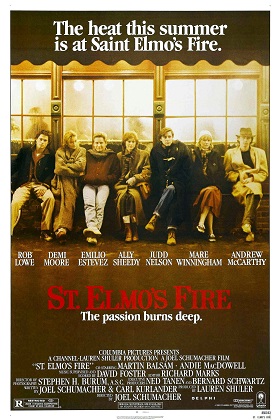
St. Elmo’s Fire is about a group of seven friends, three of whom are played by actors who co-starred in The Breakfast Club.  These friends all met at and are recent graduates from Georgetown University.  St. Elmo’s Fire follows them as they laugh, love, drink, do drugs, and try to figure out what they want to do with the rest of their lives.

For instance, there’s Billy (Rob Lowe), who has big hair and wears one dangling earring.  Billy was in a fraternity and spends most of the movie wishing that he still was.  Billy also plays the saxophone and he has a wife and a kid who he has pretty much abandoned … well, you know what?  I like Rob Lowe.  He seems like a fun guy and his DirectTV commercials were all classics but oh my God, does he ever give a bad performance in St. Elmo’s Fire.  Some of it is because Billy is not a very likable character.  He’s supposed to be the rough-around-the-edges, secretly sensitive rebel type but ultimately, he just comes across as being a loser.

And then there’s Jules (Demi Moore), who does too much cocaine and, as a result, finds herself fearing that she’s on the verge of being sold into a sexual slavery.  Jules doesn’t get to do much other than be rescued by the other characters.  Fortunately, when it looks like the group is drifting apart, Jules attempts to commit suicide and brings everyone back together.  Way to be a plot device, Jules!

Wendy (Mare Winningham) is the sweet but insecure virgin who has a crush on Billy.  Wendy works as a social worker and ends up getting insulted by the very people that she’s trying to help.  Winningham gives one of the film’s better performances but you can’t help but feel that Wendy deserves better friends.

Speaking of good performances, Andrew McCarthy also gives a pretty good one.  McCarthy plays Kevin Dolenz, the idealistic writer who everyone is convinced is gay because he hasn’t had sex in 2 years.  However, Kevin is actually in love with his best friend’s girlfriend.  As written, Kevin runs the risk of coming across as being insufferably moralistic but McCarthy gives a likable performance.  He turns Kevin into the nice guy that we all want to know.

And then there’s the Breakfast Club alumni.

Alec Newberry (Judd Nelson) was the vice-president of the Georgetown Democrats but now, because it pays better, he’s taken a job working for a Republican senator.  Alec’s girlfriend is Leslie (Ally Sheedy).  Alec obsessively cheats on Leslie, claiming that he can’t be loyal to her unless she’s willing to marry him.  The group of friends is largely centered around Alec and Leslie though it’s never really clear why.  Alec and Leslie are boring characters and, as a result, they’re a boring couple.

And then there’s Kirby (Emilio Estevez).  Estevez gives a likable performance but he often seems to be appearing in a different movie from everyone else.  Kirby is working on his law degree and he’s in love with a hospital intern named Dale (Andie MacDowell).  Unfortunately, Dale isn’t as interested in Kirby as he is in her so Kirby responds by stalking her and trying to change her mind.  There’s an earnestness and sincerity to Kirby that makes you like him, even if his behavior is actually rather creepy.

As for the film itself — well, it’s directed by Joel Schumacher and there’s a reason why Schmacher has the reputation that he does.  As a director, Schumacher is good at gathering together an attractive cast but he has close to no idea how to tell a compelling story.  St. Elmo’s Fire plods along, dutifully telling its story but providing little insight or surprise.

If you’ve read some of my previous reviews, you’re probably expecting this to be the point where I argue that St. Elmo’s Fire works as a time capsule.  But, honestly, this film doesn’t have enough insight to really work as a time capsule.  I mean, if you love 80s hair and 80s fashion, you might enjoy St. Elmo’s Fire but, then again, you could always just do a google image search and have the same basic experience.