Horror on TV: Gargoyles (dir by Bill Norton)


For today’s horror on television, we have a made-for-TV monster movie from 1972, Gargoyles!

What happens when a somewhat condescending anthropologist (Cornel Wilde) and his daughter (Jennifer Salt) head out to the desert?  Well, they stop by a crazy old man’s shack so that they can look at his genuine monster skeleton.  Before Wilde can thoroughly debunk the old man’s claims, the shack is attacked by real monsters!

That’s right!  Gargoyles exist and they apparently live in Arizona!  There’s nothing particularly surprising about the plot but the gargoyles are memorable creations and Bernie Casey gives a good performance as their leader.  The gargoyle makeup was designed by none other than Stan Winston, who won an Emmy for his work here and who went on to win Oscars for his work on Aliens, Terminator 2, and Jurassic Park.

As well, a very young Scott Glenn shows up in the cast.  I like to think that he’s playing the same character in both Gargoyles and Sucker Punch.

Enjoy!

Icarus File No. 18: Brewster McCloud (dir by Robert Altman)


First released in 1970, Brewster McCloud takes place in Houston.

A series of murders have occurred in the city.  The victims have all been older authority figures, like decrepit landlord Abraham Wright (Stacy Keach, under a ton of old age makeup) or demanding society matron Daphne Heap (Margaret Hamilton, who decades earlier had played The Wicked Witch in The Wizard Of Oz).  The victims all appear to have been killed by strangulation and all of them are covered in bird droppings.  Perplexed, the Houston authorities call in Detective Frank Shaft (Michael Murphy) from San Francisco.  Shaft only wears turtlenecks and he has piercing blue eyes.  He looks like the type of guy you would call to solve a mystery like this one.  It’s only later in the film that we discover his blue eyes are due to the contact lenses that he’s wearing.  Frank Shaft is someone who very much understands the importance of appearance.  As one detective puts it, when it comes to Shaft’s reputation, “The Santa Barbara Strangler turned himself in to him.  He must have really trusted him.”

Perhaps the murders are connected to Brewster McCloud (Bud Cort), who lives in a bunker underneath the Astrodome and who seems to be fascinated with birds.  Brewster dreams of being able to fly just like a bird and he’s spent quite some time building himself a set of artificial wings.  A mysterious woman (Sally Kellerman) who wears only a trenchcoat and who has scars on her shoulder blades that would seem to indicate that she once had wings continually visits Brewster and encourages him to pursue his dream.  However, she warns him that he will only be able to fly as long as he remains a virgin.  If he ever has sex, he will crash to the ground.

Brewster thinks that he can handle that.  Then he meets a tour guide named Suzanne Davis (Shelley Duvall, in her film debut) and things start to change….

Brewster McCloud is a curious film.  The story is regularly interrupted by a disheveled lecturer (Rene Auberjonois) who is very much into birds and who, over the course of the film, starts to more and more resemble a bird himself.  The film is full of bird-related puns and there are moments when the characters seem to understand that they’re in a movie.  Frank Shaft dresses like Steve McQueen in Bullitt and his blue contact lenses feel like his attempt to conform to the typical image of a movie hero.  (A lengthy car chase also feels like a parody of Bullitt’s famous chase scene.)  When the old woman played by Margaret Hamilton dies, the camera reveals that she’s wearing ruby slippers and a snippet of Somewhere Over The Rainbow is heard.  As played by Bud Cort, Brewster is the perfect stand-in for the lost youth of middle class America.  He knows that he’s rebelling against something but he doesn’t seem to be quite sure what.  Brewster, like many idealists, is eventually distracted by his own desires and his once earnest plans come cashing down.  Brewster becomes an Icarus figure in perhaps the most literal way possible, even if he doesn’t come anywhere close to reaching the sun.  As with many of Altman’s films, Brewster McCloud is occasionally a bit too esoteric for its own good but it’s always watchable and it always engages with the mind of the viewer.  One gets the feeling that many of the film’s mysteries are not necessarily meant to be solved.  (Altman often said his best films were based on dreams and, as such, used dream logic.)  With its mix of plain-spoken establishmentarians and quirky misfits, Brewster McCloud is not only a classic counterculture film but it’s also a portrait of Texas on the crossroads between the cultures of the past and the future.

Though it baffled critics when it was released, Brewster McCloud has gone on to become a cult film.  It’s a bit of a like-it-or-hate-it type of film.  I like it, even if I find it to be a bit too self-indulgent to truly love.  Quentin Tarantino, for his part, hates it.  Brewster McCloud was released in 1970, the same year as Altman’s Oscar-nominated M*A*S*H.  (Both films have quite a few cast members in common.)  Needless to say, the cheerfully and almost defiantly odd Brewster McCloud was pretty much ignored by the Academy.

Previous Icarus Files:

  1. Cloud Atlas
  2. Maximum Overdrive
  3. Glass
  4. Captive State
  5. Mother!
  6. The Man Who Killed Don Quixote
  7. Last Days
  8. Plan 9 From Outer Space
  9. The Last Movie
  10. 88
  11. The Bonfire of the Vanities
  12. Birdemic
  13. Birdemic 2: The Resurrection 
  14. Last Exit To Brooklyn
  15. Glen or Glenda
  16. The Assassination of Trotsky
  17. Che!

October True Crime: Out of the Darkness (dir by Jud Taylor)


The 1985 film, Out of the Darkness, takes place in New York City.

It begins in 1977 and it ends in 1978.  As the opening title card informs us, it’s a film about a city that was living in fear of the gunman known as the Son of Sam.  One of the first images that we see is an a handgun being fired at two people who are making out inside of a car.  We then cut to a police station where a homicide detective (played by Sam McMurray) reads aloud the letter that the Son of Sam sent to Jimmy Breslin.

That said, David Berkowitz, the killer who claimed that he was told to murder by a dog before later changing his story and claiming that he was a part of a Satanic conspiracy, spends most of the film in the shadows.  His name isn’t even mentioned until the film’s final third.  Instead, the majority of the film focuses on Ed Zigo (Martin Sheen), a New York City detective who tries to balance his desire to catch the Son of Sam with taking care of his wife (Jennifer Salt), who is due to have surgery for her heart condition.  Ed Zigo is dedicated and intelligent New York cop, the type who has no problem walking into a Mafia-controlled bar and asking the owner if his son has any connections to the family business.  He’s also a dedicated family man who freaks out when his daughter goes out on a date.  When his wife dies after surgery, Ed Zigo deals with his grief by throwing himself into his work but, as he tells his priest (Hector Elizondo), he no longer has his old confidence.  He fears that he’s going to make a mistake that’s either going to put his partner (Matt Clark) in harm’s way or allow the Son of Sam to continue to killing.

And really, it’s not a problem that the film focuses less on the killer and more on the people trying to track him down.  Martin Sheen gives a strong and sincere performance as the dedicated Ed Zigo, perfectly capturing not only his dedication but also his fear and his weariness.  (In many ways, his performance here feels like a forerunner to his performance in The Departed.)  The film captures the feel of living in a city where no one trusts anyone and it is also a good example of a “New Yorkers will be rude to anyone” film.  Even with a killer running around, no one wants to listen to a word the police have to say.  When David Berkowitz does show up, he’s played by an actor named Robert Trebor who gives an appropriately creepy performance.

Interestingly enough, Joe Spinell also appears in Out of the Darkness, playing the small but important role of an early Son of Sam suspect.  Though he only appears in two scenes, Spinell makes a memorably seedy impression.  Of course, today, Spinell is remembered for playing a character based on the Son of Sam in the infamous 1980 grindhouse shocker, Maniac.

(Trivia fans will also want to note that Charlie Sheen has a wordless cameo as a man who shuts his apartment door in the face of Martin Sheen and Matt Clark when they attempt to ask him if he witnessed the latest murder.  “Nice guy,” Martin says, in response.)

If you’re looking for a film in which Berkowitz is cursed out by a dog, Summer of Sam is probably the one to go for.  However, if you’re looking for a more low-key but realistic portrayal of Berkowitz’s reign of terror, Out of the Darkness is a good one to go with.

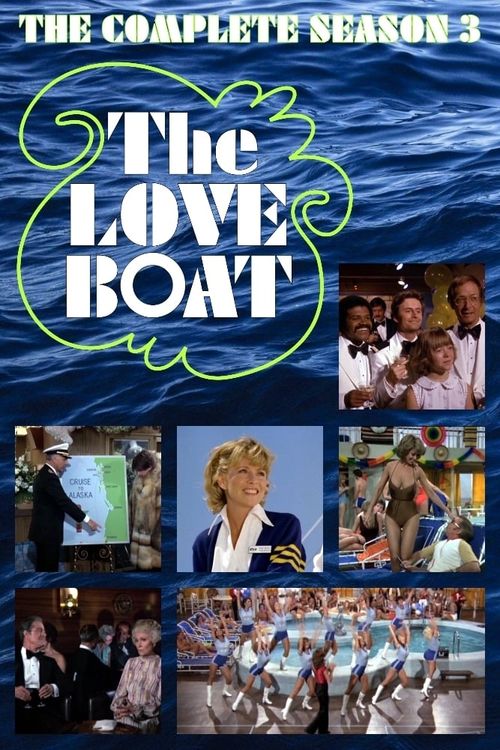
Retro Television Reviews: The Love Boat 3.5 “The Scoop/The Audit Couple/My Boyfriend’s Back”


Welcome to Retro Television Reviews, a feature where we review some of our favorite and least favorite shows of the past!  On Wednesdays, I will be reviewing the original Love Boat, which aired on ABC from 1977 to 1986!  The series can be streamed on Paramount Plus!

Today, the IRS takes a cruise.  Agck!

Episode 3.5 “The Scoop/The Audit Couple/My Boyfriend’s Back”

(Dir by Jack Arnold, originally aired on October 6th, 1979)

Captain Stubing is being audited!

Damn the IRS!  What a bunch of money-obsessed fascists!

The IRS agent, Viola Penny (Phyllis Diller), has booked a room on the cruise so that she can look through Captain Stubing’s records and….

Wait a minute.  If you’re an IRS agent, you get to go on a luxury cruise and also look through someone’s private information?  That sounds like fun!  Sign me up!

Anyway, Viola originally seems to be tough-minded and determined to toss Capt. Stubing in jail.  But then she gets drunk at dinner and, when she wakes up in the captain’s cabin, she’s convinced that she and Stubing are now lovers.  She decides to go easy on the audit but then she comes across $50,000 hidden in an ice bucket and she becomes convinced that Stubing is cheating the government and that he seduced her to keep her from finding out.  But then she discovers that the money is actually the crew emergency fund and she falls in love with Stubing again….

Yeah, it’s hard to keep track of how Viola feels from scene to scene.  At the end of the episode, she declares her love for the captain and leaves the boat.  Stubing realizes that he forgot to ask her what the results of his audit were but he also orders Gopher not to call her back to the boat.  If there’s a new captain next week, I’ll just assume Stubing’s in USP Marion.

Meanwhile, caddish Jay Cavanaugh (Lyle Waggoner) is really excited when he sees his ex-girlfriend, Patricia Lucas (Jennifer Salt), on the boat.  Jay is determined to get back together with Patricia, despite the fact that Patricia is on her honeymoon with her new husband, Danny (Richard Kline).  Danny is instantly jealous of Jay, who has a perfect smile and a perfect tan.  However, he needn’t be insecure because Patricia is totally in love with him.  Still, Danny keeps walking in on Jay flirting with Patricia and soon, he declares that the marriage is over.

Patricia tricks Jay into stepping up on a stage in the Acapulco Lounge and announcing that he’s in love with Patricia.  Patricia then announces that Jay has no idea what love is and declares, in front of all the crew and passengers, that she’s in love with Danny.  Danny and Patricia’s marriage is saved but seriously, Danny was kind of wimpy about the whole thing.  It seems like Patricia deserved better than both Jay and Danny.

Finally, Simon Scott (Ray Buktenica) is a tabloid reporter who is on the cruise because he’s been assigned to discover who the famous actress, Jackie Landers (Joyce Dewitt), is traveling with.  It turns out that Jackie is not traveling with a romantic partner but instead with her autistic son.  At first, Jackie pretends to be in a relationship with Doc Bricker but eventually, Simon discovers the truth.  However, Simon refuses to write a tabloid-style story about her child so Jackie falls in love with him and hires him to help her write her own non-tabloidy story about her son.

This episode was a mixed bag.  The IRS storyline was frustrating, largely because it featured a lot of complications that could have been prevented by people just not jumping to conclusions.  The newlyweds story felt anticlimactic because there was never any question about who Patricia would choose to be with.  But the storyline with Jackie, Simon, and Jackie’s son was actually pretty sweet.  Ultimately, this was a pleasant but forgettable cruise.

Retro Television Reviews: The Great Niagara (dir by William Hale)


Welcome to Retro Television Reviews, a feature where we review some of our favorite and least favorite shows of the past!  On Sundays, I will be reviewing the made-for-television movies that used to be a primetime mainstay.  Today’s film is 1974’s The Great Niagara!  It  can be viewed on YouTube!

The Great Niagara takes place during the Great Depression.

With the world mired in economic uncertainty and the threat of war right around the corner, people are more desperate than ever for entertainment.  One of the latest fads is attempting to conquer the Niagara by going over the falls in some sort of raft.  If done correctly, it can lead to fame and fortune.  But, if one mistake is made while trying to steer the raft against the rapids and the rocks, it can lead to death.  In fact, death is the usual outcome of most people’s efforts to conquer the Niagara.  It’s actually illegal to try to ride anything over the falls but people still try to do it and crowds still gather to watch the attempts.

Old Aaron Grant (Richard Boone) is obsessed with conquering the Niagara but, because he’s been injured in too many attempts, all he can do now is sponsor and try to help others who are willing to take the risk.  Aaron is the type who will look out at the Niagara and angrily shake his fist.  He hates the river and he hates the falls but they’re also the only thing that gives his life meaning.  After Aaron’s latest protegee, Ace Tully (Burt Young), fails in his attempt to go over the falls, Aaron starts to put pressure on his sons to make the attempt.  Lonnie Grant (Michael Sacks) knows that Aaron has allowed his obsession to drive him mad and he’s also promised his wife, Lois (Jennifer Salt), that he won’t go over the falls.  However, Carl Grant (Randy Quaid) is desperate for his father’s approval and it’s not long before he’s getting ready to enter the barrel and risk his life.

The Great Niagara is a short but interesting film.  It’s based on historical fact.  There’s been a long history of people risking their lives with stunts at Niagara Falls.  A few years ago, there was a live television broadcast of someone walking over the falls on a tightrope.  It was a huge rating success and it was, of course, sold as a tribute to the human spirit.  That said, it’s entirely believable that a good deal of the people watching were doing so because they were curious about what would happen if the guy fell off the wire.  By that same token, the crowds that we see in The Great Niagara are far more concerned with seeing someone go over the falls than they are with whether or not that person survives the experience.  Richard Boone gives an obsessive, half-mad performance as Aaron and Michael Saks does a good job as the voice of reason.  Randy Quaid gives a poignant performance as poor Carl, who is so desperate for his father’s approval that he’s willing to risk his life to try to get it.  That said, the true star of the film is the Niagara itself, which is beautiful but obviously dangerous.  When Aaron shakes his fist at the falls, it’s hard not to feel that the Niagara isn’t doing the same back at him.

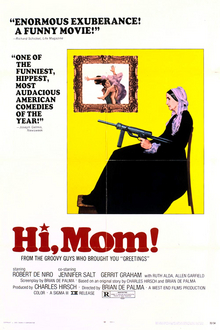
Film Review: Hi, Mom! (dir by Brian De Palma)


Released in 1970, Hi, Mom!, tells the story of Jon Rubin (played by a 26 year-old Robert De Niro).  The somewhat spacey and kind of creepy Jon has just returned to New York City from Vietnam.  After moving into a run-down apartment building and meeting the building’s superintendent (Charles Durning), Jon is hired to direct a pornographic film by producer Joe Banner (Allen Garfield).  Jon’s idea to simply point his camera at his building and to film his neighbors as they go about their day.  As quickly becomes apparent, Jon is mostly just looking for an excuse to watch and film Judy Bishop (Jennifer Salt).

Also living in the building is Gerrit Wood (Gerrit Graham), who is first seen triumphantly putting posters of Che Guevara and Malcolm X up in his apartment.  Gerrit is a freshly-minted political radical and the leader of a group of performance artists who put on a show called Be Black, Baby, in which the white audience members are forced to wear blackface and are then chased, attacked, and assaulted by black actors wearing whiteface.  (Gerrit himself is white.)  Jon is hired to play the police officer who beats and arrests the members of the audience at the end of the performance.  Of course, eventually, the real police show up….

An attempt at an episodic counter-culture comedy, Hi, Mom is definitely a product of the time in which it was made, both in its style and its thematic content.  Today, it’s best-known for being one of Brian De Palma’s early independent films and for featuring Robert De Niro in one of his first starring roles.  De Palma and De Niro aren’t exactly the first names that come to mind when one thinks about comedy and Hi, Mom shows that there’s a good reason for that.  As both a screenwriter who felt he had something important to say and a young director who was obviously eager to show off everything that he could do with a camera, Brian De Palma simply cannot get out of his own way.  Scenes are needlessly sped up.  Scenes are pointlessly slowed down.  The musical cues are obvious.  The dialogue is often so broad that it comes across as being cartoonish.  One gets the feeling that De Palma didn’t trust the audience to get the jokes so he went overboard to make sure everyone knew when to react.  All of the pointless camera trickery serves the same purpose that a laugh track would on an old sitcom.  Interestingly enough, the only sequence that really works as satire is the Be Black, Baby sequence and that’s because De Palma directs it in a semi-documentary fashion.  De Palma gets out of his own way and allow the sequence to develop a natural rhythm.  (Of course, seen today, the scene will bring to mind the upper class white liberals who pay money to have an activist lecture them about their privilege while having their friends over for dinner.)

As for Robert De Niro, he gives a typically nervy performance, one that feels like a dry run for his later work in Mean Streets, Taxi Driver, and King of Comedy.  Despite the reputation of those films, there are some genuinely funny moments to be found in all of them.  Most of them, like the classic Taxi Driver conversation between De Niro’s Travis and Peter Boyle’s Wizard, are funny because of how people react to De Niro’s obviously unhinged characters.  Both Taxi Driver and King of Comedy got mileage out of having normal people try to deal with De Niro’s unstable characters.  In Hi, Mom, everyone is equally wacky and, as such, De Niro doesn’t really have anyone to play off.  No one is really reacting to anything, De Niro-included.  (There is some spark to his scenes with Charles Durning and Allen Garfield but even those scenes seem to drag on forever.)

On the plus side, Hi, Mom! is was shot on the actual streets of New York City, guerilla-style.  (A “Re-Elect Mayor Lindsay” sign in the background confirms that the film was made on location in 1969.)  When De Palma isn’t getting in his own way with all of his fancy camera tricks, he manages to capture so memorably bleak images of New York City.  Hi, Mom! presents New York as being a dirty, crime-ridden, and menacing city but it also captures the odd grandeur of urban decay.  At its best, Hi, Mom! captures the love/hate relationship that many seem to have New York City.  The city feels both alive and dangerous at the same time.  Hi, Mom! is too uneven to work as a sustained satire but, as a documentary about New York at the end of the turbulent 60s, it’s worth watching.

I should mention that this was not the first time that De Palma and De Niro teamed up.  Indeed, De Niro was De Palma’s muse even before he met Martin Scorsese.  Hi, Mom! was a loose sequel to an earlier De Palma/De Niro film called Greetings.  (Like many of De Palma’s future films, both Greetings and Hi, Mom! were originally rated X but later re-rated R.)  De Palma and De Niro, of course, would both go onto have long Hollywood careers.  (They would later reunite for The Untouchables, a big-budget spectacle of a film that’s about as far from the grungy Hi, Mom! as one can get.)  De Palma’s career has had its ups and downs but, as of late, many of his films have been positively reevaluated.  As for De Niro, he can finally kind of play comedy.  That said, I’d rather watch Hi, Mom than Dirty Grandpa.

Horror on the Lens: Gargoyles (dir by Bill Norton)


For today’s horror on the lens, we have a made-for-TV monster movie from 1972, Gargoyles!

What happens when a somewhat condescending anthropologist (Cornel Wilde) and his daughter (Jennifer Salt) head out to the desert?  Well, they stop by a crazy old man’s shack so that they can look at his genuine monster skeleton.  Before Wilde can thoroughly debunk the old man’s claims, the shack is attacked by real monsters!

That’s right!  Gargoyles exist and they apparently live in Arizona!

(And, hey, why wouldn’t gargoyles live in Arizona?  I mean, they have to live somewhere, right? Real estate is not cheap.)

This film was introduced to me by TSL contributor and Late Night Movie Gang founder Patrick Smith and we had an absolute blast watching it.  There’s nothing particularly surprising about the plot but the gargoyles are memorable creations and Bernie Casey gives a good performance as their leader.  The gargoyle makeup was designed by none other than Stan Winston, who won an Emmy for his work here and who went on to win Oscars for his work on Aliens, Terminator 2, and Jurassic Park.

As well, a very young Scott Glenn shows up in the cast.  I like to think that he’s playing the same character in both Gargoyles and Sucker Punch.

Enjoy!

Horror on the Lens: Gargoyles (dir by Bill Norton)


For today’s horror on the lens, we have a made-for-TV monster movie from 1972, Gargoyles!

What happens when a somewhat condescending anthropologist (Cornel Wilde) and his daughter (Jennifer Salt) head out to the desert?  Well, they stop by a crazy old man’s shack so that they can look at his genuine monster skeleton.  Before Wilde can thoroughly debunk the old man’s claims, the shack is attacked by real monsters!

That’s right!  Gargoyles exist and they apparently live in Arizona!

This film was introduced to me by TSL contributor and Late Night Movie Gang founder Patrick Smith and we had an absolute blast watching it.  There’s nothing particularly surprising about the plot but the gargoyles are memorable creations and Bernie Casey gives a good performance as their leader.  The gargoyle makeup was designed by none other than Stan Winston, who won an Emmy for his work here and who went on to win Oscars for his work on Aliens, Terminator 2, and Jurassic Park.

As well, a very young Scott Glenn shows up in the cast.  I like to think that he’s playing the same character in both Gargoyles and Sucker Punch.

Enjoy!

http://www.youtube.com/watch?v=alUFKzUuudI

Lisa Watches An Oscar Winner: Midnight Cowboy (dir by John Schlesinger)


midnight_cowboy

Tonight, I watched the 1969 winner of the Oscar for Best Picture, Midnight Cowboy.

Midnight Cowboy is a movie about Joe Buck.  Joe Buck is played by an impossibly young and handsome Jon Voight.  Joe Buck — and, to be honest, just calling him Joe seems wrong, he is definitely a Joe Buck — is a well-meaning but somewhat dumb young man.  He lives in Midland, Texas.  He was raised by his grandmother.  He used to go out with Annie (Jennifer Salt) but she eventually ended up being sent to a mental asylum after being raped by all of Joe Buck’s friend.  Joe Buck doesn’t have many prospects.  He washes dishes for a living and styles himself as being a cowboy.  Being a Texan, I’ve known plenty of Joe Bucks.

Joe Buck, however, has a plan.  He knows that he’s handsome.  He’s convinced that all women love cowboys.  So, why shouldn’t he hop on a bus, travel to New York City, and make a living having sex with rich women?

Of course, once he arrives in the city, Joe Buck discovers that New York City is not quite as inviting as he thought it would be.  He lives in a tiny and dirty apartment.  He can barely afford to eat.  Walking around the city dressed like a cowboy (and remember, this was long before the Naked Cowboy became one of the most annoying celebrities of all time) and randomly asking every rich woman that he sees whether or not she can tell him where he can find the Statue of Liberty, Joe Buck is a joke.  Even when he does get a customer (played, quite well, by Sylvia Miles), she claims not to have any money and Joe Buck feels so sorry for her that he ends up giving her his money.

midnight3crowd

As I watched the first part of the movie, it stuck me that the main theme of Midnight Cowboy appeared to be that, in 1969, New York City was literally Hell on Earth.  But then Joe Buck has flashbacks to his childhood and his relationship with Annie and it quickly became apparent that Midland, Texas was Hell on Earth as well.  Towards the end of the film, it’s suggested that Miami might be paradise but not enough to keep someone from dying on a bus.

Seriously, this is a dark movie.

Joe Buck eventually meets Ratso Rizzo (Dustin Hoffman).  Ratso’s real name is Enrico but, after taking one look at him, you can’t help but feel that he’s a perfect Ratso.  Ratso is a con man.  Ratso is a petty thief.  Ratso knows how to survive on the streets but New York City is still killing him.  As a child, Ratso had polio and now he walks with a permanent limp.  He coughs constantly, perhaps because he has TB.  Ratso becomes Joe Buck’s manager and roommate (and, depending on how you to interpret certain scenes and lines, perhaps more) but only after attempting to steal all of his money.

Unfortunately, Ratso is not much of a manager.  Then again, Joe Buck is not much of a hustler.  Most of his customers are men (including a student played by a young but recongizable Bob Balaban), but Joe Buck’s own sexual preference remaining ambiguous.  Joe Buck is so quick to loudly say that he’s not, as Ratso calls him, a “fag” and that cowboys can’t be gay because John Wayne was a cowboy, that you can’t help but suspect that he’s in denial.  When he’s picked up by a socialite played by Brenda Vaccaro, Joe Buck is impotent until she teases him about being gay.  In the end, though, Joe Buck seems to view sex as mostly being a way to make money.  As for Ratso, he appears to almost be asexual.  His only concern, from day to day, is survival.

Did I mention this is a dark movie?

And yet, as dark as it is, there are moments of humor.  Joe Buck is incredibly dense, especially in the first part of the movie.  (During the second half of the film, Joe Buck is no longer as naive and no longer as funny.  It’s possible that he even kills a man, though the film is, I think, deliberately unclear on this point.)  Ratso has a way with words and it’s impossible not to smile when he shouts out his famous “I’m walking here!” at a taxi.  And, as desperate as Joe Buck and Ratso eventually become, you’re happy that they’ve found each other.  They may be doomed but at least they’re doomed together.

warhols-party

There’s a lengthy party scene, one that features several members of Andy Warhol’s entourage.  I was a bit disappointed that my favorite 60s icon, Edie Sedgwick, was nowhere to be seen.  (But be sure to check out Ciao Manhattan, if you want to see what Edie was doing while Joe Buck and Ratso Rizzo were trying not to starve.)  But, as I watched the party scene, I was reminded that Midnight Cowboy is definitely a film of the 60s.  That’s both a good and a bad thing.  On the positive side, the late 60s and 70s were a time when filmmakers were willing to take risks.  Midnight Cowboy could only have been made in 1969.  At the same time, there’s a few moments when director John Schlesinger, in the style of many 60s filmmakers, was obviously trying a bit too hard to be profound.  Some of the flashbacks and fantasy sequences veer towards the pretentious.

Fortunately, the performances of Voight and Hoffman have aged better than Schlesinger’s direction.  Hoffman has the more flamboyant role (and totally throws himself into it) but it really is Voight who carries the film.  Considering that he’s playing a borderline ludicrous character, the poignancy of Voight’s performance is nothing short of miraculous.

Midnight Cowboy was the first and only X-rated film to win best picture.  By today’s standards, it’s a PG-13.