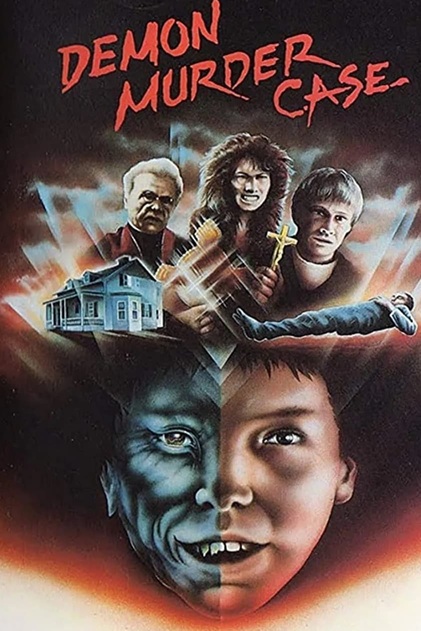
October True Crime: The Demon Murder Case (dir by William Hale)


In Brookfield, Connecticut, a 20-something man named Kenny Miller (played by a young Kevin Bacon) is on trial for murder. He stands accused of killing his landlord for no clear reason. While the media (represented by Cloris Leachman and Ken Kercheval) watch, Kenny’s attorney (Richard Masur) announces that Kenny did not actually commit the murder of his own free will. Instead, Kenny was possessed by a demon. The judge (Jack Davidson) is not impressed by the argument.

The film flashes back to the previous year. The family of Kenny’s girlfriend, Nancy Frazier (Liane Langland), has moved into a new house. Kenny notices that Nancy’s younger brother, Brian (Charles Fields), seems to spend a lot of time talking to himself. This concerns Kenny. What if Brian is talking to a demon that’s trying to possess him? It turns out that the Fraziers should have listened to Kenny because soon the house is shaking, the lights are blinking, and Brian is speaking in the voice of Harvey Fierstein.

The family gets in contact with occult investigators Guy (Andy Griffith) and Charlotte Harris (Beverlee McKinsey). Guy and Charlotte arrange for an exorcism. Actually, they arrange for several exorcisms. A total of six priests (one of whom is played by Eddie Albert) attempt to get the demon out of Brian. At one point, Kenny dares the demon to take him on personally. “Never do that!” Guy says before explaining that daring a demon to fight you is a great way to get possessed yourself. Kenny doesn’t seem to believe Guy, and I can kind of understand why. Watching this film, it was obvious that Andy Griffith was not actually Catholic, even if he did play a priest in Go Ask Alice. You can always tell these fake Catholics because they never make the sign of the cross correctly. They either use the wrong hand, or they start at the chest, or they confuse which shoulder to go to.

The Demon Murder Case was made for television in 1983 and, if the plot sounds familiar, that’s because it’s based on the same case that was dramatized in The Conjuring: The Devil Made Me Do It. Only the names have been changed. Ed and Lorraine Warren become Guy and Charlotte Harris and, needless to say, they’re a bit less glamorous in the made-for-television version. Surprisingly enough, the television version actually works pretty well. The low budget forces director William Hale to concentrate on atmosphere as opposed to special effects, and the cast is full of talented actors. Even though Griffith is not a convincing Catholic, he’s still likable in the role of the no-nonsense Guy, and Kevin Bacon does a pretty good job as the well-meaning but ultimately confused Kenny Miller. Earlier today, I complained that Bacon seemed miscast in Hollow Man. This film, however, makes good use of his down-to-earth persona. You watch this film and you think that, if Kevin Bacon could get possessed, it could happen to anyone.

As for the actual case, Arne Cheyenne Johnson (who was renamed Kenny Miller in this film) was convicted of manslaughter despite his defense that he had no control over his actions. He served five months in prison and married his girlfriend after he was released. He continues to insist that he was possessed.

Retro Television Reviews: The Great Niagara (dir by William Hale)


Welcome to Retro Television Reviews, a feature where we review some of our favorite and least favorite shows of the past!  On Sundays, I will be reviewing the made-for-television movies that used to be a primetime mainstay.  Today’s film is 1974’s The Great Niagara!  It  can be viewed on YouTube!

The Great Niagara takes place during the Great Depression.

With the world mired in economic uncertainty and the threat of war right around the corner, people are more desperate than ever for entertainment.  One of the latest fads is attempting to conquer the Niagara by going over the falls in some sort of raft.  If done correctly, it can lead to fame and fortune.  But, if one mistake is made while trying to steer the raft against the rapids and the rocks, it can lead to death.  In fact, death is the usual outcome of most people’s efforts to conquer the Niagara.  It’s actually illegal to try to ride anything over the falls but people still try to do it and crowds still gather to watch the attempts.

Old Aaron Grant (Richard Boone) is obsessed with conquering the Niagara but, because he’s been injured in too many attempts, all he can do now is sponsor and try to help others who are willing to take the risk.  Aaron is the type who will look out at the Niagara and angrily shake his fist.  He hates the river and he hates the falls but they’re also the only thing that gives his life meaning.  After Aaron’s latest protegee, Ace Tully (Burt Young), fails in his attempt to go over the falls, Aaron starts to put pressure on his sons to make the attempt.  Lonnie Grant (Michael Sacks) knows that Aaron has allowed his obsession to drive him mad and he’s also promised his wife, Lois (Jennifer Salt), that he won’t go over the falls.  However, Carl Grant (Randy Quaid) is desperate for his father’s approval and it’s not long before he’s getting ready to enter the barrel and risk his life.

The Great Niagara is a short but interesting film.  It’s based on historical fact.  There’s been a long history of people risking their lives with stunts at Niagara Falls.  A few years ago, there was a live television broadcast of someone walking over the falls on a tightrope.  It was a huge rating success and it was, of course, sold as a tribute to the human spirit.  That said, it’s entirely believable that a good deal of the people watching were doing so because they were curious about what would happen if the guy fell off the wire.  By that same token, the crowds that we see in The Great Niagara are far more concerned with seeing someone go over the falls than they are with whether or not that person survives the experience.  Richard Boone gives an obsessive, half-mad performance as Aaron and Michael Saks does a good job as the voice of reason.  Randy Quaid gives a poignant performance as poor Carl, who is so desperate for his father’s approval that he’s willing to risk his life to try to get it.  That said, the true star of the film is the Niagara itself, which is beautiful but obviously dangerous.  When Aaron shakes his fist at the falls, it’s hard not to feel that the Niagara isn’t doing the same back at him.