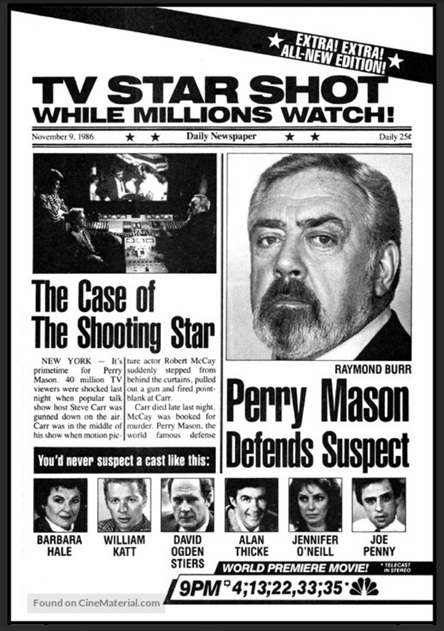
Actor Robert McCay (Joe Penny) decides that it would be hilarious to shoot talk show host Steve Carr (Alan Thicke) on live television. McCay thinks that the gun is loaded with blanks but, before he goes on the show, someone slips a live round into the gun. McCay kills Steve Carr and there are a million witnesses who see him do it. Time to call in Perry Mason (Raymond Burr)!
The third Perry Mason movie isn’t as good as the first two. Shooting someone on television as a joke and then leaving the studio immediately afterwards is a really stupid thing to do. As my sister pointed out while we were watching, even if Robert McCay wasn’t guilty of premeditated murder, he was probably guilty of negligent homicide for not bothering to double check whether or not there was a live round in the gun. McCay goes right back to shooting his movie, even while he’s on trial for murder. As for the trial, it was ridiculous. How many people can confess under cross examination in one trial? “Mistrial!” my sister yelled whenever Perry pulled one of his stunts and I agreed.
Paul (William Katt) teams up with a photojournalist (Wendy Crewson) and his investigation somehow leads to him playing a priest in a cheap vampire movie. For once, Perry didn’t give Paul a hard time about anything. Maybe he realized Paul’s scenes were the best part of The Case of the Shooting Star.
In Reagan, Dennis Quaid stars at the 40th President of the United States.
Framed as a story being told by a former KGB agent (Jon Voight) who is attempting to make a younger politician understand why Russia lost the Cold War, Reagan starts with Reagan’s childhood, includes his time as an actor and as the anti-communist head of the SAG, and then gets into his political career. Along the way, several familiar faces pop up. Robert Davi plays a thuggish Russian leader. Mena Suvari plays Reagan’s first wife while Penelope Ann Miller plays his second. Xander Berekely plays George Schultz (who was just previously played by Sam Waterston in The Dropout miniseries.) C. Thomas Howell, Kevin Dillon, Dan Lauria, and Lesley-Anne Down all have small but important roles. And the usual suspects when it comes to conservative filmmaking — Nick Searcy, Kevin Sorbo, and Pat Boone — are there to compliment Voight and Davi. I was a little surprised to see that Dean Cain was not present.
As usually happens to films that feature sympathetic Republicans, Reagan was slammed by critic but better-appreciated by the audience for which the film was made. I wasn’t particularly surprised. Movie critics tend to be liberal and Reagan is very much not that. For a professional film critic, a film like Reagan must be met with snark and derision because otherwise, one would risk cancellation. Don’t get me wrong. I’m not saying that there aren’t things to criticize about Reagan the film. I’m just saying that one should always keep in mind that critics have their own individual biases. One reason why the Rotten Tomatoes score is such an unfortunate development is because it ignores the fact that most films have things that work and things that don’t work and that quality is often in the eye of the beholder. Instead, it just tells us that a film is either a 90% or a 10%.
As for Reagan, it’s definitely a bit on the heavy-handed side but, then again, I think the same can be said for just about every political film that’s come out over the last few decades. For those who claim Reagan is somehow more heavy-handed than most, I invite them to sit through Rob Reiner’s LBJ. Indeed, the only director who has really shown a willingness to admit that a President can be both good and bad was Oliver Stone and when was the last time anyone watched Nixon? Reagan is at its weakness when it tries to recreate Reagan’s time as an actor. Dennis Quaid gives a good and charming performance throughout the film but he’s also 70 years old and, in the scenes where he plays the youngish Ronald Reagan, all of the soft-lighting and Vaseline on the lens ends up making him look like a wax figure. Once Reagan gets older, Quaid is allowed to act his age and both he and the film become much more convincing. I enjoyed the film once Reagan became President, though you should understand that I have biases of my own. I’m a fan of low taxes and individual freedom, which is why I’m also not a fan of communism or, for that matter, any extreme ideology that attempts to tell people how to live or think. “Tear down this wall!” Regan says while standing in front of the Berlin Wall and it’s a rousing moment, both in reality and on film.
In the end, Reagan is a film that will be best appreciated by people who already like Ronald Reagan. Yes, the film is heavy-handed and the framing device is a bit awkward. But Dennis Quaid’s heartfelt (and, towards the end, heartbreaking) performance carries the film. The film is not at all subtle but you know what? I’ve seen a countless number of mediocre films that have portrayed Reagan negatively, often with as little nuance and just as heavy-handed an approach as Reagan uses in its positive portrayal of the man. I sat through The Butler, for God’s sake. There’s nothing wrong with having a film that looks at the man from the other side. Those who like Ronald Reagan will feel vindicated. Those who don’t will say, “What was up with that Pat Boone scene?”
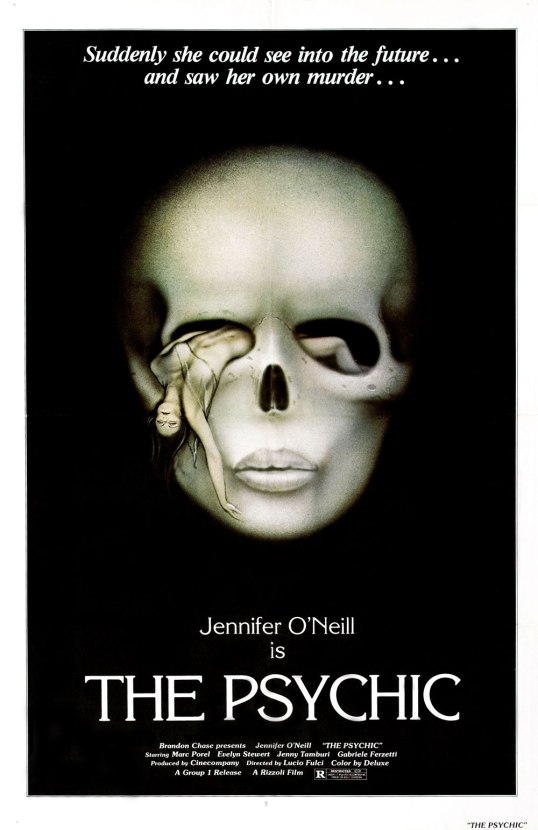
Also known as Seven Notes In Black, The Psychic is an Italian paranormal thriller that was made and released in 1977, shortly before the film’s director, Lucio Fulci, reinvented Italian horror with Zombi 2.
For years, Virginia (Jennier O’Neill) has been haunted by visions. When she was a child, she saw a vision of her mother jumping off a cliff. It turned out that, at the same time Virginia had her vision, her mother was doing exactly that. 18 years later, Virginia is living in Rome and she’s married to a wealthy businessman named Francesco Ducci (Gianni Garko, who also starred in several Spaghetti westerns). Virginia would seem to have the perfect life but she’s still haunted by disturbing visions. She sees an old woman murdered. She sees a wall being ripped apart. She sees a discarded letter. Is she seeing the past, the present, or the future? She does not know. Ducci insists that her visions mean nothing but Virginia is convinced that something is reaching out to her.
While Ducci is away on business, Virginia visits an abandoned house that her husband has recently bought. Virginia wants to renovate it but, as soon as she sees it, she realizes that the house previously appeared in her visions. When she investigates, she discovers a skeleton in one of the walls. With the police now convinced that Ducci is a murderer, Virginia tries to figure out the meaning behind her visions and looks for a way to clear Ducci’s name. Strangely, Ducci still doesn’t seem to be that concerned about any of it….
Along with Lizard In A Woman’s Skin and Don’t Torture A Duckling, The Psychic is a film that gets a lot of attention as an example of Fulci’s pre-Zombi 2 horror output. After Zombi 2, Fucli would become best known for making films that were full of gore and that often seemed to be deeply angry with the world. The fact that Fulci was also a brilliant stylist who created some of the most dream-like images ever to be captured on film would often be overlooked in all the controversy over the often violent content of his movies. One thing that makes The Psychic interesting is that, visually, it’s clearly a Fulci film. The cinematography is lush and vibrant. The visions are surreal and disturbing. However, there’s very little of the gore that came to define Fulci’s later films. Instead, the emphasis is on the atmosphere and the mystery. This is one of the few Fulci films that you could safely show an older relative.
Fulci was often (a bit unfairly, in my opinon) portrayed as being a cinematic misanthrope, as a director who little use for the characters that populated his films. That’s certainly not the case with The Psychic, though. Virginia is probably one of the most sympathetic characters to ever appear in a Fulci film and Jennifer O’Neill does a good job in the lead role. Even more importantly, Fulci seems to like her and, from the start, it’s clear that the film is fully on her side. The entire story is told through her eyes and she’s a character who you immediately root for. Like Fulci himself, she’s a visionary whose visions are often underappreciated until it’s too late. Though the film ends on a characteristically downbeat note (happy endings were rare even in Fulci’s pre-Zombi 2 films), Virginia is still allowed her triumph with one final and rather clever little twist.
The Pyschic is a bit slowly-paced but it’s still a far better film that many Fulci critics seem to be willing to acknowledge. (One gets the feeling that many critics resent any film that indicates that there was more to Fulci than eye damage and zombies.) It’s an entertaining and intriguing latter-era giallo and proof that there was more to Fulci than just blood.
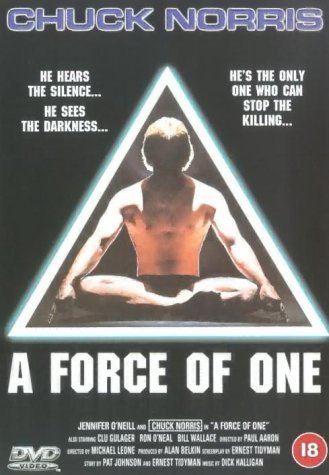
Someone is targeting a squad of undercover narcotics detectives, killing them by taking them by surprise and breaking their necks before they even have a chance fight back. Lt. Dunne (Clu Gulager) doesn’t like seeing his best detectives getting murdered so he orders all of them — including Mandy Rust (Jennifer O’Niell) and Rollins (Superfly himself, Ron O’Neal) — to take martial arts training so that they can defend themselves. And who better to train them than karate champ and dojo owner, Matt Logan (Chuck Norris)? The no-nonsense Logan teaches the detectives a few moves and even starts a tentative romance with Mandy. But when his adopted son (played by future director Eric Laneuville) is murdered by the drug dealers, Logan goes from being a teacher to being an avenger.
Since today is Chuck Norris’s 80th birthday, it only seems appropriate to review one of Chuck Norris’s better films. A Force of One was made at a time when Chuck was still trying to make the transition from being the karate instructor to the star to being a star himself. Norris had been disappointed by his previous few starring vehicles, all of which strangely played down Norris’s martial arts skills. After his friend and student, Steve McQueen, told Chuck that he needed to specialize in playing strong, silent types, Norris followed his advise with A Force Of One, which features considerably less dialogue than Norris’s previous films but also a lot more fighting.
Though the character may be named Matt Logan, Chuck Norris is basically playing himself in A Force of One. In the scenes where he’s training the detectives and talking about why he’s personally so opposed to drugs, Chuck comes across as so earnest that it doesn’t matter that he’s not much of an actor. What he’s always lacked in range, Chuck makes up for in general badassery and A Force Of One features him at his most badass. Chuck’s final fight with the ninja assassin is one of his best.
Jennifer O’Neill got top billing in A Force Of One and she and Chuck actually have decent romantic chemistry. She seems to bring him a little bit out of his shell and she’s also actually believable as a tough cop. Because this was early in Chuck’s career and the script was co-written by police procedural specialist Ernest Tidyman, A Force Of One spends as much time following round the other cops as it does with Chuck and the squad’s camaraderie is believable. The cops are all played by good character actors like Ron O’Neal, Clu Gulager, Pepe Serna, and James Whitmore Jr. and they all give pretty good performance while, at the same time, not upstaging Chuck.
One final note: There’s a scene where Chuck and Jennifer O’Neill are in an evidence room. Keep an eye out for a box that is labeled K. Reeves. That’s a reference to director Paul Aaron’s stepson, Keanu Reeves, who worked as a production assistant on this film.
Because I was born and live in Texas, a friend of mine used to ask me that constantly. His assumption was that everyone in Texas wore a cowboy hat and rode a horse to work. That, of course, is not true. I imagine that you’re more likely to see people on horseback in Central Park than you are in downtown Dallas. As well, for the most part, if you see anyone wandering around Dallas wearing a cowboy hat and cowboy boots, chances are that they’re from up north. Northerners love to come down to Dallas and see where Kennedy was shot and ask if everything really is bigger in Texas. It gets annoying after a while. Of course, I’d by lying if I said that there weren’t any cowboys in Texas. And yes, there are people down here who own horses. We’ve got our ranchers and our oilmen and our farmers. We just don’t have as many as people up in Minnesota seem to assume that we do.
And, to be honest, I’ve known a few cowboys. If you dig around my family tree, you’ll find a few people who have worked the rodeo circuit. For the most part, the cowboys I’ve known have been a proud group of people. They’re not really emotional and they might not spend much time on twitter but you can depend on them to get the job done without a lot of crying and that’s always kind of a nice thing.
As an actor, Michael Biehn has always seemed uniquely right for cowboy roles. He’s a low-key actor who doesn’t feel the need to always be the center of attention and who does his job with a minimum amount of fuss. What he does, he does well. Much like the best cowboys, an actor like Michael Biehn often gets taken for granted. Viewers just always assume that he’ll always be there, delivering laconic one-liners and viewing the world through weary but never defeated eyes.
Michael Biehn plays a cowboy in the 1997 film, The Ride. His name is Smokey Banks and he’s the type of character who, if you’ve ever spent any time at a rodeo, you’ll recognize immediately. He used to be one of the world’s greatest bull riders but now, he’s getting older. He still walks like a cowboy but he’s definitely moving a bit slower than he used to. He drinks too much. He spends too much time with the buckle bunnies. He’s like a downbeat country song come to life.
But fear not …. redemption is coming for Smokey. And, like all good redemption arcs, it all starts with being sentenced to community service. Smokey can either go to jail or he can go to a ranch and teach a bunch of boys how to be a cowboy. Along the way, he befriends a terminally ill, religious young man (Brock Pierce) who wants to learn how to ride a bull and he also ends up spending some time at a tent revival. Yes, it’s a religious film but, fortunately, it was made before the whole God’s Not Dead phenomenon so it never gets as preachy or apocalyptic as some other faith-based films. One gets the feeling that Smokey would find Kirk Cameron to be as annoying as the rest of us do.
It’s a sweet film. I mean, it’s not a movie that’s going to surprise you. It’s unapologetic about being sentimental but, at the same time, it’s such a good-natured film that it’s hard to really dislike it. Michael Biehn grounds the film with his typically low-key charm. Biehn turns Smokey into a real person and, as much as you might try to resist, it’s hard not to get swept up in his emotional journey. Considering that the film’s audience was probably limited to kids and church groups, Biehn easily could have gotten away with just phoning in his performance. That’s the sign of a good actor, though. Like the best cowboys, they’re good even when they don’t have to be.
After her lover and employer commits suicide, nurse Susan Manning (Jennifer O’Neill) needs a new job so she applies at an experimental mental hospital that is known as the Institute. The director of the Institute, Dr. Magnus Quilly (William Windom), explains to her that he cures his patients by allowing them to live out their fantasies in a controlled environment. He asks Susan is she’s prepared to “commit” herself to being a nurse. Susan says that she is and signs the papers that Dr. Quilly hands to her.
Too late, Susan discovers that Dr. Quilly didn’t hand her an employment contract. Instead, Susan has just signed her own commitment papers and is now a patient at the Institute! Dr. Quilly tells her that, as he does with all of his patients, he will allow her to live out her fantasy of being a nurse. After discovering than an electrified fence makes it impossible to escape, Susan starts working as a nurse but she soon discovers that she is not the first person to be tricked into working at the Institute and that almost all of her predecessors died under mysterious circumstances.
Committed is one of many films about what happens when the lunatics literally take over the asylum. (This is a plot that was first used by Edgar Allan Poe in The System of Dr. Tarr and Professor Fether.) The film is hurt by its low-budget but veteran B-movie director William A. Levey does a good job playing up the claustrophobia of being trapped in one location and Committed features eccentric performances from actors like Robert Forster, Ron Pallilo, and Sidney Lassick. Committed asks, “Who is actually sane in an insane world?” and answers, “Everyone’s crazy!”
The best thing about Committed is that it stars Jennifer O’Neill, a beautiful model-turned-actress who found brief stardom when she appeared as the war bride in Summer of ’42. Though O’Neill’s career never lived up to the promise of her first film, she was a better-than-average actress and she’s pretty good in Committed. Both she and the film keep it deliberately ambiguous about whether or not Susan is really a nurse or if her whole backstory is just something that she’s fantasized.
Committed is a well-made B-movie from the golden age of straight-to-video thrillers and late night HBO premieres. Despite a low-budget, this movie shows the good work that a cast and a director can do when they’re fully committed.
(Lisa is currently in the process of cleaning out her DVR! She has got over 170 movies on the DVR to watch and she’s trying to get it done before the start of the new year! Can she get it done? Probably not, but she’s going to try! 1972’s The Carey Treatment was recorded off of TCM on July 23rd.)
Dr. Peter Carey (James Coburn) is the epitome of 1970s cool. He’s got hair long enough to cover the top half of ears. He’s got a fast car. He’s got a rebellious attitude and a girlfriend (Jennifer O’Neill) who rarely questions his decisions. Though you don’t see it in the movie, Dr. Carey probably smokes weed when he’s back at his fashionably decorated apartment. How do I know this? Well, he’s played by James Coburn. Even if some of them are nearly 50 years old, you can still get a contact high from watching any movie featuring James Coburn.
Anyway, what the Hell is The Carey Treatment about? Dr. Carey has just recently moved to Boston, where he’s taken a job at a stodgy old hospital. The hospital’s chief doctor, J.D. Randall (Dan O’Herlihy, of Halloween III: Season of The Witch fame), might want Dr. Carey to tone down his free-livin’, free-lovin’ California ways but no one tells Peter Carey what to do. In fact, the entire city of Boston might be too stodgy and conventional for Dr. Carey. You see, Dr. Carey not only heals people. He also beats up people who try to stand in his way. Peter Carey is a doctor who cares but he’s also a doctor who can kick ass.
And he’s going to have to kick a lot of ass because Dr. Randall’s daughter has just turned up dead. The police say that she died as the result of a botched abortion and they’ve arrested Carey’s best friend, Dr. David Tao (James Hong). (The Carey Treatment, it should be noted, was filmed before Roe v. Wade legalized abortion.) The Boston establishment is determined to use Dr. Tao as a scapegoat but Dr. Carey is convinced that his friend is innocent. In fact, he doesn’t think that the death was the result of an abortion at all. Carey sets out to solve the case … HIS WAY!
If it seems like I’m going a little bit overboard with my emphasis on the Dr. Peter Carey character, that’s because this entire movie feels more like a pilot for a weekly Dr. Carey television series as opposed to an actual feature film. It’s easy to image that each week, James Coburn would drive from hospital to hospital, solving medical mysteries and debating social issues with stuffy members of the Boston establishment. Henry Mancini would provide the theme music and Don Murray would guest star as Dr. Carey’s brother, a priest who encourages the young men in his parish to burn their draft cards.
It might have eventually become an interesting TV show but it falls pretty flat as a movie. James Coburn is in nearly every scene, which would usually be a good thing. But in The Carey Treatment, he gives an incredibly indifferent performance. He seems to be bored by the whole thing and, as a result, Dr. Peter Carey is less a cool rebel and more of a narcissistic jerk. The mystery itself is handled rather haphazardly. On the positive side, Michael Blodgett gives a wonderfully creepy performance as a duplicitous masseur but otherwise, The Carey Treatment is nothing special.
Originally, I was going to finish up the first day of my back to school reviews by talking about A Clockwork Orange. I figured that, since the second film I reviewed was Andy Warhol’s Vinyl, it would just make sense that the fourth film would A Clockwork Orange.
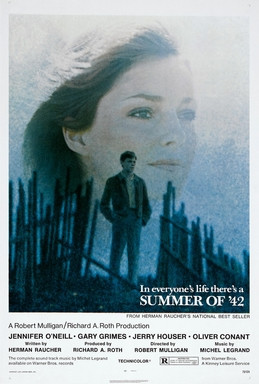
But, I don’t know. As I sat down and started to work on my fourth review, I realized that I’m not quite ready to write about A Clockwork Orange. Instead, I’d rather hold off on that until tomorrow. So, instead, I’m going to talk about Summer of ’42, another coming-of-age film that came out the same year.
That’s right — A Clockwork Orange and Summer of ’42 both came out in 1971 but — in content and sensibility — they might as well exist in different universes. In fact, the only thing that they have in common is that they both tend to show up on TCM fairly frequently and that they’ve both influenced countless other films.
Speaking of TCM, that’s where I first saw Summer of ’42. I have to admit that I’m writing this review from memory and that may not be the best way to review a film. I saw Summer of ’42 about four months ago and, at the time, I thought it was a well-done but predictable little movie. I even took notes for a future review but I didn’t get around to writing that review because … well, at the time, it just seemed like there wasn’t a lot to say about it. Summer of ’42 is a sweet film but almost everything about it is right on the surface. What you see is what you get. I’m not surprised to discover that it was the 6th highest grossing film of 1971. In a year that saw not only A Clockwork Orange but The Last Picture Show,The French Connection, Brother John, Billy Jack, Carnal Knowledge, Dirty Harry, Harold and Maude, Let’s Scare Jessica To Death, Klute, Straw Dogs, Pretty Maids All In A Row, and The Zodiac Killer, audiences were probably relieved to see a film that was neither violent, morally ambiguous, nor apocalyptic.
Instead, Summer of ’42 is a coming-of-age story that was specifically crafted to appeal to a world-weary audience’s nostalgia for the simple and carefree days of World War II. This is one of those films where an older narrator continually reassures us that we’re seeing the most defining moment of his youth and all of the pretty images are in soft focus. Hermie (Gary Grimes), Oscy (Jerry Houser), and Benjie (Oliver Conant) are three fifteen year-olds, all of whom are spending their summer on Nantucket Island. Benjie is obsessed with sex but he’s nerdy. Oscy is obsessed with sex but he’s a jerk. Hermie is obsessed with sex but he’s the narrator so we already know that he’s too sensitive to lose his virginity to any girl his own age.
Luckily, there’s a woman in her 20s who is living in a nearby beach house. Dorothy (Jennifer O’Neill) is beautiful but she’s married. However, her husband’s a soldier and it is 1942 so, pretty soon, he’s out of the picture. Hermie develops a mad crush on her and then, luckily for him, her husband dies and she spends a night teaching him the ways of love. The next morning, she vanishes but leaves Hermie a note, telling him that she will never forget him and that it’s up to him to decide what their night together meant.
(Hermie never gets around to telling us what their night together meant so I guess it’s up to us to decide. Personally, I just hope Hermie was careful who he told because, nowadays, a 23 year-old can get in a lot of legal trouble if she’s caught having sex with a 15 year-old. Maybe things were different in 1942…)
As I said before, my initial response was that Summer of ’42 was sweet but predictable. And that’s the way I still feel about it. It was well-acted, well-filmed, and Jennifer O’Neill was amazingly beautiful but there was still something about Summer of ’42 that kind of bothered me. We never really got to know who Dorothy was. Her entire character was defined by her one night with Hermie. Yes, I do understand that was kind of the point because the story was being told exclusively from Hermie’s point of view. But it still bothered me. Beyond being beautiful, tragic, and ultimately available, who was Dorothy?
But really, it wasn’t just something about the Summer of ’42 that was bothering me. Instead, it was something about the coming-of-age genre in general. I have lost track of how many nostalgic films and TV shows that I have seen that feature a narrator talking about the summer that he “became a man.” It’s amazing how many awkward teenage boys apparently lost their virginity to a beautiful older woman who promptly vanished afterwards. If, as has been recently suggested, I spent next summer in a rented beach house, am I going to be obligated to be the first lover of every 15 year-old, aspiring writer who happens to come wandering down the beach? That could be time consuming, depending on how popular the beach is.
I guess what I’m saying is that perhaps somebody needs to remake Summer of ’42 and tell it from Dorothy’s point of view.


 Through the Shattered Lens